July 1999
July 01, 1999
July 1999 issue of the Canadian Albacore Association's Shackles and Cringles (Vol XXXIX, No 3). A recap of the Albacore World's Training Camp with tuning and tactics tips from Larry Lemieux and Barney Harris; Westwood Open and Peterborough Centennial Regatta results; a foam-core mast step repair how-to; the IAA's Fall 99 biennial meeting agenda; and notices of race for the RCYC, Toronto Island, Outer Harbour, Mooredale, and Cork Albacore Championships.
The Albacore Advantage
Shackles and Cringles — July 1999 — Volume XXXIX; Number 3
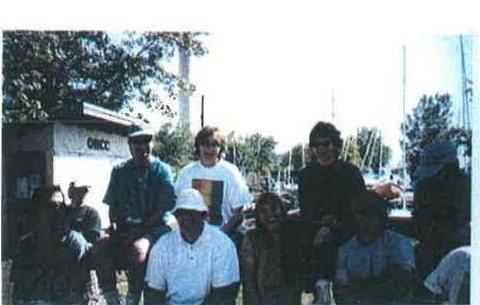
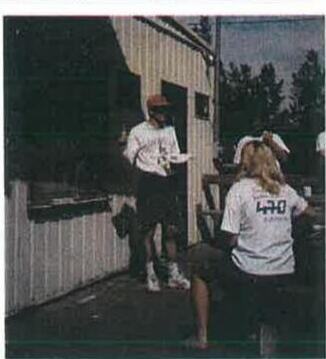
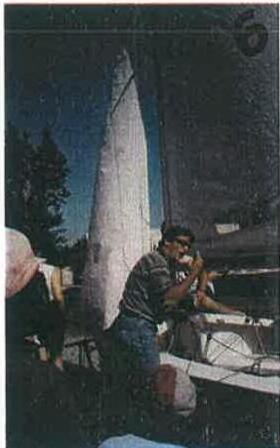
A One-design Boat
- no unnecessary expense of constant upgrades in design
A Safe Boat
- large air-filled tanks give excellent buoyancy
- hull shape gives stability on the water
- self-rescue after an unexpected puff is easy
A light and manegable Boat
- tongue load of less than 100 lbs gives ready trailerability
- launching and retrieving are a breeze
A comfortable Boat
- large, open cockpit
- benches on port and starboard sides
A Performance Boat
- seriously campaigned by major sailmakers
- planes in moderate winds
- buoyant heavy-air hull shape
Ideal for Junior Clubs
- 4 to 5 juniors will fit easily
- will stand up to heavy use
A vibrant Class Association
- well organized and vital
- recognized by the International Sailing Federation
- strong fleets through Ontario, Canada, US, Great Britain, Ireland and Bermuda
- top notch competitive sailing
- junior programs in some areas
1998/99 Canadian Albacore Association Executive
PO Box 16, 660 Eglinton Avenue East, Toronto, Ontario M4G 4G1 www.albacore.ca
| Position | Name | Contact |
|---|---|---|
| Commodore | Gord Chu | 310 Durie St, Toronto, ON M4J 1X9 H (416) 760-8778 / W (416) 733-6851 / F (416) 733-6777 [email protected] |
| Past Commodore | Bob Stiff | 20 Southlea Avenue, Toronto, ON M4G 3L9 H (416) 423-3294 / W (416) 482-5002 / F (416) 482-5040 [email protected] |
| First Vice Commodore Marketing | Laurie Harrison | 340 Avenue Road Apt 435, Toronto, ON M4V 2H3 H (416) 920-5146 / W (416) 946-3778 / F (416) 978-7705 [email protected] |
| Second Vice Commodore Racing | Doug Paterson | 221 Woburn Ave, Toronto, ON M5M 1L1 H (416) 480-0877 / W (416) 974-5101 / F (416) 974-7789 [email protected] |
| Chief Measurer | Rick Clayton | 362 Brookdale Avenue, Toronto, ON M5M 1P8 H (416) 783-9194 / W (416) 932-4427 / F (416) 932-4342 [email protected] |
| Treasurer | Jason G. Roth | 60 Cheviot Cres, Brampton, ON L6Z 4G7 H (905) 840-5395 / W (416) 675-4826 / F (416) 674-6849 [email protected] |
| Specifications Chair | David Weaver | 14 Lansdowne Rd North, Cambridge, ON N1S 2S8 H (519) 623-4402 / W (905) 525-9140 ext 24907 / F (905) 572-7944 [email protected] |
| Secretary | Raines Koby | 5 Cosdale Place, Palgrave, ON L0N 1P0 H (905) 880-1866 / W (905) 264-6123 / F (905) 264-2944 [email protected] |
| Editor, Shackles & Cringles | Nona Arneson | 95 Lawton Blvd, Apt 606, Toronto, ON M4V 1Z8 H (416) 485-3572 / W (416) 586-8642 [email protected] |
| Membership | Rose Anne Mallet | 22 Ridley Blvd, Toronto, ON M5M 3K9 H (416) 486-0515 [email protected] |
| Rear Commodore | Heather Macnaughton | 99 Harbour Square, Unit 1812, Toronto, ON M5J 2H2 H (416) 367-9898 / W (416) 868-8205 / F (416) 868-3817 |
| IAA Representatives | Rosemary Helmer, IAA Secretary | 264 St. Clair Ave. W, Toronto, ON M4V 1R7 H (416) 964-8427 / W (416) 410-4644 / F (416) 961-4644 [email protected] |
| Ian Rogers, IAA Treasurer | 155 University Ave #1600, Toronto, ON M5H 3B6 H (416) 485-5136 / W (416) 361-0826 / F (416) 361-6303 | |
| David Weaver, IAA Chief of Specifications |
Shackles and Cringles is a quarterly publication of the Canadian Albacore Association. Deadlines for publication are January 15, April 15, July 15 and October 15.
Commodore's Corner
It is now the middle of the sailing season. I hope that all of you have been able to get out on the water as much as you would like. My new daughter Samantha (born January 1st) now has her own PFD and has gone for her first sail on a keelboat in San Diego Bay. We even saw Stars & Stripes, the 1995 America's Cup boat out cruising around. Back at home, I have managed to get out on the racecourse, although this year I'll have to pick my spots rather than doing them all.
The advanced Albacore training camp was held during the latter part of June. I wanted to take the course myself, but unfortunately this was the same time that we went to San Diego. By all accounts, the participants found it very good. Look for the report elsewhere in this newsletter. I would like to thank the organizing committee. Ross King took the lead in organizing the event, with the help of Kevin Smith (who was also an instructor).
One of events that we will attend is the US National/Internationals in Delaware in October. My wife, Christine and I have already booked accommodations and a baby sitter. It looks to be a very good turnout. We have an unofficial count of 26 Canadian boats attending, 19 of who have taken advantage of the reduced fees for early registration. The US is expecting an equal number and including the Brits they are expecting between 55 to 65 boats. Looking at the names of the Canadian's who have registered so far, I know that we will be well represented with fine sailors. The US Internationals Committee has just announced that the early registration deadline has been extended to August 31. So if you haven't already made plans, it is not too late to do so and still get the reduced rates.
Closer to the home, the Canadian Championships will be held during CORK week in Kingston. This time around we will be sailing in the latter part of the week. This means that we will avoid the Lasers and Bytes, which sail in the first half. The Albacores will share Charlie course with Fireballs, Dart 18s and Mirrors. Also sailing in the latter part of the week are the 505, Finn, Etchell 22, Soling, J24, International 14 and 29er classes.
The Annual General Meeting is scheduled for Saturday, August 28. As usual we will have a raffle for an assortment of fabulous prizes. Come on down for the dinner and AGM even if you are not racing.
Finally, I would like to point out that with some of the current executive retiring at the end of this term, we are looking for motivated Albacore sailors to join the CAA executive. There will be several openings. You need not be a racer or have prior experience. We are looking for enthusiastic people. If you are interested, please feel free to contact me or any other executive member for more information.
Canadian Albacore Association
Notice of Annual General Meeting
DATE: Saturday, August 28, 1999
TIME: Immediately following dinner (approx. 7:30 PM)
PLACE: Press Room, Portsmouth Olympic Harbour, Kingston, Ontario
All members of the Canadian Albacore Association are urged to attend the Annual General Meeting of the Association. In their absence all Full Members of the Association may nominate a proxy. To be recognized, the form must be presented to the secretary prior to the beginning of the meeting. Please contact any CAA executive member to obtain a proxy form.
Agenda
- Notice of Meeting.
- Establishment of a Quorum.
- Collection of Proxies.
- Minutes of Annual General Meeting, September 12, 1998
- Reports of Officers
- Election of Officers for 1999-2000.
- Appointment of Auditor.
- Other Business.
- Adjournment.
Raines Koby
Secretary, Canadian Albacore Association
Letters to the Editor
Dear Editor,
This letter is in response to Rosemary Helmer's letter in the April issue of Shackles and Cringles. Rosemary seems to be quite concerned about the fact that the International Albacore Championships is an open event. I really don't see the basis for her concern, in any of her arguments.
With respect to inexperienced sailors entering and causing damage to other boats: Honestly...the Canadian Championships and the US Championships have been open events for years. They have had A and B fleets for years. I've competed at national events where A and B fleets started together. Sure there have been collisions, and boat damage on occasion, but it's rare, and I think that it is unreasonable to expect that because you exclude the bottom half of the fleet that you won't get hit. Top half sailors also get into trouble.......Will an inexperienced sailor go to Rehoboth? Probably, but more than likely, not, simply because it's difficult to go.
You have to find accommodations, food, entertainment, pay for fuel, not to mention taking a week or more off of work. And the club sailor (Is this the inexperienced type that Rosemary is referring to?) has other hassles like obtaining permission to remove a boat from club property, finding a trailer, crew etc. This will make (inexperienced) sailors think twice before making the commitment for sure...
...Rosemary's letter really did make me sit down and think, and for that it has merit, but her views are a little one sided (she has the right to think any way she wants, though) and her letter appears to be a strike against Barney for his opinions. That's not fair. And I can't help but think that some of her views are also against club sailors competing in the International Championships. Let's all just go down and have a good time, sail well, and become better competitors.
Henry Pedro,
Dear Editor:
I would like to take this opportunity to respond to some of the issues raised in Rosemary's letter in the last Shackles and Cringles.
To begin with dear editor, I appreciate that in your position you are constantly looking for submissions for your newsletter. Consequently, when you do get a substantial and eloquently written article from a well respected member of the CAA it is difficult to turn it back.... My reading of the article, without knowing all of facts surrounding the principal issue raised, is that I was looking at one side of a personality clash. Publishing Rosemary's article means that you will almost certainly will be hearing from the other side. His reply will probably generate a rebuttal and on and on we go, in the process loosing sight of the ostensible issue and degenerating into endless and ultimately counter-productive debate.
Getting to the issue raised I must say I was rather confused. Rosemary, in the one regatta I sailed under your auspices, the 1998 Canadians, it was made quite clear that things would be run your way within the confines of the Rules that we all agree to be governed by. When the USAA decides to run their regatta their way, within the confines of the Rules, what is the problem?...
...In closing I would like to quote from the book "Dinghy Helming" by Laurie Smith: "at least 50% of a big fleet know before the first race that they have as much chance of finishing in the top ten as of winning the (lottery). These lads go for a good sail, good company, a good laugh and usually, plenty of ale! They are the backbone of any class and without them there would be no championship - always remember this. .. Respect your fellow competitors - don't get drawn into private feuds. Finally - sail hard, sail to win, keep a sense of proportion at all times...and enjoy yourself."
Best Regards
Jim MacDonald, Westwood Sailing Club
"The Wind Always Comes From the Top of the Board"
A Recap of the Albacore World's Training Camp
By Norm Rubin & Nona Arneson
The email said "9:00 Sharp! Be rigged and ready to go out on the water." At about 10 minutes to 9:00 am on Thursday, July 17, 42 sleepy sailors descended on the four Outer Harbour sailing clubs to begin what turned out to be a fantastic long weekend of sailing. Ross King put together a superb lineup of experts to tell us everything they knew about sailing faster.
The first guest star was former Olympic Finn sailor and Canadian Finn Champion, Larry Lemieux. Although Larry hasn't sailed Albacores since he was a kid, his experience and knowledge of racing tactics jumped off the chalkboard. Larry's approach was to teach us the questions to ask and the ways to find the answers ourselves. In contrast, Barney Harris (the second guest coach) who is the current US, Canadian, and North American Albacore champion, has devoted the past 4 or 5 years to finding all the answers to the Albacore. He shared with us the very latest version of his answers. Assistant Coach and co-organizer, Kevin Smith, an Olympic Tornado sailor at Barcelona and Seoul who also sails his own 470 and Contender out of OHCC, as well as actively sailing Albacores both at OHCC and Westwood, was present for all four days. In addition, two-time Canadian Albacore Champion Alan Humphries offered his knowledge of Albacore sailing and Cynthia Baker, former 470 national team member and Lightning sailor, shared her tactical and sail trim knowledge with us. The sailors gathered at OHCC rubbed their eyes, swallowed their last few mouthfuls of coffee and began to absorb whatever they could from this team of champions.
Tip: Know where the lay line is. The lay line is NOT the line where you can make the mark sailing close-hauled, but a bit lower than that. It's the line you can sail on, not quite making the mark, then still "shoot" upwind to get around the mark without losing too much speed. This move is not to be confused with pinching around the mark. You must maintain full boat speed to make the "shoot" work.
Day one began with an introduction by Larry on how to become a better, faster sailor. He highlighted the importance of practice (lots of it) and practicing the right things. Although the best way to practice is with one other boat, Larry also pointed out that practicing on your own is also very effective. When training with another boat, Larry emphasized the importance of working together. For example, sail together on the same tack and tune your boats as you head out to a race.
Tip: Learn how to get a transit on the line and how to use it when you are starting in the middle of a long line.
After the intro on land we spent the morning doing short windward/leeward courses tacking on the whistle on the beat and gybing on the whistle on the downwind leg. Most of us have probably not tacked so often in a long time. If you were
Tip: Reset the controls for a windward leg BEFORE you round the leeward mark.
lucky enough to find yourself at the front of this tight fleet during one of the races it was a beautiful sight to see all 21 Albacores perform roll gybes simultaneously behind you. To make the starts more interesting and to make us practice using a transit, Larry had us all start in the middle 1/3 of the line. Larry suggested that another good method of practicing starts is to have half the fleet start on starboard tack and the other half on port tack. (Note, with both methods it might be useful to have someone on shore mixing epoxy.)
Tip: When you meet a boat on opposite tacks and you must duck the transom of the right-of-way boat, bear away sooner and come up hard on the wind as you pass their transom.
While these races were going on, Kevin and Alan were taking boats off the course for one-on-one instruction in roll tacking. There is still a lot of debate in the fleet about roll tacking methods, especially with regard to the "pre-heel". (The 3 steps of an aggressive roll tack will be called "pre-heel", "roll", and "flatten".) Although Larry and Barney were not opposed to the pre-heel, both felt that the roll and flatten were the most important parts of the roll tack. Alan Humphries, on the other hand, was strongly opposed to the pre-heel.
"There's nothing you can do about the conditions and neither can anyone else." Look at where the other boats are going during a race. Stay with them. You will pass more boats by following them than by going the opposite way. "You have to go the right way, even if it is slow. At least you will pass the boats that are going the wrong way."
On Friday, it was windy and the fleet went out on the lake. Cynthia Baker joined us in place of Alan and we spent most of the day doing short races, always with all three coaches giving individual attention to each team. It was a tight fleet and the competition was fierce. Mark roundings were often busy. Surprisingly, there was very little fiberglassing to be done at the end of the day. The starts got better thanks to the coaches chasing down the over-early boats and making them do gybes.
Barney's Tip: "Be patient and conservative, not aggressive. Wait for the other sailor to make a mistake or for the situation to change. If they don't make a mistake, you weren't going to pass them anyway."
Back on land, we had a short de-brief and the opportunity to watch ourselves on video - the highlight of which was Barry Farrell and Ann Savege roll tacking. Rather than making similar-size body moves, they each contributed the same amount of angular momentum: i.e. Ann hiked her hair into the water and Barry nodded his head.
On Friday afternoon, an exhausted bunch of Albacore sailors collapsed on the patios of the various outer harbour clubs. Over at Mooredale, crews proudly displayed their new collection of bruises. Even a few helms complained of various aches and pains. And we still had two more days....
Gratefully, for some of us, the wind had died down by Saturday morning. This meant that we spent much more time on land with Barney Harris who went over his boat tuning strategy. Although most of what Barney had to say was very similar to his latest tuning and sailing Guide (which was published in the January '99 and April '99 issues of Shackles & Cringles) much of it was much clearer or more concrete in person than on the written page.
Barney believes that Albacores should be rigged by the numbers. (The numbers are in his tuning guide.) Set up the standing rigging and leave it that way. This is to say the mast should be as far forward as the rules allow and the centerboard should be as far aft. The standing
Barney's Tip: Albacores are not symmetrical, so check for straightness by sighting up the mast. You are not trying to centre the mast-top over the hull (as some of us were trained to do), but make sure the mast, probably off-centre on the boat, is straight.
rigging, including mast rake (shroud pins) and spreader length and draft, should be set and never changed. This was fabulous news to those of us who hate the idea of pulling their shroud pins out on the water when the tops start blowing off the whitecaps. The running rigging, on the other hand, (prebend, vang, cunningham, outhaul, mainsheet, fairlead position, etc.) should be used to adjust for the wind conditions either to power up in light air or depower in heavy air. One of the most important points that Barney emphasized is that the mast should be straight in the boat. In terms of rigging, Barney strongly
Barney's Tip: Check the amount of the bow of the boat that is in the water while sailing. In light air, sit forward to start, but move back as the boat starts to move to the point where the "knuckle" of the bow is about 1/4" to 1/2" under the water. As the wind picks up move your weight aft so the knuckle of the bow begins to lift out of the water. Don't move so far back that the transom starts to drag.
recommends that magic boxes be replaced with his jib halyard cascade system (or a 12" magic box) that allows for much more play in the amount rig tension, which is a critical part of his boat sailing strategy.
Barney's Tip: When you can't keep the boat flat without ragging the main sail too much you need to depower. Let the jib halyard off, put on lots of vang and sheet the main in hard. The objective is to use the mainsheet to put tension on the jib luff. Letting off the jib halyard allows the mast to be raked back without adjusting the shroud pins. The effect is to rake the mast aft and bend the mast back and to leeward (sideways). The jib will luff at the top because of the lack of rig tension; however, the bottom of the jib will still be very full.
Sunday brought a little more wind, but not enough to try out Barney's depowering technique. Barney spent the day jumping in and out of boats (in most cases relieving the crew of their duties) giving critique of roll tacking. He mentioned that many of us do not keep the tiller steady during the roll of a roll tack, in effect steering the boat the wrong way momentarily. Barney stressed the
Barney's Tip: To set the centreboard correctly, look for bubbles in the wake of the boat. If the amount of board is correct or excessive, the bubbles will be almost directly behind the boat. This means you are not slipping sideways. Try less board and see if you stay on track. If the wake is trailing away on the windward side more than a few degrees you have too little board.
importance of stasis in the boat. You want to reduce the
Barney's Tip: When sailing directly downwind, let the rig tension off completely and pull the mast back to the gate. (A 12" magic box or block cascade helps here.) The leeward shroud should become so loose that it is possible to 'bend' it out of the way in order to push the boom almost out to 90° from the centreline. The board should be all the way up and the helm should heel the boat slightly to windward. This set up makes the boat "crab" slightly sideways toward the leeward mark. When you are sailing too high to carry the jib pulled back all the way, ease the pole forward, start adding board and flatten the boat.
time as much as possible that the boat is in a transient state. Settle quickly on to the new tack, making sure that the boat "squirts" out from under you as you flatten after a roll tack.
At the end of the weekend, we all went away with many things to think about. Thank you on behalf of all the participants to Larry Lemieux and Barney Harris for giving us some of the tools we need to sail faster and better. Thank you also to the assistant coaches who followed us around giving advice from the power boats and setting up race courses. Thank you to OHCC, Mooredale, J-town and Toronto Island sailing clubs who donated boats, anchors, marks, gas and drivers for the four days. And finally, thank you to Ross King and his committee who organized the event and to OHCC for hosting us all. Look out for those of us who attended the four days. You'll be able to tell who we are because we'll hopefully be keeping up to Barney at the Internationals in the Fall.□
Barney's Tip: The crew should do all the control adjustments in the boat. It is important for the helmsperson to concentrate on steering, especially if the water is wavy or choppy.
Notice of Race
1999 Albacore Open Regatta at RCYC "Royal Weekend"
The Albacore Fleet of RCYC and the RCY Club cordially invite you to join in our Labor Day end of summer sailing weekend known as "Royal Weekend".
This Club event was at one time an entire week long event but in recent years due to the time pressures experienced by all racers with work and family commitments it has been condensed into at an "action packed" weekend with plenty of racing and good fun on and off the water! The dinghy course will be held in the Inner Harbour.
Schedule of Events
Drop your boat off on the RCYC front lawn after the Friday night race if you wish and take the ferry over on Saturday morning or sail over Saturday morning - your choice!
Sat. Sept. 4 & Sun. Sept. 5, 1999
11:00 am First Gun 3-5 Races scheduled back-to-back dependent on weather.
Number of drops dependent on the number of races completed. Min. 5 races to achieve 1 drop.
Bring your own lunch.
Post Racing Party with Beer Tent, Bands & BBQ Dinner - Saturday night!
Post Racing with Beer & Awards - Sunday night
Event Price: Racing Only & Awards - $30.00 per boat
Wrist Band - $15 -20 (covers Sat BBQ, Beer& Bands - Sat & Sun)
If you have not experienced this event come and join the Celebration! We host over a 100 boats and 500+ people for this event annually. It is an event to remember and we send you back to work (post Labor Day) with memories of a great summer on the Water!
Any one coming from out of town and requiring billets please email or call as soon as possible:
Rosemary Helmer H: 1-416-964-8427 or Email: [email protected]
1999 Westwood Open Regatta
July 10, 1999, Westwood Sailing Club, Toronto, Ontario
How to Throw a Good Party
By Tim Broughton
What a great regatta! For a measly 50 bucks per boat, a great loot bag at registration (with Croakies, sunscreen, munchies, and the all-important gum for dino-breath), breakfast, lunch, dinner, a terrific race committee and a live band with a sense of humor. Race chairs of the other clubs, you have been put on notice. The bar has been raised, you will be judged to a higher standard.
By the way, there was also some sailing. Four races with three to count. The wind speed was sufficient, but the wind direction made life miserable for the race committee - north, with marks zero and one as the windward marks. The committee did an excellent job, getting all four races completed, with little in the way of the usual recalls. The conspicuous presence of a black flag probably helped.
The racing turned out to be scripted by Dickens - "Twas the best of times, 'twas the worst of times", with almost everyone having a good and a bad race. The same wind direction that made life difficult for the committee wreaked havoc with the sailors. Paul Gerlich and Sherry Mehta of Westwood set the standard early, winning the first race leading wire to wire. Thanks to a fortuitous left-hand shift at the last minute, Tim Broughton and Karen Marshall did the same thing in the second race. After lunch, race three was won by Dave Harris and Bruce Nash and race four by Robert Sieradski and Carmen Aradi. In each of the races, a good start was crucial. Because of the wind direction, the courses had very short weather legs and some of the most difficult reaches possible in the Outer Harbour. Reaching from mark zero to three with a north wind is either a true sailing challenge or a barbaric act of cruelty.
In the final accounting, the regatta was as close as it can possibly be. The top three boats had total scores within one-quarter point. Tim Broughton and Karen Marshall won with 9.75 points, tied with Paul Gerlich and Sherry Mehta, and winning on the tie-break. In third with ten points were a chagrined Ken Clarke and Kate Mullin - chagrined because they would have won except for dropping two boats in the last 200 yards of one race. Please refer back to Dickens.
Congratulations to all the competitors, and to Westwood for running one of the best regattas in years. On behalf of all the competitors, our thanks to the Westwood members who made it happen.□
| Rank | Skipper | Crew | Club | Sail # | PTS | #1 | #2 | #3 | #4 |
|---|---|---|---|---|---|---|---|---|---|
| 1 | Tim Broughton | Karen Marshall | MSC | 8037 | 9.75 | 2 | 0.75 | 7 | 21 |
| 2 | Paul Gerlich | Sherry Mehta | WSC | 8014 | 9.75 | 0.75 | 13 | 4 | 5 |
| 3 | Ken Clarke | Kate Mullin | OHCC | 7630 | 10 | 11 | 3 | 3 | 4 |
| 4 | Dave Harris | Bruce Nash | OHCC | 7166 | 12.75 | 3 | 9 | 0.75 | 14 |
| 5 | Todd Johnstone | Pat Malby | MSC | 8041 | 13 | 10 | 4 | 2 | 7 |
| 6 | Gary Bain | Sylvia Davidson | OHCC | 6700 | 24 | 7 | 2 | 15 | 20 |
| 7 | Steve Neville | Alan Abrams | WSC | 8010 | 24 | 6 | 14 | 12 | 6 |
| 8 | Peter Nurse | Kirk McGregor | SJT | 8033 | 24 | 8 | 6 | 10 | 16 |
| 9 | Norm Rubin | Nona Arneson | TISC | 8012 | 25 | 5 | 12 | 8 | 15 |
| 10 | Marek Balinski | Nora Hoffer | SJT | 8019 | 26 | 9 | 15 | 21 | 2 |
| 11 | Mike Morrison | Fran Steacy | SJT | 8017 | 26 | 12 | 5 | 14 | 9 |
| 12 | Marty Cameron | Bob Silverberg | SJT | 8032 | 27 | 37 | 18 | 6 | 3 |
| 13 | Tin Htoo | Erik Tin-Han | MSC | 7270 | 30 | 21 | 17 | 5 | 8 |
| 14 | John Gilchrist | Heather Gilchrist | MSC | 8039 | 33 | 4 | 7 | 37 | 22 |
| 15 | John Cawthorne | Jackie Grummitt | SJT | 7964 | 38 | 19 | 8 | 19 | 11 |
| 16 | Heather Macnaughton | Peter Noel | WSC | 8022 | 42 | 14 | 22 | 11 | 17 |
| 17 | Robert Sieradzvi | Carmen Aradi | MSC | 8038 | 42.75 | 16 | 26 | 37 | 0.75 |
| 18 | Evelyn Simpson | Chris Maslowski | SJT | 7961 | 46 | 17 | 20 | 9 | 24 |
| 19 | Ross King | Janet Duff | OHCC | 7403 | 48 | 22 | 10 | 16 | 26 |
| 20 | Gary Drinkill | Sanju Mehta | WSC | 7974 | 49 | 18 | 37 | 13 | 18 |
| 21 | Dianne Clark | Bill Collins | OHCC | 6731 | 51 | 35 | 21 | 18 | 12 |
| 22 | Frederick Koehlmann | Kathy Koehlmann | TISC | 8028 | 51 | 13 | 19 | 24 | 19 |
| 23 | George Roth | Leslie Connell | OHCC | 7400 | 54 | 15 | 16 | 27 | 23 |
| 24 | Elizabeth Marin | Chris Hanson | WSC | 7942 | 56 | 20 | 11 | 37 | 25 |
| 25 | Theresa Miolla | Robin Barfoot | MSC | 7479 | 62 | 29 | 24 | 25 | 13 |
| 26 | Ron Walker | Pamela Nazar | WSC | 7959 | 65 | 24 | 31 | 37 | 10 |
| 27 | Robin Slater | Greta Coopersmith | SJT | 8031 | 70 | 26 | 28 | 17 | 27 |
| 28 | Barbara Revil | Mel DeSouza | MSC | 7473 | 76 | 25 | 35 | 20 | 31 |
| 29 | Dan Desjardins | Sharon Kong | WSC | 7887 | 78 | 30 | 25 | 23 | 33 |
| 30 | Howie Glen | Karen Platkowski | WSC | 7958 | 80 | 31 | 30 | 22 | 28 |
| 31 | Nell Wilson | Mary Ann Edmondstone | TISC | 8013 | 80 | 23 | 23 | 37 | 34 |
| 32 | Al Osatchoff | Marilyn Lear | WSC | 7973 | 88 | 33 | 27 | 28 | 37 |
| 33 | Carol Burrows | Amyn Haji | MSC | 7474 | 89 | 32 | 29 | 30 | 30 |
| 34 | Ken Price | Dave Noel | WSC | 7958 | 91 | 27 | 32 | 37 | 32 |
| 35 | Babak Abbaszadeh | Rosalin Hill | SJT | 8018 | 91 | 37 | 33 | 29 | 29 |
| 36 | Jim MacDonald | Denis Curtis | WSC | 8015 | 94 | 34 | 34 | 26 | 35 |
International Albacore Association
Biennial Meetings - Fall 99
This Fall at the 1999 Albacore Internationals - known to Albacore sailors as the "Worlds" but referred to as "Internationals" because the ISAF will not allow non-International classes (by their definition of International) to use the "Worlds Title", the International Albacore Association Executive meets to review the activities of the Class over the past 2 years and to plan for the next 2 years.
As current Secretary of the IAA I am in the process of establishing the Agenda items (in consultation with the IAA Executive) for discussion at both the Open Forum (all Albacore sailors with 99 Memberships in good standing in their respective National associations may and are encouraged to attend) and the Closed Meeting of the Executive (to transact the business of the Association). The purpose of this ALERT is to encourage any CAA Member to contact me and advise if they have specific topics or issues that they wish to have discussed at either the Open Forum or Closed Executive Meetings. Topics which are within the jurisidiction of the IAA are, for example:
- Class Rule changes if any.
- Measurement issues.
- Appointment or Cancellation of Builder Licenses.
- Monitoring of distribution and encouragement of Albacore Suppliers serving the Class (Boat builders, sailmakers, spar builders/distributors, chandlers of Albacore parts specifically).
- Rotation of World/Internationals Events. (Currently 2001 - Great Britain, 2003 - Canada.)
- Selection of next Worlds site (based on recommendations of host country.)
- Expansion of the Class (Development of increased numbers of national Albacore authorities throughout the World.) Currently we have national albacore associations in Canada, UK, US, Cyprus, and Ireland. Albacores do exist in Africa, Australia, New Zealand and Bermuda but they have not yet galvanized themselves into "national authorities". We keep working at it!
- Communications (Newsletters, Handbooks, Web-sites) and advertising to promote the Class.
- Worlds Formats (qualifications processes, style of race starts and courses, RC standards.)
- Review of Albacores competitive status among 2 person, one design, racing dinghies.
- New international initiatives (relevant under the mandate of the IAA Constitution.)
- Sail/Race Training and development of Albacore owners and racers.
- Facilitating Insurance matters relating to World class coverage.
I have listed a "cornucopia" of items which I ask you to think about and to contact me with your written comments, questions etc. which I will pass onto the IAA Executive for discussion, evaluation and follow-up. We are (the IAA and national authority executives) volunteer boat owners serving other boat owners. Thus, it would be useful to hear from you so we can be responsive to your needs. And if you can volunteer to help your association in some capacity please let us know what you are interested in doing to further Albacore sailing. Dialogue keeps our class healthy and responsive to its members - so please take some time to think about these matters Please take the time to get in touch by writing to me by letter or email at;
Rosemary Helmer
264 St. Clair Ave. West
Toronto, Ontario, M4V 1R7
or Email: [email protected]
How To Repair the Mast Step in a Foam Core Albacore
by Jon Schaeffer
This article is a discussion of considerations and strategies with regard to problems associated with the mast step in foam core Albacores. The information presented is a culmination of ten years of experience in repairing this type of dinghy for a Community club.
All thirteen Albacores in our Community club fleet are less than twelve years old. In light of the long history of the Albacore one design class, these boats are relatively new but do see a lot of hard use, especially during a race. The mast step in these boats consists of a pine or spruce block 10 inches long, 3 ½ inches wide and 1 ¼ inches thick, covered by a fiberglass gel coat cap. This cap is the forward most extension of the thwart and centerboard cap. The bottom of the wood block is V shaped, comprising an angle of approximately 135°. The block itself has either been foamed into place and/or encapsulated in fiberglass. The hard setting foam offers compliance or take up for seating the gel coat cap. The wood block is the primary anchor for all fasteners for securing blocks at the bottom of the mast.
You know there is a problem with your boat's mast step when:
A) The fasteners anchoring various blocks to the mast step keep pulling out,
B) Your mast bender, if it is attached to the mast step, is able to raise and lower the whole mast, and
C) Air bubbles can be seen emanating from a point just forward of the step after recovering from a dump.
Assuming only problem A, 'coring samples' can be taken at various locations in the step to ascertain whether there is rot in the wood block by drilling into it with a small bit. If the block appears to be in good shape, then a good fix is to use a rectangle of ¼ inch thick aluminum tooling plate (alloy 6061-T651) as a tapped base for all the screw fasteners. The plates I have installed are usually 4 ½ inches wide and 10 inches long, and are mounted on top of the gel coat cap using four number ten self tapping screws. I would recommend using 10-24, 3/8 long, hex-socket cap machine screws for attaching fittings. All screws should be stainless. When screwing any stainless fastener into aluminum a lubricant such as WD-40 should be used to prevent galling (micro-welding) of the threads.
Both problems B and C are related. After mast pre-benders came into vogue at our club, which were anchored at the forward end of the mast step, there was an occasional problem with the whole step being pulled loose from the bottom of the boat. In one case, the lifting of the mast step pulled the inside fiberglass layer away from the foam core. This delamination continued forward into the bow buoyancy tank, causing it to leak. Where the rot is determined to be extensive or to correct the separation problem the whole step should be replaced.
The removal of the old mast step is best accomplished with the mast and all fittings removed. The best cutting tool I have found for fiberglass repair is a Dremel fitted with a 1 ¼ inch fiberglass reinforced cut-off wheel (426). To remove the gel coat cap, I cut it midpoint between the centerboard trunk and the mast step. I try to keep the width of cut as narrow as possible. The cap should separate from the step easily. Check the impression left by the block on the underside of the cap. It may show that the two were misaligned and that the placement of the mast step track, depending on the datum used, was off-center. A cut is then made around the perimeter of the block. Once made, the block should pry out from the bottom of the boat in one piece. Use the old block as a pattern for the new one. The Dremel can be used to clean out the rest of the residual fiberglass resin and hard foam by gently moving it at speed crossways. This must be done carefully or the fiberglass layer covering the foam core may be damaged. Once the old step has been cleaned out, the area should be wiped down with acetone.
The new blocks I have been installing are one half inch wider than the old ones. The gel coat cap easily covers this extra width. The top edges of the block should be radiused; hard corners will cause the laminate to lift. My wood of choice is mahogany, which is one of the few hardwoods recommended for fiberglass encapsulation. Do not use wood preservative.
As mentioned before, the bottom of the mast step block is V shaped with the angle approximating that of the inside bottom of the boat. This makes it is self-aligning with the keel. However, care must be taken when installing to make sure that it is level. I have been using epoxy to glue the block to the bottom of the boat for better stress distribution. The epoxy can also be used as sealant coat for the block. I would recommend using G2 epoxy glue by Industrial Formulators. A word of caution: as this epoxy sets, its viscosity drops, causing it to run. I use Plasticine dams to hold it in place.
I would expect that in tackling the replacement of a mast step, one would have some idea as to proper fiberglass laminating procedures. This would include knowing the difference between a laminating and finishing resin. The basic strategy is to seal the wood block into the bottom of the boat without any voids. Two layers of glass cloth should be sufficient.
Once the new block of wood is installed and encapsulated in fiberglass, the old gel coat cap can be fitted up. Double clamp strips of wood wrapped in wax paper to mate the cut edges of the cap and the forward portion of the thwart. Laminate from the underside to reattach. It really helps if the boat is suspended upside down to do this. When mated, the strips of wood can be removed and the gap filled with gel coat (boat right side up). The gel coat is then sanded smooth when set. The cap need not be glued to the encapsulated block, as the fasteners for the mast step track will secure everything into position. Again, you may want to consider using a plate of aluminum as your main anchor for all fittings.
There are two bad practices that are employed by different boat owners/captains which over time cause more harm than good. One is to try to attach all the blocks and fittings to the mast step track, the length of aluminum channel used to position the mast. Over time, however, the channel warps, with usually two of the three screws that were holding it in position to pull out. This allows the mast to pivit. Another related practice is to use full thread No. 10 (3/16) fasteners to position the mast foot in the channel. Any thread as a bearing surface will erode and notch the mast foot over time and create a poor fit. I would recommend 1 ¼ long, 3/16 clevis pins to secure either nylon or mahogany blocks for positioning the mast step.
To prevent the mast step from pulling loose again, you may want to consider anchoring the mast bender to the mast rather than the mast step. A like fitting to the one used for the boom vang would work well.□
Jon Schaeffer is a member of the Toronto Island Sailing Club.
1999 Remaining Albacore Races
Friday Night Races, Toronto, Ontario
| Race # | Date | Host | Location | Contact | Phone | |
|---|---|---|---|---|---|---|
| 12 | July 23 | StJSC | Outer Harbour | Marek Balinski | (416) 214-0437 | [email protected] |
| 13 | July 30 | MSC | Outer Harbour | Stephen Quick | (416) 445-3333 X311 | [email protected] |
| 14 | Aug 6 | OHCC | Outer Harbour | Ross King | (416) 422-5830 | [email protected] |
| 15 | Aug 13 | WSC | Outer Harbour | Steve Goode | (416) 964-9417 | [email protected] |
| 16 | Aug 20 | TISC | Inner Harbour | Maggie Penhallow | (416) 964-9280 | [email protected] |
| 17 | Aug 27 | MSC | Outer Harbour | Stephen Quick | (416) 445-3333 X311 | [email protected] |
| 18 | Sept 3 | OHCC | Outer Harbour | Ross King | (416) 422-5830 | [email protected] |
| 19 | Sept 10 | Shared | Outer Harbour |
1999 Toronto Harbour Master's Series
| Race # | Date | Host | Location | Contact | Phone | |
|---|---|---|---|---|---|---|
| 7,8 | July 18 | MSC | Outer Harbour | Stephen Quick | (416) 445-3333 X311 | [email protected] |
| 9,10 | Aug 8 | WSC | Outer Harbour | Steve Goode | (416) 964-9417 | [email protected] |
| 11,12 | Aug 15 | OHCC | Outer Harbour | Ross King | (416) 422-5830 | [email protected] |
| 13,14 | Aug 22 | TISC | Inner Harbour | Maggie Penhallow | (416) 964-9280 | [email protected] |
| 15,16 | Sept 12 | StJSC | Outer Harbour | Marek Balinski | (416) 214-0437 | [email protected] |
NOTE: Changes to the schedule have been highlighted in bold type.
Notice of Race
Toronto Island Sailing Club Albacore Open Regatta
Saturday, August 21st (Rain date August 22nd)
Toronto Inner Harbour and Toronto Island
The regatta is open to all Albacore sailors who are 1999 members in good standing of the Canadian Albacore Association or other National Albacore Association.
Program of Events
Entry Fee: $50.00 per boat.
If you require boat launching, a City-side launching ramp is available at the RCYC parking lot at Queen's Quay East. Cost for the day is $16.00 which includes your vehicle and trailer. A map will be provided in your registration kit.
For further information, call: Maggie Penhallow, Racing Director — H: (416) 964-9280, W: (416) 542-2524, email: [email protected]
or
Fred Koehlmann, Commodore — H: (416) 405-2921, W: (416) 777-3210
Friday, August 20
9:30 pm to 11:00 pm Registration at "Irish Rover" Pub after Friday Night Race
Saturday August 21
8:30 am to 10:00 am Registration and Breakfast at TISC Clubhouse on the Island
10:00 am Sailing Instruction Meeting for Skippers and Crew
11:00 am First gun, 3-4 races (2 back-to-back, lunch, 1 or 2 races (If time permits). If 3 races, all will count, if 4 races, the best three will count.
Bring your own lunch. (lunch on the water).
6:00 pm Social Hour - complimentary cocktail and hors d'oeuvres and cash bar
7:00 pm Barbeque dinner
8:30 pm Awarding trophies to the top three boats and top three TISC boats
9:00 pm D.J., dancing, prizes and partying until... ferry or a much later water taxi can take you back to the City.
Your registration kit will be given to you on Friday, August 21 or on the morning of the Regatta.
Outer Harbour Centreboard Club
Albacore Regatta
(Last Canadian regatta before Worlds competition)
September 11, 1999
Schedule
9:00 a.m. Registration
10:00 a.m. Skippers Meeting
11:00 a.m. 1st Race
2nd Race to immediately follow first Race
(Lunch time to be determined by the Race Committee)
2:45 p.m. 3rd Race
4th Race to follow
5th Race (time permitting.)
4:45 p.m. Cocktails
Registration: Outer Harbour at OHCC
Races: On the lake, weather permitting.
Cost: $50 per boat
Includes: breakfast--coffee, juice, muffins...
* happy hour
* dinner
* prizes
Lunch: Bring your own. Lunch is on the water.
Extra Dinner: $15
All times are approximate and weather dependent. (If 4 races, best 3 to count, if 3 or less races, all to count.)
For more information call David Harris (416)923-8416 ext. 22 or [email protected]
Centennial Regatta
July 4 1999, Peterborough Sailing Club
By George Roth
It's Hot in July... Really Hot weekend in "Megaville"(alias Toronto)...The long weekend...So lets go sailing....Well...The only scheduled regatta is "Centennial" up in "God's" country...at the Peterborough Sailing club on Clear Lake... Pack the boat and lets go have an adventure going to places where the Albacore still survives....So it's drive for two hours...no big deal (I drive half that to sail in "TeeOh" each time I want to sail twice a week!)
Well out onto 401, up 115/35 onto 7, then up 134 to 28 to some little road called...Clear Lake Road...down this narrow winding road to a sign on a tree...We are in the back woods now and it's cooler already!...down another long lane past some real neat cottages..."I think I want one in my next life"...Hey here we are...Peterborough Sailing Club.
And low and behold the first person we see is Denis!...Now Denis Wettlaufer, he drives from Buffalo...That's a drive!...In fact, in the last three years, while traveling to regattas...I've seen Denis at the Mid-Winters, Ottawa Nepean, Pointe-au-Baril, and Denis used to come to Conestoga when regattas were there...alas no longer, because we don't have a class that travels any longer!...Denis is a true traveling Albacore regatta sailor.
But this Peterborough Club. . . In the bush, a small clearing and all of these sail boats neatly parked in rows on racks. . .I counted 15 Albacore's. . .some obviously not sailing. . .But the spirit and the promise was there!
The invention this club has to launch boats for those who don't have launching dollies is a nifty, quasi marine "railway" composed of racks with a cradle to set your boat upon, then roll along a "track" . . the track made of a wooden frame, with attached angle iron holding tapered rollers that you "walk" your boat to waters edge. . . No effort. . no pulling. . No shoving. . just roll it along - with one hand no less! In the storage area there were 90° "transfer" tables that allowed you to select your parking spot. . . Neat, very neat, well engineered and thought out. Works like a charm. But those who come with dollies. . . Hey. . there is a ramp for you too! . . Two short docks. . . a super well appointed club house. . . And this is Clear Lake. .. .
Now Clear Lake it is...Yes, clean, and you may see bottom...So it's about a mile wide in front of the club...With the lake being about 4 miles long...it's one of the many on the Trent Canal system. Great atmosphere.. . Laid back without the hustle. And winds....Well those who enjoy the adventures of small lake sailing....You be at home here!...With approximately 50 foot trees to waters edge....Loads of "eddies"...The bias angle on the lake is predominately South West...and when we have HOT weather...well nice puffy HOT winds with shifts every few feet! That's the scene on this July 4...
Yes you needed life jackets...No you wouldn't dump...But...The Race committee set a triangular course with seven legs to be sailed with three races scheduled. Right on time...1100, goes the gun...and were off...The race is close...Local knowledge pays off...Reg Forth, long time local in his classic McGruer & Clark, 3236, knows the way to go...Right...even though Left looked like the right way!...Right paid...So at the end of the first race here is Reg chasing Denis for 1st and Cricket chasing Reg for third...But Roger...Local, Roger sneaks in on a lift from the right at the finish line....We finish fourth...Not good... Two other locals, one who was over anxious at the start...brought up the fleet and the six Lasers who were being handicapped with the six ALs...all finished very close behind....Lunch time...The shore land support members provided barbecued hamburgers and assorted trimmings for a nominal $5...Then back at it....
Wind was a bit more puffy...Now it's bordering on planing conditions...Good Stuff...Bang...We're off...Up to wind..pinch..in and out...crew has to move...Low side...high side, hike...big puff...then nothing...dead...up..hike...Were first at the weather...Come back...We're planing....Gybe...Low side...Middle!!!! Come back as we take off only to slow to a crawl....And we win!!!!! Good Stuff...And that Reg guy in that OLD boat...as soft as it is...He's second again!...Roger gets a another third...Denis went the wrong way and another local almost gets him at the line...But thestandings are now up to the third race...
Line up...park..everyone fighting for room at the Committee boat...Parking some more, UP...bear off..BRAKE!...Go...Dennis wins the spot...Good job...Very impressive...The beat is puffy...make up distance...Around the top...Pole up...Plane...Pull back...Round the gybe...Plane...we're getting closer....Cat & mouse up the buck...Almost up to him...he covers...We slip...Tack again. Here come Roger...Reg too...Got to cover them...Fight to the finish...Dennis wins...by 50 ft...Well done...Great racing...and it was cooler out there..super fun...That's Albacore racing...In God's· country on a hot Sunday afternoon in July. . .
(Continued)
PS – The Centennial Regatta
By Rosemary Helmer
Racing at Clear Lake gave George and I a chance to enjoy the splendours of cottage country and the warmth and friendship of local sailors which we have come to know over 20 years in the Class. It brought back happy memories of the times we used to have together regularly in the 70 and 80s when more people travelled in the Albacore class. We encourage all CAA members to do more of this! GET OUT to cottage country!
The Albacore owners at PSC Reg & Molly, Roger & Brian, David & Joyce, Terry & Lynda welcomed us to their piece of "paradise". It was so nice to know that they still sail and enjoy our favourite boat and although we don't see them at the Ontarios, Canadians, North Americans or Internationals/Worlds much anymore they are still staunch supporters of our class. We went to Clear Lake not only to enjoy the wonderful waters and winds but mostly to encourage our friends to get out to some of the bigger regattas because we want to/need to see more of them. We miss you folks! They make our class friendly and strong.
I will never forget the day Reg & Molly won the race at the 1987 Worlds in Tom's River, New Jersey in their boat which (even they admit) looked old and beat-up (still does) as if it had been through WWIII. Nobody would have put odds on them winning that race. But they did! They proved something those of us who have been around the Albacore Class a long while know - and that is that any Albacore (which meets the class rules) no matter what it's hull or equipment age can win races based on the "smarts" of its team. The proper management of our class rules over 30 years has enabled new and older Albacores to compete on an equal footing and older boats therefore to hold their value and competitiveness. So if you subscribe to the narrow view that "I can't win if I don't have the newest of equipment" you need to look inside your head and re-think your game plan.
We are fortunate to have a good boat builder in Ontario Yachts located nearby in Canada. And their new boats are some of the best built "dinghies" on the market today even with the occasional quality control issues which arise with all boat builders. If you can afford a new boat I suggest you support them by buying a new boat. But if your financial priorities are spread thinly over house, kids, cars, cottages, educations, weddings, and RRSPs an older Albacore will still allow you to get out there on the line and enjoy cottage country, CAA sanctioned events and the top honors when you get your head focussed on winning.
Finally, I have to say "hats off" to Denis Wettlaufer who as an American, who hails from Buffalo, and sails out of Niagara on the Lake SC is committed to attend just about every Regatta on the schedule. He puts the rest of us to shame and is a role model for us all. He puts more miles on his truck, enjoying all the Cdn and US regattas that he can! Well done Denis! Thanks for your commitment to our class. Always enjoy racing against you. And that fact that you keep beating me reminds me that I need to spend more time on the water. You embody the "spirit" that the late Bill Gooderham's Trophy was created to celebrate. "Albacores Travelling away from home port and spreading the word that Albacores are PLANE SAILING & FUN!"□
The Results
| Final | Boat No. | Club | Skipper | Crew |
|---|---|---|---|---|
| 1 | 5923 | NoLSC/PSC | Denis Wettlaufer | Karen Bowen |
| 2 | 7384 | RCYC/OHCC | Rosemary Helmer | George Roth |
| 3 | 3236 | PSC | Reg Forth | Molly Forth |
| 4 | 7266 | PSC | Roger Boutette | Brian Muir |
| 5 | 4887 | PSC | David Irwin | Joyce Hieks |
| 6 | 3731 | PSC | Terry Ireland | Lynda Gadd |
*** FYI ***
The Centenial Regatta was one of five regattas in the Gooderham Series. The next, and final Gooderham Series regatta is PABAR on August 14, 1999 at the Pointe au Baril Sailing Club. For more information, contact Jeff Wilkins at (416) 496-1000.
Canadian Albacore Championships at Cork
Friday August 27 to Sunday August 29
OFFICIAL NOTICE OF RACE: on Cork Web site at: www.cork.org/nor-onedesign.html
COST: $120 (prior to August 6, 1999) which includes all racing and awards, one BBQ dinner for skipper and crew and one sailor's reception for skipper and crew (3 drink tickets for each of skipper and crew)
PRE-REGISTRATION: Apply directly to Cork using the application form found on the website or in this issue of Shackles & Cringles.
ON-SITE REGISTRATION: All competitors must register with Albacore Registration desk (located at Portsmouth Harbour) during registration hours of 8pm to 9pm on Thursday August 26 or 9am to 10am on Friday August 27. All competitors MUST show valid measurement certificate demonstrating current buoyancy test and current membership of a National Albacore association. No measurement services will be provided for boats at this regatta.
- Canadian Albacore Association Annual General Meeting to be held after the BBQ dinner. Great draw prizes will be available again this year but you must be at the AGM to win!
- T-shirts will be available for sale .
- Meet at Portsmouth Tavern (right at Portsmouth Harbour) for some pool and cheer on Thursday August 26 after you drop off your boats and register.
Recommended Accommodations
St Lawrence College
(preferred for Albacore group as very close to Portsmouth Harbour)
23 Country Club Drive
Phone: (613) 544-6600 ext.4999
Fax (613) 544-9590
Double Occupancy: $27.95 per person (includes tax)
Single Occupancy: $42.01 per person (includes tax)
Includes: ensuite bath, A/C, fridge in room, microwave and toaster in common room, parking. No meals included.
Victoria Hall
Queen's University
Phone (613) 533-2223
Double: $29.44 per person per night (includes tax)
Single: $48.50 per person per night (includes tax)
Includes shared private bathroom, parking for one, and full hot and cold breakfast.
If you have any questions please email me at: [email protected]
Heather Macnaughton
Hey! Have you renewed your Canadian Albacore Association membership yet? If not, this is your last issue of Shackles & Cringles. If you're not sure, check your address label. If it has a 98 after the letter you need to renew!
If you've lost your renewal form you can find one on the web at
www.albacore.ca
Or contact RoseAnne Mallet at
(416) 486-0515
Notice of Regatta
1999 Mooredale Sailing Club Albacore Open Regatta
Saturday, August 7, 1999.
- Rules:
This regatta will be governed by the Racing Rules of Sailing (RRS), the rules of the Canadian Albacore Association and the sailing instructions. - Eligibility:
All boats must be helmed by members of the Canadian Albacore Association or other national Albacore Association. - Schedule:
5 races are planned, with one drop if 3 or more are sailed.
9:00am to 10:00am Registration in the Mooredale Clubhouse.
10:00am Competitors' Meeting
11:00am Warning signal for Race 1.
Races 2 to 5 to follow.
Lunch time determined by the Race Committee.
5:00pm Refreshments on shore.
6:30pm Awards.
7:00pm Dinner.
8:30pm Party! - Registration:
Registration 9:00-10:00am on Saturday at Mooredale. - Entry Fee:
$55.00 per boat, includes light breakfast, lunch, dinner and party with a band. - Scoring:
The low-point scoring system, Appendix A will be used.
If 4 or more races are sailed, there will be 1 drop. Otherwise all races will count.
1 race will constitute a series. - Location:
Races will be sailed in Toronto's Outer Harbour.
Albacore For Sale
Albacore 7696 (1989), mint condition, standard Albacore, tapered – Proctor D Mast, racing sails, boat cover.
Tel: Jerry Pascoe (613)472-2169.