November 2001 (Vol. XLI, Issue 4)
November 01, 2001
2001 Canadian Albacore Championships recap, observations from the 2001 Internationals in Torquay England, container packing for Internationals, the leeward reaching jib pole rules debate, a HAPCO split-tail main sheet how-to, and a buoyancy tank restoration project.
Commodore's Corner
Hello Fellow Albacore Sailors
It's hard to think sailing with the leaves falling from the trees and most boats now stored for the winter. However, sailing is just what your newly elected Executive is thinking about as we enter a brand new planning season.
The sailing and racing calendar will be filled with lots of exciting events next summer, so STAY TUNED and keep up to date by checking our web site www.albacore.ca and future editions of our newsletter for confirmation of events and dates.
The Executive is all revved up and raring to go.
First and foremost, you are reading this newsletter courtesy of Karen Piatkowski who joins the Executive as the Editor of Shackles and Cringles and will be bringing you 4 informative, educational and entertaining newsletters over the year.
Henry Pedro returns to the Executive as Second Vice Commodore to organize our participation in the first event of the new year, the Boat Show, which will be held Jan. 12 – 28 2002 (see the announcement elsewhere in this newsletter). Henry also keeps us wired, a position also known as webmaster, another important communications position.
Van Sheppard, fresh from organizing a very successful and well attended Canadian Championship in Ottawa, returns as Rear Commodore to co-organize the next Canadians with Myles Wilson. They are considering a Muskoka location.
For the first time in many years, the Ontario Championship will be held as a separate regatta thanks to the efforts of Andy Roy. Andy is long time sailor but newly converted to the Albacore class and he is keen to organize the event in the Peterborough area, probably the July long weekend.
Mary Neumann joins the Executive as Third Vice Commodore. Mary is busily communicating with Michael McNamara and other champion sailors to put the plans in place for at least one, and possibly two, racing clinics next summer. Mary is also responsible for our Youth sailing event.
Dave Smith is another new face on the Executive this year and is in charge of scheduling, putting together a Regatta and Harbour Master schedule for 2002. This is no easy task as the calendar is always jam packed, as those of us who try to find time for non sailing events in the summer well know.
Barrie Farrell joins as an ex officio member of the Executive. Barrie and the Executive are very enthusiastic about broadening the reach of the CAA, to communicate with and provide a resource to the many non-CAA Albacore sailors and clubs, so that we all continue to enjoy and benefit from a large, enthusiastic and challenging fleet.
George Roth returns as Chief Measurer and this year will be guiding us through the 'sticky' issue of Jib Sticks (see article in this newsletter). David Weaver continues to provide expert advice as Specifications Chair.
Abby MacInnes joins as Membership and will be sending out your renewal notices in February and providing you with a membership list in the summer.
Jason Roth continues as Treasurer to keep us well accounted for and Teresa Miolla returns as Secretary to record what we said and remind us what we agreed to do. Heather Macnaughton graduates to Past Commodore where the CAA will continue to benefit from her many years experience on the Executive, and I move to Commodore.
On the international scene, Ken Clarke is President of the International Albacore Association and Canada's two other representatives are Heather Macnaughton and Raines Koby. Raines is Treasurer of the IAA.
Looking even further forward to summer 2003, Canada will be hosting the International Championship, probably at Kingston in July. Heather Macnaughton and Teresa Miolla, co-organizers, are already beginning preparations.
These are your executive members and please join me in thanking them for all their hard work. If you have any suggestions we would love to hear from you.
Many thanks to the outgoing Executive, Nona (Arneson) Johnstone, Kevin Smith, Neil Wilson and Gord Chu who all did an excellent job.
We look forward to a great 2002 sailing season.
Notice Of Regatta 2002 Albacore Mid Winters Sponsored by the Sarasota Sailing Squadron
http://www.sarasotasailingsquad.com March 7, 8, 9 and 10, 2002 Club
Host Organization: Sarasota Sailing Squadron
More information will be posted on their web site, as it becomes available.
Questions /Inquiries – Jim Barr (941) 366-1972 or email: [email protected]
Accommodations info – Chris Gorton (941) 362-4883 or email: [email protected]
Mail Registration and fee to: Sarasota Sailing Squadron / Attn: Jim Barr P.O. Box 1927 Sarasota FL 34230
2001 Canadian Albacore Championships
Nepean Sailing Club, Ottawa, ON
September 14 – 16
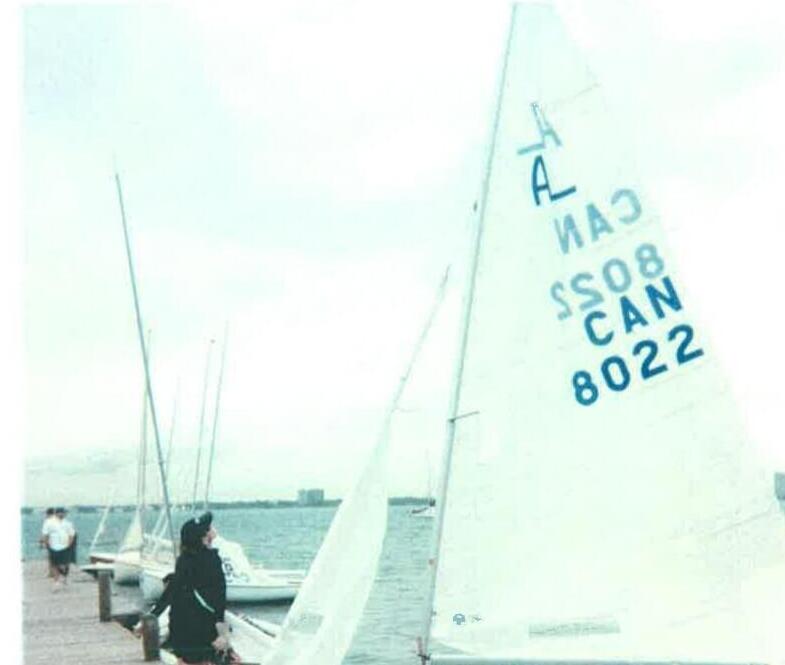
The Canadian Championships are the peak of the Canadian Albacore season, and this year's was a resounding success. With a fleet of 51 boats, this was one of the largest regattas of the year. The conditions varied enough to make racing very interesting, as the winds ranged from strong to light over a three-day period.
Barney Harris once again stole the show, as he and crew Steve Goode won the overall title. Helm Chris Maslowski and crew Rob Muller also put in a fine performance winning the Challenger Fleet division.
Friday began with registration in the morning, and many travellers with boats in tow arriving at Nepean Sailing Club. Although it was cool, the races were started close to on time in the afternoon. The winds were blowing fairly hard, and the shifts certainly kept the race committee on their toes. The first start of the regatta was blown off with 30 seconds to go, as the wind would not cooperate long enough to even get the race started. After two races, it was time to get back on-shore, warm up and dry off in preparation for the AGM and pizza party that night!
Saturday was much nicer, as the temperature warmed up and the winds dropped off. The wind dropped off so much that most of the racing was done in light to moderate air. Two races were completed in the morning, and then came lunch on the water. That was a neat sight; 51 dinghies lining up and sailing by the powerboat that was distributing lunch! Many thanks to Jill, David and Sue who packed and distributed the lunches to the sailors and race volunteers. Racing resumed after lunch, and after a total of four races for the day it was time to head for shore. Events on the water were finished early enough to enjoy a drink and chat before the main event, the Hip of Beef Dinner. NSC saw a packed house for the dinner, with over 120 people in attendance. After a delicious meal of beef, vegetables and cake, many stayed to enjoy the ticket draws, entertainment and just plain socialize.
Sunday continued to be mild, with moderate winds. Two races were completed in the morning to make a total of eight for the regatta. Awards were given out in the clubhouse after lunch, as well as prizes that were randomly drawn. Two US boats finished in the top five, and boats from the Toronto area also did very well. Top five finishes were:
Championship Fleet:
- Barney Harris/Steve Goode, USA/Toronto ON (14);
- Kevin Smith/Sharon Kong, Toronto ON (27);
- Marty Hublitz/Don Campbell, USA (31);
- Ken Clarke/Sharon Palmer, Toronto ON (41);
- Raines Koby/Abby MacInnis, Toronto ON (42)
Challenger Fleet:
- Chris Maslowski/Rob Muller, Toronto ON (23/199);
- Caroline St-Onge/Luc Desjardins, Ottawa ON (25/202);
- Steve Anderson/Cornell Carter, Ottawa ON (26/213);
- Susan Nadine-Davis/Mike Roper, Ottawa ON (37/235);
- Diane Poitras/Lise Shute, Ottawa ON (40/236)
There are many thanks owed to those who helped make this year's regatta a success. There would not have been a regatta without the participants. You all deserve a big thank you, especially those who travelled from the US. The Nepean Sailing Club, along with its staff and members who hosted, organized the dinner and helped organize and run the regatta. The Race Chair, Tom Winslow, and his race committee and volunteers did an outstanding job running events on the water. Doug Patterson who looked after our results and made sure that things on-shore ran smoothly. David Humby, Jill Sheppard and Sue Nicholson who distributed lunches and took the spectacular photos of the event. Tim Dear, Henry Pedro, Raines Koby, Caroline St-Onge, Luc Desjardins, Sue Forgues, Ed Nicholas, Harvey Barnes and everyone else who helped with organizing, registration, t-shirt sales and general trouble shooting. Finally, a special thank you to our sponsors. Our main sponsor, Ankari, provided t-shirts and various prizes. Other sponsors included Keith's, Heritage, Ontario Yachts, North Sails, Quantum Sails, Mountain Equipment Co-op, The Chandlery, Barrett Marketing, Fogh Marine and Boy O'Boy.
The challenge now is to make next year's Canadians, to be held in Muskoka, an even bigger success! Start thinking about making your arrangements to be there. I know I won't miss it!
by: Chrissy Sheppard
Observations at Internationals
A total of 16 North American teams were on the line for the 2001 Albacore Internationals in Torquay, England including 10 boats shipped over by container, five chartered, and one boat bought locally. I believe this is a greater number of NA sailors than at any prior UK Worlds or Internationals and the first time that an entire container of boats had been transported across the pond.
The breeze was on for this event. After a light and fluky first race, the fleet was treated to solid breeze for all but the final race. RC work was exceptional. Courses were LONG with 1.25 – 1.5 mile legs and 2 or 3 laps. The upwind legs were long, and with the variable winds, were very tactical. One always had to be looking way, way up course to see where the next line of pressure was going to come from, and there were many occasions where someone way out to the side would catch a lucky shift and move up in a race. Winds were mostly off shore, so aside from some small wind driven chop, there were no waves.
The reaches seemed to go on for ever. Wind would vary significantly with lulls and puffs of long duration. Boats would sail well above rhumb line to get to the new pressure and then burn down on long, long wonderful high speed planes, hiking off the back of the boat with both main and jib fully loaded, having to bear away even lower in the highest puffs, spray dousing skipper and crew – and all within a few feet of several other competing boats. Jibing in highest puffs was difficult as there were no waves to surf down and unload the rig.
The adjustable rigs added a new tuning trick to upwind sailing. We started using an adjustable rig in February in Florida, training with Chris Gorton in Sarasota Bay and continuing on the Chesapeake Bay. We found ourselves gravitating to the same shroud settings we have always had – that we were not able to get the boat going any faster by altering the shrouds. In England, we found ourselves raking more and more, and pulling the shrouds on harder. In the past, I had never raked more than 11 inches or so but we found ourselves raked to 12½ inches at times during Internationals. With each increase in rake the boat seemed to go faster especially in the higher puffs.
On the reaches we eased the shrouds to stand the rig up and increase power. I had rigged 6701 so that I could release the leeward shroud completely, and with a hinged spreader, all of the leeward standing rigging would clear away from the main. I had also set the boat up differently, with the mast stepped a bit aft which enabled the rig to tilt further forward before it contacted the deck partner. I shortened the spreaders a bit to preserve the original upwind geometry.
Many of the UK Albacore sailors have been experimenting with whisker poles rigged to leeward while deep reaching. We were schooled on its effectiveness in the second race where we rounded just ahead of Mike Mac; he set a leeward pole and proceeded to sail through our lee and extend 200 yards by the next wing mark, a pretty dramatic display. As it turns out, a leeward pole is very effective for reaching angles just above where one would wing the pole to windward. The leeward poles were somewhat shorter than the regular whisker pole. Mike Mac used a pole of 4'3" in length for his high aspect jib. We found a pole of 4'7" inches was about right for the lower aspect North Jib. The leeward pole would hold the jib out further to leeward than the crew could, and kept it filled and drawing from head to foot. It also kept the jib set properly in conditions when the crew had to remain on the windward side. The only down side was limited maneuverability: with the pole set to leeward you could not head up very high, so it was important to be sure you had a good lane before setting the pole. We rigged a leeward pole for subsequent races and found that we were able to keep pace with the top UK sailors.
With the rig stood upright and the jib set to leeward off a pole, the Albacore would really light up on those off wind legs. It felt as if we had a spinnaker up at times. In fact, on several reaches we were overpowered and actually had to rake aft by easing the jib halyard and pulling the shrouds tighter to rake the rig and reduce power to make the wing mark without having to rag the main.
The club was a short walk from the basin up the hill. The bar had a large picture window overlooking the sailing area and launching basin. The club had also set up a satellite bar on the pier when one could get light food. I found that a "post race stout and Cornish pastle" really capped off two long races in high winds very nicely.
We stayed in a B&B arranged by Joanna Byron. It was located a short walk from the launching basin and a shorter walk from the local bars. That heavy English breakfast every morning kept us fueled for the entire day so no lunches were necessary.
The "Hole in the Wall" pub was the unofficial drinking establishment for the week. This was one of those 400 year old buildings with low ceilings that appeared to be sinking into the ground. England is full of this sort of place.
Peter Fontes and John Herbert put on a party in their condo on Wednesday for all the US and Canadian sailors. We supplied two bottles of rum – which were both fully evacuated.
During the UK AGM three new rules were voted on (see sidebar article). The first was rudder materials – basically to explicitly state of what materials a rudder may be constructed. The language is clear and unambiguous. I hope that those in the US and Canada adopt the same wording to eliminate this loophole in the class rules.
Advertising was the second issue. The decisions was to allow none, a little, or unlimited. The vote was close, but the decision was to ban all advertising save for one square meter on the mainsail.
The third issue was to reduce the expense of measuring fiberglass hulled albacores. We in North America have not been conducting full hull measurements of Albacores for over 20 years, figuring that if the hulls were being constructed from approved tooling that this was a waste of time, since the finished boats do not vary by a measurable amount. This fact only came to the attention of the RYA and NAA after I sold 8011 to Neville Herbert in the UK. When I sent over my measurement data and no hull offsets were included, the RYA rejected this basis for a measurement certificate, but gave Neville a temporary wavier till after Internationals. The discussion grew from there – the Brits recognized that the NA practice of neglecting these measurements makes sense for fiberglass hulls molded from approved tooling. The practice of measuring the hull offsets is necessary for all wood hulled boats, since their shape is not as well controlled. This was passed with the provision that a few boats will be randomly selected for full measurement.
As an aside, Kingsfield issue seems to have been put to rest once and for all.. All of the Kinsfileds sailing at Torquay had either been "bumped" or were ok to begin with, and it appears that this is no longer an issue of contention. This was great to see.
UK Nationals have been arranged at Herne Bay in July of 2002. I remember Herne Bay – site of the 1985 Albacore worlds. It howled every day for a week. I was totally unprepared for sailing in that kind of wind. As of right now, I am planning on chartering a boat for this one.
Finally, we expect three UK teams at US Nationals this season:
- Peter Fontes and John Herbert from Parkstone Yacht Club
- Neville Harbert and Steve Penfold from Maidenhead SC
- Victoria Brooks and Richard Thorpe from Maidenhead SC
I believe that we have competitive boats arranged for all three UK teams. I can hardly wait!
by: Barney Harris
USA 6701
Rules voted in during the UK AGM.
A) Rule 8 Rudder.
- The rudder may be lifting or fixed and of any shape.
- When in position on the hull and fully lowered it shall project not less than 550mm. below the intersection of the line of the keel and transom measured along the line of the aft face of the transom.
- The rudder shall be constructed ONLY of the following materials. They may be used in any combination: Wood. GRP. Resins. Aluminium. Brass. Paint and varnish.
B) Introduction of a Rule to control advertising…
The Albacore Class adopts Category A as specified in Appendix I of the 2001 ISAF Rules except that an area not larger than 1 metre long by ½ metre high positioned in the lower ⅓ of the mainsail may have personal advertising.
C) Add a new Rule to Part B- Measurement Rules…
GRP hulls constructed on moulds approved by the Association and in accordance with methods approved by the Association need not have their external hull shape measured (Items 3 to 58 on the Measurement Form inclusive). However, an average of one hull in every ten shall be fully measured, chosen on a random basis. In addition the Association may insist that any hull be fully measured.
Under Rule 12: Temporary Suspension;
12.4 This rule is Suspended for the period January 1, 2002 to the date of the AGM, 2002 only. This is the time period for experimentation by all Canadian sailors within the current rules.
Container Packing for Internationals
This year's Internationals marked the first time that a container of Albacores was shipped from North America to the UK. Planning for this began soon after Worlds in 1999. We began with a call for reservations – a non refundable cash deposit to hold a spot in the container. We asked for non refundable cash so that we had a tangible indication that a person was really serious about going to the event. With an event like this more than a year in advance, just about everyone will say they would like to go. There is something about putting up money in advance that makes noncommittal, confused people think very clearly and is the only way for planners to get a "real" answer in advance.
We began by obtaining several quotes to ship a container round trip. There are many little ins and outs of shipping things internationally, and it took many phone calls and emails to get an apples to apples comparison of the bottom line price. Some freight forwarders would merge some items together such as ocean freight (cost of carriage on the ship across the ocean) and terminal handling charges (cost to load the box onto the ship). The bottom line is that we had to ask for clarification on each term to be sure no cost items were left out. After several rounds of cost clarifying and some sharpened quotes, we selected the freight forwarder based on the expense and their responsiveness.
We obtained an ATA Carnet to clear the boats and gear through customs in the UK and back into the US. The Carnet is like a passport for stuff – and it simplifies the process of getting into and out of a country for a temporary visit. We were also able to buy insurance through the Carnet provider which covered the load during transit.
Loading was conducted at a facility north of Baltimore. The labor contracts with the port require any containers to be loaded by longshoremen. We sought to avoid this and had the container trucked to a site beyond the reach of the union's tentacles. The site was a covered warehouse. The container on a truck chassis was backed up to the loading dock. We were able to roll each boat in, get it prepared for shipping, and pack it into the box out of the sun and rain.
We used a 45 foot "hi cube" container which is just large enough to fit 12 boats in three sets of four. Each set consisted of one hull hung from the overhead, two suspended from the bulkhead, and one upside down on the deck. Each hull had a pad secured to the deck at the mast partner and a 5 foot length of 2x4 strapped across the side decks about 2 or 3 feet forward of the transom. The fore deck pad was formed by rolling a 2x2 ft piece of carpet around a length of line which was wrapped around the hull. The partner pad was further connected by a length of line around the rolled carpet lead through the mast partner and secured to the mast step. The rear 2x4 was simply wrapped around the hull and lashed off. We also added a length of line secured to the thwart and lead around the hull to the opposite side which provided a nice hand hold when lifting the boat on its side.
The inside length of the container was less than 45 feet, so the boats had to be overlapped about one foot. We put the first set of boats into the container stern first and the second set in bow first so the bows could be overlapped. We would fold a piece of carpet over the corner of the transom which rested against the inside of the container and secured carpet between the overlapping bows. With each boat tied up and in contact with one another, the load was pretty stable and resistant to moving.
The shrouds and spreaders were removed from the masts and we wrapped each mast with carpet at the spreader fittings, whisker pole ring, goose neck, and cleats. We then slid the masts into the container along the sides of the bottom boats. Each mast is padded where it will contact the deck or other masts, and so were isolated from each other.
One key to this was the dollies which were collapsible. The light weight aluminum Seitech and Spoot Ride dollies can be disassembled to fit into small spaces between boats, and would enable a 12 boat load. This loading method may pose difficulty for those in the UK since the vast majority of their dollies are welded and do not collapse. I estimate that a 45 foot container could hold a minimum of ten and possibly 11 boats assuming each boat came with a rigid welded steel dolly.
HAPCO Marine donated two 600 foot spools of line – one spool of ⅜ inch diameter New England Sta Set x-lite and one spool of ⁵⁄₁₆ Samson Melges braid to be exact, to the container effort. The x-lite was cut into 27 foot lengths – the exact size for Albacore main sheet; and the Melges braid was cut to 22 foot lengths, suitable for an Albacore jib sheet. HAPCO anticipates that much of this line will be useful after the trip and will be included in future rebuilt and new albacores.
Ten boats and gear were packed into the container for the outbound trip. We packed 11 boats into the box for the return trip along with ten spare masts, and an assortment of other gear. All boats and equipment arrived in the same condition that it was loaded. It required around 5-6 hours to load the container for each leg of the trip. We arranged the container to be delivered at the West River Sailing Club two days before their Annual Regatta.
Unpacking in the US took only 55 minutes – and we had 11 Albacores sitting on the lawn ready for the regatta that week end, boosting our numbers to 24 for this event. A perfect end to the story.
by: Barney Harris
USA 6701
The issue of "Leeward Reaching Jib Poles"
The following is a summary of a presentation held at the Canadian Albacore Association, Annual General Meeting, Nepean Sailing Club, Friday, September 14th, 2001, as part of "new business." A follow-up as a postscript states the actions planned for the 2002 racing season.
Some Background
Prior to 1997 the International Racing Sailing rules listed an item under "outriggers" that in effect stated that a "whisker pole" may not be sheeted on the same side as a boom. In 1997 the ISAF re-wrote the entire rule book with intention of simplification. In this process, the rule was re-stated to allow such an "outrigger." Some enterprising English sailors, members of several classes, chose to begin using what may be described as a "Leeward Reaching Jib Pole." As members of another class and the Albacore class in the UK they have relied upon the current racing rule to validate their intention upon the use while in competitive events.
At the 2000 UK Nationals, several competitors showed up with a far ranging variation in design, using this device in many forms, some even rigging line from the spreaders in order to adjust the angle and the settings while in use. Others used as simple of a device as a broom stick with two nails in order to hook it to both the mast and the jib clew.
There was some discussion at the UK 2000 AGM regarding the introduction and an allowance of a trial on it's use. At this point the National Albacore Association of England has made no final resolution.
AGM Demonstration of the pole in question
Barney Harris, a US sailor, a Canadian Association member, demonstrated a comparison of the regular head pole as well as a proposed simple version of the shorter pole. Barney then made the description statements that those whom sail with a suit of North or maybe Kingston (JC) sails may find with the low aspect, shorter luffed, wider jibs, that a pole near 4 feet, 7 inches would likely be in order. Those sailing with higher aspects sails such as McNamara, Ullman, perhaps Sobstads may need an even shorter pole in the range of 4 feet, 3 inches. Barney's demo simple pole was of the same metal tubing as the current head poles, with the similar RWO clip fittings on both ends.
Barney continued his presentation, as an advocate, that he had in fact used his demo model in a recent USSA event with his wife Becky as crew, "at which he noted… likes it because it relieves her of the pain of holding the jib out to leeward while reaching in light airs. If she likes it, I'll bet that most crews will like it. I like the new tactical dimension and better performance…". This experience led him to conclude that while previously he might have been ambivalent toward acceptance, now he was sold on it's addition to the class.
Canadian 2002 Proposal
At the AGM of the CAA in September 2001, the Chief Measurer proposed to all in attendance that a "trial test" period of six to eight months be instituted. This will allow CAA members to understand the use, the application, the materials required, the costs and any other observations that would allow them to form an opinion on the use or non use of these "new" devices. Some other questions that may be considered by all are that of the complexity that may be allowed within the design; the instructions necessary to those new in the class each year within the community clubs to be able to use it skillfully; and the safety in use of this added equipment that may be needed if a person wants to be among those competitive racing members of the class.
During the proposed trial use, Canadian sailors are encouraged to express their comments and experiences with these additional poles to the Chief Measurer of the class verbally or by written messages. By the end of the trial period, if there is a consensus among the active class members toward general adoption, the CAA will publish the proposed wording of the addition to the class rules.
This wording is expected to be as a result from direction given by the Rules Committee of the International Albacore Association who would outline the rule changes necessary, and prepare a resolution to be proposed at the 2002 AGM of the CAA, tentatively to be held in Muskoka at a site not yet announced.
Next step
The CAA AGM discussion ended with a request that the Chief Measurer of CAA ask for the Rules Committee of the International Albacore Association to frame the wording for a rule or rules which would clarify the existing Albacore Class Rules, and provide an unambiguous definition as to the construction and use of the "Leeward Reaching Jib Pole."
This rule is to be available to all members of the associations of the International Albacore Association (CAA, USAA and NAA) prior to the 2002 sailing season. It will then be published for use in the test phase described above in Canada. The rule(s) would then be available for voting on at the 2002 AGMs of the member associations of the IAA.
The International Rules Committee is to be comprised of, Under article V.5 of the IAA Constitution, the Chair of the IAA Rules and Specifications Committee, Dave Weaver, with the three Chiefs Of Specifications (Chief Measurers). They are representing England's NAA, Michael McNamara; representing USSA, Rolf Zeisler; representing CAA, George Wm. Roth. The committee will consider all observations and comments from all member sailors within the class as input while considering and arriving at a rule wording solution.
Postscript of actions following the AGM
To date several positive discussions between members of the IAA executive and the above named rules committee have transpired.
Actions taken to be in effect for the 2002 Racing season:
In effect immediately in Canada:
Within the class rules to make it clear that we are within a test period the following amendments have been made to these specific rules in question.
Under Rule 11: The additional statements;
11. Headsail Poles
11.1 One or more headsail poles may be carried while racing.
11.2 The overall length of headsail pole(s) including fittings shall not exceed 1830 mm
Under Rule 12: Temporary Suspension;
12.4 This rule is Suspended for the period January 1, 2002 to the date of the AGM, 2002 only. This is the time period for experimentation by all Canadian sailors within the current rules.
For the 2002 racing season:
For those events sanctioned by the CAA, the Race Chairs of those clubs sponsoring are asked to add to their individual Notice of Race and their Sailing Instructions a clear statement as to whether the event advertised allows the use of the proposed "Leeward Reaching Jib Pole" under the test proposal time period or temporarily bans the use in that event (ie such as the 2001 Canadians listed). This is requested to maintain a sense of fairness within the class events to all competitors, as well as to avoid those opposed attempting unfortunate protest actions.
(Please note that the USAA has approved similar provisions for 2002 USAA racing events. Please check with the individual USSA event for actual instructions.)
IAA Rules committee
The IAA rules committee will be working toward the following objectives:
By December 31, 2001 – International Rules Committee drafts rule changes in deems appropriate. (These are to be 'published' on each national association web site.)
January 1, 2002 to July 31, 2002 – Experimentation of reaching poles in North America (and, of course their continued experimental use in the UK). Additionally, during this period Albacore sailors will be able to communicate their views on these rules to the Rules Committee until this date.
By July 31, 2002 – International Rules Committee finalizes drafts rule changes in deems appropriate.
By August 15, 2002 – Ratified by a majority of votes of Members of the Association (IAA), in accordance with the Constitution of the IAA.
By November 30, 2002 – Approval at a General Meeting of each of the National Associations.
By December 31, 2002 – submit agreed rule changes to the Royal Yachting Association for incorporation into the International Rules of the Class.
George Wm. Roth,
Chief Measurer, Canadian Albacore Association
23 October 2001
My long/short pole
Race 3 Torquay Internationals 2001
Having arrived at the windward mark in sixth place I thought I was in for a good result. By half way down the first reach I had been overhauled by a group of six boats, all using short poles! It was then I decided to join them and make one of my own.
The first one was simple an old jib stick I had sat on and badly bent cut down to the same length as Mike Mac's. I was back in the hunt and quickly became convinced both of the effectiveness of the short pole and the extra fun it gave.
Looking around for somewhere better to stow it I thought "Why can't the long pole be used for both?"
Extendible poles are one answer but then I saw Mike Holmes short pole and he explained how he used it. Adapting his idea to the standard long pole could not have been easier.
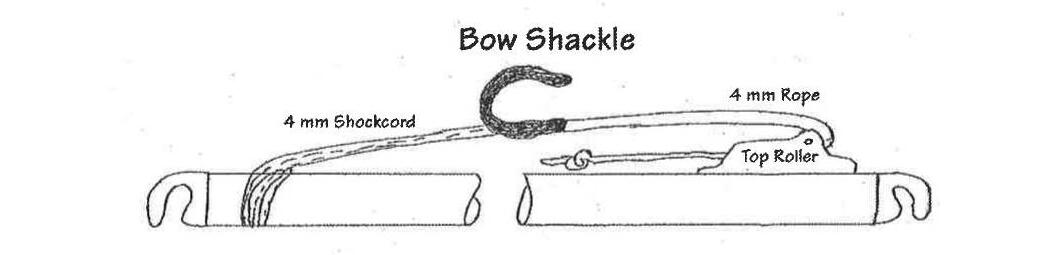
Screw a top roller Clamcleat to one end of the pole, facing outward. Thread a odd length of rope through it and tie on an old bow shackle I had lost the pin for. A short length of shock cord to tidy things up and that was it. I now have a pole I can use conventionally, as a short pole anywhere from about two feet long to five feet eleven inches and it can be released when acting as a short pole by just uncleating the rope. This is handy if the wind shifts suddenly or you get luffed. All in one pole and the cost? About £5! I had lent my first short pole to another Albacore sailor and have now said he can keep it and lend it to others. I am really happy with my long /short pole and can't see me going back to separate long and short poles.
The leeward pole issue has now been referred to the R.Y.A. for a formal ruling by Mike Mac' but until we get a decision try short poling. It brings a new dimension to Albacore sailing at very little cost.
Dave Le Page
GBR 6911 (Jo Cool) and K1575 (Shikna)
YEAR 2001 BOAT SHOW VOLUNTEERS NEEDED!
FREE ADMISSION TO BOAT SHOW IF YOU WORK AT CAA BOOTH FOR TWO TO THREE HOURS
DATES: JANUARY 11TH TO THE 20TH
PLEASE CONTACT HEATHER MACNAUGTON IF YOU WOULD LIKE TO VOLUNTEER
[email protected] or (416) 367-9898
The 44th Annual Toronto International Boat Show is the biggest boat show in Canada, and also one of the largest in North America! Boaters and newcomers come from all over Canada and from the north eastern United States to shop the thousands of boats, accessories and marine services that are available. Boats range in size from 6' to 57', including runabouts, cruisers, motor yachts, sailboats, trawlers, fishing and pontoon boats, deck boats, inflatables, electric and wooden boats, personal watercraft, performance boats, canoes, kayaks, and pedal boats.
Check out www.discoverboating.com/boatshows/toronto/ for further information.
PLEASE SUPPORT THE ALBACORE CLASS AND HAVE FUN DOING IT!
HAPCO Split Tail Main Sheet for an Albacore
HAPCO uses polypropylene covered line with a blended spectra and polypropylene core for the hauling part and a tail of 1/8 inch spectra. While the polypro does not hold us as well in sunlight and wear, the line is very light and does not soak up much water weight while sailing. The spectra does not soak up water either, so the entire assembly does not drag in the water while sailing off wind in light air.
Tools and Ingredients
- 27 feet of ⅜ inch diameter New England Ropes Sta Set X-Lite
- 190 inches of ⅛ inch diameter Spectron 12
- Spool of #4 Marlow waxed nylon whipping twine
- Masking tape
- Sewing needle
- Sharp knife
- Two Harken HK281 stainless steel straps with #8 fasteners, locking nuts, and flat washers
- Two Ronstan RF1981S shackles
- Drill with ¹¹⁄₆₄ inch bit
- Screwdriver and pliers
- Lighter
Procedure:
- Choose one end of the main sheet and cross stitch the ⅜ inch line ten times about 2 feet from the end.
- Wrap masking tape around the chosen end and cut it off cleanly.
- Push the core out from the main sheet around 10 inches.
- Cut off around seven inches of the core.
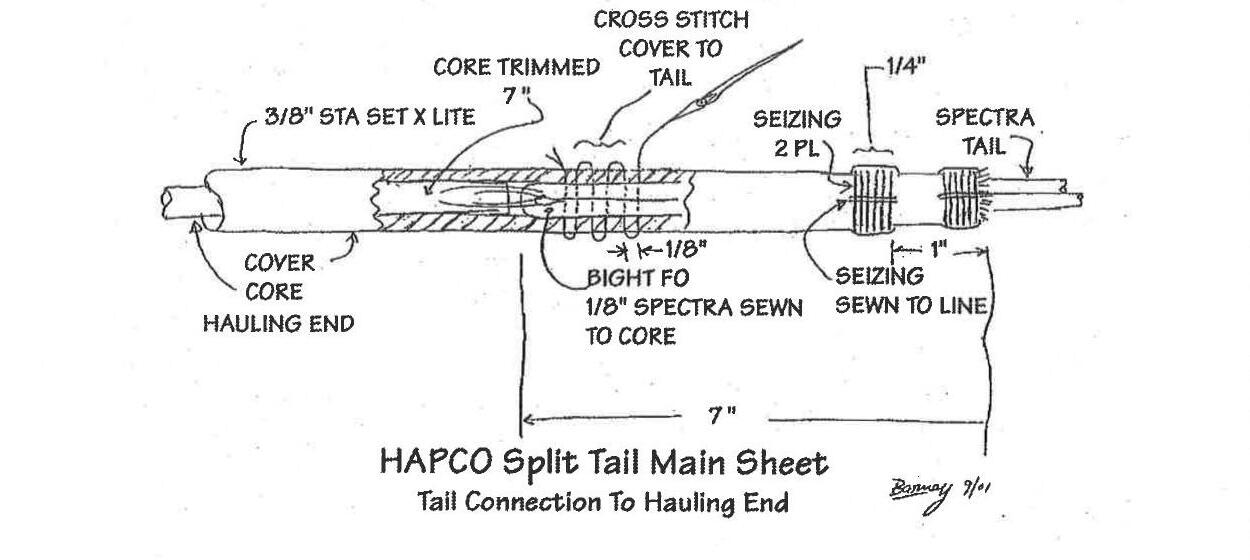
- Fold the spectra 12 in half and sew the middle to the end of the core.
- Milk the cover over the core and draw the bight of spectra inside.
- Cross stitch the cover to the bight of spectra such that the stitching goes through both sides of the bight as shown in the sketch.
- Apply a seizing one inch from the end of the cover. Sew the seizing to the cover.
- Carefully peel back the masking tape and apply a second seizing to the very end of the cover about ¼ inch back from where the spectra emerges. Sew this seizing to the cover and through the spectra.
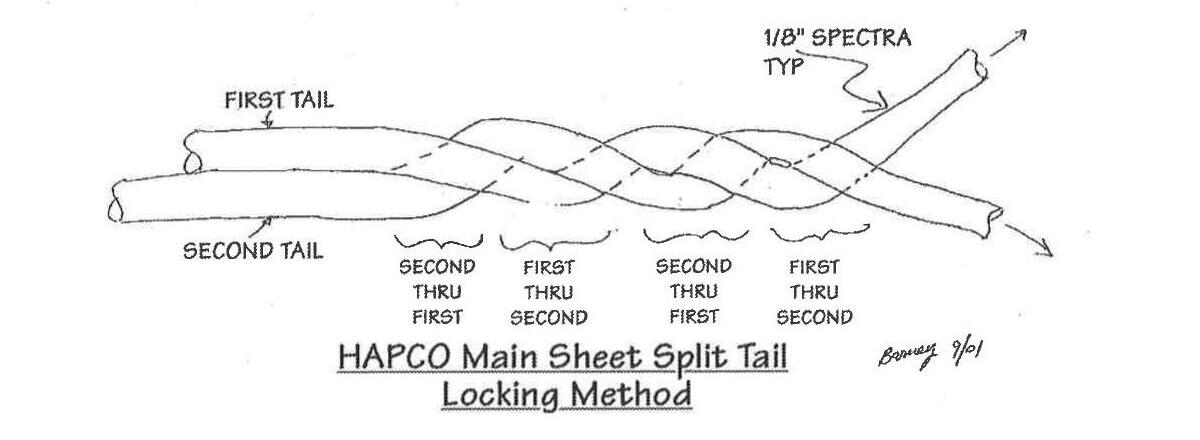
- Cross stitch the spectra around 45 inches. Use ⅛ inch stitches with #4 Marlow waxed whipping twine.
- Wrap tape on both ends of the spectra tails, forming a point on each end. Poke a hole in the first spectra tail and pass the second through. Poke a hole in the second tail and pass the first through. Repeat this once. When correctly done, it should not be possible to pull the tails apart.
- Splice a small eye into the ends of each spectra tail arranged at a finished length of 34 to 35 inches. Note: the spectra gets shorter when spliced. Pull the eye very tight around the Ronstan shackle.
- Install the Harken eye straps 13 inches forward of the transom with fasteners arranged athwart ships.
- Shackle the main sheet tails to the eye straps and run the main sheet through the blocks on the boom. Adjust the location of the blocks on the boom so the main sheet is perpendicular to the boom when the boat is rigged and the boom center lined.
- Burn and seize the opposite end of the main sheet.
- The mainsheet will be slippery when new – either run it through the washing machine on delicate with a little soap or just use it for a while. Soaking the main sheet in a bucket of water overnight will help.
The above described main sheet is designed to have spectra running up through rear block on the boom but to not quite get to the forward block on the boom. This way, the transition from spectra to X Lite is not normally running over the block while sailing upwind, so the main sheet runs smoothly and without any bumps.
by: Barney Harris
USA 6701
Restoring the Bouyancy Tanks on 6878
On March 31, 2001 I became the proud owner of Albacore 6878, a Skeene built in 1980. The boat was in pretty good shape, but like many Skeene and Ontario Yachts (non-foam core) Albacores built in the hull number 6800 to 7500 range, the seat tanks had separated from the floor leaving lots of space for water to enter the bouyancy tanks. The previous owner had placed air bags in the tanks to provide floatation. My plan was to re-seal the tanks to restore the buoyancy and to add rigidity to the hull. Having no experience in doing fiberglass repairs I relied on Peter Duncan's assurances that he and Barney Harris would coach me through the process. In fact, Peter was just starting a similar restoration of hull #7264, and suggested we might lend one another a hand at some of the more time-critical points. He suggested I start out by getting some guidance from Barney who has completed several restorations of this kind.
Following Peter's advice, I contacted Barney, who said he was working on an article which would describe the process in some detail. He offered to send me the set of instructions he had completed and asked that I embellish them as I went through the restoration, turning them into a finished article in the end. So here is the article, the main substance of which was provided by Barney Harris, with comments and additions by both Peter Duncan and me based on our work on #6878 and #7264.
Clearly, preparation is the key to a project of this kind.
Equipment
- 4 or 4.25 inch power grinder (Dewalt or equivalent), for grinding off gel coat
- Dremel tool with abrasive sanding drums and cutting disks, for detailed grinding
- Air Filtration Mask or dust mask, depending on whether work is done inside or out
- Eye protection
- Thin laytex gloves
- Orbital sander, detail sander and or sanding block
- Rasp, Screwdrivers or small prying tools, hacksaw blade
- Shop Vac
- Whisk broom
- Cotton rags & paper towels
- scissors for cutting fiber glass
Materials
- 37 ft. of 4" wide 9 oz. Fiberglass cloth (Gueogon WEST), or alternatively, 23 ft. of 4" wide 9 oz. Fiberglass cloth and 15 square feet of fiberglass mat
- 1 quart Epoxy resin (WEST 105)
- Slow epoxy hardener (WEST 206)
- 6 oz Colloidal silica (WEST 406)
- Acetone
- Small can of polyurethane primer (Interlux or equivalent)
- Small can of polyurethane enamel top coat (one part poly- Interlux or equivalent)
- 3 or 4 inch masking tape that is thick, in a contrasting color such as blue
- newspaper for masking
- disposable 1 inch china bristle brushes
- mixing cups and stir stix (yogurt cups and popsicle sticks work well)
- 80 grit wet or dry sandpaper
- 100 grit sandpaper
- marking pen or pencil
- yard stick for measuring and for use as a straight edge
If you have not worked with fiber glass before I suggest you read Fiberglass Boat Repair and Maintenance by West Systems before embarking on this project. Properly done, fiberglass is pretty easy to work with, but an error can be difficult to fix once the epoxy has cured.
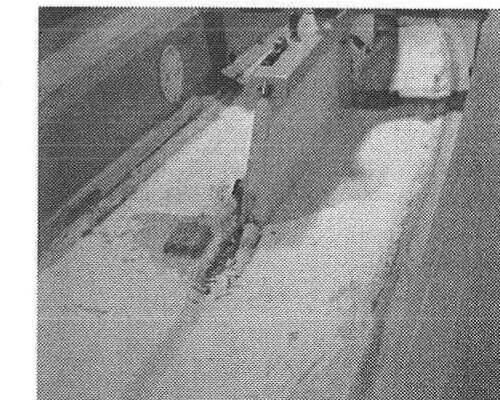
Photo 1
Instructions
- Clean boat with soap/water to remove debris and dirt from floor-tank joint area. Dry thoroughly. Allow boat to stand indoors for a week or so with a few lamps nearby to drive all water away. Water or moisture can ruin epoxy resin, and I found that water would drain from the darndest places when turning the apparently dry boat into different positions. Remove all internal rigging and hiking straps. Mask off any fittings and blocks in the way. Time – about 2 hours [See Photo 1]
- Mark a line along the bottom of the seat, just after it turns from vertical to horizontal, along the floor. From this line, measure and mark a line 4" toward the center of the boat along the floor. The hull joint should be between the two lines, not quite equidistant. This 4" area is where we will grind away the gel coat so the fiberglass will adhere well.
- Place two layers of masking tape coinciding with these lines. The masking tape serves to reduce grinding scratches beyond the area intended for repair. Time to mark and mask – about 1 hour
- Using the grinder and Dremel tools, remove around 80% of the gel coat and/or paint, meaning you should see about 80% of the fiber glass with spots and blotches of old gel coat remaining covering about 20% of the prepared surface. Do your best to remove as little of the original fiberglass as possible. Leaving 20% of the gel coat/old paint is about right – you will remove too much of the original boat structure if you attempt to remove 100% of the gel coat or paint. Use the Dremel tool for corners and hard to reach areas. I found the flexible extension for the Dremel tool to be useful.
- The grinding is the nasty part of the job. Gel coat dust gets everywhere, so cover up. I suggest that you do this outdoors if possible. If not, try to have someone available to run the vacuum cleaner as you grind, to help control the dust. It is easy to make a mistake while grinding, just a slip and you could grind a hole in the boat, so take extra care while doing this part of the job. Time – Grinding, about 5 hours [See Photo 2]
- Using the grinder, make a slight chamfer on the edge of the tank flange lip to help soften transition from tank flange to floor.
- With a hammer and chisel, remove loose adhesive between the tank flange and the hull.
- Use a rasp, dremel tool cutting disk, detail sander, and/or old hacksaw blade to remove as much of the old adhesive as possible where the joint has already cracked. Be careful to not push chunks of old adhesive into the tank. Some previous repairs had been attempted on #6878, so there was a fair bit of old epoxy to be cut out using the Dremel tool.
- Remove and dispose of masking tape; vacuum away all dust and material; use a whisk broom to loosen dust stuck in pores in the fiberglass.
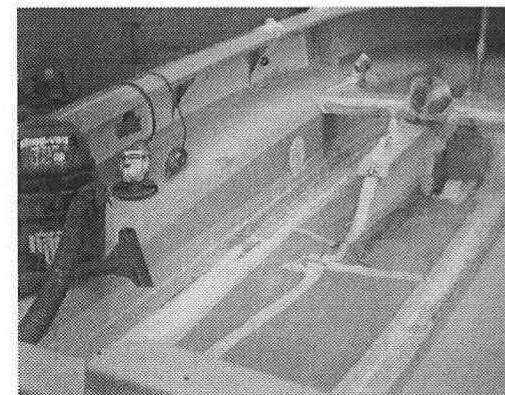
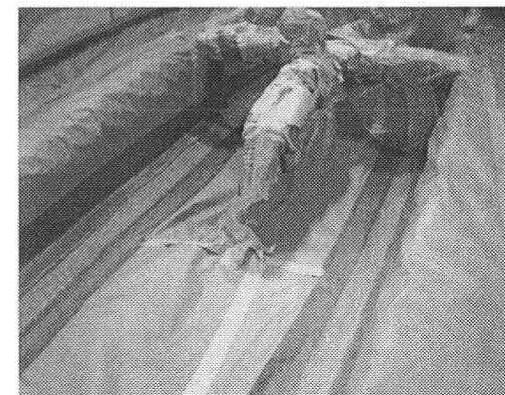
Photo 2 Photo 3
- Wash the area clean with acetone; allow surface to dry.
- Use newspaper and masking tape to mask off the area above and below the ground areas. Be as precise as you can to leave only the area that will be covered in fiberglass exposed. [See Photo 3]
- There are some things to consider before starting the fiberglass work. First, make sure the boat is well supported so it does not rock around when you are working on it. Also, be careful that the hull is not distorted by the way it is supported and constrained, or else the distortions will become permanent when the resin cures. I used a dolly that was low enough that I could easily reach inside the boat without leaning on anything. Time is of the essence when working with fiberglass, and is directly related to temperature. . If the temperature is above 75 degrees only work on half of boat at a time as epoxy cure may be too rapid. An alternative is to have help. By working together, Peter and I were able to glass the entire area, with three layers, in about 2 hours. You should lay out all the materials you will need ahead of time. [See Photo 4]
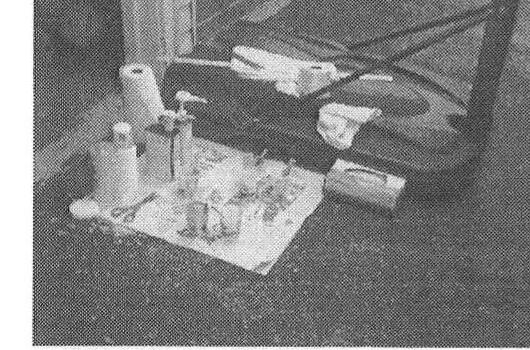
Photo 4
- There are a couple of approaches we have seen used in fiberglassing the tanks to the floor. One is to use two layers of glass tape, one to cover the entire area, and the other long enough to cover the high traffic area (1 foot ahead of the front end of the centerboard case to 1 foot aft of back of the centerboard case). This second strip will be about 7 feet long. The second approach is to use two layers of fiberglass mat, covered by a final layer of 4" - fiberglass tape.
- Cut and test fit fiberglass mat and tape. Cut mat in 3.5" strips to fit underneath the 4" tape strips. Be certain that the masked area is just wide enough to accommodate the fiberglass. Be certain that no fiberglass will end up on top of masking tape.
- Mix epoxy and coat the ground areas with a thin layer of resin. Coat facing surfaces where old adhesive was removed using a screw driver to pry them apart.
- Mix epoxy and collodial silica to a peanut butter consistency. Force the mixture into the tank to hull joint where old adhesive was removed. Use a screw driver to pry the surfaces apart; use enough to fill the gap but don't fill the entire tank with the stuff!
- Form a smooth fillet from the top of the tank flange to the hull, which should extend as inboard the same distance as the flange is above the hull inner surface. Note, that when you apply this fillet, the mixture will be thinned by the epoxy already painted on, so use a thick mixture to keep the resulting fillet from running.
- Working from the bow to transom. Lay mat or tape on wet epoxy on the tank flange and work it over the fillet and onto the hull. After the mat or glass tape is positioned, wet it out with additional resin. Use adequate resin to fully wet out the glass, but not so much that it begins to pool in lower areas or run out of the cloth. Press down to fill voids and air pockets.
- If using mat, lay a second layer of mat over the first and fully wet out glass with epoxy. Then lay the layer of fiberglass tape over mat and fully wet out with epoxy. If not using the mat, the second layer should be the 7 foot strips of tape to cover the high traffic areas.
- Allow epoxy to cure until it is not sticky to the touch or just barely so. Inspect work and clean off any runs or epoxy spikes with a sharp knife. Of course your technique was perfect and there are no major voids – but if there are, these can be filled with epoxy and colloidal silica using a hypodermic at this time.
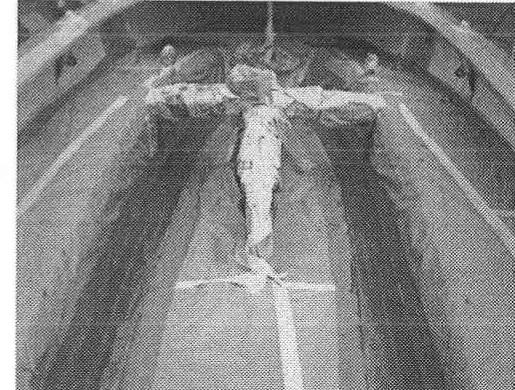
Photo 5
- Allow epoxy to continue to initial cure – no trace of stickiness but soft enough to dent with your fingernail (4-6 hours depending on temperature); remove all masking materials. Clean up any errant resin drops or smudges by scraping or with acetone.
- Allow epoxy to fully cure (3-10 days depending on temperature). [See Photo 5]
- File off all sharp edges with a rasp or power sander.
- Wet sand epoxied area with 80 grit wet or dry sandpaper. Inspect with a lamp to ensure that no shiny areas remain. Keep sanding until all of the fiberglass has been dulled. Sand the fiberglass where it bends over the fillet very gingerly to not cut any of the glass fibers which would weaken the repair. Thoroughly clean all sanding residue and dry up all water.
- Using an orbital sander and/or Dremel tool, smooth the transitions around the edges of the fiberglass tape to the hull and tank flange. These transitions should be no more than ¼ inch or so. Sand around ¼ inch beyond the extent of the fiberglass. Clean up all dust. Clean with acetone.
- Re-mask area of repair, this time ¼ inch wider than previous masking. Because #6878 had previously had rough fiberglass work done on the floor, I decided to paint the entire floor to get a uniform look, rather than painting just the strip around the hull joint.
- Prime repair area with any good quality single part polyurethane primer; allow to dry.
- Lightly sand primed surface with 150 or so grit paper, removing around 25 to 50% of the primer in the process. Replace any messed up masking.
- Apply top coat- one part polyurethane paint, flowing on enough to be completely opaque but without runs or sags. I added a flattening agent to the paint to dull the glossy paint in order to blend better with the original floor surface.
- Remove masking materials after paint cures to the touch. Allow paint to fully dry before walking on or sailing the boat. [See Photo 6]
- Perform buoyancy test to verify integrity of repair
On many boats of this age you will also find separation where the chain plate columns meet the deck of the boat. I had this problem and had to seal this area as well. Place the boat upside down on a set of workhorses to access this area. [See Photo 7]
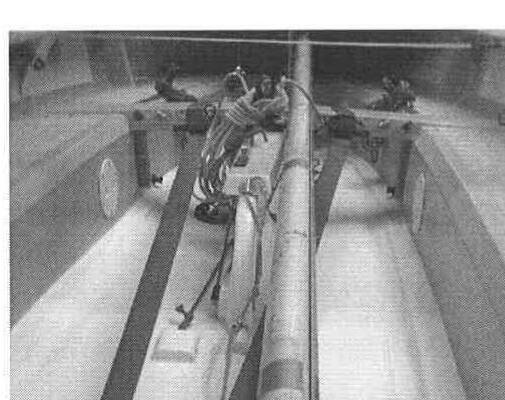
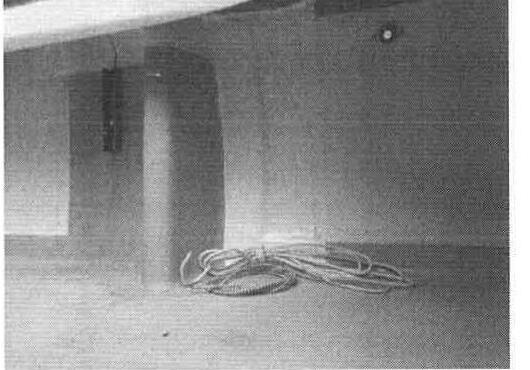
Photo 6 Photo 7
by: Peter Duncan
Jeff Hackett
Barney Harris
Canadian Albacore Association — Executive
47A Harbour Square, P.O. Box, 81047 Toronto, Ont. M5J 2V3
www.albacore.ca
| Position | Name | Contact |
|---|---|---|
| Commodore | Ann Savege | 35 Church St. #302, Toronto, ON M5E 1T3 H 416-361-1808 / B 416-922-5322 [email protected] |
| Past Commodore | Heather Macnaughton | 99 Harbour Square, unit 1812, Toronto, ON M5J 2H2 H 416-367-9898 / B 416-868-8205 / F 416-868-3817 [email protected] |
| First Vice Commodore | Dave Smith | 30 Dancer's Drive, Markham, ON L6C 2C4 H 905-887-8422 / B 416-493-9020 [email protected] |
| Second Vice Commodore | Henry Pedro | 2210-736 Bay St., Toronto, ON M5G 2M4 H 416-593-4438 / C 416-991-8581 [email protected] |
| Third Vice Commodore | Mary Neumann | 135 Ulster Street, Toronto, ON M6G 1E7 H 416-968-1696 / B 416-968-9081 [email protected] |
| Rear Vice Commodore | Van Sheppard | 509-215 Parkdale Avenue, Ottawa, ON K1Y 4T8 H 613-729-8939 / B 613-599-7603 x282 [email protected] |
| Specifications Chair | David Weaver | 14 Lansdowne Rd North, Cambridge, ON N1S 2S8 H 519-623-4402 / B 905-525-9140 x 24907 / F 905-572-7944 [email protected] |
| Chief Measurer | George Roth | 212 Willowdale Avenue, Waterloo, ON N2J 3M1 H 519-746-1300 / B 519-746-1300 / F 519-746-1162 [email protected] |
| Treasurer | Jason G. Roth | 60 Cheviot Cres., Brampton, ON L6Z 4G7 H 905-840-5395 / B 905-362-4435 / F 905-362-4605 [email protected] |
| Secretary | Teresa Miolla | 326 Riverside Drive, Toronto, ON M6S 4B2 H 416-769-0990 / B 416-236-1871 / F 416-769-0660 [email protected] |
| Editor, Shackles & Cringles | Karen Piatkowski | 350 Laird Drive, Toronto, ON M4G 3X9 H 416-429-0432 / B 416-203-2300 Ext. 223 [email protected] |
| Membership | Abby MacInnes | 29 Burlington Crescent, Toronto, ON M6H 2L5 H 416-654-0685 / B 416-978-2600 / F 416-978-6168 [email protected] |
| Committee Members — Ontario Championships | Andy Roy | 15 Claudette Court, Peterborough, ON K9J 7Y7 H 705-750-0189 / B 705-743-9249 [email protected] |
| Co-organizer Canadians | Myles Wilson | 21 Webster Grove Rd., Newton, NH USA 03858 H 603-382-4696 / B 978-465-1900 Ext. 267 [email protected] |
| Wistowe Island | Minett P.O., Minett, ON P0B 1G0 | |
| Albacore Class Marketing | Barrie Farrell | 46 Bellefair Ave., Toronto, ON M4L 3P8 H 416-693-6223 / B 416-243-0848 / F 416-243- [email protected] |
| IAA Representatives | Ken Clarke | 1236 Queen Victoria Avenue, Mississauga, ON L5H 3H3 H 905-891-5742 [email protected] |
| IAA Representatives | Heather MacNaughton | 99 Harbour Square, unit 1812, Toronto, ON M5J 2H2 H 416-367-9898 / B 416-868-8205 / F 416-868-3817 |
| IAA Representatives | Raines Koby | 5 Cosdale Place, Palgrave, ON L0N 1P0 H 905-880-1866 / B 905-792-6080 [email protected] |