Spring 2001
April 01, 2001
Volume 41 Number 2. Commodore's Corner, Albacore Race Training 2001, 2001 North American Albacore Championships & RCYC Open NOR, Barney Harris's "Putting Together an Albacore Racing Program," the 2001 Albacore Midwinters (Sarasota) full results, Nepean Sailing Club and Outer Harbour Centreboard Club regatta notices, Barney Harris's "Splicing Vectran Line" and "HAPCO Vang and Jib Halyard Systems Overview" rigging how-tos, Norman Halstead's "Save Your Centreboard" safety-line how-to, J-Town and Westwood Open regatta notices, and the 2001 Canadian Albacore Championship Preliminary Notice of Race.
Another Season Begins
2000/2001 Canadian Albacore Association Executive
| Position | Name | Contact |
|---|---|---|
| Commodore | Heather Macnaughton | 99 Harbour Square, Apt 1812, Toronto, ON M5J 2H2 H (416) 367-9898, W (416) 868-8205, F (416) 868-3817 [email protected] |
| Past Commodore | Gord Chu | 310 Durie Street, Toronto, ON M6S 3G3 H (416) 760-8778, W (416) 733-6851, F (416) 733-6777 [email protected] |
| First Vice Commodore, Racing | Neil Wilson | 77 Harbour Square, Apt 1710, Toronto, ON M5J 2S2 H (416) 203-8395, W (905) 712-1084 Ext 3605 [email protected] |
| Second Vice Commodore, Marketing | Henry Pedro | 2210 – 736 Bay Street, Toronto, ON M5G 2M4 H (416) 593-4438, W (905) 458-2849, F (905) 458-2870 [email protected] |
| Third Vice Commodore | Kevin Smith | 46 Panorama Court, Apt 703, Etobicoke, ON M9V 4A4 H (416) 743-6818, W (416) 249-3361 [email protected] |
| Chief Measurer | George Wm. Roth | 212 Willowdale Avenue, Waterloo, ON N2J 3M1 H (519) 746-1300, F (519) 746-1162 [email protected] |
| Treasurer | Jason G. Roth | 60 Cheviot Crescent, Brampton, ON L6Z 4G7 H (905) 840-5395, W (905) 362-4435, F (416) 441-9921 [email protected] |
| Specifications Chair | David Weaver | 14 Lansdowne Road North, Cambridge, ON N1S 2S8 H (519) 623-4402, W (905) 525-9140 ext 24907, F (905) 572-7944 [email protected] |
| Secretary | Teresa Miolla | 326 Riverside Drive, Toronto, ON M6S 4B2 H (416) 769-0990, W (416) 236-1871, F (416) 769-0660 [email protected] |
| Editor, Shackles & Cringles | Nona Arneson | 95 Lawton Boulevard, Apt 608, Toronto, ON M4V 1Z8 H (416) 485-3572, W (416) 946-4501 Ext 5708 [email protected] |
| Membership | Ann Savege | 35 Church Street, Apt 302, Toronto, ON M5E 1T3 H (416) 361-1808, W (416) 922-5322 [email protected] |
| Rear Commodore | Van Sheppard | 215 Parkdale Avenue, Apt 509, Ottawa, ON K1Y 4T8 H (613) 729-8939, W (613) 599-7603 Ext 382 [email protected] |
| IAA Representatives | Neil Gunn, Ken Clarke | |
| IAA Chief of Specifications | David Weaver |
Shackles and Cringles is a quarterly publication of the Canadian Albacore Association. Deadlines for publication are February 15, April 15, July 15 and November 15.
The Albacore Advantage
A One-design Boat
- no unnecessary expense of constant upgrades in design
A Safe Boat
- large air-filled tanks give excellent buoyancy
- hull shape gives stability on the water
- self-rescue after an unexpected puff is easy
A light and manageable Boat
- tongue load of less than 100 lbs gives ready trailerability
- launching and retrieving are a breeze
A comfortable Boat
- large, open cockpit
- benches on port and starboard sides
A Performance Boat
- seriously campaigned by major sailmakers
- planes in moderate winds
- buoyant heavy-air hull shape
Ideal for Junior Clubs
- 4 to 5 juniors will fit easily
- will stand up to heavy use
A vibrant Class Association
- well organized and vital
- recognized by the International Sailing Federation
- strong fleets through Ontario, Canada, US, Great Britain, Ireland and Bermuda
- top notch competitive sailing
- junior programs in some areas
Commodore's Corner

Hello Fellow Albacore Sailors – HAPPY 40th ANNIVERSARY of the Canadian Albacore Association in 2001! Watch for special prizes/events celebrating our 40th year of existence.
New Racing Rules
As most of you are aware, ISAF has issued new 2001-2004 Racing Rules of Sailing. Because the rule books are not available until mid May, the Canadian Yachting Association recommends classes do not implement the rules until June 1, 2001. We, as a class, have decided to go along with this for Friday Nights and Harbour Masters. For regattas it is highly recommended we follow the CYA prescriptions.
For everyone's reference, the CYA prescriptions for the 2001-2004 CYA/ISAF rule book will be posted shortly on the CYA website www.sailing.ca (under the racing section).
Rule Books
For Toronto sailors, Peter Vasoff from St. Jamestown Sailing Club is ordering the New Rules book for general sale–about 50 copies. Mary Romaniuk, Race Chair at J-Town has advised that they will post the availability of the books on their bulletin board when they come in.
Seminar
Thank you to David Jube from Toronto Island Sailing Club who organized a rules seminar with Lynne Beal (International Judge) and Doug Creelman held on May 14th at the Toronto Sailing and Canoe Club. Both Lynne and Doug are respected experts in both the Racing Rules of Sailing and Judging circles. The organization of this by David was much appreciated as it is much easier to learn from a presentation than from reading on your own.
Gooderham Series
The Gooderham Series is won by the sailor who attends the most regattas designated as Gooderham series regattas and does the best in all of these. For the year 2000, Neil Wilson, First Vice Commodore has designated the following as Gooderham Series regattas:
- Tarts & Balls — June 2/3 — Toronto/Humber Bay
- North Americans — June 9/10 — Toronto/Lake
- PABAR — Aug 18 — Pointe au Baril
- Canadians — Sep 14-16 — Ottawa
- Centennial Regatta — July 1 — Peterborough
The rule will be that only sailors who participate in at least THREE of these regattas will qualify. Come on out and compete to be the Gooderham Series winner. Your name will go down in Albacore History!
North Americans
Canada is hosting the North Americans this year at RCYC during the week of June 9 and 10th. This should be a great event with lots of sailors up from the US. Rosemary Helmer is the main organizer of this event and I am assisting her in matching up billets. If you either need a billet or would like to offer your home for billeting, please write me at [email protected]. Hope to see you all there. -Heather
Announcement & Correction
The correct date for the LSSA Regatta (including the Youth Albacore Championships) is June 30-July 1st. The dates listed on page 13 of Shackles & Cringles, Winter 2001 are incorrect. My apologies for the confusion. The next deadline for Shackles & Cringles submissions will be moved up to July 1st, for the summer 2001 issue. Thanks, Nona.
Hans Gottschling
The Dinghy Boatcover Specialist
Tel. 905 277-3306
Fax 905 277-9021
Web site: Gottschlingboatcovers.com
Albacore Race Training 2001
June 16 & 17
Place:
Toronto's Outer Harbour. Hosted by Westwood Sailing Club. On the water training may be either in the Outer Harbour or out on the Lake. Race training includes the HarbourMaster races on Sunday 17th, Outer Harbour, 1:30 pm start.
Coaches:
Chris Gorton: Current Albacore Midwinters Champion, past Canadian and North American Albacore Champion
Oskar Johansson: 1999 Pan Am Sunfish Gold Medallist, National Team Laser sailor
Kevin Smith: past Olympian, 2000 Albacore Friday Night champion
Social:
None, planned. (Eds. Note: The Toronto Island Sailing Club is having a Lobster Fest on Saturday evening. For details and/or tickets, please contact TISC at 416-203-6872 or email to [email protected]
Eligibility:
This training course, endorsed by the Canadian Albacore Association, is designed for all novice, intermediate and advanced racers.
Novice and intermediate sailors will receive individual coaching priority.
Sailors from all countries who are members of their national association are welcome.
Registration and Entry Fee:
Entry fee is $60 per boat. See registration form included in this issue of Shackles & Cringles.
Questions:
Contact Kevin Smith by email: [email protected]
Notice of Race
2001 North American Albacore Championships & RCYC Open Albacore Regatta
Date: Saturday, June 9 – Sunday, June 10, 2001
Host Club: Royal Canadian Yacht Club, Toronto, Ontario, Canada
Organizing Authority: The Royal Canadian Yacht Club and the Canadian Albacore Association.
Racing Rules: This regatta will be governed by The Racing Rules of Sailing (RRS), the prescriptions of the Canadian Yachting Association, the Albacore Class Rules, the Sailing Instructions and the Canadian Albacore Association constitution.
Event Category: This regatta is designated as a Category A event.
Eligibility: Regatta is open to all Albacore sailors who are 2001 members in good standing of their national Albacore Association (AA). Be prepared to provide at Registration;
- a valid Albacore Association 2001 Membership
- a valid Measurement card - proof of a completed 2001 buoyancy test.
- proof of insurance for the Albacore being sailed.
These are RCYC and CAA insurance requirements. We ask for your cooperation. If in doubt RCYC reserves the right to confirm membership with the respective national AA, request an immediate buoyancy test, or refuse registration.
Fleet: There will be one Fleet.
Scoring and Awards: The Low Point System will be used. Fun prizes will be awarded daily after racing during “Beer on Shore” gathering. Prizes to Top 5 NA teams & Top 3 RCYC Open teams.
Measurement: RCYC will not provide Measurement services for boats at this Regatta. Registrants are encouraged to make their own arrangements for measurement of sails, boats, equipment via a current AA Measurer prior to the event. If you need to locate a measurer we can provide a list. Only two sets of sails may be registered.
Access: Enter the RCYC Parking Lot off Queen's Quay East, South Side. (See Map) City side trailer parking, crane and ramp are visible at the east end of parking lot.
Parking: $10.00/day/car in the RCYC city parking lot. This lot is not owned by RCYC. Our members pay for parking as well. Time limited, free street parking on Small St. (runs North off Queen's Quay) and Mill St. (runs East off Parliament 1 block north of Lakeshore Blvd) Read city signs. Early arrival prior to 8:30 am suggested.
Notice of Race – Albacore North American Championships....cont'd
Docking: Launching dollies available on the island side. Registrants are encouraged to store their boat on the north lawn of Club on both Fri. and Sat. nights.
Ferries: To Island - Quarter to and quarter past the hour. To City - On the hour and half hour.
Ferry – Dress Code: Men: Shirt with collar & sleeves; long trousers (no jeans) or Bermuda shorts worn with knee length hose. Ladies: Dress; or a skirt, slacks (no jeans) or Bermuda shorts with blouse, sweater/tunic.
Dinner: Dining Area - Dress Code:
Men: Jacket, shirt, tie pants or knee length shorts with knee length hose/socks.
Ladies: Pant suits or dresses or skirt & blouse.
Program of Events & Times:
| Day | Time | Event |
|---|---|---|
| Fri. 6/8/01 | 7:00 am - 9:00 pm | Registration–RCYC Island Club, Dinghy Dock Verandah; Club Cash Bar - Ovens Room |
| Sat. 6/9/01 | 9:00 am - 10:00 am | Coffee/Juice & Donuts/Muffins |
| 9:30 am | Skipper's Meeting - RCYC Dinghy Docks | |
| 11:00 am | First Gun, 2 or 3 Races, (RC to signal Lunch on water); Fun Prizes -“Candid Camera Sleuths” will be watching! | |
| After Racing | Beer on Shore, Fun Prizes | |
| 6:00 pm - 7:00 pm | Cash Bar | |
| 7:00 pm / 9:00 pm - 12:00 am | Dinner (Location to be determined) / Entertainment in Ovens Room or elsewhere. | |
| Sun. 6/10/01 | 8:00 - 9:00 am | Coffee/Juice & Donuts/Muffins |
| 9:00 am | Leave Dock for Race Course South of Toronto Islands | |
| 10:00 am | First Gun, 2 or 3 Races (Lunch on the water). No race to start after 1 pm. | |
| After racing | Beer on Shore & Fun Prizes | |
| 4:00 pm ± 1 hour | Prize Giving |
Entry Fees: $90.00 Cdn per boat (Late Registration); $80.00 Cdn per boat (Early Registration Cheques & Mail dated May 31, 2001); $40.00 per person Extra Dinners - Saturday evening. - Order Fri. at Registration
Includes: Registration Package, 2 T-Shirts, 5 races, 2 or 3 Saturday, 2 or 3 Sunday, Ferry Pass to Island Saturday and Sunday, Coffee/Juice & Donuts/Muffins Sat & Sun morning, Beer/Soft Drinks after Sat & Sun racing, Prizes to top 5 NA teams & Top 3 RCYC Open teams, Sat evening dinner for Skipper & Crew, Prizes. Please bring your own lunch!
Billets: The CAA and the RCYC Fleet extend a particularly warm welcome to all new Albacore sailors. Traveling from out of town? Please call Heather Macnaughton (H: 416-367-9898, Email: [email protected]) at least 2 weeks in advance and we will attempt to arrange a billet with a Toronto Albacore sailor to minimize your travel costs. If you are willing to billet a team please call them directly or give your names to Heather and she will arrange to connect you with a team.
Questions? Contact Rosemary Helmer H: 416-961-2425 or Email: [email protected]
Watch RCYC (www.rcyc.ca) and CAA (www.albacore.ca) for updates.
Please Join us! Especially new sailors! A fun filled event awaits you!
Putting Together an Albacore Racing Program
A sailor will not become better simply by showing up and racing a few events each season. Wishing one could do better does not make it happen, you must take an active approach and carefully manage the time, fiscal, and other resources available to you. This article concerns how to approach the totality of ones sailing to do the best overall for the amount of time and energy you are willing to invest.
Begin with a reality check
First, frankly assess your commitment to sailboat racing and determine how much time, effort, and money you are willing to dedicate to improving. Set a reasonable objective which considers your current level and your ability and willingness to invest time and money. For example, if you are new to sailing, winning a major National or World Championship would be an unrealistic objective, unless you had several years to totally commit to sailing. Avoid specific numerical goals – instead key on things like not having a major strategic blunder, breakdown, or capsize, or finishing better than those with whom you normally compete.
Self Assess
Write down around ten strengths and weaknesses from areas related to your sailing. They could be items such as endurance, vision, starting, downwind speed, composure under pressure, or any other factor. The facets of sailboat racing could be viewed as the links in a chain. You can be very strong in most, but a few weak areas will continually send you to the back of the pack race after race. Often one can get the big gains right away by improving where one is weakest. Once your game is consistently devoid of major disaster, you must then begin raising your entire level across all fronts.
Plan Your Season
Set a schedule for the season with one or more events that could be considered peaks. For the 2001 season we have an August World Championship and Fall US and Canadian National Championships – two peaks. Plan what you will work on leading to one or both events. One must break each identified weakness down into its smallest sub components. These issues can be hardware or software related. Better finish line results will occur only after you have improved many or all of these sub components.
Hardware Issues
All winning racers have one thing in common: they are able to get and keep their focus out of the boat and on the real issues that reside on the race course. It is natural to be concerned with the events in the boat – after all, you are sailing in a boat – and your attention is naturally drawn there. However, anything that distracts the crew has a deleterious effect far beyond the inability to cleat the jib or adjust the outhaul. Imagine if every time you shifted gears in your car it required that you reach into the back seat to fix something? You would be lucky to make your daily commute without an accident. Having some nagging malfunction, no matter how seemingly insignificant, will serve as a distraction which will rip your consciousness from the big picture and allow it to fall into the bilge, from which it takes great effort to remove once lodged. Your mind can exist outside only when you have utter confidence in your boat's ability to function: the boat should not require your attention while sailing.
So….fix everything. Make the list-o-major thing to repair as the season progresses, order the parts, and learn what it will take to do the work. If the list is long, prioritize it, and make sure you hit the really major items. Time and money are limited for everyone – and you want the best bang from every bit you invest in your sailing. Its always best to perform major projects during the winter so that you do not interfere with the on the water portion of your program. This also ensures that you have the time to learn the correct method of getting the work done, get the correct materials or parts, and not be pressured by an impending sailing date to kludge something together at the last minute.
Rigging
Set up rig and sail controls for minimum friction with appropriate purchases and throws which are convenient to operate while sailing. Sail controls simply should not break. The means to install fittings which will not fail under normal and abnormal sailing conditions are well known. Fix any marginal area such that it will not fail or wear out. Use ball bearing blocks; use right sized lines and fittings.
Foils
Pull them out of the boat and look at them at least once a year. Fill scratches and dings with epoxy with lightweight, easily sanded filler. Sand them as smooth and fair as your can – with no limit. I sand my foils to 2000 grit – and while I may lose a race, I know its not my foils that are slowing me down.
Every few seasons it's a good idea to do a full refinishing, sanding off most of the old paint, filling the scratches, and recoating with a high quality coating system. Be certain that the foils are sealed and that water cannot intrude on the core material whether it is foam or wood. If water has found its way in, you must remove it and any damaged core material. This is particularly important near the root. Be certain to inspect the foils after any encounter with the bottom. It is okay to perform a quick repair to restore the smoothness and watertight integrity with the intent on doing a proper repair later in the season.
Sails
The Albacore class limits new sail purchases to one main and one jib every year. I believe it is best to time the first use of new sails to coincide with your scheduled “peaking” events - so don't squander them early in the season. I will keep three sets of sails in use – the newest set for a targeted major event – this year it's the Worlds in the UK. Last years sails are for other championship events, and the sails bought the year before last season are for practice and general sailing around. My older sails, which are not all that bad, are either donated for the fleet boats or sold. This way, the brand new sails you pull out for your major event become the lightly used set all ready to tune up with at the beginning of the following season. Extend the useful life of your sails by minimizing luffing, keeping them rolled and out of the sun when not in use.
Weight
At a minimum, know the weight of your boat –both hull only and all up sailing values. Be cognizant of how packing for a day's racing will affect the total sailing weight. Use line types that do not absorb water, fix the leaks, leave the giant cooler at home and leave the anchor in the trunk of the car. Keep the boat covered, tipped up high, and dry when not sailing. It may not be possible to bring an older boat down to minimum weight, but you can avoid adding unnecessary weight.
The hull
Ensure that your buoyancy tanks do not leak and that the parts of the hull are rigidly connected to each other. This means the deck to hull, centerboard cap to trunk, and seat tank to hull joints are in good condition. If they are not, these should have the original adhesive ground out, re-filled with an epoxy based filler, and then glass taped and painted.
Fill and fair any hull scratches. Check the centerboard gasket and replace if necessary. Inspect all blocks, lines, chain plates, mast step, and rudder fittings to ensure that they are rigidly connected with no room to wiggle. Tighten all fasteners. Replace chronically loosening non-locking nuts with ones with nylon inserts, and re tighten them for the last time. If fasteners into the hull are stripped, fill the old holes with epoxy, re-drill and re-fasten them. If the fitting holes are elongated, replace the fittings.
On the mast, ensure that the mast base is rigidly affixed to the base. Inspect the goose neck for wear and replace it if it deviates significantly from a new one. Inspect the shrouds, there should be no broken strands or kinks. Halyards eventually wear out, inspect and replace them if the main halyard is frayed or the wire rope part of the jib halyard exhibits “fish hooks.” Check the mast for straightness by standing it vertically and sighting up the track. Straighten if necessary. If the mast is cracked or dimpled, replace it.
Set the boat up according to the tuning guide sold with your sails. All of them will say to have the centerboard at the maximum distance aft permitted by the class rules. Make this adjustment – just take the day and do it.
Software
Albacores require a crew of two which contrasts with the typical arrangement of a supposedly all knowing boat owner / driver and anyone who would go sailing that day. I would no more enter a major event with a pick up crew than play a game of tennis doubles with someone I met on the street. The significance of crew capability becomes clearer to me every year I continue to race with David Byron in the front of the boat. David is more than 180 pounds of meat on the rail, he is 50% of the operation, the eyes of the boat, and an equal partner in what we do every race. The consequences of sailing with such talent for the past 5 years have been dramatic: our routine has become honed to the point that operating the boat is almost an afterthought; our minds are completely freed up to concentrate on the bigger picture. I don't have to distract myself asking him to adjust the jib; it's already there. Likewise, David, when formulating our first leg upwind strategy, is not concerned with how fast the boat will go.
Find a regular crew you can deal with and who wants to build a program. Set a time period. Two years is a good start – get things working the first season and hone it to a razors edge the following year. A financial involvement is good – it instills a sense of ownership and is the most tangible way to really convey a commitment to the program. Since we are talking about racing Albacores here and not a big boat, the costs are really minimal. Buying a jib or helping out with some boat preparation are great ways to build a team mentality.
Boat handling
What could tying your shoes, shifting from 2nd to 3rd gear in your car, brushing your teeth, and signing your name possibly have to do with sailboat racing? Each of these actions have the following things in common: all are things we do every day; once we initiate the task, there is not much forethought, no mid course corrections, and little conscious effort. The same must be true for your boat handling. Anyone can get there using the following process: Begin by practicing with your crew on non-racing days. Go out and do several tacks, gybes, and mark roundings. Now, stop and talk about the specific things that each person does – particularly what each does in response to the other. For instance, how does the crew know when to pull the boom over in a gybe? What cues are they acting on? Now, methodically develop a choreographed procedure for each maneuver, refining the steps as necessary. Practice these slowly and deliberately at first, and build speed only after you have the pattern down. Now, arrange a couple practice sessions with your crew to permanently sear this information into your brains. Its not enough to talk about it – it's a timed motor pattern cued to spoken and unspoken events and is more physical than intellectual. In fact, the more you keep your brain out of the picture the better – don't worry about how you are going to capsize on that next high wind gybe – just find a wave and carve the boat around and do it, and leave your brain to worry about trivia like what you are going to wear to the bar.
Rules
Obtain a copy of the current rules and read them. Then, focus on one sailing rule a month or so: spend an hour and carefully read a rule and the associated appeals. Read the class rules cover to cover.
Knowing the rules cold is okay – but it does not end with knowing your rights on the course. The best sailors will rarely find themselves in a protest situation because they can see the situations developing and take appropriate action before things get into extremis. After every encounter on the race course in which you had to assert rights or give way, think about it afterwards and consider what tactical moves you could have made leading up to the event to avoid an altercation and come out ahead. Could you have claimed an overlap earlier? Not tacked quite so close? I often find that a close encounter will disrupt my whole train of thought for the race and while I may succeed in getting that last concession, I will lose in the long run.
Strategy and Tactics
Begin by becoming cognizant of the wind's direction all the time. Learn the effects of lifts and headers on the relative position of nearby boats, and how gains and losses occur during a race. Learn what being inside and outside a shift mean, and how to position one self to be on the inside relative to the competition. Get a real compass and install it permanently into the boat.
In the absence of some local knowledge or pattern, I will use the following priorities:
- Sail to the area where the wind is strongest.
- Once in the better breeze, get onto the lifted tack.
- Avoid corners: use every opportunity to get back to the middle of the course.
Sail around before the start of the race and note the range of wind direction, any wind direction trends, and whether there is more wind on one side of the course or another. Determine the median wind direction. Discuss this with your crew and reach an agreement on the boat's heading and state of the wind. You may figure out the favoured side of the course or you may not, but making it a priority and a set part of your routine will contribute to getting and keeping your mind out of the boat and on the course
Starts
Vast amounts have been written on the underlying rules, tactics, and strategy during starting. Read as much as your can, practice basic skills such as starting / stopping and timing an approach. Become intimately familiar with how your boat responds. Get used to sailing in close proximity to other boats. Don't freak out; get in there and mix it up. Take out a big insurance policy and apologize in advance if necessary. Thinking ahead really made it click for me - where do I have to be at 45 seconds so that at 30 seconds I am in position in the front row of boats so that at 15 seconds I am approaching the line so I hit it at full speed at zero?
Speed
Setting the boat up on the numbers is a good start but there is more. The best drivers have an acute sense of when the boat is performing well and when it is not. This sensitivity is not inborn, but must be developed over years. Putting some process around it can accelerate acquiring the touch. First, get in a boat with a better sailor and watch them steer. Then, have them coach you as you steer your boat. Learn to be sensitive to the boats state: is the power level right? It is bound up or released? Can you point? How about the fore and aft trim? Are you ploughing or dragging? Do some two-boat tuning and spend lots and lots of time sailing. Steer and sheet the boat as if your life depended on it. Make every encounter with a wave perfect. Cyclops your attention onto the boat and its trim, and strive to really feel what is going on with every sense. Your not solving math problems here, it's physical, and there is no way to get really good without becoming one with the boat.
Putting it all together
Some people would rather not apply a businesslike approach to something they do for fun in their spare time – but you can only achieve so much without some planning, organization, and work. You are going to spend some time sailing anyway, why not invest a little bit more time to plan and manage your sailing and begin your ascent? Climbing your way through the fleet is rewarding and fun. Make your plans, do some practice, and get the boat fixed up and tuned. Build a team, set a few goals and go for it!
Suggested Reading:
“Sail, Race, and Win.”
Eric Twiname
Step by step process for self evaluating and improving one's sailing. A great book which really hammers on the “blamers” and how to teach one's self how to improve via a variety of methods.
“Winning in One Designs”
Dave Perry
Classic compilation of articles written during the late 1970s and early 1980s. Particularly valuable for demystifying upwind strategy in a shifting breeze.
“The Inner Game of Tennis”
W. Timothy Gallwey
Has nothing to do with sailing per se, but is a good sports psychology book which explains how the cognizant evaluating self meddles with and screws up the competent can do self. I HATE it when he does that!
Racing Rules of Sailing
A necessary evil. Read them, review them occasionally -- then focus your energy on avoiding circumstances where you might have to use them.
RYA – the Albacore Class Rules
A little dry - but not as dry as the yacht racing rules. Essential to have at least a nodding understanding.
“ High Performance Sailing”
Frank Bethwaite
Neat book containing both anecdotal and hard data on the history, physics, and developments surrounding all facets of a sailing boat including weather and wind, foils, hull shape, and rigs and sails. References the Albacore as the archetypal classic dinghy type.
The Albacore Midwinters – Sarasota, FL USA
Sarasota sailor Chris Gorton and crew Heather Macnaughton of Toronto held off the current US, Canadian and North American Champion Barney Harris and crew Becky Harris to claim the 13 race 2001 Albacore Mid-Winters regatta hosted by the Sarasota Sailing Squadron March 16-18. Air temperatures near 30, the water temperature above 20 and a good breeze each day made for excellent racing conditions. Winds ranged from 18-22 knots on day one, 5-10 knots on day two and 14-18 knots on day three.
“Getting clear air to get free and tack over” was crucial to never finishing less than third, Gorton said, who sailing with Heather Macnaughton held their own in the heavier winds on day one going upwind, only to fly on the reaches. “Chris and Heather rounded the gybe mark a length behind us, caught a puff and blasted off on a non-stop surfing plan to the leeward mark,” said American sailor Marc Witoswki. “They were going so fast that it was hard to read their numbers by the time they reached the end of the 3/4 mile leg. Henry Pedro and Cynthia Baker from Westwood Sailing Club in Toronto as well as Ian Aukema and Lorisa Stein from St. Jamestown sailing club made the trek to Florida and finished 7th and 11th respectively. The 21 boat fleet was the largest Albacore Mid-Winters turn out in 15 years, proving once again that the Albacore class is on the rise.
| Sail # | Boat Name | Skipper | Crew | R1 | R2 | R3 | R4 | R5 | R6 | R7 | R8 | R9 | R10 | R11 | R12 | R13 | Pts | w/Drop | Pos |
|---|---|---|---|---|---|---|---|---|---|---|---|---|---|---|---|---|---|---|---|
| 7700 CAN | Baldrick's Cunning Plan | Chris Gorton | Heather Macnaughton | 3 | 1 | 1 | 2 | 2 | 2 | 2 | 2 | 1 | dsq | 3 | 2 | 2 | 47 | 23 | 1 |
| 6701 USA | Exotic Material | Barney Harris | Becky Harris | 1 | 2 | 4 | 1 | 1 | 1 | 1 | 1 | 9 | dsq | 6 | 1 | 1 | 53 | 29 | 2 |
| 6434 USA | Mega Woof | Peter Duncan | Marc Witowski | 2 | 5 | 3 | 7 | 3 | 7 | 3 | 3 | 4 | dsq | 2 | 5 | 3 | 71 | 47 | 3 |
| 8021 USA | Toucan | Jim Graham | Susan Graham | 12 | 10 | 5 | 3 | 7 | 6 | 6 | 5 | 7 | 2 | 5 | 8 | 5 | 81 | 69 | 4 |
| 7499 USA | Wild Thing | Dave Huber | Dory Samuels | 6 | 4 | 6 | 10 | 13 | 8 | 4 | 9 | 11 | dsq | 4 | 3 | 8 | 110 | 86 | 5 |
| 7305 USA | Dan Caplan | Jeff Solsby | dnf | 7 | 8 | 8 | 6 | 5 | 13 | 7 | 3 | 1 | 13 | 12 | 6 | 113 | 89 | 6 | |
| 8050 CAN | Bone Machine | Henry Pedro | Cynthia Baker | 4 | 3 | 2 | 5 | 4 | 4 | 10 | 6 | 14 | dsq | 7 | 6 | dnc | 113 | 89 | 7 |
| 7492 USA | Greg Jordan | Ken Stanek | 9 | 8 | 7 | 15 | 9 | 10 | 9 | 4 | 6 | dsq | 1 | 7 | 7 | 116 | 92 | 8 | |
| 5923 USA | Denis Wetlaufer | Diane Goebes | 8 | 6 | 11 | 4 | 16 | 11 | 12 | 11 | 8 | dsq | 9 | 13 | 13 | 142 | 118 | 9 | |
| 7456 USA | Audacious | Robert Bear | Charles Bracewell | dnc | 12 | 10 | 14 | 5 | 16 | 8 | 10 | 2 | dsq | 12 | 10 | 11 | 158 | 134 | 10 |
| 6898 CAN | Get Behind the Mule | Ian Aukema | Lorisa Stein | 11 | 9 | 9 | 9 | 19 | 3 | dnf | 15 | dnf | dsq | 8 | 4 | 4 | 163 | 139 | 11 |
| 7378 USA | Cool Runnings | Rolf Zeisler | Sue Zeisler | 5 | dnf | dns | 11 | 11 | 15 | 5 | 13 | 5 | dsq | 10 | 9 | 9 | 165 | 141 | 12 |
| 7347 USA | Midnight Maintenance | Stephanie Strand | Daphne Byron | 10 | dns | dns | 12 | 12 | 9 | 17 | 17 | 12 | dsq | 15 | 11 | 12 | 199 | 175 | 13 |
| 7107 USA | Madfish | Rick Meyer | Jack Harding | dns | dns | dns | 13 | 14 | 12 | 7 | 12 | 13 | dsq | 11 | 14 | 10 | 202 | 178 | 14 |
| 7457 USA | Lemonade | Bob Kleysteuber | Wilda Heiss | dsq | 11 | 12 | 6 | 15 | 14 | 16 | 14 | 10 | dns | dns | dns | dns | 218 | 194 | 15 |
| 8026 USA | Razz-M-Taz | Joanna Byron | Gretchen Wilkinson | 7 | 17 | 17 | 16 | 10 | 19 | 14 | 8 | dns | dns | dns | dns | dns | 228 | 204 | 16 |
| 7101 USA | Myles Wilson | Ingrid Henry | dns | dns | dns | 18 | 8 | 13 | dns | dns | 15 | dsq | 14 | 15 | dns | 251 | 227 | 17 | |
| 7396 USA | Paul Norloff | Susan Cintron | dnf | dns | dns | 17 | 18 | 17 | 11 | 16 | dnf | dns | dns | dns | dns | 271 | 247 | 18 | |
| 7987 USA | Marmalady | Saskia Mooney | Kathryn | dns | dns | dns | 20 | 17 | 18 | 15 | 18 | dnf | dns | dns | 16 | dns | 272 | 248 | 19 |
| 6642 USA | John Liang | Monika Hein | dns | dns | dns | 19 | 20 | 20 | 18 | 19 | dns | dns | dns | dns | dns | 288 | 264 | 20 | |
| 7101 USA | Scott Odell | dns | dns | dns | dns | dns | dns | dns | dns | dns | dns | dns | dns | dns | 312 | 288 | 21 |
Don't Forget….
Tarts & Balls! June 2-3
See the CAA website at www.albacore.ca or last month's Shackles & Cringles for a Notice of Race
Notice of Regatta
Nepean Sailing Club Dinghy One Design Regatta
June 22-24, 2001
Invitation: The Nepean Sailing Club (NSC) invites you to attend the 2001 Nepean Sailing Club One Design Dinghy Regatta to be held Friday through Sunday, June 22-24, 2001.
Site: The Nepean Sailing Club One Design Regatta will be held on Lac Deschenes and hosted by the Nepean Sailing Club.
Eligibility: This regatta is open to: Albacores, Fireballs, 505's and 29er's. Competitors must meet all ownership, Class membership and yacht measurement requirements and have paid all event fees before becoming official competitors.
Schedule:
Friday, June 22, 2001
16h00-21h00 Registration
Saturday, June 23
07h30-09h00 Registration for late arrivals
08h30 Skippers meeting
10h00 First gun on all courses
Sunday, June 24
10h00 First gun on all courses
16h00 Awards
Rules: The Nepean Sailing Club One Design Regatta will be governed by the 2001-2004 Racing Rules of Sailing, the prescriptions of the Class Rules for each competing fleet and the Sailing Instructions.
Scoring: The Low-Point Scoring System will be used. There will be one throwout providing that that five or more races have been completed.
Trophies: Trophies shall be awarded to the top three boats in each fleet.
Registration: Registration forms can be printed and faxed to the office at 613-828-4636.
Fees: The entry fee will be $30.00. The fee and completed entry form must be received by the organizing committee before 08h30 Saturday June 23, 2001.
Contact:
The Nepean Sailing Club
3259 Carling Avenue
Nepean, Ontario
K2H 1A6
(613) 829-6462
Phil Locker email: [email protected]
Nepean Sailing club on the Web: www.nsc.ca
Splicing Vectran Line
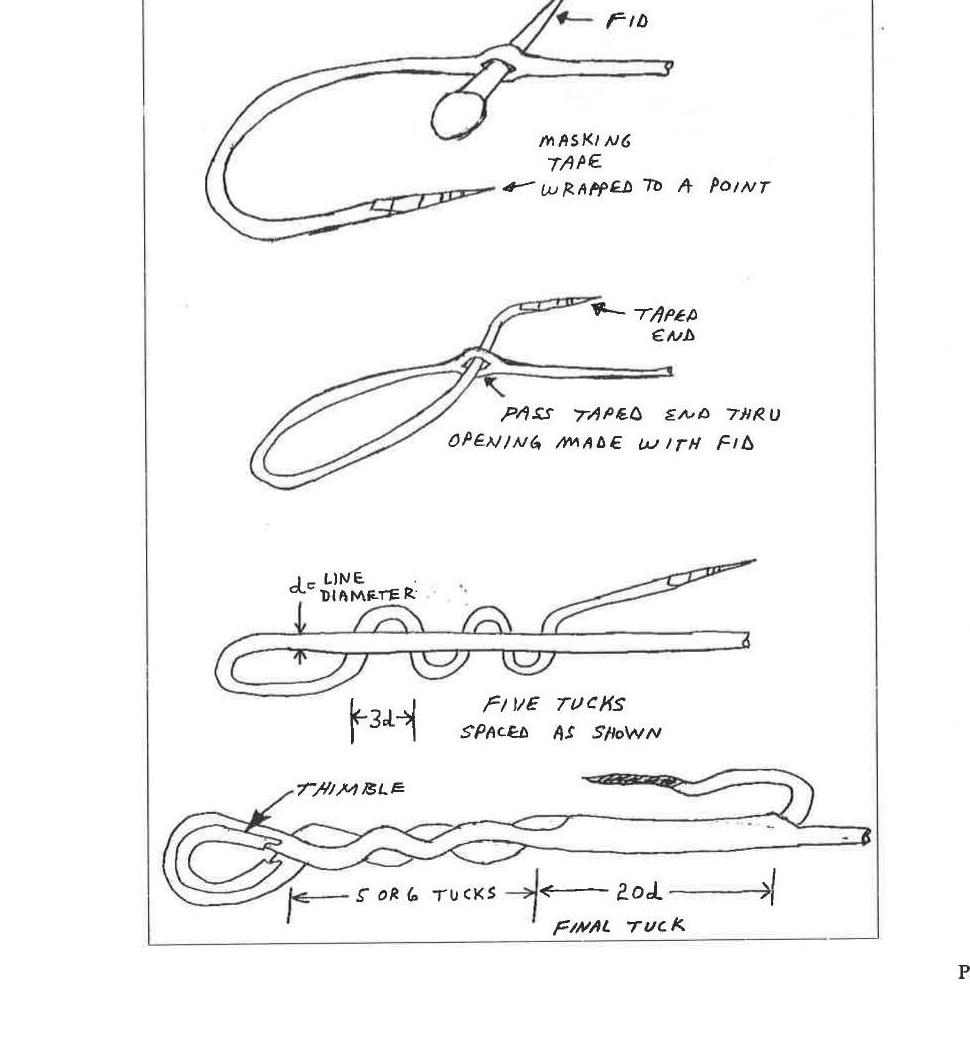
Both HAPCO vang and jib halyard systems are based on cascaded systems using light weight low stretch vectran line for all but the final purchase. Using vectran minimizes losses due to friction, makes the system stiff, and since vectran does not absorb water, results in an absolute minimum sailing weight. Vectran is also the easiest of the low stretch lines to splice. The splicing process is depicted in the accompanying figures. Begin by taping the end of the line to be spliced. I have found that it helps to form the tape into a point. Mark off the line – about 40 line diameters plus that required for the eye, or about 5 inches for 1/8 inch line. Using a marlin spike, make a hole through the line as shown and pass the end of the line through itself. Repeat this step for a total of five or six tucks, spacing each subsequent tuck by about 3 line diameters. Finally lead the remaining line tail up through itself, using the marlin spike to open the line up. Finish the splice by seizing with #2 Marlow waxed nylon whipping twine at the throat near the eye and near the end of the tail as shown, using a needle to stitch the seizing to the line. The splice will be smooth and can run over sheaves, and so does not detract from the system's throw.
Outer Harbour Centreboard Club
Albacore Regatta
July 7, 2001
Registration: Outer Harbour at OHCC
Races: On the lake, weather permitting.
Cost: $50 per boat
Includes: breakfast–coffee, juice, muffins…
* happy hour
* dinner
* prizes (for best cross-dresser)
Lunch: Bring your own. Lunch is on the water.
Extra Dinner: $15
Schedule
9:00 a.m. – Registration
10:00 a.m. – Skippers Meeting
11:00 a.m. – 1st Race
2nd Race to immediately follow first Race
(Lunch time to be determined by the Race Committee)
2:45 p.m. – 3rd Race
4th Race to follow 3rd Race, time permitting.
4:45 p.m. – Cocktails
5:15 p.m. – Dinner
Awards
All times are approximate and weather dependent.
(If 4 races, best 3 to count, if 3 or less races, all to count.)
For more information call David Harris (416)923-8416 ext. 22 or e-mail; [email protected]
HAPCO Vang and Jib Halyard Systems Overview
HAPCO has developed smooth running vang and jib halyard controls for the Albacore; both are the result of trial and error over the past several years of Albacore racing and rebuilding.
JIB HALYARD
Please forgive the “Patent-ease” her, but it's the only way to really convey all the details with no chance of misinterpretation. The jib halyard (1) is a length of 1/8 inch 7x19 stainless wire rope. The top end is fitted with a captive pin shackle (2) and connects to the head of the jib (3). The hauling end is fitted with a 30 inch loop (4) that serves to keep the crimp fitting (5) always in the mast throughout its range in travel. This feature prevents the halyard (1) from hanging up in use and reduces fatigue near the crimp fitting (5), since it is never flexed.
Jib Halyard
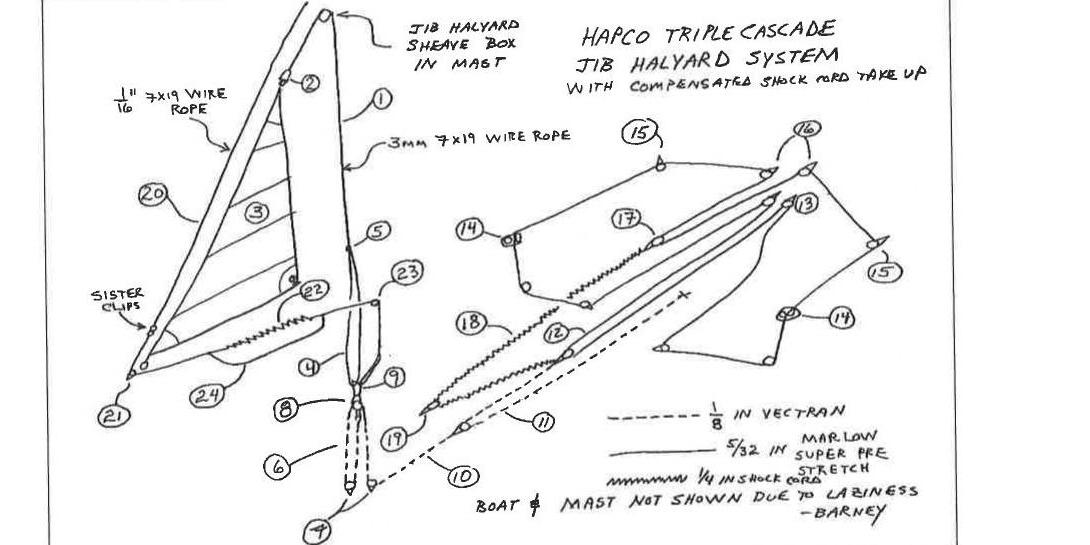
The jib halyard system uses a 3:1 tackle (6) at the mast. Two single hi load sheaves (7) are affixed adjacent to the mast step. A single high load block with becket (8) with a captive pin snap shackle (9) connects to the jib halyard (1) where it exits the mast, just under the deck. The hauling part of the first stage (10) is lead aft along the centerboard trunk and connects to two cascaded 2:1 purchases (11) and (12). The final purchase is lead all the way to the transom (13), then forward to the side consoles where it ends in a cam cleat (14). The line lengths are adjusted such that the entire system remains aft of the centerboard pin when eased and just two blocks in the stern as the 3:1 cascade two blocks at the mast step. This gives a range of motion of about two feet, and enables both short and long luff jibs to be used without altering the boat. It also enables the jib halyard to be released enough to slacken the jib luff while the mast is back to the gate.
The second part of the jib halyard is the compensated take up system. This relies on a continuous loop of line. From the cleat the tail (14) is lead aft and to swivel blocks under the rail (15), and thence to the center of the transom (16). A bight of line where the two sides join is reeved through a bullet block (17) connected to a length of shock cord (18). The shock cord is lead forward, around a block (19) in front of the centerboard trunk and aft to the third cascade stage (12). This serves to compensate the take up – as line is payed out, the shock cord (18) is eased in exact proportion, so the take up always has the same preload. The compensated shock cord take up also serves to pull out the third stage (12) of the jib halyard cascade.
(Continued from page 15)
The forestay (20) is attached to the mast, lead through a turning block (21) at the stem, aft over the fore deck, connected to a short length of shock cord (22), and around a through deck block (23) and down alongside the mast at the partners, and connected to the shackle (9) at the top of the jib halyard first stage (6). This system keeps the forestay (20) tensioned at any jib halyard setting, and provides a constant reference from which one can gauge luff sag while sailing to windward. In addition, the forestay shock cord (22) serves to pull the first and second stages (6) and (11) when the jib halyard is eased. An additional length of line B is run in parallel to the shock cord (22) to keep the mast from falling if the shock cord (22) were to fail - in accordance with rule 12.1.
The combination of forestay and take up shock cords (18) and (22) enable the crew or driver to ease the jib halyard in any conditions - even when the jib luff is slack. The small amount of friction in the cascades (6), (11), and (12) are overcome by shock cord (18) and (22) tension. As a consequence one never needs to stand up and yank on the shroud to drop the mast back when sailing down wind: simply ease the halyard at the control and the mast falls back under its own weight.
HAPCO Triple Cascade Vang System
BOOM VANG
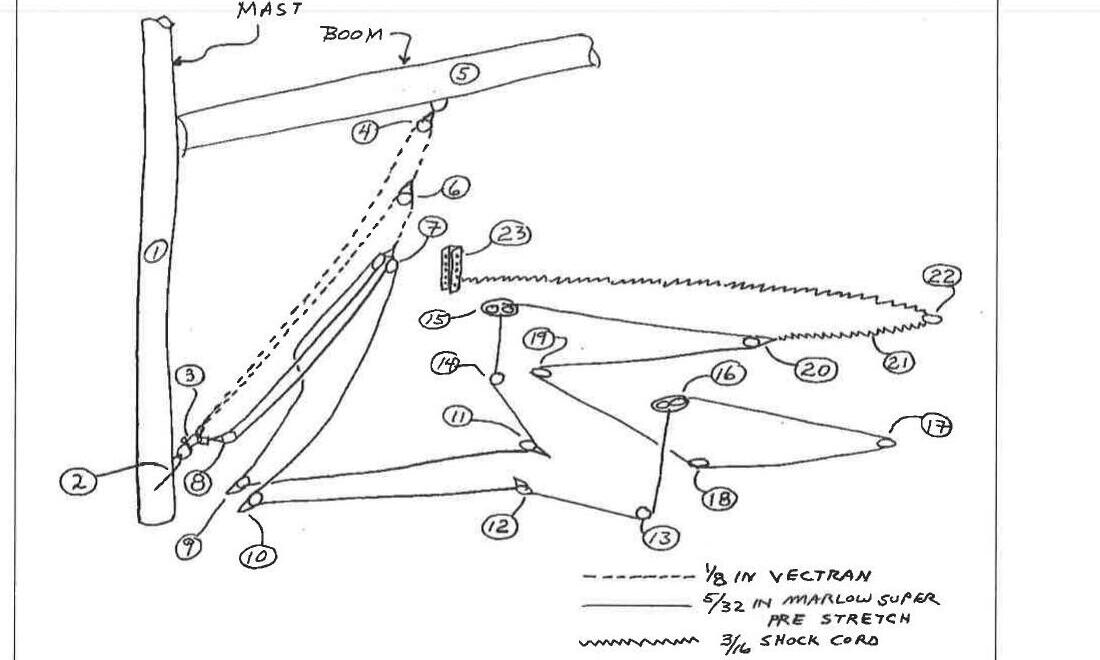
The vang system is also a triple cascade. Stages one and two are 2:1 each and with a 4:1 final stage produces a total purchase of 16:1. The vang tackle is dead ended at the mast (1) base (2) with a snap shackle (3). Stage one leads from the mast base to a Harken HK300 wire rope block (4) permanently mounted to the boom (5). The hauling part of the first stage is lead to a second HK300 (6). The second stage is also dead ended at the mast base (2), lead through the second HK300 (6) to a low load double block (7). 1/8 inch vectran line is used for the first two stages. The third stage passes through the double block (7) to a single block (8) at the mast base (2) and finally to two swivel blocks (9) and (10) mounted just aft of the mast step, where the hauling part is redirected aft along the centerboard trunk. Swivel blocks (11) and (12) under and thru deck blocks (13) and (14) in the thwart lead the hauling part to two cam cleats (15) and (16) on the side deck consoles. 5/32 inch marlow super pre stretch is used for the third stage.
The tail is lead aft from the port cleat (16) to a cheek block 17 affixed under the rail on the port side, then forward to a cheek block (18) on the seat tank, and then across the boat over the centerboard trunk just aft of the thwart to another cheek block (19) which turns it aft on the starboard side to a floating bullet block (20) connected to a shock cord (21), and then to the other console cleat (15). The shock cord (21) is lead aft to a cheek block (22) mounted under the rail, and forward to the chain plate (23). For light air, the shock cord (21) is disconnected from the chain plate (23) to allow the vang to be eased totally slack.
While sailing, the vang is being adjusted nearly constantly in response to wind strength fluctuations. The 16:1 purchase is adequate, but not too much. The shock cord take up cleans up the tail after an adjustment. The vang is easily adjusted by either crew or driver. I will often have my crew sail with the vang in their hand and adjust the vang in real time as the breeze varies.
EFFICIENCY
I have measured the efficiency of several different tackle systems and have found that it is absolutely critical to have a system that uses the absolute minimum number of blocks and no sliding contact or foul leads anywhere. I have found that about ten percent of tension is lost for each time a line passes over a brand new top quality ball bearing sheave. This translates to an efficiency of 5% for each 2:1 purchase. I have also noted that in other boats that it is critical that every block be correctly aligned and to not chafe. I found the efficiency of the above described jib halyard system to be about 50 percent. This means that a tension applied by the crew will result in a jib halyard tension equal to the product of it and the efficiency. So, if the crew pulls the above described 12:1 jib halyard system with a force of 10 pounds, the resulting tensions will be 10lbs(12)(50%) or 60 pounds.
Frequently, people's initial reaction to what seems like a mass of lines and blocks is that the system is “too complicated.” But consider this: racing dinghies is complicated. You must keep the boat balanced and going fast, adjusting to wind and sea conditions every moment all the while the issues of real importance are on the water half a mile away. The last thing you want to deal with is making sure your feet are not tangled in the tail end of the vang control when you must lay that perfect lee bow roll tack on someone. The advantage of these systems become apparent while racing - the ability to simply adjust the vang or jib halyard without having to hunt around for the control, without having to relocate the crew's but, without having to worry about the tail getting fouled in the main or jib sheet block, and never have to think about running out of travel since they are continuous. This enables the helm and crew to keep their eye on what's important - everything outside the boat.
Notice of Race
2001 J-Town Albacore Regatta
Saturday, July 28th
Toronto, Outer Harbour
Entry Fee $65 per boat. Includes breakfast, lunch and a birthday bash dinner and party. Pre-register at the Friday Night Series on July 27th or sign up the day of the regatta between 9-10 am.
For more information contact Mary Romaniuk
416-927-9501 or [email protected]
St. Jamestown Sailing Club
Save Your Centreboard
Last season and the season before I saw several broken Albacore centreboards. Every one that I saw was, without fail, a direct result of a capsize i.e. people standing too far out on the centreboard to achieve sufficient righting moment on recovery. Such mistreatment of centreboards is extremely expensive, embarrassing, and in certain circumstances, downright dangerous. So how can it be avoided?
The fitting of appropriate “safety lines” is the solution. This allows the person on the centreboard to have their feet placed right next to the hull (thus reducing the stress on the centreboard). The necessary righting moment is achieved with the ability to lean back whilst pulling on the safety lines.
Fitting safety lines to an Albacore is extremely easy, and Monarch has had them fitted for years. Here is the recipe for success:
Ingredients
2 x 6 mm x 4m lines (preferably line which does not absorb water)
2 x 5 mm x 20 cm shock cords
2 x cheap nylon jam cleats
4 x small screws (to fit the cleats)
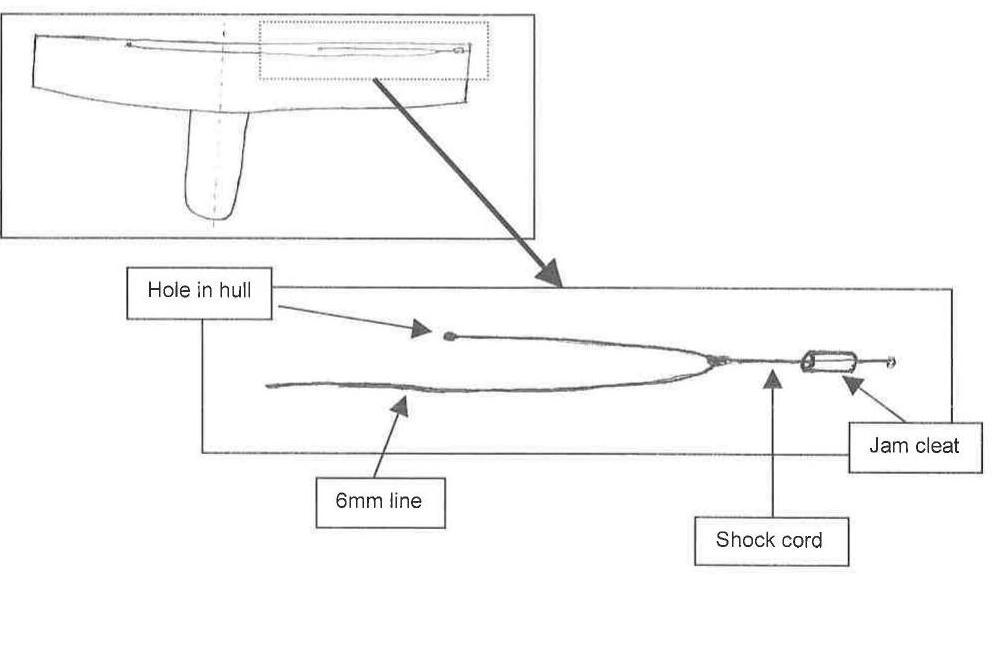
Drill two holes through the hull as tight underneath the decking as it's possible to drill them. Make them roughly four feet apart with the first one being a couple of feet in front of the centreboard when fully down, and the second one being a couple of feet behind it. Monarch's safety line is 6 mm rope, so the hole size must be slightly larger than this. Make absolutely sure that any bare timber created is properly treated with varnish and/or resin.
Pass your 6 mm rope into the boat through the foremost hole and tie a largish knot at the end inside the boat. Measure the rope to the stern along the outside of the boat, and then forwards again to the second hole. Pass the rope through the hole, and again tie a largish knot on the inside of the boat.
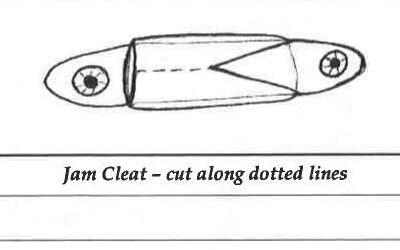
Using a Stanley knife cut the jam cleat between the end of the V and the end of the tube. Screw the jam cleat to the outside of the hull at the stern as close as possible under the deck with the V pointing forwards. Attach a shock cord to your new safety line, and slide the other end into the jam cleat. Now adjust the length of your safety line so that the shock cord is under slight tension in the V.
The safety line should now be held taut along the outside of the hull. When you pull the line, the shock cord should pull through your cut jam cleat releasing the line. When you stretch it back the narrowing of the shock cord should make it fairly easy to replace in the V. It's obviously important to make sure that the line cannot break free easily as you don't want it to drag in the water at any time (even inadvertently). Worse still is the prospect of it catching on something without you realising!
Repeat the process on the other side of the boat.
When you next capsize, you should be able to stand on the centreboard and immediately in front of you will be the (still cleated) safety line. Grab the line and it will easily pull out of the cleat at the stern. You can then hang on to one part of the line with each hand as you lean backwards being careful to have your feet right next to the boat putting very little strain on the centreboard. If you have not made your knots in the ends of the safety line big enough, it is at this point that it will become evident!
You might also find that you're less likely to actually lose your balance and fall off the centreboard. The best of us have done this in the past, and some have been seriously injured in the process.
Once the boat is back upright don't forget that your safety line is now “free”. Although you won't be able to pull it tidily back into the cleat at the stern, If you pull on one of the knots under the side deck you should be able to pull all the loose line into the boat. Tidying up will have to be done once you get ashore.
Norman Halstead
Monarch 6403
PS – Please accept my apologies for the terrible drawings. My art teacher gave up on me at a very early stage when I was at school, and since then my lack of skill has had plenty of time to perfect itself. I hope all is clear!
2001 Canadian Albacore Championship
Sponsored by: ANKARI
Preliminary NOTICE OF RACE
Date: 14-16 September 2001
Location: Nepean Sailing Club, Ottawa Ontario, Canada
Fee: $130.00 on or before 15 August 2001, $150.00 after 15 August 2001.
Registration: 13 September, 1900-2100 hours, 14 September, 0900-1130 hours
Skippers Meeting: 14 September 2001, 1200 hours
First Gun: 14 September 2001, 1300 hours
Number of Races: Intent is 2 on Friday, 7 total, one race constitutes a series
Accommodation:
Camping available on site with 24 hour access to bathroom and showers, Billets available on a first come first serve basis. List of local hotels sent on request. Contact: [email protected]
AGM: 14 September 2001, 1900 hours
Included: Saturday Dinner & Dancing and prizes
Must be a member in good standing of the Canadian Albacore Association or other National Albacore Association.