Summer 2009
July 01, 2009
North Americans at RCYC, mast pre-bend and ram tuning, a tour of the Ontario Yachts factory, and a "Getting to Know" interview with North Americans champion Sarah Bury.
Message from the Commodore
Sailing is in full swing! We started when the snow was still on the ground with a new Racing Rules of Sailing Clinic in March— let us know if you'd like a copy of that power point. Then the CAA hosted an Open House at Ontario Yachts where members saw Albacores in production and spoke to the maker himself, Don Oakie. In June we had a Top of the Fleet workshop— a two day clinic led by Chris Cook— and the fans are raving about their start line learnings!
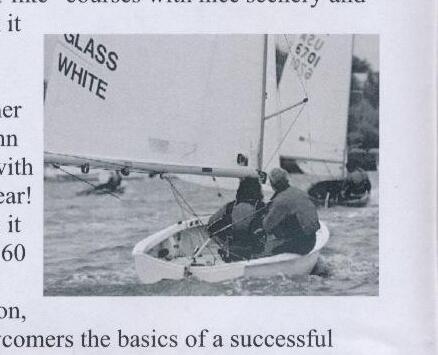
For those who dusted the snow off their boats, both the Mid Winters in Sarasota and the Mid Atlantics in New Jersey were fun and competitive events! Sarasota, where the wind is constant, the temperature warm and the logistics fantastic! And the shrimp, stop me please! What a great way to break up a freezing winter in Toronto! New Jersey featured shifty (very shifty) winds on shorter “harbour like” courses with nice scenery and the B52's who were playing the local theatre— yes Baby Boomers still rock it out when the babysitter is available!
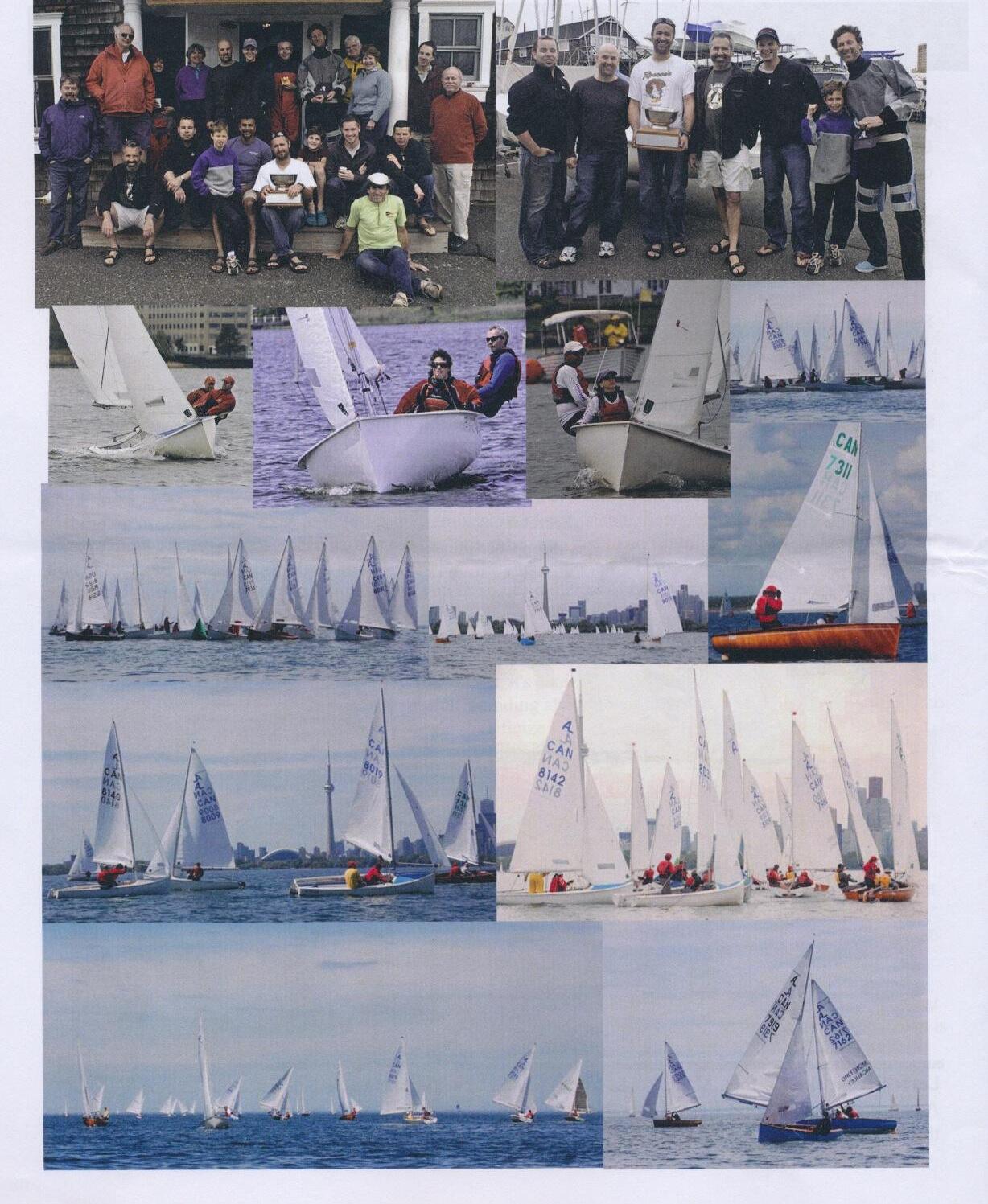
We also had the North American Championships hosted by RCYC - with a very warm thanks to the leadership of Heather MacNaughton (former CAA Commodore) and Chris Cook (Principal Race Officer, Olympian Finn Sailor). 48 Albacores on the line and shifty winds (frustrating for some) with a new sailing team of Sarah Bury and John Hudson taking the prize this year!
It seems that the Class is growing or at least very active. Rumour has it that the Friday Night Series in Toronto boasted a recent record of close to 60 boats on the start line— can you imagine!!
Then there was Racing 101, led by Tim Broughton and Laurie Harrison, Toronto local winners and a very experienced team, who taught some newcomers the basics of a successful racing program. That same weekend featured the Nepean One Design with what another challenging fleet— did some Nova Scotians sail in that one? And let's not forget that on Sunday June 14 several Albacores were packed up ready to hit the high seas en route to Largs, Scotland for the World Championships in July!
The race is on and your CAA is looking forward to more exciting events at some new venues. We are still working on a Junior Event— have honestly encountered a bit of resistance. If we don't pull it off this year, we commit to trying again. In the meantime, we hope to award our Junior Trophies to Junior Sailors at the Canadian Championships slated for September 18, 19 20 in Hamilton— our Annual General Meeting will be held on the Friday night.
August 29/30 we are hosting the Ontario Championships at the Buffalo Canoe Club— a fantastic spot to sail with wonderful amenities. And let's not forget that the Shelburne Nova Scotia Yacht Club is gearing up for another East Coast Championship!
If you'd like to join the fun anywhere in Canada— even if you can't get a boat to where you want to go— contact us and we will be happy to try and arrange a charter, a loaner. Sail with us and join the fun! Sail fast!
Cathyann White, Commodore, Canadian Albacore Association
Changing Upwind Angles
Tell-tails enhance the sensitivity of sailors so that they may make precise adjustments to course and sail trim. The closer the boat and sails are to an optimal orientation the better they will perform. Most people intuitively understand that, however, many people would be surprised at how fast performance degrades as we move away from optimal. That is to say that there is a sharp spike in peak performance when at optimal angles, but things drop off exponentially from there. Certainly everyone who races attempts to achieve optimal course and trim, but it is such a dynamic, multidimensional challenge that even the best sailors only achieve it occasionally. What differentiates great sailors from the good ones is the degree to which they stray. That is why it is so important to stay focused. I once heard a coach admonish his student by saying, “the only time you were steering well was when you were crossing over between pinching too much and reaching too much”.
Tell tails only react to apparent wind. Apparent wind is a fairly simple concept. It is the combination of the true wind and the velocity at which we are traveling. A consequence of this is that the faster we travel the further forward our apparent wind moves. As the apparent wind moves forward the tell tails react by telling us to head down. That leads us to a curious observation. The windier it gets the faster we sail. The faster we sail the farther away from the true wind we need to turn. This would seem to lead us down a spiral of sailing ever faster but never getting to the windward mark any sooner. That might be the case if it weren't for an even more curious phenomenon that impedes us from achieving superlative speeds upwind. We call it “hull speed”. Hull speed is not really a speed limit, rather it is an asymptotic limit. Think of it this way. Boats push the water down at the bow, and it springs back up at the stern. This creates a kind of wave. The longer the waterline the longer the wave. Waves travel through deep water at a “specific velocity relative to their wave length”. To be specific, the speed of a surface wave is proportional to the square root of the wavelength. Or, in more understandable fashion, the longer the waterline the longer the wave produced, the faster a boat might travel. Therefore our waterline length limits our speed upwind. Downwind the Albacore can sometimes break free of this wave and start to plane, but upwind we can not develop enough thrust to plane so we are stuck with “hull speed”.
So what does this have to do with upwind angles? Once a boat achieves a speed close to its hull speed it won't go much faster even if the wind continues to build. The waterline wave simply won't go any faster than its wavelength dictates. The result is that in heavier wind the boat stops dragging the apparent wind forward and the tell tails signal the skipper to sail closer to the true wind. Conversely, when boats are sailing well below their hull speed, such as in light air, they are not impeded by their water line hull speed limit. The boat becomes fast relative to the wind speed. This causes them to drag the apparent wind well forward which causes the tell tails to signal the skipper to head down away from the true wind. In puffy conditions this makes it difficult to distinguish between a puff and a lift, or a header and a lull.
Finally, I think it is important to categorize the race you are about to sail. Will there be enough wind to sail at hull speed, or will you spend most of the time below hull speed? If it will be a hull speed race then all the boats will limit to their hull speed and they will perform at similar speeds. Performances will be consistent across the course. Therefore, the dominant factor will be wind shifts. On the other hand, if boats will be sailing below their hull speed such as in light air there will be diverse performances across the race course. During light air races a slight increase in wind might double your speed! That can't happen in moderate to heavy air. Therefore, in light air the game becomes dominated by wind velocity. Who cares about wind shifts if you have the opportunity to double your boat speed? Good Luck and stay focused on those tell-tails.
Grace Under Pressure
“Grace under pressure and fulfills commitments”, was my first reaction as Don Oakie greeted our “tour group” at Ontario Yachts on May 14, 2009.
My thought of “grace under pressure” was because Don was not put out to see our tour group but welcomed us warmly. It started with the best laid plans; the notice that had been posted on the members' forum of our club, the Toronto Island Sailing Club, read, “Don Oakie of Ontario Yachts has arranged with the CAA to open up his shop for a meet and greet and tour of Ontario Yachts to see boats in production. Date: Saturday, May 16th”. Our club is a community club and it had ordered a new boat from OY for delivery this year.
These plans however, as Robert Burns immortalised it, “gang agley”:
- the tour date is changed to Thursday evening, 6:30ish—are we still interested?;
- on Wednesday we learn that Bob Weir and I are the only ”group” that can make it.
So, Bob and I had a semi-private tour but Don didn't stint on the tour; clearly a man who honours his commitments. Although he didn't say so, Don had obviously scheduled the tour so that we could see Albacores that ranged from being in the midst of manufacture to being ready to be shipped. Don explained that it's more efficient to get out and set up the moulds only once, so he likes to make all the Albacores for the year in one production run.
I didn't take notes so I'm not able to provide you with a recap of the tour and can only provide highlights:
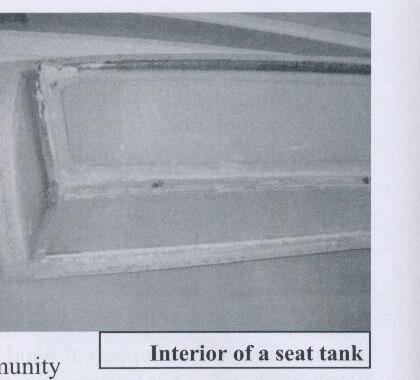
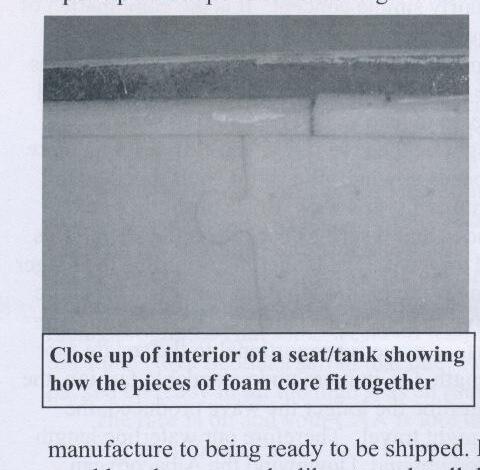
The foam core construction provides so much strength that the boats can now easily approach or achieve that minimal hull weight of 109 kg (240 lbs) without lack of strength or torsional rigidity being an issue. In fact, pieces of core are used for attachment points for such things as the shrouds.
Albacores are not the only boats manufactured at OY nor is the work limited to boat production (it's a full service boatyard with some unique and interesting projects).
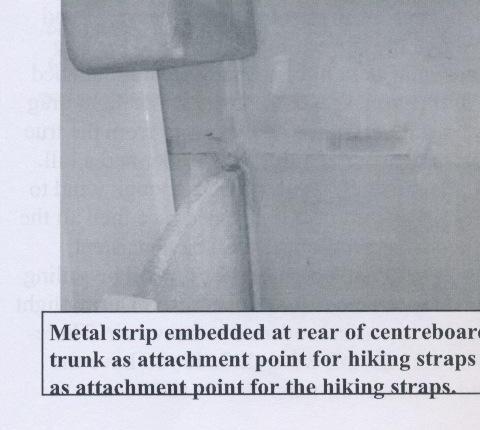
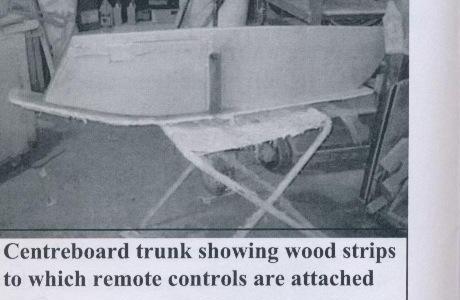
I strongly suggest that the next time that a tour is offered, take it!
North Americans
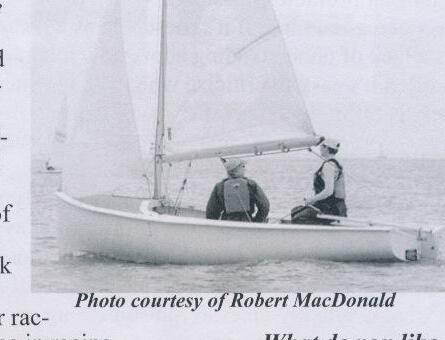
The North American Albacore Championships were held the weekend of the 13th and 14th of June in Toronto at the Royal Canadian Yacht Club.
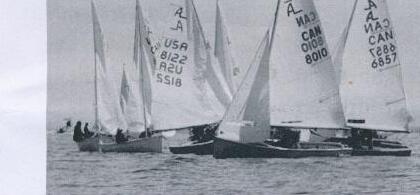
The weekend started early with visitors from out of town arriving as early as Wednesday to practice on the fresh waters of Lake Ontario. Guy Tipton came in with his whole family from Shelburne, Nova Scotia while his crew, Matt King, flew in for a whirlwind weekend. Peter Duncan came up from the Annapolis, Maryland area to sail with his longtime sailing buddy from Muskoka, Dave Niblett. Barney Harris, Marty Hublitz, Lars Rathjen and Lum drove all Thursday night from Washington, DC with a double decker trailer just in time to set up and sail. No sleep for these hardy souls! Chris Gorton flew in from South Carolina while Barney Harris's crew of almost 15 years, David Byron, flew in from San Francisco. Warner Monteiro and wife, Sonja, come down from Ottawa as well as Rory Martin and crew. Warren Hall and his daughter joined us from cottage country and Paul Townsend and crew came all the way from Ann Arbor Michigan.
The regular Albacore Friday night race was held in the Inner Harbour. The wind gods were not with us although 54 boats finished the race. Barney Harris and Dave Byron, the defending North American Champs won the race and took the mugs for the top placing US boat while Warren Hall and daughter scooped the mugs for the top out of town Canadian boat. Since many people had opted to camp on Toronto Island where RCYC is located, and others had their dollies transported by the RCYC barge that was arranged, we had the Friday night mug giving on the verandah of the island club. The night was a perfect temperature of about 74 degrees with no bugs (and no wind). Since our NA's were being held with the RCYC Open, (two hundred and sixty seven boats registered) the club was hopping with all sorts of activity including many members and guests watching the final hockey game in the Crown and Beaver bar. Finally, the Albacore sailors all headed off to the Annex locker building where Dave Provan and crew, Christine Short, hosted a "tailgate" rum party. Many of us went to sleep on either our larger boats or camped on the island so we had no worries.
The next morning we started racing in light and variable winds at 11 am with 50 albacores on the line on a new course called the Trapezoid. This course shape was used in the Olympics last year and made it easier for race committee s to run multiple fleets. The first race, which was the Prince of Wales' Race, was won by Sarah Bury (Canadian Sailing team member) and crew, John Hudson. The second race was won by Robert Bartelewski (Bartski) and crew in his boat Fugly. The third race was won by long time NA Champs Barney Harris and David Byron. No black flag races on Saturday - the racers were behaving themselves.
Top Five Competitors
(full results at www.rcycopen.ca)
- Sarah Bury and John Hudson
- Barney Harris and David Byron
- Allan Measor and Richard Piercey
- Warner Monteiro and Sonya McAuley
- Paul McHugh and Patrick Szeto
Saturday night we had a lovely outdoor BBQ with the rest of the RCYC Open sailors and then another Annex party hosted by the RCYC Albacore fleet. We saw videos of the day's racing around sundown and the dance band started right after. Many sailors enjoyed dancing under the stars while viewing the amazing Toronto skyline at night.
The next day's first race, the Governor General's Race, was won by Barney and David. Unfortunately, due to shifty and dying winds, only one race was held. It was a black flag race after a general recall and three teams got tossed. With only four races held we did not get a throw out that some of us really wanted!
After the award ceremony on the island, the Albacore fleet again hosted a social gathering at the Annex and it was again a beautiful sunny warm day. Special thanks to Chris Cook and his committee for doing an amazing race committee job and the RCYC for providing the Albacore fleet with such warm hospitality. Lastly, thanks to my husband, Dave, for all of his work and support over the weekend.
Manipulation: Pre-Bend and Ram
Well I'm certainly not a ‘tech-head’ when it comes to sailing. So if you are looking for a silver bullet to fast insight you may be disappointed. The words which follow are intended more for those who are new to the class and are trying to grasp the why and how of manipulating your mast to improve performance. I hope I do this cause justice. Mast ram and pre-bend are not the only way to manipulate your mast. Other ingredients include vang, rig tension and spreader set up. This article will focus on the former only.
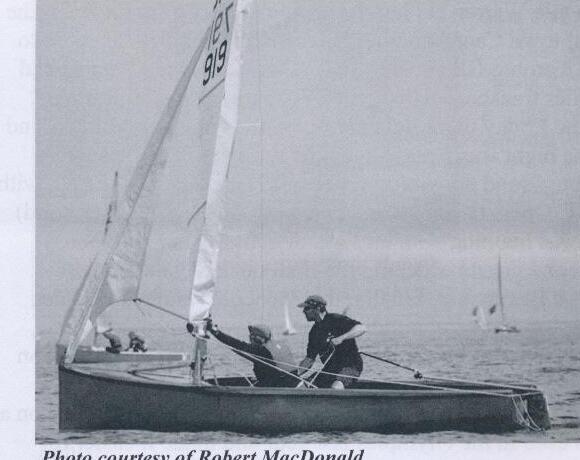
First off what are they? Pre-bend is the technique of bending your mast (think of an archer's bow) such that the tip of the mast deflects aft and the lower third/half is pulled forward. Ram is the technique of pushing the mast back to reduce bend in the mast. I was told by a famous sail maker that it is never good to have the mast dead straight. In other words, some degree of mast bend should always be maintained.
The most basic set up to accomplish pre-bend is a block and tackle system running around the mast at deck level to the hardware attached at the bow where the tack of the jib is attached. A cleat by the mast on the deck would allow you to pull on and release as required. By pulling the control line you pre-bend your mast.
The most basic way to ram your mast (push it aft and prevent it bending in the lower third/half of the mast) is to put blocks or chocks (plastic/wood) in the mast gate between the front of the mast and deck. As the main is sheeted tight and/or vang is applied, the mast is prevented from bending.
The more fancy way to accomplish pre-bend and ram is with a strut. A strut is a piece of aluminum tubing attached one to two feet in front of the mast on the deck and runs on an angle upwards back to the mast. It attaches to a car which slides up and down on a track on the mast. The car is controlled by a line pulling the car up (pre-bending the mast) and another line pulling the car down (ramming the mast back.) The strut is about 2-2.5 ft long. The lines run back to a multi block purchase set up to make it easy to operate.
A third way to accomplish the task of pre-bending and ramming is the use of magic boxes fixed underneath the deck. Best to look around boats in the fleet to get an idea of these set ups. The strut, I believe is the preferred set up. From a pre-bend standpoint it pulls the mast from a point higher up the mast and therefore has a stronger affect. One downside of the strut is it does give the jib sheet and pole something to snag during tacks and pole sets. At least that's what Abby (MacInnes) tells me.
Of course the reason why you want to ram and pre-bend is to control the shape of the sail for different conditions. Pre-bending the mast will pull the cloth of the main sail flat as the mast bends. It also opens up the leech as the tip of the mast bends back and the distance between the mast tip and boom tip is reduced. Thus ramming, the opposite, allows the sail to stay more full and the leech more tight. Spell check just told me that ‘more full’ is not grammatically correct. Obviously they didn't consult sailors.
So when do you want to do which: pre-bend or ram? First off, just to be safe here, the application is only for sailing upwind. The answer can be broken into three categories: 1/ light air when the crew sits inside the boat to leeward; 2/ when the crew is on the windward deck to slightly over powered or over powered just in the gusts; 3/ consistently over powered.
The first category (crew inside the boat to leeward) is when you want to apply pre-bend and flatten the main. The further the crew is to leeward the more you want to apply pre-bend and visa-versa. As the wind builds and the crew moves to windward let the pre-bend go slack.
So why is this good? Flattening the main does two things: 1/ a flatter sail makes it easier to improve airflow around the sail and 2/ opens up the slot between the jib and main which also improves airflow. Note as you apply pre-bend you will have to snug up the rig tension (jib halyard), which naturally will be slackened as the mast bends. Very important to release rig tension once you ease or release pre-bend. Yes, details like this get tricky.
The second category, when the crew is on the deck to slightly over powered, is when you want to apply ram. Ram prevents the mast from bending too much, the main from flattening too much and as a result keeps the sail more powerful. As you move to consistently being over powered (third category) you release the ram and let the mast bend as much as possible to help de-power the sail. Thus, when you are in the third category you are no longer using ram or pre-bend. In those conditions you want to vang very hard to bend the mast to flatten the sail.
Another item to remember about ramming is to ease the rig tension (jib halyard) slightly because when you put ram on, it naturally tightens rig tension as you push the mast back. Conversely when you ease the ram, then rig tension needs to come back on.
Those are the general principles of ram and pre-bend. Once you get the hardware installed you need to make a numbered grid system on the hardware so you can determine optimal settings. It's a trial and error process to get it dialed in to the sweet spot. Each boat is slightly different and will have its' own sweet spot.
Pre-bend is not used when sailing on reaches and runs. Ram can be used to set the mast position for reaches and runs. My understanding is that for reaches you want the mast to be vertical as possible, whereby vertical is thought to be the most powerful position for the rig. Because in North America we can't adjust rake (shrouds) during the race you become a bit limited to getting the mast vertical with the ram especially if the breeze is up and you have increased rake. For runs the ram system is employed to efficiently push the mast to the back of the gate. This is done by easing the rig tension (jib halyard.) The mast is pushed to the back of the gate on runs so you can get the boom out further.
The downside of these controls is they become distracting particularly for the skipper. It's critical that the skipper has their head out of the boat in the heat of the action. Missing one wind shift quickly gives away the perks of fine tuning these controls. Like anything else, the key is practice. Good luck!
On the Water
The sailing season is well underway and so is CAA Training. I am happy to report that we have at least one more training initiative underway: a mentoring workshop scheduled for August 9th – lead by our very own Allan Measor. This workshop will provide an opportunity for “newer” sailors to be matched with a more experienced helm (if you are a crew) or crew (if you are a helm) so that you can spend the day focusing on your specific skill set during training drills while gaining some valuable insight from your mentor. Stay tuned and more information will be sent out when it is available.
This season we have completed two fantastic training workshops! Of course the CAA could not complete these workshops without the commitment of volunteers and community club support. Thank you to Outer Harbour Centerboard Club and Mooredale Sailing Club for hosting our two initial events as well as volunteer support boat drivers (Steve Robertson, Cathyann White) and those that helped organize and keep the fleet updated (Christine Short). And of course a THANK YOU to our workshop leaders and participants! The CAA is proud to promote these events on behalf of our members. I have included a summary below of each workshop. I hope we can continue with these great training opportunities - and if you have an idea for a workshop—let us know!
Top of the Fleet: June 7-8
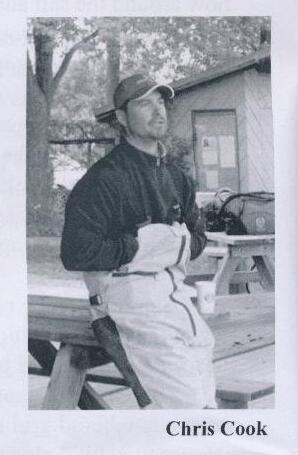
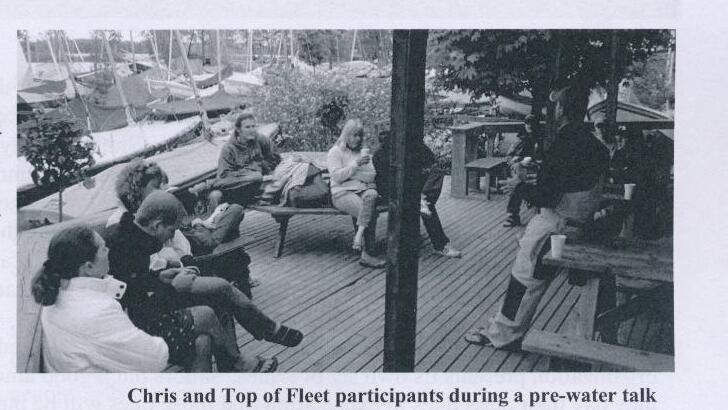
Ten of Canada's albacore top fleet spent the weekend with Olympian Chris Cook running drills and focusing on “speed”- upwind and down. The weather cooperated with some sun and some pretty good wind. The workshop was broken down into 3 different sessions and by the end…exhaustion was setting in. The Argentinean (or rabbit) drill was impressive to watch from the coach boat and more impressive when I was participating as a crew on the second day— a great opportunity to focus and work on sailing upwind fast (which for me meant moving faster than I am used to!). And perhaps the training week end was helpful, as two of the top three boats at the North American Championships the next weekend were workshop participants, with Sarah Bury and John Hudson taking home the Championship trophy.
Workshop participant Mary Neuman: "The Chris Cook training was great for me (and crew Chris Molder)… with intense boat on boat drills and ten boats that were almost always with a couple of boat lengths of one another gave us lots of time to greatly improve our boat handling skills. We also took away from the training areas that we needed to work on by ourselves. I still can't spin up on the line and bear off again without going forward but I have some sense of what I am trying to achieve. With Tim Broughton winning the aggressive start prize at the end of the weekend (really he did) I am not sure that I should worry about going forward (at the start)- faster might be better."
Racing 101: June 20-21
We fought some blustery weather Saturday morning but it was great to see workshop participants eager to hit the ~15 knot winds as an opportunity to practice boat handling. Sunday the workshop included participation in the Harbour Master race, with the “coaches” Tim Broughton and Laurie Harrison looking on and providing feedback. Once again, something must have gone right as workshop participant Almir Tavares won his first mug as a helm!
Workshop participant Jason McVeigh: “If you are new to sailing and moreover racing in the Albacore fleet there is one thing you will find quite astonishing- the openness of members of the fleet and individuals' willingness to share their 'trade secrets' of winning. I am now in my third year of racing and second year of helming. I have slowly progressed from the bottom to the mid-bottom (of race results)! But this was all made possible by some of the best members of the fleet providing me their time. Another huge factor in great training is the Racing 101 clinics sponsored by the Canadian Albacore Association.”
Getting to know Sarah Bury
What are your goals for the upcoming season? My goal is to continue having fun in the Albacore fleet and to learn more about how to sail the Albacore fast! I hope to sail a bunch of weekend events and the Canadians in Hamilton in September. I will continue to sail in a match racing program that I did last summer in Sonars and will sail some match race events.
What changes would you like to see in the Albacore (if any)? I think it is really good that the Albacore fleet (in bigger events), offers two different fleets to encourage the participation of newer racers, but unfortunately I don't think many people take advantage of it and so more often than not there are not two starts. I think two fleets is a good way to bring along the skills of newer racers and to give them confidence in racing.
Congrats in winning the 2009 North Americans recently held in Toronto. Although the conditions were challenging, what attributed to your success? My very patient teammate, John. In those types of conditions you really just have to stick with it and sail your own race and he was constantly reminding me of that, and keeping a cool head for the both of us!
Who was your biggest early influence in sailing? A family friend, David Millar, introduced me (and my family) to sailing with his keelboat and then by subsequently sponsoring my brother and I to take sailing lessons at RCYC. He has been a huge supporter of all my sailing endeavours. (And of course Dave Provan, who was my race coach when I was 16. He taught me everything I now know!)
What other classes have you sailed? I learned to sail when I was 6 or 7 in Optimists and have sailed in a bunch of different classes. Any sailing you do will help you to gain more experience and help you succeed.
Why did you decide to sail Albacores? I wanted to try something new and sailing a dinghy that had lots of good competition.
What do you like about the Albacore Class? I really like the sense of community that the Albacore fleet has; everyone is really friendly.
You have sailed successfully with several different crew, at your best as a competitor, what are your strengths? I think my experience sailing is one of my biggest strengths. I have been sailing for 20 years, so have seen a lot of situations, wind conditions, competitors etc and all of those help me in my sailing.
Yes, they can— and someday you should too
Anyone who has ever worked in a restaurant knows that the kitchen is organized chaos - it's hot, there's blood, screaming, cursing, serious time constraints, constant complaints, and the saying "you can't please everyone all the time" doesn't just ring true - it clangs. Similarly, anyone who is serious about sailing knows (or should know) that running a class is pretty much the same as running a professional kitchen - but with more blood and no hazard pay - actually, no pay whatsoever. While most consider sailboat racing a fun hobby, there is an “unfun” but necessary component of it, which is ensuring the growth and continuation of the fleet by overseeing several things, such as advertising, the support of local builders, updating of rules, etc. History has shown that a class can live or die by the choices made (or not made) by the executives that govern it.
Being on any volunteer committee is not an easy task, and being on a volunteer committee for a sailing organization presents its own set of issues. Sailors put a good amount of time and money into their hobby, and they pay their class dues in expectation that those dues will be put towards the promotion and growth of the fleet and the running of good regattas. But like any other organization, the membership won't always agree that what is being done is the right thing to do. Conflicts can, and regularly do, arise about what is "best" for the fleet - whether the fleet is large or small. Having served on the Canadian Albacore Association (which has a large fleet) and now working for the North American Contender Association (which has a small fleet), I've come to understand some of the challenges (and having not served very long in either position, I'm sure they're just the tip of the iceberg). Just to note a few examples: in a large, stable, fleet, there are a lot of people to answer to, many of whom have been sailing for the long time (and just to add another fun twist, a large proportion of the Canadian Albacore fleet comes from the Toronto community clubs with their own execs, agendas, ideas, and rules for boat use). In a small fleet, you face the challenge of how to attract new racers and keep things going with virtually no money. In either case, there are always detractors.
But criticism can be a good thing. It promotes questions, which promotes thinking, which can promote change for the better. But criticism is not a good thing if it's presented as a personal attack or phrased indelicately. It's also a bad thing if there is a lack of understanding about how much and what kind of work goes into the administration of a fleet. All too often it's easy to criticize when you are standing in the forest and all you can see is your own tree. And the view is different when you're looking from the top down.
The fact of the matter is, people don't volunteer for committees unless they want to do some good (because they aren't doing it for the money), and a sailing committee is no different. The people who volunteer for a sailing organization volunteer because they are passionate sailors who have a vision, and they want to grow their fleet and ensure a high level of competition. In order to achieve those broad goals, there are long meetings, conflicts (which can become very heated), balancing the concerns of many, and having to piss off a few, but the insight it gives you into what it actually takes to run something as apparently simple as a race clinic or produce a newsletter is invaluable. It is also an amazing opportunity to watch a group of people be so generous with their time and effort to further a sport.
Anyone who is serious about sailing owes it to his or her fleet to put some time into the trenches. Or at the least, to appreciate that there's a lot of work going on behind the scenes to ensure that your sailing season is fun. In other words, that beer and the race committee don't appear out of thin air, so the next time you see a member of your executive, you might want to say "thanks". And, screw Flanders.
2009 Canadian Albacore Association Executive
Commodore
Cathyann White
[email protected]
Past Commodore
Teresa Miolla
[email protected]
First Vice Commodore
Allan Measor
[email protected]
Second Vice Commodore & Website
Henry Pedro
[email protected]
Third Vice Commodore & Training Officer
Michelle Arnot
[email protected]
Rear Commodore
Kevin Soldaat
[email protected]
Specifications Chair
Dave Weaver
[email protected]
Chief Measurer
George Roth
[email protected]
Editor– Shackles & Cringles
Jelena Balic
[email protected]
Secretary
Alison Goodwin
[email protected]
Membership
Christine Short
[email protected]
Treasurer
Mary Free
[email protected]
IAA Treasurer
Raines Koby
IAA Representative
Teresa Miolla
Canadian Albacore Association
www.albacore.ca
111 Sunnyside Ave., Toronto, ON M6R 2P1
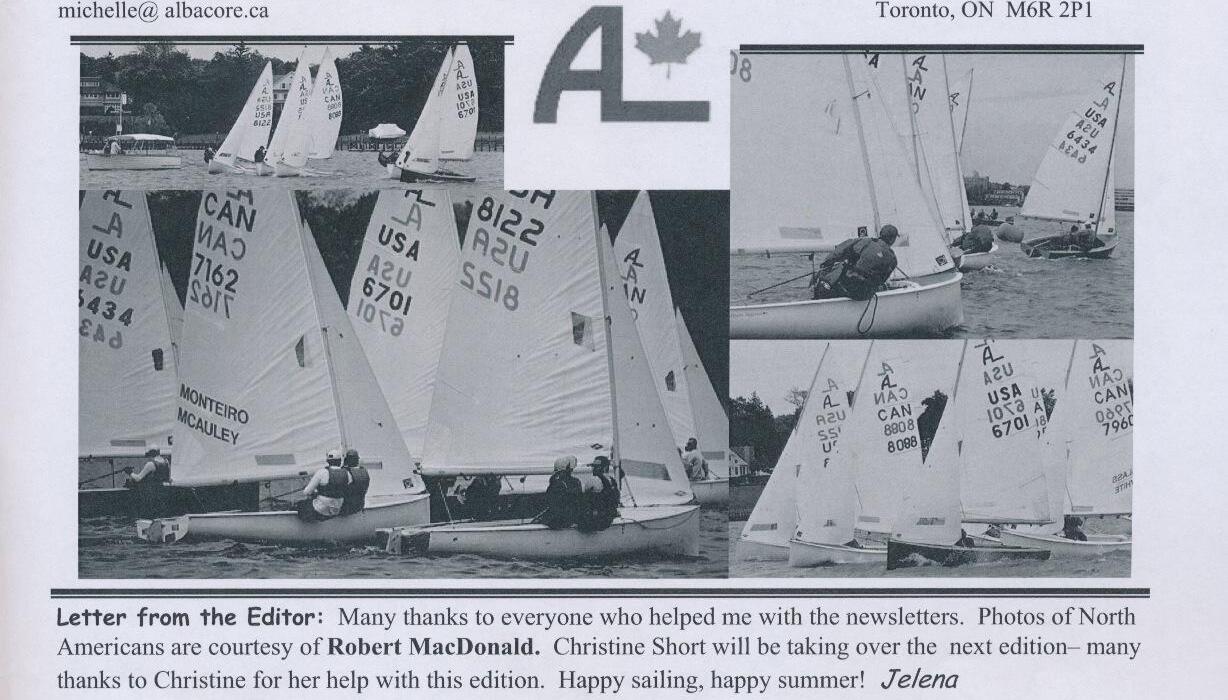
Letter from the Editor: Many thanks to everyone who helped me with the newsletters. Photos of North Americans are courtesy of Robert MacDonald. Christine Short will be taking over the next edition– many thanks to Christine for her help with this edition. Happy sailing, happy summer! Jelena
Mid-Atlantics and North Americans