Winter 2001 (Volume 41, Number 1)
December 01, 2001
Winter 2001 issue of the Canadian Albacore Association's newsletter: Barney Harris on capsize recovery technique, the CAA's 40th-anniversary Youth Championships pull-out section, Barney Harris's afternoon sail with UK champion Michael McNamara, and Henry Pedro's detailed CAN-8050 winter re-rigging project (continuous jib halyard, vang, cunningham and barber-hauler cascades).
Shackles and Cringles — Winter 2001
Volume 41; Number 1
Canadian Albacore Association
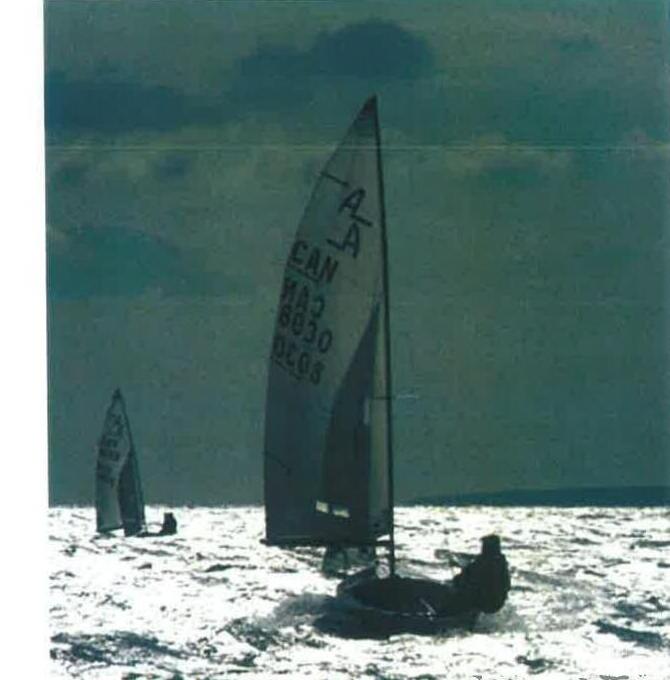
Kevin Smith and Karen Piatkowski take on the challenge of Georgian Bay at the 2000 Canadian Albacore Championships held in Meaford, ON. Photo provided by K. Piatkowski.
Inside this issue:
- Commodore's Comments — p.3
- Albacore Racing Schedule — p.4
- Capsize Recovery – It's Not in Your DNA by Barney Harris — p.5
- Notice of Race - TARTS 2001 — p.8
- Special Pull Out Section - Youth Albacore Championships 2001 by Rosemary Helmer — p.9
- An Afternoon Sail with Michael McNamara by Barney Harris — p.13
- LSSA Advance Notice — p.13
- CAN 8050 - A Winter Project by Henry Pedro — p.14
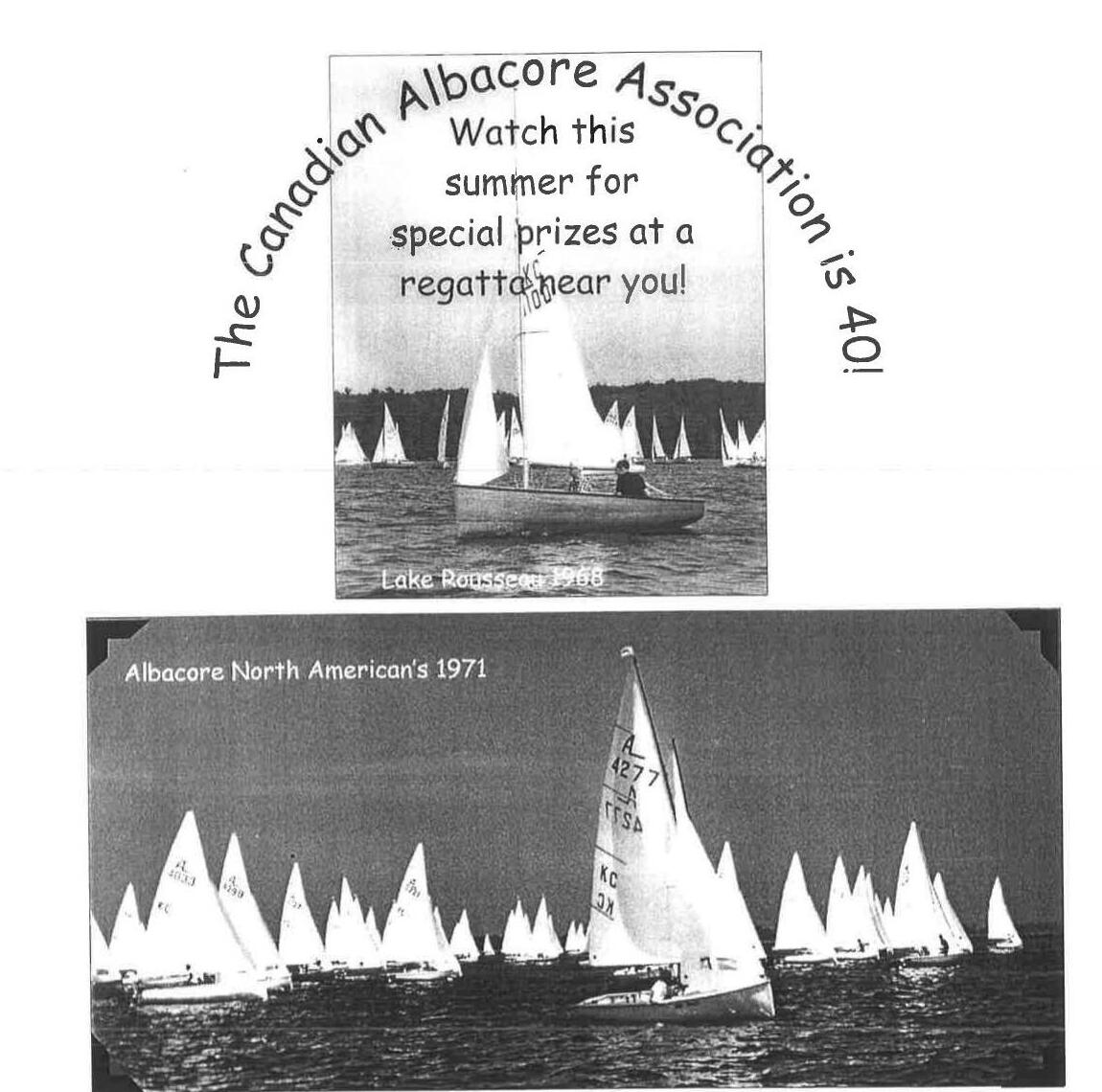
- Happy 40th Birthday to the CAA — p.20
The Albacore Advantage
Canadian Albacore Association
Box 81022, 47A Harbour Square, Toronto, ON M5J 2V3
www.albacore.ca
A One-design Boat
- no unnecessary expense of constant upgrades in design
A Safe Boat
- large air-filled tanks give excellent buoyancy
- hull shape gives stability on the water
- self-rescue after an unexpected puff is easy
A Light and Manageable Boat
- tongue load of less than 100 lbs gives ready trailerability
- launching and retrieving are a breeze
A Comfortable Boat
- large, open cockpit
- benches on port and starboard sides
A Performance Boat
- seriously campaigned by major sailmakers
- planes in moderate winds
- buoyant heavy-air hull shape
Ideal for Junior Clubs
- 4 to 5 juniors will fit easily
- will stand up to heavy use
A Vibrant Class Association
- well organized and vital
- recognized by the International Sailing Federation
- strong fleets through Ontario, Canada, US, Great Britain, Ireland and Bermuda
- top notch competitive sailing
- junior programs in some areas
2000/2001 Canadian Albacore Association Executive
| Position | Name | Address | Phone | |
|---|---|---|---|---|
| Commodore | Heather Macnaughton | 99 Harbour Square, Apt 1812, Toronto, ON M5J 2H2 | H (416) 367-9898 W (416) 868-8205 F (416) 868-3817 | [email protected] |
| Past Commodore | Gord Chu | 310 Durie Street, Toronto, ON M6S 3G3 | H (416) 760-8778 W (416) 733-6851 F (416) 733-6777 | [email protected] |
| First Vice Commodore, Racing | Neil Wilson | 77 Harbour Square, Apt 1710, Toronto, ON M5J 2S2 | H (416) 203-8395 W (905) 712-1084 Ext 3605 | [email protected] |
| Second Vice Commodore, Marketing | Henry Pedro | 2210 – 736 Bay Street, Toronto, ON M5G 2M4 | H (416) 593-4438 W (905) 458-2849 F (905) 458-2870 | [email protected] |
| Third Vice Commodore | Kevin Smith | 46 Panorama Court, Apt 703, Etobicoke, ON M9V 4A4 | H (416) 743-6818 W (416) 249-3361 | [email protected] |
| Chief Measurer | George Wm. Roth | 212 Willowdale Avenue, Waterloo, ON N2J 3M1 | H (519) 746-1300 F (519) 746-1162 | [email protected] |
| Treasurer | Jason G. Roth | 60 Cheviot Crescent, Brampton, ON L6Z 4G7 | H (905) 840-5395 W (905) 362-4435 F (416) 441-9921 | [email protected] |
| Specifications Chair | David Weaver | 14 Lansdowne Road North, Cambridge, ON N1S 2S8 | H (519) 623-4402 W (905) 525-9140 ext 24907 F (905) 572-7944 | [email protected] |
| Secretary | Teresa Miolla | 326 Riverside Drive, Toronto, ON M6S 4B2 | H (416) 769-0990 W (416) 236-1871 F (416) 769-0660 | [email protected] |
| Editor, Shackles & Cringles | Nona Arneson | 95 Lawton Boulevard, Apt 608, Toronto, ON M4V 1Z8 | H (416) 485-3572 W (416) 946-4501 Ext 5708 | [email protected] |
| Membership | Ann Savege | 35 Church Street, Apt 302, Toronto, ON M5E 1T3 | H (416) 361-1808 W (416) 922-5322 | [email protected] |
| Rear Commodore | Van Sheppard | 215 Parkdale Avenue, Apt 509, Ottawa, ON K1Y 4T8 | H (613) 729-8939 W (613) 599-7603 Ext 382 | [email protected] |
| IAA Representatives | Neil Gunn, Ken Clarke | |||
| IAA Chief of Specifications | David Weaver |
Shackles and Cringles is a quarterly publication of the Canadian Albacore Association. Deadlines for publication are February 15, April 15, July 15 and November 15.
Commodore's Corner
By Heather Macnaughton
Hello CAA Members and Friends: I hope you are all having a great winter. Thanks to everyone who helped out with the Toronto boat show. We needed a large number of people to spread the work around and everyone did a great job pitching in. Henry Pedro, our 2nd Vice Commodore did a great job organizing the show. All of the club volunteers were very much appreciated for all your hard work at the booth. Once again the booth was a success and without everyone's help this would not have been possible. Special thanks to all of those who helped with set up or take down.
Some of us will be back in an Albacore within the next month. The Mid-Winters will be held in Sarasota, Florida, March 15 to 18 and a great turnout is expected this year, possibly the largest in 15 years. More boats than ever will be in attendance from the Washington area and at least one (Henry) will be travelling with a boat from Canada. I will be travelling from Toronto by air to crew for Chris Gorton and am looking forward to learning a lot from Chris again this year.
Neil Wilson, First Vice Commodore, has been busy finalizing the race schedule for the year and we have a very busy and fun summer ahead of us. The North Americans will be held at RCYC during their usual LORC weekend, June 9th and 10th. This should prove to be a great event, with racing out on the lake during the day and great partying in the evening. Hope to see lots of competitors from both sides of the border out for this event. We will be arranging billets as usual for those competitors from out of town.
Van Sheppard, our Rear Commodore, from Nepean Sailing Club is organizing the Canadians in Ottawa for the weekend of the 14 to 16 of September. This should be a lot of fun and a chance for many of us to visit our National Capital which we may not do that often. The Americans may find it interesting to see our beautiful parliament buildings!
In addition to hosting these two major regattas this year, Canada, with Kevin Smith organizing, will once again be hosting a weekend of Race Training, probably mid-June. Keep tuned to Shackles and the Web site for further news.
Ann Savege, Membership Chairperson will be mailing your membership applications very shortly in a separate mailing (if not already). Please fill out your application and send back as quickly as possible so as not to interrupt your Shackles & Cringles mailings and so you can participate in all the fun CAA sponsored events.
Look forward to seeing some of you at the Mid Winters in Florida next month!
Heather
Hans Gottschling
The Dinghy Boatcover Specialist
Tel. 905 277-3306
Fax 905 277-9021
Web site: Gottschlingboatcovers.com
2001 Albacore Racing Schedule
| Date | Long Weekend | FNR | HM | Regatta | Host | Location |
|---|---|---|---|---|---|---|
| Fri May 4 | FNR-1 | O | OH | |||
| Fri May 11 | FNR-2 | J | OH | |||
| Fri May 18 | Victoria Day | FNR-3 | M | OH | ||
| Fri May 25 | FNR-4 | T | IH | |||
| Sun May 27 | HM-1 | R | IH | |||
| Fri June 1 | FNR-5 | W | OH | |||
| Sat June 2-3 | Tarts & Balls | TS | Lake | |||
| Fri June 8 | FNR-6 | T | IH | |||
| Sat June 9 | N Americans | R | Lake | |||
| Sun June 10 | N Americans | R | Lake | |||
| Fri June 15 | FNR-7 | J | OH | |||
| Sun June 17 | HM-2 | T | IH | |||
| Fri June 22 | FNR-8 | M | OH | |||
| Fri June 29 | Canada Day | FNR-9 | O | OH | ||
| Sat Jun 30 – Jul 1 | Canada Day | LSSA/Youths | R | Lake | ||
| Fri July 6 | FNR-10 | W | OH | |||
| Sat July 7 | OHCC Open | O | Lake | |||
| Sun July 8 | HM-3 | W | OH | |||
| Fri July 13 | FNR-11 | M | OH | |||
| Sat July 14 | Ladies Helm | J | OH | |||
| Fri July 20 | FNR-12 | W | OH | |||
| Sat July 21 | Westwood Open | W | OH | |||
| Sun July 22 | HM-4 | O | OH | |||
| Fri July 27 | FNR-13 | J | OH | |||
| Sat July 28 | St. Jamestown Open | J | OH | |||
| Sun July 29 | HM-5 | J | OH | |||
| Fri Aug 3 | Simcoe Day | FNR-14 | W | OH | ||
| Aug 4-10 | Internationals | Torbay UK | ||||
| Fri Aug 10 | FNR-15 | M | OH | |||
| Sat Aug 11 | Mooredale Open | M | OH | |||
| Sun Aug 12 | HM-6 | M | OH | |||
| Fri Aug 17 | FNR-16 * | J | OH | |||
| Sat Aug 18 | New Skippers | W | OH | |||
| Sat Aug 18 | PABAR | PA | Point au Baril | |||
| Fri Aug 24 | FNR-17 * | T | IH | |||
| Sat Aug 25 | Toronto Island Open | T | IH | |||
| Sun Aug 26 | HM-7 | T | IH | |||
| Fri Aug 31 | Labour Day | FNR-18 * | W | OH | ||
| Sat Sep 1-2 | Labour Day | Royals | R | IH | ||
| Fri Sep 7 | FNR-19* | M | OH | |||
| Sun Sep 8 | HM-8 | J | OH | |||
| Fri Sep 14 | Canadians | N | Ottawa | |||
| Sat Sep 15 | Canadians | N | Ottawa | |||
| Sun Sep 16 | Canadians | N | Ottawa | |||
| Sat Oct 6-Oct 8 | Thanksgiving | US Nationals | MB | Monmouth NJ |
* FNR starts at 6:45 pm effective Friday August 17th.
Every effort has been made to ensure the correctness of this schedule. Please check the official Notice of Race for each event for final details and any changes.
Key
HM Harbour Master Racing Series, Toronto
FNR Friday Night Racing Series, Toronto
Host Clubs
M Mooredale Sailing Club
J St. Jamestown Sailing Club
W Westwood Sailing Club
T Toronto Island Sailing Club
O Outer Harbour Centreboard Club
R Royal Canadian Yacht Club
N Nepean Sailing Club
TS Toronto Sailing & Canoe Club
PA Point Au Baril Sailing Club
MB Monmouth Club
Toronto Area Locations
OH Outer Harbour, Toronto
IH Inner Harbour, Toronto
Lake South of Toronto Island
Capsize Recovery – Its Not In Your DNA
By Barney Harris
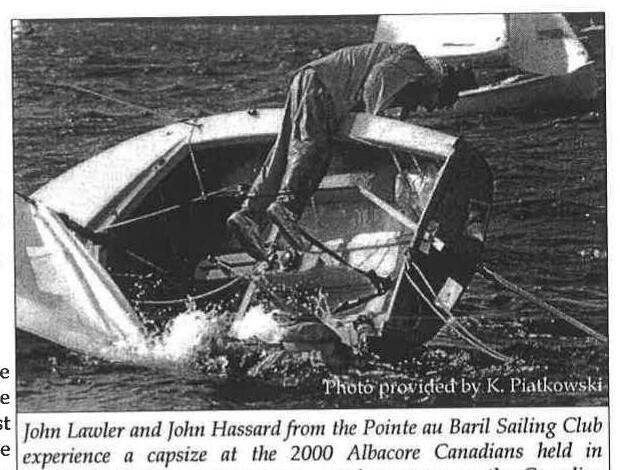
Recovering from a capsize is not a skill we are all born with – it is acquired like everything else associated with racing small dinghies. All one needs to improve is to learn some basic techniques along with a basic understanding of the underlying physics of a capsized boat.
Get to the Board
During a capsize, try to make it to the centerboard – that is to step one leg over the rail and onto the board before the mast contacts the water. Take a step onto the board to prevent the mast from going under the water. If you are not able to make it to the board, then by all means, resist the natural tendency, to climb to the high side (usually greater in water below 50 degrees F) as this will only drive the rig underwater and make righting the boat difficult. Instead, fall into the water and swim around or under the boat to the centerboard as fast as possible.
Ensure People are Safe
First, count your crew; unless your name is Jasper, there should be one in addition to yourself. After ascertaining that your crew is ok, getting one crew onto the centerboard as quickly as possible and preventing the rig from totally submerging is the most important thing you can do. Check that the board is down, put it down if it is not. One person climbs onto the centerboard. Ensure that the main sheet is uncleated and find the bailer. About 1 1/2 persons are required to right an Albacore – this means that one person needs to be on the board and completely out of the water and one person can be hanging on the board and partially immersed.
No Need to Hold the Boat Into the Wind
I have observed some persons who seem intent on swimming the boat's bow into the wind before righting. This is a waste of time and increases the likelihood that, if in shallow water, the mast will become stuck in the mud and, if in deep water, the boat will end up turtled. Furthermore, a boat pointed into the wind will be in irons after righting, and will heel towards the side on which crew climbs, placing the luffing rig outboard of the hull, and causing the boat to yaw or weathervane towards and recapsize onto the crew, adding insult to injury!
Leeward Capsize
Now, if the capsize was to leeward, simply right the boat by applying righting moment on the centerboard. Moment is the product of force times a distance – this could mean more weight near the hull or less weight further away from the hull. Be careful to not overstress your centerboard by standing too far from the hull; they can break; avoid walking on the trailing edge. When the mast starts to clear the water, simply swing your aft leg over the rail and walk over the boats as it rights. It is best if one member of the crew remains in the sea to minimize the amount of water in the boat after righting.
Windward Capsize Techniques
Righting is more difficult when the hull is to leeward of the rig, as often happens following a death roll, dropped tiller, or auto tack windshift event. since the main will fill as soon as it is raised from the water - and recapsize the boat. There are four techniques I know of to deal with this situation: weathervane, scoop, ride em down, and dive.
Weather Vane
The easiest is to simply raise the mast a couple feet out of the water allowing the exposed portion of the main to fill. This will weathervane the boat around until the mast is pointed roughly to leeward at which time the boat can be righted. It takes a bit of concentration to raise the main high enough out of the water to turn the boat, but not so high that it rights and recapsizes.
Scoop
Have one crew member swim to the windward (submerged) side of the boat and float into the cockpit. The other crew member then climbs onto the centerboard and rights the boat – as the sail fills the boat will be stood upright rapidly – the crew member on the centerboard will be lowered into the sea – and the crew member in the cockpit will be scooped up. Their weight will prevent a second capsize in all but the most extreme conditions. The scooped crew can hike a bit on what will be the windward side as the boat right, which will reduce the probability of a subsequent capsize to leeward.
Windward Capsize – Ride em Down
A third technique is to ride the centerboard down and around. As the boat is stood upright by the breeze, drop and hug the board – and take a deep breath. You will be pulled under water as the boat is stood upright by the wind. While under water, crawl around to the opposite side of the board; do not let go! With no one in the hull to resist, the boat will recapsize quite rapidly – and when it does, you will already be on top of the centerboard and ready to right the boat using the procedure described for rig to leeward of the hull.
Windward Capsize – Dive!
The fourth technique is to dive for the new windward side. Slowly right the boat; when the mast tip just begins to clear the water surface, the breeze will fill the main, tending to stand the rig up. Continue using less and less moment as the main fills. When the sail fills to the point that the boat begins to right itself, step over the rail and move quickly to the submerged side just as the breeze stands the boat upright. One must use caution to duck under the boom, which will be swinging wildly. Assuming that you have not lost your teeth or have been clothes-lined by the vang, hike out a bit on the new windward side to keep the boat from recapsizing. Uncleat the vang and main and jib sheets as you cross the boat for full credit. When done correctly, this is the fastest means of getting going following a windward capsize – but it is the most daunting.
Mast in the Mud
Wind and wave action will tend to drive the mast of an Albacore, capsized to leeward in shallow water, into the bottom. Wind, wave, and current forces on the hull will quickly force the mast deep into the bottom, then bend/break it like a toothpick in a block of cheese, ruining your day in the process. Worse yet, if the mast fails below the jib halyard, the rig will no longer be sprung into the hull by shroud tension, the mast may come unstepped and punch holes through the hull, which could ruin your week. You must be quick to prevent or minimize damage.
If your mast is really stuck in the mud you may not be able to self rescue and will have to rely on outside assistance. An inexperienced crash boat crew often believes that they must come into physical contact with the stricken craft – to place their hands on the boat. Nothing could be further from the truth: two boats in close proximity in steep chop only compounds the problem and can cause more damage than they prevent, particularly in challenging sea conditions. It is imperative to keep the crash boat away from the stricken craft. The crash boat must retain their ability to maneuver using their engines – and they cannot do this if they are next to another boat with people in the water.
Pass a line from the crash boat to the stricken albacore. To pass a line, tie float or an empty Clorox bottle to a 30 or so foot length of polypropylene line and allow it to drag behind the crash boat. The crash boat then drives slowly to windward of the stricken craft; the line will be blown down onto the boat where it can be easily grabbed.
Next, lead the line over the rail and tie it to the thwart with a slip knot. Keep the loose end of the slip knot in your hand and instruct the crash boat operator to slowly back down at right angles to the boat – the idea is to remove the mast from the muddy bottom as one would remove knife from a sheath. One crew member should be on the centerboard while the mast is pulled clear of the mud. As soon as the mast is out of the mud, untie the crash boat by pulling the slip knot tail. Right the boat, thank the rescue boat crew and ask them to go away.
Get Back on the Horse
After righting, get to the main sheet and, if you have not already done so, uncleat it. Get the tiller and hiking stick untangled, and drag the second crew member aboard like a gaff hooked tuna [I keep a gaff hook in my boat just for this purpose!] If the boat's buoyancy tanks are tight, you should be able to sail the boat out from under the water by simply sheeting in on a reach with the stern scuppers open. Sit aft in the boat to encourage water to flow out the scuppers. Sail for a while and close the scuppers when there is only a few inches of water remaining in the bilge. The suction bailers will remove the remaining water. If there is not adequate wind to sail the boat dry, use a bucket to remove 20 or so percent of the water and sail the boat dry using the suction bailers. It is important to keep the boat moving, to maintain steerage, and to keep the boat level and in control. What naval architects refer to as the "free surface" effect of all that water sloshing around reduces the boat's stability, since it will slosh to the low side and increase the tendency to roll.
Buoyancy is Good
In contrast to what some have expressed, the high degree of buoyancy in the Ontario Yachts Albacore is a blessing. After righting, the boat floats with enough freeboard to enable both crew to board and sail the boat away with little if any bailing. The solid forward bulkhead prevents water from sloshing forward and burying the bow. Having sailed – and capsized Albacores with less than adequate buoyancy [I am embarrassed to say exactly how many times!], trying to bail out swamped boat with waves washing over the rail and filling it up as fast as you can remove it is no fun.
The notion that the best Albacore is one which floats low in the water when on its side – as evidenced by the ease by which one can climb onto the centerboard of a capsized boat - is misguided. Less buoyancy is a double edged sword – and the down sides outweigh the advantages in my opinion. The current OY design may float a bit higher when on its side, but it will also float higher after being righted –and will be faster, easier, and safer to sail dry with less chance of a recapsize.
How to Climb onto the Board
The only downside of this buoyancy is that the boat will float a bit higher when on its side, and the centerboard will be 10 inches or so above the water's surface, making it awkward to get onto the board. I have found an easy way to climb onto the board is to swim to the forward side and reach over the board with both hands, grasping the trailing edge and floating ones body close to horizontal. Now, rapidly force your legs down as you raise your torso onto the board using both arms. Once on the board, stand up and grab the rail, keeping your feet near the hull and away from the trailing edge.
Recovery Line
Another alternative is to equip one's Albacore with recovery lines. A recovery line consists of short length of cordage dead ended under each rail about midships, one on each side. While sailing, this line is lead aft and held taught under the rail, clear of the sea in a clam cleat or with a shock cord. A line diameter of ¼ inch with several knots is usually adequate. When capsized, the crew swims to the stern and grabs the recovery line, and use it to assist their climb onto the centerboard. Sometimes it is not even necessary to climb onto the centerboard – both crew pull the line and the boat will right. A shock cord retract on the recovery line helps will keep it out of the water after a capsize recovery.
A recovery line is particularly useful in the event of a turtling event. In this case, simply swim to the stern and grab the leeward line. Now swim to midships on the windward side of the upturned hull while clutching the line, which will now be lead over the hull. Use the recovery line to climb onto the bottom by placing one's feet on the underside of the side deck and standing up. Right the boat by hanging from the recovery line till the boat begins to rotate, and step onto the centerboard as the boat rights. Continue to right the boat as described above.
Don't Just Read About It
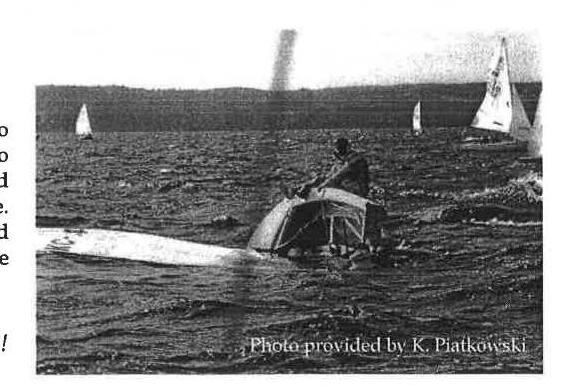
People are not more born with the skills needed to right a boat any more than they were the ability to sail it. Both are skills which can only be acquired through a combination of instruction and practice. Practicing and perfecting the techniques listed above will reduce the time you spend on your side after a capsize - it has for me!
Hang in there guys. Practice makes perfect!
TARTS 2001
June 2-3, 2001
Toronto Sailing & Canoe Club
Invited Classes: Albacore, Fireball, International 14, Wayfarer
| June 2: | First Start @ 1100 hours Bring your own lunch on the water |
| June 3: | First Start @ 1030 hours No starts after 1400 hours |
Number of Races: A minimum of 5 to a maximum of 7 races are planned
Regatta Fee: $30-$35
Information: Derek Griffiths — Tel: 416-825-8184 — e-mail: [email protected]
The TS&CC Grill will be open for breakfast at 0830 hours on both days. And of course, complimentary muffins, coffee and tarts.
If people wish to bring their boats to the club earlier in the week, they would be more then welcome to join in with the TS&CC club races which are held on Tuesdays and Thursdays.
NOTE! Due to the "Ride for Heart" being held on Sunday, June 3. Lakeshore Blvd will be closed on Sunday morning until 1130 hours.
HOWEVER! The regatta organizers have arranged a police escort for competitors that will run from 0730 hours until 1130 hours on June 3. Details will be available upon registration.
Canadian Albacore Youth Championships 2001
June 30 – July 1st at LSSA
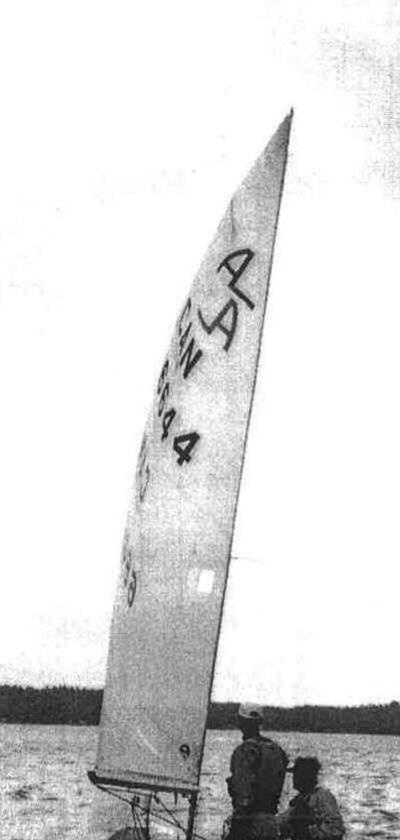
2000 Canadian Albacore Youth Champions, Matt Simpson and Trevor Wallace set sail for the 2001 Canadian Albacore Youth Championships hosted at RCYC June 30 & July 1, 2001 as part of the 107th LSSA (Lake Skiff Sailing Association) Regatta on the Dominion Day long weekend.
Photo by R. Suzuki
I imagine Uffa Fox, prolific UK Yacht designer would be absolutely thrilled to know that his lovely little Albacore has migrated to many countries around the world and that she will in 2001 enjoy her 40th year of sailing Canadian waters. I imagine if he could talk to us yet again he would say "...you know I have designed many yachts but once they sail off my drafting table they take on the life that their owners and owners' Associations plan for them. So plan their future well, nurture them tenderly and they will always pay you the dividend of a safe day on the water with sun or rain in your ears, wind in your hair and frequently a smile on your face....." So inspired by these thoughts I along with others have set out on a mission to introduce new young, sailors to our favourite boat and we know the Albacore will work her magic on them too!
Albacore Mission
Were we to have created a mission for our beloved Albacore ... should it not be .... every season to introduce and re-introduce our Youth sailors to the joys of sailing Albacores... to the opportunity to compete in a truly one design tactical fleet where the opportunities of spending a wonderful day on the water planing to one's heart's content are not limited but for our own abilities to maintain, tune our boats, to strategically plan our way around the course and to tactically implement our plan. Sailing consists of nothing more than doing all this in the company of friends while dodging a few sharks and shifts here and there only to arrive at the dock knowing if today were our last that we had been truly blessed.
Youth Mission
So here is our mission in Albacore life - to continually grow the number of Youth sailors participating in our Youth events annually and to awaken in them a passion for Albacore sailing that so many of us have found over so many years and to chase that passion all the way to Albacore ownership and commitment to our class association. To help them search out their chosen hull and to tenderly nurture their acquisition into top operating shape.
Vision
The life blood of any class of sailboat is the number of new owners (be it new or second hand hulls) which join our ownership ranks annually and most particularly the Youth sailors who each year awaken to the love of Albacore sailing.
Rebirth of Youth Championships
The 2000 Youth Albacore Championships hosted in Muskoka revisited the origins of the class planing across Lake Rosseau. Youth teams enjoyed a wonderful day long; cornucopia of light air, building breeze, strong gusts, sunshine, a smattering of rain and a solid wind to take the Fleet home to a BBQ, among new friends, prize giving, applause from siblings and parents and the flash of cameras to record the event.
2001 Canadian Youth Championships
As part of our 40th Anniversary celebrations the 2001 Canadian Youth Championships will shift south to be part of the 107th running of the prestigious annual LSSA (Lake Skiff Sailing Association) multi-class regatta hosted in 2001 by the Royal Canadian Yacht Club. The races will be held on the open waters of Lake Ontario south of the Toronto Islands. Youth sailors can look forward to great Race Committee work, a full program of events, which will attract 500+ Youth sailors over 3 race courses. The Albacore Youth Fleet will have their own start on the Double Handed course.
The Club Sponsors' Approach
To create a good nucleus of Youth sailors we are inviting each of the Ontario Albacore Clubs to field a Youth team of one or more boats. And we have an incentive to start recruiting that team now - there will be an Club Team Award for the Club with the most boats competing. So Youth Directors, Head Instructors help your team win this new award by recruiting your Club Team now and working with the Youth sailors to get those Albacores shipshape and don't let repairs or possible breakdowns stand between the sailors and a wonderful two days on the water and the lure of a ....Youth Seminar and a medal.
How Do You Enter?
Start by putting the dates of June 29 - July 1 on your calendar and plan to attend.
Recruit lots of Youth Sailors, those already in your Club's Youth programs, new youth sailors enrolling for the first time this season, encourage a neighbour's or relative's child to begin sailing Albacores at your Club to participate. Everyone is welcome and we encourage you to gather as many Youth sailors as possible to participate. We are particularly hoping to encourage a number of young women to sail as part of mixed or all female teams. There are many Women actively racing and sailing Albacores.
Recruit a one or more Youth Teams from your Club to sail your Albacores in the 2001 event and register as soon as possible. (If you know anyone who needs a boat and can't find one let us know we can assist with making charter arrangements.) We would particularly like to encourage mixed (male and female) and some all women's crews to sail.
Find and encourage as many other Albacore Youth Teams from your Club to attend. Call your fellow sailors or new recruits to the sport and personally invite them to join your team. Send their names by email to Rosemary Helmer, Regatta Chair, [email protected] and she will send them a personal invitation to the 2001 event.
Send us the names of Junior/Youth Club Directors/Instructors that you know in your area who have Albacores so that we can send them a poster and invitation to the event.
Start working on your Albacore now (buoyancy is particularly important). According to our Class rules all boats must be tested and signed off for buoyancy; annually. We take our and your safety seriously. If you are unsure of how to test for buoyancy refer to page 63 in the 1999 Canadian Albacore Association Handbook which Helm's received in your 2000 Regatta registration packages. Any Questions? email or call George Roth, the Albacore Class Chief Measurer at [email protected] or 519-746-1300.
Tune-up your Albacore for speed by using the tuning guides in the CAA Handbook (see pages 68-80) or those available on the CAA website www.albacore.ca. Need specific advice email Kevin Smith at [email protected].
Get your boat in top shape. We all sail much better when we take pride in sailing a good looking Albacore in top repair. Don't let breakdowns stand between you and a great day of sailing and possibly an award. Work with your Club Instructor/Coach or Junior Youth Director or parent to get the appropriate repairs done well in advance of the event. Youth sailors - don't ask others to do the work for you, work with them to get it done and ask them to show you how if you don't know so that you learn this valuable knowledge. When you take responsibility for your boat and equipment's repairs as soon as they are needed you take control over your ability to succeed and you will learn a lot and have fun too.
If you need major repairs done to your Albacore and don't believe you are capable of the work yourselves contact Ontario Yachts (Dirk Kneulman or Don Oakie) our licensed North American Albacore boat builder at 4160 Morris Drive, Burlington, Ontario, L7L 5LP, 905-639-8382 or email [email protected]. Ontario Yachts also as a small boat part chandlery from which you can buy parts for your Albacore. You can also contact Luis Perez at Patagonia Boat Works 416-237-0572 or email [email protected] for expert repairs.
Parents and Adult Albacore Owners
You can help to make this event a wonderful weekend for Youth Sailors. We encourage you to volunteer to help in any capacity you are able. We need persons to:
- assist Youth Sailors to sail/train at their clubs prior to the Youth Championships to get practice in handling Albacores safely and with skill.
- work with Youth Sailors to get their boats in good repair prior to and at the event.
- help trailer boats to RCYC and to get boats rigged on the City side for transfer to the RCYC Island facility where they will be docked on the front lawn.
- bring with them power boats and drive these as Safety and/or Tow boats at the regatta on Sat. June 30 or Sun. July 1, 2001. If you can bring a boston whaler, zodiac or other run-about for safety purposes we are delighted to have your assistance.
- if you own an Albacore and you are willing to charter it for the Youth Championships please contact Rosemary Helmer at 416-410-4644 Ext. 1 email [email protected]
- help with Registration at RCYC on the Fri. 6-9 pm June 29, or Sat. June 30 8-10 am.
Thank You
Special thanks to Albacore parents: Alan Hutton, Scott and Mary Jane Meddick, Sue and Fred Nicholson, Dave Rider, Murray Sarafinchin and Tom Simpson, for their assistance at the 2000 event. Join us again in 2001. Do bring more parents with you.
More Information
For the official Notice of Race and location maps watch the next issue of this Shackles and Cringles Newsletter and the Web-sites at:
- CAA (www.albacore.ca)
- OSA (www.sailon.org)
- RCYC - Regatta host (www.rcyc.ca)
2001 Albacore – Youth Awards
Top Crew (helm & crew) in each of the following categories:
- 13 & Under
- 16 & Under
- 19 & Under
- 23 & Under
- Club Team Award
- Top Female Team Award (female helm & crew)
Billets
We are prepared to host out-of-town Youth sailors at billets (members' homes) so as to minimize the costs of staying in Toronto. Contact: Rosemary Helmer.
See you June 30 and July 1, 2001 for a great Youth Event!
An Afternoon Sail with Michael McNamara
By Barney Harris
We arrived at Looe with the expectation that our 1999 speed advantage would still be intact – we were totally wrong. As it turns out, Mike had to set his boat on a compromise setting while racing in North America, since he could not adjust his shrouds while racing. In the UK, Mike was free to set his rig optimally both upwind and down, and was equal or a click faster upwind and WAY faster off wind. He made very few strategic mistakes, while always going about as fast as an albacore can go: a very difficult combination to beat.
Mike won the race on Thursday of the UK Nationals, giving him the series. Afterwards, he asked if I would like to go for a sail. We hopped into his boat, a meticulously prepared and maintained Mk 2 Woof GBR 6493, while David Byron and former UK sailmaker turned computer weenie Richard Bowers re launched 8011. Mike's boat is equipped with a Needlespar mast, Milanes centerboard, Bloodaxe rudder, and of course, a McNamara main and jib. 8011 is equipped with a Superspar M2 mast, Canadian North main and low aspect jib, and Guck manufactured / Harris designed rudder and centerboard. We left the beach beating into a fresh 15-18 kt. Breeze and 2-3 foot chop. I steered with Mike as crew; Richard steered 8011 with David crewing. As we sailed mike commented that the only really scary thing about getting old is "...not being able to do this anymore..." meaning sailing an Albacore in the breeze. Mike, who is in his fifties, was hiking out with his knees over the side deck at the time - the musings of a guy who really enjoys his sailing and is deeply attached to his Albacore. I understand his feelings completely.
Mike's boat was set up with a small amount of rake and moderate vang tension. Mike's sails are flatter than the Norths, and the jib is very tall. It took a few minutes but we were finally able to get both 8011 and 6434 up to speed and sailing well. After about 20 minutes of sailing we found the upwind speed of the two boats nearly identical.
Mike is amazingly fast on the reaches, sometimes gaining a hundred yards on a single reach. I have always wondered how he does it. During the 1999 US Nationals and Internationals in Rehoboth, we actually had a bit of a speed edge over Mike while going to windward. But he was consistently faster than us off the wind. We bore off onto a broad reach. He blew the leeward shroud completely, eased the windward shroud, standing the rig up vertically or maybe a little more so. The boom was WAY up in the air and the leach is very twisted and open. I thought that the open twisted leech might be spilling too much wind, but Mike pointed out that the top of the sail was not luffing, and so it must be pulling boat forward. Mike explained that he sails reaches by keeping the crew hiked out, while he sits upright to see the waves just ahead of the boat. Mike will head up to keep the crew hiked and not bear away until surfing on a wave, and thus maintain nearly constant apparent wind. We bore away with 8011 on our tail. After what seemed like a only few minutes, we had extended by a hundred yards.
David and I sailed the Canadians a few weeks later, and we applied some of Mike's reaching techniques. We set the main up with lots more twist than usual - off until the top part of the sail was just full and the entire luff broke evenly in response to a luff. I kept David on the rail and hiked by heading up above the rhumb line in the lulls – sometimes 20 degrees above the course. When a nice looking wave came along, we simply bore off on it, and, with one smooth large pump of the main accelerated. The greater speed added to our apparent wind, and even though we had just born off 30 or 40 degrees, I had to pull the main in several feet to keep it full. A few times we almost had to sheet to centerline. The results were great – we gained or extended on every off wind leg – sometimes quite dramatically. Goes to show, you can always learn something new.
LSSA — June 23-24, 2001
Preliminary Notice of Race
Royal Canadian Yacht Club
Information:
RCYC Sailing Office
LSSA Rep: Derek Griffiths
Email: [email protected]
Invited Classes: All centreboard classes are welcome
June 23: First Start @1100, BBQ in the evening
June 24: First Start @1100, On Sunday, no starts after 1430
CAN 8050 Re-rigging Project
By Henry Pedro
We took a garden variety Albacore and re-rigged it with the latest systems.
Albacore CAN-8050 started life out as a regular community-club issue Albacore. Like any new Albacore these days that was built for racing, it was delivered at minimum weight, with basic remote sail controls, tapered mast and cored hull. It has proven to be quick and nimble when handled properly, having carried its skipper and crew to a second-place finish at the Canadian Albacore Championships and a top-ten finish at the North American Albacore Championships. Not bad for an off-the-shelf production line model.
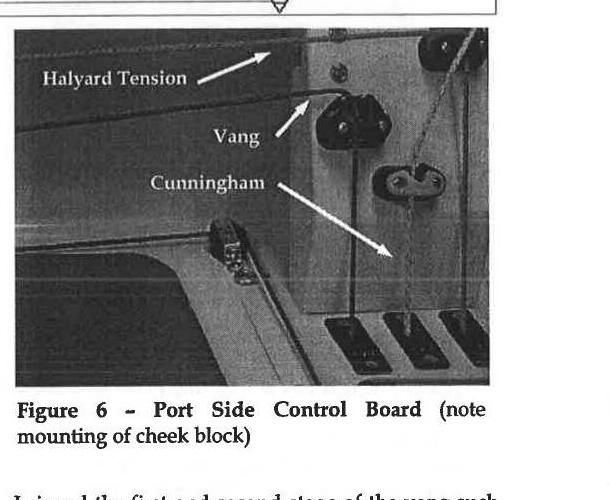
Having sailed this boat for a season I became frustrated with a few things and decided that a winter project was in order. 8050 came equipped with three sail controls remote-led to the side rails. These controls were jib halyard tension, vang and cunningham. Each remote line ended in a figure-eight stopper knot.
This led to some problems: firstly, when sailing in anything over moderate conditions where the crew and skipper were always sitting out hiking, the remote halyard tension and vang tension ropes were constantly being adjusted one one side more than the other. This makes sense in that many beats favour one tack over another, and planing reaches are always sailed on the same tack. Too many times when rounding the windward mark and needing to let out vang tension there seemed to always be not enough line to let out! Sure enough, looking down to the leeward side of the boat there would invariable be three metres of remote line! Anyone who has sent his or her crew diving to the opposite side of the boat to "even out the remotes" knows what I'm talking about. Try this in 20 knots of wind!
The only true solution to this problem is to make the remote lines continuous. A simple concept - just make the remote tails really long and splice them together, but how does one keep things neat and simple? For this we went looking and eventually ended up in North American Albacore Champion Barney Harris's workshop. He has come up with some nifty packaging solutions that I have recreated, adapted, and in rare cases, improved upon for CAN-8050.
Continuous 12:1 Triple Cascaded Jib Halyard Tensioner:
Almost everyone is familiar with the ubiquitous Harken Magic Box™. Simply put, it is a compact 8 inch or 12 inch long self contained pulley system that is rigged for eight-to-one purchase. That is, pulling on the free end of the magic box with one pound of force should produce eight pounds of force on the business end. This is rarely the case because of the small and numerous (7) pulleys. There is a huge amount of friction generated in these boxes, which makes them horribly inefficient.
The first thing we did on CAN-8050 was replace this magic box system with a cascaded multi-purchase system. this consisted of a 3:1 first stage, a 2:1 second stage and a 2:1 third stage with a total purchase of 12:1. The disadvantage here is that this system operates in the entire length of the cockpit! The advantage is much less friction, hence greater efficiency. Besides I packaged it in such a way that it does not get in the way of the skipper or crew in normal operation of the boat. In order to do this, I removed all the "stuff" from the inside of the transom, including the hiking straps. I needed a clean slate to work with. (Figure 1)
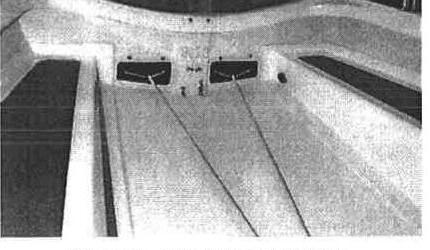
Next I built the first stage of the cascade: the 3:1 system. I used 1/8" Vectrus-12 rope, a high-load single "bullet" block with a becket, a high load cheek block riveted to the side of the mast base, and a high load single bullet block attached to the mast step with an eye strap. Because I decided to use a cheek block on the mast itself rather than on the step, I made the becket on the first bullet block removable so that I can un-reeve the line when I want to remove the mast. The first stage terminates at another thimble attached to a final high-load bullet block. The end point of the first stage is around the centreboard pivot bolt on the port side of the centreboard trunk. Try to be imaginative and see a mast rather than a 2 x 4 in this picture. (Figure 2)
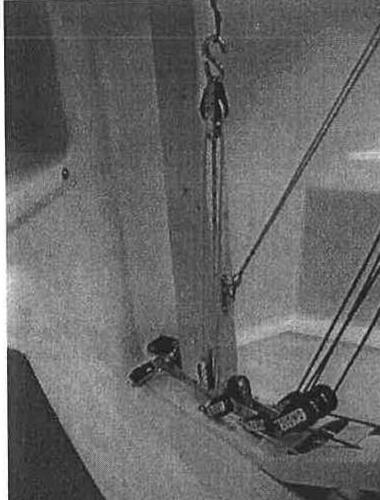
Rather than tying any knots in the rope (which reduce the lead carrying capability of the rope) I inserted a wire thimble and back-spliced wherever a knot would have been. Vectrus-12 is a fairly new product which has a very high breaking strength: try 2000 pounds for a 1/8" diameter rope! And to boot, it doesn't stretch or creep, it is low friction running through blocks, and doesn't cost much more than other lesser ropes on the market.
The second stage of the halyard cascade is a simple 2:1 system that dead-ends on the transom (with a back-spliced thimble) and runs through the terminal bullet block on the first stage. The second stage also terminates in its own block, in this case a lightweight 40mm carbon airblock. The end point is right up near the centreboard pivot bolt. I did this so that the two end blocks in stages 1 and 2 run into each other with the rig tension fully off. The rope used was the same as in stage 1: 1/8" Vectrus-12.
The third stage is a bit more complex. I had two options. I could simply rig the third stage and terminate the lines at the remote control boards on the gunwales at the thwart, or I could rig them so that the third stage would be continuous with a shock cord take-up. I chose the latter so that I could eliminate the line tails that always ended up in the bottom of the cockpit, or were too short on one side when I wanted to let rig tension out. There is no real good way to explain it, but take a look at the pictures, and the line diagram (see Figure 4 on page 14). The third stage ropes are 5/32" Marlow Super Pre-Stretch.
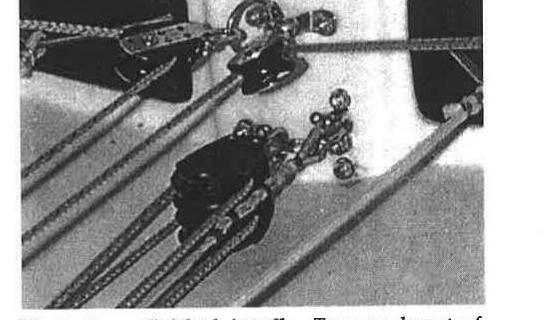
Figure 3 – Finished install: Transom layout of halyard cascade, third stage. Note the detail of the installation on the transom.
5/32" Marlow Super-Prestretch line than runs more smoothly through the blocks, and allowed me to splice the ends together and let the splice run through the blocks. Plus I added a slick shock-cord takeup system that pulls up the slack in the line tails. This also makes the third stage continuous, allowing you to pull vang on one side, and let it out on the other side without having to worry about running out of line. The shock cord is attached to the chainplate via a sister-clip which lets you release the shock cord when you're not sailing (to extend the life of the shock cord) and in light air when you do not want any tension at all in the vang. The schematic on page 15 shows how the layout of the vang third stage is arranged. Notice how the blocks and cleats are mounted (remember, measure twice and drill once!)
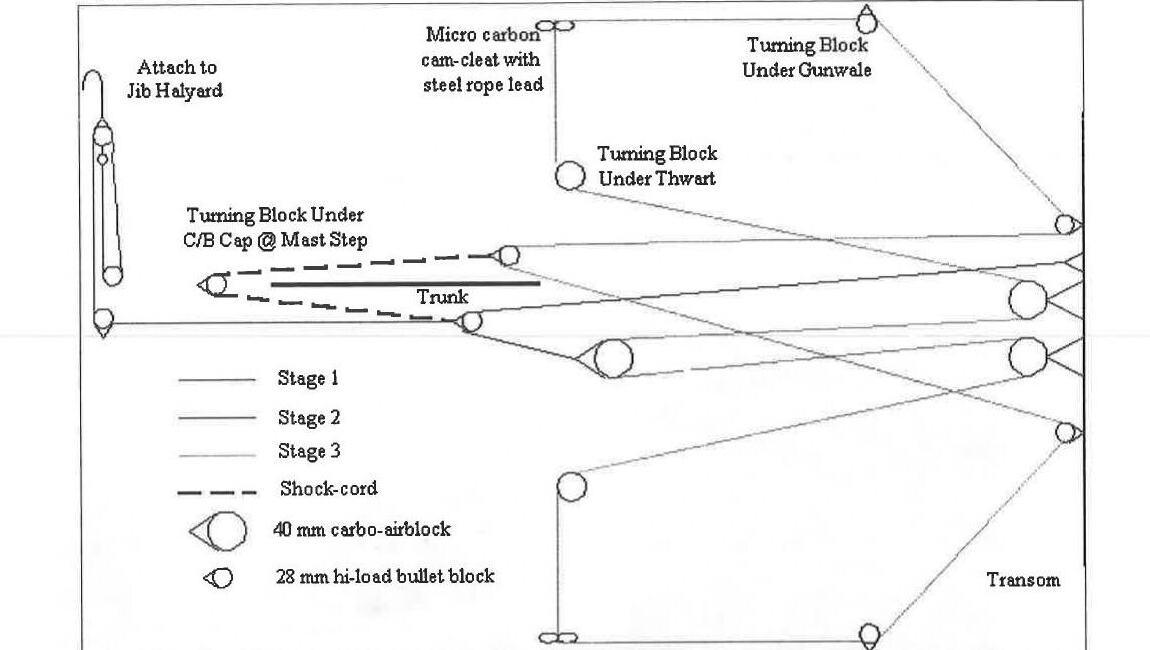
Figure 3 (diagram) – Jib Halyard Cascade
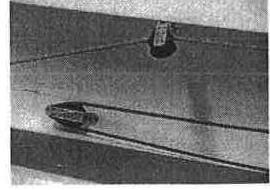
Figure 5 – Port Side, 17" forward of transom.
I rigged the first and second stage of the vang such that when the vang is completely off, all three blocks (see 1, 2, & 3 in Figure 8 page 15) hit each other at the attachment point of the boom. This ensures maximum travel in the vang, which is important. When you're sailing upwind in 25 - 30 knots of wind
Continuous 16:1 Triple Cascade Vang
I did not have to do too many modifications to the vang. Ontario Yachts produces racing Albacores with 16:1 vang systems that are terminated at the side control boards. I kept the same basic layout with some improvements. First, I replaced stages 1 and 2 with small high load bullet blocks and 1/8" Vectrus-12 line.
This gave me a low friction super strong stages 1 and 2 where it is needed most. Stage 3 is similar to the stock factory issue, except that I used thinner 5/32" Marlow Super-Prestretch line than runs more smoothly through the blocks, and allowed me to splice the ends together and let the splice run through the blocks.
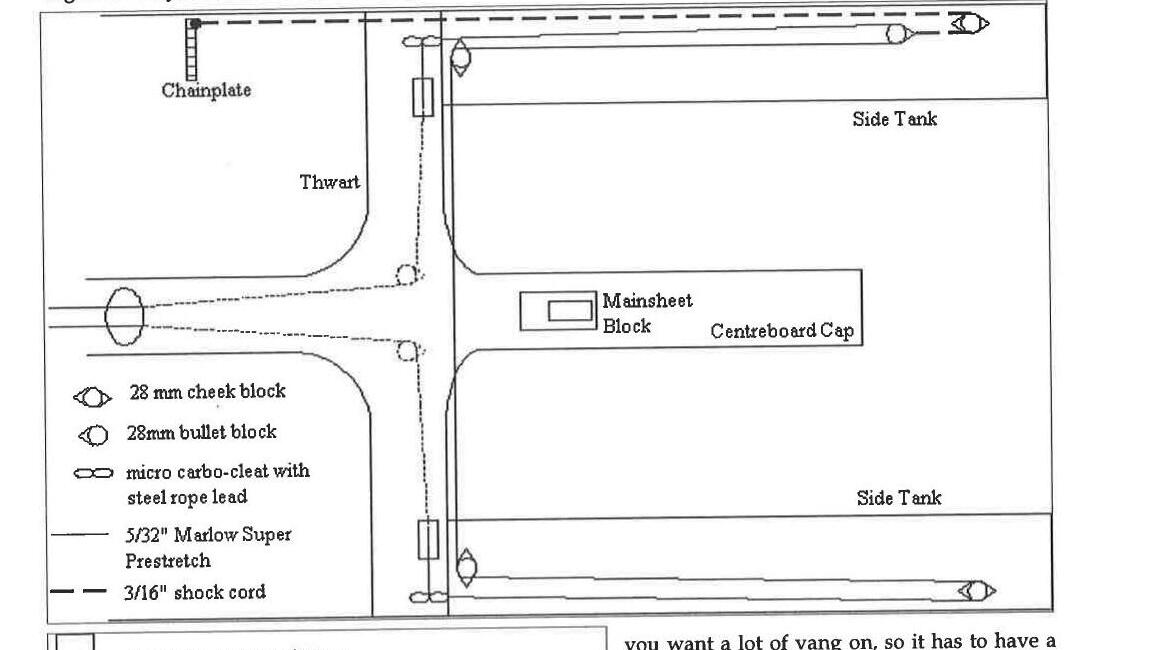
Figure 7 – Layout of the vang third stage
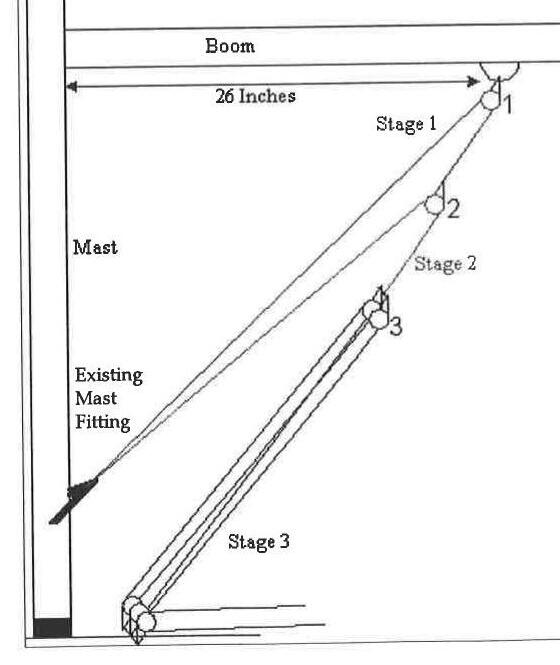
Figure 8 – Set up of Vang
...you want a lot of vang on, so it has to have a large range.
In older boats this was not a problem, because they were only two stage systems: a 3:1 first stage with a 4:1 second stage. This system is triply-cascaded (stage 1 = 2:1; stage 2 = 2:1; stage 3 = 4:1) so careful measurements have to be made as to how each stage interacts with the other. I made the attachment point on the boom 26" aft of the gooseneck. This was a good compromise between crew space and leverage. I also decided to leave the triple block intact at the mast step, although there are alternately rigged systems which replace this triple with two swiveling single blocks, and a third bullet block at the "existing mast fitting" (see below). It is said that this setup allows the vang to operate more smoothly when reaching, although you do lose some range in vang travel. I will investigate this setup in the future and report its relative benefits.
Note that stages 1 and 2 both dead-end at the "existing mast fitting". In fact, these are not two pieces of rope, but rather the same continuous piece of rope with a thimble spliced in. This is less work because it involves one less back-splice, but requires more accurate measurement. With the thin 1/8" rope used in stages 1 and 2 along with the relatively thin 5/32" line used for the third stage, the vang is now super smooth, and easy to pull.
4:1 Cunningham
I went with this particular 4:1 system for two reasons: Firstly I wanted both minute control of the mainsail luff tension in medium airs and high power in heavy air. The long pull of a 4:1 system allowed me to have razor sharp control of the luff tension in medium winds, and I can really whale on the cunningham for heavy air, since 4:1 give me significant mechanical advantage. Secondly, I wanted a cunningham system that did not use the mainsail's cunningham hole as a purchase point. ie: I did not want the rope to "run" through the hole. This system is ingenious in that it pulls equally on both sides of the mainsail.
It is not a new idea. Tornado sailors have been using this type of system for years, a variation of this setup is drawn out in detail in the back of the Harken catalogue, and Toronto Friday Night Series champion Kevin Smith first showed it to me. (See Figure 9.)
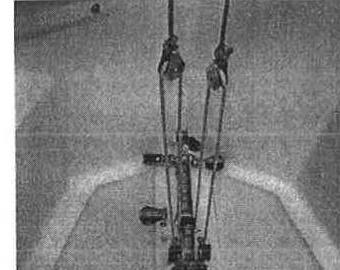
Notice the third bullet block that is rigged "sideways" in the mast step. The two pink (the darker lines in the above photo) lines run all the way up to the cunningham hole in the mainsail. The port side pink line is terminated as a loop. The starboard side pink line is terminated in a plastic ball. When I hook the cunningham up, I pass the loop through the cunningham hole, put it around the ball and tug down on it gently. Easy to rig, easy to derig, and this system really works. Try it.
2:1 Remote Barber-Hauler
Lately, if you ordered barber haulers on your new Ontario Yachts boat you would get a basic system that consisted of a plastic ring tied to a line that led through the deck at the bulkhead. This line then went under the deck across to the opposite side of the boat and terminated at a "clam-cleat" on the aft side of the deck.
I found this system quite silly, because by the time you really need barber-haulers, you are already planing. This means the crew is up on the side, sitting aft in the boat. It really didn't make sense to send the crew up to the front of the boat, disturbing the boat's balance, causing it to fall out of plane. This necessitated a remote system, but how to go about installing it in an already crowded control board? Put the cleat underneath the control board! I first tried this on CAN-7700 the boat that I crewed in for the 1999 Albacore Worlds with Chris Gorton. Spending a full week in that boat meant that it had to be crew friendly, so we tried that system and it worked beautifully.
Next, I wanted the barber hauler to be a 2:1 system, so that the crew would not have to release the jib to set the barber hauler. In high winds, the tension in the jib sheet is high, which makes setting a 1:1 barber hauler difficult to impossible. Not so with this system. My barber hauler (which is a variation on the system that Chris Gorton developed) uses the stock position for the through-deck fitting, and instead of the high friction routing, I installed a 16mm double airblock in the bulkhead. I also used 12mm micro ball bearing blocks for turning and purchase, and plain 1/8" cored polyester pre-stretch lines. (See Figure 11.) OK, so I made them pink for high visibility.
The finishing touch was to use 28mm bullet blocks instead of plastic rings at the terminus of the barber hauler (the part that you feed the jib sheet through) Although this requires the use of thinner 1/4" jib sheets, they run much more smoothly through the barber hauler which makes jib trim a breeze in heavy air. It does however, require the use of gloves.
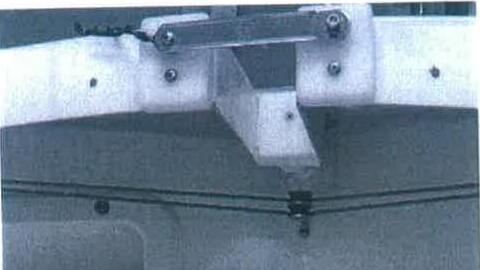
Figure 10 – Double airblock mounted on the bulkhead under the deck for turning.
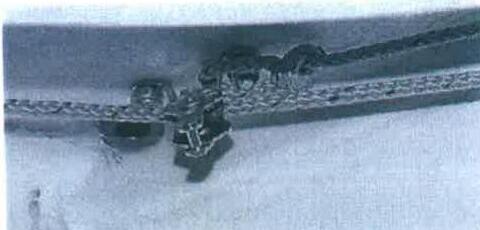
Figure 13 – Detail. Notice to the left is the through-deck fitting for the port-side barber hauler.
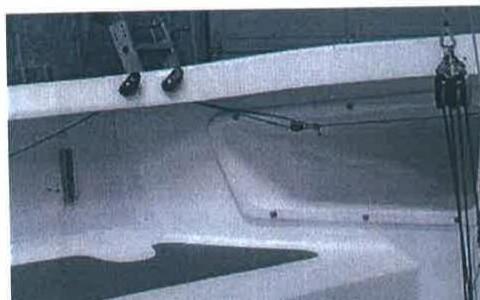
Figure 11 – Starboard Barber hauler led to the port side. Note: 12 mm micro ball bearing block for a 2:1 system.
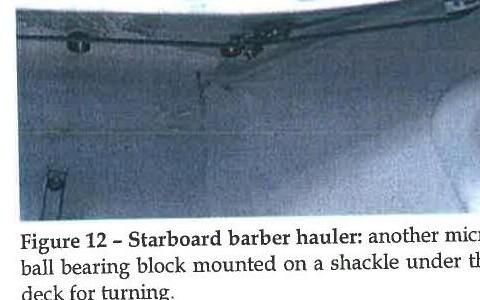
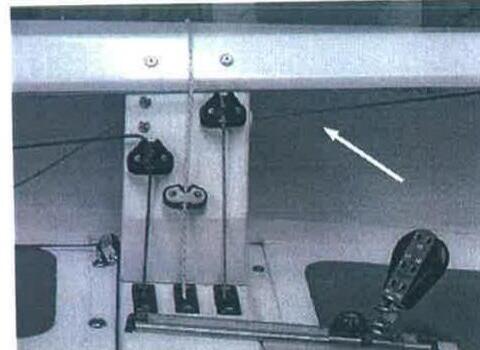
Figure 14 – The finished control board: Notice how the barber hauler (arrow) runs underneath the control board through a cleat mounted upside-down under the board.
Conclusions:
Well that is stage 1 of the winter project. Hopefully all these systems will add to the pleasure of sailing, and allow me to make sail adjustments without having to think about what I am doing. Because all the systems are now logically laid out, with a definite place for each one, I can make adjustments without having to take my eyes off the water. It will help me keep my head out of the boat and in the race longer. I'll see how well they work!
Questions or comments? Email me at [email protected]
Special thanks to Chris Gorton, Barney Harris, Kevin Smith for letting me steal your ideas. HP.
It's time to Renew!
This is your last issue of Shackles and Cringles for the 2000 Season. Get your membership form and fees in now and avoid the disappointment of missing an issue. Who knows what secrets will be revealed in the Spring 2001 issue! Don't wait, do it today!
Albacore Regatta Posters
If you would like extra posters to put up in your clubhouse or to wall paper a room in your house, please contact someone on the Canadian Albacore Association Executive. They will be happy to provide you with as many copies as you need. Thank you to George Roth, Jason Roth and the following people from Heidelberg Canada - Ray Fagan, Todd Baillie and Steve Thomson. Great job!