2010 Issue 4
December 01, 2010
The CAA previews its 50th-anniversary year and the 2011 Toronto Internationals (venue, schedule, and a new larger jib-window rule), George Carter's two-part guide to sailing in waves, Peter Duncan on the newly reformatted (but functionally unchanged) Albacore Class Rules, Andrew Alberti's TSS-diagrammed breakdown of tacking too close at the weather mark, and the 2011 executive.
Message from the Commodore
Happy Holidays
Are you as excited about the upcoming sailing season as your 2011 CAA Executive? The Executive has met three times thus far and wow do we have some great things happening for the 2011 sailing season and beyond.
Each member of the Executive has been asked to describe their portfolio and share their vision and execution plan of their respective portfolios. With the assistance of Ken Yamazaki and WaveRate Communications, we have created a page on the CAA website for each of the portfolios and have described a bit about each position, a bit about us and our personal goals for our elected position. Throughout the year we will go back and update our page with any news or progress reports. You can access our pages off the main page under “about” then click “get to know your Executive”.
I would like to take this opportunity to thank Alison Goodwin, Kevin Soldaat and George Roth who have stepped down from the CAA Executive and welcome Julie Postil and Susan Higgins to the team. Cathyann White also has stepped down however, she remains involved as Past Commodore overseeing the new Executive and lending her experience and knowledge.
Communication is very important to your Executive. I have identified as many “Albacore Clubs” as possible and added the Commodore or Albacore representative to my mailing list and I will often send out class information that I/we feel is important for you to know. It is my hope that these contacts will share any information we send out to their class members. We are always open to feedback, comments and questions and we can be reached through your class web site under “contact us”.
We will continue with Cathyann’s initiative to communicate and meet with the Community Clubs and we plan to sit down again in the early New Year to discuss topics that are specifically related to them and the CAA. These meetings are very important; they allow the CAA and the Community Clubs an opportunity to work together towards a common goal.
Finally, 2011 is a very important year for the CAA, not only are we hosting the Internationals, but the CAA is also celebrating its 50th Anniversary !! The Internationals committee is working very hard to put on a fantastic week of sailing and fun. Our goal is 70 boats + to sail this event. Please make sure you mark this event on your sailing calendar.
Enjoy the holiday season.
Best wishes,
Thank you to all contributors.
Cover photo — Peter Trebuss
New Rule Permits Larger, Safer Jib Windows
As many of you will know, several years ago we undertook a study to determine if new material would permit the use of larger windows in Jibs without increasing their cost or reducing their durability. This so-called X-jib program was very successful and demonstrated that the larger windows greatly improved visibility and therefore safety while not affecting either the sail cost or its useful life. Unfortunately, at the time we were in the process of a major rules rewrite to put them into the ISAF format and we had no mechanism for making a change to the Rules. Our 2010 AGM approval of the reformatted Rules changed that and the International Rules Committee (IRC) of the IAA has now been able to act on the X-jib study findings. If the IRC can develop unanimity on a rule change, the new rule can be made effective immediately, pending approval at the following AGMs of IAA country members.
I am pleased to report that, effective immediately, new jibs can be ordered with larger windows as specified in our new jib measurement rule which has been forwarded to our sail makers and posted on our web site. Basically, the new rule permits 2 windows with a total effective area of 0.4 square meters, just over double the area of jib windows previously allowed. Parenthetically, it is worth noting here that few jibs were actually built in the past with windows of maximum allowable size. There are some simple limitations to the placement of the windows in the jib which prevent their being located in highly loaded areas. It is unlikely that any sail maker would do this, but these limitations are built in to ensure as much as possible that the sail will maintain the same life as ones with smaller windows.
Anyone wishing to purchase new sails for the upcoming sailing season is entitled to order their jibs with larger windows as specified in the Interim Rule.
2011 Toronto International Boat Show
January 8–16, 2011
Direct Energy Centre, Exhibition Place
Toronto, ON
Drop by and visit the Canadian Albacore Association booth
2011 Albacore Internationals
20th Albacore Internationals 2011, Toronto
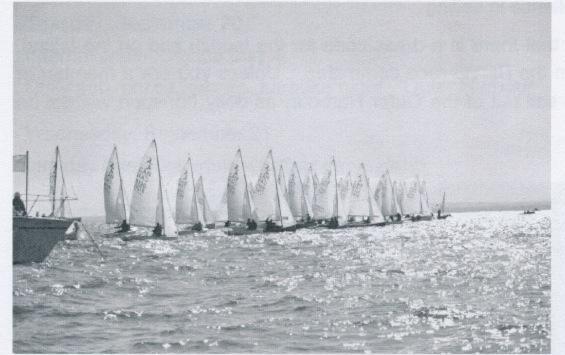
The Canadian Albacore Association invites you to CELEBRATE 40 years of International competition at the 20th Albacore Internationals! We have an exciting week planned of great sailing and social events.
We are pleased to be hosting our event in Toronto, using two venues. The majority of the social events will be taking place in the Outer Harbour where competitors can meet every day before and after racing for the daily awards and social activities. The Outer Harbour allows for a large number of boats to easily launch every day and sail to the racing area on Lake Ontario. This is also a good facility to store the shipping container.
We are especially pleased to have the Royal Canadian Yacht Club be the organizing committee in conjunction with the Canadian Albacore Association. RCYC hosted the 1st Albacore Internationals in 1971. RCYC was founded in Toronto in 1852 to serve both as a yachting recreational club and, in the British tradition, as an unofficial auxiliary of the Royal Navy in the defence of the waters of Lake Ontario. RCYC is one of Canada’s premier sailing and social clubs, with an emphasis on family participation, the development of junior sailors, and a Corinthian attitude towards excellence in sailing.
We will have two banquet dinners on the Island, please be advised that there is a dress code for the launch and on the Island. Sailors launching out of the Outer Harbour will be notified daily from the RCYC race committee. Unless you are a member of RCYC and store your albacore on the Island, it is advised that you sail out of the Outer Harbour, as dolly transport will not be provided.
Schedule of Events (Preliminary)
September 13–15
Measurement of Boats and Sails (*Outer Harbour) Pick up Registration Package, Late Registration
Friday, September 16
Measurement of Boats and Sails (*Outer Harbour) Pick up Registration Package,
Mid–day 1-2 practice races, Competitors Meeting
Saturday, September 17
Canadians Regatta (Champion, Challenger & Junior Fleets), Internationals Regatta Day 1
Daily pub, prizes, games, Casual dinner, Canadian AGM - *Outer Harbour
Sunday, September 18
Canadians Regatta (Champion, Challenger & Junior Fleets),
Internationals Regatta Day 2
20th Anniversary Banquet Dinner, Canadian Regatta Awards
Opening ceremony for the Internationals
**RCYC Ballroom DRESS CODE
Monday, September 19
Internationals Regatta Day 3
Daily pub, prizes, games, IAA Representative Meeting (closed meeting) - *Outer Harbour
Tuesday, September 20
Internationals Regatta Day 4
Daily pub, prizes, games, karaoke night -*Outer Harbour
Wednesday, September 21
Lay day (Flex Schedule weather dependant)
Thursday, September 22
Internationals Regatta Day 5
All members meeting, Presentation of the 2013 Internationals - *Outer Harbour
Friday, September 23
Internationals Regatta Day 6 - International Awards Banquet Dinner - **RCYC Ballroom DRESS CODE
In order to compete in the 2011 Internationals, all boats must comply with either the current RYA Rules or the current IAA Rules. In keeping with the North American ‘National Variations’, rig adjustment while racing is NOT permitted. All competitors will be limited to registering two headsails and two mainsails.
The Canadian’s Regatta can be sailed on its own, 6 races planned 5 to count
The International’s Regatta will be scored as a cumulative of both the Canadian results and the International results. 14 races planned 12 races to count.
** Check the Canadian Albacore Association’s website for continuous updates.
Sailing in Waves
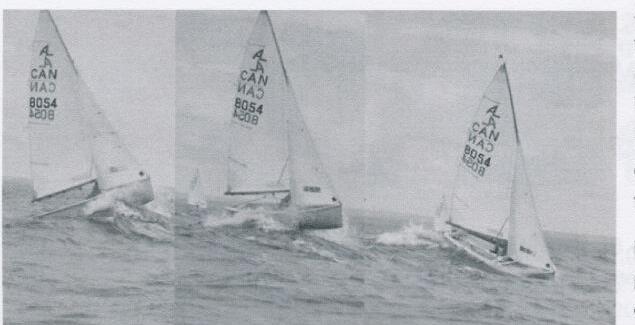
A couple of weeks ago I was asked by Christine if I could write an article on sailing in waves. I was a bit reluctant as I don’t consider myself in any way an expert on this and believe that there are many others who know much better. However, I agreed as long as Raines would review first as I consider him to be very good from my observations of his transom!
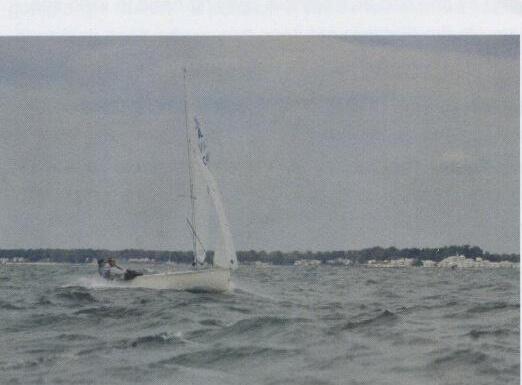
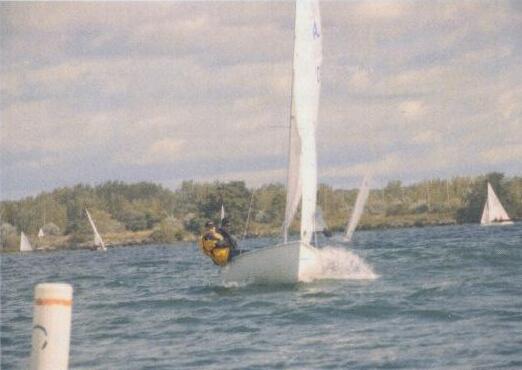
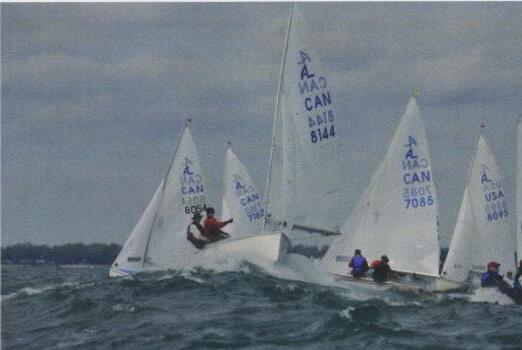
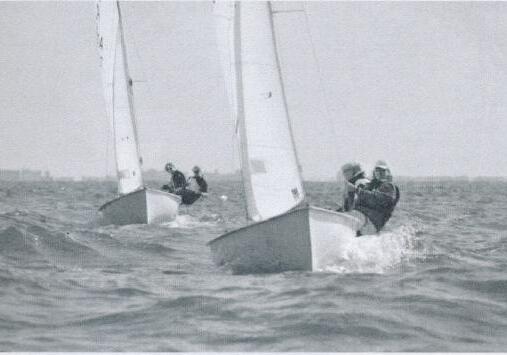
Many of us get little experience in sailing in waves, particularly harbour sailing in Toronto. Then events like the Canadian Championships at Crystal Beach present a big challenge as there are definite skills that are needed to make good progress in big waves. Like snowflakes, no two waves seem to be the same! There are basic principles I think, but there is no substitute for practice in waves as often as possible and also practicing in the conditions present in each race. Sailing in waves is a challenge, when waves are large, I find that it takes almost all of my concentration to steer and sheet for the waves and I can focus on almost nothing else. If you get the chance to see Olympic Finn and Laser sailors on video it is incredible how much effort and fitness they dedicate to moving the boat as fast as possible through waves, both upwind and down. As I say, I don’t consider myself an expert, but here are the principles as I see them:
Upwind
The basic principle for upwind sailing in waves is simple. Head up to wind up the face of the wave, bear off away from the wind down the back. Why is this?
Firstly apparent wind: Waves affect the apparent wind the sails see when sailing upwind. As the boat slows due to sailing uphill and as the rig leans back up the wave the apparent wind slows and the boat can point closer to the wind. As you sail over the wave the boat speeds up slightly and the rig leans forward the apparent wind increases and you need to bear away.
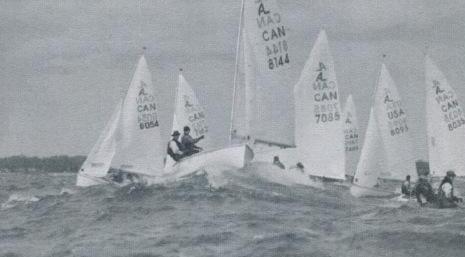
Secondly avoiding the bow digging into the wave and slamming down after the wave:
It makes sense to lean back in the boat up the face of the wave to lift the bow and to lean forward to bring the bow down over the back of the wave to minimize resistance up the wave and the slam of the boat back into the next trough. Also as the boat is invariably heeling slightly, when you push the tiller away and head up, the back of the boat sinks and the bow is lifted slightly, when bearing away with the rudder, the transom is lifted and the bow sinks. These two principles are very well explained in this article here, which also covers the different types of movements that are allowed in the rules. http://www.roostersailing.com/articles/Upwind_kinetics.html.
With the frequent changes in the apparent wind direction sails should be set up so that they do not stall and have a wide groove of operation (groove is the degrees of steering angle between the inner and outer tell-tales stalling). In general widening the groove can be achieved by increasing jib luff sag by letting off some rig tension and straightening the mast slightly, the trade-off being a lower pointing angle. The sails will stall less if they are twisted and the slot between the jib and main is wider than for flat water. Sheet the jib and main slightly less tight so the leach tell tales are flying almost all the time, maybe move the jib cars back slightly also.
Offwind Sailing
If waves are approaching the boat at 90° or more to the boat heading then they have the potential to help move the boat forwards. Whether this is to promote planning or to allow the boat to bear off more towards a leeward mark all depends on the wind strength, wave height and reaching/running angle. Barney covered much of this in his article on offwind sailing in the UK nationals, if you haven’t read this it is essential reading.
Waves give an opportunity to increase the boatspeed significantly, but also can slow the boat tremendously if you get them wrong. In general don’t chase a wave unless you are certain you are going to catch it.
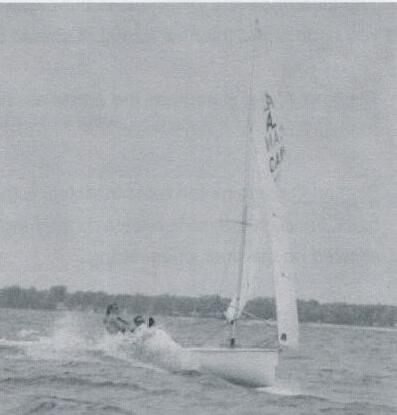
In lighter winds on reaches and in most winds when running, generally it is best to use the extra boatspeed from the waves to gain distance to leeward, then you can head back up after the wave for an increase in boatspeed. If the waves all seem to be the same size and are moving at the same speed as the boat, keep an eye out for low spots that appear that allow you to break through the wave ahead. This will allow gains to be made on the boats around.
In classic surfing conditions, the challenge is to get the boatspeed up to that of a passing wave, then ride the wave for as long as possible. To catch a wave, normally head up and sheet in to increase boatspeed just as the stern begins to lift. The bigger and faster the wave the more aggressive this needs to be.
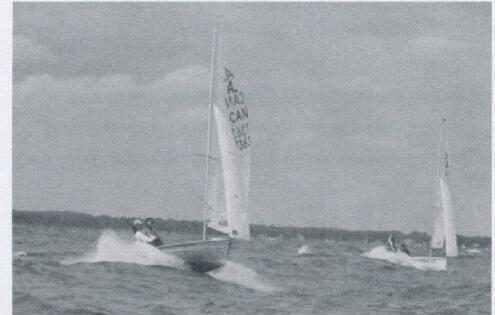
Then bear away, to move with the wave, maybe move forward in the boat to bring the bow down, hike out and pump the main and jib once. The timing of the pump is critical, the aim is to accelerate the boat not to just maintain the speed. Once you have caught the wave, don’t head straight down it as the bow will run into the back of the next wave quite quickly. Either head up or bear off so the boat surfs down the face of the wave so you can ride it for as long as possible. You will probably have to move the crew weight back to keep the bow up. When in the trough, head back up to maintain the boatspeed and look for the next wave! All of this requires very good communication between crew and helm to ensure that sail trim, weight distribution and pumping is all carried out in unison. With the steering needed to catch and stay with the waves it normally pays to have a little more centreboard down in the water, particularly when running to help steering and stability.
Summary
Waves are a big challenge to master in what is already a complicated sport. This article only scratches the surface, there is no substitute for getting out onto open water and practicing the techniques. The best thing though, is that mastering waves, particularly downwind is arguably the most fun you can have in an Albacore. Day 2 of the Canadian Championships was one of the best days sailing I have ever had and I for one can’t wait for the next chance to practice and get a little bit closer to the good guys!
New Rules! Same as the Old Rules!
After five years of careful work to modernize the Albacore Class Rules by rewriting them in ISAF format, the new International Albacore Class Rules are finally ready to view (on the web at www.albacore.org/rules) and use. In rewriting the rules, the International Rules Committee (IRC) took great care to preserve all aspects of the current rules and practices in the class. Boat owners should find no differences: a boat that was legal under the old rules should still be legal under the new rules. There is no need to have boats re-measured. Just begin checking the new rules when making any modifications to your boat.
The difference you will find is in the organization of the rules. Initially it may seem a bit harder to find particular rules, but once you understand the new format, it should become much easier to track down a particular rule.
Sections A and B address the administration of the rules and boat eligibility. This is where the documents and process of measurement are regulated.
Section C contains the rules that deal with how various parts of the boat must fit together for racing. For example, how the lower black band on the mast relates to the height of the boom is in this section. This part also covers what is allowed and not allowed on the boat when racing.
Sections D-G are where you find the detailed requirements for construction and measurement of individual parts. All of the measurements for a centerboard or hull can be found here. If you want to know how the centerboard must fit in the hull, you have to look in section C.
Section H contains various appendices to the rules. The appendices contain drawings, procedures (such as buoyancy test procedures) and the process the class must follow to change the rules.
The US and Canadian members have approved use of these new rules. The British members (NAA) will review them and vote on them next summer, but in the meantime the NAA has given tacit support by approving the first rule change under the new rules. As reported elsewhere, the IRC has revised the new rules to allow for larger windows in the jib to give better visibility and reduce collisions.
Due to requirements of the RYA, the organization that administers the Albacore Class in the UK, a similar set of “National” Albacore Class rules has been developed for use in the UK only. These rules contain the UK variations for use of adjustable stays and rate of adding jibs to a measurement certificate. The “National” rules are nearly identical in language, but embody the philosophy of making all rules “closed” such that only things explicitly stated are permitted in the Albacore class. The “International” rules that will be used in the rest of the world are “open” allowing some leeway for sailors to innovate except where the rules impose prohibitions. With continued collaboration between all countries, the Albacore Class can look forward to many decades of exciting international competition under these rules.
Tacking Too Close at the Weather Mark
Tacking at the weather mark always seems to cause some confusion. To discuss this, we first have to take away the mark and look at tacking too close. The rules that first come into play are rule 13 and rule 15.
13 While Tacking
After a boat passes head to wind, she shall keep clear of other boats until she is on a close-hauled course. During that time rules 10, 11 and 12 do not apply. If two boats are subject to this rule at the same time, the one on the other’s port side or the one astern shall keep clear.15 Acquiring Right of Way
When a boat acquires right of way, she shall initially give the other boat room to keep clear, unless she acquires right of way because of the other boat’s actions.
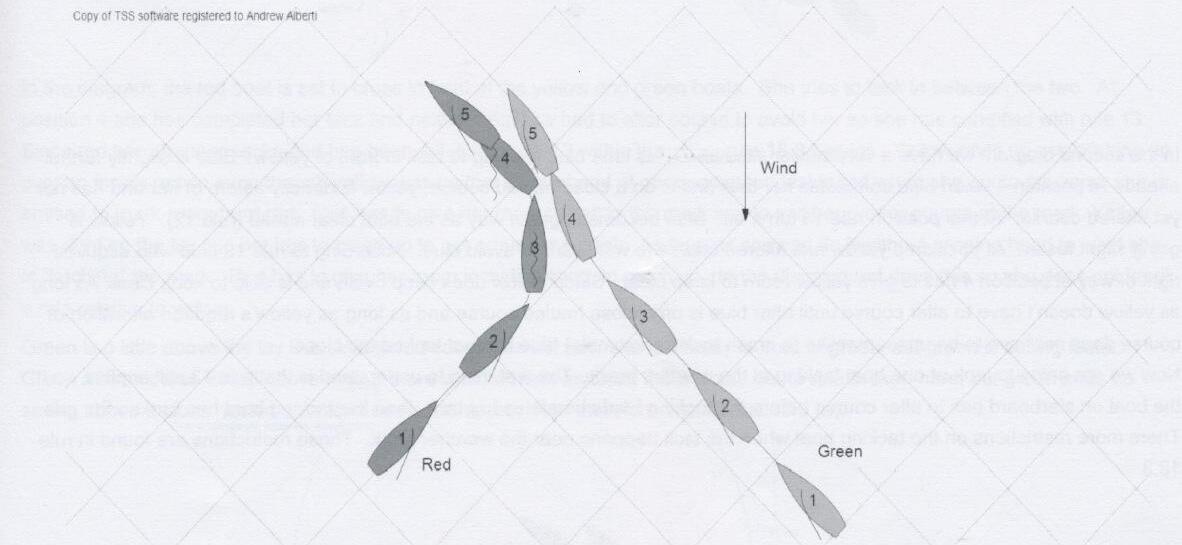
In the first diagram the green boat on starboard is approaching the red boat on port. The red boat decides to tack right in front of the green boat. Rule 13 starts at position 3 when the red boat crosses head to wind. It ends when the red boat gets to a close course which in this diagram is at position 4. This was part of one of the questions I was asked recently. You will notice at position 4 red’s sail is still flapping. That does not matter. She is still on a close hauled course. This is probably the same angle off the wind she was sailing before she tacked. It is probably about the same course that green is sailing. It is the same course that she will sail after she brings in her sails. It is probably about 40 degrees off the true wind. In the diagram by position 4 green has already had to alter course to windward by position 4. This means that red broke rule 13. She “tacked too close”.
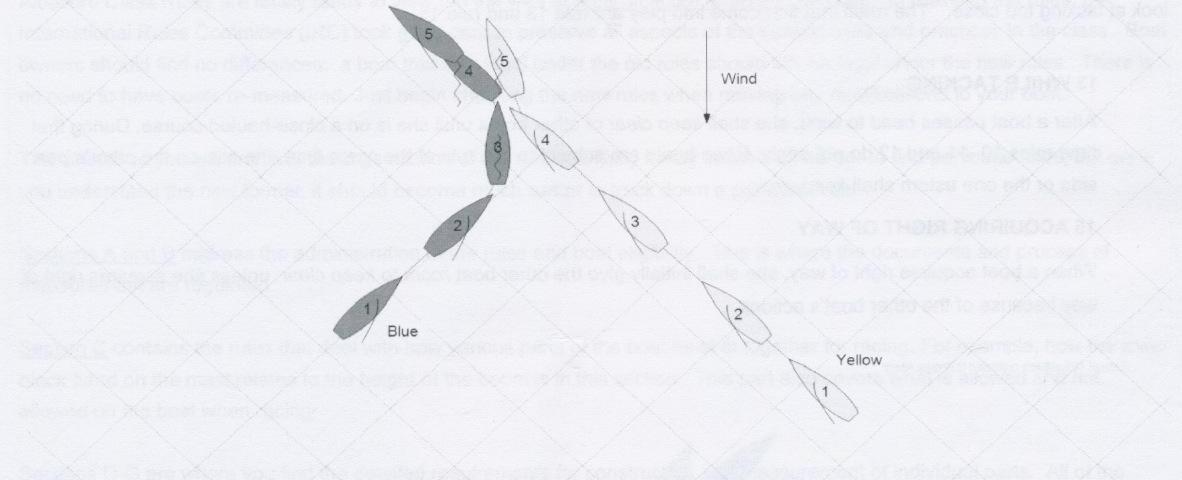
In the second diagram we have a very similar situation. This time blue is trying to tack in front of yellow. Blue is slightly further ahead. At position 4 when blue completes her tack and is on a close hauled course, yellow is directly astern of her and has not yet altered course. At this position rule 13 turns off. Blue becomes right of way as the boat clear ahead (rule 12). Yellow is going slight faster. At position 5 yellow has altered course to windward to avoid blue. According to rule 15 blue who acquired right of way at position 4 has to give yellow room to keep clear. Since yellow does keep clear, she is able to keep clear. As long as yellow doesn’t have to alter course until after blue is on a close hauled course and as long as yellow’s required alteration of course does not have to be unseamanlike (a crash tack for example) blue has not tacked too close.
Now we are going to look at one boat tacking at the weather mark. The first thing to understand is that rule 13 still applies, so if the boat on starboard has to alter course before the tacking boat completes her tack, then the tacking boat has broken the rule. There more restrictions on the tacking boat when the tack happens near the weather mark. Those restrictions are found in rule 18.3
18.3 Tacking When Approaching a Mark
If two boats were approaching a mark on opposite tacks and one of them changes tack, and as a result is subject to rule 13 in the zone when the other is fetching the mark, rule 18.2 does not thereafter apply. The boat that changed tack(a) shall not cause the other boat to sail above close-hauled to avoid her or prevent the other boat from passing the mark on the required side, and
(b) shall give mark-room if the other boat becomes overlapped inside her.
Andrew Alberti, National Judge and National Umpire
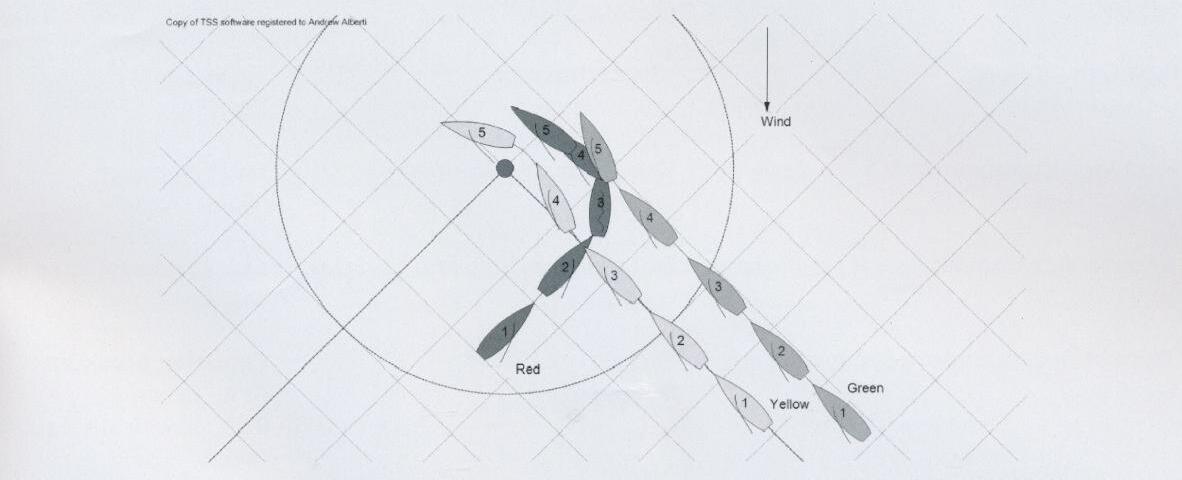
In the diagram, the red boat is set to cross in front of the yellow and green boats. She tries to tack in between the two. At position 4 she has completed her tack and neither boat has had to alter course to avoid her so she has complied with rule 13. Since red has changed tacks and has been subject to rule 13 within the zone, rule 18.3 applies. Yellow ends up establishing an overlap inside red so even though yellow was neither clear ahead of nor overlapped inside red when she got to the zone, she is entitled to mark-room from red. Red has to give her room to sail to the mark and to sail her proper course at the mark. Yellow was right on the lay line but has to pinch up to get around the mark. As long as she can do it without passing head to wind she is “fetching” the mark. Red has to give her room including room to pinch up. In the diagram red does this so she does not break a rule relative to yellow.
Green is a little above the lay line. When red completes her tack she is directly in front of green, but green is sailing faster. Green alters course to sail above red. If there was no mark involved there would be no rule broken here, but green ends up sailing above a close hauled course to avoid hitting red. Red therefore breaks rule 18.3 (a).
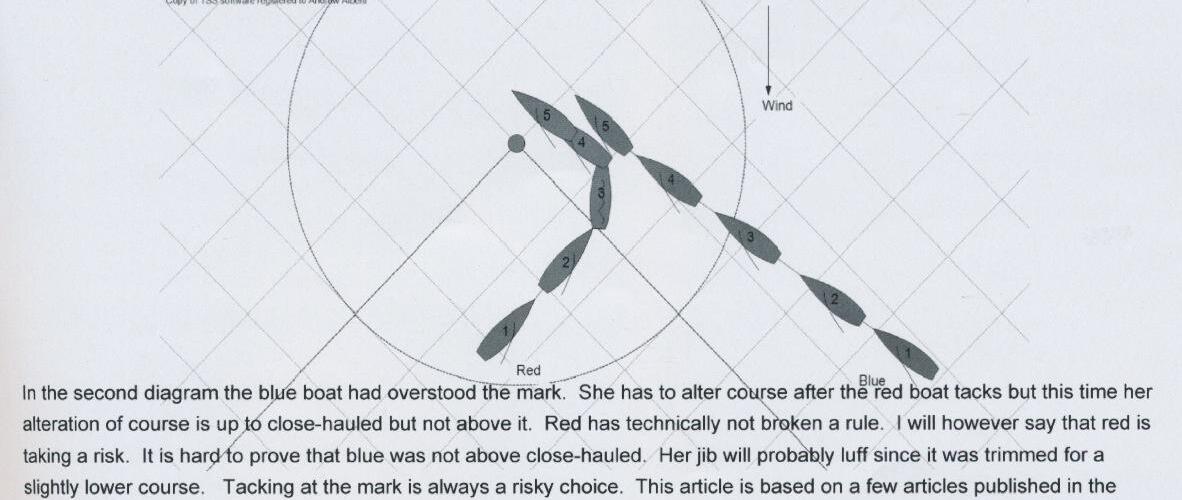
In the second diagram the blue boat had overstood the mark. She has to alter course after the red boat tacks but this time her alteration of course is up to close-hauled but not above it. Red has technically not broken a rule. I will however say that red is taking a risk. It is hard to prove that blue was not above close-hauled. Her jib will probably luff since it was trimmed for a slightly lower course. Tacking at the mark is always a risky choice. This article is based on a few articles published in the RCYC Kwasind. These monthly articles can be found with an animated version of the diagrams (including the diagrams in this article) on their website at http://www.rcyc.ca/Doc-Types/Know-Your-Rules.aspx.
2011 Canadian Albacore Association Executive
| Commodore | Jeff Beitz |
| Rear Commodore | Christine Short |
| Membership | Julie Postil |
| Past Commodore | Cathyann White |
| Chief Measurer | David Weaver |
| Treasurer | Mary Free |
| First Vice Commodore & Race Chair | Jefferson Hall |
| Specifications Chair | David Weaver |
| IAA Treasurer | Andrew Callum |
| Second Vice Commodore & Promotions | Ken Yamazaki |
| Editor – Shackles and Cringles | Christine Short |
| IAA Representative | Cathyann White |
| Third Vice Commodore & Education | Sarah Bury |
| Secretary | Susan Higgins |
Canadian Albacore Association
970 Queen Street East
PO Box 98093
Toronto ON M4M 1J8