April 1996
April 01, 1996
April 1996 issue of the Canadian Albacore Association newsletter (Vol. XXXVI No. 2) — Bob Stiff’s Commodore’s Comments on the 1996 season, Ask the Experts on centerboard gaskets and trailer-strap hull undulations, Flotsam, four rigging Tricks (cunningham purchase, goose neck pin, the Paul Van Leeuwen magic box purchase, prebender repair), the RCYC Open notice of race, Michael McNamara’s Fast Forward Seminars, the 1996 CAA, Toronto Friday, Harbour Master’s and USAA schedules, the North American Championships notice, The Fashion Page, Market Place and the IYRU 1996 Experimental Right-of-Way Rules and Definitions.
Shackles and Cringles — April 1996
Canadian Albacore Association — Volume XXXVI, Number 2
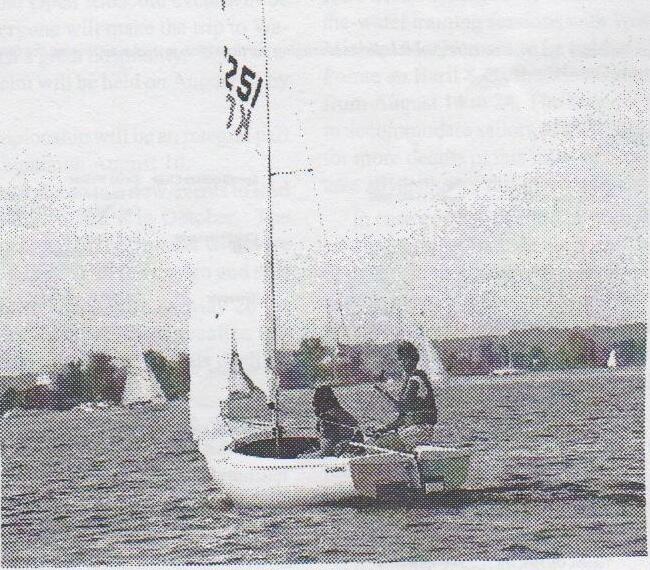
It won’t be long now
In this issue: Expert Advice (page 4) · Tricks (page 6) · Mac Seminars (page 9) · New Exptl Rules (page 15) · and more…
The Albacore Advantage
Canadian Albacore Association, P.O. Box 31021, 725 College St., Toronto, Ont. M6G 4H7
A One-Design Boat
- no unnecessary expense of constant upgrades in design.
- large air-filled tanks give excellent buoyancy
A Comfortable Boat
- large, open cockpit
- benches on port and starboard sides
A Performance Boat
A Light and Manageable Boat
- tongue load of less than 100 lbs gives ready trailerability
- launching and retrieving are a breeze
- hull shape gives stability on the water
- self-rescue after an unexpected puff is easy
A Safe Boat
- seriously campaigned by major sailmakers
- planes in moderate winds
- buoyant heavy-air hull shape
Ideal for Junior Clubs
- 4 to 5 juniors will fit easily
- will stand up to heavy use
A Vibrant Class Association
- well organized and vital
- recognized by the International Yacht Racing Union
- strong fleets through Ontario, Canada, US, Great Britain, Ireland and Bermuda
- top notch competitive sailing
- junior programs in some areas
The Canadian Albacore Association
The Canadian Albacore Association is responsible for encouraging participation in and maintaining the integrity of the Albacore class in Canada.
1995/1996 Executive
| Position | Name | Address | Contact |
|---|---|---|---|
| Commodore | Bob Stiff | 20 Southlea Avenue Toronto, ON M4G 3L9 | Res. 416 423 3294 Bus. 416 482 5002 |
| Past Commodore | Jim Quibell | 495 Vanguard Crescent Oakville, ON L6L 5G6 | Res. 905 827 9019 Bus. 416 231 1222 Sat/Sun. 705 454 3524 |
| First Vice Commodore | Chris Gorton | 14 Chilton Road Toronto, ON M4J 3C6 | Res. 416 423 0845 |
| Second Vice Commodore | Gord Chu | 38 Queensdale Avenue Toronto, ON M4J 1X9 | Res. 416 465 5558 Bus. 416 972 7336 Fax 416 972 5515 [email protected] |
| Third Vice Commodore | Dave Bussin | 24 Munro Boulevard North York, ON M2P 1B9 | Res. 416 223 3851 Bus. 416 223 3851 Fax 416 225 0287 |
| Rear Commodore | Mike Leishman | 94 Harris Avenue Toronto, ON M4C 1P6 | Res. 416 699 8100 Bus. 416 494 3343 Fax 416 494 0949 [email protected] |
| Specifications Chair | David Weaver | 14 Lansdowne Road, North Cambridge, ON N1S 2S8 | Res. 519 623 4402 Bus. 905 525 9140 Extension 24907 |
| Chief Measurer | Rick Clayton | 362 Brookdale Avenue Toronto, ON M5M 1P8 | Res. 416 783 9194 Bus. 905 670 8700 |
| Treasurer | Heather Wroldson | 5 Harrison Road Toronto, ON M2L 1V3 | Res. 416 447 5244 Bus. 616 982 2120 Fax 416 944 5891 [email protected] |
| Secretary | Lynn Shannon | 362 Brookdale Avenue Toronto, ON M5M 1P8 | Res. 416 783 9194 Bus. 416 510 6766 [email protected] |
| Shackles Editor | Uwe Ackermann | Dept Physiology, University of Toronto Toronto, ON M5S 1A8 | Bus. 416 978 4017 Fax 416 978 4940 [email protected] |
| Membership | Ross King | 635 Broadway Avenue Toronto, ON M4G 2S6 | Res. 416 422 5830 Bus. 416 592 3676 Fax 416 592 4000 |
Shackles and Cringles is a quarterly publication of the Canadian Albacore Association.
Deadlines for publication are January 15, April 15, July 15 and October 15.
Commodore’s Comments
By Bob Stiff
Does anyone remember spring? Can it be summer? A rash of errant tornadoes (not the twin hull kind) blew through this part of Canada last weekend! Ready or not it’s time to get back on the water. Besides, there’s always next winter to perfect those centre board gaskets.
There’s a great line-up of events coming up for this season, including our North American Championship which has been on hold for quite a while. Mark your calendars and plan to be at the Buffalo Canoe Club on July 27 and 28 for a great 5-race series with our friends from the USAA. Yes that’s Buffalo as in the Canadian side of Lake Erie just upstream from the great Niagara Falls. Relax, there’s no whitewater on the course, just a little current.
In addition to the North American’s some other notable changes in the regatta schedule published in January include:
- Mooredale S.C.’s Vice Regatta was on Sunday April 28.
- Conestoga’s annual Open Albacore event will be on June 1 and I hope everyone will make the trip to Waterloo to enjoy Conestoga’s great hospitality.
- The Women’s Helm will be held on August 18 by St. Jamestown S.C.
- The Ontario Championship will be an integral part of Mooredale’s Open Regatta on August 10.
Mooredale S.C. has introduced two new events to lead off the new schedule and then end it in October. The Spring and Fall Vice Regattas. Hmm!, wonder what vice they’ve got in mind. Guess we’ll all have to go and see.
The first Harbour Masters race goes on May 26th at 1:30 PM and almost every other Sunday thereafter. Enjoy some great competition with 25 to 30 boats duelling for the coveted mug.
If you prefer TARTS, you can mingle with the Fireballers and Wayfarers June 1 and 2 at TS&CC in Humber Bay or there’s also the Peterborough Examiner regatta at Clear Lake on June 2nd. The next weekend, June 9 & 10, it’s the RCYC’s fabled Albacore open regatta, where I have been known to turtle my boat on boarding from the dock in full view of the verandah. (In recent years I have developed the centredeck boarding slide which almost eliminates the Albacore’s propensity for rolling over at the dock. I’ll be happy to demonstrate this complicated manoeuvre to anyone in need of amusement.)
June 15, the Nepean Sailing Club holds their Midland Walwyn annual open event which includes Albacores and a large number of competitive fleets with lots of action both on and off the water. This regatta is closely followed by the 100-and-something LSSA regatta on June 22 & 23 at Ashbridges Bay Y.C. and then the Centennial Regatta at Clear Lake on June 30.
No wonder the grass never gets cut. We’re already into July and there’s a big event almost every weekend.
Commodore’s tip of the month: Make a 1/2-size reduction photocopy of the schedule (Page 10) and stick it in your DayTimer or whatever calendar you carry around with you and you’ll never have to wonder about regatta dates again.
Rosemary Helmer, through the auspices of the RCYC, has arranged for a number of special on-the-water training sessions with World Champion Michael MacNamara to be held at Conestoga S.C., Pointe au Baril S.C., the RCYC and Nepean S.C. from August 14 to 24. The sessions will be varied to accommodate sailors of all levels of ability. Look for more details in this issue of Shackles and plan to take advantage of this extraordinary opportunity.
In case you haven’t found enough events on our schedule, we’ve include the latest USAA schedule of events in this issue and there are a number of nearby regattas where our members would be most welcome. If you call ahead our US friends will go out o their way to help you with accommodations and other advice. However, be cautious if they tell you to go right!
The last word. Please send in your membership renewal and annual dues NOW!
Good sailing.
Bob Stiff, Commodore
Ask the Experts
In the last issue Chris Gorton asked about the best way to make a centerboard gasket. His own advice is this:
A centerboard gasket can be a real drag. Literally. A poorly fit gasket causes turbulence and drag under the water line. There are several ways of reducing drag; the first is to check what kind of material your gasket is made of. The standard here is sail cloth and the cloth has a texture you can feel by rubbing your finger nail across it. Texture causes drag and a smooth material, such as mylar, is a better substitute. OK. I know it’s not rocket science. The real trick is to get a smooth fit around the centerboard when it is fully down. When sailing upwind with full board, look down into the centerboard trunk. Can you see water swirling around? If you can then you probably have a stream of water coming in through a gap in the board gasket, near the leading edge of the board. Water streaming in like that means that you are carrying more water in the trunk and that means added weight as well as constant turbulence as the water exits the trunk. You can stop the flow through the trunk without replacing the whole gasket: Take a rubber glove, a large, stretchy, dish washing kind of rubber glove. Cut out a piece wider than the total gasket slot width. Make it long enough to go from the front of the slot to the forward edge of the board when it is in the fully down position. Retract the board. Now start attaching the piece of glove, yellow side out, under the aluminum retainer strip by the forward screw. Stretch slightly and screw in the first screw of the long retainer. When one side is completely attached, stretch the has-been glove across the width of the slot, put it under the other long aluminum retainer and fasten all screws. Remove any excess glove outside the retainers, using a very sharp knife. Put the board fully down and look for bunching near the leading edge. If you see any or if the bit of glove moves down the board by more than 1/2 inch then cut a small semicircle in the bit of glove. When the centerboard is partly retracted there should be enough tension in the rubber gasket to start folding the sailcloth gasket. Water pressure should then be able to do the rest.
When the centerboard is fully down check that the thick upper part of the board at the trailing edge doesn’t leave a wide gap at the aft end. If it does then remove the board and file or belt-sand it to thin the aft top edge. I needed to sand off about 1/2 inch to retaper the thin-to-thick part vertically.
When I needed to replace the whole gasket I used mylar as a replacement. It’s available at sailmaker’s shops. A thickness of 6 mm is, I believe flexible enough. The edges must be cut with a knife on a good, smooth surface. I apply a bead of silicone to hold the mylar in place between the screw holes. The bead also helps to waterproof the holes. The overlap of the two mylar halves should be 3/8 to 1/2 inch. The aluminum retaining strips are the roughest thing you (should) have under water. Sand them lightly and fill the screw holes if you want to spend the time. There is one “DO NOT”. It is, do not reattach the aft aluminum retainer. Put it in a jar and store it on a shelf in your garage or some other out-of-reach place. The mylar or sail cloth gasket will fold much better without the aft retainer.
Heather Wroldsen had this query: After I came back from the Worlds’ I noticed that my hull has undulations where I had placed the strape during trailering. How can I get rid of those undulations?
We got a lot of mail on this one. That which can be repeated is reprinted here.
“Why not sell it to Peter Nurse as a beer cooler? The J-town executive would never suspect that that’s where the beer’s kept.”
“Why not ask Dave Bussin to take it for a little drive along the QEW?”
“Have you thought of getting your contact lenses reground? New laser technology can fix it so that you just won’t be able to see those undulations.”
“I used to believe in shark cartilage. I now believe that magnets are better.” — Derek Shenstone
Definitive advice came from Don Oakie of Ontario Yachts:
“Don’t crank the hell out of the straps when trailering, it’s not necessary. It’s also a good idea to put padding like an old PFD between the straps and the hull at the pressure points. The only way to fix the rippling once it’s in the hull is to apply a gelcoat-like putty and then fair the hull.”
Flotsam
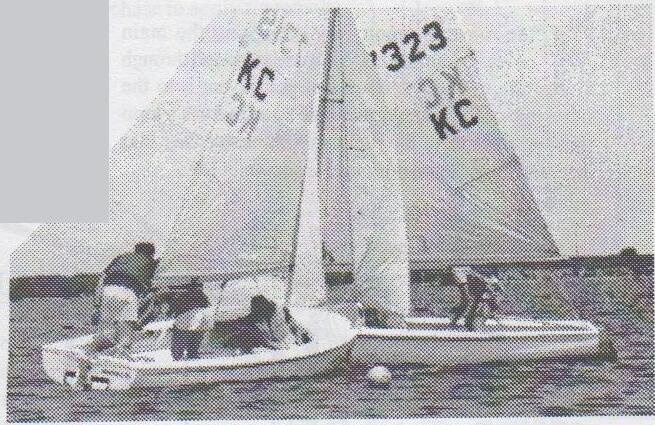
The January issue showed this photograph and carried the question, posed by Pablo Cazaurang of Toronto, which yacht had the right of way.
There were several responses of the open-and-shut variety. Only one of the respondents appreciated the finer points of the situation. Peter, also from Toronto, called and asked whether we had noticed that the two yachts in the picture are rounding the mark in opposite directions. He also wanted to know which boat Pablo was in and is it true that Arnold was in the other one?
Well, gee, no, Peter. We hadn’t noticed. That does put a different spin on it, doesn’t it?
Pablo’s in the other one.
Tricks
1. Purchase on the Main Cunningham
The most common way of rigging the main cunningham seems to be to take the end through the eye in the main sail and fasten it to the other end of the cunningham line so as to form a loop through the eye in the main sail. A neater way that also gives you some purchase is shown below.
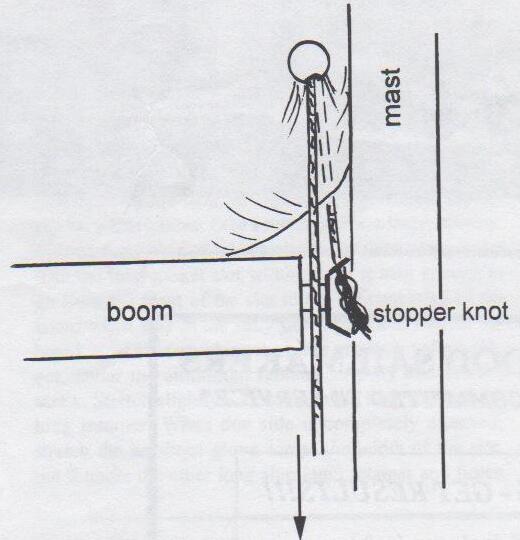
Take the dead end through the eye in the main and then feed it through the space between the goose neck and the mast. Terminate with a stopper knot.
2. The Pin through the Goose Neck
How often have you sailed in conditions where minimal or no vang is required, have tried, at a critical moment, to adjust the outhaul and have pulled the boom right out of the goose neck?
Try this.
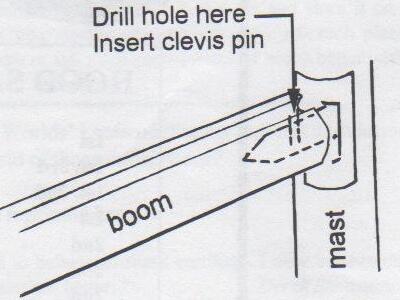
Put the boom in the goose neck, attach the main halyard to the stern end of the boom and level the boom. As shown in the attached diagram, drill a 7/64 vertical hole through the upper face of the boom and through the center line of the goose neck. You can now hold the boom in place with a split pin inserted through the hole. During storage, transport or rigging, you can use some thin line through the head of the pin to keep the pin dangling near the goose neck.
3. The Paul Van Leeuwen Magic Box Purchase
The 74xx series of Albacores (and others) have the magic box mounted on the mast, the S hook facing up. Each of the two line ends is led back to a single block on each side of the centerboard trunk and from there under the thwart to a through-the-deck block and up to a cam cleat on the port or starboard gunwhale.
This arrangement does not really give you enough purchase to apply rig tension under conditions where you want rig tension.
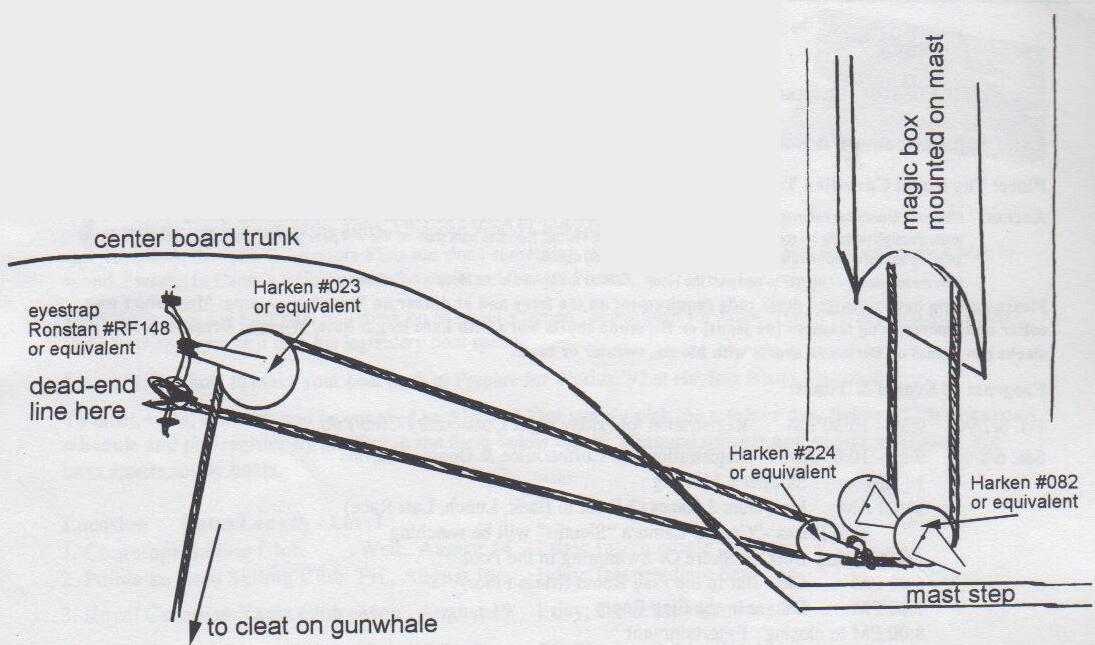
The diagram shows the solution Paul showed us several years ago. Terminate each end of the magic box line in a small block (Harken #224 or equivalent). Take some 1/4 inch prestretched line, dead-end it at the eyestrap that holds the magic box block to the centerboard trunk. Feed the other end of this line through the small block on the magic box line, return it through the block on the centerboard trunk and bring it up to the captive cam cleat near the gunwhale.
4. Fixing the Broken Mast Prebender
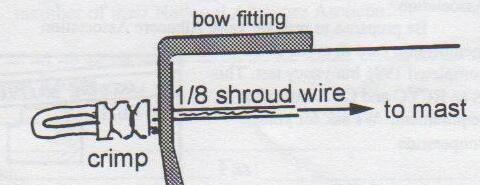
Albacores in the 74xx series have a mast prebender in which the wire holding the block under the foredeck is terminated in an eyestrap that is located right in the very tip of the bow. Repairing the eyestrap or the wire attached to it is difficult for a grown person. You could try child labour, but it will be a difficult battle.
An alternative solution is shown on the right. Drill a 7/32 inch hole right through the bow fitting from the outside. Feed the new wire through the hole, put a crimping sleeve over the end, form a small loop and crimp the sleeve, leaving a neat finish between sleeve and bow fitting.
Notice of Race: The Royal Canadian Yacht Club — Open Albacore Regatta
Date: Saturday, June 8 & Sunday, June 9, 1996
Place: The Royal Canadian Yacht Club & Toronto Inner Harbour
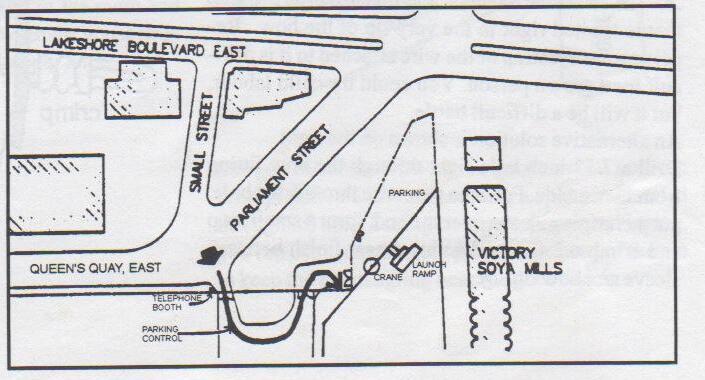
Access: City-side launching ramp available. Enter the RCYC parking lot off Queen’s Quay, East. South Side. (See map below.) Follow route through parking lot round to crane and ramp will be visible. Room to park trailers. We will provide dollies on the island side. Boats may be stored on north lawn of Club on both Fri. and Sat. nights.
Ferries to Island: Quarter to and past the Hour. Ferries to City: On the Hour and Half hour.
Please note we have a revised dress code requirement on the ferry and at dinner on Saturday evening. Men: Shirt with collar and sleeves; long trousers (no jeans) or Bermuda shorts worn with knee length hose. Women: Dress; or a skirt, slacks (no jeans) or Bermuda shorts with blouse, sweater or tunic.
Program of Events & Times
| Fri. 6/7/96 | 9:30 – 10:30 PM | Registration @ Friday night Community Club Pub. |
| Sat. 6/8/96 | 9:00 – 10:00 AM | Registration and Coffee/Juice & Donuts/Muffins |
| 10 AM | Skipper’s Meeting | |
| 11:00 AM | First Gun. 3 Races (2 Back to Back, Lunch, Last Race) Fun Prizes — “Candid Camera” “Sleuths” will be watching | |
| After Racing | Beer on Shore Or Swimming in the Pool | |
| 6:00 PM | Cash Bar in the Flag Room (Main Floor) | |
| 7:00 PM | Dinner in the Flag Room | |
| 8:00 PM to closing | Entertainment | |
| Sun. 6/9/96 | 9:00 – 10:00 am | Coffee/Juice & Donuts/Muffins |
| 11:00 – completed | 2 Races. Lunch between races. Fun Prizes | |
| After racing | Beer on shore or Swimming in the Pool | |
| 4:00 PM ± 1 hour | Prize Giving |
Entry Fees Include: Five races, 3 Saturday, 2 Sunday, 1 drop race. (all races count if fewer than 5 races are sailed). Ferry Pass to Island Saturday and Sunday, Coffee/juice & Donuts/Muffins each morning. Beer/Soft Drinks or swim after racing. Dinner, Entertainment, Flags and Prizes to Top 3 Crews.
Please bring your own lunch!
- $80.00 per boat, including 2 dinners.
- $55.00 per boat, including 1 dinner.
- $30.00 per boat, not staying for dinner.
- $25.00 per person, dinner only.
Regatta Eligibility
- Regatta is open to all Albacore sailors who are 1996 members in good standing of their National Albacore Association.
- Be prepared to provide valid Albacore Association membership card & proof of a completed 1996 buoyancy test. This is an RCYC and CAA Insurance requirement. We ask for your cooperation.
Questions? Call Rosemary Helmer or Janice Peck, R.C.Y.C.
Please Join us! Especially new sailors! A fun-filled event awaits you!
Fast Forward Seminars with Michael McNamara
3 Time — Albacore World Champion (1991, 1993, 1995)
Just when you thought Summer 1996 would be boring and nothing could match the excitement of the 1995 Albacore World Championships in Kingston, the RCYC Albacore Fleet has done something to make 1996 exciting! We’ve invited Mike Mac to spend 2 weeks in Canada training with the various Albacore Fleets.
If you have seen the Fast Fwd hull mark on Michael’s famed “Showdown for Jador” (GBR 6493) then you understand how appropriate it is to his legendary boat speed.
Join us! Learn how to make your boat go fast! Prepare for Worlds ’97 at Hayling Island, England!
To meet, train, sail with and be coached by Michael Mac simply pick the seminar date below which suits your schedule and pre-register by mailing in the form below today. Respond quickly and secure your spot! We have spaces for 80 boats.
| Location | Dates | Length — Level |
|---|---|---|
| 1. Conestoga Sailing Club | Wed., August 14 | 1 day; Intermediate Seminar |
| 2. Pointe au Baril Sailing Club | Fri., August 16 | 1 day; Intermediate Seminar |
| 3. Royal Canadian Yacht Club | Mon., August 19 | 1 day; Canadians Seminar * |
| 4. Royal Canadian Yacht Club | Tue.–Wed., August 20, 21 | 2 day; Worlds Seminar † |
| 5. Nepean Sailing Club | Sat., August 24 | 1 day; Intermediate Seminar |
* You have competed at Nationals (A Fleet). † You have competed at Worlds.
Seminar includes: Dry Land Briefings. On-the-water drills and racing. Video Taping and Debriefing. Opportunity to sail with Michael Mac. Seminar Notes. 1990 CAA Handbook. Some daily fun prizes. Lunch & Drink (each day).
Seminar Prices
| 1 day Seminar | 2 day Seminar | |
|---|---|---|
| Assoc. Member * | $60.00 per boat | $120.00 per boat |
| Non-Member | $80.00 per boat | $160.00 per boat |
* One (1) member of the crew must be a Boat owning member of their National Albacore Association.
[A mail-in registration form (name, address, hull number, contact numbers, 1st and 2nd seminar choice) followed in the original.]
Inquiries or cheques, made payable to “RCYC Albacore Fleet”, to: Rosemary Helmer, Toronto, Ontario.
Each Seminar can accommodate 10 – 16 boats. Register early.
Don’t miss this opportunity of learning how to go FAST FORWARD!
1996 Albacore Regatta Schedule
Revised. April 30, 1996
| Date | Event | Host Club | Location | |
|---|---|---|---|---|
| April 28 | Spring Vice Regatta | Mooredale S.C. | Outer Harbour | |
| May 26 | Harbour Master | RCYC | Inner Harbour | |
| June 1 | G | Warm Water Regatta | Conestoga S.C. | Conestoga Lake |
| June 1-2 | TARTS | TS&CC | Humber Bay | |
| June 2 | Peterborough Examiner | Peterborough S.C. | Clear Lake | |
| June 8-9 | RCYC Open | RCYC | Inner Harbour | |
| June 15-16 | Midland Walwyn | Nepean S.C. | Nepean | |
| June 16 | Harbour Master | Westwood S.C. | Outer Harbour | |
| June 22-23 | LSSA | ABYC | Ashbridges Bay | |
| June 30 | Centennial Regatta | Peterborough S.C. | Clear Lake | |
| July 7 | Harbour Master | OHCC | Outer Harbour | |
| July 13 | G | OHCC Regatta | OHCC | Outer Harbour |
| July 20 | Westwood Open | Westwood S.C. | Outer Harbour | |
| July 21 | Harbour Master | Mooredale S.C. | Outer Harbour | |
| July 27-28 | North American’s | Buffalo Canoe Club | Niagara River | |
| July 28 | Harbour Master | St. Jamestown S.C. | Outer Harbour | |
| August 3 | NC | Team Racing | RCYC | Inner Harbour |
| August 4 | G | Balsam Lake Open | Balsam Lake S.C. | Balsam Lake |
| August 4 | NC | Albacore Junior’s | Muskoka Lakes S.C. | Muskoka Lake |
| August 10 | Lake Ontario Challenge | Bronte Harbour Y.C. | Oakville | |
| August 10 | Ontario Championship | Mooredale S.C. | Outer Harbour | |
| August 11 | Harbour Master | Westwood S.C. | Outer Harbour | |
| August 17 | G | PABAR | Pointe au Baril S.C. | Georgian Bay |
| August 17 | New Skipper’s Race | Westwood S.C. | Outer Harbour | |
| August 18 | Women’s Helm | St. Jamestown S.C. | Outer Harbour | |
| August 24 | Toronto Island Open | Toronto Island S.C. | Inner Harbour | |
| August 25 | Harbour Master | Toronto Island S.C. | Inner Harbour | |
| Aug 31/Sept 1 | St. Jamestown Open | St. Jamestown S.C. | Outer Harbour | |
| September 7 | Round the Island Klinger | St. Jamestown S.C. | Toronto | |
| Sept. 7-8 | G | Fanfare ’96 (Area 10) | Nepean S.C. | Nepean |
| September 8 | Harbour Master | St. Jamestown S.C. | Outer Harbour | |
| September 13-15 | Canadians’ | Geneva Park | Lake Couchiching | |
| September 14 | Not-the-Canadians’ | Mooredale S.C. | Outer Harbour | |
| September 21 | Fall Vice Regatta | Mooredale S.C. | Outer Harbour |
G = Races designated for Gooderham Series. The Gooderham Trophy was established in memory of Bill Gooderham to encourage Albacore sailors to travel to regattas across Ontario. It is awarded annually to the helm who achieves the best results in the series.
NC = Venue or event not yet confirmed
Harbour Master scoring: Ian Aukema, St. Jamestown.
Harbour Master Treasurer: Rosemary Helmer.
1996 Toronto Friday Race Schedule
| Date | Host Club | Location |
|---|---|---|
| May 3 | Mooredale | Outer Harbour |
| May 10 | St. Jamestown | Outer Harbour |
| May 17 | OHCC | Outer Harbour |
| May 24 | Mooredale | Outer Harbour |
| May 31 | Westwood | Outer Harbour |
| June 7 | Toronto Island | Inner Harbour |
| June 14 | St. Jamestown | Outer Harbour |
| June 21 | OHCC | Outer Harbour |
| June 28 | Mooredale | Outer Harbour |
| July 5 | OHCC | Outer Harbour |
| July 12 | Toronto Island | Inner Harbour |
| July 19 | Westwood | Outer Harbour |
| July 26 | St. Jamestown | Outer Harbour |
| August 2 | OHCC | Outer Harbour |
| August 9 | Mooredale | Outer Harbour |
| August 16 | Westwood | Outer Harbour |
| August 23* | Toronto Island | Inner Harbour |
| August 30* | St. Jamestown | Outer Harbour |
| September 6* | Westwood | Outer Harbour |
* signifies a 6:45 PM start
Scoring Responsibilities: Friday Night Series: Will Lincoln, Mooredale.
Sailing the Information Highway: More Web Sites of Interest
http://www.odyssee.net/~jlevy/toc.html/
1996 Toronto Harbour Master’s Series
The Harbour Master’s Series for Albacores began in 1978 to promote weekend racing. It was organized by three clubs located on the Toronto islands, The Royal Canadian Yacht Club, North Toronto Sailing Club and Westwood Sailing Club. The perpetual Trophy was donated by Captain John Mann, the Harbour Master of Toronto. Hence the name of the series. The series consists of 2 races, back-to-back on 8 Sundays, for a total of 16 races.
1996 Organizing Clubs and Representatives
| Mooredale Sailing Club | Todd Johnstone |
| Outer Harbour Centerboard Club | Ross King |
| St. Jamestown Sailing Club | Ian Aukema |
| The Royal Canadian Yacht Club | Rosemary Helmer |
| Toronto Island Sailing Club | Elizabeth Fedorkow |
| Westwood Sailing Club | Steve Neville |
Scorekeeper: Ian Aukema, St. Jamestown Sailing Club
Schedule of Races
| Race No. | Date | Host Club | Location |
|---|---|---|---|
| 1&2 | May 26 | RCYC | Toronto — Inner Harbour |
| 3&4 | June 16 | WSC | Toronto — Outer Harbour |
| 5&6 | July 7 | OHCC | Toronto — Outer Harbour |
| 7&8 | July 21 | MSC | Toronto — Outer Harbour |
| 9&10 | July 28 | StJSC | Toronto — Outer Harbour |
| 11&12 | Aug. 11 | WSC | Toronto — Outer Harbour |
| 13&14 | Aug. 25 | TISC | Toronto — Inner Harbour |
| 15&16 | Sept. 8 | StJSC* | Toronto — Outer Harbour |
Awards & Prizes
Weekly Prizes to Top Three Skippers and Crews for Individual Races
Overall Series Champion — Harbour Master Trophy
Participation Award — David Treissman Memorial Trophy
*1996 Prize Giving at St. Jamestown Sailing Club following September 8, 1996 races.
Entries
- Any yacht which is a member of one of the organizing clubs or their National Albacore Association is eligible to participate in the Series.
- Members of MSC, OHCC, StJSC, TISC and WSC will have their fees paid by their clubs.
- Members of RCYC or any other Club must register their yachts and pay their $16.00 per boat series fees to “Rosemary Helmer — Harbour Master Treasurer”.
- Boats registered for the Series are eligible for full participation in the racing, awards and prizes. Completed registration forms with cheques are to be mailed to the Harbour Master Treasurer, Toronto, Ontario.
[A registration form (name, boat number, address, contact numbers) followed in the original.]
Waiver of Liability
By participating in this Series of Races, I understand that I voluntarily assume and am knowledgeable of the risks of sailing and I assume sole responsibility for myself, my crew and the boat in which I sail. I agree to hold harmless and free of liability the organizing Clubs, their members, employees, officers and individuals appointed as volunteers for this Race Series and the Canadian or US Albacore Associations for any damage, material or personal, suffered by me and my crew during the racing or otherwise.
1996 USAA Regatta Schedule
| Date | Event | Site | Contact |
|---|---|---|---|
| May 18 – 19 | Mid-Atlantics | Clinton NJ | Art Mohan |
| May 25 – 26 | Spring Regatta | Washington DC | Daphne Byron |
| May 25 May 26 | Memorial Day & Bridge Race | Red Bank NJ | Margaret Little |
| June 1 | Spring Fling | Red Bank NJ | Margaret Little |
| June 14 – 16 | Kerr Dam Fun Daze | Kerr Lake NC | Bill Kleysteuber |
| June 29 – 30 | Women’s Nats. | Washington DC | Joanna Byron |
| July 6 – 7 | Rock Hall | Rock Hall MD | John Macielag or Don Dunn |
| July 6 July 7 | Independence Day & Bridge Race | Red Bank NJ | Margaret Little |
| July 13 – 15 | Cambridge | Cambridge MD | Ed Nabb Jr. or Yacht Club |
| July 27 – 28 | N. Americans | Buffalo Canoe Club | Not Available |
| Aug 10 – 11 | Fishing Bay | Deltaville VA | Bob Wardwell |
| Aug 31 Sept 1 | Labor Day & Bridge Race | Red Bank NJ | Margaret Little |
| Sept 7 – 8 | Leukemia Cup | Washington DC | Matt Edwards |
| Sept 28 | Tuna Bowl | Red Bank NJ | Margaret Little |
| Oct 12 – 14 | Nationals | To Be Announced |
Notice of Regatta: North American Albacore Championships
Saturday, July 27 and Sunday, July 28, 1996
at
The Buffalo Canoe Club, Lake Erie, Ontario
Schedule of Events
| Saturday, July 27 | |
|---|---|
| 9:00 | Registration begins at BCC |
| 10:00 | Skippers’ Meeting |
| 11:00 | Race 1; Race 2 follows immediately |
| 13:00 | Lunch |
| 14:00 | Race 3 |
| 16:30 | Beer and Wine Reception |
| 18:00 | Barbecue Dinner |
| Sunday, July 28 | |
| 10:00 | Race 4; Race 5 follows immediately |
| 13:00 | Lunch and Awards |
Camping and other reasonable accommodation are available nearby. Watch for more information in future issues of Shackles and Cringles.
For more information contact Bob Stiff.
The Fashion Page
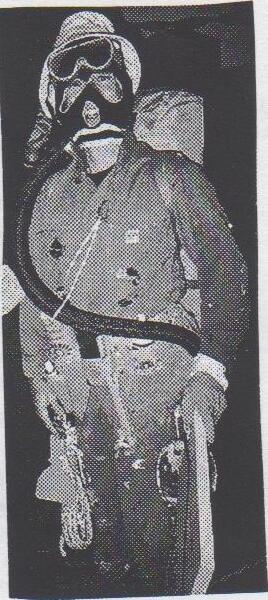
One of the charming aspects of Albacore sailors is their dress code. A casual observer might be driven to explode with a thoughtless phrase like, “What dress code?”. Casual observers have often mistaken our attention to local details as inattention to the Armani dictates of the sailing world. Little do they know of our long-lived efforts to have Harry Rosen carry designer hiking boots. Little do they know of the annual Derek Shenstone seminars on co-ordination, accenting and creative duct taping.
Our range is wide. We blend into the Muskoka scene with Versace shorts, the RCYC scene without jeans and the community club scene with Spadina schmatter. We are expert at the seamless blend of form and function and in Toronto’s Outer Harbour, function poses special challenges.
The water of the Outer Harbour is ideal for the beginning sailor because you can always walk to shore if you dump on it. Such waters can be hard on your Hermes. Enter the Lincoln Sunday Sailing and Survival Suit (right). Fashionably detailed, yet functionally formed. It offers protection against rays, gases, thermal shock and bird bombs. There’s a Kaleshnikov whistle to fend off outboard yahoos. Available in S, M, L, XL in navy, pine, olive and fluorescent orange.
Market Place
#7980
Very fast. Superbly rigged.
Extremely crew-friendly.
Excellent price includes all tuning data.
Jorg Pawlik.
For Sale — Virtually New Sails!
1995 JC Sails (Main & Jib) used at 3 regattas (10 days at Worlds).
Call Rosemary Helmer.
Chris Gorton has compiled a master list.
- Albacores for sale
- Albacores wanted
- Parts for sale or wanted
Call Chris for a copy of the list or for putting something on the list.
1996 Experimental Right-of-Way Rules and Definitions
IYRU — sponsored by Harken. Printed in the original as a fold-out booklet (“Cut off these last 3 pages. Fold in the middle and make your own rule book.”); the pages are sideways in the scan and are given here in reading order.
The International Yacht Racing Union asks National Authorities, clubs and classes to test these rules and to send comments or suggestions to:
IYRU Racing Rules Committee
c/o IYRU
27 Broadwall, Off Stamford Street
Waterloo, London, SE1 9PL
United Kingdom
Send email to [email protected].
The 1996 experimental rules will be the basis for a draft of the right-of-way rules for the 1997-2000 rule book, to be acted upon in November 1996.
Definitions
Clear Astern and Clear Ahead; Overlap
One boat is clear astern of another when her hull and equipment in normal position are behind an imaginary line abeam from the aftermost point of the other’s hull and equipment in normal position. The other boat is clear ahead. They overlap when neither is clear astern or when a boat between them overlaps both. The terms clear astern, clear ahead, and overlap apply to boats on opposite tacks only when rule 8 applies.
Keep Clear
One boat keeps clear of another when the other boat can sail her course with no need to take avoiding action.
Leeward and Windward
A boat’s leeward side is the side on which she is or, when head to wind, was carrying her mainsail. The other side is her windward side. When two boats on the same tack overlap, the one on the leeward side of the other is the leeward boat. The other is the windward boat.
Mark
A mark is any object the sailing instructions require a boat to pass on a specified side. Its anchor line and objects attached accidentally or temporarily are not part of it.
Obstruction
An obstruction is something a boat could not pass, if she were sailing changing course substantially. An object that can be safely passed on only one side and an area so designated by the sailing instructions are also obstructions. However, a boat racing is an obstruction to other boats only if each of them is required to keep clear of her or give her room.
Proper Course
A boat’s proper course is a course she would sail to finish as soon as possible in the absence of other boats referred to in the applicable rule. A boat has no proper course before her starting signal.
Racing
A boat is racing from her preparatory signal until either she has finished and cleared the finishing line and marks or retired, or the race committee has signalled a general recall, postponement, or abandonment.
Room
Room is the room a boat needs in the prevailing conditions to manoeuvre promptly in a seamanlike manner.
Tack, Starboard or Port
A boat is on the tack, starboard or port, corresponding to her windward side.
Time
Time is the time a boat needs in the prevailing conditions to manoeuvre promptly in a seamanlike manner.
The definitions Bearing Away, Close-hauled, Gybing, Luffing, Mast Abeam and Tacking are deleted. Other definitions are unchanged.
Rules When Boats Meet
These rules apply between boats sailing in or near the racing area that intend to race, are racing, or have been racing. However, these boats are subject to the International Regulations for Preventing Collisions at Sea or government right-of-way rules when the sailing instructions so state or whenever they meet other vessels. A boat not racing shall not be penalized for breaking an experimental right-of-way rule except rule 4.
Section A — Primary Rules
1 Avoiding Contact
Every boat shall, if reasonably possible, avoid contact with another boat. However, a right-of-way boat or a boat entitled to room need not act to avoid contact until it is evident that the other boat will not keep clear or give room.
2 Acquiring Right of Way
When a boat acquires right of way, she shall initially give the other boat room and time to keep clear, unless that boat gave up her right of way by her own action.
3 Changing Course
When a right-of-way boat changes course, she shall give the other boat room and time to keep clear.
4 Not Racing
A boat not racing shall, if reasonably possible, not interfere with a boat that is racing.
Section B — Right-of-Way Rules
A boat has right of way when another is required to keep clear.
5 Opposite Tacks
5.1 When boats are on opposite tacks, the port-tack boat shall keep clear.
5.2 When a starboard-tack boat on a beat is within two of her hull lengths of a port-tack boat, the starboard-tack boat shall not change course if as a result the port-tack boat would have to take additional action to keep clear.
6 Same Tack
6.1 When boats are on the same tack and overlapped, the windward boat shall keep clear.
6.2 When boats are on the same tack and not overlapped, the boat clear astern shall keep clear.
6.3 When boats are on the same tack and a boat clear astern establishes a windward overlap, she shall do so far enough away from the leeward boat that the windward boat has room and time to keep clear if the leeward boat changes course.
6.4 On a free leg of the course, when a leeward boat that established an overlap from clear astern is less than two of her hull lengths from a windward boat, she shall not sail above her proper course.
6.5 When a boat on a free leg of the course is less than two of her hull lengths from a boat on the same tack that is either a leeward boat or a boat clear astern steering a course to leeward of her, she shall not sail below her proper course unless she gybes.
7 Tacking
A boat tacking shall keep clear of other boats from the time she is past head to wind until she is on a close-hauled course. Rules 5 and 6 do not apply.
Section C — At Marks and Obstructions
8 Room to Pass a Mark or Obstruction
8.1 BASIC RULE
A boat overlapped outside or clear astern of another shall give the other boat room to pass a mark or obstruction. This basic rule is modified by other parts of rule 8.
8.2 APPLICATION
Rule 8 applies between boats from the time they are about to pass a mark or obstruction on the same side until they have passed it. However, it does not apply at a starting mark or its anchor line or between boats on a beat on opposite tacks. Parts of rule 8 modify a boat’s rights and obligations under the rules of Section B.
8.3 TWO-LENGTH REQUIREMENTS FOR ROOM
(a) A boat overlapped inside another is entitled to room only if the outside boat was able to give room when the overlap began and the boats are overlapped when either boat comes within two of her hull lengths of the mark or obstruction. If so, the inside boat remains entitled to room even if the overlap is broken later.
(b) A boat clear ahead of another is entitled to room only if she is clear ahead when two of her hull lengths from the mark or obstruction. If so, she remains entitled to room even if an overlap is established later.
8.4 TACKING AT A MARK OR OBSTRUCTION
(a) A boat clear ahead that tacks to pass a mark or obstruction is subject to rule 7.
(b) After two boats on opposite tacks have approached a mark or obstruction and one of them tacks within two of her hull lengths of it, the boat that tacks is subject to rule 7 and
(1) is not entitled to room if the other boat must sail above close-hauled to avoid her.
(2) shall give room if the other boat becomes overlapped inside her.
Rule 8.3 does not apply.
8.5 GYBING AT A MARK OR OBSTRUCTION
An inside right-of-way boat that will have to gybe at a mark or obstruction to sail her proper course shall sail no farther from the mark or obstruction than needed to sail her proper course.
8.6 ROOM AT A CONTINUING OBSTRUCTION
At a continuing obstruction, a boat that establishes an inside overlap from clear astern is entitled to room only if at that time there is room to pass between the outside boat and the obstruction and the outside boat is able to give room. Rule 8.3 does not apply.
8.7 DOUBT ABOUT AN OVERLAP
When there is substantial doubt about whether a boat established an overlap as required or broke an overlap in time, it shall be presumed that she did not.
9 Room to Tack at an Obstruction
9.1 Except at an obstruction that is a mark or its anchor line, when safety requires a close-hauled boat to make a substantial course change to clear an obstruction, and when she intends to tack but does not have room to tack without colliding with another boat on the same tack, she shall hail for room to tack and avoid the other boat. Before tacking, she shall give the hailed boat time to respond.
9.2 The hailed boat shall either
(a) tack as soon as possible, in which case the hailing boat shall tack as soon as possible, or
(b) immediately hail ‘You tack’, in which case the hailing boat shall immediately tack and the hailed boat shall give room. Rules 5 and 7 do not apply.
Section D — Other Rules
When a rule of Section D applies between two boats, the rules of Section B do not apply between them.
10 Penalty Turns; Correcting Starting Errors
A boat making turns to take a penalty under rule 52.2(a) or Appendix B1, paragraph 1.1, shall keep clear of boats not doing so. A boat sailing toward the pre-start side of the starting line or its extensions to comply with rule 51.1(b) or rule 51.1(c) shall keep clear of boats not doing so until she is wholly on the pre-start side.
11 Capsized, Aground, Anchored, or Rescuing
Unless unable to do so, a boat shall keep clear of a boat that is capsized with her masthead in the water or has not regained control after being capsized, or is aground, anchored, or trying to help a vessel or person in danger.
Text of Rules Copyright © 1995 International Yacht Racing Union, All Rights Reserved
IYRU Racing Rules ’93-96 Contents
Last changes made on: January 29, 1996
URL: http://www.sailing.org/rules/xrule96
Contact: [email protected]
Copyright © 1995-96 Arthur Engel, All Rights Reserved