April 1999
April 01, 1999
April 1999 issue of the Canadian Albacore Association newsletter — Gordon Chu's Commodore's Corner, the Albacore World's Training Camp announcement, a Letters to the Editor exchange on the 1999 Internationals qualification debate, Henry Pedro's Mid-Winter Regatta recap from Sarasota, Barney Harris's two-part tuning and sailing guide, Rosemary Helmer's "How To" on measurement certificates, and notices of race for RCYC, St. Jamestown, CYA Sail East, the Harbour Master's Series, and the full 1999 regatta schedule.
The Albacore Advantage
A One-design Boat
- no unnecessary expense of constant upgrades in design
A Safe Boat
- large air-filled tanks give excellent buoyancy
- hull shape gives stability on the water
- self-rescue after an unexpected puff is easy
A Light and Manageable Boat
- tongue load of less than 100 lbs gives ready trailerability
- launching and retrieving are a breeze
A Comfortable Boat
- large, open cockpit
- benches on port and starboard sides
A Performance Boat
- seriously campaigned by major sailmakers
- planes in moderate winds
- buoyant heavy-air hull shape
Ideal for Junior Clubs
- 4 to 5 juniors will fit easily
- will stand up to heavy use
A Vibrant Class Association
- well organized and vital
- recognized by the International Sailing Federation
- strong fleets through Ontario, Canada, US, Great Britain, Ireland and Bermuda
- top notch competitive sailing
- junior programs in some areas
1998/99 Canadian Albacore Association Executive
| Position | Name | Address | Contact |
|---|---|---|---|
| Commodore | Gord Chu | 310 Durie St. Toronto, ON M4J 1X9 | H (416) 760-8778 W (416) 733-6851 F (416) 733-6777 [email protected] |
| Past Commodore | Bob Stiff | 20 Southlea Avenue Toronto, ON M4G 3L9 | H (416) 423-3294 W (416) 482-5002 F (416) 482-5040 [email protected] |
| First Vice Commodore, Marketing | Laurie Harrison | 340 Avenue Road Apt 435 Toronto, ON M4V 2H3 | H (416) 920-5146 W (416) 946-3778 F (416) 978-7705 [email protected] |
| Second Vice Commodore, Racing | Doug Paterson | 221 Woburn Ave. Toronto, ON M5M 1L1 | H (416) 480-0877 W (416) 974-5101 F (416) 974-7789 [email protected] |
| Chief Measurer | Rick Clayton | 362 Brookdale Avenue Toronto, ON M5M 1P8 | H (416) 783-9194 W (416) 932-4427 F (416) 932-4342 [email protected] |
| Treasurer | Jason G. Roth | 60 Cheviot Cres. Brampton, ON L6Z 4G7 | H (905) 840-5395 W (416) 675-4826 F (416) 674-6849 [email protected] |
| Specifications Chair | David Weaver | 14 Lansddowne Rd North Cambridge, ON N1S 2S8 | H (519) 623-4402 W (905) 525-9140 ext 24907 F (905) 572-7944 [email protected] |
| Secretary | Raines Koby | 5 Cosdale Place Palgrave, ON L0N 1P0 | H (905) 880-1866 W (905) 264-6123 F (905) 264-2944 [email protected] |
| Editor, Shackles & Cringles | Nona Arneson | 95 Lawton Blvd., Apt. 608 Toronto, ON M4V 1Z8 | H (416) 485-3572 W (416) 586-8642 [email protected] |
| Membership | Rose Anne Mallett | 22 Ridley Blvd. Toronto, ON M5M 3K9 | H (416) 486-0515 [email protected] |
| Rear Commodore | Heather Macnaughton | 99 Harbour Square, Unit 1812 Toronto, ON M5J 2H2 | H (416) 367-9898 W (416) 868-8205 F (416) 868-3817 |
| IAA Representatives | Rosemary Helmer, IAA Secretary Ian Rogers, IAA Treasurer | 264 St. Clair Ave. W. Toronto, ON M4V 1R7 155 University Ave #1600 Toronto, ON M5H 3B6 | H (416) 964-8427 W (416) 410-4644 F (416) 961-4644 [email protected] H (416) 485-5136 W (416) 361-0626 F (416) 361-6303 |
| IAA Chief of Specifications | David Weaver |
Shackles and Cringles is a quarterly publication of the Canadian Albacore Association. Deadlines for publication are January 15, April 15, July 15 and October 15.
Commodore's Corner
Another season is on its way! Many of us find this to be an exciting and busy time of year when we begin to get our boats into the water. And many also find that the work and various projects seem to pass by quickly as we dream of those idyllic sailing conditions to come.
For myself, I am torn between doing these things versus looking after my first child Samantha. She was born Jan 1 and is growing like a water lily in the Toronto Inner Harbour in August. Obviously Samantha will take precedence for my wife and me, but we will also get our share of time on the water. I do not intend to let my titles go totally undefended this summer. My daughter really enjoys her baths, so we expect her to really take to the water as she gets older.
The Spring Thaw Get-together was held as advertised on April 14. It was a smallish gathering, but I think that everybody there enjoyed the chance to gam with one another. I would like to thank Ken Mitchell from Ullman Sails and Luis Perez from Patagonia Boatworks for taking the time from their busy schedule to be able to speak to us. I certainly found their talk to be interesting and very practical.
There is one exciting bit of news this spring from the association and that is the Albacore World's Training Camp being held June 17-20 in Toronto. Please see the notice and application form included in this bulletin. This is an advanced race training course and we have assembled some top notch coaches. These include Canadian Olympians Kevin Smith (Tornado) and Larry Lemieux (Finn) as well as current Canadian and US Albacore champion Barney Harris. This is a must for anybody wanting to move up in the coming International Championships in the US in October.
Also a reminder that the membership year has started so I ask that you promptly return your renewals.
Albacore World's Training Camp
June 17-20, 1999, Toronto, Ontario
This advanced course, endorsed by the Canadian Albacore Association, is designed for top-half-of-the-fleet sailors who want to move up to the next level, especially for the International Albacore Championships coming up in the US in October. This training camp is best suited to those CAA skippers who have sailed in previous World's or Canadian Championship "A" fleets.
Date:
This is a 4-day course running full days from Thursday June 17 to Sunday June 20.
Location:
The course will be held at the Toronto Outer Harbour clubs. The on-water training may be either in the Outer Harbour or out in Lake Ontario.
Instructors:
June 17-18 training is being led by Larry Lemieux, Canadian Olympian and former Canadian Finn champion. Assisting Larry will be coaches Kevin Smith, Canadian Tornado Olympian and a third coach still to be named.
June 19-20 training is being led by Barney Harris, current Canadian and US Albacore champion, also assisted by coaches Kevin and TBD.
The focus for both the water and land training will include tactics, strategy, starting, and boat handling. Barney will key in specifically on Albacore boat speed and handling.
Registration/Costs:
The course is open to skippers who are members of the Canadian Albacore Association (this also includes sailors from community clubs that have purchased membership for their boats). Registration is limited to 24 boats in order to provide individual boat attention by the three coaches. The costs for the course is $135.00 per boat (2 people).
Please find the registration form inserted into your copy of Shackles & Cringles.
Letters to the Editor
Greetings,
What a pleasant surprise to find your organization and web site during a bit of meandering around the web. Perhaps you can explain something that I have wondered about for a few years.
First though, I own an Albacore - a classic purchased by my father for our use at the cottage - sometime around 1957/8. I can remember the day it was delivered in the oak shipping cradle, to the 'landing' at the end of the road - all the way from Fairey Marine in Hamble Hants, England. Made from moulded mahogany, our Albacore is still in close to mint condition.
I wonder if the late Bill Gooderham saw his first Albacore at the same Toronto boat show my father used to talk about. There were no other Albacores on Lake Bernard (Sundridge) and no instructions for rigging - so my Dad and I drove around the nearby lakes looking for someone who knew how to do the rigging. He was one of the few males who always read instructions - and I inherited those genes.
He finally had to 'just figure it out' and we have had many happy hours of family sailing at the cottage. We have never raced our boat and the gear has been well maintained. The sails are the original egyptian cotton sailcloth - no mildew - emblazened with the numbers A132. I know that new Dacron sails would add a lot more speed - but I would miss the smell of the cotton sails.
My questions concern the sail numbers. Do these numbers refer to the boat or do they refer to the sails? How were these numbers assigned and what do they represent? When it becomes necessary to replace these sails, can the number be transferred? Finally, if these numbers indicate registration with a Canadian Albacore association - do you know if my father, Dr. Philip A. Voelker, was ever a member?
It has been several years since we last launched the sailboat. Replacing stairways and other cottage construction projects along with increased work demands have cut down on our available sailing time. We also shifted to windsurfing which didn't require as much time and made it easier to put things away at the end of a weekend. But - this year she will definitely be back in the water!
Thanks for any information you may have.
Cheers,
Cam Voelker
Waterloo Ontario Canada
[email protected]
Hi Cam,
Thanks for the lovely letter. It is always nice to hear from Albacore sailors and to hear their stories and memories.
The sail number is very significant. Each individual Albacore in the world is assigned a unique hull number by the international class association for each boat built by a licensed builder. The very first boat was assigned #1. #132 is clearly one of the earliest. There are now over 8,000 Albacores worldwide.
It is the practice now for the builder to permanently etch the hull number on the inside of the transom. The sail number should also match the hull number. Since you have cotton sails, I would assume that these are the original sails made for your boat, so that #132 would also be your hull number. Of course it is possible for a boat to have sails with non-matching numbers (especially if you purchased somebody else's sails). You should probably look for the hull number next time you are at the cottage to check. If and when you buy new sails, you should ask the sail maker to add the numbers which match your hull number.
The Canadian Albacore Association Handbook was published in 1990. In it is a listing of all Albacores in Canada (and some US) known to the Canadian association. Boat number 132 is not listed. I do see however that #133 is listed as also being a Fairey Marine boat. I also scanned the list to look for your father's name but I did not see it. Therefore I can only assume that your father was never a member of the Canadian association.
We are very happy to hear that you and your family have kept the boat in good condition and that you will be sailing it again this summer.
Gordon Chu, Commodore, CAA
P.S. Cam, would it be alright if we published your letter in the next issue of our newsletter?
Dear Gordon,
Yes, you may publish my letter if you wish. Had I known the note might have been published I would have emphasized the passion my father had for Viva II (his Albacore) and Viva I (his wife). A prairie girl, my mother probably felt she had received a back-handed compliment when the Viva II was named, but Dad believed they shared similar characteristics. They were beautiful, strong, good with children, and dangerously exciting when pushed too hard!
Cheers,
Cam Voelker
Dear Nona,
As you know I have supported the Editor of Shackles & Cringles over the past 20 years by contributing various Notices of Race, Regatta Reports, articles and announcements. I will happily continue to do so when I have time and relevant contributions to offer. However, from time to time I find myself getting vexed about two things and I would like other CAA members to begin to find, consider, discuss, and offer some solutions to these matters.
Periodically someone comments to me that they have read "yet another" of my insertions in the pages of Shackles & Cringles. Many say "thanks - interesting article" while others act as if I am dominating "the magazine". I would like to clarify that if others wrote articles for the Editor then my submissions would be one of many. Instead, they end up being the sole contribution the Editor gets to edit and without which you and other Editors have said "Gee I would need to write the entire issue myself."
So here is my challenge to those who like to "comment, yet do nothing"! Why not get off your duffs and write something yourself! And don't give us the excuse "I don't have the time!" You have the time to comment and/or snipe from the side lines so why not write it down. Or is it that you prefer to snipe and not write anything productive or useful? A boat owners' Association needs to hear from all quarters of its membership. Regrettably we frequently do not receive communications from our members yet a few are the first to have opinions to throw at me, the Executive or the Editor. Perhaps those few of you in this category would like to volunteer your time instead of wasting mine and that of others with your negative comments. If you don't own a boat you can contribute something from a 'Crews perspective" and while you are at it why not become an Associate member of the CAA? The CAA needs not only its members monies but their active involvement and an understanding of their thoughts on many issues relevant to all.
This brings me to my second point. I have read several articles from Barney Harris in the past issues of Shackles & Cringles. While I am pleased that he is taking time to contribute articles such as the very informative boat tuning article in the last issue, I don't agree with all of his visions for the Albacore class.
As an American I think Barney's views are relevant to the USAA and I leave it to their members to agree or disagree with him. However, his views and challenges to the Canadian qualification process for the 99 Internationals are totally disrespectful and should be irrelevant to Canada. We are independent thinkers. We don't need Barney to tell us what to think!
In 98 in an effort to support the USAA hosted 99 Worlds/Internationals event Canada devised, published and ran qualifying events around the geographical circuit which encouraged participation at local regattas. The process was fair, open to all and productive. The qualification process identified 20 qualified helms to go to Worlds a year in advance of the event which gave people plenty of time to plan their holidays and racing schedules or to decline their position in favor of the next qualified Canadian helm. Canada was prepared to qualify more helms if the USAA wanted to encourage a larger attendance from Canada to help them make their budgeted break-even targets. But we did not hear from them on this point. In fact, Canada was never to my knowledge, via the normal IAA process of communication, courteously asked by Barney, the Worlds Committee nor the USAA to consider abandoning our formula. Instead they wrote a Notice of Race which makes 99 an Open Event and which contradicts the existence of Canada or the UK's respective qualification processes. In so doing I believe they hold their views as more important than ours and that they view the 99 event as "theirs" not "ours" (internationally). I believe the US could have taken our views into consideration, in fact they did not.
The fact of the matter is that the event the US proposes to be Open is not at all. Yes, they have taken away the restriction of calibre! But, much remains restricted and quite rightly so, for example; albacore association membership, boat and liability insurance, payment of the USAA's registration fee (which for Canadians given our current exchange rates) is quite high for a 4 day event, not to mention the cost of taking time away from work, travel, accommodation - all for what? For the privilege of participating in an event at which you now run the risk of experiencing more protests, collisions and acrimony as inexperienced helms now have the right to learn "live at Worlds" at the expense of those who have met a standard of qualifying competence? (By the way the Canadian standard of competence was not significantly restrictive it simply controlled the inexperienced; it was for helms to place in the top half of the Fleet. If a helm cannot make that standard then Canada has traditionally taken the view that they should not be on a Worlds line as a helm.) In the past this has not precluded non-qualifying helms from crewing for a qualified Canadian helm and thereby gaining further experience.) Me thinks this so called OPEN event is a misnomer and a disincentive to go rather than a positive incentive to attend. As someone who has had $8,000.00 worth of unintentional damage inflicted on my boat over the past two years by inattentive helms, not to mention the time I have had to waste on the paperwork of insurance claims and time off the water because my boat was being repaired, I am not amused by the prospect of the highest calibre event the Albacore class runs worldwide being downgraded to a "free for all" in which the only qualifying criteria Barney considers valid is "those with a pulse!" and those with "the money to go".
Further Barney has told several of us that our thinking is "flawed' because we don't agree with him. In fact, in my opinion I believe his view demonstrates no respect for Canada's efforts to support the US event in a manner which is consistent with our traditional qualifying processes. Not everyone from the UK will be able to attend either because they cannot take the time or money to come. So natural restrictions do exist elsewhere. And how does the UK decide who gets into the UK container? Perhaps Barney would like to comment on that point as well?
Simply put I don't see why Canada needs to;
1) abandon its very well thought out Qualification Process to suit Barney or the USAA for the 1999 Worlds / Internationals.
2) give Barney's articles full coverage in S&C with no opportunity for Canadian IAA members or CAA members to comment in the same issue. The 98-99 qualification process was designed with input from and approved by the CAA Executive after much thought based on the way we have established past qualifications processes. It is a formula which works to encourage high calibre participation and to encourage practice in advance of the event by those aspiring to attend. It has been used with great success in the past and in discerning A & B Fleets for Canadians and the US National for many years. I see no need to go to this "OPEN" unrestricted calibre event!
3) attend US Internationals if our thinking is disregarded or disrespectfully labelled by Barney as "flawed".
I for one am still considering whether going to this 99 event is a good idea. I sail for the fun of being among friends. Our discussions have not sounded friendly to me. The wide Open formula gives me more cause for concern than motivation to attend. I'd be interested to know what other CAA members think? I'd be appreciative if you would publish my letter.
Rosemary Helmer, CAN 7384.
Dear Rosemary,
As the editor of Shackles & Cringles I appreciate contributions regarding Albacore sailing from all Albacore sailors. I beleive the greater the variety of contributors the better the publication will be. You have made a significant contribution to Shackles & Cringles in the past and it is my hope that you will continue to do so.
While it is inappropriate for me to comment on your opinions regarding Barney Harris and the World's your comments regarding the contents of Shackles & Cringles deserve my response. As you must be aware, Barney Harris is the current US, Canadian and North American champion. Therefore, I don't think it is an unreasonable assumption that Albacore sailors, regardless of their national association are interested in what he has to say with regards to racing albacores. To my knowledge Shackles & Cringles has published all articles that have been received for publication. Publishing Barney's material has not been at the exclusion of hearing the opinions about tactics and tuning from someone else. I would also add that Barney Harris is a member of the Canadian Albacore Association.
Nona Arneson, Editor
1999 Albacore Mid-Winter Regatta
March 23-26, Sarasota Sailing Squadron, Sarasota, FL USA
By Henry Pedro
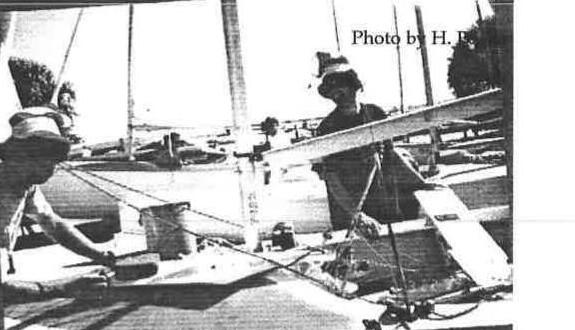
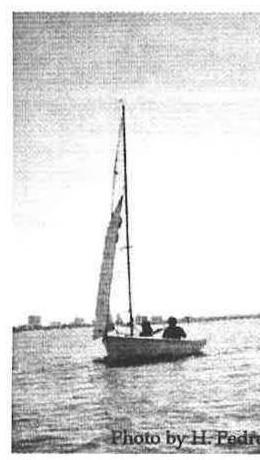
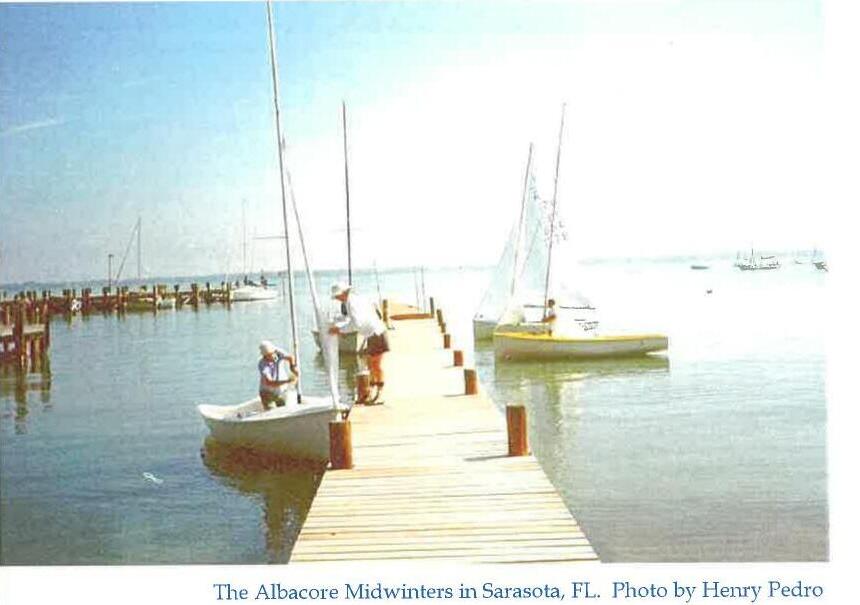
Well, March finally rolled around this year and with it came the usual glut of changes: the end of ski season, maple syrup, warmer weather and of course, the Albacore Mid-winters. That's right. While the rest of the world was wondering when they were going to get to go sailing again, a stalwart bunch made the trek to Sarasota for the annual ritual. Not just a rust remover, this regatta featured plenty of hard sailing, long beats, longer reaches and even longer social events.
The week-long event started off innocently enough. Slowly, but surely, boats started trickling into the area and by Monday afternoon all were ready to hit the water. But not before declarations were made, accusations thrown and underwear lost. (More on this later.)
Tuesday Morning: The mayhem begins. Six boats head out onto the water. The committee heads out. The committee heads back to shore leaving six Albacores at the course area. Turns out the committee forgot their chart on shore. Racers are left wondering if this is a bad omen. No matter. It gives Chris and henry time to actually make it to the start line on time (their biggest challenge for the week). The starting sequence begins. Stopwatches are set. Flags go up, flags come down, skippers and crew scratch their heads. Start flag goes up. No one crosses the start line. Someone finally figures out that the start flag just went up and punches it. Wondering what was going on? Well, it turned out that the starting sequence was only 4 minutes long.
Fourth Race: Sail to the "G" mark, then the "D" mark then the "B" mark, back to "G" and finish on a run to the "I". Sounds simple doesn't it? Sure, until a parade of Albacores race back and forth across the bay looking for a "G" mark that didn't exist.
The tone for the week was set and things didn't clear up much. The rest of the week was mostly sailed with the participants in that familiar sort of mid-regatta haze. (You know the one - halfway between drunk and a full-blown hangover.)
Okay, so on to some non-sailing events.
Many participants caught the sunset at "The Beach House" restaurant and took over as the in-house entertainment. You've got to feel for the poor in-house guitarist. He must have been feeling a wee bit inadequate when they all started singing the theme to "Gilligan's Island".
Then there was the party at Chris and Cassie's place. Everyone came well prepared. Especially Dave (The Fish) Huber who must have carted over several barrels of exotic Caribbean run and other assorted liquid goodies. It was a fabulous barbecued chicken dinner with plenty of black beans, rice and enough salad to feed all of Sarasota. Features of the night were: The full explanation of why Saskia showed up to the regatta with no underwear; Joanna and Dory's critique of the Sarasota fashion statement, the "T-back"; Rolf's sunburn (folks he glowed red hot!); and Jim and Sue's impromptu swim in the fifth race (wind 5 knots). After the party, each sailor had to contribute an undergarment that was dutifully stored in the first place trophy and held hostage by the race committee until the closing ceremonies.
Closing ceremonies included a fabulous steak, salmon and beer dinner hosted by Cassie Gorton, followed by the awards presentation and the Returning-of-the-undergarments Ritual. This included the prominent display of each garment on Henry and Chris' mast, the careful examination of each unmentionable and the subsequent return (we hope) to its rightful owner. All this to the wafting notes of the theme to Gilligan's Island being sung in the background.
Then we all packed up and went home. So where were all of you?
Notables:
- First place went to Chris Gorton and Henry Pedro who missed the start of the first race because they were busy watching the dolphins instead of the committee's flags.
- Second place to Dave Huber and Dory Samuels who sailed naked throughout the whole regatta. (Something about aerodynamics and windage...?)
- Third was awarded to Jim and Sue Graham who managed to have a great swim on the weather leg in the fifth race.
- Fourth went to Saskia Mooney and Joanna Byron who did a fabulous job of come in last place in the second race and then working their way up the fleet to win the last race. Go girls!
- Fifth to Rolf and Sue Zeisler who taught us that you can make champagne fizz last longer by sticking a spoon in the neck of an open bottle.
- Sixth to Dennis Wetlaufer and Foster (somehow no one managed to get his last name) who had the greatest looking sunburns you've ever seen.
Notice of Race
TARTS '99
June 5-6, 1999
Toronto Sailing & Canoe Club
Invited Classes: Albacore, Fireball, International 14, Wayfarer
June 5: First start @ 1100. Bring your own lunch on the water.
June 6: First start @ 1030. On Sunday there will be no starts after 1400 hours.
Number of Races: A minimum of 5 races/maximum 7 races are planned.
Regatta Fee: $30
Information: Derek Griffiths, Phone: (416) 944-1353, email: [email protected]
The TS&CC Grill will be open for breakfast at 8:30 AM on both days. And of course, complimentary muffins, coffee and tarts.
NOTE! Due to the "Ride for Heart" being held on Sunday, June 6, Lakeshore Blvd will be closed on Sunday morning until 11:30 AM.
HOWEVER! The regatta organizers have arranged a police escort for competitors that will run from 8:00 AM to 11:30 AM on June 6. Details will be available upon registration.
LSSA
Preliminary Notice of Race
June 26-27, 1999
Ashbridges Bay Yacht Club
Invited Classes: All centreboard classes are welcome.
June 26: First start @ 1100. Lunches are included, BBQ at 1800 hours
June 27: First start @ 1100. On Sunday there will be no starts after 1430 hours.
Minimum of 5 races planned, 1 race will constitute a regatta.
Information: ABYC Sailing Office Tel: (416) 698-4498
LSSA Debbie Thomas email: [email protected]
Lake Skiff Sailing Association
Albacore Tuning and Sailing Guide - Part II
Sailing the Albacore
By Barney Harris
Sailing Upwind
The Albacore has a fairly wide groove. It can be sailed very close to the wind in flat water - even to the point where the jib is luffing almost all the time, or driven off slightly with additional speed for nearly constant VMG to weather. The key to good upwind speed is keeping the boat in balance and trimmed properly. The helm will know when the boat is out of balance, typically it will have excessive weather helm. Once the boat is set up as described above, the helm will be primarily a function of heeling angle. The best angle is when the helm goes dead in your hand - no force on the tiller either way. This seems unnatural at first, that there is a lack of "feel." Some sailors believe that a small amount of weather helm is good, that the rudder at a small angle of attack contributes to the total lift generated by the boat. I contend that the rudder is nothing more than a brake which is applied each and every time it is used. Ideally one wants the rudder to simply follow the boat and not develop any lift and have minimal drag.
Drifting Conditions
Prebend the mast almost to the limit on the deck mast partners. The vang and Cunningham should be slack, & outhaul tight. Steer slightly below a close hauled course. Adjust the jib halyard to produce a jib luff sag of 3-4 inches when accelerating, and around 2 inches when up to speed. This means loosening the jib halyard before sailing through wakes or chop. If the boat stops for any reason, ease the jib halyard and bear away to build speed, easing the main sheet. Speed is very important - and more important than pointing. Do not hesitate to bear away 10, or even 20 degrees away from the wind to maintain or build speed. Pinching high of a close hauled course in suicidal. The boom should be outboard of the rail to accelerate and never center lined. Clear air and the ability to bear away are important - if you are being pinched up by someone to leeward, either bear away and drive through their lee into clear air or make two clearing tacks. Weight should be forward - to the shrouds in no wind, and moving aft to keep the knuckle just submerged when the boat has perceptible headway.
Light Winds
Leave the mast prebent. The main will begin twist. Counter this by applying vang such that the main's shape is held constant. The mainsail top leech tell tail should be flying about 50% of the time. Tighten the jib halyard in flat water such that the sag is between 0.5 and 1 inch. In chop allow the jib to sag up to 3-4 inches to accelerate or drive off to leeward to change position or when sailing through waves. Place crew weight far forward until the boat is moving, at which time weight should be adjusted to keep the knuckle of the bow at or just below the water surface. Keep the boat perfectly flat in winds in which the sails will stay full.
Moderate Wind
Increase vang to maintain leech tension such that the tell tails are flying 100% of the time - if they are not the vang is too tight. Vang tension is a critical adjustment. If it is too tight the boat will lack drive; too loose and the boat will be overpowered and exhibit weather helm. Since there is such a small difference between a stalled leach and a correctly set vang, the crew must adjust it constantly in response to the changing wind velocity.
Jib halyard should be adjusted for 1 to 2 inches of sag when sailing normally, eased a bit when accelerating or sailing through chop, or when sailing low of close hauled course. As with the mainsail leach, the jib luff sag must be maintained within a very narrow range, necessitating constant adjustments in response to wind velocity. Another source of feedback to which one can correlate the jib halyard to is leeward shroud tension: the jib halyard should be set to where the leeward shroud is just not quite tensioned - in fact the leeward shroud should alternately tighten and slacken when sailing through waves. If the boat seems to point well but is going slow, ease the jib halyard a bit. Conversely, if the boat has adequate speed but does not point, tighten the jib halyard. Do not allow the boat to heel more than a few degrees. Hike out, ease the main, and steer a little high of close hauled. It may be necessary to ease the main out well past the leeward rail. The jib can be sheeted in very tight -until the jib leech tell tail is just about to stall.
Focus on keeping the boat moving fast when sailing in steep chop. The objective is to avoid having the boat stopped when it's bow comes off one wave and smashes into the next. Watch the water 5 to 10 feet from the boat's bow for larger than normal or breaking waves. Steer up or down to avoid the worst waves - down mostly. It may be necessary to bear away 10 or 15 degrees. Keep the boat flat throughout this transition. The crew and helm must ease both main and jib such that they are correctly trimmed throughout the maneuver - and hike a bit harder. Maintaining the boat's balance and trim while bearing away minimizes ground lost to weather while ducking a steep wave. It is important to have "wiggle room," that is, you do not want boats close to leeward in steep chop as they inhibit your freedom to maneuver to best encounter (avoid) waves. In large seas one should head up slightly to meet an oncoming waves, and bear away on the back side. This reduces the amount of pounding a bit and therefore the energy dissipated. If the crew torques forward and down at the crest it helps the bow follow the back side of the wave and lessens slamming. Adjust fore-n-aft weight such that the knuckle of the bow is just above the water's edge in smooth water, and a bit higher in steep chop.
There is an interesting wind range where the jib halyard can be eased a bit, to say 3-4 inches of sag, and the jib luff tension can be controlled with the main sheet. This is useful in the 12-15 knot range in flat water with occasional motor boat wake - like the Potomac River in summer, when sailing underweight, i.e. with a light crew. Ease the vang off a bit so the main twists and the mast is straighter than you would normally sail with. Now when the main is sheeted tightly, it's leech and jib's luff will be tensioned simultaneously. When sailing in smooth water keep the main sheet tight, hike hard, and feather a little to keep the boat flat. This will depower the rig a little by pulling the mast aft, allowing it to bend. The tight main leach and jib luff will provide pointing ability. When encountering motorboat wake, easing the main sheet a little will allow the jib luff to sag somewhat and the mast to pivot forward, powering up both sails. So the tune of the entire rig can be changed by adjusting the min sheet. This technique does not work when the wind strength increases to the point that the main must be eased to keep the boat flat.
High Wind
At some wind level the boat will become overpowered. The reader may know the sensation - boat over on her ear, huge weather helm, having to ease the main, which is always luffing, well outside the leeward rail, and pinch up into the wind to keep from being blown over. The skipper and crew are hiking really hard, but the boat just does not move. The boat feels "bound up."
Albacore sailors in the UK use mast rake to reduce rig power in high winds. Mast rake is set with the jib halyard. Jib luff tension is then set by adjusting the shrouds. Albacores in the UK use a wide variety of systems to adjust shrouds ranging from simple levers, to cascaded block systems, to hydraulics. Raking the mast aft does several things. As the mast above the deck is moved aft, pivoting about the mast step, the geometry and juxtaposition of where each shroud touches the hull, spreaders, and mast changes. When in its upright position, the shrouds, spreader tips, and hounds all lie in one plane, more or less, and work to constrain middle of the mast's motion fore-n-aft thereby limiting bend. Raking the mast aft moves the hounds (where the shrouds connect to the mast) and spreaders aft, placing the spreader tips aft of a plane described by the hounds and chain plates. When the rig is tensioned the mast will bend in response to the shrouds trying to become straight. While sailing raked, the spreaders will constrain the mast less, and the mast bends still more. Greater mast bend pulls the middle from and flattens depowers the main. A person on the boat will see the main as being flatter. The leech will have a twisted open shape - no matter how much vang is applied. The main will no longer be back winded just aft of the mast.
Depowering in this manner reduces the heeling moment while maintaining drive at only a small penalty in pointing ability. The sensation is that the boat has been "released." It now eagerly punches through steep chop. The main can now be sheeted in almost to centreline and kept full with helm and crew sitting on the weather rail - just going for a boat ride. You will lose some pointing ability with these adjustments - but the increase in controllability and speed more than make up for this.
Increasing mast rake also moves the jib halyard to mast connection, rotating the jib aft about its tack. If the jib leads are not adjusted at the same time they will be effectively leading higher from the jib. This depowers the jib by twisting it off . I believe it better to maintain the jib lead, that is, move the lead forward a bit to maintain the top to bottom luffing characteristics described above.
In North America, it is illegal to adjust the shrouds while racing. Easing the jib halyard alone has the contradictory effect of increasing jib luff sag, powering up that sail, and permitting the mast to rake, with the accompanying increased mast bend and reduced main sail power. Conversely, tightening the jib halyard reduces power in the jib by straightening its luff, and increases main power by pulling the mast forward, which reduces bend. We North Americans must adjust our shrouds before the start of a race. In higher winds, one should adjust the shrouds down a pin hole or two to rake the mast aft and depower the rig. The amount of rake will be less than that used in the UK, since too much will reduce power on off wind legs. North American Albacore sailors must strike a balance between upwind manageability and off wind power. This compromise prevents North American Albacore sailors from sailing their Albacore's to the boat's full potential, but reduces the boat's complexity and cost.
Raking the rig aft may seem like it would only exacerbate the already large weather helm, but in fact the opposite is true. Before raking the mast, the helm will have to ease the main out, causing the forward part of the sail to back, with a corresponding aft shift in the center of effort. Bending the mast and thereby flattening the main by raking allows the whole sail to be used, so the effect on weather helm is not as great as one might think. In extreme conditions one may have to raise the centerboard a small amount to move the center of lateral resistance aft and maintain balance. There should be NO net helm when sailing upwind.
Considerable vang must be used when racing upwind in high wind. I have a 16:1 vang and pull it as hard as I can to bend the mast and control the leech. When the mast is raked aft, it will seem like no amount of vang will bring the leech into line.
Reaching
In general, adjust the rig for maximum power in all but the most extreme conditions. Ease the jib halyard to obtain 3-4 inches of luff sag. Ease the Cunningham, and outhaul, and ram or block the mast aft at deck level. Vang tension is critical, as always: tensioning the vang has the contradictory result of depowering the rig from greater mast bend, and increasing power by tightening the leech. Forcing the mast aft at deck level nets both, by preventing the mast from bending with increasing vang tension. The vang must be adjusted to almost remove twist from the main - but not hook the leach. I find that there is never one perfect setting - you can only get close. Then you must iterate up and down, a little more, note your relative speed, then a little less. When you begin to go a little faster than the boats around you - hold that setting, until your relative speed drops, and repeat. Adjust fore-n-aft trim, as always, to keep the bow knuckle at the water's edge.
The crew must manually fly the jib, holding it outboard of the rail. The crew must watch the jib tell tails and keep them all streaming by adjusting the lead up or down in response to the ever changing winds and heading. Helm and crew must communicate constantly to maintain top speed: the jib sheet tension is the primary indicator. The boat can be born away from the wind until the jib sheet tension begins to drop. If the helm maintains this course, the boat will lose speed, and permit others sailing at only a very small amount closer to the wind to pass. If a wing or leeward mark has been set such that the rhumb line course is below that which will keep the jib full, it is often better to sail a little high initially, and then switch to wing and wing for the later half of that leg.
Raise the centerboard. Look at the wake as it passes the stern. If the bubbles are equal side to side, raise the board a bit. Too little centerboard is indicated by the wake trailing to windward of the stern, caused by leeway from inadequate lift - put the board down a bit. As with the vang, periodically adjust the board about the nominal setting.
The Albacore planes readily in moderate and high winds. The crew must adjust their weight to prevent the bow burying in waves, but not to move too far aft, as the rounder after sections may lead to instability. The helm and crew must coordinate sail trim in planing conditions. When a puff hits, the apparent wind will move a bit aft, and the crew must ease the jib momentarily to maintain correct trim. The jib must be trimmed in gradually as the boat accelerates in the greater wind velocity. Steer the Albacore down the face of waves until planing, and head up or down to avoid running into the next wave in front, thereby maintaining speed.
Running
Mike MacNamara (past Albacore World Champion and sailmaker) said it best when he explained that the Albacore goes best when it is "...sailing out from under itself," that is, heeled slightly to windward and going a little sideways. No where is does this apply more than running.
In the UK, Albacore sailors will ease both shrouds and rake the mast far forward in the boat. This removes all mast bend below the hounds, which has a dramatic effect on off wind performance as the main is greatly powered up.
In North America we do the opposite: the formula is to rake the rig by easing the jib halyard and ramming the mast aft with blocks in the partners or mast ram. This serves the dual purpose of powering up the rig by straightening the mast and permits the boom to be pushed out to right angles to the boat's centerline by allowing the leeward shroud to go slack. The vang adjustment is critical - as the optimal setting is just enough to just begin to hook the leech. At this tension, a slight increase in wind velocity will make the main twist off too far, and a slight reduction in wind strength will allow the leech to hook. For this reason, the vang must be constantly adjusted - as the optimal setting is not something which can be readily sensed or explained: keep adjusting it till you are going a little faster than those around you - then hold, until your speed advantage ends, and repeat.
As stated above, the jib halyard should be eased until the mast falls aft onto the gate, and eased more until it sags 6 to 8 inches from the forestay while set on the whisker pole wing on wing. Pull the jib sheet until all slack is out of the jib when sailing dead down wind.
Raise the centerboard until it is completely inside the boat in all but high winds. Adjust weight fore-n-aft until the transom is as low in the water as possible without dragging (look at the boat's wake through the plexiglas transom flaps). Heel slightly to weather and allow the boat to crab slightly to leeward. Do not steer the boat - instead try to settle into a steady state condition where the rudder is not being used except to correct for small transient imbalances. If there is a consistent weather or lee helm, heel the boat further to windward or leeward respectively until you can not detect force on the tiller. The skipper and crew should not move around in the boat. Note that with the centerboard all the way raised, you will not be able to change course. This requires that you think far ahead during off wind legs - to get set up in a lane of clear air, and avoid altercations with other boats. The Albacore does not make better VMG downwind by sailing above a dead downwind course. For this reason, focus on keeping the boat pointed directly at the leeward mark. Note the wind shifts and, with the boat pointed at the mark, gybe when you are by the lee. Focus on keeping the boat pointed at the mark during and directly after each gybe.
The Albacore can be sailed like this to about 10 or 15 degrees above dead downwind. When conditions require you to sail higher, you will have to lower the board about 1/3, ease the jib, which is still on the whisker pole, until it will just barely remain filled. Flatten the boat, unblock the mast and tighten the jib halyard a bit. Ram the mast aft to keep it straight. The boat can be sailed up to a beam reach in this manner without losing too much. If this course must be maintained for an extended period it is better to strike the pole and fly the jib to leeward.
Place the helm and crew's weight as far forward as possible in drifting conditions. Adjust weight laterally to create a slight heel to windward. The crew must hold the boom out and into the shrouds forcibly. The jib should be winged out on the whisker pole. Remain motionless in the boat. When the wind picks up and the boat begins to move adjust the weight aft a bit until the transom is nearly kissing the water.
In high winds one must be right on top of the boat to keep it upright. Raising the board fully is still fastest - but risks a capsize. I prefer to raise the board all the way, since it is fastest, and will instruct my crew to maintain a "death grip" on the centerboard in these conditions - so even if they slip and fall, the board will be lowered a bit and provide steering control. Sailing the boat in these conditions is a real balancing act - one must keep all the driving and drag forces lined up. Alternatively, just leave the board down about 1/4 or so. Keep the weight aft to prevent the bow from burying. The skipper should sit on the weather rail and the crew sits wherever necessary to balance the boat. The vang is critical in puffy high wind conditions sailing dead down wind. When a puff hits, the rig will deflect, bending the mast towards the leech and spilling air by twisting. This creates a reaction which tends to heel the boat to windward - a very unnatural feeling (particularly when the mast hits the water!) The helm can compensate for this by heading up a small amount and / or pulling in the main sheet to generate more leeward heeling moment. Of the two sheeting the main is preferable - heading up in heavier conditions will result in a rapid increase of heeling moment, and if the crew does not respond quickly a capsize to leeward can result. Also, if the centerboard is not down enough, the boat will simply slide sideways through the water when the helm attempts to head up, likely resulting in a capsize to windward. If the main appears to twist off too much and / or the boat suddenly feels "weird," tighten the vang a little. Watch for puffs and be ready. Typically the vang is adjusted for the average wind strength about every minute and main sheet and steering are used to react to changes on a second by second basis.
The Albacore will surf readily. The helm must strive to keep the boat's bow surfing down the face of a wave, but never stuffing into the next wave in front. Instead, when approaching the next wave, bear off or head up to avoid the next wave and maintain speed, coordinating weight placement to keep the boat upright.
For Sale/Wanted
The Toronto Island Sailing Club is updating its fleet and has for sale two boats with sails. A 1987 Albacore #7470 and 1990 Albacore #7634. Boats have been maintained and are in good condition. Asking price is $2500 per boat. Also available for sale are a number of sets of sails starting at $100 per set. For more information contact Elizabeth Fedorkow, Fleet Captain TISC at 416-766-7833 day or evening or by e-mail at [email protected]
How To Obtain a Measurement Certificate for your Albacore
by Rosemary Helmer
This article is the first of what we hope will be a series of "How To" articles contributed by various members of the Canadian Albacore Association. Over the Fall Nona Arneson and I have had various conversations about how we can make the pages of Shackles & Cringles more relevant to all boat owning CAA members.
I offered to begin this column by writing an article on Measurement Certificates. I hope all those reading this issue/column will think about some How To topics which you can contribute and then put pen to paper or fingers to keyboards and submit your article to Nona by her next submission deadline of July 15th. Beware she is very prompt and if you are not on time you may be late as I learned this issue when I emailed her 2 contributions on April 16th. She virtually had the publication finished and ready to go within 24 hours of my submission.
Measurement Certificates
(Note: All references to page numbers are from the 1990 Canadian Albacore Handbook.)
What is a Measurement Certificate?
- Has two components in Canada- a blue card (combined with your Membership) see page 35 and a detailed Measurement Form see page 37 - 39. The latter is filled out by the approved CAA Albacore Measurer who measures your boat and the former is completed by the Chief Measurer (currently Rick Clayton) when he receives the completed Measurement form from the CAA Measurer. On the blue Measurement Certificate/Membership Card Rick will record the key data about your boat.
- Sail/Hull No.,
- Name of the Measurer of your boat,
- Builder of your boat,
- Year the boat was built,
- The boat's last weight as recorded by a CAA Measurer and filed with the Chief Measurer
- The amount of Corrector Weights required to bring your bare hull in dry condition up to the minimum weight (240 lb. or 109 kg Rule B 6.2) if it is underweight.
- Exceptions (any exceptions to rules noted when Measured.) These usually refer to accepted Exceptions by the CAA Chief Measurer and CAA Chief of Specifications in consultation with the International Chief Measurer of the Class and the Royal Yachting Association (which maintains the copyright to the Albacore Class Rules.) Unacceptable exceptions must be corrected to ensure compliance with the Class Rules before a Measurement Certificate will be issued.
- Date of Certificate Issue
- Chief Measurers Signature.
Why do I need a Measurement Certificate?
- To confirm you own or are buying a "bona fide" Albacore.
- To confirm your Albacore measures in under the Class Rules.
- To ensure you can register for major CAA/IAA Albacore racing events where the Certificate is required before your registration can be accepted. (For example, Albacore Worlds/Internationals, North Americans, Canadians, Ontarios or any other local regattas where registration requires it.)
- To be aware of whether your boat is sailable and/or sellable.
- To protect your investment in your boat. Boats in good condition with Measurement Certificates typically command a "higher price" in the market place than those without. Those without may not sell.
How do I get a Certificate?
New Boats
When you buy a new boat from a builder (Ontario Yachts in Canada) or other builders in the UK, you should arrange to have a national albacore association/RYA Measurer measure your boat before you accept final delivery and make final payment. This is your confirmation that you are getting a "bona fide" Albacore. If you have the time, and I strongly suggest you make the time, try to be present when the Measurement is performed. It will be the first step in a major education about the nature of the boat you are buying. It is your "due diligence" step to take to protect yourself in the "Caveat Emptor" (Buyer Beware) acceptance of new ownership. Builders are more than happy to comply with this requirement because they know once your boat has passed measurement you will be a happy customer. If any minor or major corrections are to be made it is best they and you know about them at this stage and take the appropriate steps to ensure the boat passes measurement.
Second-hand Boats
When examining a boat for consideration of purchase from an existing owner do request to see the Measurement Certificate and detailed Measurement Form. If you buy the boat without reviewing and obtaining these documents you accept the liability of not knowing whether the boat can "measure in as an Albacore" and you will have little or no recourse legally to demand "make goods" or "compensation" from the previous owner.
If the owner does not have these documents, has lost them, or does not know if the boat has been measured you have several courses of action, before or after you buy the boat. You may wish to ask the owner to have a successful measurement performed on the boat as condition of purchase. Who pays for the measurement is subject to negotiation of cost sharing between the buyer and seller.
To determine if the boat has been measured you can call CAA Chief Measurer (Rick Clayton) and ask him to research the CAA files on this hull number. He will tell you the date and details of the last recorded and filed copy of the Measurement Certificate/Form. He can then arrange to issue a new Measurement Certificate with or without re-measurement. If the boat was measured recently or is still owned by the person whose ownership name is recorded on the last measurement on file and no major changes have been done to the boat since its last measurement, then accepting a reissued copy of the last measurement may be acceptable to you and the owner. If however, major work/changes (hull repair, additions of fittings, new foils, spar or boom) have been undertaken to the boat since its last measurement then you would be wise to request a re-measurement to know "what you are buying".
To obtain a first measurement or re-measurement of an Albacore call the CAA Chief Measurer (Rick Clayton) or Chief of Specifications (David Weaver) and request a list of CAA Measurers. Contact a Measurer and arrange a mutually convenient time to have the boat measured. The cost of Measurement is not a set fee, but usually amounts to $20.00 - $50.00 honorarium for a partial or full measurement, respectively. Additionally, the Measurer is entitled to recover out of pocket costs for travel to get to the boat if they so chose. A full measurement takes 1.5 - 2 hours. If you can get the boat to the Measurer that would be helpful. The Measurer will need to arrange to borrow the CAA Measurement scales to weigh your boat and this may dictate where they measure the boat as the scale needs to be properly hung and secured to safely tether your boat from them. Once the boat has been fully measured or partially measured (for example, if you know specific areas that need to be re-measured because of work/changes that have been done to the boat) the Measurer will advise you of the outcome and suggest corrective steps if any. Once corrective steps have been completed to the Measurer's satisfaction or if none are required they will release the completed and signed Measurement Form to the Chief Measurer (Rick Clayton) and he will complete and release to the owner the new Measurement Certificate. Do request a copy of the Measurement Form for your records.
How frequently should I have my boat measured?
- When a boat is newly purchased from a builder.
- Any time major equipment changes are made to a boat or major repairs have been undertaken due to repair or betterment of the hull or rigging.
- When you don't know the measurement status of the boat.
- If you are concerned about minimum weight and wish to know if natural weight increases due to rigging changes or years of sailing during which the hull could have gained weight through water absorption.
Recommendation:
If you want to be confident you are buying/selling or sailing an Albacore arrange to get your boat measured soon. By doing so you also help the CAA (which is a volunteer organization of boat owning members helping other members) to be in touch with its many boat owning members and Albacores owners who are prospective members. Protect the value of your boat and arrange to get it measured. At the same time why not become a CAA member.
R. Helmer
IAA Past-President & Current Secretary
Owner of Cricket (CAN 7384)
- Information regarding the new Pleasure Craft Operator's card can be found at http://www.ccg-gcc.gc.ca/obs-bsn/boatgui/operator.htm (Candian Coast Guard).
- The Toronto Island Sailing Club will be hosting a CYA Level II Race Management Course on Sunday, May 16th for anyone who is interested. TISC is located on the Toronto Island, Toronto, ON. The course will be run by Carole Pearcey who is a Level IV Race Officer. She has run several world-class events (including Kingston a couple of years ago) and is a race management instructor of all levels. The cost will be $20 per person for the entire day starting at 9:30 am. For more information and directions to the Toronto Island Sailing Club please contact Maggie Penhallow at (416) (416) 964-9280 email [email protected].
Notice of Race
The Royal Canadian Yacht Club - Open Albacore Regatta
Please Join us! Especially new sailors! A fun filled event awaits you!
Date: Saturday, June 12 & Sunday, June 13, 1999
Place: The Royal Canadian Yacht Club & Toronto Inner Harbour
Access: City side launching ramp available. Enter the RCYC Parking Lot off Queen's Quay East, South Side. Follow route through parking lot round to crane and ramp. Trailer parking in compound. Paid car parking in lot. (RCYC does not own lot.) Free parking on nearby side streets and on Mill St. 1 block north off Parliament St. (Watch for tow zones.)
Dollies provided on the island side. Boats may be stored on north lawn of Club on both Fri. and Sat. nights. Ferries: To Island - Quarter to and past the Hour. To City - On the Hour and Half hour.
Please note we have a revised dress code requirement on the ferry and at dinner.
Men: Shirt with collar & sleeves; long trousers (no jeans) or Bermuda shorts worn with knee length hose.
Ladies: Dress; or a skirt, slacks (no jeans) or Bermuda shorts with blouse, sweater or tunic.
Program of Events & Times:
| Fri. 6/11/99 | 5:00 - 9:00 pm 9:30 - 10:30 pm | Boats may be stored on the Front Lawn after the Fri. Night race. Registration @ Friday night Community Club selected Pub. |
| Sat. 6/12/99 | 9:00 - 10:00 am 10:00 am 11:00 am After Racing | Registration and Coffee/Juice & Donuts/Muffins Skipper's Meeting First Gun 3 Races (2 Races Back to Back, Lunch, Last Race.) Fun Prizes -"Candid Camera Sleuths" will be watching! Beer on shore or Swimming in the Pool Join us for the RCYC Open Saturday Night Dinner, band & dancing. Dinner tickets may be purchased at Registration, |
| Sun. 6/13/99 | 9:00-10:00 am 11:00-completed After racing 4:00 pm ± 1 hour | Coffee/Juice & Donuts/Muffins 2 Races Lunch between races. Fun Prizes Beer on shore or Swimming in the Pool Prize Giving |
Entry Fees Include: $35.00 per boat, Dinner Extra - Price: To be Determined.
5 races, 3 Saturday, 2 Sunday, 1 drop race, (if fewer than 5 races sailed all races count). Ferry Pass to Island Saturday and Sunday, Coffee/Juice & Donuts/Muffins each morning, Beer/Soft Drinks or swim after racing. Flags and Prizes to Top 3 Crews. Please bring your own lunch!
The RCYC Fleet extends a particularly warm welcome to all new Albacore sailors.
Traveling from out of town? Billets can be arranged via Lynne & Keith MacInnes H: 416-922-6440
Email: [email protected] for out of town guests. One week notice please!
Regatta Eligibility:
Regatta is open to all 1999 members in good standing of a national Albacore Association.
Be prepared to provide valid Albacore Association membership card & proof of a completed 1999 buoyancy test. This is an RCYC and CAA insurance requirement. We ask for your cooperation.
Questions? Rosemary Helmer Email: [email protected] H: 416-964-8427 or Janice Peck R.C.Y.C. 416-967-7245
Notice of Race
St James Town Sailing Club
Albacore and Laser Regatta
July 24, 1999
- Regatta will take place on Lake Ontario in the Outer Harbour.
- This regatta will be governed by the 1997-2000 Racing Rules of Sailing (RRS) as amended by the International Sailing Federation (ISAF), effective on January 1, 1998, by the prescriptions of the Canadian Yachting Association when they apply, by the rules of the Canadian Albacore Association, and by the Sailing Instructions.
- Registration will take place on July 24th, 1999 between 8:00am and 10:00am.
- Sailing instructions will be available at the registration desk.
- Six races are planned.
- No starting sequence will be initiated after 5pm.
- The low point scoring system, appendix A 2.2, will apply modified, so that each boat series score will be the total of its race scores with the worst score discarded if four races have been completed. Two completed races shall constitute a series.
- The entry fee will be $50 for the Albacores and $30 for Lasers.
- All boats must be accompanied by a valid measurement certificate and current buoyancy endorsement.
If you need more information, please contact:
Marek Balinski (416) 214-0437, or [email protected]
CYA SAIL EAST '99
Notice of Race
Friday July 23 to Sunday July 25, 1999
Charlottetown Yacht Club
Charlottetown, P.E.I. Canada
Albacore, Byte, 420, Laser, Laser Radial, Laser 2, Optimist
CYA Sail East '99 is an open event and is being organized by the Charlottetown Yacht Club in conjunction with the P.E.I. Sailing Association and the Canadian Yachting Association.
The entry fee includes T-shirt, on-water lunches for the regatta days. Friday's BBQ tickets available separately.
| Classes | July 9th & before | After July 9th |
|---|---|---|
| Laser, Laser Radial, Byte & Optimist | $50.00/boat | $70.00/boat |
| Laser II, Albacore | $70.00/boat | $90.00/boat |
| Coaches Package (Parents, Chaperon, etc.) | $45.00/per | $45.00/per |
For more information and a detailed Notice of Race and Registration form please contact:
Jeannie Lea, 84 Greenfield Avenue, Charlottetown, PEI, Canada, C1A 3N8
Email: [email protected], Tel: (902) 892-8922, Fax: (902) 566-0416
www3.pei.sympatico.ca/west.wind/saileast/saileast.html
1999 Toronto Harbour Master's Series
Notice of Race
The Harbour Master's Series for Albacores began in 1973 to promote weekend racing. It was organized by three clubs located on the Toronto Islands, The Royal Canadian Yacht Club, North Toronto Sailing Club and Westwood Sailing Club. The perpetual trophy was donated by Captain John Mann, the Harbour Master of Toronto, hence the name of the series and is maintained by RCYC. The series consists of 16 races (2 races back-to-back on 8 Sundays).
CAA Schedule: Doug Paterson H: 416-480-0877 [email protected]
Scorekeeper: Neil Wilson, TISC, H: 416-203-8395, B: (905) 896-6962 [email protected])
| Race # | Date | Host | Location | Contact | Phone | |
|---|---|---|---|---|---|---|
| 1,2 | May 30 | RCYC | Inner Harbour | Rosemary Helmer | (416) 964-8427 | [email protected] |
| 3,4 | June 20 | TISC | Inner Harbour | Maggie Penhallow | (416) 964-9280 | [email protected] |
| 5,6 | July 11 | MSC | Outer Harbour | Steven Quick | (416) 445-3333 X311 | [email protected] |
| 7,8 | July 18 | TISC | Inner Harbour | Maggie Penhallow | (416) 964-9280 | [email protected] |
| 9,10 | Aug 8 | WSC | Outer Harbour | Steve Goode | (416) 964-9417 | [email protected] |
| 11,12 | Aug 15 | OHCC | Outer Harbour | Ross King | (416) 422-5830 | [email protected] |
| 13,14 | Aug 22 | MSC | Outer Harbour | Steven Quick | (416) 445-3333 X311 | [email protected] |
| 15,16 | Sept 12 | StJSC | Outer Harbour | Marek Balinski | (416) 214-0437 | [email protected] |
Awards & Prizes
Weekly Prizes to Top Three Skippers and Crews for Individual Races
Overall Series Champion- Harbour Master Trophy
Participation Award -David Treissman Memorial Trophy
1999 Prize Giving at St. Jamestown Sailing Club - Sun. Sept. 12th after racing.
Entries
- Any yacht which is a member of one of the organizing clubs or their National Albacore Association is eligible to participate in the Series.
- Members of MSC, St.JSC, TISC and WSC, will have their fees paid by their clubs.
- Members of OHCC and RCYC or any other Club must register their yachts and pay their $16.00 per boat series fees to "Rosemary Helmer" - Harbour Master Treasurer.
- Boats registered for the Series are eligible for full participation in the racing, awards and prizes. Completed registration forms with cheques are to be mailed to: 264 St. Clair Avenue West, Toronto, Ontario, M4V 1R7.
1999 Friday Night Race Schedule
Toronto, Ontario
| Race # | Date | Host | Location | Contact | Phone | |
|---|---|---|---|---|---|---|
| 1 | May 7 | StJSC | Outer Harbour | Marek Balinski | (416) 214-0437 | [email protected] |
| 2 | May 14 | WSC | Outer Harbour | Steve Goode | (416) 964-9417 | [email protected] |
| 3 | May 21 | OHCC | Outer Harbour | Ross King | (416) 422-5830 | [email protected] |
| 4 | May 28 | TISC | Outer Harbour | Maggie Penhallow | (416) 964-9280 | [email protected] |
| 5 | June 4 | MSC | Inner Harbour | Stephen Quick | (416) 445-3333 X311 | [email protected] |
| 6 | June 11 | TISC | Outer Harbour | Maggie Penhallow | (416) 964-9280 | [email protected] |
| 7 | June 18 | StJSC | Inner Harbour | Marek Balinski | (416) 214-0437 | [email protected] |
| 8 | June 25 | WSC | Outer Harbour | Steve Goode | (416) 964-9417 | [email protected] |
| 9 | July 2 | StJSC | Outer Harbour | Marek Balinski | (416) 214-0437 | [email protected] |
| 10 | July 9 | OHCC | Outer Harbour | Ross King | (416) 422-5830 | [email protected] |
| 11 | July 16 | WSC | Outer Harbour | Steve Goode | (416) 964-9417 | [email protected] |
| 12 | July 23 | StJSC | Outer Harbour | Marek Balinski | (416) 214-0437 | [email protected] |
| 13 | July 30 | MSC | Outer Harbour | Stephen Quick | (416) 445-3333 X311 | [email protected] |
| 14 | Aug 6 | OHCC | Outer Harbour | Ross King | (416) 422-5830 | [email protected] |
| 15 | Aug 13 | WSC | Outer Harbour | Steve Goode | (416) 964-9417 | [email protected] |
| 16 | Aug 20 | TISC | Outer Harbour | Maggie Penhallow | (416) 964-9280 | [email protected] |
| 17 | Aug 27 | MSC | Inner Harbour | Stephen Quick | (416) 445-3333 X311 | [email protected] |
| 18 | Sept 3 | OHCC | Outer Harbour | Ross King | (416) 422-5830 | [email protected] |
| 19 | Sept 10 | Shared | Outer Harbour |
The official scorer for FNR and HM for 1999 is Neil Wilson
H: 416 203 8395, B: 905 896 6962, email [email protected]
Results can be found on the web at
www.albacore.ca
1999 Gooderham Series
The Gooderham Series for 1999 will consist of the following races:
| Albacore Mid-Winters, Sarasota FL, USA | March 23-26 |
| Nepean Open, Nepean, ON, CAN | June 19-20 |
| Centennial Regatta, Peterborough, ON, CAN | July 4 |
| St. Jamestown Open, Toronto, ON, CAN | July 24 |
| PABAR, Point au Baril, ON CAN | August 14 |
The Gooderham trophy was established in the memory of Bill Gooderham to encourage Albacore sailors to travel to regattas across Ontario. It is awarded annually to the helmsperson who achieves the best result in the series. To be eligible, a helmsperson must complete at least three of the listed events. Scores will be calculated based on all 5 regattas. Please forward results from these regattas to Doug Paterson, Second Vice Commordore, Racing, Canadian Albacore Association.
1999 Revised Albacore Regatta Schedule
| Date | Event | Host Club | Location | Contact | Phone | ||
|---|---|---|---|---|---|---|---|
| Mar 22-26 | Mid Winters | Sarasota S.S. | G | Sarasota, Florida | Rosemary Helmer | 416.964.8427 | [email protected] |
| June 5-6 | Tarts & Balls | TS&CC | Humber Bay | Derek Griffiths | 416.944.1353 | [email protected] | |
| 6-Jun | Peterborough Examiner | Peterborough S.C. | Clear Lake | Harold Briggs | 705.742.2746 | ||
| Jun 12-13 | RCYC Open | RCYC | Inner Harbour | Rosemary Helmer | 416.964.8427 | [email protected] | |
| Jun 19-20 | Nepean Open | Nepean S.C. | G | Nepean | Ed Nicholas | 613.738.7050 | [email protected] |
| Jun 26-27 | Lake Skiff Sailing Assoc. | ABYC | Ashbridges Bay | Debbie Thomas | 416.461.7420 | [email protected] | |
| Jul 4 | Women's Helm | St. Jamestown S.C. | Outer Harbour | Marek Balinski | 416.214.0437 | [email protected] | |
| Jul 4 | Centennial Regatta | Peterborough S.C. | G | Clear Lake | Harold Briggs | 705.742.2746 | |
| 10-Jul | Westwood Open | Westwood S.C. | Outer Harbour | Steve Goode | 416.961.4717 | [email protected] | |
| Jul 23-25 | CYA Sail East | Charlottetown Y.C. | Charlottetown, PEI | Jeannie Lea | 902.892.8922 | [email protected] | |
| Jul 24 | St. Jamestown Open | St. Jamestown S.C. | G | Outer Harbour | Marek Balinski | 416.214.0437 | [email protected] |
| Aug 7 | Mooredale Open | Mooredale S.C. | Outer Harbour | Steven Quick | 416.445.3333x311 | [email protected] | |
| Aug 14 | PABAR | Pointe au Baril S.C. | G | Georgian Bay | Jeff Wilkins | 416.496.1000 | [email protected] |
| Aug 14 | New Skipper's Race | Westwood S.C. | Outer Harbour | Steve Goode | 416.961.4717 | [email protected] | |
| Aug 21 | Toronto Island Open | Toronto Island S.C. | Inner Harbour | Maggie Penhallow | 416.964.9280 | [email protected] | |
| Aug 27-29 | Canadian Championships | CORK | Kingston, On | Heather Macnaughton | 416.367.9898 | [email protected] | |
| Sep 4-5 | RCYC Royal Weekend | RCYC | Inner Harbour | Rosemary Helmer | 416.964.8427 | [email protected] | |
| 5-Sep | Fanfare'99 (Area 10) | Nepean S.C. | O | Nepean | Ed Nicholas | 613.738.7050 | [email protected] |
| Sep 11 | OHCC Open | OHCC | Lake/Outer Harbour | Ross King | 416.422.5830 | [email protected] | |
| Sep 18 | 'Round the Island | St. Jamestown S.C. | Toronto | Marek Balinski | 416.214.0437 | [email protected] | |
| Oct 9-11 | US National Championships | Rehobeth S.C. | Dewey Beach, Delaware USA | Joanna Byron | 703.276.3867 | [email protected] | |
| Oct 12-15 | International Championships | Rehobeth S.C. | Dewey Beach, Delaware USA | Joanna Byron | 703.276.3867 | [email protected] |
G = Gooderham Series
O = Ontario Championships
New Skippers Race - Must not have helmed in a Friday Night Race the previous year (1998).
Please Note: This schedule is subject to change.
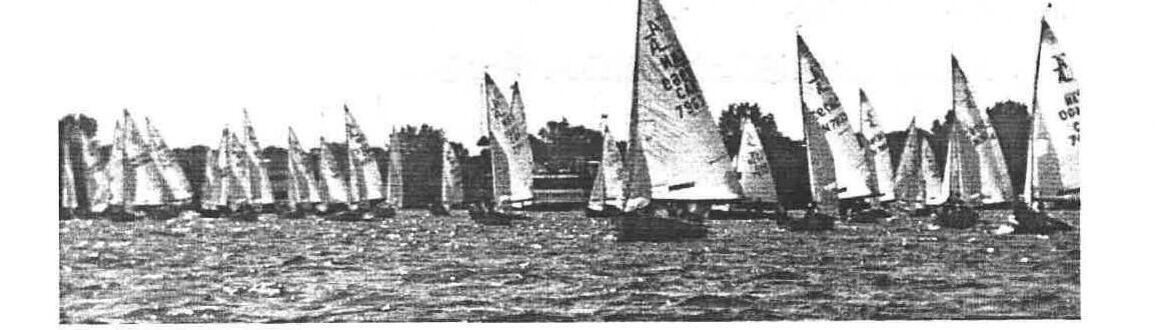
Photo by A. Cheung
Mark Your Calendar
Canadians at CORK
Friday, August 27 - Sunday, August 29, 1999
$120 per boat includes:
- 7 Races (2 races Friday starting at 12 noon, 3 on Saturday at 10 am, 2 Sunday at 10 am)
- Dinner at Kingston Yacht Club on Friday night
- Sailor's reception on Saturday after sailing (includes 3 drink tickets for each sailor)
Registration forms will be available in the next issue of Shackles & Cringles and will also be mailed to all CAA members directly. For further information, please contact Heather Macnaughton at (416) 367-9898 or email at [email protected]
See you there!
Sailing on the Web
Canadian Albacore Association – www.albacore.ca
Sailing Organizations
National Albacore Class Association of the UK – www.sis.port.ac.uk/~wilsonst/albacore.htm
The US Albacore Association – www.my-town.com/sailing
Canadian Yachting Association – www.sailing.ca
International Sailing Federation – www.sailing.org
Ontario Sailing Association – www.sailon.org
Albacore Sailing Clubs
Cypres Albacores – www.geocities.com/colosseum/sideline/1413
Hamilton Bay Sailing Club – www.hwcn.org/link/hbsc
Kanata Sailing Club – www.achilles.net/~jamesb/ksc/
Mooredale Sailing Club – www.runningtide.com/msc/
Nepean Sailing Club – www.nsc.ca/
Potomac River Albacore Fleet – www.geocities.com/colosseum/bleachers/2101
RA Sailing Club – magi.com/!racentre/clubs/sail/
Royal Canadian Yacht Club – www.rcyc.ca
St. Jamestown Sailing Club – www.sailtoronto.com
Toronto Island Sailing Club – www.user1.mshri.on.ca/arneson/tisc.htm
Westwood Sailing Club – www.westwood.on.ca
It's time to renew your Canadian Albacore Association Membership.
Your 1999 Application Form has been included with this issue of Shackles & Cringles.