Early Spring 2008
April 01, 2008
Jelena Balic's debut as editor, Ed Young's "Pragmatic Race Committee" tips, Allan Measor's spring boat-maintenance guide, Jason McVeigh's account of indoor sailing at the Toronto Boat Show's "Battle of Lake Ricoh", Adam Nicholson on the World Indoor Albacore Championship, a CAA Member Appreciation Party recap, Dear Albie advice on hiking and mast rake, and the 2008 executive.

Message from the Commodore
I'm looking outside and everything is covered in a foot of snow with another storm beckoning. I'm wondering if Wiarton Willy really saw his shadow predicting an early spring…hardly believable until I look at the calendar and realize that the Midwinter Regatta in Sarasota, Florida is only a month away!!
Meanwhile back at Albacore central all the executive members have been busy beavers. Henry and his energetic team once again set up at the International Boat Show. I had the pleasure of spending a 3 hour shift in the booth. It was interesting to hear how many people learned to sail in an albacore or had one at their cottage. Many friends old and new stopped by to say hello; the furthest friend was from our new fleet in Shelburne, NS! Meanwhile there were 4 albacores floating around in the RICOH Centre demonstrating how easy it is to sail one of these fine machines. Special thanks to Lianna Giovanda, who organized the event from start to finish and all the Outer Harbour community sailors who participated. There are pictures on the website (www.albacore.ca).
Thanks to Janet Duff, our Membership Director who organized our first ever “Member Appreciation Party”. We had a good group show up (even our newest member, Tom all the way from Buffalo) to enjoy complimentary “beverages” and enough snacks to sink an albacore.
The schedule is almost complete with a little tweaking still underway. For the first time you will see a regatta in Nova Scotia and a new fall series held in the Outer Harbour, prolonging the season.
Michelle Arnot, Training, has been busy corresponding with “special mystery instructors from afar” to coach a mid fleet session, as well as a refresher course and a Women's session. Keep checking the website for updates. Speaking of which, we are undergoing a renovation on our website, and hope to roll it out this spring.
On a personal note I would like to publicly congratulate John Miolla, Commodore of the Outer Harbour Sailing Federation. He was presented with the Ontario Sailing “Award of Excellence” for his tireless contribution to saving the Outer Harbour. Countless hours, boxes full of correspondence and endless numbers of meetings have gone into this project which silently works in the background to save our idyllic paradise for sailing, learning how to sail and racing that is affordable. Had this framework not existed, many people might never have been exposed to this sport. Thank you John for all your work!
See everyone soon. Meanwhile I'm off to Thailand to see if I can keep one of those skiffs upright for longer than a leg!
T
Commodore
Message from the Editor
Hi! It's Jelena, the new editor of Shackles and Cringles. I'm following in Christine's hard to fill footsteps. I'm a reasonably new sailor and racing is more tiring, both physically and mentally, than I ever could have imagined.
If you haven't been asked to contribute, it's because I didn't have your contact info or you were too darn good at running away at my approach! I tried to be gently persuasive when requesting submissions. (I now realize that threatening to sabotage a club's regatta is not the best way to get articles.) Some individuals also volunteered other people in order to get off the hook–sneaky, but effective. I was afraid I'd have to reprint the only sailing article I've written. (If you want to read my take on Canadians 2006, let me know.) Or perhaps I'd have to write several articles using a variety of pseudonyms. ("Sailing in light air days" by Summer Breeze.) But it was unnecessary. Thanks to all who contributed content and ideas.
The cover illustration was designed and created by Alliocha. Thank you for your visual creativity.
New sailors, old salts, serious pieces or fluff– send it all to me, I need your stuff!
On The Water…
As the new Training Officer for the Canadian Albacore Association I am excited about some of the training events we are putting together for the 2008 season. I myself am quite new to Albacore sailing, and therefore am appreciative of all the “continual” upkeep of skills required to maintain and even improve our sailing ability. So with that in mind, we are in the midst of putting together some great workshops for sailors with wide-ranging skill sets.
MOVING UP from MID-PACK… This high energy weekend workshop will be run by a top albacore sailor/trainer from outside the CAA and will be limited to those found IN THE MID-PACK. Last year's race results will be taken into account and those at the TOP end will be– out of luck. That is right– this is an ideal opportunity for the MID-fleet to learn from the world's best…. We are hoping to offer this workshop at the end of May.
RACING 101… This is another great workshop weekend aimed at those relatively new to racing and still trying to get a handle on the rules of the road. This workshop will supply a review of rules, hints for the starting box and little things that experienced racers have taken years to learn. If you're new to racing or if your racing skills are rusty, this weekend is for you! We want to get as many of you out on the water this year, so you can make the most of the season. The workshop will be led by some of the CAA's top racers/trainers. We are hoping for a weekend in early June– what a great way to get ready for the onslaught of summer regattas.
WOMEN of the WATER… This one day event will be focused on women looking to improve their Albacore sailing skills and gain confidence on the water. Women learning from women: how to take advantage of our smaller size and hints for a few things we just do differently. Look out for a late June or early July date.
All workshop dates are still to be confirmed– but remember to check the webpage (www.albacore.ca) for details on the training workshop that fits your needs this season.
See you on the water…
Michelle
The Pragmatic Race Committee
Let me start off by saying that I have no formal schooling in running races, so if you have formal certification and disagree with any of my assertions, then you are probably correct. But I am still right.
…you are probably correct.
But I am still right.
First of all, a little perspective: I started sailing Albacores back in the mid 1970s, although I don't remember much about this phase of my sailing career. Back then, as a five-year-old, sailing at the cottage in McGruer & Clark Albacore 4259 involved sitting inside the boat with one of those big cloth-wrapped neck brace style D.O.T. life preservers that made it impossible to move my neck. The other thing I remember was my mom and dad winning the annual multi-class, handicapped, Round Lake Regatta each summer. I remember my dad taking it far too seriously and complaining a lot that the race committee was drunk and off by at least 22 seconds on the starting guns.
Fast forward thirty years, and here I am, perfectly sober and running a slightly higher level club race in Toronto's outer harbour. Maybe it's one of the Sunday Harbour Master series races. And just like clockwork, someone from Mooredale is telling me the start line is too short or some dude from TISC is confirming if it is buoys to port. Or someone from JTown is telling me the line is left-end skewed. In any case, the race gets off and everything goes fine.
So, how does one get the privilege of running races? At St. James Town Sailing Club, we have this nasty tradition that the helm of the boat with best finish (not including those in the top three overall) run the regatta the following year. Back in 2003, I finished 7th and earned the privilege of running things in 2004. Things went pretty good in 2004 and since then, I've run a number of races and regattas in the Albacore and Laser classes.
So, what makes running club races go well?
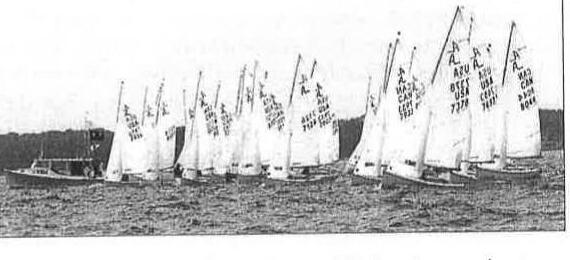
1. It helps if the chief race official is at least a semi-active racer in the fleet. I've seen highly trained race guys with their GPS's and instruments, trying to set the perfect line and course, moving the upwind mark on every oscillating wind shift, but losing sight of the bigger picture. That bigger picture being that it is better to get five races completed than to have 3 "perfect" races.
2. Set a line that is slightly left-end favoured. This can be difficult, because the wind can shift, but the very best start line is not perfectly perpendicular to the wind. It is left favoured by one boat-length. Also, in a fleet like the Toronto Albacore fleet, which seems to become a little more unruly each year, it helps keep the fleet behind the start line.
3. If the wind is light and expected to be light (like on many Friday evenings) set a shorter course. The real length of a race is the time it takes, not the distance covered. A compressed six leg course is going to yield a more interesting race than a two-legger with longer legs.
4. If the wind is strong, move the gybe mark further out so that there are some real planing reaches. I don't think it's legal on a true Olympic course, as the gybe mark has to be set at specific angles to the other marks, but this is club racing and no one is going to sail an Albacore in the Olympics, so let's make it fun. When the wind gets strong enough to plane, these reaching legs cease to be boring parades and provide opportunities for passing.
5. If you are on the race committee, do not talk to any of the competitors once the sequence starts. You may get distracted and miss a signal.
6. Don't try to be perfect. Make things as good as you can, but the main goal should be to have a fun day. This means minimizing the wait time between races. I usually spend a lot of time observing the behaviour of the boats on the upwind leg to try to get an idea of what's happening with the wind so I can quickly make adjustments for the next race. The most frustrating regattas I have sailed in had long waits between races, while the committee chased wind shifts, reset the line and postponed starts. These were even more frustrating than the many races I have done poorly in.
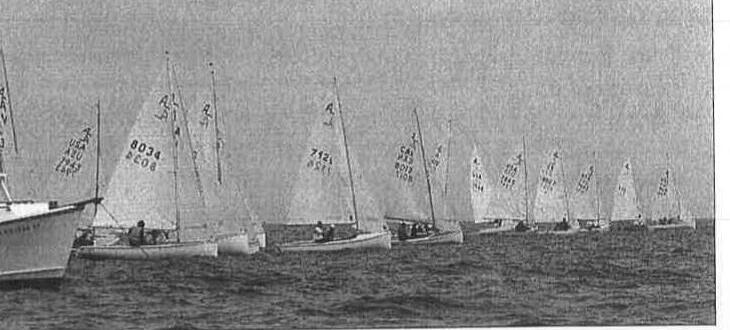
One final note: If you have sailed a lot in the fleet, run a race or regatta once in a while. It's a great way to get perspective of things and to experience the challenges that our race committees face. Getting a fleet of 50 Albacores (many helmed by people with abnormally strong personalities) to start cleanly is not an easy task. Our race committees deserve a lot of credit for the job they do and for staying sober until after the racing is done.
Snowbirds
Really, it is not so great living here in Santa Cruz, California this winter. Sure we are three blocks from the beach on the Pacific Ocean, and a block from the yacht harbour. But this just means we have a lot of wave and seagull noise. And on those otherwise quiet nights, the sea lions barking in the distance can be quite annoying. Their racket keeps me awake for actual minutes sometimes. Foghorns can be a noisy problem too - I'm sure you all can sympathize with me on that one.
The temperature does not get to 15C most days– hardly the stuff of paradise, I am sure you'll agree. And the wind… the wind! Sometimes when we go biking up the coast we have an actual headwind! Not to mention the surfers carrying those big boards, and people walking dogs, and women with baby carriages– we constantly have to swerve to avoid these California hazards.
So mostly we stay indoors, and dream about next summer in Toronto, those quiet evenings with the sun going down behind the CN Tower, the smell of gelcoat, those post-race woulda coulda sessions on the deck at the club… and Suzanne dreams about all the butts she's going to kick on Friday nights in 2008 (she's already sketching out her victory speech) - I normally forbid her dreaming about other people's butts, but in this case that butt could actually be mine! And I dream about those secret go-fast improvements I am going to make to 7983. I'd love to tell you what they are, but then they wouldn't be secret now would they.
So you guys can rejoice in Ontario! You are already there! We have three more months here (ugh!), and a long hard journey to get there. You are the lucky ones.
Albacore Maintenance
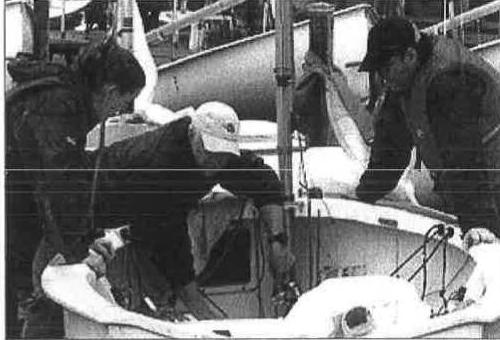
With spring around the corner, and only two months to the first sail, getting your boat ready for the season is a priority. A warm day or two in early April can provide the opportunity to get your boat in order while not missing a prime sailing day. Waiting until later in April might not be as cold on the hands, but you might miss those wonderful spring breezes.
Hull
Bow Tank Buoyancy leaks: The most common areas of bow tank buoyancy leaks are around the tank plug. Sometimes the plug receptacle becomes loose. A dab of marine sealant usually addresses the issue. Another area, if you have a front storage compartment, is the seal around that area. Tightening the screws around the compartment may fix the leak; if not, some Sikaflex or other marine sealant will be needed. Other common locations include areas where hardware is fastened to the hull, the mast ram block, or forestay/painter attachments. Remove the offending hardware, clean the area and the screw. Place a dab of marine sealant in/around the screw hole and replace the hardware.
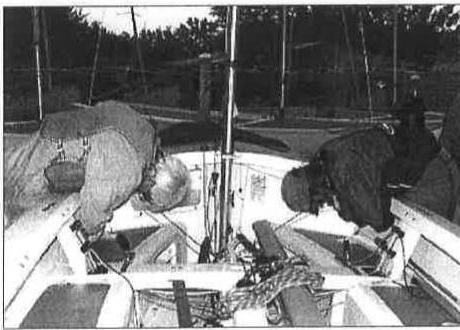
Side tank buoyancy leaks: By far the most common location of all leaks (on OY boats) is through the rear thwart attachment screws. These screws easily loosen over a winter and a sailing season. They must be tightened regularly (but do not over tighten as the holes are somewhat fragile) and dab some marine sealant to prevent leaks. These screws lose purchase over time and I suggest creating portholes in the side tanks and using a screw/bolt combination. This provides a much better long term solution but is a larger project as boats do not come fitted with portholes from the manufacturer. Lastly, like the bow tank, the drain plug receptacles can become leaky; removing/cleaning and resealing will usually correct any issue. If it's too worn, a new plug assembly may be required.
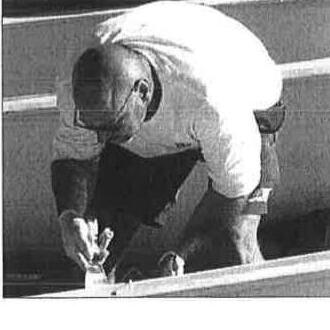
Epoxy or Standard Fiberglass: The short rule of thumb is that if you need significant strength, like a mast step or gunwhale strengthening, then epoxy is your friend. For areas that do not require strength but likely need gelcoat and sanding, then fiberglass resin is your best bet. Epoxies harden to a marble-like substance, making them a pain to sand, and gelcoat doesn't adhere too well to them (but can be done if careful). Resins, which are what the glass albacore is built with, have more flexibility. They dry faster, sand easier and match the hull composition. Try these two websites for more details and best practices in working with resins (http://www.sailtoronto.com/PDF/FIBERGLASSINGSTEPS.pdf AND http://www.fiberlay.com/howto/fiberglass-Epoxy-Basics-Training-Guide.pdf)
Boat cleaning
Spring is a great time to wash out the cockpit and outer hull of your boat. For most situations, a high pressure washer is ideal. Gelcoat can discolour over time, so using a specific hull cleaner will bring the white back into your boat's smile. Boat cleaner chemicals are toxic– use rubber gloves and keep fresh water close by. Some people polish/wax their boat but I recommend against it. A proper wet sand with 1200 grit is more effective than adding wax/polish to your hull. Some of us have learnt that the hard way. Have you tried righting a capsized boat with a polished board and hull? It's like trying to ride a greased pig on a race track. And with cold spring water, you don't want to have difficulty righting your boat.
Sails
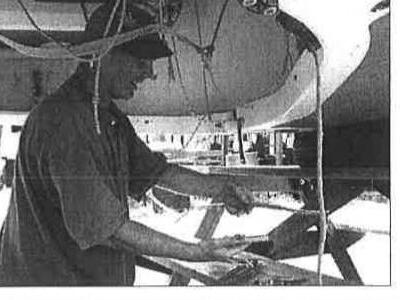
To roll or fold: Rolling a sail into a sail bag is superior as folding tends to leave creases that will become permanent.
To Batten or Not to Batten: A debate exists whether to leave your battens in the pockets or take them out. I've spoken to a Toronto sailmaker who's indicated that leaving them in is fine throughout the summer, and can save on wear and tear of the batten pockets. However, do take them out for long periods between uses.
My Worst Maintenance Mistake
One week before the Canadians, 2005 I decided that more grip was needed on the floor to manage the roll tacks. What better item to install than sticky grip tape for the crew and the helm? It worked fantastic, for THREE days, then the rain came. The tape lifted partially and wouldn't re-attach. Fearing a lack of roll tack bliss, I pulled out my trusty silicone tube and applied silicone to the offending tape and hull. I pressed them together and waited overnight. The next morning, the first day of Canadians, I raced to the club and found dew in the hull. Much to my chagrin, the tape wasn't attached and a film had manifested throughout the floor…..a silicone film. Nothing removes a silicone film, maybe that's why those implants are so much trouble? I tried soap, solvents and even bbq cleaner to get the film off, no luck. The best I could do was to throw sand in the bottom of the boat and go out sailing. Now, because the mainsheet had settled in the bottom of the boat, it too had picked up the disease, the silicone slide. I spent the rest of the regatta with my feet on each seat, not on the floor. The mainsheet was double wrapped around my hand to provide some grip and roll tacks became like gymnastics on ice. Moral of the story: silicone is a sealant and NOT a glue.
The end result of the "Silicone Experiment" is in full view on the CAA website, under results for the 2005 Canadians. You will find my name somewhere on that list. My only hint is to look down the list, not up.
I invite others with maintenance tips for your Albacore to contact the CAA as we intend to save a spot in each edition for maintenance. I'm hoping to get some ideas on wood maintenance next. In addition, send us your worst maintenance mistake; we are looking for good stories to add to our column.
…everything for the boater
power and sail
TOLL FREE 1-800-361-2890
email: [email protected]
website: www.gencomarine.com
GENCO
Show your current CAA card to receive a 10% discount! Thank you, Genco, for your support!
The Battle of Lake Ricoh
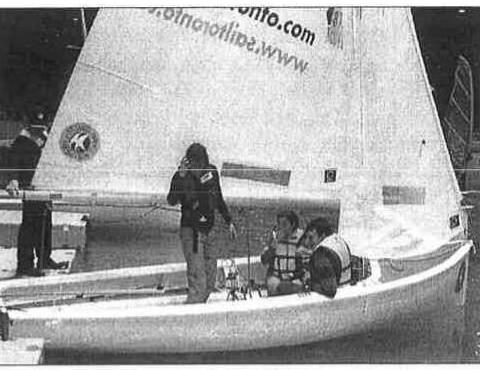
The suspense was intense! It was the 2008 Toronto Boat Show and I was to sail the indoor lake of the Ricoh Centre! But the “lake” became a pond, perhaps a puddle. And we were to have four boats out there?! Yes, jockeying for position with Westwood and two boats from JTown. In fact, JTown brought a fleet with sails in reserve and a landing party on the dock. They had invaded the place and infiltrated the boat show staff with one of their own! And I was there for a simple sail…
It all started with a subtle persuasive attempt to get me not to sail. Had I sailed before? (Despite years of sailing at the cottage and camps I played it down to my one year of Mooredale experience). One season but I am ok I replied… The looks were spellbinding! Were they to sail with this rookie? How were we all to navigate that dock placed in the centre of this lake (intended for the wake boarders)… And why didn't they consult with us on this? On the far side there was a car on display. To date I have no idea what model it was but it did put a shadow on our wind. To the West end was the largest log contraption known to the Western world. Apparently the wake boarders, wind surfers, and motor boats were a consideration for accommodation!!!
Liana Giovando gave the rundown. Get up high on the fans' right next to the no name car then a quick gybe and just brush by the wakeboard obstacle. Sounds fun and easy doesn't it? Imagine doing this with only a partial centre board! So there I was, departing the dock with a mother and son on board. Working to show off my full one year of Albacore expertise I set sail. It was only a moment later that I reinforced my talents to my new crew by rubbing up against the dock located so strategically in the centre of the lake! A little push off and we hit mock speed. With a dozen more enthusiasts and a few dozen more laps around the paralyzing fast track, it was a great way to spend a Saturday evening.
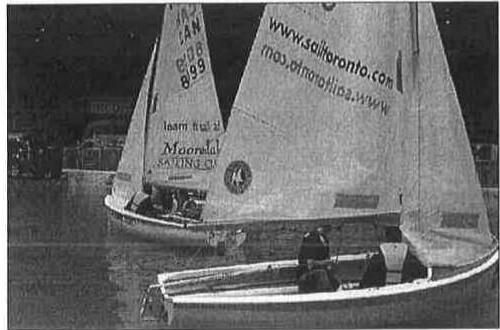
Day two, Monday evening, was looking more promising. Phil Burchinshaw, our Mooredale Commander and Chief of the high seas, brought all his British Navy experience to the table. The seas were calm and despite an ambitious fleet raring to go, the show's attendance was bordering on empty. This provided just the opportunity for us to be all we could be: two experienced sailors in the same boat. With some manual tuning of the fans and with just the right amount of fine tuning to the sails we reached unimaginable speeds of two or three knots. The adrenalin was over the top! I couldn't ignore my natural tendency to beat out the other participants. What a night of excitement for a racing enthusiast!
At the end of the day it seems that Mooredale kicks it up on the water and the J Town crew kicks it up on the dock! Our fearless leader Phil handed out the olive branch. That and a pint of beer at a local Toronto watering hole set the setting for peace talks. Despite the fact that Pasquale Leone was a former Mooredalian we set our sites on the future. We negotiated a peace settlement and have allied ourselves to take command of the high seas of the Outer Harbour. Westwood was not present… See you all on the deck with a brown soda.
Sailing in Toronto in Jan. Wow. The wind was always steady (at least the wonky bits were always in the same place). And every time around the rink you had to watch out for the car. Why was there a car on the water? No one seemed to know. We are all experts now at light wind sailing with half centre board. One of the great byproducts of this event was members of the 3 clubs involved meeting each other (and going out for beers afterwards). We need more interclub activities I think.
Big Fish Small Pond
Rub a dub dub,
four Albacores in a tub.
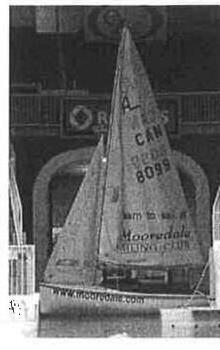
The Canadians dominated the 1st World Indoor Albacore Championship, at the Toronto International Boat Show, Jan 12-20th. The event was plagued with light but very steady winds. To win you had to maintain speed and have excellent roll tacks or suffer the fate of being stuck in irons.
We sailed in the Ricoh Coliseum, a hockey rink for the Toronto Marlies (a farm club for the Maple Leafs) and a rodeo field for the Royal Winter Fair. It was a great and different experience to race in only 3 feet of water lacking full centerboard depth. In my first race I had the pleasure to sail with Maxim Newby. I usually have tacking duels with Milutin Adjacic and Maxim, so it was hard to not give any tips to Maxim to make him an even more feared competitor. The race had a 3min start. I was a bit late off the line but had the preferred end and a one tack to round the mark. At the mark we had a little mix-up with other boats coming up the rear and a boat in front of us trying to tack. You needed to be careful of irons, which I just discovered in this tiny arena. I lost a boat or two but as the 2007 Finn World Champion Rafa Trujillo does, you just keep chugging along. Coming up on the second lap I passed the second boat and at the gybe mark made the inside boat gybe too close to effectively keep speed going and then passed to the finish. Thanks to the fellow competitors.
Besides sailing it is a boat show after all. The CAA had a great booth and was well attended. Of course there were large keelboats, small keelboats, dinghies, large powerboats, small powerboats, sail makers, Sobstad, Quantum, North, UK Halsey were all there, and various Chandleries such as Fogh Marine and Genco Marine. Gul had a booth for those that wanted to see the clothing for the New Year.
I plan to sail in the Albacore as much as I can this year but as a Member of the Canadian Sailing Team for the Finn it is hard to find the time. I would like to take the opportunity to thank The Canadian Albacore Association, Liana Giavando, Henry Pedro, Jelena Balic and my CST sponsors, Fogh Marine, Gul, Harken, McLube, Rolex, Gant and Salmon Cove. See you on the water soon.
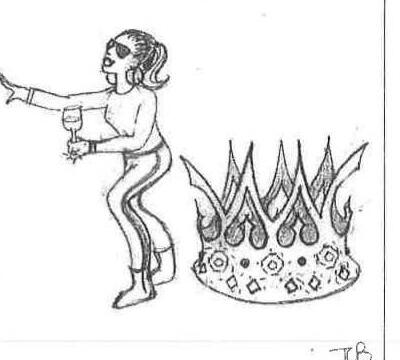
Princess Sailing 101
Commonly heard phrases include:

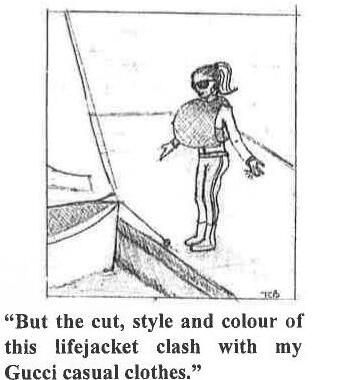
“Is this the boat that takes us to the yacht?”
“Where's the motor? The kitchenette? The cushions for the seating area? The seating area? The crew?”
“When the metal beam moved over, it put a dent in my Swarovski crystal studded tiara.”
“Where's the pool boy with the umbrella drink?”
“When does happy hour start?”
“Princess” sketches by Tannis Baker
Situation: It's a light air regatta and the races are postponed. You're stuck on the water, waiting for the races to resume. What are some ways to help pass the time? (Send your responses to [email protected])
CAA Member Appreciation Party

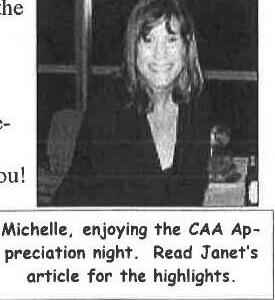
Thanks to everyone who came out to our first CAA Member Appreciation Night on January 26th at the Alexandra Yacht Club. We had about 50 people with a good contingent from J-Town, I must say. Yvonne Howard even showed up with all her aches and pains after having been in a car accident the day before, and insisted that I take a picture of her cleavage. Must have been the painkillers talking.
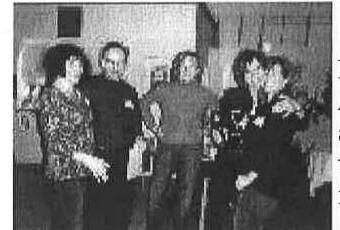
We also had visitors from Buffalo, Tom Wilkinson and his wife, Diane, who came up to Toronto to meet the members of the Canadian Albacore fleet. They have recently purchased their own Albacore and are anxious to get involved. Plenty of people were willing to give them tips, as only sailors like to do. We hope they didn't leave too confused!!
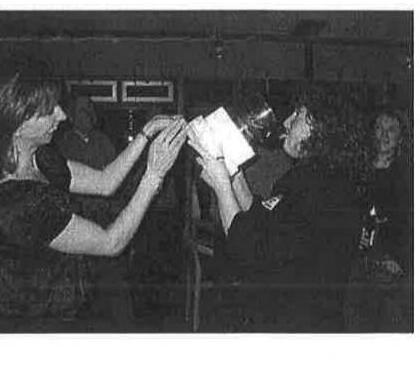
During the evening, oddly enough, I didn't hear a lot of racing talk. I guess I wasn't standing in the right places! Henry brought in the CAA booth so everyone had a chance to see themselves and others in action, or inaction depending upon the wind. Cathyann White was presented with the recently recovered First Place trophy for the Canadians B fleet and was so excited she forgot to take it with her. Or maybe she didn't forget……it was filled with beer when she received it so that might have had something to do with it. Alan Humphries came long enough to let us know he was leaving for the Turks & Caicos and make us all jealous.
Thanks to Jelena, Merle, Bob and Teresa for helping with the setup and to Pablo for taking charge of the food.
It's hard to believe that sailing season is just a couple of months away when you can see a foot of snow on top of the cars!!
Dear Albie
Questions? Concerns? Need some advice? Send your letters to Albie.
Dear Albie:
My helm keeps telling me to hike. I don't want to. My helm could use the exercise. What do I do?
Princess Cushytush
Dear PC:
Good call Princess! Aside from pushing that little stick around and telling you what to do, the helm really does nothing, so he or she should be the one with his or her bum over the gunnel. I'm sure a few well-placed pokes in his or her beer gut and a raised eyebrow will have him or her hiking like a SOB. As for the helm telling you to hike to keep the boat flat, well, we all know there is more than one way to skin a cat, and there's also more than one way to keep a boat flat. In this case, it's very easy for your helm to ease the mainsheet, and if he refuses (silly bugger - who wants to go fast?), then dumping the jib will achieve practically the same effect. You may also want to pre-empt your sailing session with a discussion on why hiking is fundamentally bad - it's destructive on your knees, puts a lot of stress on the hiking straps, and is just plain uncomfortable. Good luck!
Dear Albie:
I'm new to sailing. What is a mast rake? What's it used for?
Need Mast Rake 101
Dear NMR 101::
Hmm. Your question is a bit too technical for me, I'm afraid., so I referred it to Raines Koby.
Mast rake refers to the positioning of the top of the mast fore and aft. The rules governing the Albacore class in North America permit racers to adjust rake during the race only with the jib halyard whereas in the UK they are permitted to use the shrouds as well to change rake. This variance in rules is commonly the source of a heated debate.
Mast rake is adjusted based on wind speed. The mast is positioned reasonably straight (up and down) in light wind, raked a little more aft in medium winds as you become over powered and even more in the breeze when you are significantly over powered. Increasing rake is a way of de-powering the rig to make the boat easier to manage.
Mast rake is adjusted based on wind speed.
To increase rake you ‘pin down.’ This means to adjust the shrouds down a position or two on the chain plate which brings the tip of the mast aft.
To tune your boat for mast rake fix a measuring tap on the main halyard, pull it to the top and measure down to the inside corner of your transom. Mark the position on the chain plate and make a note of the measurement in a tuning journal. Contact your sail maker for the recommended settings for their sails. Use these as bench marks but through tuning and racing experience you need to determine the sweet spot on your boat as each boat is slightly unique.
The other way mast rake is adjusted for North American racing is during a run. The strategy here is to release the jib halyard and allow the mast to swing to the back of the partner (the slot at the rear of the foredeck.) This is down to allow the shrouds to slack which in turn allows the main to swing further out for sailing dead down wind.
2008 Canadian Albacore Association Executive
| Commodore | Teresa Miolla |
| Past Commodore | Ann Savege |
| First Vice Commodore | Allan Measor |
| Second Vice Commodore & Website | Henry Pedro |
| Third Vice Commodore & Training Officer | Michelle Arnot |
| Rear Commodore | Kevin Soldaat |
| Specifications Chair | Dave Weaver |
| Chief Measurer | George Roth |
| Editor– Shackles & Cringles | Jelena Balic |
| Secretary | Cathyann White |
| Membership | Janet Duff |
| Treasurer | Jason Roth |
| IAA Treasurer | Raines Koby |
| IAA Representative | Teresa Miolla |
Canadian Albacore Association
47A Harbour Square, P.O. Box 81085
Toronto, ON M5J 2V3
www.albacore.ca
Member Appreciation Night