Shackles & Cringles — Fall 2016
September 01, 2016
A deep dive on reading and using wind shifts, Paul Clifford on racing tactics leg by leg, Andrew Alberti on the rules at a crowded windward mark, and how two clubs are getting more people on the water.

Commodore's Message
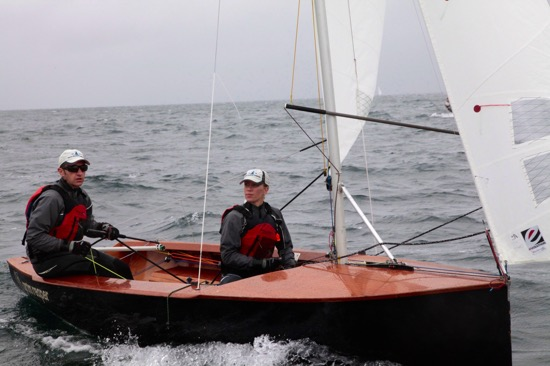
Hello Albacore Sailors,
It is now September and we are into the home stretch of the 2016 sailing season. We have had several great events this season with more still to come. Be sure to check the CAA website, www.albacore.ca, for the most up to date schedules, race results, and class information.
We had a successful Ontario Championships held at Mooredale Sailing Club. Many thanks to the folks at Mooredale and Michael Williamson for this effort. I am glad to see that the number of participating boats increased this year over the past few, which is a good sign. Congratulations to 2016 Ontario Champions, Darren Monster and Andrew Rydholm! You can find the detailed results and the prize-giving on the website.
The East Coast Championships held at Shelburne Yacht Club had a good turn out with 15 boats over the 3 day event with some familiar names scoring in the top 5. James Stanley and Julie Stewart took home the top award.
Toronto's Friday Night Racing and Harbour Master Series' participation has been healthy again this season. At the last check there were 73 participating skippers and 143 participating crews in the FNR in Toronto and 14 boats racing at Nepean Sailing Club. Newer racers are joining the more experienced albacore sailors and the Harbour Master B-Fleet is continuing rather well.
We at the CAA continue to discuss the ways in which we can encourage new sailors to get into our great boat, as well as bringing other sailors “out of the woodwork”. If you have any suggestions as to how we can improve on this, please forward them on to the CAA executive at albacore.ca.
The Canadians are fast approaching this month in Toronto. The last time the Canadians were held in Toronto was 2011, in conjunction with the International Championships. We are lucky to have many excellent venues to host our annual premier sailing event. Darren Monster is again working diligently to ensure that this event lives up to our expectations. Remember our Annual General Meeting is to be held that Saturday, the 16th. The Agenda and other meeting details will be sent out under correspondence. All attendance is welcome and input valued, as we continue to make the Albacore the best choice for double handed sailing.
Another piece of important information is concerning our newsletter - Shackles and Cringles. This long time periodical has always provided valuable information on the Albacore, and the people who sail it. Along with all publications these days, we have to make adjustments as technology and methods of communication change. Considering all the currently accepted methods of obtaining information (websites, blogs, social media, etc.) we have been looking hard at the way the CAA communicates. Our Shackles and Cringles editor, Tannis Baker, sent out an online survey to get the class perspective on our newsletter and the expectation of delivery ie, mail, email, postings, etc. I hope that you read further on as Tannis explains the findings of the survey and makes suggestions as to how we communicate to our class in the future.
Good luck to everyone for the remainder of this great season and hope to see you all at the Canadians!
Ian
Shackles Is Evolving!
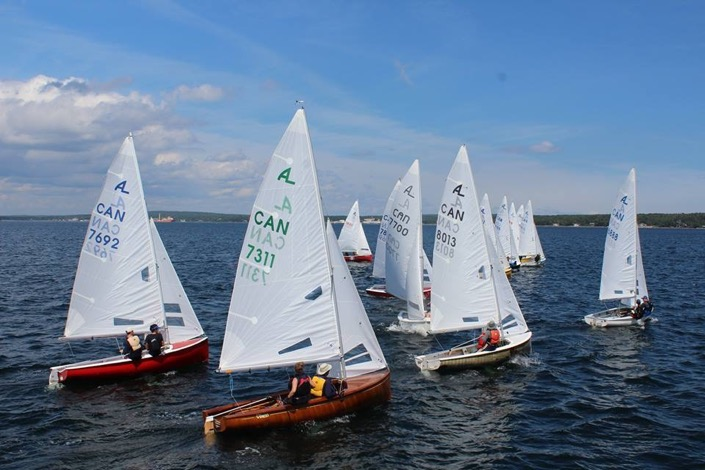
Hi Albacoreans!
It was brought to my attention earlier this year that, what with all the more immediate forms of communication available to Albacore sailors (club newsletters, facebook group feeds and website postings), a tri-annual magazine has a hard time keeping up.
So, I checked with you, the membership, to see whether you would welcome a modernized Shackles and Cringles. A good majority of those that took the time to respond to the online Survey (thank you all!!) gave a thumbs up to the idea of more frequent postings.
However, it also seems that most of you read Shackles online already but are worried about not being notified of more frequent posts and would like some form of Best Of, produced digitally and/or on hard copy, anyway. So, to begin with, we will send out notifications for each posting and I'll put together a magazine-formatted Best Of Year End issue.
I believe a new form of delivery is worth a try, since the “blog” format under the Shackles & Cringles banner would:
- provide more frequent and timely communication (approximately every 2 weeks mid-season, less often off season)
- provide the same number of quality articles/year as before
- provide the ability to subscribe to the feed (so, eventually, you won't need a reminder)
- automatically create an index of past posts for reference (so, eventually, you may not need a Best Of)
- include more varied material, like video/colour pics (our printed mag is mostly black and white)
- be discussion-friendly with an optional comments section (contributors can opt in/out)
- bring more traffic to our website in a more search-engine friendly format, accessible to sailors of other classes, thereby promoting ours to them
In order to manage contribution frequency, I will continue to ask people well in advance of a deadline and plan to have several pieces ready to go at any one time. Please feel free to contact me with any ideas you may have or if you would like to contribute anything: articles, reports, photos, videos (to link to Raw Fish), poems, jokes, cartoons.
Tannis Baker
[email protected]
Shi(f)ts Happen!
We've all been there. A big fat wind shift. You can win or lose BIG from being on the right or wrong side of it. So how do you know what the “right” side is and how do you get yourself there in time to make some good of it? In this article, we will give you some hints to help you know when you are sailing in a shift even if you don't have a compass and provide some explanation and illustrations to help understand the “right” side and the “wrong” side. Finally, we will tap on the shoulders a few top sailors to help us see the telltale signs of a shift to come.
Warning: The article starts out slow for beginners but by the time we get to advice from the top sailors if is full out mind-blowing so don't give up early if you already know some of this.
Identifying A Shift As It Happens
With Land In Sight
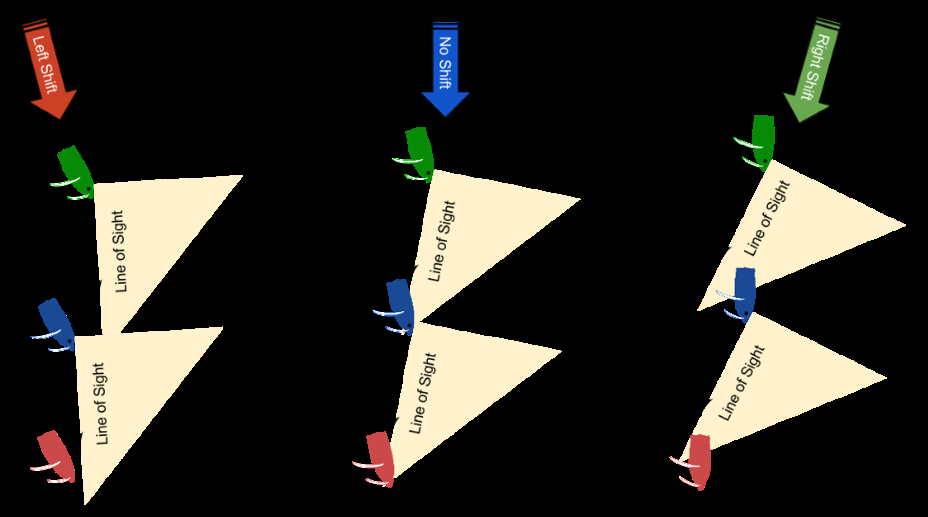
It is usually easy to tell the wind is shifting when you can see the shore in front of you. Imagine you are sailing upwind on a port tack and you have to adjust your course to keep your sails trimmed to a close-hauled course. If it appears as though the land is moving out from behind your sail, you are sailing in a right shift. In a left shift, the land will appear as though it is moving behind your sail.
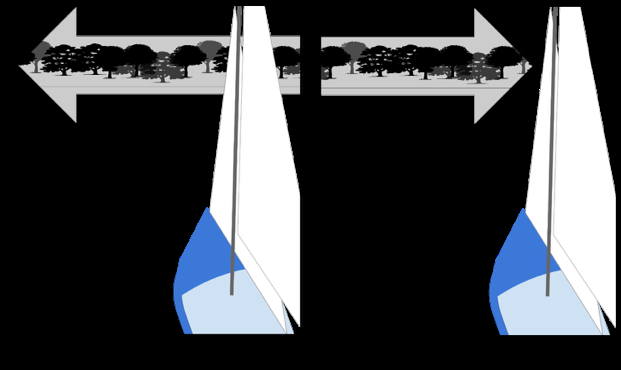
The same is true of sailing downwind. We always talk about the wind in relation to the upwind perspective of the racecourse so left and right are not your left and right, but the left and right side of the racecourse if you are facing upwind. Imagine you are sailing downwind on a port tack. You need to adjust your course to keep your sails trimmed to the optimal down-wind setting and you notice that the land in front of you appears to come out from behind your sail. The wind has just shifted to the right side of the course. Likewise, if the land in front of you appears to go behind your sail, the wind is shifting to the left.
On starboard tack, the principle is the same – just reversed. If your sail gradually covers up the land in front of you while you are on a starboard tack, the wind is shifting right. If the land appears to be moving out from behind your sail on a starboard tack, the wind is shifting left.
Identifying A Shift When It Happens, With No Land In Sight
When you cannot see land, you can use other boats in your race to identify shifts.
You will see more of the transom of the boats in front and to leeward of you as the wind shifts right on a port-tack (assuming everyone is sailing upwind, in the same wind and sailing the same speed and angle to the wind). You will see less of them as the wind shifts left on a port-tack.
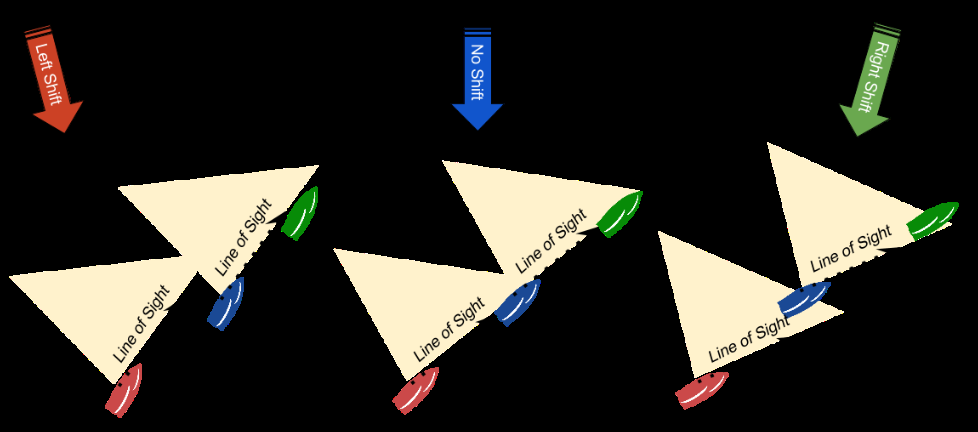
Sailing close-hauled on a starboard tack, you will see more of the transom of the boats in front and to leeward as the wind shifts left and less as it shifts right.
The same goes for downwind on both port and starboard tacks.
Gaining Or Losing In A Shift
Many people use the metaphor of ladder rungs to describe gaining and losing ground in wind shifts. The idea is to imagine a giant ladder laid across the racecourse with its rungs running horizontally across the width of the course. A boat that is higher up the ladder is further up the course and therefor ahead of her competitors if they are sailing upwind. A boat on a lower ladder rung is ahead of her competitors sailing downwind.
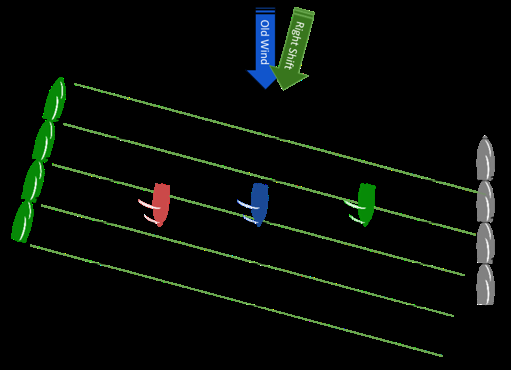
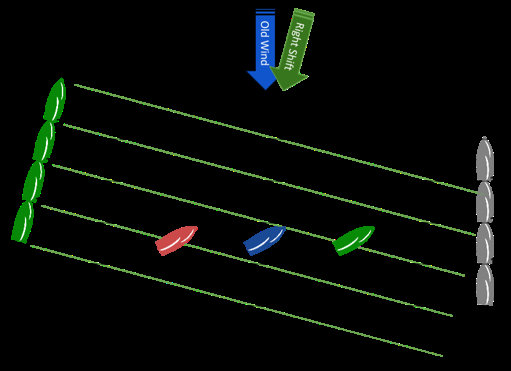
In the first drawing below, the red boat, the blue boat and the green boat are all even because they are all on the same ladder rung. In the second drawing, Blue is ahead of Red and Green is ahead of Blue.
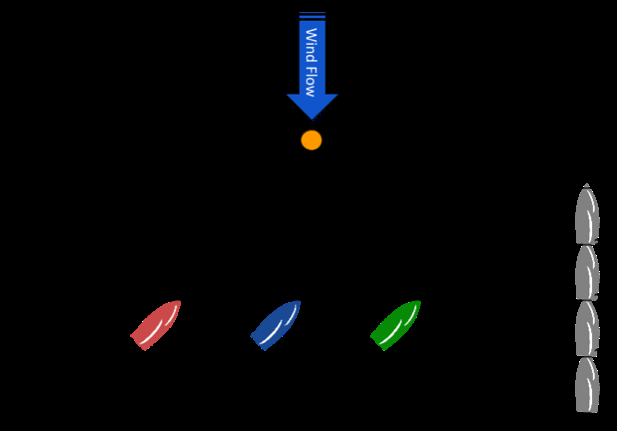
Ladder rungs are a handy metaphor because they help us see what happens when the wind shifts. The marks and finish line of a racecourse don't move when the wind shifts but the orientation and proximity of the boats racing changes in relation to those fixed objects. Ladder rungs help us understand how that change effects our race because we imaging the ladder shifting with the wind. The rungs of our imaginary ladder are always 90° to the wind as it moves.
The first drawing above shows a racecourse with no shifts and three boats that are even in the race. They all have their bow two boat-lengths up our imaginary ladder.
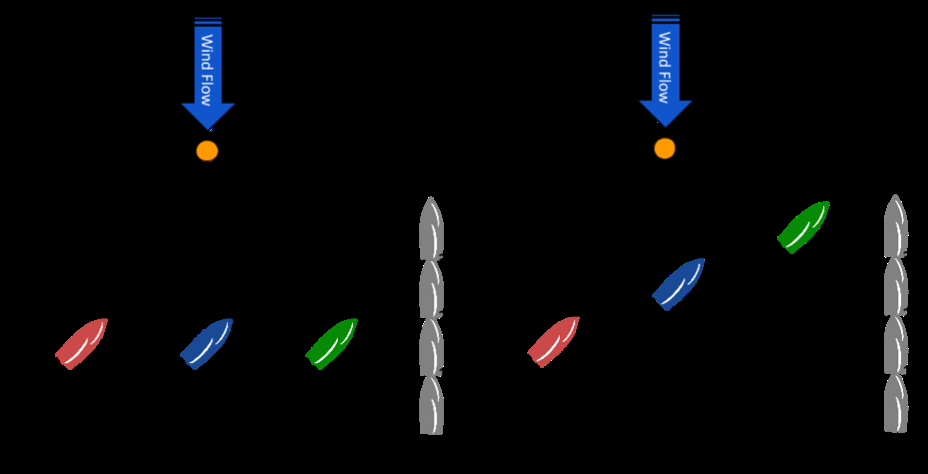
In this next drawing, there has been a 15° wind shift to the right. Look at where the boats are on the ladder as we shift it 15 degrees to the right as well. Green is now half way between the second and third ladder rung while red is halfway between the first and the second. That is to say, that Green is now half a boat-length ahead of Blue and a whole boat-length ahead of Red. It paid for Green to be to the right side of the other boats as the wind was shifting right. Of course, she will have to tack before the wind shifts back to realize that gain, but she is still looking good.
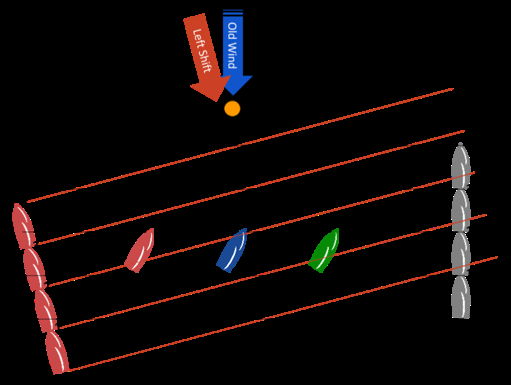
This next drawing shows a 15° shift to the left from its original position in the middle of the course. Red has gained in this drawing. Red is now half a boat-length ahead of Blue who is half a boat-length ahead of Green.
The moral of the story here is that you want to be closer to the direction the wind is shifting than the rest of your competitors. If the wind is shifting right, you want to be to the right of everyone and if the wind is shifting left, you want to be to the left.
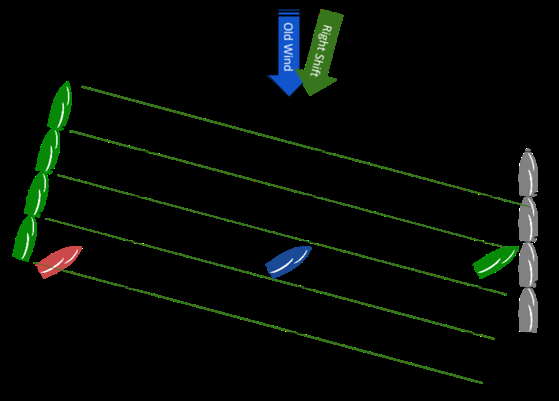
Wind shifts affect us just as much going downwind. You can see in the drawing above that all three boats were even in the old wind. However, after a 15° shift to the right, Red is further down the ladder and ahead of Blue who is now ahead of Green. When sailing downwind you want to be the farthest boat from the direction the wind is shifting to gain the most.
Separation
The more separation you have between yourself and other boats on the same ladder rung, the more your position will change when the wind shifts. This is referred to as leverage.
Red, Blue and Green are all on the same ladder rung in the drawing above in the “old wind”. However, with the same 15° shift we saw in previous examples, Green is now a full boat-length ahead of Blue who is roughly a full boat length ahead of Red. This is because there is more separation between the boats and therefore more leverage when the shift comes.
It is risky to separate yourself from your competitors on the racecourse for this reason but if you are very confident about the shift to come, it can pay big time. The farther you are from the fleet, the more you will maximize your gain or loss.
The metaphor of ladder rungs helps us to visualize the gain we achieve by being on the “right” side of the course and the loss we experience from the “wrong” side. By now you can see why you want to be closer to the shift sailing upwind and father from the shift sailing downwind.
The tricky part is getting yourself to the “right” side of other boats before the shift happens.
Telltale Signs Of A Shift To Come
All the experts say sail towards the next shift going up wind and away from it going downwind. The million-dollar question is how do you know when the next shift will happen and where it will come from? For that, we have tapped on the shoulders of a few top sailors to help us identify the telltale signs the wind is about to shift.
We got a great response from our friends at the top of the fleet and most of them did not stop at just a few words on anticipating wind shifts. We have done our best to summarize the key points touched on here and included links to the full explanation given my each contributor separately.
- The best thing is preparation.
- Check the forecast! - Checking for the possibility of thermal wind or fronts that will move across your racecourse and effect your wind. Ask yourself “is there a possibility of a more dominate wind that could come and impact this race course this morning or later today?”
- Sail up the course before the race and look for a pattern in wind shifts – oscillating or persistent shifts. If it is oscillating, what is the timing of the oscillations?
- With a change in velocity, there is usually also a change in direction. If light wind gets lighter or builds, that is your telltale. Use your knowledge of the forecast or hints from the conditions around you to take advantage.
- Look at other boats on the same course in front of you and out to each side of you, are they pointing higher or lower than you?
Thank you very much to our contributors: Dan Borg, Thomas Fogh, Emiliano Bolgeri, Street Silvestri, George Carter, and Paul Clifford.
Read the full explanations at albacore.ca, and reviewing Paul's Tactics piece in this issue.
How Can We Sail More? Sunday Sinners
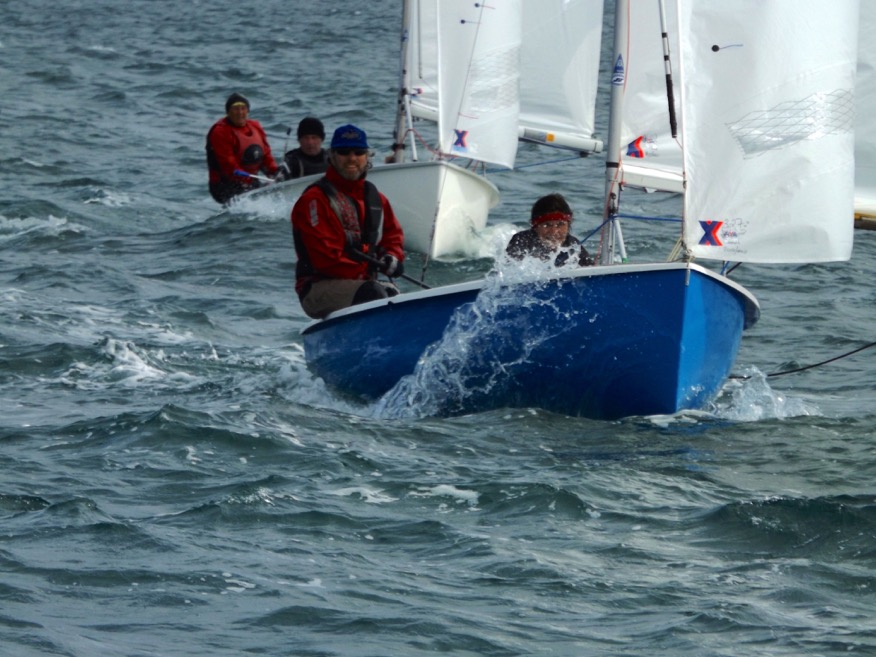
How CAN we sail more? This was a question some members at St James Town Sailing Club (J-Town) had when they finished their White Sail III class (that's Cansail 2 for all you new sailors) over 5 years ago.
Their solution was simple: get together on Sundays to sail as part of a group. Of course, once two or more boats start sailing together, a race is almost certain to ensue. The new sailors thought about how to structure this racing and Sunday Sinners was born.
The sailors first made some decisions on how they wanted these races to run, how to score them, and what they wanted the goal to be. One of the most important factors was participation; they valued this more than everything else, so they devised a scoring system which encouraged participation and gave people who wanted to do better in the entire series an incentive to show up. The members also wanted to encourage everyone to come, but with the understanding that the point was to get better and to not just show up and win. So they also handicapped “Old Salts” (although they are, to this day, wholeheartedly welcome). The last rule was to promote development, so they required that helms and crew change places between races, in order for the boat to count.
In the beginning, rabbit starts were the norm, but as more people started to attend, they realized that having someone on a motor boat would allow them to set a more appropriate course. The problem they faced, however, was that if a person was on the motor boat, they wouldn't be able to sail. The solution was simple, elegant, and two fold: 1. In order to be able to win the series, a person must have volunteered at least once on the motor boat that season and, 2. In order not to penalize someone for volunteering, those running the races were awarded half of the maximum points that they could get for that day if racing. In this way the group developed an incentive to volunteer that wasn't detrimental to a sailor's standings.
The program proved popular among all sailors, and the J-Town executive decided (to the delight of some, and the irritation of others) to incorporate it into regular events run at the club. They have asked various members over the years to act as the Sinners Commissionaire and each one has brought their own unique view and personality to the programme, from those who just run races, to the current commissionaire, who treats each day out like a class, with a brief and debrief to discuss what happened on the water.
Each participant gets something different out of the experience: from the up and coming racers who get to work on applying everything they learned the Friday before in a less aggressive environment, to the pleasure sailors who get to sail more than they would otherwise. Regardless of sailor type, however, one thing is certain: more time on the water makes everyone a better sailor.
So if you are in the Outer Harbour feel free to come out to the J-Town Sinners; or if you happen to be in Hamilton, Ottawa, Shelburne, another community with an Albacore fleet, or in a different fleet altogether, I would try to start a similar programme because you can help sailors get better at both sailing and racing, and let's face it, there is no better way to spend a Summer's day then on the water.
You are Invited to attend 3 Days of Albacore Sailing at its Best!
September 16 - 18
The Canadian Albacore Association presents
The Canadian Championships 2016
Hosted by Ashbridges Bay Yacht Club
30 Ashbridges Bay Pk Rd, Toronto ON (abyc.on.ca)
The Importance Of Tactics
How crucial are “tactics” relative to other important factors like boat speed, boat handling and race strategy? The answer is, “It depends”.
And interestingly, it depends greatly on those very same factors listed above. If your boat's speed is faster than average, that automatically impacts your tactics by increasing your choices. If your boat speed is slower than average that fact means you will be more limited in your tactical choices. And if the fleet is roughly the same speed as one another—then tactical choices are likely to become crucially important.
Similarly, if your boat handling distinguishes you either by being better or worse than other boats, then you will adjust your tactics accordingly. For example if you are among the few excellent sailors that can actually gain ground by tacking, then you will have no hesitation in engaging a close competitor in a tacking duel. If, on the other hand, your tacking skills are sub-par, you may think twice about doing that “perfect” lee bow on a boat that you know can squeeze up a little higher and then bear off and roll over you to windward.
Or, if you are trying to hold off a competitor on a close reach on the second reach leg of a triangle course, and you know they can begin planing slightly before you, then your tactical decision will be to position your boat to make sure they can't sail above and over you. Of course the introduction of other competing boats on that leg who might be trying to overtake you by going lower, complicates the tactical choices even more …. especially if the surrounding boats have better speed.
Spending time practicing enough so that you can master your boat handling skills will give you far more tactical choices. It is also worth investing time in learning to tune your boat and set it up in a variety of wind conditions. (To begin with, I recommend just copying the best sailors' settings.)
For now, let's assume that you are neither much slower nor much faster than the boats around. We'll do that here because it makes it easier to discuss tactics, remember that this is NOT reality. Undoubtedly an experience that almost all of us share is the frustration of trying to keep those faster boats from passing us. Many time World Champions Barney Harris and David Byron were always very gracious winners when they'd say “it is easy to look brilliant tactically from the front of the fleet”.
Most of what I'll be sharing with you here I've heard from others, learnt by reading, or by watching better sailors than I. One of those things that I must attribute to someone else, (but can't remember to whom) is the difference between strategy and tactics. Strategy, as this idea goes, is the plan that one formulates to go around a race course as fast as possible in the ABSENCE of other boats. Tactics are the plans that you develop during the race to gain advantage RELATIVE TO your competitors. One can win a race without a perfect strategy - so long as tactically you can keep the other boats behind you by the time you cross the finish line. Of course the best sailors will try to put together the ideal race from a strategic point of view while making tactical decisions to minimize the interference from other boats.
This is a concept worth examining more closely. How do you position yourself at the start and subsequently through all the legs of the race in such a way as to be able to sail your strategic plan while minimizing interference from competitors? …..
Starting Tactics: Clear Air And The Option To Tack
If the course is long and you have superior boat speed, try starting as near as possible to the favoured end, and in clear air. Be aware of picking a spot where you can sail for awhile and gain some lengths on the boats around you, and then be in a position to tack if you wish, without worrying about ducking or fouling competitors.
But what if the first leg is short, the wind is shifty, and you and your crew have practiced enough that you are confident in your boat handling and you can tack as much as you need to to take full advantage of the shifts and the gusts? (Think the typical Friday Night Race northerly.) You might want to start as the second or third boat back at the committee boat because you know that if you start there, you can tack when you want to. Better still, if you're crossing the line at full speed, even if it is ten seconds late, you may be able to prevent the boats starting just ahead of you from tacking, thus being in the controlling position for as long as you stay on starboard tack. By starting a little late at the Committee boat you likely have preserved the option of tacking quickly, even if it isn't the best start in the fleet.
Starting in big fleets will require different tactics than starting in small fleets. With a lot of boats on the line, most of us will have the goal of creating space on the line and finding a lane at the start to gain maximum acceleration. You create space by squeezing up to the boat to windward and protecting your leeward flank by pushing the boom out and turning down. That way you take up as much space as you can without moving forward much. With a few seconds to go (assuming you're sitting close to the line) you trim in and bear off a little so that you're moving at maximum speed at the gun.
In smaller fleets it pays to fight for the best start at the favoured end. Sometimes that's even the case in large fleet starts when the line is very uneven. Knowing what the favoured end is is a given. It is also really important to have a clear idea of whether or not you'll need to tack shortly after the start (do you anticipate a header, is the boat to windward really fast and likely to pass you, …?) and position yourself along the line accordingly.
Tactics On The First Beat: Watching The Fleet
If your strategic plan on the first upwind leg has you starting at the committee boat end, tacking immediately onto port, and sailing to just short of the starboard tack layline because you believe the wind will clock to the right ten degrees and hold there for the entire beat, and that indeed happens—making that course the shortest distance sailed and therefore the fastest to the first mark—you will be in the lead. But if you don't want to bet it all on there being only one gradual shift on the leg, yet you still want to be to the right of the fleet, you may still start at the committee boat but sail on starboard until your competitors start to tack onto port. You would then tack too and try to be the farthest right boat. You still should come out ahead at the first mark, but not by as much as if you had banged the right layline and got the full advantage of the ten degree lift. In this scenario, just being farthest to the right RELATIVE to your competitors is enough to stay ahead, even if you didn't take full advantage of the right shift.
Tactics On The Beat: The Rungs Of The Ladder
I recommend learning about the rungs of the ladder, and how one's relative position is affected by the wind shifting to the right or the left, and how that moves you up a rung or down a rung relative to your competitors. Are you the inside boat on a lift? Have you positioned your boat ahead and to leeward because you are sailing into a header and want to take maximum advantage of the shift? Since I'm not including diagrams with this article, I'll say no more about this here. But learn about rungs upwind. [Ed: see Liana's excellent article in this issue.]
Tactics At The Windward Mark: Plan Ahead—Strategy And Tactics
As you approach the windward mark, you need to have a plan as to how you want to sail the first reach. The first plan is your strategic one. Are there any factors that would influence you to go off of the layline, given that sailing a straight line is usually the fastest course in an Albacore? Perhaps there are. If there are marginal planing conditions, sailing low for awhile on half the leg and not planing might allow you to sail a little higher while on a plane for the other half of the leg. Or if it is gusty, bearing off on the gusts will keep you in them longer, while heading up in the lulls will increase your speed slightly when it lightens. And there could be other factors, like current or geographic wind patterns.
But these are not your only considerations. You have tactical choices to make which may or may not trump your strategic plan. What are other boats going to be doing on the reach? Are your competitors in front and going low? Are they behind in a group and going high? Is it a tight parade, or is the fleet spread out? Again, you'll need to assess your relative speed to the boats around you. Are you trying to pass slower boats or fight off faster ones? And, a very important factor to consider is whether you are on a tight reach or a broad one. Try to observe enough on the windward leg so that your mind is actively weighing these questions as you get to the windward mark and get set for the reach.
I won't discuss all the possible scenarios here as there are so many. But as I said above, do figure out if the reach is tight or broad. All things being equal (which they are not, but…) a tight reach tends to favour those who go higher earlier on, as the latter part of the leg will see those boats heading back down towards the rumline mostly on a beam reach and their wind shadow will make it hard for overtaking boats to sail through. Whereas a broader reach will allow the boat who sails low at the beginning of the leg to come up at the latter part of the leg with more speed while the windward boats trying to fight to sail over one another during the reach are now sailing down towards the gybe mark, sometimes even wing and wing and going slower. The lower, faster boat is also inside in order to claim mark room if needed.
Tactics On The Second Reach - Windward And Inside At The Mark
Usually the second reach sees the toughest battles to pass to windward, with the goal of getting inside position at the leeward mark. The skillful and supremely patient sailors may end up gaining a lot if they can sail low enough to clear their air and finish the second reach by coming up with speed, especially if the gang above has gone too high and have to sail down to the leeward mark.
For the boats fighting for an overlap prior to arriving at the three boat length zone, it is important to establish if an overlap existed or not BEFORE they got to the zone. If there was no overlap prior—but a boat is claiming to have established it in sufficient time—the onus is on the boat claiming “room at the mark” to prove it. If there was an overlap prior to arriving at the zone, but the outside boat claims that it was broken before the zone, the onus is on the boat that is now claiming “no overlap, no room” to prove that.
Given the rule about onus, it is important to craft your tactical choices accordingly. Relative to your competitor, are you likely to be able to squeeze that modicum of speed out of your boat to gain the advantage? If the boats in your group have sailed high on the reach, are you and your crew able to do two quick gybes at the leeward mark faster than your competitor as you fight for that inside position? And what about after you round? Does your strategy call for you to go to the right side or the left side of the next upwind leg? Or does it call for you to tack on shifts up the middle? So, are you rounding in a position to best be able to execute your strategic plan?
Tactics: Getting Your Head Out Of The Boat
It is a full time job just watching all the other boats, looking at the wind and water ahead, and trying to formulate a strategy for sailing each leg as fast as you can. All that, AND then you must modify your plan to take into account the relative position of the other boats and anticipate what they might do. In order to do this well and be a successful tactical sailor, both helm and crew must to get their “heads out of the boat”. Sailing the boat fast needs to become second nature. Maneuvering the boat at least as well as those you are racing against—preferably better—will allow you to consider the full range of options available to you, including last second decisions to take advantage of the mistakes of others. (And we all know from first hand experience that there are many, many mistakes made on a race course.) Confidence in your speed and your handling of the boat will free your mind to go to the really fun aspect of Albacore racing—the interplay of tactics and strategy. Practice enough so you can “get your head out of the boat” when you race!
Tactics At The Finish: How To Gain Right At The End
Usually at the finish—even if the fleet started off with fifty Albacores on the line—your race has been distilled down to the one or two boats just ahead of and behind you. The decisions you make as you approach the finish line can make a difference of a few places. These decisions can leave you with a lingering feeling of satisfaction or bewilderment. At the earliest possible opportunity you must try and determine two things: 1) What end of the finish line is favoured, and 2) On your approach to the finish, is there likely to be a wind shift and from where?
Regarding the first, there is usually a favoured end of the line, but the only way to determine that is to “eyeball it”. Ask yourself what end seems closer to you as you are sailing up the middle of the beat. Observe the boats finishing in front of you and try to determine which ones are beating out the others by finishing at a certain end.
Second, try to determine which end of the line might have more pressure or if the wind is moving to the right or the left. You are looking for little gusts not big shifts. Look at the boats ahead - how are they pointing, how are they healing? Are any footing off to the finish or pinching up because they miscalculated the layline? Look at the water to windward. Are there signs of gusts or changes in direction? Look especially at the flags of the committee boat, because for us, that is the clearest indicator of the wind direction and strength as we approach the finish line.
After determining what you think the wind is going to do and what end you want to finish at, you now must think of how you want to position yourself against close competitors. If you want to hold off boats that are behind and you are on the same tack, sailing them a little further past the layline might be the tactically smart thing to do. Or if you know one end is closer, tacking first when you can lay that end might be the right thing to do.
If you are trying to overtake a close competitor, you have a good chance of doing that if you can read that final wind shift coming into the finish line, and are able to split tacks and come across on a lift while s/he is on a header. Better still, if that last shift is a righty, and you get farther right and then come into the finish on starboard tack and force your close competitor to either tack or duck you right before the finish line, there's no more satisfying way to end a race.
I consider myself to be really privileged to race in one of the few places on the planet that gathers together so many great, aspiring-to-be-great, and just-for-the-fun-of-it sailors, who get out on the water most days of the summer to enjoy racing. I hope this small contribution has shed some light on the aspect of Albacore racing that I find the most challenging and fun—the tactical game—played between so many Albacore sailors that I enjoy and respect.
Albacore Share At Nepean
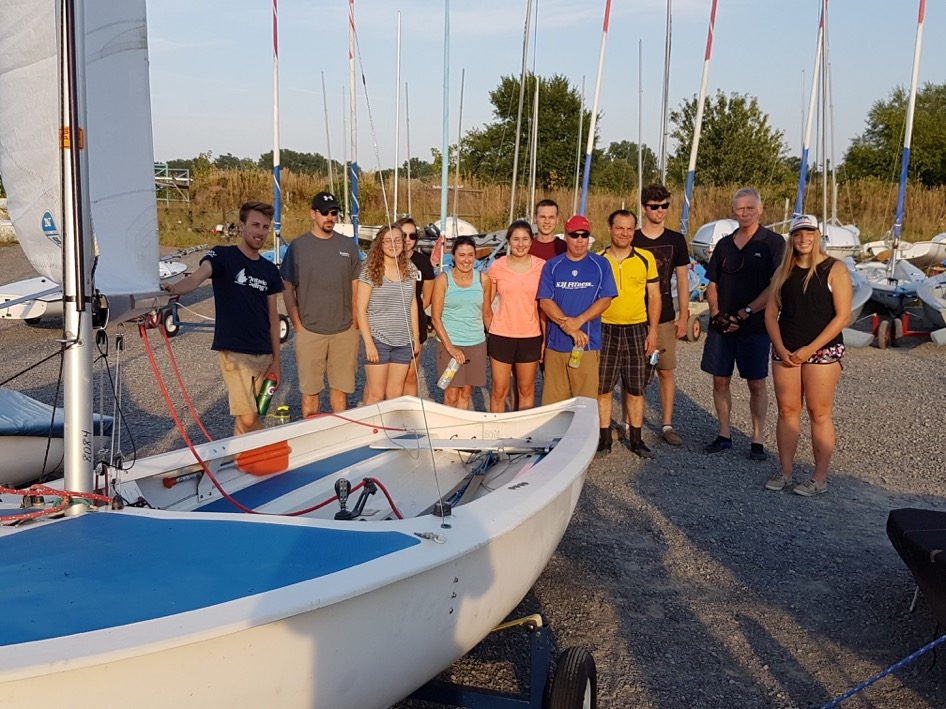
It's a sultry August evening, in the hottest summer on record. The keelboat racing on Monday, Tuesday and Thursday have good wind this week, but on this dinghy race night, Lac Deschenes in Ottawa/Gatineau is flat as a millpond. The dinghies and cats of the Nepean Sailing Club Wednesday race fleet have looked at the water and retired to the bar. Race committee is flying the cat-in-the-hat and it looks like they are about to retire to the bar as well.
The Albacore fleet doesn't mind too much as they have just returned from their annual road trip to the Gatineau River Yacht Club regatta, where the usual shifty winds were gusting 20 knots, 30 degree angle changes on the puffs, with capsizes and shark bites - but that's a story for another day.
In the yard, a small crowd has gathered around Albacore 8084, who is wearing her cruising sails. It's the 12 sailors of the Advantage Boating CanSail 3 class. Ron Schute and Doris Parolin who run Advantage Boating are introducing the boat to them. They've been training Cansail 1/2 sailors on 420's, but even these new sailors can see that the Albacore is a larger vessel, with more sophisticated control of the sail shape. The flyaway jib pole causes some initial confusion, but they get it after a few experiments.
Dominic Goodwill from the NSC Albacore fleet is on hand. He explains that the Albacore is rated faster than the 420 and is the ideal next step for them.
Then, their instructor spots that the breeze has moved in from the Quebec shore. It filled in too late for the racers, but it'll work well for the trainees - they are on a tight lesson schedule and are focused on getting their practice in. So they leave the Albacore for now, rig the 420s and head out.
The Nepean Sailing Club itself teaches CanSail, race program and adventure sail to about 300 kids each year. For adult sail training, Advantage Boating is NSC's commercial partner. Advantage offers learn-to-sail and learn to cruise on dinghies and keelboats.
The challenge with learn-to-sail is this: after you do your training course, what's the next step? Buying your own boat could be a huge step, you probably don't know what kind of boat you want, and you probably won't get organized until the following season. There are community clubs in Ottawa, but not so many. And from the perspective of the local fleet, we can't afford to lose people in the gulf between sail training and hardcore enthusiast.
Advantage Boating helps to bridge this gap with its Sail Share program. As Advantage describes it: “You have completed your sailing lessons on a dinghy or keelboat and wish to continue sailing but you're not ready to buy your own boat. Perhaps you just want to have fun sailing and don't care about owning your own boat.” They have a fleet of sail boats, where their program members pay a flat annual fee, then use the boats whenever they wish, without the commitment of time and treasure of boat ownership. Advantage has run Sail Share with tremendous success for a number of years with a fleet of keelboats from 22 to 29 feet at NSC and Britannia Yacht Club.
This year, they are expanding into dinghy sail share, and selected the Albacore.
Why the Albacore? Because, as Ron points out, it's a natural next step from the 420 and is easy to sail for beginners, but is a subtle boat as you gain more experience. An important factor in his decision was the existing fleet of 15 privately-owned Albacores at NSC, and strong commitment from the NSC Albacore fleet to help the new sailors.
After some searching, they found a good quality used Ontario Yachts boat 8084 out of Toronto. It's in decent shape, and very similar to several of the NSC fleet.
So, 8084 is rigged and ready to go, and some of the CanSail 3 graduates have signed up to sail her. As Fall arrives, the wind picks up and Lac Deschenes is the perfect venue for their next step.
Three Boats At The Weather Mark
This month, I am going to discuss a situation slightly more complicated than I usually address. This situation involves three boats at the windward mark.
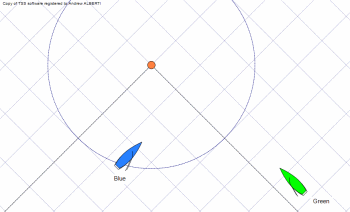
I will start with a two boat situation. Green is approaching the windward mark on starboard. Blue is approaching on port. At position 4, Green starts to tack and by position 5, she has completed her tack inside the three-boat length zone. Blue then luffs to get around the mark, forcing Green to luff above close-hauled. Blue clearly breaks rule 18.3a, since she has passed head to wind within the zone and then caused the other boat to sail above close-hauled.
18.3 Tacking In The Zone
If a boat in the zone passes head to wind and is then on the same tack as a boat that is fetching the mark, rule 18.2 does not thereafter apply between them. The boat that changed tack
(a) shall not cause the other boat to sail above close-hauled to avoid contact or prevent the other boat from passing the mark on the required side, and
(b) shall give mark-room if the other boat becomes overlapped inside her.
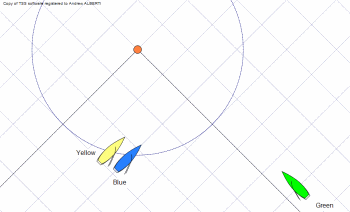
In the second diagram, there is a very similar situation, but with three boats. Blue and Yellow are both approaching on port tack. Both boats pass head to wind within the zone. Both boats complete their tack, then both boats luff. Yellow luffs to clear the mark, and because Yellow is the leeward boat and has right-of-way according to rule 11, Blue is forced to luff to avoid her. Green has to luff to avoid Blue for the same reason. Now because Green has luffed above close-hauled both Blue and Yellow break rule 18.3a. According to rule 64.1 (a), however, Blue is exonerated since she broke rule 18.3(a) as a consequence of Yellow breaking the same rule. Therefore, Blue would not be penalized while Yellow would be. Yellow's proper course of action would be to have gone below the mark, or back at position 1 asked Blue for room to go behind Green.
11 On The Same Tack, Overlapped
When boats are on the same tack and overlapped, a windward boat shall keep clear of a leeward boat.
64 Decisions
64.1 Penalties and Exoneration
….
However, (a) when as a consequence of breaking a rule a boat has compelled another boat to break a rule, the other boat shall be exonerated.
With permission from Andrew Alberti, who has been writing these monthly articles in the RCYC Kwasind since early 1997, explaining the Racing Rules of Sailing. Andrew is a National Judge and National Umpire. He is a member of the Sail Canada Rules and Appeals Committees.
Your 2016 CAA Executive Board
| Rear Commodore & Canadians Regatta Chair | Darren Monster |
| Commodore | Ian Brayshaw |
| Past Commodore | Mary Neumann |
| First Vice-Commodore & Race Chair | Michael Williamson |
| Second Vice-Commodore & Promotions | Graham Pearson |
| Third Vice-Commodore & Education | Frank Loritz |
| Secretary | George Carter |
| Membership Secretary | Michelle Adolph |
| Treasurer | John Cawthorne |
| Chief Measurer | Ken Yamazaki |
| Specifications Committee Chairman | David Weaver |
| Editor, Shackles & Cringles | Tannis Baker |
© 2016 Canadian Albacore Association | www.albacore.ca