Fall/Winter 2013
November 01, 2013
A commodore's year-end wrap-up, tuning and tactics notes from the Rehoboth North Americans, a recap of the 2013 Canadians and Ontarios, the story behind the new Ovington/Rondar boats, and a sailor's poem.
Commodore's Message
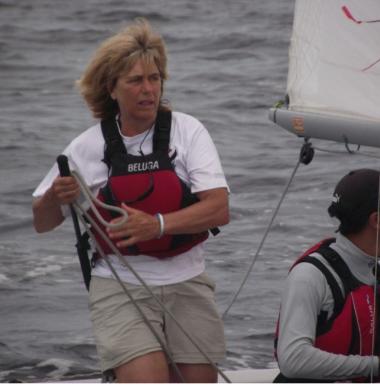
Here is my year end wrap up, and look ahead to next year's activities:
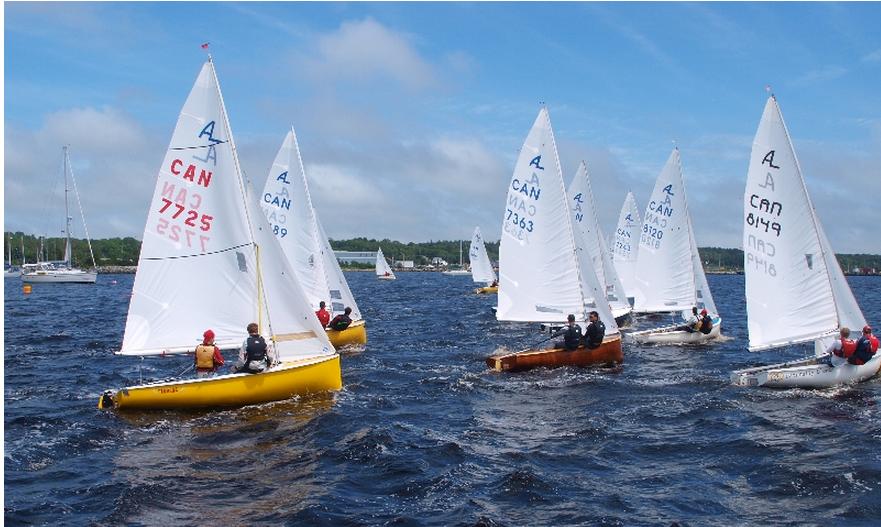
We had another very successful, action packed sailing season. There were great regattas throughout the summer. The Canadians/ East Coast Championships in Nova Scotia and the Ontarios/Moredale Regatta were both wonderful successes due to the hard work of the organizing committees, and the fun-loving attitude of the sailors. More on racing can be found elsewhere in this issue including an article by Barney Harris and David Byron on the North Americans with tips on sailing faster.
The arrival of 12 brand new Ovington/Rondar boats in August gave many sailors a real boost. George Carter compiled the detailed specs, and managed the purchase process. The new boats are wonderful, well made and very competitive, but also great for beginners. See George's article on the process of getting the new Ovington/Rondar boats. Kenata SC, after buying three used Albacores this Spring, is seriously considering rejoining the CAA as a community club member.
Looking forward to next year, we again have a busy regatta schedule. Highlights include the Canadians which will be held in Nepean September 19th to 21st giving everyone an excuse to hang out with their Ottawa sailing friends. In September the winds are likely to be strongest, and the weather still warm. The North American's are tentatively to be held at CORK in August. Kingston is a great venue for predictable winds, and cheap accommodation in the university and college residences. Various options are being explored for the Ontarios which will be held early in the sailing season. The Toronto clubs are looking into expanding the Fall Series both by extending the season and increasing the number of races each Sunday.
All sorts of training is being looked at for next year including beginner, intermediate and advanced clinics, with possibly more beginner training later in the season when people have found their sailing legs and want to get into racing. Other things that are being contemplated are: off-season clinics for rules, weather for sailors and another visit to the Evolution sail loft, training for race officers, and dinghy rescue.
I would like to thank all the Executive for their hard work last year keeping the CAA up and running: and in particular the retiring members -- Sheena Brennan, Ian Brayshaw, Jenny Gibbons and Neil Wilson
On a personal note, the editor said she was looking for “artistic” content for Shackles and Cringles, so I submitted a poem of mine on sailing. She has declared it “dope”, so it's here. If you have anything artistic related to Albacore sailing send it in for possible inclusion in future issues.
Last but not least, have a wonderful holiday season.
Random Thoughts From Rehoboth
Rehoboth continues to serve as an excellent venue for fall sailing. The Albacore class has conducted a plethora of events from 1988 through the most recent North American Championships including two week-long World Championships. While we did lose some racing days during this most recent event, the fact remains that during this 15 year span we have never lost a day of racing due to lack of wind. This is a telling statistic – and, along with RBSA's nice members, easy launching, parking, and reasonable food and housing rates, makes me want to return again soon. Here we offer some random thoughts regarding the event, the venue, social events, and some ranting about the sailing.
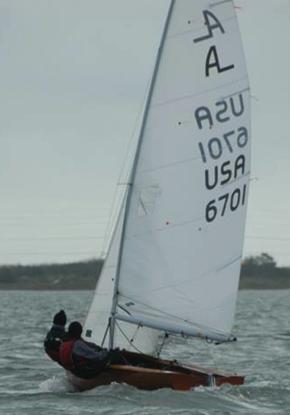
UPWIND SAILING – You know, that old wood (6701) boat DOES go well up wind in a blow. It has wonderful feel and balance and when correctly set up and tuned it absolutely charges to windward. It's something I have yet to fully replicate in the HAPCO boats. We were raked at around 9 inches all day Monday. Shrouds dropped 2 pins from their normal up right setting. The mast was around 3/8ths of an inch aft of the partner. We held it there by taking the slack out of the mast ram to constrain bend at the gooseneck and thereby force it further up the rig.
With the full racer x sails I have been using shorter (15 1/2 inches) and more swept (8 ¼ inches) spreaders – I have found that one can always stand the rig up further to replicate the effect of less sweep and longer spreaders, and we can get more bend higher in the rig on windy days, so the set up results in greater versatility overall. We used moderate vang to tension the leech. When loaded the main fills, the mast bends, flattening the main, and the leech twists wide open. We had the jib leads around 2 pins aft of normal. The jib was sheeted in pretty tight, nearly flat on the bottom third and had a fair amount of twist. In the higher gusts the top ¼ of the jib would spill open and not fill – simply going along for the ride.
The large amount of twist in both sails makes for a very gradual change in power with heading – one can head up a small amount and unload the rig or fall off and increase power. Still, steering up wind was critical to modulating power. In gusts we ease the main a small amount and feather up to maintain equal pressure in both sails, frequently steering high enough to lift the jib's windward telltale. In overpowering gusts we would occasionally feather up so high we would just begin to back the front of the jib. This is very narrow groove – just a small amount higher and the boat loses drive and stops, a bit lower and it's overpowered, but when it's right on the main and jib are equally loaded, the power matches the available righting moment, and the boat motors to windward, just not quite climbing over its own bow wave, rooster tail breaking cleanly from the transom. I would add that “groove” is a bad analogy because the boat does not fall into it – in fact just the opposite – one must actively steer with great focus and precision to maintain the state between power loss and over load – its more like balancing a stack of dishes while walking on a tight rope, in a cross wind, in the rain
I note a common steering mistake in high winds is NOT feathering up as I describe above. When in winds strong enough that the full jib alone will over ride the crew's ability to hold the boat upright, the boat will heel no matter how much main sheet is eased. The boat will be out of balance, with a lee helm, heeled over, and with the boom dragging in the water, and may result in a capsize. By combining a smaller ease of the main with feathering up as described above, the boat remains in balance and under control as both sails are more equally loaded.
In extraordinarily high gusts we ease the jib sheet a half inch or so. The crew must be right on top of this and ideally hand trimming the jib the entire time. There is little time for uncleating and this is typically too disruptive.
It was interesting sailing in the flat water – which is unusual for that breeze level. We found our normal fore n aft trim had us dragging our transom, so we re-positioned ourselves a touch further forward than we normally would in the absence of steep chop that would normally accompany this level of wind.
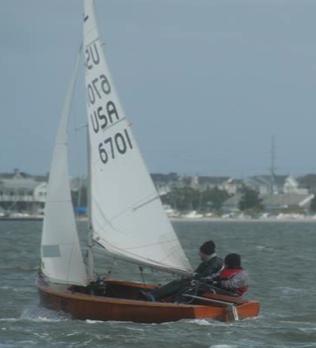
UPWIND STRATEGY: Our strategy was to balance risk between covering, pressure, and angle. We noticed a geographic effect close to the windward mark consisting of gusts from the left each time we approached. In addition there seemed to be some sort of wind anomaly where if one was just a touch too far to the right when approaching the mark boats to the left would climb away. No clue why this was occurring, but in the course of 10 windward mark roundings it was there every time – so we organized ourselves to be close to the port tack lay line each time we were approaching the windward mark. As for the rest of the course, our observation was that it was fairly even with randomly scattered pressure and a few shifts with a total range of about 15 degrees.
As we lead at every leeward mark, our objective was defense – maintaining our lead, but a strategy based solely on defense will usually erode one's lead, the lead distance being cashed in for greater certainty. The longer (approx 1 mile) windward leg length, shifty winds, and plethora of competitive boats meant that we had to balance sailing a good windward leg (the war) with covering our closest competitors (the battle).
Our approach after rounding the leeward mark was to first get the boat onto the lifted tack and then, as the pressure was fairly evenly distributed across the course, primarily to stay in phase with the major shifts, secondarily to keep in touch with our nearest competitors, AND still arrive to the left of others at the final port tack approach to the windward mark. Often we would not react tack for tack with boats behind, especially when they tacked from a high lift. We would wait, and wait for the lift to drop and THEN tack to a loose cover.
The wind conditions had been pretty steady and the meteorology did not predict change, so we were betting that our trajectory up the windward leg based on first principles was, on average, more likely to be faster than a competitor catching an enormous shift in a corner. While we frequently extended up wind it was always with some uncertainty that some large unexpected wind event could occur that would place others far to one side closer or even ahead and in so doing we accepted the possibility that a battle may have been lost – but winning the war requires a whole regatta perspective and at times this necessitates a partial detachment from the tactical event of the minute.
OFF WIND SAILING: Our off wind reaching set up and tuning was straight out of that article we published in 2010. It has taken over a decade to crack the Albacore reaching speed puzzle. I look at photos of other boats and I see two nearly ubiquitous and chronic tuning mistakes.
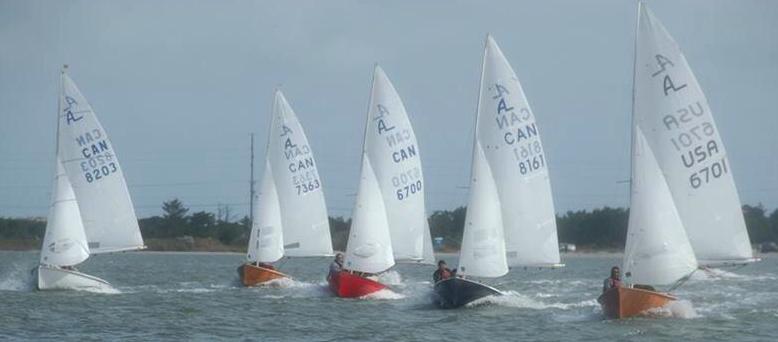
The first is not using enough jib stik. I have found that the jib stik must be extended as far as possible. This requires frequent adjustments and focused attention and proactive action by the crew as the apparent wind angle changes – but doing so keeps the entire jib pulling. Relaxing with less than the maximum possible jib stik extended is easier to trim, but the bottom third of the sail stalls as the curvature near the clew is too great for the flow to remain attached. This relaxed jib stik setting may be less work to trim, but it leaves speed on the table. This is clearly illustrated in this most popular face-book photo. Note the jib shape on 6701 with the jib stik pushing the jib clew outboard whereas the other boats in this photo have less jib stik and so the bottom aft of the jib has far too much curvature. The bottom of every one of these jibs is stalled and generating only a fraction of the potential aerodynamic force available.
The second chronic issue is too much vang / inadequate twist. Our main has telltales in each panel mid way between the luff and leech, so we can readily determine when the sail is stalled. The Albacore main must have significant twist to have correct angle of attack from tack to head. The details of this are more fully explained in the article from 2010. With an even slightly over tensioned vang, flow over the upper quarter of the sail stalls, again, leaving speed on the table. We set up our main such that every main sail leech and mid chord telltale streams, extracting the greatest possible aerodynamic force available. The differences between a correctly set and an overly vanged main sail are very small, but the speed difference is significant.
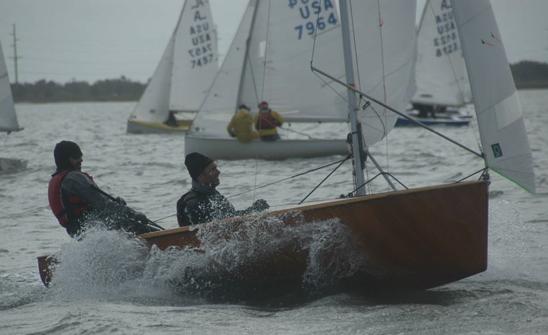
OFF WIND STRATEGY: Our goal is to sail each reaching leg in the minimum time possible by travelling the shortest distance consistent with good speed. The wind strength and course angle was just a touch too light and low to result in constant planing. Our process was to stick to the rhumb line in displacement mode until a clearly discernable wind line approached. We would head up a little to meet the new breeze and then, once fully planing, burn down as low as possible while maintaining a plane.
This required constant, focused, and coordinated sail and weight trimming. In this way we stayed in each puff longer as we followed it down. We frequently checked our relationship to the rhumb line to stay as close as possible, thereby ensuring we sailed the shortest distance.
I am perplexed by those who chronically give in to the urge to sail high on reaches. Kindly note that I am not referring to boats sailing in traffic and responding to tactical situations with competitors attempting to pass to windward. No, these are otherwise well sailed boats, far from other competitors, with no tactical considerations or constraints. Again and again I watch these people sail a course far above the rhumb line. I recognize the temptation: heat the boat up and it immediately leaps onto an easily sustainable plane – but this short term, feel good act results in less time in each gust, a longer distance sailed, and sometimes a slow deep reach or dead down wind crawl to the mark at the end of the leg. Our process of sailing low while maintaining a plane in a gust is painstaking work and nowhere near as fun, but over the twenty reaches we spent precisely ZERO time wing on wing, going slow at the end of a leg.
A NEW TRICK: On Friday I went out for a sail and only had a fixed rudder. The depth at Rehoboth is quite shallow for several hundred yards from shore. Bearing away rudderless in high winds and sailing dead down is difficult. I recall that when I raise the centerboard when landing at a beach rudderless the boat will “weathervane” with its bow into the wind – so I figured that I could “sail” backwards from the beach with no rudder and no centerboard – should work in theory but I had never actually tried it. Well it turns out that this worked pretty well. We left the beach in reverse with the centerboard fully retracted, rudder off the transom, jib uncleated and luffing, and the main sheeted to centerline and the boat backed away from the beach. We were able to “steer” the boat by pushing the main to one side or another to keep the bow into the wind. Pretty cool.
MAIN SHEET KNOT: Place a single over hand knot in the main sheet such that the boom is prevented hitting the side stay too hard. Doing so helps keep the boat under control during gybes and prevent the boom breaking from hitting the shroud. We once broke a boom several years ago following a capsize recovery for not having this knot. An added benefit is that this knot in main sheet will end up in the helm's hand on a fast reach!
EASE THE VANG: One should not sail around between races with the same amount of vang on as when sailing up wind. The tight leech and low boom can cause a capsize if the boat heels a small amount and the boom end is dipped into the water. Capsize recovery is also complicated. Bottom line is that one should ease the vang several feet when not sailing up wind.
“Uncle David, did you do the same as Grandma and tip over today?”
— Jake Beaver, 4 Years old.
CENTERBOARD BREAKAGE: Most Albacore centerboards are not structurally capable of withstanding the weight of the crew more than a foot or so away from the hull. Either install and use righting lines or the jib sheet to get your weight out while keeping your feet close to the hull when righting.
GYBING IN FLAT WATER: Gybing in high winds and flat water is challenging. There are two approaches. One is to go into the gybe with the maximum speed possible, bearing away until the main backs and, as it crosses the boat, to steer an “S” such that when it lands on the other side the force will drive the boat fore ward. The crew and helm must be ready to move in case the boat is not exactly so aligned. This gybe technique is fastest in a racing situation, but, in flat water, one must nail this perfectly to stay upright. We performed several gybes in the high winds while practicing on Saturday and nearly lost it twice.
The second method is to steer well by the lee and, as the boom crosses the boat, to continue to head up on the new gybe such that as the boom reaches the other side the main is left almost completely luffing. The helm and crew must be on the new windward side and ready to hike out – or not – to keep the boat upright. After the gybe the boat can be born away. This is somewhat slower in a racing situation but there is greater margin for error.
NON SKID IN 6701: David and I have sailed 6701 since 2000 pretty much without any major changes. The cockpit sole is finished bright just like the rest of the hull. Coming from 8200, with its non skid paint on the inside, 6701 seemed like an ice rink. Both of us were slipping and sliding all over the place. I almost went out the back on a gybe on Saturday! This never seemed to be a problem in the past. Fortunately for us, Darren and Tony gave us some non skid tape for the bilge.
MINOR MALFUNCTIONS: Things may have looked nice on 6701 but we did have some problems. We ripped the foot of the main sail at the first leeward mark rounding, so we were not able to tension the out haul without going beyond the black band on the boom, and so we sailed around with too much fullness in the lower part of the main. 6701's main sheet was nearly worn out and while we stitched it back together we were not able to correctly adjust the main without risking the cover ripping and jamming in the block. Instead we had to steer the boat more than normal. Fortunately the waves were small. Finally, at one point we heard a big “crack” from inside the boat while sailing up wind. I still have no idea what that was – but I was waiting for the centerboard case to detach from the cockpit floor and float into the middle of the boat during the entire regatta!
ON GOING EARLY & STAYING LATE: October is just about the nicest time of the year in the eastern mid Atlantic. The temperatures are moderate. There is some flux to the weather that frequently brings nice winds. In Rehoboth the town is almost entirely open for business and the cost of lodging, food, and entertainment along with the crowds, are down from their highs of summer. Several folks arrived early to relax and enjoy the beautiful conditions. For some reason I am always frantically gluing a boat together or assisting with logistics and have never made it there for the week before, but maybe some year…
PEOPLE COMING OUT OF THE WOOD WORK: We saw a few old faces: Doug Foord, Dave Smith, Lars Rathgen, Van Sheppard, Dave Yemc, & Lloyd Leonard all managed to make an appearance. Hopefully they will remember to make it out for next years' events.
WHO WE MISSED: We sorely missed a few regulars as well. Marty Hublitz, Peter Duncan, Jamie and Julie, Ernest and Jason, Nathan Marsh, Les Crane, and others. You guys all missed a really nice event and will have to console one another that next year will be here before you know it.
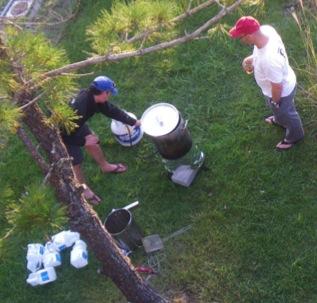
A FAMILY EVENT: We had many parents and their children along for the nice weekend and some who were sailing including the Rathgens, Gortons, Sheppards, Paramore, and three generations of Byrons.
CANADA HOUSE: A gaggle of Canadians, still with post-traumatic stress disorder from cheesy-poof battles of years past, nabbed the same great place and hosted parties every night, including a Thanksgiving dinner after sailing on Monday. Having dinner for 30 on the table at 7ish after 5 hours of sailing and boat packup is no small feat. Tony Z worked some deep-fried magic outside while Kelly cranked out innumerable other goodies inside, and lots of other pitched in to make it all happen. It was a little tough starting the drive home on a full belly at 10:30p with a workday looming in the morning, but it was worth it. Nothing beats a long meal with great food and friends.
Even with one day of racing when we planned on three, this was a great event. Lots of families and friends we haven't seen in awhile motivated to socialize more than made up for it. See you next season, or if your luck runs out, in a Hapco penalty boat repair session.
Remember: keep calm, and follow us – to Rehoboth for 2014 US Albacore Nationals.
Major Regattas 2013
Although it was hard to get Ontario sailors to commit to going out of the province for the first time ever to the Canadian championships, in the end 17 boats made the journey to Shelburne to join another 16 boats crewed both by local teams and invited teams from throughout the province. The races were impeccably run and the weather while looking doubtful cooperated to provide excellent racing, the town's beautiful waterfront consisted of well-preserved 18 century buildings created a great setting, the partying was great helped along by Henry Pedro's and Guy Tipton's wife's' Boxing Rock beer, the hospitality (including the Commodore of the Shelburne Harbour YC playing rocking dance music with his band) could not have been better and everyone had a wonderful time. Those who didn't go missed a special event.
The event was won by Allan Measor and Richard Piercey from St Jamestown SC, with Darren Monster and Tony Zakrajsek also from J-town in second place, and Kevin Smith and Jason Brown from Westwood in third, with the Youth Trophy again being won by Evan Bower and Nick Williams from Shelburne Harbour Y.C.
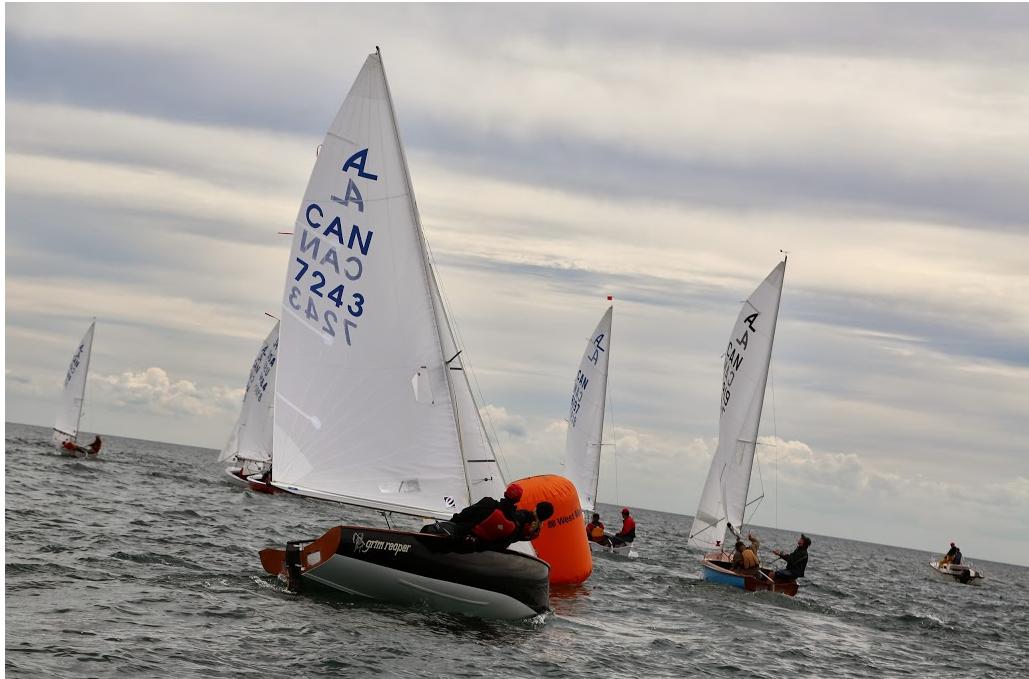
George Carter and the gang at Mooredale also put on an excellent regatta, having moved the Mooredale regatta from August to become the two-day Ontario's in mid-September. Much of what I have said about the Canadians could also be said about the Ontario's including that the winds came through after looking doubtful. There was brilliantly run racing, great food, a fun party and once again a good time was had by all.
Robert Bartelewski and Oleg Sirghii from Mooredale S.C. in third place. [Ontarios] won, Darren and Tony Z came second, with Robert Bartelewski and Oleg Sirghii from Mooredale S.C. in third place.
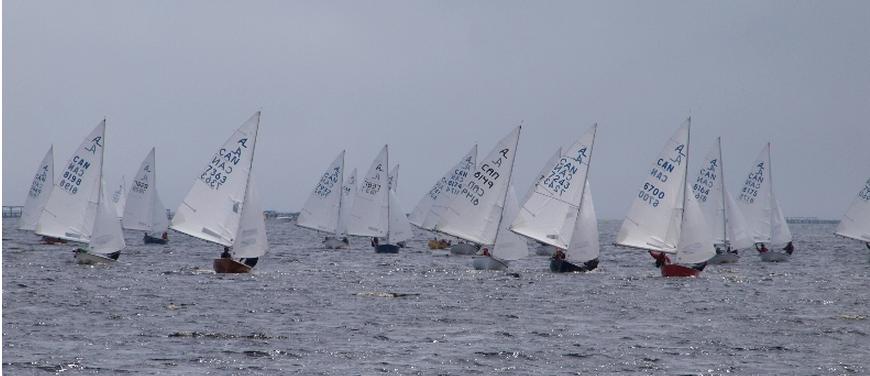
The Internationals were held in Abersoch, Wales this year. Those who went from Canada did very well with George Carter and Tony Z coming second to Barney Harris and David Byron so that the Brit team of Neville Herbert and Mark Fowler had to settle for third. The North Americans in Rehoboth at Thanksgiving saw a large contingent of Canadian teams. Barney Harris and David Byron won but the next eight spots were all Canadians with Tony Z once again in second place.
Results of all the regattas can be found at albacore.ca.
2013 New Albacore Construction
A reliable supply of cost-effective good quality new boats is vital for every dinghy class, however this is particularly the case with the Albacore class in Canada. The majority of boats are purchased by community clubs using them for teaching sailing. These boats are subject to heavy use, far more than a privately owned boat raced once or twice a week. The requirement for new boats was becoming an increasingly concerning issue when the quality of the available boats from local suppliers was not up to the standards required.
However, a cost-effective process has been established to supply well built boats from the UK into Canada and in three years, 31 boats have been brought to Toronto, in three separate container shipments revitalizing the Canadian fleet at a crucial time. Each year the process and boat has been improved. This article will summarize the current process and look forward to future steps.
Key Requirements
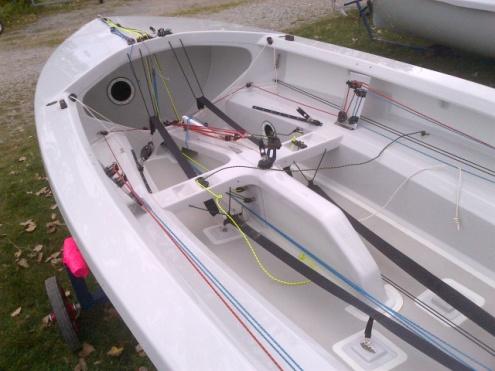
The must-haves in my opinion for a new boat are:
- Cost effective product offering good value
- Minimum work required on receipt, including measurement
- Strong, durable construction, minimum maintenance and high uptime
- Fitted with quality parts readily available in Canada
- Suitable for teaching new sailors
- Competitive on the racing circuit
- Common base boat upgradable to higher specification by private owners
The Hull
The hulls are made at Ovington Boats near Newcastle in the North of England. Ovington are a large volume manufacturer of boats, most notably the Olympic 49er and 49er FX, the 29er amongst other boats such as the flying fifteen, International 14, VX1, Byte, Phantom and Musto skiff. The mould for the boat is owned by the National Albacore Association (NAA) and was previously operated by Speed Sails. Ovington took over the manufacture of the boat and fabricated at the NAA's expense a new deck and interior moulds, changing the resin used for construction to epoxy resin from polyester. For each hull built a royalty is paid to the NAA to cover the costs of mould maintenance.
The hulls made by Ovington are first class and the finish and durability so far is second to none. There has not been a single boat so far that has had any issue with build quality. There are a couple of things to bear in mind with the Ovington hull. Firstly is that Ovington are a high volume, production-oriented business and the Albacore is a small volume product in their operation. When the moulds are taken down from storage and prepared for a production run, they require labour to be prepared. For this reason, Ovington only accept a minimum production run of 5 boats. This would likely be an issue for the UK buyers if it were not for the annual orders placed by the Canadian clubs.
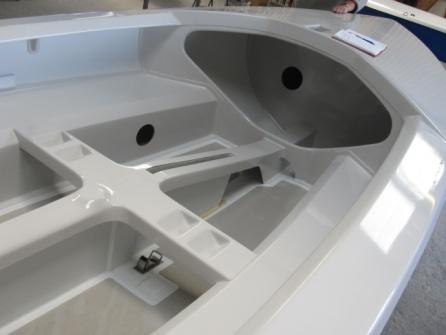
Secondly the Ovington interior mould was designed for control lines to pass through the thwart seat, through the recesses in the photograph here. However after two years of experimenting with this, the conclusion is that this does not work effectively for the vang and jib halyard and a separate control panel must be installed in the boat to give effective operation of these controls. Ovington are not interested in fitting out the boats and the installation of all of the fittings and rigging must be carried out by a third party.
The Fit-Out
We have been working with a company called Rondar Raceboats, located to the west of London due to their own alignment with Milanes foils and moulded foil construction and their experience with container exports. Rondar Raceboats are a boatbuilding company in their own right. Slightly smaller in their output than Ovington but responsible for most of the worlds production of 420 dinghies, they make almost all of the 505s (almost all of the top 20 boats in the 505 worlds will be made by Rondar), they make the Viper 640, Enterprise dinghy, the K1 and K6, Cadet and most interestingly the Firefly, which is essentially a baby Albacore.
The completed hulls are transported up to 6 at a time by road from Ovington to Rondar 500 km away. Rondar Raceboats are responsible for moulding and installing the foils, supplying the mast, boom and rigging and installing all of the fittings and lines for the boats.
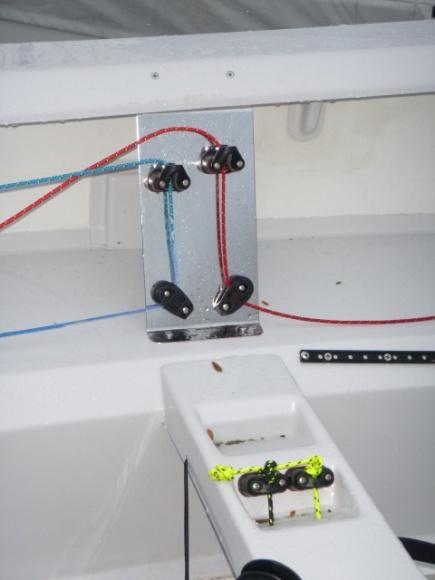
The specifications that Rondar are using have been painstakingly put together with the requirements listed at the start of this article in mind. This combination of requirements is not widely appreciated and although the boat is in constant development, the 2013 boats have been the closest boats to achieving all of these objectives. Rondar are the largest purchaser from Harken in the UK and also from Superspars, so they are able to get the best possible pricing. The length of time taken to fit the boat out has dropped and made some significant hardware upgrades possible to the boat spec from 2012 to 2013 without significant price increases. The side control panels, full Harken fit-out and continuous rig-tension/vang were the key upgrades here.
With regard to the fitting out specification of the boat acknowledgement has to be given to Barney Harris who allowed us to use his mast, boom and centerboard specifications which saved a lot of development time. He has been very supportive of the import and fit-out of the Ovington hulls.
When a boat arrives at Rondar, the only piece of hardware that is installed are the bailers. Every other item that you see on the completed boat has been individually specified and installed by Rondar. There are two key items that are made by Rondar themselves. The side control panels which are fabricated at Rondar from stainless steel and then sent off site for electro-polishing. Secondly the foils are moulded by Rondar at their shop.
The Foils
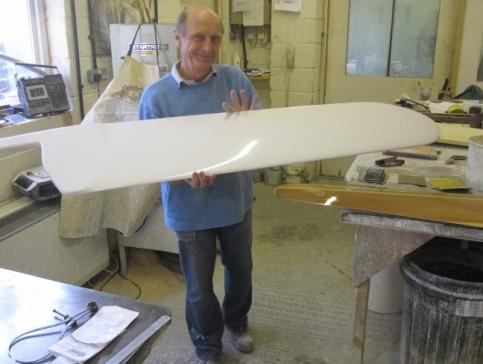
The fabrication of the foils is a story in itself. Everybody in the UK buys a Milanes centerboard for their Ovington Albacore and almost everybody buys a Milanes rudder also. They make the best racing foils no doubt, however they are not the best foils for a boat designed for teaching, nor are they the most economical solution (not to say they are not good value – I think they are). They are too sharp on the trailing edge, too highly polished and the centerboard is too flexible for repeated capsize practice, not to mention that wood needs very careful maintenance.
The first set of boats had foils made by Phil's Foils in Ottawa. They served the purpose however there were several drawbacks. Firstly the centerboard did not fit the Ovington hull due to an interference between the handle and the centerboard case due to an oversight on my part. The handle of the board had to be modified to allow it to fit into the case. Secondly the boats could not be fully measured in the UK because the foils were not present, creating more work at this end.
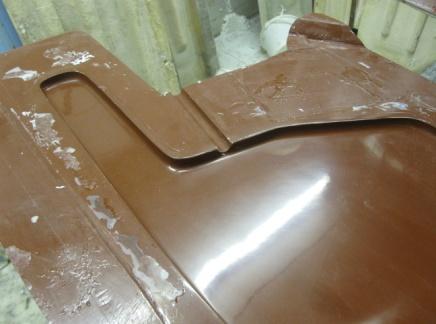
The solution for this was to get a brand new set of wooden foils made by Milanes and to take a mould from them. This allowed strong, economical foils to be made by Rondar, who work closely with Milanes, with slightly less sharp trailing edges and made from fiberglass using epoxy foam and resins. The resulting foils are a little heavier than the OY foils and the wooden Milanes foils, but have been built to be very strong. (Photos are of Phil Milanes holding the first moulded centerboard and a close-up of the centerboard mould). This should have been the end of this story, however the first batch of centerboards expanded further after they were removed from the moulds and test-fitted into the boats and this was not discovered until a day or two before shipping the 2012 order. This required Rondar to hold these boards from the container, sand them down and airfreight them to Toronto at their cost. Then the centerboard mould was re-made slightly narrower (although this was not the sole reason for the problem). The good news is that we now actually own a mould for making rudders and centerboards, this is owned by myself, not Rondar. The centerboard design was modified slightly so in theory the boards should fit an OY, HAPCO or Ovington hull.
Container Transport
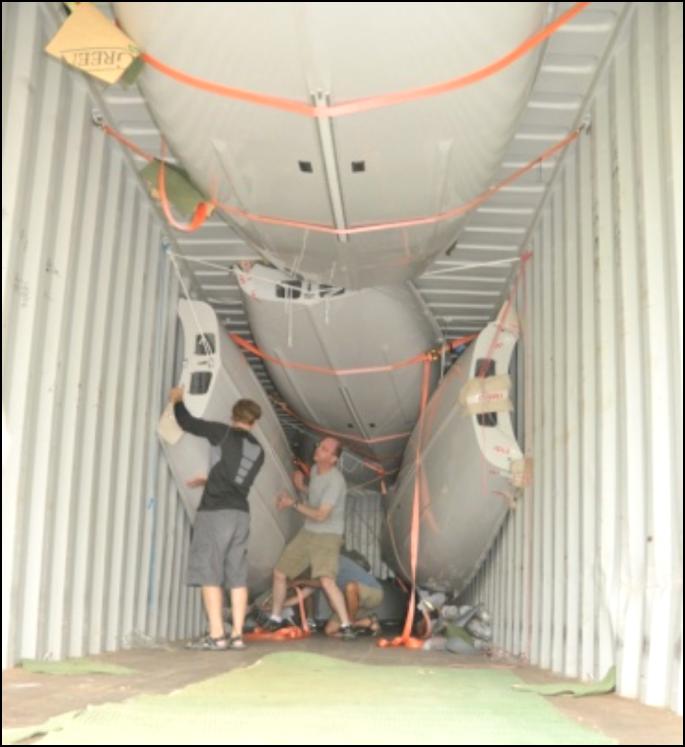
The next piece of the supply chain puzzle is container shipping. This is not an operation to be undertaken lightly, it is fraught with hidden charges and pitfalls for the uninitiated. Fortunately Rondar (and P & B before) have experience of container freight, particularly Rondar who also manufacture in Boston and ship containers of parts and products to North America regularly. Secondly Chris Peacock from Westwood has been an unsung hero to this point using logistics experience from his work to make the container transport and associated duty payments of the boats totally painless. Containers cost pretty much the same amount door to door regardless of size. Albacores need at least a 40' container due to the length of the mast. 6 boats fit into a standard 40' container, 8 boats fit into a 40' ‘high cube' container and 12 boats in a 45' ‘high cube' container. As the costs are pretty much the same regardless of the container size (about $4500-5000 USD) fitting 12 boats into the container saves around $350 per boat on shipping costs compared to an order of 6 boats.
The Product
Considering the ‘Key Requirements' listed at the start of this article, the 2013 Ovington/Rondar is the closest yet in achieving all of the objectives. There were still some minor changes required to perfect the boat on receipt but these were very minor. The stock boat is very competitive. I was very pleased with 8203, my club boat this year winning the JTown Regatta in light winds and placing 2nd in the North Americans in Rehoboth in strong winds and only 310 lb in the boat using the standard foils.
With regard to price the final boat price was just under $13,200 including all duties and taxes, excluding sails. This is the cheapest boat for a number of years. All in all, a great boat at a great price.
Boat Covers
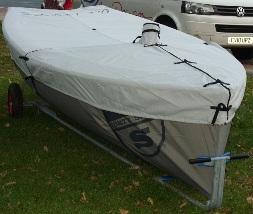
One thing that I have pushed hard for is for every boat to have a cover purchased for it. Leaving boats uncovered as we do in the Toronto community clubs is almost unheard of in the UK. Some sailing schools do this with less expensive boats that are replaced frequently, but this is the exception rather than the rule. Covers in Canada have historically been priced higher than in the UK and with a strong sales pitch in the first container we brought 11 boats and 26 covers! With a bit of a push North Sails now supply covers to us at less than the price of covers in the UK and in 2013 Evolution have started to supply covers that also look good. This is a big improvement and the boats will look better and last longer now they are covered.
The Future?
So where do we go from here? We have cheap great quality boats for now – we should buy lots of them! Looking forward there are a few considerations. Firstly, we are to an extent at the mercy of the GBP:$CAN exchange rate for the hull manufacture. If the exchange rate worsens, then the boat cost increases proportionately. Secondly the Albacore is a boat whose current mould design requires a high level of man hours to construct the hull. This introduces extra labour costs compared to the construction of most comparable dinghy classes.
For now the plan is to optimize the current process. For the 2014, coloured hulls, and mast struts and Milanes wooden foils will be available as options for private boat buyers and further small improvements will be made in the fit out of all boats.
The $10,000 Albacore?
Looking forward we have to wrestle with the conflicting issues of the Canadian Albacore market relying on a UK manufacturer using high man-hour moulds in a foreign currency with a complicated supply chain, yet the UK class is to an extent relying on orders from Canada for Ovington to supply any boats at all in the UK. Many classes in the UK have faced the mould issue and redesigned their boats and changed some non-performance related class rules, to allow construction man-hours to be significantly reduced, sometimes cut in half. An Albacore made in a newly designed mould, in polyester or vinylester may cost $2000-3000 less to buy than the current boat, leading surely to more boats sold and the improved prospects for the future.
These are things to bear in mind for the future, possibly the not-too-distant future. For the time being, enjoy your new Rondar/Ovington boats -a lot of work from a lot of people has gone into them!
Sailing
I can't hear
The sails flap and crack
Drowning out instructions
Ropes taughtened, arranged, made ready
Painter undone, the boom pushed out
The boat moves slowly backwards
Security abandoned
Land is irrelevant
Water and wind reign
The breeze fills the sails with a rush
Forward with speed, catching our breath
Can we ride the beast?
Hair streaming, bodies extended
Sails flattened, concentration and exhilaration
The thrill of speed
The unexpected slap of water to the face
A huge sky
Filled with air and beauty
Changing with the same winds
That challenge and constrain us
As the boat finds new energy and
Races ahead of the wave
Daringly stable, until something
Bigger than a proverbial butterfly wing
Jolts the boat
Lifting fear, confidence and competence
To the throat and synapses fire
Muscles counteract those windy, watery forces
Restraining the beast and urging it on
Alive, very alive, deep in the elements
A gorgeous freedom
A stunning world of altered sensation
Stinging water, wild wind, banging waves
Excite the skin, ears, hair, nostrils,
Join the mind and body
To bend the boat to our will
Circumscribed by nature
Riding the boat, the wave, the gust,
Attached by a foothold
My torso horizontal, suspended
Only inches above the blue grey
Semi-solid water
Blown about
Attending with every sense and fiber
Such pleasure
Such oneness with the inanimate boat and animate lake and sky
Cannot last
Aching, tired, drenched,
We end our visit to the stormy heavens
Touch land, earth, the ordinary, the safe.
Mark Your Calendars:
Toronto International Boat Show: January 14th to 19th 2014
If you want to volunteer at the Canadian Albacore Association booth and get free entry to the show, please contact Dominic Goodwill at [email protected]
| Commodore | Mary Neumann ([email protected]) |
| Past Commodore | Jeff Beitz |
| First Vice Commodore and Race Chair | Mary McMahon |
| Second Vice Commodore and Promotions | Dominic Goodwill |
| Third Vice Commodore and Education | Frank Loritz |
| Rear Commodore - Canadians Regatta Chair | Position vacant |
| Secretary | Position vacant |
| Membership Secretary | Kerry Munro |
| Treasurer | John Cawthorne |
| Specifications Committee Chairman | David Weaver |
| Chief Measurer | Ken Yamazaki |
| Editor, "Shackles & Cringles" | Gillian Houston |
| CAA liason on behalf of Maritimes | Guy Tipton |