Issue 1 2011
April 01, 2011
The CAA's 50th-anniversary year kicks off: a commodore's message previewing the 2011 Internationals in Toronto, a hiking-pants gear roundup, a guest column asking whether sailing's "fundamental principle" of self-policing still holds, Michael Blackburn's top 10 sailing-fitness tips, Jefferson Hall on sailing with your spouse, Andrew Alberti's primer on how to protest, and the 2011 executive.
Message from the Commodore
Are you ready for the 2011 sailing season?
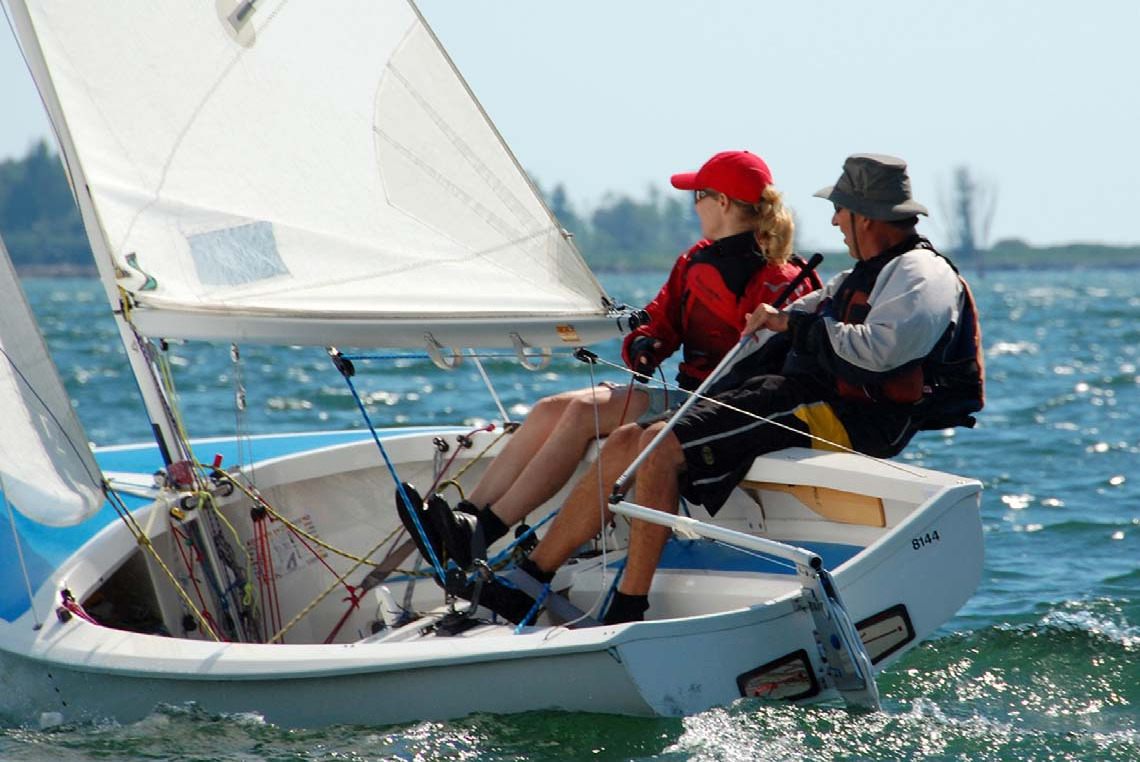
I love the buzz in the air with everyone ramping up their programs in preparation for the Internationals Canada is hosting in September with RCYC and the Toronto harbour clubs. By all accounts, it looks like we will have a record amount of participants and with that, a very competitive fleet. Clubs have purchased new boats, private members have purchased new boats and older boats are being bought and refurbished. I am constantly receiving requests and questions on how and where to get a boat. This is a great time for Albacore sailing in North America.
The Albacore is one of only a few large dinghy fleet classes that offers a fair advantage to such a wide range of Albacores built over the years. Not too many dinghy classes can boast boats from the 70’s, 80’s, 90’s, or recently produced boats, to all having a fair shot at winning the Internationals, this will be evident in September. I have said it many times before and I will say it again, a well maintained, properly set-up Albacore in the hands of a good sailor is as competitive as anyone else on the water, regardless of the year of the boat. This is great for the Class.
It is not unreasonable to expect a new, well built Albacore to remain competitive for 20 years and beyond, this is a luxury for any class and we are fortunate we have it in our Class. It is the goal of this Executive to continue working towards maintaining and improving the Albacores built here in Canada at present and in the future. The growth of the Class relies on a well built, fair priced Albacore, this hasn't changed since the inception of the Canadian Albacore Association in the 60's.
Finally, I would like to take this opportunity to thank Teresa Miolla for her many years of contributing to the CAA, first as Class Secretary, then, Class Commodore and now Teresa is busy organizing the 2011 Internationals. Although, Teresa is no longer on the CAA Executive, I inadvertently missed acknowledging and thanking her in the last issue of Shackles because she is still so actively involved with the CAA. We all rely heavily on her and refer to her constantly for her guidance. Sorry T!
Looking forward to see you all on the water.
Thank you to all contributors.
Front photo — Robert MacDonald
Back photo by Alan Pike
Send content to [email protected]
Sailing Gear
Over the years, I have had several conversations with members about sailing gear, more specifically, hiking pants. For those of you who do not use hiking pants, this might be of interest to you.
In 2002, Ian and I decided to leave the J-24 class and move back into Albacore sailing after a 17 year absence from the class and dinghy sailing in general. We realized that the class as a whole in Toronto was going to be a tough fleet to jump back into and do well. We targeted three regattas that summer, The Ontario’s in Peterborough, the Internationals in Kingston and the Canadian’s in Toronto. We had sailed in all three locations in the past and knew of the wind potential of all three venues. Recognizing our age and our lack of dinghy sailing muscle tolerance, we both invested in hiking pants to help lessen the pain associated with long upwind hiking beats.
Hiker # 1
Our first pair of hikers were from Australia, “Queensport” was the brand name. These were a farmer John style with glued in battens fixed in place. They worked well, great in fact if we compared to what we were use to wearing (nothing).
Pro’s and con’s
Loved the stiff battens, loved the neoprene, it kept us warm on Lake Ontario. The negative we found with this type with the permanently attached battens were not in the right place for our legs and the bottom of the battens dug into the top of our calves…to the point of starting to chafe our skin.
Hiker # 2 (for Jeff)
I was sent an email from a company out west that specialized in Laser equipment and sailing gear, “Rooster”. This company offered a farmer John style hiking pant with the added bonus of ordering custom sized hiking pads for your specified size. The pads are formed so they curve around your leg and can be removed and placed pretty much anywhere in the back of the leg for custom positioning.
Pro’s and Con’s
Very comfortable, love the ability to adjust the pads. The negative I have found, you have to order on-line so you have to use their chart for pad sizing. I believe I ordered one size too big on my pads. The neoprene after a day of racing and being wet stretches and your pants creep down putting your pads too low. The adjustable straps help that however, but I have stretched my straps to the point that I have had to take them in and have new ones sewn in. Also, I do not think I have lost weight but I have noticed my pants fit looser so stretching seems to be an issue for me. If I was going to re-order I would go down a size.
Hiker #2 (for Ian)
Last summer I brought in a few pairs of Zhik products. Hiking straps, Boots and Power pads. The power pads are a pad that on its own you just slip over your leg and put it in the position you want it. They have a lycra pant that goes over them that helps keep them in place. From a skipper’s perspective, Ian finds them comfortable, convenient and easy to use. I have tried them as a crew and do not share the same fondness for them. I found they shifted a bit too much and as well found them bulky. As a side note, with the Zhik Power pads you can thicken up the pads which I have done. This is the reason for the “Bulkiness”. For a skipper they are great, this is all Ian uses in all conditions now.
Hiker #3 (for Jeff)
While down in Florida I tried a new set of hikers from Gill. Pro Hikers. These are very similar to the Roosters with the removable and adjustable hiking pads. The Gill hikers are a bit more of a wet suit vs. the Roosters which for this upcoming year sailing on Lake Ontario will be perfect. I do not have too much to comment on my Gill hikers however they do seem to answer a few of the problems I have had with my Roosters (both are great).
For those of you looking to invest in hiking pants this year, I suggest you go to a store that offers knowledge of the product, variety and to be sure to try them on. The skipper’s needs are different than a crews needs.
Other options
I see a few people sailing with pads that straps on over your sailing gear (porno pants) and others have wet suit shorts with pads built in on the backs of the legs. We have no experience with these.
The CAA will be announcing a program shortly with a local retailer and equipment supplier for members. If you are thinking of upgrading your sailing gear this spring hopefully our program will help you get the gear you need and save you a bit of money as well.
Is the ‘Fundamental Principle’ Still Relevant?
As a racing sailor who is also a coach, judge and umpire, I worry that the ‘fundamental principle’ which is the foundation of our (mostly) ‘self regulating’ sport has become significantly less relevant. As a consequence, our racing rules appear to have less value to competitors, and the behavior we expect these rules to encourage is not as prevalent as it used to be.
Quoting from the RRS, “Competitors in the sport of sailing are governed by a body of rules that they are expected to follow and enforce. A fundamental principle of sportsmanship is that when competitors break a rule they will promptly take a penalty, which may be to retire.” Most of us would agree that this means;
1) If I hit a mark and whether someone sees me do it or not, I should take a one-turn penalty;
2) If I tack to port because I can’t fetch the starting pin and force a boat on starboard to tack when she can fetch, I should take a two-turns penalty whether or not the other boat hails protest; and
3) If a boat fouls me in a way that significantly worsens my position in the race, I should enforce the rules and protest.
However, what I have observed on the race course over the past fifteen years, in the U.S. and abroad, is a growing percentage of sailors who do not enforce and follow the rules. I see sailors break rules with contact between boats and ignore their infraction, even when the other boat protests or the infringing boat gains an advantage in a flagrant foul. I am not talking about incidents where who is at fault is unclear and no penalty turns are taken or no one is protested. We all do that from time to time. I’m talking about the apparent trend towards an obvious level of clear infractions with no action by either party. What seems puzzling is, if it is so easy to exonerate, why does it happen so seldom? Why do sailors break rules and keep on sailing if no one protests? Why do sailors use kinetics when there are no judges around? And a related question is, why aren’t there more protests taken to the room? Are the rules not as relevant in today’s world as they used to be?
Perhaps the best analogy is speeding on the highway. Lots of us drive above the speed limit. But when the radar detector says we are approaching a trap, or we see a cop parked up ahead or coming up behind us, we slow down. But most of the time, the ‘speeders’ speed. Similarly, when there are judges or umpires enforcing Rule 42 (kinetics) on the water, body pumping, rocking, and sculling seem to disappear when the judge boats are close by, but they often reappear when the judge moves on to observe other boats. And, when judges whistle their observation of a foul with the option to protest, competitors usually take their penalty…and when the judges are not around (or don’t whistle/protest), not much happens. Just like speeding, it seems as if one doesn’t break a rule unless an official says we do.
In a recent Laser event, the judges flagged over forty Rule 42 infractions, but observed at least twice as many serious infractions of Part 2 rules (many where boats gained an advantage), and that does not include twice again as many contact incidents observed at the starts with an adequately long line…
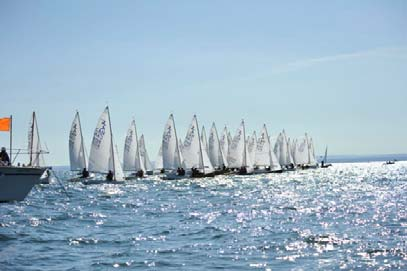
and fewer than five percent of sailors took voluntary penalty turns. I guess judges can only control the behavior they are authorized to monitor, unless they want to discourage enforcement and compliance by the sailors.
If indeed our racing rules and the ‘fundamental principle’ have become less relevant to many sailors (but not yet the majority) …why is this the case and should we do something about it? Here are some possible reasons for lack of ‘compliance’:
- Most of today's sailors under the age of forty have grown up playing a variety of sports where you do not break a rule unless the referee or umpire says you broke a rule (and penalizes you).
- Mark roundings in large fleets of Optimists and Lasers have complex situations where no one can figure out who broke a rule, and starts are often so crowded that minor contact is frequent. Both lead to lack of protesting that may well carry over to the rest of the race course.
- “No harm no foul” is a more practical way to sail. Minor contact or a close incident is viewed as ‘no harm’, so just as going 5 mph above the speed limit doesn’t seem to break the law, neither does minor contact on the starting line.
- The protest process most often requires a major time commitment with an uncertain outcome…and the rewards from social activities after sailing are a 'better use of time'.
- Protesting is also inhibited by peer pressure, so "you owe me one" can be a more practical solution when you are fouled. Cooperation is far more socially acceptable and productive on the race course.
The rules are complex, particularly for transitions, and only the most dedicated and experienced judges/umpires/sailors understand them well…and most sailors don't take the time to really learn and understand the rules.
What can we do about the problem? Is it practical to fully referee our sport? Of course not…although we know umpiring works pretty well for all concerned in team racing, match racing and medal races. And there is good evidence that having judges or umpires on the course with authority to signal by whistle their observance of a foul, and protest if they want to, can work in big fleets when the judges are positioned at the starts and mark roundings where most incidents occur. However, there are clearly not enough judges or umpires to implement broad scale on the water judging.
So what do we do? Should we abandon the fundamental principle? I would not because the majority of races sailed each year have to rely on it. Should we accept the sailors ‘no harm - no foul’ principle? I would not because clearly it is leading to some ‘no protest - no foul’ behavior where some sailors gain a big advantage. Perhaps we need to change the incentives to protest and at the same time the incentive to exonerate on the water and to avoid the protest room. For example:
1. Give more power to the protestor. Allow a protested boat to take a 25% scoring penalty any time prior to the hearing (unless there is damage or injury or competitive advantage claimed in the protest). However, if the protested boat does not take a scoring penalty before the protest hearing (either voluntarily or as a result of arbitration) and is deemed to have broken a rule by the protest committee, the penalty is a DNE.
2. Make it easier for a protested boat to exonerate on the water. Change the alternative penalty for immediate exoneration to one-turn except within the zone or when there is contact, where it remains two-turns.
3. Require on-the-water judges with Sailing Instruction permission to protest at all national championships, ladder events and international qualifiers. An on-the-water protest by a judge/umpire is an automatic three turn penalty (two more turns than a voluntary penalty, except at a mark or with contact), and can still be taken to the protest room if there is damage, injury, or competitive advantage is gained, for a possible DNE.
4. Increase the penalty for a breach of rule 2 (fair sailing), perhaps a DNE and a DNC for the next nearest race in the series.
Some may feel that the direction (and it is only that) suggested above is draconian, and perhaps it is. However I believe the issue needs to be addressed with big changes if we want to reverse the decline in adherence to the ‘fundamental principle’.
Top 10 Things for Sailing Fitness
Fit For Sailing
Laser champion and coach Michael Blackburn offers the best techniques for better performance.
Michael Blackburn’s first resources specific to sailing fitness Sail Fitter came out in in 1997, he has released the third edition of his work – this time on-line as a downloadable e-book. Here are Michael’s top ten things you must do for sailing fitness – the 2011 version:
1. Be Adaptable.
Set a general training plan, then adapt it constantly. Books on training for sport say to set a periodised training plan a few months or even a whole year in advance, then follow it. However, that’s just not good enough to get the best out of yourself at each and every session, particularly in sailing where wind strength has such a big impact on the physical intensity of training.
Sometimes you might want to do a hard session, but the wind isn’t there. To compensate, you can add on a little fitness work post-sailing or do another gym session the next morning. Sometimes, you turn up to training in not-so-good condition (eg, lingering fatigue), so then you might reduce the volume and/or intensity of the session.
Have a good idea of what you want to achieve today and this week, check the weather forecast and be prepared to modify your training plans as needed.
2. Recover Well.
Use ice and cold water recovery practices. Remember that you don’t get fitter from training until you get a chance to rest and let the body rebound. You can recover faster for your next training session using recovery strategies like cold water immersion.
Some people recommend making the bath really cold (12-15 deg C) but I like it straight out of the tap (about 18 deg C). I’d sit in the half-full bath, cooling my back and legs, for 5-8 mins. That usually has me shivering so it feels like it’s enough. While getting in is hard, afterwards you really feel a difference by way of reduced soreness and faster recovery.
3. Develop Your Back.
Sailors suffer injuries to their backs more than any other part of the body. Try to include exercises for your lower back and deep abdominal muscles everyday. There are specific exercises in the book.
4. Have Stable Shoulders.
After backs, shoulders are sailors’ next most injured body part. Sailing often requires sudden, strong movements of the arms over a large range of motion and these can trouble the shoulder joints. Serious sailors should include shoulder stabilization exercises as part of their strength training routine. (Search ‘shoulder stabilization’ on Youtube.)
5. Hip Flexors.
Alongside working on your abdominal muscles, work on your hip flexors. Most of the time when you are sailing, the hip flexors are in a shortened position so you need to correct that at the end of the day with some stretches. Hip flexor stretches can help improve your posture, help the muscles recover and participate in reducing lower back issues.
6. Equipment.
Think of ways your equipment can help enhance your sailing endurance. The obvious item is battened hiking pants which spread the load and improve blood flow. Also consider whether your grip on the boat is good enough (gloves, boots, wetsuit). I glued pieces of rubber on my hiking pants where they touched the gunwale to improve grip and make it more efficient when I tried to throw the boat around.
Make sure your ankles and body are well supported (boots and trapeze harness) and lastly, try to keep your muscles cool rather than hot when racing as overly hot muscles are less efficient.
7. Whey Protein.
If you need to gain weight, supplement your diet with whey protein combined with a quality muscle-building resistance training program. (Protein won’t work by itself.) Skim milk powder is high in protein and when mixed with milk and flavouring makes a cheaper body building drink than the mega powders in nutrition shops.
8. Be Scientific.
Keep quality records of your fitness. The aim here is to find out what works through trial and error. (Hopefully not so much error.) Body weight is the first thing you should keep track of over the long term. After that, think of tests you can apply to yourself to measure your fitness for sailing. (You might start with the home fitness tests in the book.) I have an excel spreadsheet with 10 years of my results from time trials in cycling, rowing machine, pool running, and even surf ski paddling. It’s great to be able to look back and see the improvements.
9. Hike.
Use a Swiss ball as a hiking bench to train the legs when the wind is light. If you should have done some hiking but there wasn’t enough wind, Swiss ball leg extensions can be a great substitute. Try 15-20 reps, rest for 5 sec, then do 15-20 reps and continue through to 100 reps in total.
10. Better Technique.
Hike at 90% effort rather than trying to sustain a more intense position that compromises your ability to steer, trim and decide tactics and strategy. You may not get as much righting moment, but you will gain more by trimming the boat accurately and being in a better mental state to decide which way to go. However, do go flat-out off the start!
The new edition of Sailing Fitness and Training (2011) by Michael Blackburn will be available via Amazon.com ($9.99 US) and can be read on any device with Kindle installed. See www.sailfitter.com for release info.
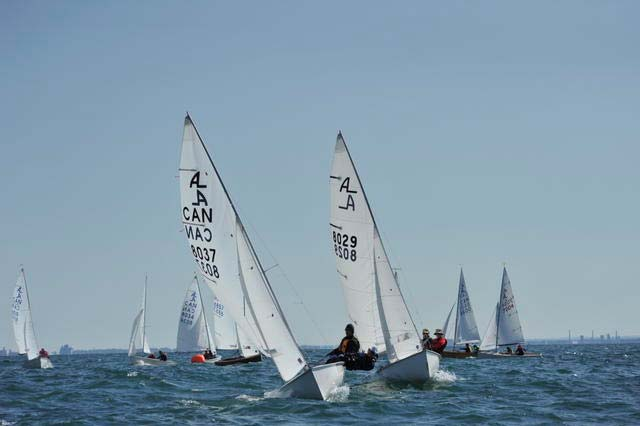
Sailing With Your Spouse
This article is about the ins and outs of sailing with your partner or spouse. Based upon my experience as well as some stories I have heard it is clear that racing as a couple is not for everyone. However, I also know that it can be a rewarding pursuit if you have the right chemistry and personalities. The key is all in setting expectations, respecting one another and communication which can also be applied to most any pairing.
Perhaps it is best to preface the article with some background information.
Early in our relationship it became clear to Tracy and her family that I have an addiction to sailing. Initially I think they believed that I was sailing on cold weekends and driving to places like Miami, Annapolis & Houston to avoid family dinners and quality time. If there was a race, practice or cruise I wanted to be there, rigging & tweaking the boat, out on the water, and analyzing it afterwards. In time they came to understand that it was in my blood and something that I needed to do.
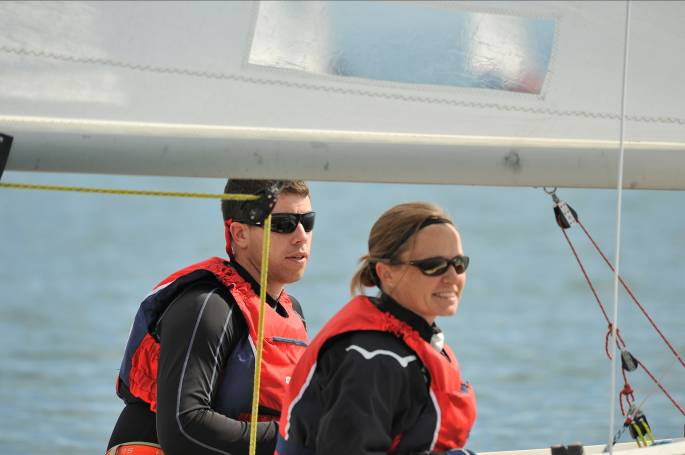
I used to race on a five person team which was rewarding but became too much of a time commitment and logistical nightmare trying to make it mesh with family life. Enter the Albacore. I had been looking at the Albacore since I heard it was an active class in Toronto and ‘easily’ sailed by husband/wife teams. For a couple of years I considered entering the class and was searching high and low for a boat that I could afford. One week before we were to be married I found one in Burke, Virginia. Since I am a guy and was not overly involved in the wedding logistics I wanted to retrieve the boat the weekend before our wedding as the seller was moving to Texas. The answer was NO. Fair enough, provided something could have gone wrong causing me to miss the nuptials or perhaps my input would be needed on some last minute plans.
Wedding bells, honeymoon and a road/shopping/Albacore retrieval trip later we were set to go for the following season. After one Harbour Master and Friday night we were hooked and excited to compete in the 2006 North Americans. The first day dawned with some impressive breeze which left nearly half of the fleet ashore. Tracy was a bit daunted but we launched and planed out to the race course barely able to breathe due to the spray and were tired but having a blast! Rounding the committee boat we capsized but she managed to pull the board down as we went over so we righted quickly and struggled up the first beat. By the top we figured out how to depower a bit and launched in pursuit of the fleet. Gybing inside of four or five boats in the graveyard we were excited until my knee gave out and we had to retire. The season was over and two kids later this husband wife duo had spent three sailing seasons apart.
Last year we were finally able to realize our initial goal of racing as a husband/wife team. As the season approached some people at my club told me I was crazy. They tried to sail with their wives and it always ended in disaster. I was even told a story about some guy who had to sail in alone because his wife had enough of his vocals and swam ashore. Others said that they were excited I was sailing with my wife as they felt that would take me out of the game and make me an easy pass….while I did not agree with them I nearly proved them to be prognostic.
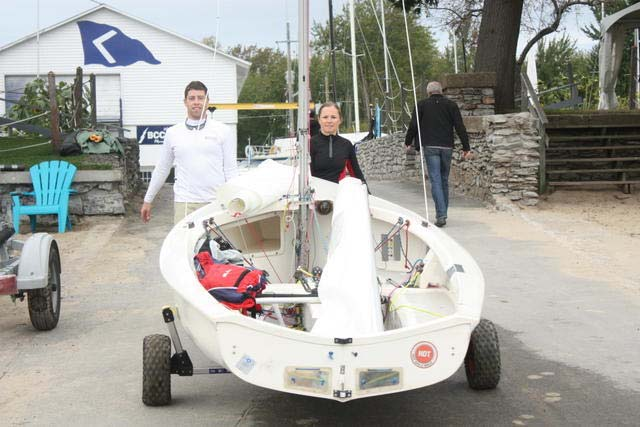
When we bought the boat the program was simple, having fun and doing as well as possible. Somewhere in there I added expectations and it became less fun. I needed to get back to the fundamental rule, make it fun and all else will follow. After being rude to my number one crew I was given a second chance and we competed in a tough Canadian championships and survived a lot of ups and downs including a tough five race day which reminded both of us what it was all about. Sadly it took a near bottoming out for me to smarten up but sometimes you need to hit the bottom to climb back up.
Looking back, I think that the main hurdle was that I neglected to consider the fact that I had spent three seasons in the boat getting used to the controls and fleet and I expected her to jump right back in and have us at the same level. Hindsight is everything and I am pleased that we overcame and have found an understanding. Perhaps we can emulate the longevity and success that George & Suzanne Wilson had, especially given that they were the previous owners of our current boat.
I have sailed with a lot of different people in varied roles on both small and large teams and one thing that holds true across them all is that teamwork is key and communication is the cornerstone. Communication has to go both ways and it must be constructive. If both you and your partner are competitive and active there is no reason that you cannot take your partnership out onto the race course. In theory it should be easier for you so long as you can keep from turning into Captain Crusty.
Here are some tips for successful teamwork no matter who you race with:
- Establish the roles and responsibilities and the communication terms
- Divide up responsibilities and trust one another
- Keep it simple in the beginning and use one term for each thing, do not confuse with extra nautical jargon (i.e. windward versus weather)
- Be patient and teach instead of expecting
- Respect your partners time and effort, especially if they are participating in your addiction
- Do not yell or assign blame
- Leave other issues ashore and boat issues afloat
- Always have fun
Protests
At some point in your racing career you are going to be involved in an incident where a rule is broken. If you are the boat that breaks the rule, you can (and should) either take a penalty or withdraw. If you believe the other boat broke a rule you have the option of protesting. In this issue, I will discuss about how you protest.
The first thing to do is to hail “protest” (and if your boat is 6m in length or more, put up a protest flag.) The requirements are listed in rule 61.1(a)
61.1 Informing the Protestee
(a) A boat intending to protest shall inform the other boat at the first reasonable opportunity. When her protest concerns an incident in the racing area that she is involved in or sees, she shall hail ‘Protest’ and conspicuously display a red flag at the first reasonable opportunity for each. She shall display the flag until she is no longer racing. However,
(1) if the other boat is beyond hailing distance, the protesting boat need not hail but she shall inform the other boat at the first reasonable opportunity;
(2) if the hull length of the protesting boat is less than 6 metres, she need not display a red flag;
(3) if the incident results in damage or injury that is obvious to the boats involved and one of them intends to protest, the requirements of this rule do not apply to her, but she shall attempt to inform
It is important that these things are done quickly. The rule states that the requirement is “at the first reasonable opportunity for each”. Various appeal decisions have clarified that the first reasonable opportunity is a short time, not a long one. Unless you are in danger, there are very few reasons for not hailing “protest” quickly. If there is damage obvious to the boats involved, 61.1(a)(3) makes it clear that these requirements do not apply.
So now you have hailed (and flown you flag,) what next. Look around for other boats that may have seen the incident. They may be good witnesses later. Next you may decide not to protest. There is no requirement to protest an incident (even if there is a collision with damage, though I recommend that all collisions with damage should be protested). There is no requirement to file a protest just because you hailed protest. Hail (and put up the flag first), decide later whether you want to follow through.
If you do decide to follow through, keep your flag up until you have finished. Some sailing instructions require you to inform the race committee at the finish. If you were out of hailing distance at the time you first hailed protest, make sure that you inform the other boat.
Once you have gone to shore go the protest desk or race office, get a protest form and complete it. There is a time limit for filing. If it is not specified in the sailing instructions it is two hours after the last boat in the race finishes.
61.2 Protest Contents
A protest shall be in writing and identify
(a) the protestor and protestee;
(b) the incident, including where and when it occurred;
(c) any rule the protestor believes was broken; and
(d) the name of the protestor’s representative.However, if requirement (b) is met, requirement (a) may be met at any time before the hearing, and requirements (c) and (d) may be met before or during the hearing.
The first thing that you should do is try to determine whether there are any arbitration processes in place and when the protest/arbitration will be heard. Arbitration is becoming more and more common but I will assume for this issue that it is not being used. I recommend helping the committee to find the boat that you are protesting. The protest may be heard sooner that way.
The next thing that you should do if you haven’t done so already is look for witnesses. Find out what other boats saw the incident. If they did see it get them describe to you what they saw.
Make sure that what they observed lines up with what you think happened. If it doesn’t, you may want to think carefully about whether things happened the way you think they did. Don’t bring in witnesses that will not help your case. You should also sit down and think about your own story. Think about the relationship between speed, time and distance. There is a table in the inside of the CYA rulebook that compares speed and distance. If we look at the diagram which shows a case that we looked at a few months ago. If you are the yellow boat and 24 feet long travelling at about 5 knots at position 1 you need to understand that each of the next positions is about 3.5 seconds apart, so position 6 is about 20 seconds after position 1. Work out how to tell your story in a few simple steps.
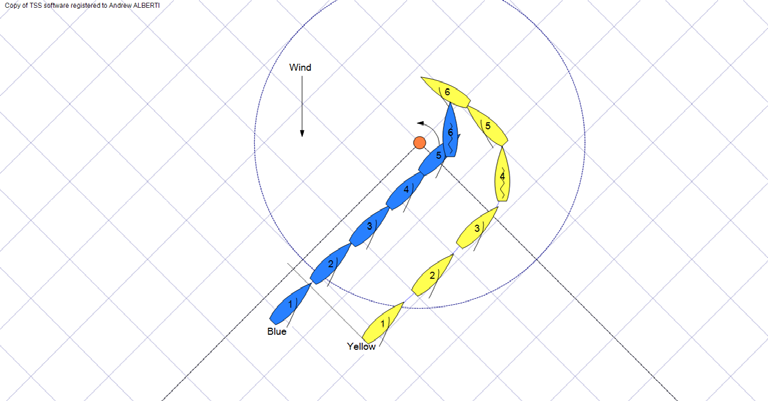
Look at your rule book. Work out which rules apply. Work out what the key points you will have to establish. Eventually you will be called into a hearing. If you are the protestor you will have already seen the protest that you filed. If you are the protestee, you should be given a copy ahead of the protest to have a chance to review and prepare. If both boats protested about the same incident then the protest should be heard together. Even if only one protest is filed, either boat can be disqualified.
The procedure for the protest committee is shown in M2 and M3 of Appendix M of the CYA rule book. This appendix is only a recommendation. The committee does not have to follow it exactly but is well advised to do so. The rules they actually have to follow are in Section B of Part 5 of the rule book (rule 63, 64 and 65). Both boats have the right to have a representative in the hearing. (rule 63.3) The first thing the protest committee will do is introduce themselves and determine whether there are any interested parties (rule 63.4). If you feel that any of the protest committee members are interested parties you should object to them at this time.
Interested Party A person who may gain or lose as a result of a protest committee’s decision, or who has a close personal interest in the decision.
The protest committee will then determine whether the protest is valid (rule 63.5). If there are concerns about the hail of protest, the protest flag if required (rule 61.1(a)) whether the protest has all of the required information (rule 61.2) and whether it was filed in time (rule 61.3) those will be dealt with now. If there were two or more protests filed about the incident only one needs to be valid for the protest to be heard, once one is found valid they won’t check about the other.
Next the protest committee will ask each party in turn to describe the incident as they saw it. Don’t be surprised if your opponent saw things differently. You saw the incident from different perspectives so it is natural. You will get a chance to ask your opponent questions. When presenting your story and when asking questions concentrate on the key points that are needed to establish your case. Don’t get distracted by differences that don’t matter. Each party will have a chance to bring in witnesses. Unless they will establish a key point that you can’t establish on your own, I would usually recommend that you not bother to call witnesses from your own boat. It is quite common for a witness to end up introducing discrepancies that weaken the case. You will get a chance to question the other boat’s witnesses. Along the way the protest committee will ask questions as well. When all of the witnesses and questions are done, you will each be given a chance to summarize your case. You will then be excused while the committee works out their decision.
2011 Canadian Albacore Association Executive
| Commodore | Jeff Beitz |
| Past Commodore | Cathyann White |
| First Vice Commodore & Race Chair | Jefferson Hall |
| Second Vice Commodore & Promotions | Ken Yamazaki |
| Third Vice Commodore & Education | Sarah Bury |
| Rear Commodore | Christine Short |
| Chief Measurer | David Weaver |
| Specifications Chair | David Weaver |
| Editor – Shackles and Cringles | Christine Short |
| Secretary | Susan Higgins |
| Membership | Julie Postil |
| Treasurer | Mary Free |
| IAA Treasurer | Andrew Callum |
| IAA Representative | Cathyann White |
Canadian Albacore Association
970 Queen Street East
PO Box 98093
Toronto, ON M4M 1J8
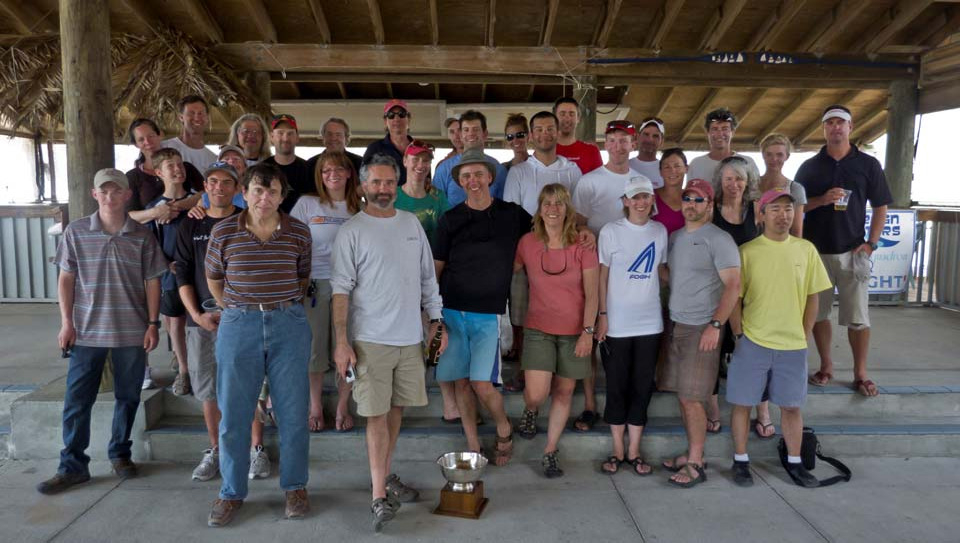
Mid Winters Regatta, Sarasota 2011