Issue 2 2010
June 01, 2010
Commodore Cathyann White on the season's measurement days and the Class Rules ISAF re-write, Raines Koby on deciding who to cover, Ken Yamazaki's centreboard-friction upgrade, Peter Duncan's guide to switching to high-aspect sails, Ralph Glass on the White Mamba's naming, Darren Monster welcoming a refurbished 7363 back to the fleet, Andrew Alberti's mark-room rules breakdown, and the 2010 executive.
Message from the Commodore
Ahoy Sailor!
I hope this message finds you sailing in fair winds and good weather! A bright, hot early start to the season is what we have been experiencing in Southern Ontario.
On May 1st the CAA held our first Measurement Day. The Measurement Team was on hand in Toronto and managed to measure in more than 30 sets of sails, 1 hull and weigh a boat or two along with hotdogs to boot! The next Measurement Day is planned for Nepean (June 25th) the day before the Ontario’s Regatta – please check the website and let George Roth know if you require anything to be measured – a little advance notice is helpful so we can be prepared.
We have held 2 training events so far – a Rules Session at RCYC City Club when the weather was still chilly followed by a windy Intermediate Racing Clinic hosted by Raines Koby and Abby MacInnes – with lots of reach to reach dumping – I mean gybing – in good breeze in the Outer Harbour. We are set for Racing 101 coming up shortly (June 19/20) with coaches Sarah Bury and Richard Piercy sharing their racing skills and knowledge at our beginner race clinic.
The first CAA sanctioned regatta this year will be The Ontario Championship Regatta (June 26/27) being held at the Nepean Sailing Club as a part of the Nepean One Design Event – NOD – this event should not be missed so hitch up and head out!
Further to the discussion which Raines Koby facilitated at our last AGM in September, work has been ongoing with respect to the re-write of our Albacore Class Rules. The International Rules Committee (“IRC”) has been working hard on what we hope will be our final re-write of the Rules to conform with ISAF standards – this re-write is our enabling document. This latest version is being reviewed by some folks in both Canada and the USA for their feedback.
You may recall the original submission was presented in 2006. The request was made of the National Albacore Association (“NAA”) but the response was made by the IRC. We hope that the NAA will accept this final submission of our International Albacore Association (“IAA”) Rules in their new ISAF format. We will bring to our 2010 AGM an ISAF formatted IAA Rules for the Albacore Class for CAA approval. The goal of this version is to confirm our administration – and maintain our International Association – not to initiate changes to specific technical rules at this time – that will be Part 2 of the process…but we need to sort Part 1 first and foremost.
Once we ratify the Class Rules we can begin the process of reviewing some of the specific rules that I know some of our members want clarified or amended – such as those pertaining to large jib windows, the definition of buoyancy among others. I think it may be worth stating how rules get changed in our Class – so with a little help from my friends here is the basic method:
In order to recommend a rule change, members should understand the process as outlined in the IAA Constitution. Proposed Rule changes, or requests for Rule interpretation, are directed to the IRC of the IAA. Such suggestions, requests and/or ideas are discussed by the IRC and, if an agreement to proceed is achieved, suitable wording is formulated. The proposed change is then approved by the IAA and sent to member countries for ratification at each member’s AGM. No country can proceed with rule changes without the formal approval of all member countries of the IAA as outlined in the IAA Constitution. While this process may seem cumbersome at times, it provides stability and preserves the integrity of the Class internationally.
Currently at this time, the Royal Yachting Association (“RYA”) does not recognize the IAA or the IRC – so that really is our first goal – to sort our Class Administration first and then we can tackle the potential change requests. I am hopeful we can ratify the Administration at each member countries’ AGM (we need consensus) and then we can reconcile the specific change requests before the Internationals in Toronto 2011.
I think it is worth noting that this represents an enormous amount of work by a lot of people on our executive as well as the IAA, who have spent time and brainpower on these specific issues on our behalf. We owe them a big THANK YOU!!
Ok – but back to the fun stuff – Have you got your trailer up and running and your road maps out? How about a route that takes you from Toronto – Harbour Masters in June, then onto Nepean for the NOD and Ontario’s, then maybe Muskoka for a sail in cottage country, then Shelbourne for a taste of the East Coast, round back up through Hamilton, Crystal Beach Buffalo Canoe Club (for the Canadian’s of course) and onto Rehoboth for the North Americans in October? A big long sailing summer/fall road trip across two countries! What could be better than a Class that has all that!? See you on the water!

CAA Measurement Days
Measurement Days will be offered at the listed locations below so that those boat owners who are in need of any class measurement services, for New Sails to be certified, Boats to be re-weighed or other Measurement services may come to that location on those specific days. Several of the Measurers will be on site at that location to endorse and certify new suits of sails or provide other measurement services.
The reasoning behind offering of these services on specific dates at locations, is to allow all boat owners to access the class measurers at a convenient time in advance of the regatta and sailing events during the sailing season. In general all requests for measurement will be handled only at these dates, not on an as requested basis as has been the rule during the past sailing seasons. There will be no measurement available for anyone at or during sailing regatta events during the sailing season. Special cases may be handled on request.
Each Boat Owner will be asked to request by a form shown as a PDF or Hardcopy, to the Chief Measurer in advance for what services they will require. The boat owner will be asked to fill out in advance a Request for Measurement form, submit this with his request to the Chief Measurer as outlined on the form.
Each boat owner will need to provide his/her measurement certificate, for the specific hull that any new sails will be endorsed and certified for. The same certificate must be present for any boat re-weighing if that service is requested. There will be a fee to be paid to the individual measurer at the time of measurement for any and all services requested.
Date
Friday 25 June, 2010 in Ottawa at Nepean Sailing Club
Offering: sail measurement, hull weighing, other requests
15:00 to 20:00
Date
Tuesday 17 August 2010 in Toronto at OHCC and or at a sail loft for out of town requests
Offering: sail measurement only
14:00 to 17:00
Date
Tuesday, 7 September 2010 in Toronto at OHCC and or at a sail loft for out of town requests
Offering: sail measurement
14:00 to 17:00
See Measurement Form Enclosed
Stay tuned for some exciting news from Ontario Sailing and the Canadian Albacore Fleet!!
“Should I Stay or Should I Go”?
How do you decide who to cover when your competition (those close in front and behind) are splitting sides on the course?
We figure there are two types of these situations: when there are close competitors behind and ahead, or when there are close competitors behind who opt for different sides of the course.
When there are close competitors ahead and behind:
- We think about our strategy – the fastest way around the course. If the boats behind us are going the wrong way, then we figure they are no longer a worry, but we still keep an eye on them. If the boats ahead of us are going the right way, then we have to weigh the costs of getting out of phase with the potential gains if/when a shift shows up.
- We think about the overall regatta standings – who do we need to beat, who do we need to ensure finishes behind us? If there is more to gain than lose, then we go after the boat in front. If there is more to lose than gain, then we cover the boats behind and forget about catching the leaders.
- We think about our chances of catching (or being passed) depending on who they are and what leg we are on. For example, if it is a windy beat to the finish, and we think we are faster to weather than all of them, then we forget about who is behind and we go after the boat ahead of us.
When there are close competitors behind who split:
- We think about strategy – same as above
- We think about the overall regatta standings (same as above), and generally cover the boat who can cause us greater harm in the standings if they pass us.
- If the opportunity presents itself, we will close cover one boat to force them back into close proximity of another boat in the hopes of starting a tactical battle between them – then they both go backwards.
How different is it on the last leg?
The answers above are pretty much all about the last leg or two. In the first few legs of a race, we try to stay out of tactical battles so we can focus purely on the strategy. Decisions about covering, who to cover, etc., are only really considered towards the end of a race. The only exception is the last race of a regatta, when finishing ahead of another boat, no matter where we both finish in the race, is key. Then it’s a bar fight.
From past experience I have been guilty many times of covering but giving away the farm in the process. In other words it’s a dangerous game. Often you are better just to sail smart and fast and forget about covering. The problem with covering is you miss shifts and pressure and sail the slow way around the course letting boats behind get past. There are times when that strategy is ok, i.e. you can risk letting others pass as long as you stay ahead of ‘so and so’ to win or maintain a position in the standing.
In general, it’s the last leg or two of the race when the boats are spread out that you will consider covering your closest competitors. If the fleet is still tight it can be very costly if you screw up. Also at the end of a regatta if you are in the money you might consider trying to cover the competitor you need to beat from early on in the race.
If boats are splitting tacks and you need to decide which pack to cover your thought process would be: as long as I beat so and so I don’t mind going the wrong way – so you go that way. Otherwise you need to go to the favoured side of the course. Sometimes you can manipulate the situation by tacking to the favour side and pulling the boats that count with you.
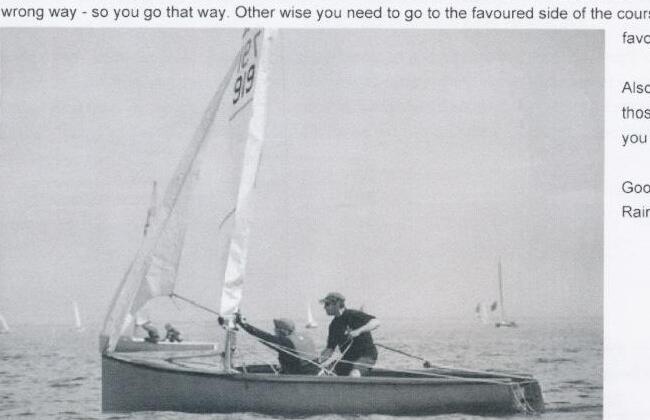
Also you also need to consider your speed and tacking ability versus those you plan to cover. It difficult to cover someone clearly faster so you are better to focus on speed and wind shifts.
A Simple Centreboard System Upgrade
The diagram below details a simple centerboard system that has been implemented on most boats at J-Town (plus a few outside of J-Town) to ease use and minimize damage from accidental groundings. The system is a compromise between the basic design of a single line run to a cleat and the more complicated race systems with remote up-hauls and downhauls.
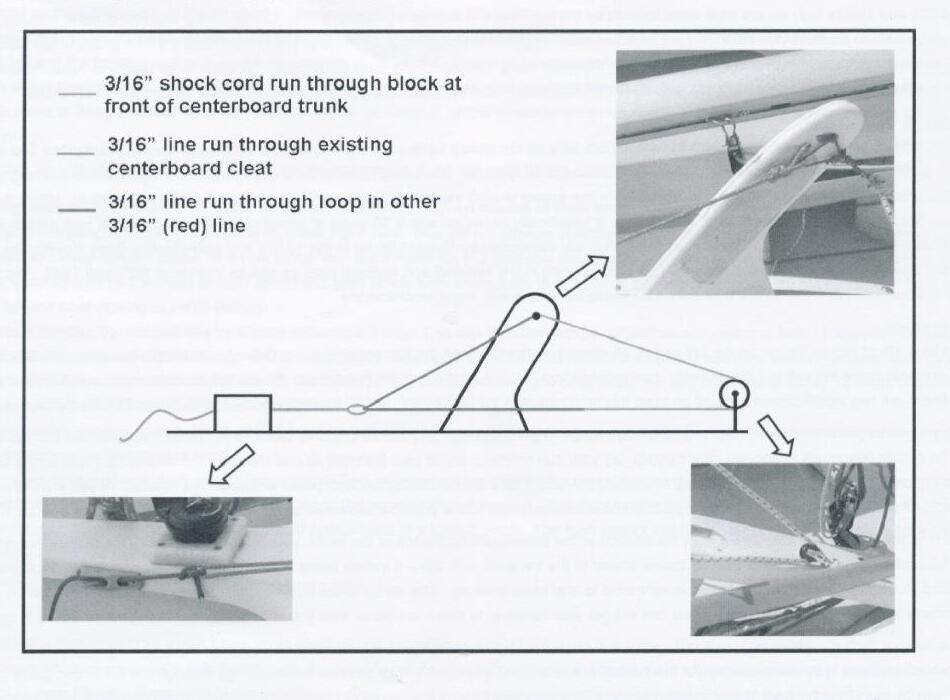
The design is based on a continuous line/shock cord loop. A second line run to the original centerboard cleat adjusts the tension of the loop and provides friction to hold the centerboard in place. Aside from the lines and shock cords, the only modification to the boat is the installation of a single block at the front of the centerboard trunk.
Some advantages of the system are:
- The centerboard will kick up if there’s an accidental grounding, minimizing damage.
- An easy one step adjustment for centerboard positioning; simply move the board to the desired angle and the system should provide enough friction to prevent it from moving out of position.
- Low cost and easy to implement; aside from line and shock cord, only one small block is required at the front of the centerboard trunk. The loop tensioning component makes setting the correct friction relatively quick and easy.
One Design Boat Covers
Hans Gottschling
The Dinghy Boat Cover Specialist since 1969
[email protected]
Switching to High Aspect Albacore Sails
Modern Albacore sailors use one of two distinct types of sails on their boats commonly called either “low aspect” or “high aspect” according to the cut of the jib. While very different in shape and how you set each of these types, both have produced top results in the class for over 20 years.
Some History
In the late 1970’s and 1980’s high aspect sails were favored by the top sailors in the class (Poyntz, Storer, Luard, Ewing and McNamara) who captured top places in North American regattas with sails cut by Storer/Sobstad, Eggers and McNamara. In the late 1980’s and 1990’s a new group of top sailors (Clark, Humphreys, Holmes, Weiss, and Harris) began to dominate the class using low aspect jibs from North Sails. By 2000 most sailors in North America were following the lead of Barney Harris and using low aspect North Sails while most UK sailors stayed with the high aspect design from McNamara.
Making the Switch
The early 2000’s have seen a distinct trend back to high aspect sails as top sailors have used them to win the 2001 Internationals and place 2nd in 2003 Internationals as well as finish at the front of many national and regional regattas. Switching types of sails often requires a significant re-learning period. The purpose of this article is to help those making the switch from low aspect to high aspect sails do so as quickly and efficiently as possible. While the information in this article can be generally applied to any high aspect jib, it is specifically based on nearly 30 years of experience I’ve had using the high aspect sails from Sobstad Sailmakers in Barrie, Canada. These sails were originally developed by Richard Storer in the 1970’s and optimized by Barry Poyntz who used them to dominate North American Albacore sailing from 1977 to 1985 winning many National and regional titles as well as Worlds in 1977 and 1983. The sails currently produced by the Sobstad loft in Barrie are built from the Poyntz templates with slight modifications.
Before you go sailing
The Sobstad jib is 10-12 inches longer on the luff and much shorter on the foot than the low aspect sail you have been using. As such a few modifications are required to your boat to get the sail to function well. Just putting them up on a boat set up for low aspect (North) will almost certainly end in disappointment and frustration. There are two modifications needed on most boats: 1) shorten the jib halyard and 2) extend/relocate the jib fairlead tracks inboard and forward.
First shorten your jib halyard. While you might have enough range to get the sail up, you almost certainly won’t have enough range to use the sail in all wind conditions. To decide how much to shorten your halyard, lay your current jib on top of your Sobstad jib and measure the difference in the length of the luff wire between bearing points. Shorten your halyard by this amount (+/– about an inch), remaking the Nico press or swages as needed. (If you want to switch back to the low aspect sail you can easily do so by making a luff wire extender for the top of your low aspect jib using a short length of Kevlar or Spectra line).
Second, examine your jib tracks. Measuring from the aft face of the transom along the top of the seats, you will need to be able to position the vertex of your jib sheet in the fairlead block in the range of 92-105 inches ahead of the transom, with 98 +/– 4 inches being the most commonly used range. High aspect jibs can also be sheeted much farther inboard, especially in light wind to maximize pointing. The vertex of the jib sheet can be as narrow as 13-14” off the centerline, but the most common range is 15-16” off center. If you can not get your fairleads to these positions, then you will need to relocate your jib tracks in order to properly set the jib.
With these two adjustments, you can probably get the Sobstad sails to function properly. For best performance, go through the full tuning guide (the most current copy can be found on the web at www.albacore.org/USA/members/tuning_training/tuning_guide_sobstad.asp) and set up your boat according to the guide. Note that the guide is a work in progress as it is updated when new information about how to get the most from your Sobstad sails is available.
Setting the jib
If you have been using low aspect sails and switch to Sobstads, the first thing you will notice is they look and set very differently. The first temptation is to try to make the Sobstad jib “look like a North.” This is nearly impossible and many top sailors have been frustrated trying. After noting that both are curved triangles of cloth, the similarity ends. So one of the first things to do is NOT to try to make them look and function like a low aspect jib.
Setting a Sobstad jib correctly requires balance of three adjustments:
- sheet tension (how hard you pull the jib sheet)
- jib luff sag (as controlled by rig tension through jib halyard and main vang)
- fairlead position (as controlled by where you locate your jib fairlead car)
Setting a high aspect jib requires feel and experience to get the balance of these three controls right so the sail is fast. Pointing and speed are both affected by these settings. Get them right and the boat will sail upwind performance equal or better than the rest of the fleet. Assuming you have set the boat up according to the tuning guide and you are sailing in moderate (8-12 knot winds) on flat water, initially set the jib up as follows:
- set the fairlead to place the vertex of the jib sheet in the fairlead block about 100 inches ahead of the transom
- set the jib halyard at about 8 inches of rake (as measured on the forestay from sheerline to bow) and adjust to give the appearance of about 2 inches of sag between the jib luff and the forestay pulled in a straight line with shock chord. Note that boom vang tension can affect luff sag (more vang=less sag). I’m assuming the vang is set appropriately for the wind conditions (leach just firm and overbend wrinkles from clew to luff just beginning to appear).
- Sheet the jib sheet to bring the leach in to where it appears to be about 2” off the spreader when viewed from the skipper’s station through the visibility window on the main.
With these settings you should see a small amount of backwind from the jib on the main (in the area 9-12” aft of mast and about 36” above boom).
From this starting point, begin to make finer tuning adjustments to optimize speed relative to other boats.
- if boat is not going or pointing try easing jib sheet 1/2-1 inch. This will not change sheeting angle, but will put twist in jib and open leach. Jib needs to retain a considerably curved fore/aft shape. If it ever looks “flat” like a North jib, it is probably oversheeted. These sails are much more sensitive to sheet tension. When in doubt, ease jib a bit (1-2 inches) to build speed and then slowly work sheet back in to develop pointing. In light air, do not try to point high; ease sheets and keep sails full and boat moving to avoid stalling.
- if boat is moving, but not pointing try slightly reducing luff sag. This can be done with jib halyard tension, vang or both. Experiment to find the right mix. Be careful not to remove too much luff sag. Sail is designed to have about 2”. If the boat feels like it has too narrow a steering groove, then try adding some luff sag. In light air or chop add more luff sag for more power. 3-4 inches of luff sag is okay in the 1-2 foot chop produced by 12 knots of breeze on open waters like Lake Ontario or the Chesapeake Bay.
- adjust fore/aft position of jib leads to optimize even break in jib luff and adjust backwinding of main. Further aft on jib lead will reduce tendency to luff at bottom first and reduce backwinding of main.
- do not get obsessed with making a jib leach telltale flow. A leach telltale on a high aspect jib behaves much more like the leach telltale on a mainsail. It flows only about 30-50% of the time with continual flicking to the leeward side of the sail. This might seem to indicate a closed leach, but the sail works fine under these conditions. Also don’t be fooled by the visual appearance of a closed leach. The high aspect sail has a narrow chord that often appears to be more closed than a wider chord low aspect sail.
See tuning guide for more complete suggestions for setting sails.
Setting the main
In contrast to setting a high aspect jib which takes some practice and experience, setting the main is a snap. The main has moderate draft forward and a very smooth airfoil shape which requires very little fiddling with the mast to get it to set right. Unlike the North main which requires a lot of pre-bend and considerable mast adjustment to keep the very deep main trimmed correctly, the Sobstad main requires very little applied mast bend and adjustment.
The sail is cut with about 2 inches of luff round that needs to be accommodated by mast bend. With the spreader settings and rig tensions suggested in the tuning guide this is easily achieved without any pre-bend of the mast in all but the lightest conditions (<5 knots).
Assuming you have set the boat up according to the tuning guide and you are sailing in moderate (8-12 knot winds), initially set the main up as follows:
- Raise the main to the black band at the top of the mast. Pulling the boom down to the lower black band should produce a slight tension fold along the luff of the sail. This will blow out as soon as you begin to sail. In very light conditions you can release about 1/4 inch of main halyard tension to avoid over flattening the luff of the sail.
- Apply vang tension to the point that you begin to see overbend wrinkles extending from the clew to the luff. In this wind range the leach telltale will stream about 30-50% of the time and flick to leeward the rest of the time. In very light winds (<5 knots) you can increase the twist in the main and open the leach by applying some pre-bend to the mast to retain the 2 inch luff curve cut into the sail. If you apply pre-bend you will need to adjust jib halyard tension to take up the induced luff sag.
Fine Tuning
Getting the most out of your sails requires optimizing the way you set them for your style of sailing, crew weight, equipment and conditions of the day. This article is intended to help you make the most important adjustments to get high aspect sails working on your boat. The full tuning guide offers more advice, but the ultimate performance from any set of sails is developed through hours of boat-on-boat tuning taking note of what works and what doesn’t. I encourage you to share knowledge you gain with me and other users of Sobstad sails. As new settings and techniques are proven out over a wide number of sailors I’ll incorporate those into updates of the tuning guide.
I look forward to your comments, success stories, questions and tips.
What’s in a Name…
In the dark winter of 2006-2007, Cathyann White out of the blue asked if I wanted to race with her. Despite her overly rosey view of my skills, and my basically zero racing experience, I said yes. She had experience. She’d sailed with the best. This could be fun.
As the snow melted I asked for a list of which regattas she wanted to attend. Her response was, well, ALL of them. My first thought was that wherever we placed, at a minimum I ought not be a hazard to the fleet, so I dug into the rules and spent hours on various websites that teach them. The rules made sense here in the warm confines of my den, but on the water things moved faster and as the season started we found ourselves spinning like tops. I did my best to settle my sins with the requisite post-race beer, and found my victims to be understanding, and even helpful, without exception. You know who you are, and thanks for that.
Supported by the experienced racers at JTown, and by others in the fleet always happy to help, I was soon snowed under with more boat, strategy and tactics tips than I could possibly digest. At one point I was asked “what kind of battens are you using?” and it was clear I was over my head. I’ve often said I never thought there was a sport harder than golf, but here it is. Just whack this ball at that stick? Easy.
By the end of the 2007 season we managed to top the “Challenger” Fleet here in Canada and in the US, each time against just a few, but feisty, rivals. Up here, John Hudson & Sarah Stewart courteously positioned their boat just right to be pushed past the port lay line as we approached the finish, and in the U.S. it was Diane Goebes who showed me what being taken up to the moon might look like. Such a nice lady, but I’m close-hauled! “If she rolls you, we’re toast” yelled Cathyann, so we followed her lunar trajectory and in the end held them off for a narrow win.
Sweet. All that fresh air at the front of the pack, having to find the next mark for ourselves, and some nifty trophies to boot. Maybe DFL would be in the past, even playing with the big kids. But of course not. In 2008, we continued to struggle, but this stupid sport started making more sense to me. The boat was going faster, sometimes, and our “spin to race factor” was declining. And the fun of regattas, on and off the water, was more than enough to keep me in the game.
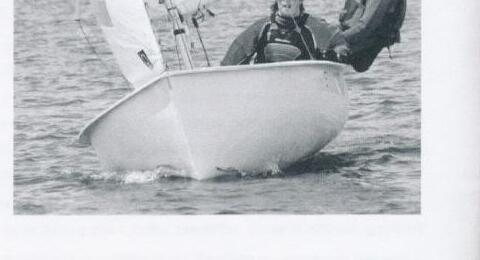
February, 2009. Warner Monteiro, the Admiral of Team Waverate up in Ottawa, called to ask if I was sailing the MidWinters in Sarasota in March. “I don’t have a boat”. “I can lend you one.” “I don’t have a trailer.” “The boat’s already there.” “How much?” “We can work that out.” Hmm. Spring in Florida sounded good. The shrimp BBQ sounded good. Free camping sounded good. My wife’s encouragement sounded good. Go Time.
On arrival I was introduced to CAN 7960, a former TISC boat that Warner had bought, refurbished and maintained with care. Unlike me, it had some pedigree. The Sarasota regatta was terrific, even if you still had to hold the results upside down to see our names near the top.
Then the RCYC/NA’s in June, and over to Largs for the Internationals in July. 7960, still on loan, seemed to go pretty well. I wanted to change a bunch of stuff to make it more like the JTown club boat I maintain and race. Warner talked me out of it like a thoughtful parent, explaining why he thought the boat was set up well as it was. Cheers to him for not voicing that I simply didn’t know how to sail it. And, through all the thrills and spills, Cathyann’s patience hadn’t worn out. Like NASA, failure was apparently not an option.
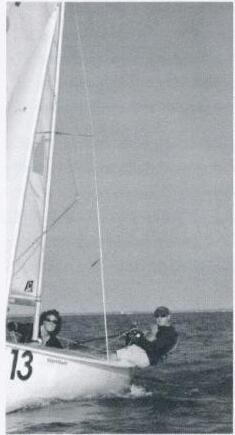
So by the end of the ’09 season I followed through on what may have been Warner’s “rent to own” plan, ponying-up to buy 7960. Built in 1992 by Ontario Yachts, it’s just 2 pounds over the minimum weight and with a hull as shiny as Al’s head. If you hear me attributing poor showings to the hardware, just ignore it.
The name? For a few weeks this past winter I was working at Heart for Africa’s new farm/children’s home project in Swaziland, named Project Canaan. HfA is a charity dedicated to helping orphans and vulnerable children, headed by some long-time friends. On Day 1 the others working on the farm, some terrific young Kenyans, asked why I wasn’t afraid of the resident snakes, particularly the deadly black mamba, the fastest snake in the world. My mind spinning, I sputtered “because, because, well, um… I am The *White* Mamba!” and struck my best martial arts pose. The nickname stuck, and I spent the rest of my visit trying to live up to it.
Back home I told my tales, and Cathyann said “White Mamba? That sounds like a great boat name!” So after some champagne tossing down in Sarasota and various toasts to the maritime gods (part of any proper re-naming ceremony), and even Cathyann’s new team shirts (hers says “White”, mine says “Mamba”), the White Mamba is on the water.
Welcome Back CAN AL 7363
I started sailing Optis when I was around 5 or 6 years old, eventually moving on to the RCYC ankle biters and junior club programs. My parents have always been avid sailors and racers and I’ve been very fortunate to have done a lot of ocean sailing throughout my life including sailing throughout the Caribbean and Central America, as well as the Mediterranean and Adriatic seas.
I joined JTown Sailing Club in 2005 and spent most of my time racing Lasers until 2007(?) when I began actively racing in the Albacore fleet. Previously I sailed at RCYC, racing the Star Class for 6 years. Growing up I raced competitively with my parents on our C&C 34 for around 6 years as well as spending several years sailing on the 8 meter named Vision at RCYC where I discovered my passion for wooden boats. Looking back, my racing repertoire includes; Stars, 14s, Lasers, 8 Meters, C&C 34s, Laser 2s, Albacores and many more!
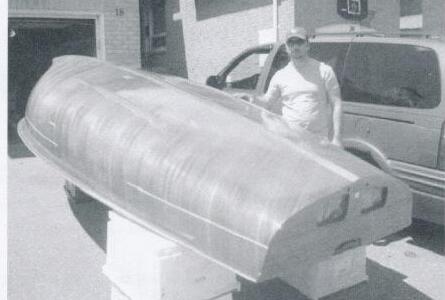
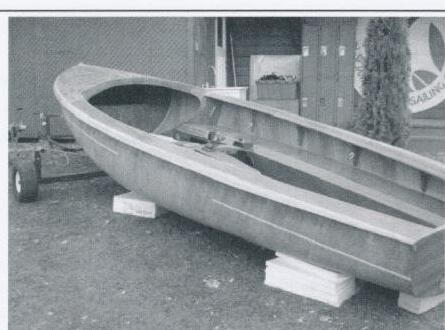
AL 7363 was built in England in 1983 by Woof. Woof boats were built in 3’s and 7363 was one of the last 3 Woof boats ever built. The boat was originally owned by Ron and Leslie Bat (boat name: Batman), then sold to Dave Smith and his wife (boat name: Tide in Knots).
The last time 7363 was raced competitively was at the 2007 International Championships in Kingston. Under both of its names, the boat and its owners were known to be fast and very competitive!
Currently 7363 is getting a facelift consisting of re-varnishing and a complete hardware update.
I will be sailing with my crew Carley Fort; a new sailor who joined JTown through the White Sail program in 2008 and began racing competitively with me in the same year. Our goal for this season is to get familiar with the new boat. While our first planned regatta will be RCYC, we are shooting for a top 5 finish at the Canadians this year. As a long-term goal, we will train for the 2011 International Championships here in Toronto.
Know Your Rules
Don’t Tack Within Three Hull Lengths of the Mark II
Last issue I discussed a very simple summary of part of the buoy room rule “Don’t tack within three hull lengths of the mark”. The situation described below is based on the facts found from a protest in 2008. The rules were written differently but I believe the conclusion would be the same with the 2009-2012 rules.
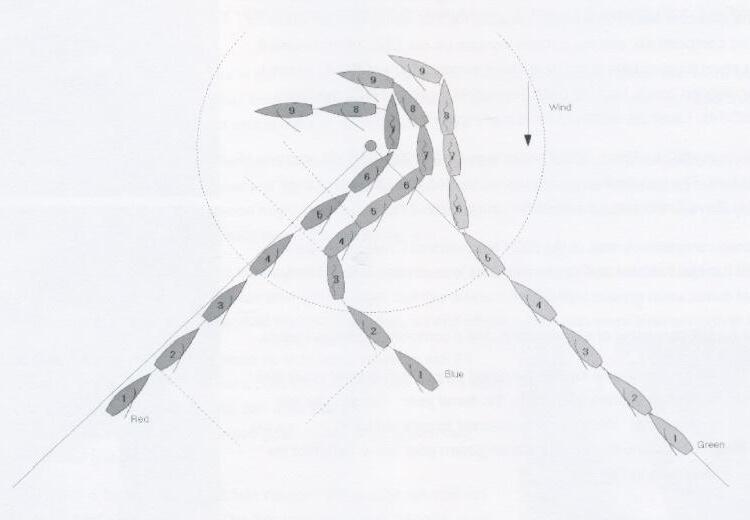
All three boats were approaching a weather mark. Blue and green were on starboard tack. Red was on port. Blue was not laying the mark so tacked to port. She completed her tack at position 4 ahead of red and hailed to red “no room”. At position 5 red got an overlap inside blue. At position 6, green on starboard had to alter course to avoid blue and red. At position 7, blue and red tacked inside green and rounded the mark.
Let us look at the rules step by step. At position 2, blue entered the three length zone. Looking at red and blue, according to rule 18.1, rule 18 does not apply since the boats were on opposite tacks on a beat to windward.
18.1 When Rule 18 Applies
Rule 18 applies between boats when they are required to leave a mark on the same side and at least one of them is in the zone. However, it does not apply
(a) between boats on opposite tacks on a beat to windward,
Neither boat was clear ahead and since rule 18 did not apply and they were not sailing more than ninety degrees from the true wind, they were not overlapped.
Clear Astern and Clear Ahead; Overlap One boat is clear astern of another when her hull and equipment in normal position are behind a line abeam from the aftermost point of the other boat’s hull and equipment in normal position. The other boat is clear ahead. They overlap when neither is clear astern. However, they also overlap when a boat between them overlaps both. These terms always apply to boats on the same tack. They do not apply to boats on opposite tacks unless rule 18 applies or both boats are sailing more than ninety degrees from the true wind.
At position 4, blue completed a tack onto port. At first glance it would seem that rule 18.3 would apply but red was going to have to tack to round the mark so she was not fetching the mark, and therefore rule 18.3 did not apply.
18.3 Tacking When Approaching a Mark
If two boats were approaching a mark on opposite tacks and one of them changes tack, and as a result is subject to rule 13 in the zone when the other is fetching the mark, rule 18.2 does not thereafter apply.
Fetching A boat is fetching a mark when she is in a position to pass to windward of it and leave it on the required side without changing tack.
At position 4 they were both on the same tack, so rule 18 did apply. The most common part of rule 18 is rule 18.2(b). The boats were not overlapped when the first reached the zone and neither boat was clear ahead when they reached the zone, therefore rule 18.2(b) did not apply. This leaves rule 18.2(a). At position 5, red and blue were overlapped and blue had to give red room, which she did.
18.2 Giving Mark-Room
(a) When boats are overlapped the outside boat shall give the inside boat mark-room, unless rule 18.2(b) applies.
(b) If boats are overlapped when the first of them reaches the zone, the outside boat at that moment shall thereafter give the inside boat mark-room. If a boat is clear ahead when she reaches the zone, the boat clear astern at that moment shall thereafter give her mark-room.
From position 4 to position 6, red and blue were on port and green was on starboard so red and blue had to keep clear of her. She was therefore an obstruction to red and blue. It is possible that at position 4 or 5 blue could have hailed red for room to tack (rule 20 which overrides rule 18) but she didn’t. Instead she kept going and at position 6 green had to alter course to avoid her and blue broke rule 10. Blue was disqualified.
This is admittedly a complex reading of the rules. In simple terms, blue tacked within the three length zone (twice) so you can guess that she was probably in the wrong and it turns out that she was.
The situation described was difficult to fit into two hull lengths using the 2005-2008 rules. It is slightly more likely to occur within three hull lengths using the 2009-2012 rules.
2010 Canadian Albacore Association Executive
| Commodore | Cathyann White [email protected] |
|---|---|
| Past Commodore | Teresa Miolla [email protected] |
| First Vice Commodore | Jefferson Hall [email protected] |
| Second Vice Commodore & Website | Ken Yamazaki [email protected] |
| Third Vice Commodore & Training Officer | Sarah Bury [email protected] |
| Rear Commodore | Kevin Soldaat [email protected] |
| Specifications Chair | David Weaver [email protected] |
| Chief Measurer | George Roth [email protected] |
| Editor – Shackles & Cringles | Christine Short [email protected] |
| Secretary | Alison Goodwin [email protected] |
| Membership | Christine Short [email protected] |
| Treasurer | Mary Free [email protected] |
| IAA Treasurer | Raines Koby |
| IAA Representative | Teresa Miolla |
Canadian Albacore Association
970 Queen Street East
PO Box 98093
Toronto ON M4M 1J0
www.albacore.ca