Issue 3 2010
September 01, 2010
Outgoing Commodore Cathyann White's farewell message, a Women's Helm Regatta retrospective marking St. Jamestown's 20th anniversary, the proposed 2010 International Albacore Class Rules, a Q&A with George Carter on refurbishing 7982, "There is No I in Team", a Shelburne NS East Coast Championships recap, a two-part reaching-speed tuning article from Barney Harris & David Byron, "The Last Taboo" on capsize recovery, a Mary Lake cottage-country report, and the 2010 executive.
Message from the Commodore
Ahoy Sailor!
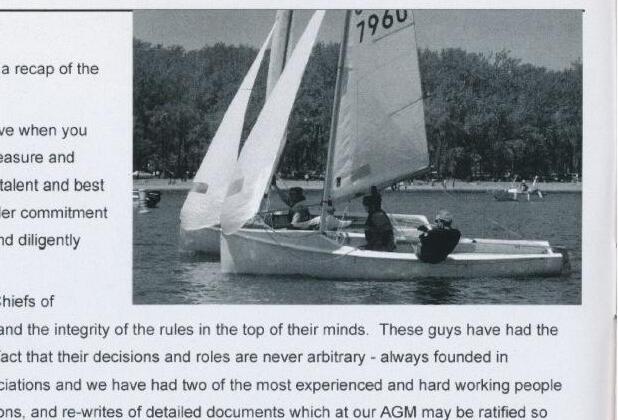
This will be my last message as Commodore of the CAA, and so, here follows a bit of a recap of the past two years and some reflections of my time in this role.
It seems that there never is enough time to realize all of the plans and dreams you have when you start an endeavour like this. I feel extremely proud of the team that I have had the pleasure and privilege to have worked with. Each member of our team has volunteered their time, talent and best efforts simply because they love sailing, they love the Albacore and they have a broader commitment to community. What a delight to be surrounded by people who just do stuff, willingly and diligently while often accepting very little acknowledgment.
35 years plus have marked the careers of David Weaver and George Roth – our two Chiefs of Specification and Measurement. Both have always maintained the safety of the fleet and the integrity of the rules in the top of their minds. These guys have had the challenge of not always making the popular decisions but I have always relied on the fact that their decisions and roles are never arbitrary – always founded in principle. We have the most comprehensive Albacore records of all the national associations and we have had two of the most experienced and hard working people represent our interests at the IAA and IRC tables through countless hours of negotiations, and re-writes of detailed documents which at our AGM may be ratified so that we can move our class and rules into the next phase of development.
David has agreed to stay on if we’ll have him as George is stepping down, and David has expressed a willingness to help mentor our measurement team to acquire new members and ultimately a new Chief Measurer.
Sarah Bury has brought her own personal experience to our training portfolio by organizing and personally leading exceptional clinics and ensuring each one is delivered to great satisfaction and attention to every detail!
Jefferson Hall has organized, facilitated, convened, scored, crosschecked, and awarded the prizes at all of our major sailing events. This work largely takes place, in the dead of winter with many phone calls and email exchanges with clubs and meetings that must proceed the season. So much work and terrific results!
Ken Yamazaki is the fastest web poster around. Send a note and a few hours later it magically appears on the web. We have never had such incredible exposure in Sailing World and at the boat show before! Awesome public relations and a quiet calm contributor.
Alison Goodwin, the woman who keeps it organized, running around collecting trophies, getting them engraved and keeping the minutes and records of all our activity!
Teresa, our Past Commodore, now organizing the Internationals in Toronto next year– a voice of reason and humour in stressful moments.
Mary Free and the thankless job of treasurer. Banking, reporting, signing authorities– if we had a nickel for every bank meeting and cheque posting Mary has had to handle– always on time, accurate and with a SMILE on her face.
Kevin Soldaat, our Canadians organizer – working from a distance and keeping the National event all in order – planning takes a full year for an event that is over on three short days.
Christine Short, who did double duty this year – Membership and Shackles and about a hundred other emails, promotions, details and picking up every piece of detail to completion. I have never had a more efficient partner with such a fast turnaround.
Whew. I honestly believe there are only two words we should say to a volunteer: and they are THANK YOU! I wanted to thank each of them publicly.
I have had a great couple of seasons sailing with my buddy Ralph. We met and came through the Community Club program at J Town and what a wonder the Community Clubs are! Every year hundreds of adults enter the class to learn to sail and make new friends. They volunteer, and many race – 55 on the start line many Friday nights this summer in the Outer and Inner Harbours. The Community Clubs are an incredibly important and special aspect of our association! Ralph and I have sailed in so many places these past few years! From Sarasota to Scotland, Crystal Beach, to Ottawa and all over the Chesapeake! Great winds, great friends and too many funny road stories for 1 page. A particular highlight for me this year was attending the East Coast Championships in Shelbourne, Nova Scotia for the second time. What an amazing place and what amazing people. Guy Tipton and Wayne King have a fleet of Albacores and sailors who are addicted to sailing! This year 118 kids graduated from White Sail in Albacores and 18 CYA instructors also trained in Albacores. Amazing, compelling work – all volunteer driven.
I tell you – it has been quite a ride! Please take the time to thank my team. So this is Commodore Cathyann, signing off – I will see some of you at the AGM, and if not – keep sailing. There is lots of season left to go – more wind coming and I look forward to seeing you through my jib window on the water.
Women’s Helm Regatta
After a decade’s plus absence from the Albacore fleet, my spouse, Paul van Leeuwen and I are back with a rather weathered old community club boat, 7969, crewing for our kids in the local Ottawa fleet.
Re: Women’s Regatta, St. Jamestown Sailing Club celebrates 20th Anniversary 2010
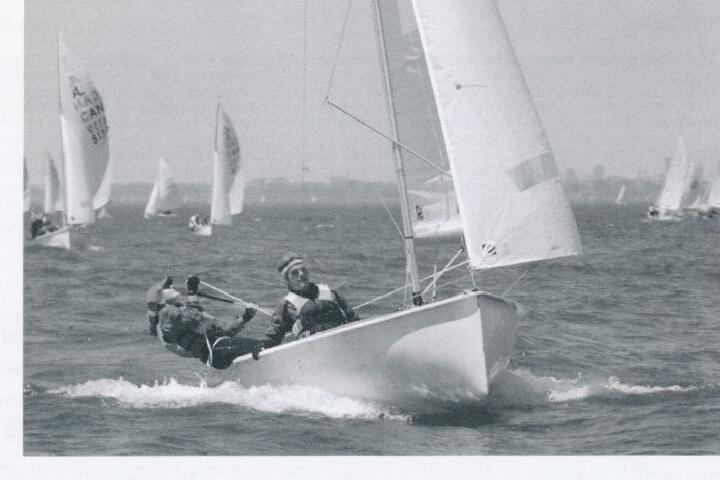
SO thrilled to see St. Jamestown SC is still hosting this regatta after all these years. In 1990, I founded this regatta when I was Race Chair of J-Town. There was a serious dearth of women helmsmen competing in the Friday Night Community Club Races or regattas. Men were allowed to crew but not helm so that more women would be encouraged to skip. I had always hoped it would continue and am grateful for J-Town’s continued championing of this regatta.
In the early years, J-Towner’s Dave Matthews (Kilnger) Race Chair, Peter Vasoff, Egon Bartholamus (now deceased) and myself were the main drivers. Although it was just a “ladies” regatta, high standards and great courses were set with punctuality expected at the start line! Kilnger made beautiful wood trophies for the winners.
In the inaugural race, Klinger, Peter and I formed the on water RC. Conditions were perfect. However, almost all of the competitors were late off the docks to the start line. As the minutes ticked down to the start, I realized only one maybe or two boats would make the line at the gun and asked Klinger and Peter to postpone the start. It was imperative that the First J-Town Women’s regatta be a positive experience, otherwise no one would return the following year. Klinger and Peter were doggedly determined to show up the ladies. This race would start on time with or without them.
Inexplicably, seconds before the start gun, a blackboard posted on the rear of the RC boat dropped straight down into the lake. On the blackboard were the course mark instructions. There was dead silence. Peter and Klinger looked up to the skies and agreed “divine intervention” was the only probable cause and postponement was the only possible solution. By the time a new course board was sent out to the RC all the ladies were ripping up the start line! A good omen for a regatta that continues to this day.
The Proposed International Albacore Class Rules-2010
The Rules
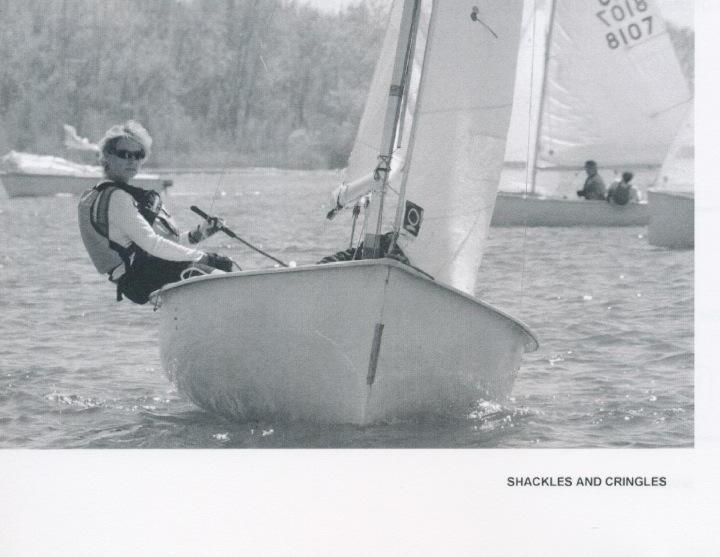
The Rules have been established to define the Albacore Class, maintain its integrity, promote safety, and provide for fair sailing. These Rules have been developed over the past 35 years by the International Rules Committee (IRC), which is made up of representatives of member countries of the International Albacore Association (IAA), and approved by the IAA members. Currently, those members are Canada, USA and UK. Interpretation of the Rules is the exclusive purview of the IRC and any changes to the Rules must be approved by the IAA and member country AGMs through a process specified by the IAA Constitution. The Rules currently in force were last published in 2004 by the Royal Yachting Association (RYA), which holds the copyright for the Albacore design.
Background to Proposed Reformatted Rules
In 2005, the RYA requested that the Rules be reformatted to conform with that of the ISAF. The IRC was assigned this task with the mandate to ensure that the reformatting did not change the specifications of the Albacore. The boat must be the same. However, the 2004 Rules not only specified the boat details but described the national variations between countries and specified a number of aspects of Class administration such as approving builders and their tooling, and boat measurement.
The IRC submitted its proposed Rules to the RYA in the ISAF format in September of 2006 as requested. After about 3 years of relative silence, we were informed that the RYA rejected any reference to the IAA and any national variations which previously existed in the Rules. Basically, the RYA considers the Albacore to be a UK National Class and refuses to recognize the large and active Albacore Class in North America. Obviously, this is not an acceptable position for Canada and the USA. We have been licensing builders, measuring boats and administering the Albacore Class in North America since 1961.
While the National Albacore Association (NAA) in UK must accept the position of the RYA, they continue to have a strong desire to keep the Albacore the same in the UK as in North America and to continue to share with us the responsibility for maintaining and modifying the Rules in accordance with the IAA Constitution. This is the genesis of the currently proposed International Albacore Class Rules-2010. They are intended to do the following:
1. Maintain the Albacore specifications in the ISAF formatted Rules the same as it was under the old rules. (RYA-2004)
2. Recognize fully the IAA’s responsibility for administering the Albacore Class internationally, including licensing builders, measurement of boats, and a process for Rule interpretation and change as specified in the IAA Constitution.
Thus, the proposed Rules will maintain the definition of the Albacore while recognizing formally the true partnership of IAA member countries in administering the Class.
Importance of CAA Ratification of the Proposed Rules
Since 2006, it has not been possible to make Rule changes because the process for doing that has been in limbo. The reformatting of the Rules required a massive international effort, difficult enough to achieve while trying to keep the boat ‘the same’, never mind attempting to make changes at the same time. For much of this period, our hands have been tied because of RYA delays. The process has taken far too long and led to much frustration for Class members as well as those charged with the responsibility for carrying out this task. The proposed International Albacore Class Rules-2010 represent the best effort of many dedicated Albacore sailors and have already been approved unanimously by the US AGM. Their approval in Canada is essential and will accomplish the following:
1. The Albacore specifications will remain the same as in 2004 but in ISAF format.
2. The administration of the Rules will be controlled by the IAA in accordance with its Constitution.
3. The barriers which have been preventing us from making Rule changes for the past 4 years will be removed.
Thus, we will have the same boat, a stronger international administration, and a document which will enable us to deal with the backlog of issues such as larger jib windows, buoyancy, and electronic devices. It is worth noting that the IRC can create provisional rules, made effective immediately, to be ratified at subsequent IAA member AGMs. Thus, for example, a new rule could be put in place before Christmas this year which permits larger jib windows. Everyone seemed very pleased with our experimental Jib program and implementation of a revised rule has been awaiting completion and approval of the reformatted Rules. I urge the CAA members to join our US colleagues and approve the proposed International Albacore Class Rules-2010 at our AGM.
One Design Boat Covers
Hans Gottschling
The Dinghy Boat Cover Specialist since 1969
[email protected]
Q & A with George Carter
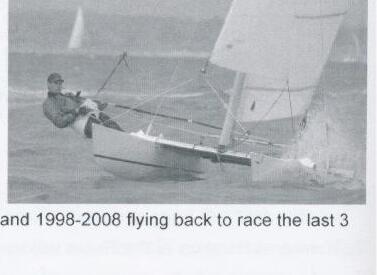
All in all, about 30 of my 35 years! I started sailing when I was 5, crewing for Dad back home in the UK in a borrowed Enterprise dinghy, similar to an Albacore. We were a light weight team so we bought a boat called a Graduate, 12ft long and more suited to a father and son. We sailed that for maybe 3 or 4 years on a pretty small lake, then I enjoyed a week long training course in a Topper singlehanded dinghy and we bought a secondhand one later that year. It was bright yellow, very 1970’s! So Dad sailed a laser and me the topper for a few years. We kept the Graduate and attended open meetings still. One day we were capsized at a windy event in Devon. A load of Dart 18 catamarans flew past us having a great time in the breeze. The scene was set. Later that year we had a go at sailing both Dart 18’s and the smaller version, the Dart 15. We bought a second hand 15, moved to a bigger lake and I crewed for Dad for 2 or 3 years. As I grew older, we bought a second one and we raced them both singlehanded. I was about 14 at that time. I sailed Dart 15s singlehanded until I left the UK in 2005. We attended all the regattas towing both boats on the one trailer. We were very competitive with each other! Dad won the nationals in 1997, I won in 1993, 1996 and 1998-2008 flying back to race the last 3 years.
How / why did you sail the Albacore when you moved to Canada? I was in Toronto on business a year or two before I moved out here and saw the Albacores on the inner harbour. I was impressed with how many boats there were, so when I moved to Canada I looked for the Albacore clubs and joined Mooredale. I enjoy racing and I don’t mind what I sail as long as there is good racing.
What do you like with albacore fleet? The shear number of boats that come out for the racing makes for great competition. There are so many good sailors locally and in North America. I think the numbers of boats racing regularly and the depth of talent in the fleet is unsurpassed almost anywhere in the world outside professional sailing. The sailors are generous with their time and advice. The amount of help and advice I have received in the last few years from the fleet has been amazing. I have learned so much.
When you were looking for to purchase a boat – what features were you looking for? I didn’t think that I was at a sailing level when I could justify a new boat, also it’s a big investment. So we (Almir Tavares from Mooredale and I) looked for a good secondhand boat. We spoke to a lot of people and decided that ideally we wanted an OY boat that was in the 79XX series. There were two on offer, we couldn’t get to see one of them before the winter so we bought the other, an ex Westwood boat. We thought a lot about weight and we weighed 7982 before we bought it. It was overweight at first which concerned us, but after drying it out and removing the storage tank is closer to minimum weight, still the heaviest boat of that era due to previous repairs and extra reinforcing by the previous owner and us.
How did you refurbish 7982?
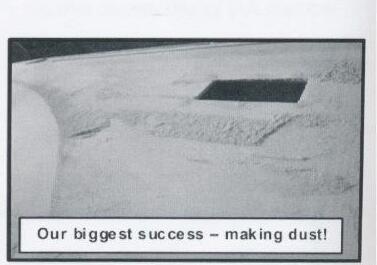
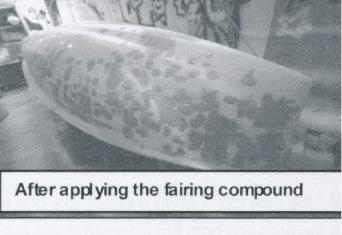
Just after we bought the boat there was a chat page thread regarding fairing hulls that Warner answered. So we followed his guidelines. It is an unusual approach as we used epoxy (which is brown) instead of polyester gelcoat and therefore we committed to painting the boat, however the boat needed painting anyway. We dyed the boat purple with gentian violet and sanded the hull with a longboard to highlight dimples. The result was quite shocking, hundreds of dimples and you could see many areas of damage repair. One where it looked like the mast had come through the bottom of the boat! We filled the dimples with West epoxy with 410 fairing compound, sanded again, re-filled the areas that were no good and repeated and repeated this! Our biggest product over the winter was dust! We then replaced the slot gasket and refitted the bailers and hand painted the hull with Interlux Epoxy Primecote and Perfection. Possibly the strongest smelling paints ever made! We used rollers with thinned paint to reduce the runs and sags and then sanded between coats. All in all I think there are 7 or 8 coats of paint on the hull. The painting went quite well except for the dust in the air affected the paint so sanding was required between every coat. We then sanded to 2500 grit, cut and polished the hull.
The whole process was complicated by being in the (generously loaned) Mooredale shed in the winter. At -11°C it was tough to work in the cold, but also we had difficulty getting the epoxy to cure and heating up at the start of each day took time. There were a couple of low-point days where we spent hours scraping uncured epoxy off the hull. In the end we learned to heat the shed, boat and epoxy up with our trusty propane heater before applying the resin, carefully measuring the temperature of each. Several times we got the boat too warm causing delamination blisters which we had to grind out, re-glass and fill. We had set a deadline of making it to Sarasota and to meet this ended up working until midnight each night for a couple of weeks prior to leaving.
I wanted to fit a mast strut so we chose to reinforce under the deck to make sure that the hull was strong enough to take the loads. In Sarasota we collected parts ordered from Hapco including new foils. Fitting these the day before the regatta was a bit stressful. Luckily Barney has done this plenty of times and lent a hand. Without his help it would have been a lot harder.
How many hours did you spend over the winter making it race ready? Is there anything you would do differently? I dread to think. Excluding all the work done since, just getting to Sarasota was 300 man hours I expect. However if it was done in a heated garage with all of the right equipment and experience I expect that we could do it again in less than half the time. We learned a lot from doing what we did so the extra time wasn’t wasted. Certainly doing the work ourselves taught us so much about the boat and has given us more confidence in the boat than we otherwise would have. The boat has never let us down, only the other way around!
What tips/suggestions would you offer to any new racer? How much practice time? Any books that you would suggest reading? I learned a lot by crewing, I didn’t helm in my first two years at Mooredale. Through crewing I got the chance to sail with and learn from many different people so I would certainly recommend this. In fact in my first Albacore year I sailed with more people than I had sailed with in the previous 30 years! Once you have good control of the boat through maneuvers, try building up experience through regular race training and practice races. Harbourmaster and Friday Night races are the way to go if you are in Toronto keeping clear of the busy parts of the race course at first while you build up confidence. Get out on the water as much as you can – there is no substitute for this. Remember that the races are very tough. Set achievable targets and gradually build on these. Don’t get disheartened at first, if you learn to race in Toronto in Albacores, your skills will be up with the best!
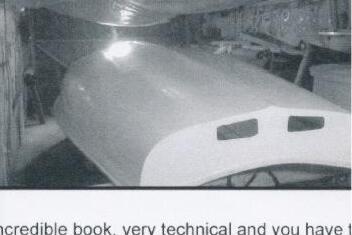
With regard to books, “Winning in One Designs” by Dave Perry is an excellent book to start with. If you really want to get to the very top of the fleet “High Performance Sailing” by Frank Bethwaite is an incredible book, very technical and you have to read it at least 5 times (I am on my first reading still), there is so much in this book.
Any other bits of advice…would be great!! I think just make sure that you are enjoying what you are doing. Get out on the water as often as possible and always try to learn something every time you do go out. The best teams are just that, teams, where there is excellent communication between the crew and helm. I came from almost 30 years of single handed sailing and I struggle with this still, but it is vital to get your communication working well. A team is definitely more than the sum of its parts. Oh and get good at hiking, particularly if you are at the lighter end of the weight range!
There is No I in Team
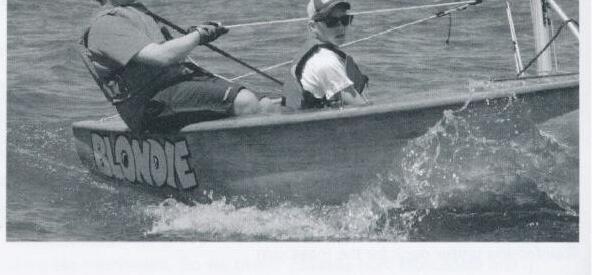
Talk – at least a bit about what you are seeing or thinking – so both members are on the same page and prepared…
Execute – in your head to prepare and in practice so you get your systems down and can perform good mechanics by rote – then you can get your heads (both of them) out of the water – great teams know where one another’s weight is in the boat on a roll tack, have done a thousand mark roundings in practice and have some “team moves” they can pull on when the pressure is on.
A for me is “At the end of the day” keep it all in perspective – at the end of the day – this is about having fun right?
M “My race too” – when it seems like one member of the team has done something wrong/poorly/etc know that this race belongs to BOTH parties in the boat and both are invested in the outcome and probably doing their very best despite mix ups, mistakes and results
Team means 1 + 1 = 3
What I expect/request from crew:
- Best possible boat handling
- Lots of communication on starts what’s going on around us and beyond
- Compass reports
- Eye for boat boats crossing: ahead, behind, collision
- Input on higher/lower/slower/faster
- Input on pressure
- Input on boats on the other side(s) of course
- Asking me what my plan is in anticipation of a mark rounding or the next leg
- Finding the next mark on downwinds
- Feedback after the race on the good, bad and ugly
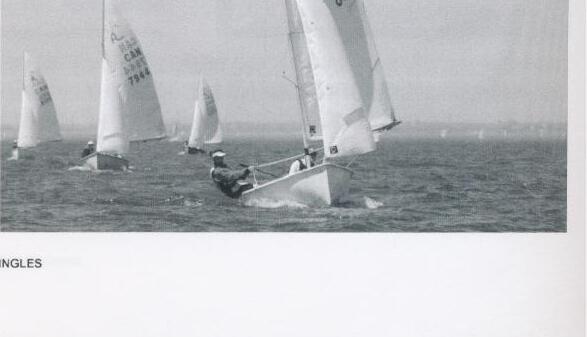
Shelburne Nova Scotia, East Coast Championships
Once again S.H.Y.C hosted a first class event August 20-22.
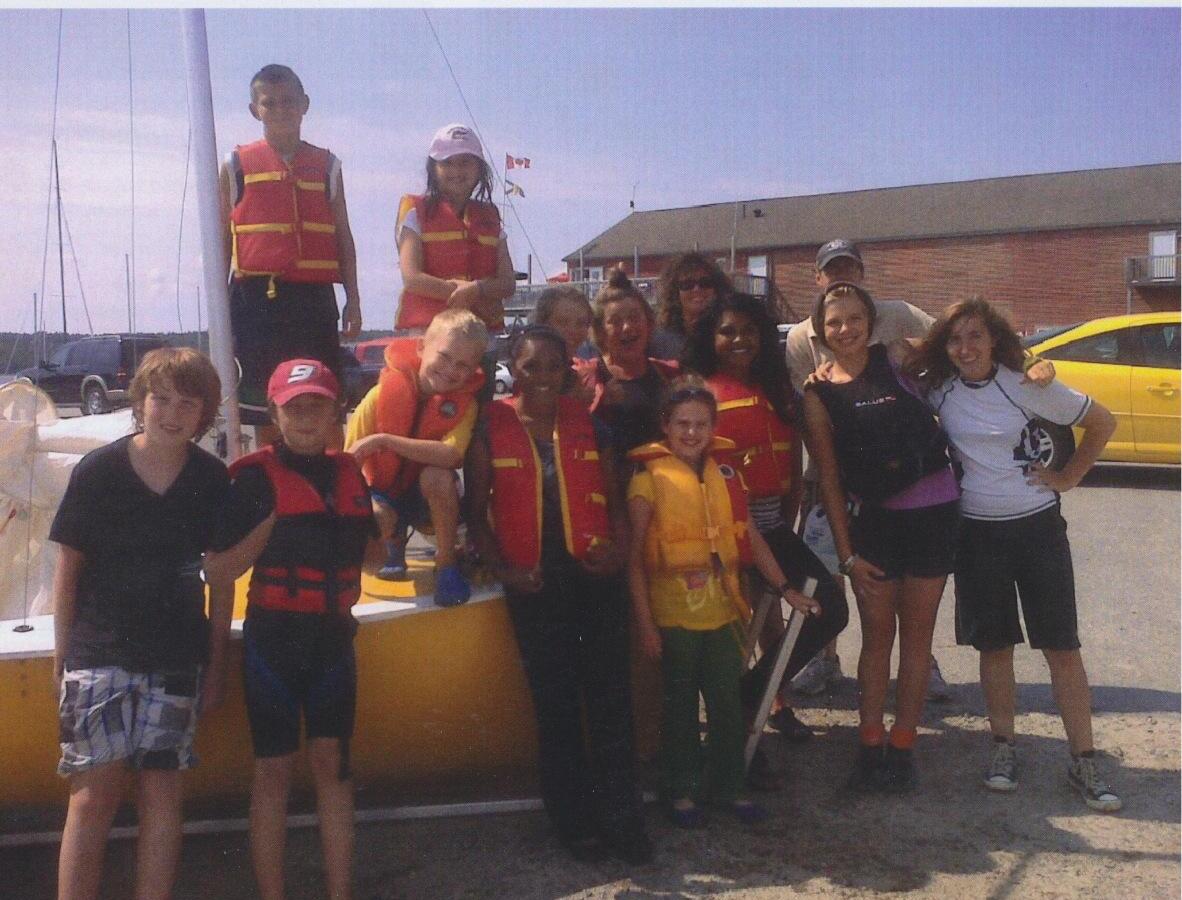
There are many reasons to be impressed with the Shelburne Harbor, however one of the most remarkable aspects of this east coast fleet is the prevalence of an exceptional Junior Sailing Program, which has been cultivated and trained by Guy Tipton. This summer, more than 80 children and teens graduated from the White Sail program – all in Albacores. Also 18 CYA Sailing Instructors (most of whom are teenager and young adults) were also certified in albacores. The photo on the cover of this month’s edition of Shackles shows the Friday afternoon sailing school returning after a day on the water. Many of these young people participated n the East Coast Championships – and really held their own! It feels like a great future for Albacores is alive and well in Shelburne Nova Scotia!
Events started with a Skippers Meetings for the weekly Friday Night Race which was to be included as the first race in the series. A complex start using land based marks, transits and musket fire launched this exciting match up. A more traditional course set up was used (unlike previous years) with a triangle course and all marks rounded the same way! Competitors raced until the committee got tired of watching and blew a finishing gun indicating that the next mark would be the last.
All of this followed by delicious seafood chowder and competitions in the clubhouse for championship: Spinaker Packing, Knot Tying and Mussel Eating.
None of the folks from away placed very well except for Henry Pedro who made great time at the Spinnaker pack up but was ultimately disqualified for messy work and Ralph Glass who was simply disqualified for a countless number of infractions.
Day two began with seals frolicking on the race course – sunshine and 10-12 knots of sea breeze. Exciting races in great conditions was the order of the day. Barney Harris and Lee Mullins dominating the majority of these races, except for one in which local Guy Tipton ended a gybing dual on the run and snuck into the lead just before the finish line. Those of us who have sailed with Guy have come to calling his wild tactical antics while running at the leeward mark “Guy Tiptons”. Apparently these aggressive maneuvers can pay off. After said gybing dual Ralph and I were almost at the finish line – as Barney and Lee rounded and when faced us and I yelled out “Is that all you’ve got old man?” reminiscent of another sailing duel that took place on another continent years ago. [Barney took exception to the “old” part.]
Saturday evening featured the club’s annual Pig Roast and Live Band party with a real down home, old fashioned kitchen part taking place in the auditorium next door for those who had purchased tickets in advance.
Sunday dawned cloudy and calm with a hearty pre-sailing competitor breakfast. Luckily the wind Gods came through again and as the clouds parted the sea breeze came up to provide similar winds. This day dolphins greeted us on our way out to the race course.
A total of 8 races, awesome hospitality, fantastic billeting arrangements, great meals and fun all around made for a wonderful Shelburne experience. If you have not been there yet – I strongly encourage you to show up next year. You are guaranteed a warm welcome and good sailing!
Fast Thoughts on Reaching Speed
At the UK Nationals in Lyme Regis in July, 2010, we didn’t always round the weather mark first, but had better off wind speed than other boats and won almost every race. Our off wind speed is the culmination of over a decade of work with the Albacore. In this article we explain how to make an Albacore go on a reach. In a second (future) article we will explain down wind speed.
To make an Albacore go on a reach requires rig controls with adequate range of adjustment, a few tell tail yarns, and some practice. This article attempts to address both fixed and adjustable rigs.
Rig Controls
In the UK the Albacore is sailed with on-the-fly adjustable shrouds and jib halyard. For UK racing, the rig must be capable of rake settings from 4 – 12 inches. For the purposes of this article “rake” is the measurement from the shear mark on the headstay to the upper tip of the boat’s bow with the slack just removed from the rig. In addition one must be capable of releasing the leeward shroud an additional 5 or so inches. As a point of reference, normal upwind sailing requires a rake of around 6.5-7 inches.
For sailing in North America, the shrouds are fixed and the minimum value of rake is constrained by where the shrouds are pinned. The minimum value of rake varies boat to boat but should be on the order of 6.5 to 7 inches. In higher winds Albacore sailors in North America often pin the shrouds down to increase rake and decrease power.
Almost all racing Albacores have adjustable vang, outhaul, mainsail cunningham, and jib cloth tension. Fast reaching requires all of these in addition to some form of mast ram. This can be as simple as blocks to constrain the mast’s forward motion. We have a strut type mast ram installed. This is capable of pushing or pulling the mast over the full range of motion permitted by the class rules via a rope tackle system lead aft to the helm.
Just about all racing sailboats have tell tail yarns installed on the main sail leech and jib luff. To these we add three sets of yarns in the middle of the main, about mid chord and at the ¼, ½ and ¾ heights.
One additional control is the headstay. The vast majority of Albacores have the headstay hanging slack or tensioned by a short length of elastic. Our head stay is connected to the jib halyard tackle via a short length of elastic and to a 2:1 tackle to a cleat on the fore deck. It’s attached to the jib halyard tackle so the tension remains constant as the halyard moves. Class rules require that the headstay support the rig in the event the jib halyard is released, so ours is fitted with a stopper ball on the 2:1 tackle such that it prevents the mast from tilting aft of the aft partner even if it is uncleated.
Sail Design
The RacerX sails we use have lots of molded shape and moderate luff curve. We, like everyone else, use mast bend to alter the curvature, increasing power on the reaches by straightening the mast and decreasing power (and improving efficiency) by flattening the sails up wind. I believe that the fuller sails enable us to extract more power from the wind when reaching than flatter designs. Like all things this does come with a price – and the downside is that we must use a large amount of pre bend in light to moderate conditions to pull all of that fullness out and open the leech. Sailing upwind in higher winds with featherweight crew is problematic as well, particularly in choppy water. Flatter sail designs work better in this case and in some ways are more versatile.
Adjusting the Rig
Frank Bethwaite’s second book High Performance Sailing says in regard to sailing on a reach, that a boat going to windward is all about aero and hydrodynamic efficiency – and that means achieving a high ratio of the lift from the sails and foils to the induced drag – since with the sails close to centerline the induced drag is in a direction to slow the boat. For best performance we flatten the sails and place the centerboard all the way down. When reaching the sails are eased far from centerline and so the induced drag, which could be considered roughly in line with the boom, is primarily pulling the rig to leeward. The added speed we get from the increased lift far outweigh the loss incurred from the added drag in doing so. Albacore reaching is all about maximizing the magnitude of lift from our sails. We accomplish this by adjusting curvature of the sails by way of mast bend and jib luff sag to wring the maximum power from the sails.
To clarify, the word “curvature” refers to the deviation from a straight line connecting the luff and leech, as if one were looking at a cross section of the sail formed by the intersection of the sail and a plane at a right angle to the mast. “Bend” refers to the mast and its deviation from a straight line connecting its base and the hounds.
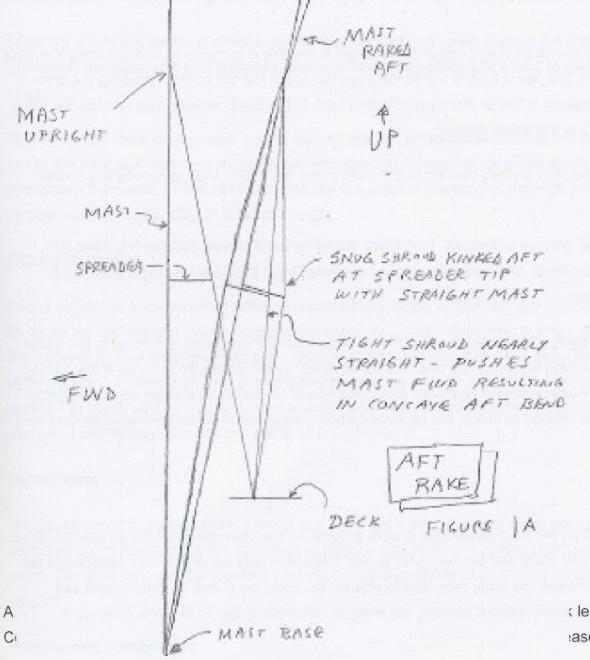
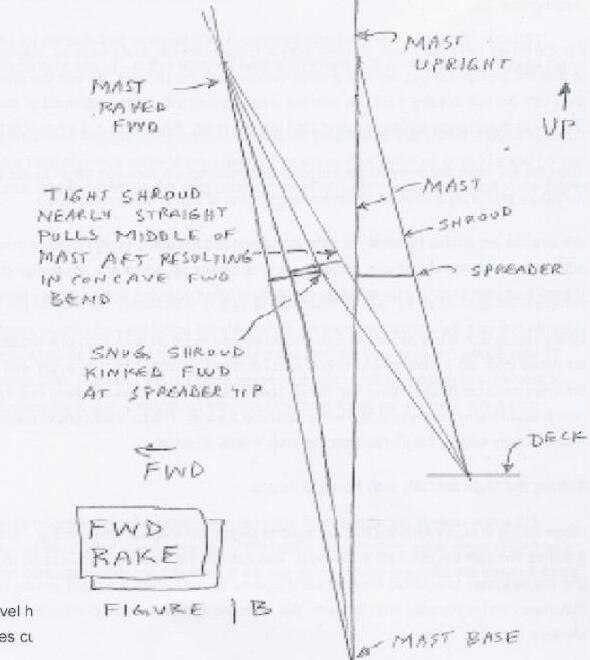
First a quick review of rig mechanics… At a nominal up wind rake setting (6.5 to 7 inches) we have our rig configured such that the shrouds, hounds and spreader tips are all in the same plane when viewed from the side, so shroud tension has no effect on mast bend. Now, if one were to rake the mast aft by easing the jib halyard say 4 or so inches to a rake setting of 10 or 11 inches and take up the slack in the shrouds, one would see, when viewed from the side, that the shrouds are pushed aft of the plane described by the hounds and shroud attachment locations on the hull by the spreaders as depicted in Figure 1A. If one were to increase tension, the shrouds go straight, pushing the spreader tips forward, resulting in the mast bending concave aft a small amount. With a sail hoisted the aft bend pulls cloth from the middle and reduces the curvature. Conversely if one were to rake the mast forward to a setting of, say 4 inches, the spreaders pull the shrouds forward of the above described plane. Tighten the rig and the shrouds straighten and bend the mast concave forward a small amount as depicted in Figure 1B. A sail hoisted has more cloth pushed into the middle, increasing curvature. In general, a flatter sail has less power and is more efficient whereas a fuller sail has more power. This is one of the reasons that increasing rake reduces power while reducing it does the opposite and why Albacore sailors rake the mast aft while sailing upwind and ease the shrouds and rake forward when sailing down wind.
Setting the Main with Adjustable Shrouds
When reaching in the UK we ease both shrouds to around a 4 inch rake setting. We then blow the leeward shroud off completely. The mast hangs on the windward shroud. The jib halyard no longer controls the mast rake. The leeward shroud is slack and the leeward spreader has folded forward and totally clear of the main. We ease the Cunningham and out haul. We then ram the mast aft at the deck to increase the main sail curvature and power. Sounds simple – but if the mast is too straight the cloth piles up at the luff and it creates too much curvature in the front of the sail.
Trimming to fill a main with excessive luff curvature results in most of the sail being stalled. When optimally set the mast is rammed such that the main sail has the greatest amount of curvature that is evenly distributed from luff to leech. Reaching this threshold is the key adjustment and, like many things in sailing, it does not lend itself to numerical calibration. This must be set each time while looking at the sail’s shape and the boat’s speed.
The second facet is the vang. Our vang setting is heavily influenced by our years spent competing with (following) Michael McNamara. He always is so annoyingly fast on the reaches. We have watched him sail past and away from us many times…trying to discern what was making his boat go so much faster than ours. We finally got our opportunity one afternoon in Looe in 2000. Michael had just stitched up his umpteenth UK Nationals win (with a race to spare) and asked if I’d like to go for a sail. We launched 6493 and 8011 into the remainder of a fresh afternoon sea breeze. The entire story is posted online on the USAA web site, so I won’t repeat it here, but I can still recall to this day Mike’s calm, Socratic questioning leading me to correct the mal adjustments I had made while steering his boat. The issue here is twist. The top of Albacore main sail is in relatively clear winds 20 or so feet above the sea surface while the middle is affected by the diverted air from the jib. It makes sense that this sail should be twisted, since the jib outflow is diverted aft, so that the angle of attack is optimal from top to bottom. In practice, to get the vang correct one must look at the luff and yarns on the leech and in the middle of the sail. When correctly set on a reach all yarns are streaming and the luff is not backed. I have found that it is possible to stall those yarns in the middle of the sail while the leech yarns stream and the luff is filled – and that typically the fix is to ease the vang a small amount. As with the ram, the vang setting must be done in real time. We typically made 8 to 10 small vang adjustments on each off wind leg at Lyme Regis this year.
Setting the Jib
For the jib we have the sheet, jib stick, halyard, cloth tension, and headstay. Easing the halyard and sagging the jib luff is roughly analogous to straightening the mast in that the greater luff sag creates greater curvature in the jib – but, as with the main, this has a limit. If the jib luff sags too much the luff hooks, requiring the crew to over trim the sail to keep it full. As with the main, getting the greatest amount of curvature in the jib evenly distributed from luff to leech without over curving the luff is the key to maximizing the power, and also like the main, this is also not amenable to a numerical setting.
Ease the luff cloth adjustments for the jib until horizontal wrinkles just begin to appear. Any excess tension in the cloth in the sail’s luff tends to reduce the overall curvature and bring it forward towards the luff, both of which we seek to avoid.
We use the adjustable headstay in light to moderate conditions, applying just a small amount of tension. This holds the rig forward and de couples the mast ram adjustment from the jib luff sag, allowing us to optimally set both sails. In windier conditions, like those we enjoyed at Lyme Regis this year, the rig is sufficiently loaded that both sails can be set independently without applying any headstay tension.
When sailing with a low aspect jib one should extend more jib stick than one would think. This keeps the jib out and away from the main and with roughly the same curvature from top to bottom and only a small amount of twist. This may apply with a high aspect jib as well, but we’ve never tried it so we don’t know. While sailing the crew must continually hand trim the jib sheet, particularly when reaching in a dynamic situation of waves and gusts where the helm must steer way up to get to new pressure and then way down while catching a wave. The jib stick control can be cleated at times, but requires frequent adjustment. Practice makes perfect here – as correctly setting the jib requires the crew’s total attention.
Setting the Main and Jib with Fixed Shrouds
When racing in North America it is not legal to adjust the shrouds while racing – and so we have developed a work around. In this case we ease the jib halyard about 2 inches and ram the mast aft in the boat. This causes the leeward shroud to go mostly slack and the spreader to fold forward mostly out of the way. Meanwhile we use the headstay to hold the mast forward against the ram. With the mast sprung between the step, ram, and headstay, the mast bend and therefore main sail curvature can be adjusted with the ram. We seek the same situation of maximum curvature without hooking the entry or luff. Setting the jib in North America is identical to sailing in the UK.
Sailing Offwind
We were chasing Mike Holmes and Colin Smith at the UK Nationals in 2003 down one reaching leg in an 18-20 knot breeze. As I recall we were sailing outside the break water at Portsmouth in the open sea. I remember thinking to myself, “Where’s he going?” as he alternately sailed way above the rhumb line to get to the next puff and then way, way below the rhumb line, extracting all there was from the waves they were planing on – and further into the lead away from us. The key lesson here is that the fastest route to the wing mark isn’t necessarily continuously towards it.
As for the racing at Lyme Regis this year, I noticed that if all one did was point at the wing mark one would occasionally catch a nice wave and have a short ride. The pressure was on and off with new puffs coming across the course. We would sail just a touch above rhumb line to the next pressure with the sails sheeted in to a beam or tighter reach and hiking hard to keep the boat flat. The waves are passing underneath with little effect as the boats course is close to right angles to the wave propagation and so the slope of the sea before the boat is mostly flat. At this point the sails lift, which could be considered to be at right angles to the boom and drag, which could be considered to be in line with the boom, are at roughly equal angles to the boat’s heading.
As we reached the next puff, we would bear away as our righting moment was saturated by the additional wind, while simultaneously looking for a wave to burn down on. When the next nice looking wave came through we would simply bear away – to a course slightly to moderately below rhumb line and ease the sails some. With the sails eased the lift will be more nearly aligned with the boat’s course and the drag only pulling to the side. Even though we would frequently bear away 20 or 30 degrees we often would have to re sheet the sails as the boat accelerated – heck some times it seemed like it fell – down the face of the wave bringing our apparent wind forward. As we surfed down the wave we would heat up and sheet in just before the bow reached the wave trough to stay on the face and surfing at higher speed. As we heat up the apparent wind increases in strength and goes way forward, and requires both sails to be sheeted in and the crew to hike harder. As the boat’s course is now closer to the direction to the mark, the VMG goes up. Everything is good – but the slope of the water in front of the boat is not as steep, and the boat’s speed must remain even higher to stay on the wave since its course and the wave propagation are now mis aligned. Sail and boat handling here are critical - one sheeting, weight placement, or steering error can drop you off the plane / force you back down below rhumb line to regain speed.
Often we would encounter another wave behind the first and never leave a full plane for periods that seemed like minutes but were probably under 30 seconds. Eventually the wave and puff subsides and boat falls off its plane and slows to displacement speed - at this time we heat it up to get to the next puff and repeat the cycle.
This was even more pronounced on the bottom reach – where simply sailing the course meant displacement mode almost the entire way. We sailed above the rhumb line to the next gust and bore away sometimes steering through 45 degrees down the face of a nice wave to get planing and either heat back up or hold a low course to maintain the plane. In this case the wind did not support planning at the high course, and required on the spot decision whether to bail out and go high in the hopes for new wind or stay surfing at a too low angle.
Weight Placement
I’d say by far the most common error Albacore sailors make while reaching is to sit too far forward, particularly in light to moderate winds: we try to keep the weight as far aft as we can without overly dragging the stern. That said, often having one’s weight slightly forward helps initiate surfing. In these conditions we may momentarily trim our weight forward a small amount. Once surfing, one must trim aft to keep the boat on its lines and the bow out of the water. Be careful to not violate rule 42 while adjusting fore-and-aft trim; the adjustment must be smooth and without an abrupt stop. Attaining the correct fore-and-aft trim is not amenable to a numerical setting – in fact EVERY time we are on a reach we are constantly making small adjustments to our fore-and-aft trim until the boat lights up. A small, say 3 inch change in where the helm sits can make all the difference.
Centerboard
The centerboard is a pretty basic control, but there are some nuances. First, our centerboard is adjustable from the rail via a rope and tackle system with a 2:1 purchase going down and a 3:1 purchase to raise. It also tapers to a very sharp edge at the bottom – since the tip of the board is the trailing edge when raised on a reach. We generally use the smallest amount of board possible when sailing off wind consistent with good control. If we are going slowly, we raise the board a small amount.
Practice and Persistence
The techniques I have outlined are not something people can just go out and do – getting the sails set just right is daunting – and one only has very subtle cues to go on. My two final and probably most important points are that you need to practice setting up the boat, adjusting the sails, and sailing, all outside a racing situation. We’ve spent countless days sailing side by side with other boats trying out different things. One can not expect to simply read an article and instantly go faster without investing time on the water developing one’s own skill. Second is that many times when we sail it seems like we’ll have the boat set up to what we believe are correct settings and yet we are not going well. Often we must refine to get just the correct combination of trim and sail adjustment to go well in that day’s particular conditions. So the message here is don’t give up if the boat speed doesn’t immediately improve, the Albacore is a sensitive and responsive creature - keep working to refine the set up until it happens.
The Last Taboo – But We All Do It
Dumped
Everyone does it, but not everyone likes to talk about it. For some, it’s painfully embarrassing (literally); for others, it’s a normal occurrence that is given no real thought. But no matter the age, experience, or even the conditions of the day, capsizing happens – everything from the 2-knot “I was looking for my sandwich” dumps to the 30-knot “sit at the gybe mark and become part of the boat graveyard” knockdowns.
Sailors tend to remember the first time they went in – for most it was while learning to sail under the watchful eye of the sailing instructor who was helpfully shouting instructions and encouragement from the nearby safety boat. But the reality is that most capsizes don’t happen in light winds when the water is flat and calm, and only the most confident (or stupid) would go out when it’s honking assuming that righting a capsized boat is always piece of cake.
The general wisdom for righting a capsized dinghy is to get on the board as fast as you can to stop the boat from turtling. Once on the board, you can probably do a dry recovery (stepping into the boat as it comes upright). But there are differences among dinghies when it comes to the fastest way to get it up and sailing, and even in a one-design class like the albacores, there can be differences among the boats in the best way to recover from a capsize. Here are some things to think about the next time you go out:
The Boat and Equipment
The tuna you are sailing may have lots of hidden surprises that you’ll only discover when you dump, such as unknown leaks or slight differences in how the builder installed the buoyancy tanks. These two things could result in a boat floating higher (or lower) than you expected when capsized, turtled, or righted, and you have to figure out how best to handle this. I’ve heard that there is a significant difference between the older Ontario Yachts albacores and the newer ones (with the newer ones floating so much higher that it’s very hard to get on the centreboard and back in the boat). Also, a nice shiny buffed hull helps a boat go faster, but it also makes it harder to clamber up on, so tread carefully. The boat aside, you also may learn too late that your lifejacket is more of a straightjacket. You probably haven’t even thought about this because most people assume it’s enough to have and wear the PFD, but an improperly fitting lifejacket (or worse, one that just doesn’t work due to age and breakdown) can be a serious issue. I had a top-of-the-line PFD but it was made for men, meaning the padding (in addition my natural padding) created a lot of bulk that prevented me from getting back into my boat. Women should consider getting life jackets that are specifically made for women (the bulk of the padding is in the back). You should also be sure that your lifejacket isn’t worn out and doesn’t ride up when you go in the water or you’ll be fighting with it while fighting to get the boat righted.
The Crew
Fitness among sailors varies a lot, and it can be a big factor when you flip. Some sailors (in particular women) may lack the upper body strength needed to haul themselves on the centreboard or back into the boat. Some sailors (in particular men) don’t realise that the 20 beerpounds they gained over the past few years may be too much to haul back into the boat. You probably don’t want to find out that you need to get to the gym this way. Weight is an issue that racers think about a lot, but in addition to making a tuna go fast, a certain amount of weight is needed on the centreboard to get the boat upright. Fitness and weight totals should be known ahead of time, and every team should have someone strong enough to get on the board. If you have determined that only one person is strong (and big) and big enough to right the boat, then you may want to practice the “scoop” (where one sailor rights the boat from the centreboard while the other lays in the capsized hull and is scooped in as the boat comes up). It may also be the case that two small albacore sailors need to get on the board together to right the boat. Smaller and less agile crews might also consider installing righting lines to make life easier (and safer).
There’s also a certain element of emotional fitness at play. For newer sailors or those who aren’t comfortable being in the water, getting thrown into the lake could be scary, and so it helps to be comfortable going in so that when the time comes to get the boat upright, no one is freaking out instead of helping.
The Conditions
The sailing conditions can also have a huge impact on your ability to right your albacore. Getting the mast pointing upright is that much harder if you’re in heavy air with wavy conditions. The wind and waves will likely be pushing your boat so that the bow is no longer pointing into the wind, which makes it more difficult to get the boat upright. Heavy chop can also make it tough to stay on the centreboard (especially, once again, if the board is shiny and waxed for speed!). And never ever underestimate the impact of cold water on the entire exercise – simply put, cold water means muscles will seize up and you’ll be moving slower. And even in warm water, don’t underestimate how tiring righting a boat can be - getting back into the boat for the sixth time could just prove to be too much.
I’ve also heard it said that a racecourse is the best place to practise in heavy air because you have lots of safety boats just waiting to help you out, and while this could be true, sailors should still exercise a degree of caution and know their limits (and be aware of the racing rules that state it’s the decision of every skipper whether or not to race – implying that you are expected to know how to help yourself). The chances are that if you’re dumping, lots of other people are dumping, and I’ve never been to a regatta where there is one safety boat per competitor. This means that you could be waiting for assistance if you can’t save yourself, and if so, I hope you dressed for the day AND you’re not being pushed into, say, a rock wall. Sometimes it can also be the case that the safety boat isn’t the safest option – a non-inflatable rescue boat, plus wind and waves, plus an inexperienced driver, can all add up to serious damage to your turtled hull, which is something to keep in mind. Going out and practising capsize recovery is probably just as smart as going out and practising heavy air gybes (in fact, one will probably lead into the other). At the least, knowing you can right your boat quickly will add to your fun, and for the racers, keep in mind that every minute you are spending doing your Michael Phelps impression, your competition is adding to the lead.
Cottage Country – Racing on Mary Lake
Port Sydney is a small village nestled on Mary Lake just south of Huntsville. There is no physical club house yet PSYC has organized a sailing race every summer Saturday for about 50 years. Boats typically head out from cottages or the town dock for a two o’clock start. Our best turn out this year was 9 Albacores (coloured hulls dominate) and a laser. The fleet has expanded this year and a number of young sailors challenge on a regular basis. Ribbons are awarded at well attended post race parties hosted by different members (both sailing and social) on a rotating basis.
If you are in Muskoka and want sailing cottage style come join us!
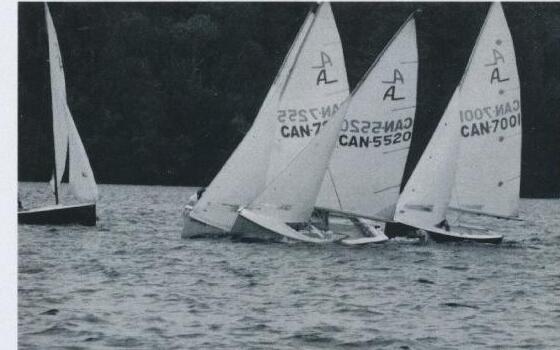
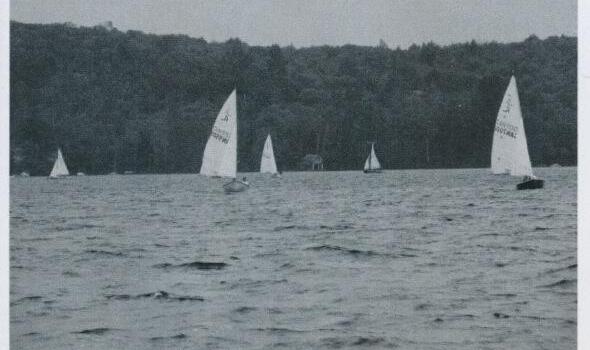 Village of Port Sydney in background
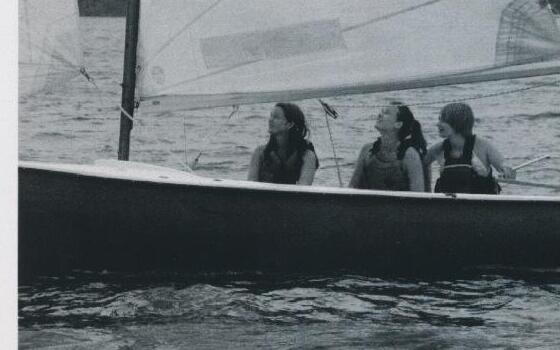
a boat load of cousins sailing Miss Genevieve a rescued Allen Albacore being refurbished.
2010 Canadian Albacore Association Executive
| Commodore | Cathyann White [email protected] |
|---|---|
| Past Commodore | Teresa Miolla [email protected] |
| First Vice Commodore | Jefferson Hall [email protected] |
| Second Vice Commodore & Website | Ken Yamazaki [email protected] |
| Third Vice Commodore & Training Officer | Sarah Bury [email protected] |
| Rear Commodore | Kevin Soldaat [email protected] |
| Specifications Chair | David Weaver [email protected] |
| Chief Measurer | George Roth [email protected] |
| Editor – Shackles & Cringles | Christine Short [email protected] |
| Secretary | Alison Goodwin [email protected] |
| Membership | Christine Short [email protected] |
| Treasurer | Mary Free [email protected] |
| IAA Treasurer | Raines Koby |
| IAA Representative | Teresa Miolla |
Canadian Albacore Association
970 Queen Street East
PO Box 98093
Toronto ON M4M 1J0
www.albacore.ca