January 1996
January 01, 1996
January 1996 issue of the Canadian Albacore Association newsletter (Vol. XXXVI No. 1) — Bob Stiff’s Commodore’s Comments on “The Next Sailing ‘Fix’”, an “Oh! Is that how it works?” guide to fixing a twisted outhaul, Ask the Experts reader questions, a “Know our Sponsors” thank-you for the 1995 season, Karen Atkin’s “Sailing the Information Highway” web links, “The Racer’s Edge” 27 boat-preparation tips, the 1996 Albacore regatta and Toronto Friday race schedules, Letters, the Peter V. membership contest and the Market Place.
Shackles and Cringles — January 1996
Canadian Albacore Association — Volume XXXVI, Number 1
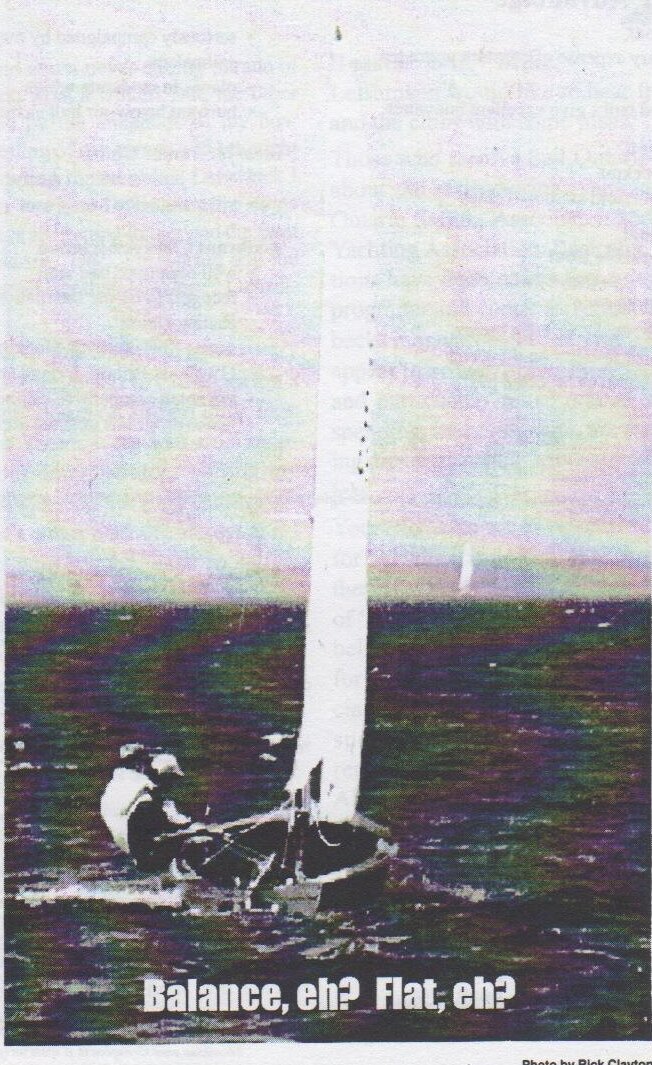
McNamara and Gifford in Kingston
Photo by Rick Clayton
In this issue: Outhauls (page 4) · Know our Sponsors (page 6) · Sailing the Net (page 9) · The Racer’s Edge (page 10) · The Peter V. Contest and more…
The Albacore Advantage
Canadian Albacore Association, P.O. Box 31081, 785 College St., Toronto, Ont. M6G 4H7
A One-Design Boat
- no unnecessary expense of constant upgrades in design.
- large air-filled tanks give excellent buoyancy
A Comfortable Boat
- large, open cockpit
- benches on port and starboard sides
A Performance Boat
A Light and Manageable Boat
- tongue load of less than 100 lbs gives ready trailerability
- launching and retrieving are a breeze
- hull shape gives stability on the water
- self-rescue after an unexpected puff is easy
A Safe Boat
- seriously campaigned by major sailmakers
- planes in moderate winds
- buoyant heavy-air hull shape
Ideal for Junior Clubs
- 4 to 5 juniors will fit easily
- will stand up to heavy use
A Vibrant Class Association
- well organized and vital
- recognized by the International Yacht Racing Union
- strong fleets through Ontario, Canada, US, Great Britain, Ireland and Bermuda
- top notch competitive sailing
- junior programs in some areas
The Canadian Albacore Association is responsible for encouraging participation in and maintaining the integrity of the Albacore class in Canada.
1995/1996 Executive
| Position | Name | Address | Contact |
|---|---|---|---|
| Commodore | Bob Stiff | 20 Southlea Avenue Toronto, ON M4G 3L9 | Res. 416 423 3294 Bus. 416 482 5002 |
| Past Commodore | Jim Quibell | 495 Vanguard Crescent Oakville, ON L6L 5G6 | Res. 905 827 9019 Bus. 416 231 1222 Sat/Sun. 705 454 3524 |
| First Vice Commodore | Chris Gorton | 14 Chilton Road Toronto, ON M4J 3C6 | Res. 416 423 0845 |
| Second Vice Commodore | Gord Chu | 38 Queensdale Avenue Toronto, ON M4J 1X9 | Res. 416 465 5558 Bus. 416 972 7336 Fax 416 972 5515 [email protected] |
| Third Vice Commodore | Dave Bussin | 24 Munro Boulevard North York, ON M2P 1B9 | Res. 416 223 3851 Bus. 416 223 3851 Fax 416 225 0287 |
| Rear Commodore | Mike Leishman | 94 Harris Avenue Toronto, ON M4C 1P6 | Res. 416 699 8100 Bus. 416 494 3343 Fax 416 494 0949 [email protected] |
| Specifications Chair | David Weaver | 14 Lansdowne Road, North Cambridge, ON N1S 2S8 | Res. 519 623 4402 Bus. 905 525 9140 Ext. 24907 |
| Chief Measurer | Rick Clayton | 362 Brookdale Avenue Toronto, ON M5M 1P8 | Res. 416 783 9194 Bus. 905 670 8700 |
| Treasurer | Heather Wroldson | 5 Harrison Road Toronto, ON M2L 1V3 | Res. 416 447 5244 Bus. 616 982 2120 Fax 416 944 5891 [email protected] |
| Secretary | Lynn Shannon | 362 Brookdale Avenue Toronto, ON M5M 1P8 | Res. 416 783 9194 |
| Shackles Editor | Uwe Ackermann | 29 Burlington Crescent Toronto, ON M6H 2L5 | Res. 416 654 0685 Bus. 416 978 4017 Fax 416 978 4940 [email protected] |
| Membership | Ross King | 635 Broadway Avenue Toronto, ON M4G 2S6 | Res. 416 422 5380 Bus. 416 592 3676 Fax 416 592 4000 |
Shackles and Cringles is a quarterly publication of the Canadian Albacore Association.
Commodore’s Comments
By Bob Stiff
The Next Sailing “Fix”
Snow, ice, wind and a never-ending parade of smiling skiers; what a winter! But, the other day I brushed by the underside of my boat hanging from the ceiling of my garage and I thought about the big job waiting for me there. Last week I took my boat cover to Hans Gottschling for some adjustments. The days are getting longer and the Boat Show is now a memory. Docks-in, spring and the next sailing ‘fix’ are nearer than last year’s Canadians.
Our representation at the Boat Show was very successful, thanks in large part to Chris Gorton’s hard work and many hours on and off duty. Don Oakie and Ontario Yachts were also most helpful in providing our demonstrator. During my short stint at the display on the final Sunday afternoon there was a great deal of interest and I met many people who owned, used to sail or knew someone who had an Albacore. There was much interest in what happened when you pulled on this, where to find parts and where to sail. The clubs were actively distributing brochures with membership information and a large number of Albacore owners and potential Association members were noted in Chris’s log book.
The Preliminary 1996 Regatta and Racing Schedule is in this issue of Shackles & Cringles. Gord Chu has held many discussions and meetings with the clubs and has successfully coordinated the majority of requests. It’s not too early to make holiday plans around those major events. The Junior Canadians still needs a host and David Bussin and Mike Leishmann would like to hear from the Juniors and the clubs with some ideas.
Those who receive Sail Ontario will have read about the restructuring plans in place for The Ontario Sailing Association and The Canadian Yachting Association. Basically, these organizations have been compelled to re-evaluate their programs and focus to reflect significant cutbacks in government funding. The initial results appear to be very appropriate. All organizations and particularly those related to discretionary spending, including ours, are faced with declining membership and having to achieve more with less.
Your executive has developed a balanced budget for ’96 which is dedicated to preventing any further erosion of our capital fund after several years of ‘usual’ expenditures exceeding revenues. We believe that the capital fund must be reserved for special and significant projects. Our Association also depends on volunteerism for our success and we hope that everyone will rededicate themselves to the objects of the Albacore Class during the coming sailing season. Every member should undertake to find one new member.
Good Sailing!
Bob Stiff, Commodore
The Outhaul
Oh! Is that how it works? Another one in the irregular series
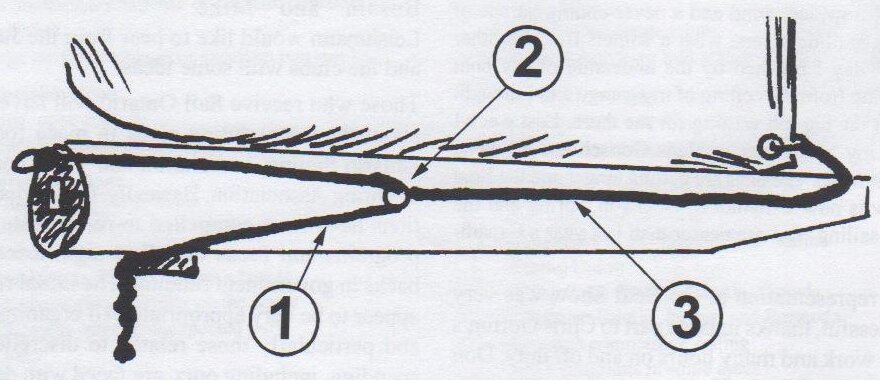
The outhaul is used to tighten the foot of the mainsail. One of its most annoying features is that it sometimes stops working. Many Albacore sailors throw up their hands in frustration at that point because the friggin’ thing is inside the boom and how the hell are you supposed to get at it in there, eh?
Step 1:
Go to page 6 and check out which one of our sponsors makes the kind of brew that would help you move to step 2. Have one.
Have another.
Look at the diagram to figure out how the thing is supposed to work.
If you see two diagrams, give up for the day and resolve to try another sponsor next time around.
If you see one diagram, go on to step 2.
Step 2, analyzing the construction:
The outhaul uses two lines (labeled 1 and 3 in the diagram) and a single block (labeled 2 in the diagram). One end of line 1 is dead-ended with a knot in or near the gooseneck plate; its other end runs through a cleat about 50 cm aft of the gooseneck. At the distal point of exit line 3 usually runs through a sheave.
Step 3, analyzing the problem:
First check whether or not the foot of the main sail is able to move freely in its groove.
Next check whether or not the outhaul line has wedged itself between the exit sheave and the boom.
If neither of these are a problem then it is most likely that line 1 has become twisted or that 1 and 2 have become intertwined. There seem to be two common causes for this. Often the lines are too long so that the motion of the boat can have its evil ways with the loose ends. The other problem is that application and release of tension on line 3 will make it twist around its longitudinal axis. The cheaper the line, the more twist.
Step 4, fixing the problem:
Replacing line 3 with shroud wire may add a bit of weight to your finely tuned racing edge and will create a need for a shackle at the other end, but it definitely cuts down markedly on the problem of twist.
Undo the knot in line 1 at the gooseneck plate and attach a very good length of whipping twine or other thin line.
Reach in under the exit sheave at the stern end of the boom and carefully pull out the works. If the thing won’t come out all the way you have a mother of a twist and if you get angry at this point you’ll blow it. Attach another piece of whipping twine to the end of line 1 that’s coming out through the cleat near the gooseneck. Continue to pull carefully from the stern end.
Once everything except the rescue ends of the whipping twine is out of the boom, repair and replace.
Reattach the whipping twine ends in such a way that you’ll be able to pull the new line through the existing holes.
Use the whipping twine to pull everything back into place, make the required knots, cut off any excess line and have another brew.
Ask the Experts
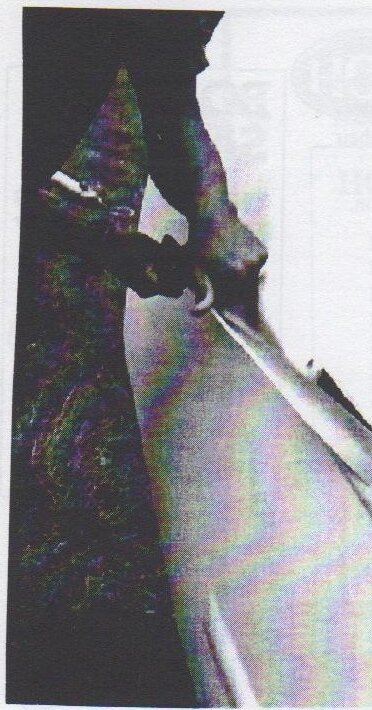
This man has figured out a way of making ace centerboard gaskets.
There are at least two others who have figured out better ways.
Chris Gorton (Westwood Sailing Club, Toronto) asks:
“What’s the best way to make a centerboard gasket?”
Heather Wroldsen (CAN 7944, Outer Harbour Center Board Club, Toronto) has a toughie:
“After I came back from the Worlds’ I noticed that my hull has undulations in it where I had placed the straps during trailering. How can I get rid of those undulations?”
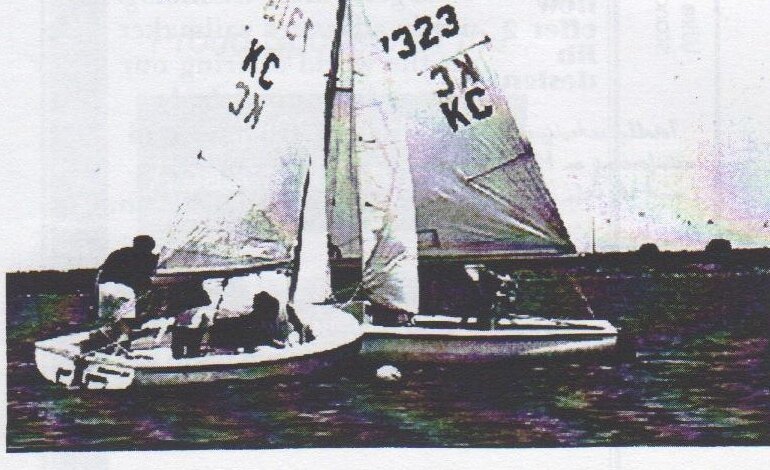
Pablo Cazaurang (Toronto) wants to know which yacht has the right of way at this mark rounding.
Know our Sponsors
They donated liquids and solids; sails and hats; key rings and centerboards; epoxy kits and ditty bags, jackets and books; advertising space and gift certificates; advice on the water and off; their time and their encouragement. Mostly their encouragement.
These pages show some of our sponsors during the 1995 sailing season.
There were others.
Thank you.

Sailing the Information Highway
by Karen Atkin
Reprinted from ‘Gybe Talkin’’, v21 n1 (1996) Newsletter of the Mooredale Sailing Club, Toronto. With permission.
It is possible to go sailing without leaving the comfort of your own home (or office) by sailing on the information highway. I have discovered some of the following Web Sites that people may find interesting, including some, such as the weather, which are actually useful. Once Environment Canada starts charging for phone calls to the (marine) weather information line, it will be easier and cheaper to get the conditions and forecast via the web. Have fun sailing the web!!
- Weather — http://www.on.doe.ca/text/fpcnll.wto/
- Marine Weather — http://www.on.doe.ca/text/fpcn21.wto/
- IYRU Home Page — http://www.paw.com/sail/IYRU/
- CORK — http://www.novatech.on.ca/nautical/corkintr.html/
- The Sailing Source - The Internet Sailing Magazine — http://www.paw.com/sail/
- Mark Rosenstein’s Sailing Page — http://community.bellcore.com/mbr/sailing-page.html/
- AnneMarie’s Sailing Page — http://www.xs4all.nl/~avdberg/sailing/htm/
- Guide to the 1996 Olympic Games — http://atlanta.olympic.org/index.html/
- Guide to the 1996 Olympic Games - Yachting — http://atlanta.olympic.org/sports.yachting/yachting.html/
- CYA Home Page — http://www.cdnsport.ca/~smorrow/
News from the Net
Released by the US Navy (Daily Telegraph, London, January 12, 1996)
#1: Please alter your course 15 degrees to the north to avoid a collision.
#2: Recomend you alter your course 15 degrees to the south to avoid a collision.
#1: This is the Captain of a US Navy ship. I say again, alter YOUR course.
#2: No, I say again, you alter YOUR course.
#1: THIS IS THE AIRCRAFT CARRIER ENTERPRISE. WE ARE A LARGE WARSHIP OF THE US NAVY. ALTER YOUR COURSE. NOW!
#2: This is a lighthouse. Your call.
The Racer’s Edge
Adapted from Dellenbaugh, D.; Boat Preparation. Sailing World, May 1989, pages 54-55.
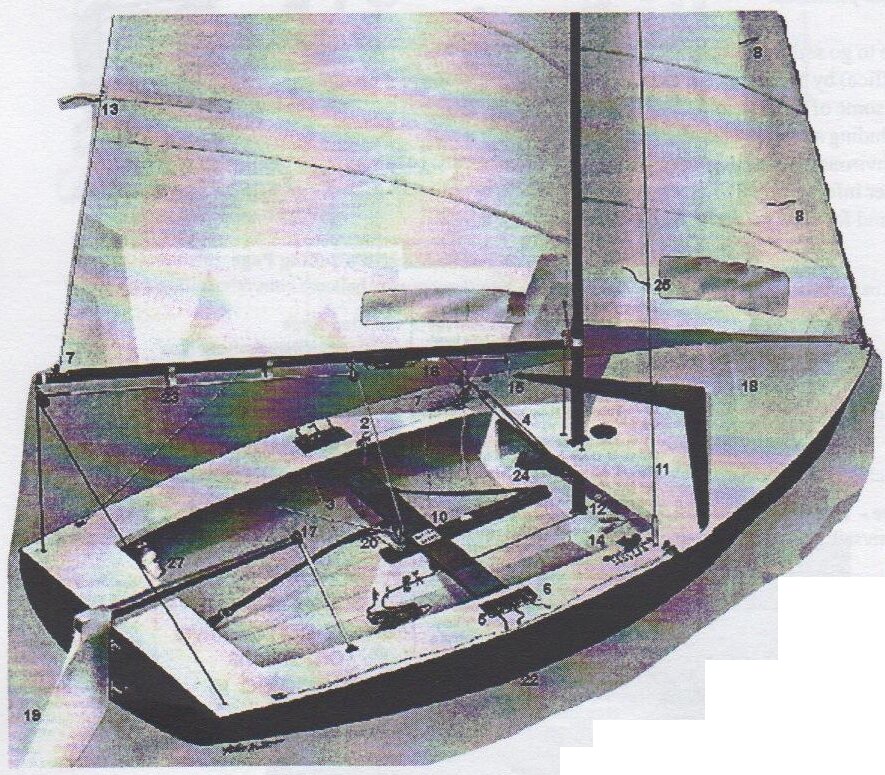
In the sport of sailing, success often depends more on what you do before a race than what you do during a race. You can have the best strategy and tactics in the world, but if your foils are slow or if a hiking strap breaks on a beat, you will not be first around the buoys.
Pre-race preparation is especially important in one-design racing. When all the boats are nearly identical, you have to look for any way possible to make your boat a little faster and a little easier to handle. Even if that final wet-sanding of your rudder will have a minimal effect on your actual speed, the psychological boost can be tremendous.
With this in mind, here are some small tricks and ideas that can give you a physical and mental “preparation edge” over the competition.
- Use electrical tape to cover sharp edges. Smear silicone seal over tape ends to keep them from coming loose.
- Make your hiking straps easily adjustable to facilitate switching from straight-leg hiking (tighter straps) to droop hiking (looser).
- Use a shock cord to hold up hiking straps in normal hiking position. Check strap attachment points for chafe every day.
- Boomvang lines should be prestretched or Kevlar to minimize stretching. Main and jib sheets should be thicker and softer than control lines.
- Colour-code control lines. It is easier to ask an inexperienced crew to pull the yellow line than to explain where the cunningham is.
- Mount control cleats so lines are easy to adjust from a fully hiked position. Keep cams free of dirt. Don’t leave lines in them when storing the boat.
- Put numbered reference scales along the outhaul, jib tracks and so on. This will make it easier to duplicate fast settings.
- Place telltales about 6" to 12" aft of jib luff. Keep them away from sail seams. To get rid of static electricity, spray yarn telltales with a lubricant like WD-40.
- Store code flag “B” (the protest flag) where someone can quickly grab it in case of protest.
- Tape a diagram of code flags into the cockpit for easy reference. You can get this from the rulebook and cover it with plastic or buy a plasticized version from your sailing supply store.
- Use a Loos tension gauge to measure and duplicate precise shroud tension.
- Make sure bouyancy tanks are bone dry and air-tight. Check port covers and plugs before sailing each day to be sure they’re tight.
- In windy conditions, use a stitch or two to keep each batten in its pocket. Carry a spare batten of each size just in case.
- Keep two top battens on board: A soft one for light air and a stiffer one for a breeze.
- Cut all line tails as short as possible to minimize tangles.
- All clamcleats should be metal. Plastic ones wear out more quickly and don’t hold as well.
- Use a solid rubber universal on your tiller extension to reduce play and get best feel.
- Get rid of all non-essential weight, especially in the ends of the boat and aloft.
- Sand trailing edge of centerboard and rudder to eliminate concavity and thereby reduce speed-robbing vibration.
- Adjust the height of the main sheet cam so that the mainsheet is just above the cleat when you’re holding it from a hiked position.
- Shim the head of the centerboard (or the inside of the trunk) to get a tight fit, especially along the bottom of the trunk.
- Wet-sand the entire bottom with 600-grit paper on a block.
- Use duct tape, wire, webbing, or sailcloth to make loops on aft part of boom. These hold up the main sheet and keep the helm from getting strangled.
- Carry a ditty bag. Include pieces of line, shackles, knife, tape, screwdriver, pliers and so on.
- For tangle-free telltales on shrouds, attach the yarn to a plastic bushing that rotates around the shroud. Place it on top of a stainless steel washer that is held up by a small wrap of tape around the shroud.
- Carry a grease pencil to write compass headings on your deck or on a clear piece of plastic mounted on the deck.
- For easy drinking while racing, use a juice-filled bicycle squirt bottle that was frozen overnight.
1996 Albacore Regatta Schedule
As of February 5, 1996
| Date | Event | Host Club | Location | |
|---|---|---|---|---|
| April 27 | Spring Vice Regatta | Mooredale S.C. | Outer Harbour | |
| May 25 | NC | Warm Water Regatta | Conestoga S.C. | Conestoga Lake |
| May 26 | Harbour Master | RCYC | Inner Harbour | |
| June 1-2 | TARTS | TS&CC | Humber Bay | |
| June 2 | Peterborough Examiner | Peterborough S.C. | Clear Lake | |
| June 8-9 | RCYC Open | RCYC | Inner Harbour | |
| June 15-16 | NC | Nepean Open (?) | Nepean S.C. | Nepean |
| June 16 | Harbour Master | Westwood S.C. | Outer Harbour | |
| June 22-23 | LSSA | ABYC | Ashbridges Bay | |
| June 30 | Centennial Regatta | Peterborough S.C. | Clear Lake | |
| July 7 | Harbour Master | OHCC | Outer Harbour | |
| July 13 | OHCC Regatta | OHCC | Outer Harbour | |
| July 20 | Westwood Open | Westwood S.C. | Outer Harbour | |
| July 21 | Harbour Master | Mooredale S.C. | Outer Harbour | |
| July 27 | Women’s Helm | St. Jamestown S.C. | Outer Harbour | |
| July 28 | Harbour Master | St. Jamestown S.C. | Outer Harbour | |
| August 4 | Balsam Lake Open | Balsam Lake S.C. | Balsam Lake | |
| August 10 | Lake Ontario Challenge | Bronte Harbour Y.C. | Oakville | |
| August 10 | Mooredale Open | Mooredale S.C. | Outer Harbour | |
| August ????? | NC | Albacore Junior’s | TBA | TBA |
| August 11 | Harbour Master | Westwood S.C. | Outer Harbour | |
| August 17 | PABAR | Pointe au Baril S.C. | Georgian Bay | |
| August 17 | New Skipper’s Race | Westwood S.C. | Outer Harbour | |
| August 18 | Team Racing | TBA | TBA | |
| August 24 | Toronto Island Open | Toronto Island S.C. | Inner Harbour | |
| August 25 | Harbour Master | Toronto Island S.C. | Inner Harbour | |
| Aug 31/Sept 1 | St. Jamestown Open | St. Jamestown S.C. | Outer Harbour | |
| September 7 | Round the Island | Klinger (J-Town) | Toronto | |
| Sept. 7-8 | NC | Fanfare ’96 (Area 10) | Nepean S.C. | Nepean |
| September 8 | Harbour Master | St. Jamestown S.C. | Outer Harbour | |
| September 13-15 | Canadians’ | Geneva Park | Lake Couchiching | |
| September 14 | Not-the-Canadians’ | Mooredale S.C. | Outer Harbour | |
| September 21 | Fall Vice Regatta | Mooredale S.C. | Outer Harbour |
Races still to be designated for Gooderham Series
NC = Venue or event not yet confirmed
TBA = To Be Announced
Scoring Responsibilities
- Harbour Master’s Series: Ian Aukema, St. Jamestown
1996 Toronto Friday Race Schedule
| Date | Host Club | Location |
|---|---|---|
| May 3 | Mooredale | Outer Harbour |
| May 10 | St. Jamestown | Outer Harbour |
| May 17 | OHCC | Outer Harbour |
| May 24 | Mooredale | Outer Harbour |
| May 31 | Westwood | Outer Harbour |
| June 7 | Toronto Island | Inner Harbour |
| June 14 | St. Jamestown | Outer Harbour |
| June 21 | OHCC | Outer Harbour |
| June 28 | Mooredale | Outer Harbour |
| July 5 | OHCC | Outer Harbour |
| July 12 | Toronto Island | Inner Harbour |
| July 19 | Westwood | Outer Harbour |
| July 26 | St. Jamestown | Outer Harbour |
| August 2 | OHCC | Outer Harbour |
| August 9 | Mooredale | Outer Harbour |
| August 16 | Westwood | Outer Harbour |
| August 23* | Toronto Island | Inner Harbour |
| August 30* | St. Jamestown | Outer Harbour |
| September 6* | Westwood | Outer Harbour |
* signifies a 6:45 PM start
Scoring Responsibilities
- Friday Night Series: Will Lincoln, Mooredale
- Harbour Master’s Series: Ian Aukema, St. Jamestown
Letters
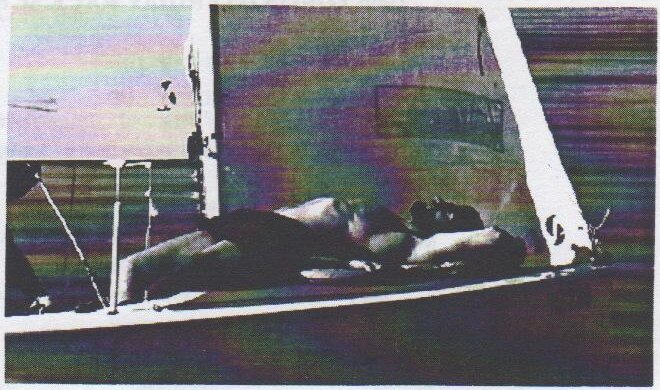
Dear Sir:
I hope you don’t mind pictures because there’s something my skipper does that can’t be described in words.
Could you please tell me whether the position shown in the accompanying photograph is normal for an Albacore skipper?
Just Wondering
Dear Just Wondering:
What is normal depends very much on your culture and on the situation. Judging by your skipper’s grin, we would have to know what went on immediately before this picture was taken. We have consulted our expert on sail trim and it is his opinion that the droop of the wire indicates excessive tension in the front. Good cunningham, though. He also says that the position shown is one of the best for checking whether or not the jib is blown out.
ed.
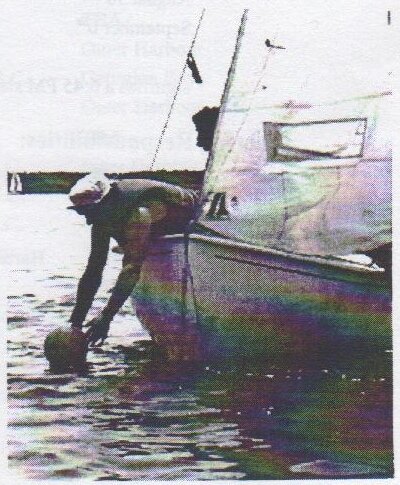
Dear Sir:
Is this an acceptable way of “shooting” the mark?
North by Northwest
Dear North by Northwest
It is more acceptable than using an AK-47 and riddling the thing to a state of negative buoyancy. However, it would be much better if at least one of the two people in the boat went to the back and steered the thing.
ed.
Contest! Contest!
This issue of Shackles contains the membership application/renewal form for 1996.
For as long as anyone can remember, Peter Vasoff has been the first to return his form and his cheque.
Beat the Pants off Peter V.!
If you return your completed form and cheque to Ross King before Peter V. returns his, you win a pair of authentic Peter V. sweat pants.
If you introduce 3 new members to the CAA this year, you win an authentic Peter V. shopping bag.
If you introduce 5 new members to the CAA this year, you win an authentic, FILLED Peter V. shopping bag. Yes, I.Y.R.U. rulings and appeals, 1786 to 1994, complete.
Get those applications and cheques to Ross!
Market Place
Boats for Sale
#7977
Hot News!!!
Barney (#7977) is for sale at a lake bottom price. Barney needs a special home. Someone who likes fiberglassing.
Someone who has a little extra time to give.
Barney is in amazingly good shape after its land-planing experiment on the QEW.
There must be a great humanitarian out there who will come to the rescue.
David Bussin
KC7400
1982 Don Young Hull. Includes North sails, compass, top and bottom covers, trailer and dolly, custom “easy to sail” controls.
This wooden boat has recently been refinished and is proven fast.
Bob Leonidas
- Sexy British male (VERY rare) #7362 seeks fun-loving sailor to share sun, wind and laughter.
- Offspring of loving boat-builders and coffin makers, Knight and Pink (1983).
- Alluring racing-green complexion on very fair cold-rolled Mahogany bottom. (Recent minor cosmetology).
- Excellent wardrobe with several quality suits by JC and North. Sleepwear (full pajamas) by Hans G.
- Well-equipped for easy handling and passionate performance.
- Extremely responsive and rewarding to the right touch.
- Favourite pastime: Planing
- Most annoying habit: Going off a little early
It could be Magic
Merlin c/o Gary Bain
Boats Wanted
Wanted. Good used Albacore. Prefer recent model fiberglass hull, but will also consider others.
David Vincent