January 1998
January 01, 1998
January 1998 issue of the Canadian Albacore Association newsletter (Vol. XXXVIII No. 1) — Gordon Chu’s Commodore’s Corner from the Toronto Boat Show, letters from Ed Nicholas and Barney Harris on sponsorship and fleet growth, “Bright Ideas: Promoting the Class”, a pre-season boat preparation checklist, Helpful Hints #276 and #277, the 1998 changes to the Racing Rules of Sailing, “What’s in a Name?” on Albacore boat names, a tell tales primer, cold water survival, an OSA government update, the tentative 1998 regatta schedule and the Mid-Winter Regatta in Sarasota.
Shackles and Cringles — January 1998
Canadian Albacore Association — Volume XXXVIII, Number 1
In this issue: Class Promotion (page 5) · Fix It Now (page 6) · What’s In A Name? (page 10) · Mid Winters (page 16)
The Albacore Advantage
Canadian Albacore Association, P.O. Box 16 660 Eglinton Ave., East, Toronto, Ont. M4G 4G1
A One-Design Boat
- no unnecessary expense of constant upgrades in design.
A Safe Boat
- large air-filled tanks give excellent buoyancy
- hull shape gives stability on the water
- self-rescue after an unexpected puff is easy
A Light and Manageable Boat
- tongue load of less than 100 lbs gives ready trailerability
- launching and retrieving are a breeze
A Comfortable Boat
- large, open cockpit
- benches on port and starboard sides
A Performance Boat
- seriously campaigned by major sailmakers
- planes in moderate winds
- buoyant heavy-air hull shape
Ideal for Junior Clubs
- 4 to 5 juniors will fit easily
- will stand up to heavy use
A Vibrant Class Association
- well organized and vital
- recognized by the International Sailing Federation
- strong fleets through Ontario, Canada, US, Great Britain, Ireland and Bermuda
- top notch competitive sailing
- junior programs in some areas
The Canadian Albacore Association
The Canadian Albacore Association is responsible for encouraging participation in and maintaining the integrity of the Albacore class in Canada.
1997/1998 Executive
| Position | Name | Address | Contact |
|---|---|---|---|
| Commodore | Gord Chu | 38 Queensdale Avenue Toronto, ON M4J 1X9 | Res. 416 465 5558 Bus. 416 733 6851 Fax 416 972 5515 [email protected] |
| Past Commodore | Bob Stiff | 20 Southlea Avenue Toronto, ON M4G 3L9 | Res. 416 423 3294 Bus. 416 482 5002 [email protected] |
| First Vice Commodore | Laurie Harrison | 24 Noble Street Toronto, ON M6K 2C8 | Res. 416 536 7025 Bus. 416 946 3139 Fax 416 536 8196 [email protected] |
| Second Vice Commodore | Mike Leishman | 94 Harris Avenue Toronto, ON M4C 1P6 | Res. 416 699 8100 Bus. 416 822 7354 Fax 416 368 0956 [email protected] |
| Third Vice Commodore | |||
| Rear Commodore | |||
| Specifications Chair | David Weaver | 14 Lansdowne Road, North Cambridge, ON N1S 2S8 | Res. 519 623 4402 Bus. 905 525 9140 X24907 Fax 905 572 7944 [email protected] |
| Chief Measurer | Rick Clayton | 362 Brookdale Avenue Toronto, ON M5M 1P8 | Res. 416 783 9194 Bus. 905 670 8700 |
| Treasurer | Heather MacNaughton | 83 Lillian Street, Unit #1 Toronto, ON M4S 2H7 | Res. 416 481 8503 Bus. 416 982 2120 Fax 416 944 5891 [email protected] |
| Secretary | Raines Koby | 5 Cosdale Avenue Palgrave, ON L0N 1P0 | Res. 905 880 1866 Bus. 905 264 6123 Fax 905 264 2944 |
| Shackles Editor | Uwe Ackermann | Dept Physiology, University of Toronto Toronto, ON M5S 1A8 | Res. 416 778 6897 Bus. 416 978 4017 Fax 416 978 4940 [email protected] |
| Membership | Peter Nurse | 76 Normandy Blvd Toronto, ON M4L 3K3 | Res. 416 698 5726 Bus. 416 396 6736 [email protected] |
| IAA Representatives | Rosemary Helmer, IAA Secretary Ian Rogers, IAA Treasurer | 264 St. Clair Ave., West Toronto, ON M4V 1R7 155 University Ave., Suite 1600 Toronto, ON M5H 3B6 | Res. 416 964 8427 Bus. 416 410 4644 Fax 416 961 4644 [email protected] Res. 416 485 5136 Bus. 416 361 0626 Fax 416 361 6303 |
| IAA Chief of Specifications | David Weaver |
Shackles and Cringles is a quarterly publication of the Canadian Albacore Association.
Deadlines for publication are January 15, April 15, July 15 and October 15.
Commodore’s Corner
It is about halfway through the Toronto Boat Show as I write this. With the completion of the International Trade Centre on the exhibition grounds, there is a new look to the show this year. The good thing is that the sailing area is no longer seperated in a different building from the rest of the show.
The Albacore display this year used one of the boats built in 1997, courtesy of St. Jamestown Sailing Club. We also used the professional display that was originally built in the mid-80’s. I for one had not seen this display before, as it had been in storage for some time. One can see that good pictures of Albacores in action really are timeless. Special thanks goes out to Raines Koby, Peter Nurse and Laurie Harrison for their efforts in putting the show together. I was glad to see a lot of interest in the class, both from people who had sailed the boat previously and from some experienced sailors from out of town who are looking to get involved in a class.
One of the highlights of the show to me was the appearance of an Open 50 Around Alone (formerly BOC) single-handed racer. These extreme boats are only slightly smaller than the Open 60 which were used in the recent Vendee Globe or the Whitbread 60 currently racing around the world.
The big news is the completion of the Canadian Albacore website at “www.albacore.ca”. Thanks to Vice-Commodore Laurie Harrison for her hard work. Please go have a look. If you have any ideas for enhancement or if you have some content that you feel would be of interest, then by all means give us a shout. We very much want to make the site more meaningful for existing and potential Albacore sailors.
Thanks go out to RCYC which has agreed to store the association’s historical files in their archives room on St. George Street. The association had rented storage space in the past, but more recently the association’s records had been sitting in various members basements and garages. Now, we will have everything stored in good environmental conditions and at no cost.
Gordon Chu
Web Sites of Interest
- www.albacore.ca — Canadian Albacore association
- www.sailon.org — Ontario Sailing Association
- www.cs.cmu.edu/Unofficial/Canadiana/CA-sites.html
Letters to the Editor
Hi folks: I am trying to obtain sponsorship for our four local regattas in the Ottawa area in the amount of $16,000. I am also trying to get individual boat sponsorships where a company would buy boats and put its logo on the sails. I’m also trying to get Media coverage. Media interest is quite high. We hope to incorporate the Canadian and American Regattas into this sponsorship in the future. My personal belief is that the Albacore fleet will not grow unless we get corporations involved. None of us have the benefits like Toronto’s having five clubs side by side. The problem is we would like to stay associated with the CAA, USAA and UKAA. If this works in Ottawa, there is no reason why fleets in other areas such as Washington or elsewhere could not do the same thing. It would be beneficial in trying to establish fleets in other areas such as Kingston, Montreal or any American city. I realize Toronto will probably be against this, but I’m hoping the Americans will think it’s a good idea. I don’t believe this will change the fleet at all except to allow it to grow. We tend to be fighting a losing battle by trying to have the fleet grow without outside help. As a race-ready Abacore is now running around $13,000.00, are we slowly pricing ourselves out of the mom and pop market? Boat designers, having completely destroyed keelboat one design, are now focusing on dinghy fleets with new designs coming out by the dozen every year. Unless the Albacore fleet expands to other areas, it will become a boat exclusive to the Toronto area and cottages. Please send me any ideas you have pro/con on this concept.
Ed Nicholas (613) 738-7050 (Red Albacore 5858)
Ed et al:
I am all for sailing sponsorship and more Albacores. However, I have found the only way to create a new fleet of anything is from the inside - by local people who really want to sail something. We in the US have several brainstorming meetings each year to assess our fleet, and figure out how to grow it. We have tried many things. In my experience, the only fleet growth technique which works every time is when the organization is promoted from within by its members. This happens one person at a time, and typically only after an extended period of borrowed boats, crewing, and friendly cajoling. Hope to sail against you this year,
Barney Harris TEAM SPOT Albacore USA 8011
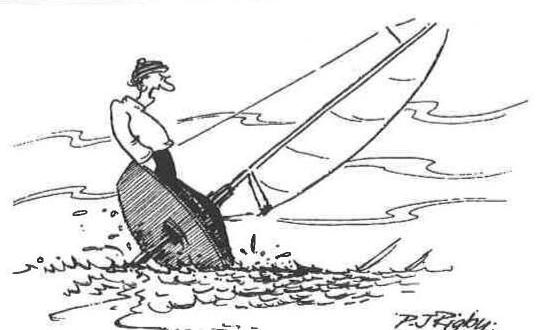
“Amanda – you’re on the wrong side again!”
Bright Ideas: Promoting the Class
The letter from Ed Nicholas (page 4) raises not only an interesting idea, but also the general question of what we might do to promote growth of the Albacore class. There must be as many ideas as there are Albacore sailors. Why not try some of these to promote Albacore sailing in your District?
Publicity
- set up a display of your own by working with the local shopping centre management on a special (crowd-gathering) display of a fully-rigged boat
- exhibit several boats ranging from the newest fibreglass models to older wooden ones. Hand out information on the Albacore and on your club.
- when we hold the Ontario’s, Canadian’s or North American’s, think of phoning local media and try to get coverage of the event.
Encouraging Regatta Participation (by Barney Harris)
- Dollar prizes can work well if they are awarded in a way that promotes the class or encourages participation in general new members in particular. I believe that awards and recognition for newcomers and beginners are far more important than they are for the winners. It’s not necessary to give a cash prize or a bigger trophy for chronic winners; they would race Albacores whether they won a trophy or not. However, everyone wins if the prizes are awarded to encourage fleet growth, travel, participation, etc. For example,
- at the Worlds in the UK, the largest trophy was given to the people who finished worst but had completed every race (not a trivial feat). They were not aware of this trophy. It was awarded last and drew thunderous applause. Boy, were they suprised! I bet we’ll see them next year.
- How about paying for a newcomers’ next year community club dues (or a portion of them)?
- How about partially funding travel expenses to a future out-of-town regatta?
- How about buying refreshments for the next regatta?
- Sponsor dollars or services can be focussed in this direction to be effective and NOT encourage a bunch of hot-shot prize hunting.
Encouraging Club Members
- Advanced Racing Clinics are a perfect way to encourage both improving sailors and the top competitors in your club into greater participation and involvement.
- Tuning Clinics which concentrate on intensive boat handling drills, practice, tuning and individual analysis.
- Boat Repair Clinics will draw racers as well as cottage sailors. Get a decommissioned hull from a Community club, make some holes in it and teach basic fiber glass repair to participants
- Helping the new sailor
Discouragement at being chronically at the bottom or middle of the fleet is a common complaint, but there are remedies. Why not try- Regular Racing Clinics, run by accomplished club racers are a perfect way to encourage new racers and to teach boat handling skills to all participants
- Borrow-a-Crew races, with experienced racers serving as crew, are a good way to teach effective navigation around the race course.
Reaching out
As established members get to be parents, consider a Juniors program at your club.
What should I be doing now?
By the time the next issue of Shackles appears the Community Club keeners on the Toronto waterfront will already have launched their boats and will probably have held their first regatta. That may not be everyone’s cup of tea, but it is not too early to be thinking about the next sailing season. Less than 10 weeks from now your toy will be afloat and now’s the time to start thinking about pre-season and off-season preparations. If you have access to your boat and a heated space for working on her, here are some things to check.
Alignment
Check that the mast, centreboard and rudder, indeed the general hull form, all complement one another and are aligned.
The only way to check for this is to put the boat on trestles, with the mast in the boat, rigging in place, but without sails.
- Lower the centerboard and hang the rudder with the blade fully down.
- Center the tiller and tie it in place.
- Lay a spirit level across the side decks in order to level the whole boat. When this has been done quite simply walk back about 20 steps from the bow and position yourself so that you can visually line up in vertical planes all the surfaces of the mast, centerboard and rudder. If any of these items are at an angle, one to the other, vertically, then you have spotted one of most speed-robbing problems for all sailboats.
- The mast gate may be off-center with respect to the center line of the boat
- The mast step may have been screwed in crooked, or simply off centre.
- The centreboard box may be angled one way or another apart from any obvious warping in the centreboard if it is an older one.
- The rudder is most frequently the one element that is out of alignment because it is often hung off centre and crooked.
Hull Finish
One of the best methods of obtaining peak performance from your boat is maintaining a smooth hull surface.
- The finish on older boats can be restored by wet-sanding the hull, starting with 400-grade paper and working up to 600-grade or higher, if available. When wet-sanding, use a wood or rubber sanding block to obtain an even finish and be sure to use plenty of water because it helps to lubricate and clean the sandpaper, thus increasing its effectiveness. To bring the gloss back to the hull’s finish once the wet-sanding is completed, finish off with polishing compound. Depending on the hull’s condition, it may be necessary to start with fairly coarse wet sandpaper, such as 320-grade, then gradually work up to 600-grade or higher. Be careful that you don’t sand down through the gelcoat to the layer of fiber glass underneath. If a dark-coloured tinge begins to appear, stop wetsanding because you are getting too close to the fiber glass laminate.
Hull Fairness
Hull fairness can be checked by eye or by running a board with a flat surface over the hull, marking with a felt pen any points that are high or low. The most accurate method of checking hull fairness is to use a mechanic’s feeler gauge, which measures differences in thousandths of an inch. This feeler gauge should be suspended within a square frame, with all bottom surface projections of frame and gauge flush and in plane. Pass this frame over the hull and mark any high or low spots that are encountered.
- Indentations in the hull can be faired with micro-balloons or epoxy.
- High spots can be removed by wet-sanding
Centerboard
- The centerboard and rudder should be perfectly smooth and have sharp trailing edges. A slightly squared off trailing edge and tip help to reduce turbulence and this will contribute significantly to over-all boat speed.
- The centreboard should have no slop within the centreboard box so that when a puff hits the rig the board does not deflect in relation to the hull and so there is no power loss.
- A good, snugly fitting gasket at the bottom of the centerboard trunk will prevent the added turbulence of an open slot and will keep you from carrying the weight of several gallons of water around inside the centerboard trunk The gasket may be made from mylar or sailcloth. All screw heads of the keel band holding the centreboard gasket in place should be filled, (ordinary car body filler is perfectly good for this). If there is any ridge or depression where the keel bands are fitted to the bottom of the boat fairing pieces should be constructed and sanded into shape, using body filler. The object of this exercise is perfect smoothness and fairness for the easy passage of water over the bottom of your boat. Attention to this will show itself in greatly improved downwind performance in light air, when the hull surface drag is a tremendous speed robbing factor.
- If the centerboard trunk is longer than is needed to house the centreboard then cut out a filler piece from a block of unicellular foam/styrofoam and fit it at the back end of the inside of the centerboard box, inside the gaskets. This foam filler will be lighter than the excess water that you were carrying around before.
Rudder
- To reduce turbulence between the rudder and the boat, be sure that the rudder is hanging perfectly vertically and that it is tucked up against the hull as tightly as possible.
- The rudder fittings should have virtually no play in them so as to provide a light sensitive feel.
- The rudder blade should be held perfectly firmly within the cheeks of the head assembly.
Transom
- The point of intersection of the transom and the bottom of the hull should be a perfectly sharp edge. His provides a perfectly clean cut off for the water leaving the hull in planing conditions and it will prevent a rooster tail of water being thrown up onto the rudder stock and creating further drag at the speeds of displacement sailing.
- The control line for the transom flaps should be led to a point where the skipper can easily detach and attach it.
Bailers
If your boat does not have self bailers then consider installing them. A pair should be situated eight inches out on either side of the centerboard at the deepest point of the hull, which is directly under the thwart on most makes of Albacore. Medium-sized bailers are adequate.
Hiking Straps
Remember that hiking straps hold you in the boat when you most need to be held.
- Check the straps for wear and repair or replace.
- Consider installing an adjustment for the forward portion of the straps so that the crew can vary the vertical height of the straps and, therefore, position over the side of the boat in relation to leg length and wave conditions.
Helpful Hint # 276
Cutting or Drilling the Mast or Boom
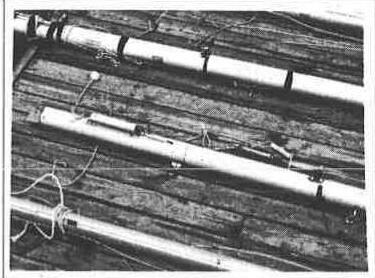
If it is necessary to cut a mast or boom to length, a simple way to mark a square line round the section is to wrap a piece of paper with square corners round the tube, lining up the edges and pencilling round.
The section should be cut with a 24 tooth per inch hacksaw, working round the tube rather than going straight through.
Fittings Can be attached by stainless steel self-tapping screws but great care must be taken to drill the correct size holes. Drill a clearance hole through the outer part, that is the fitting when adding a part to the outside of the mast, or the mast wall when fitting a heel plug or similar plug. Then in the part to be threaded a smaller hole must be drilled. To get a good thread in the thin mast wall, drill a hole the same size as the core of screw, but if the screw is to be driven into thicker metal, like a casting, a slightly larger hole should be drilled. In either case, always put a spot of grease on the screw before driving it home, otherwise it may shear off.
When moving fittings, or attaching new ones, care should be taken to avoid drilling holes too close to each other, particularly horizontally across the section, and in high stressed area of masts. For the same reason, large holes should not be cut for internal uphaul sheaves, etc. In these applications, a top and bottom fixing sheave cage should be used rather than one with side fixings.
Helpful Hint #277
Fairlead Repairs
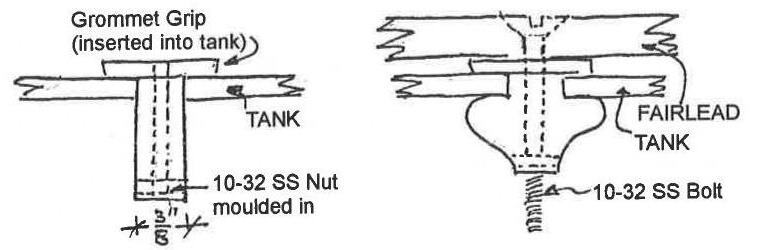
Fairleads are often mounted on top of buoyancy tanks. If a repair is necessary, don’t use sheet metal or self-tapping screws. The coarse threads don’t hold well. Pop rivets are equally bad. From a sheet metal cladding contractor, scrounge some 3/8" grommett grips. Throw away the nuts and bolts supplied and buy some #10-32 stainless steel nuts and bolts. Drill a 3/8" diameter smooth hole for a snug fit of the grommets, insert the bolts and voila! The following diagram illustrates the idea:
Changes to the 1997 - 2000 Racing Rules of Sailing
Effective January 1, 1998
Changed wording is underlined.
Rule 14 (b)
(b) shall not be penalized under this rule unless there is contact causing damage.
Rule 17.1
A boat clear astern that becomes overlapped to leeward and within two of her hull lengths of a windward boat, shall not sail above her proper course while the boats remain overlapped and less than that distance apart, unless as a result she falls astern of the windward boat.
Rule 49.1
Competitors shall use no device designed to position their bodies outboard, other than hiking straps and stiffeners worn under the thighs.
Definition of “Keep Clear”
One boat keeps clear of another if the other can sail her course with no need to take avoiding action and, when the boats are overlapped on the same tack, if the leeward boat can change course in both directions without immediately making contact with the windward boat.
Definition of “Obstruction”
An object that a boat could not pass without changing course substantially, if she were sailing directly towards it and one of her hull lengths from it. An object that can be safely passed on only one side and an area so designed by the sailing instructions are also obstructions. However, a boat racing is not an obstruction to other boats unless they are required to keep clear of her, give her room or, if Rule 21 applies avoid her.
What’s in a Name?
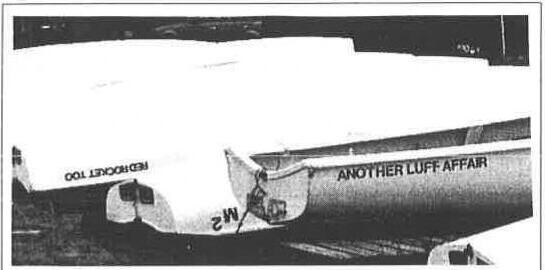
Sailboats have been given names since they first took to the seas. In some parts of the world the selection of a boat’s name is given the same care and attention as is the naming of a child. We seem to be different because many Canadian Albacore sailors prefer the anonymity of their assigned sail number. Chris Gorton has tried hard to change this and great fun’s been had in some Community Clubs with name that boat competitions.
Your boat’s name can be inspired by any source. Some boat names are inspired by the boat’s physical appearance such as the yellow decked, white hulled Albacore, “Sunnyside Up” that sails out of Toronto’s Outer Harbour Centerboard Club. Some names are inspired by a sense of irony. When Jorg Pawlik started winning consistently in the early eighties against the woodies he named his fiberglass boat “Woodpecker”. Then Jorg moved to a woody himself, purchasing the proven winner of the Poyntz brothers and named it “Poyntless”. Ken Clarke was probably just commenting on the small change it cost him to purchase and race “Just another Toy”. In other households choices must be made and that’s probably what inspires a name like Ian Rogers’ “Baby Grand”. At the Mooredale Sailing Club in Toronto the Albacore sailed by Janet Duff whose legs go all the way to her hips is called “Too Tall”. The St. Jamestown Sailing Club has had a string of “Luff Affairs”. Some are mindful of poetic possibilities and that’s how the boat sailed by Bob Stiff received the rhyming name of “Whiff”. When Joe Li was active in the fleet he had a bit of a reputation in protest rooms. It was fitting that he should have named his Albacore “Beast of Burden”. And speaking of animal-inspired names, Rosemary Helmer chirps in with “Cricket”. Some change their boat’s name to suit the occasion. Barney Harris is a master of this. While he was chasing Michael McNamary at the 1994 World’s in Kingston he called his boat “Mac Attack”. After a particularly steamy evening in a local pleasure emporium it became “Hot Tub”.
Some names just make you wonder. “Dog Breath” falls into that category. Dave Harris’s Albacore. Out of Outer Harbour Centerboard Club in Toronto. The story is that Dave’s frequent crew, talkative and classically trained Kevin Smith, was asked to comment on their partnership. Kevin gushed, “Dogma brevis vehementius tiller humorus est” which, translated into the vernacular means roughly, “His steering’s worse than his humor”. Dave’s a taciturn, soft-spoken guy; always uses as few words as possible. So he focussed on the first two words of Kevin’s statement, “Dogma brevis” and that’s how “Dog Breath” came about.
It really doesn’t matter what your inspiration is. Don’t let another season pass without giving your boat a name. If you don’t then look out for the boat (re)naming squad that’s been known to strike at venues as august as the World’s.
What the Tales are Telling
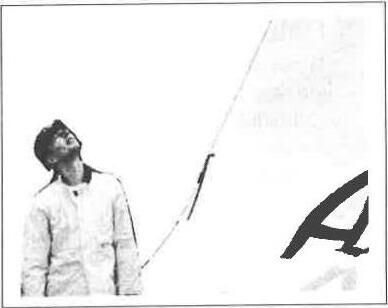
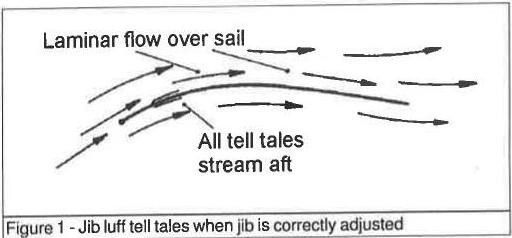
Tell tales are 6 to 8 inch long tufts of wool or spinnaker nylon that are placed on the sail to act as indicators of air flow at various points on the sail. A tell tale streams aft in a smooth manner when there is laminar flow over that part of the sail. On the other hand, when turbulence exists the tell tale reacts violently and shows clearly at what point of the sail turbulent flow develops.
Some take the use of tell tales too far by covering their sails with them. Most of the race is spent adjusting the sail setting to try to get the wool tufts lined up like little soldiers, with little regard to the more important wind shifts and tactics. A few strategically placed tell tales are all that is necessary.
Installing Tell Tales
Jib
Only three tell tales are needed on the jib. Most sailing supply stores will sell packages of glue-on woollen tales. They should be spaced equally up the luff and about 8 inches back from the luff wire. Make sure that the tell tales are away from any stitching as they may catch and defeat the object of having them there.
Main Sail
The most worthwhile place to put tell tales on the main is at the leech. A quick glance upwards is all that is required to see what is happening with the tell tales and adjustments can be made accordingly. Strips of spinnaker nylon, sewn into the leech, are best. Wool tufts should be avoided because they have the habit of catching in the stitching and do not wear well on a mainsail leech. Always use a bright colour for easy recognition against the sky.
Using Tell Tales
Jib Tell Tales
The tell tales on the jib luff are used as an aid to fairlead positioning, to help in upwind steering and as an aid to the correct setting of the jib in reaching.
Upwind Steering
Ideally all the tell tales should stream aft on both sides of the sail when sailing at the correct angle to the wind (Fig. 1).
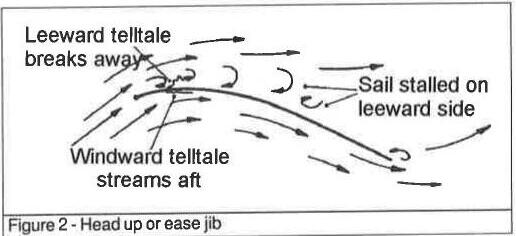
- If we bear away too much the leeward tell tales will flutter violently as the air flow breaks away from the lee side of the sail (Fig. 2). When this happens then luffing up to the correct angle to the wind or easing the jib sheet will re-establish laminar flow over the lee side of the sail and both leeward and windward tell tales will stream correctly.
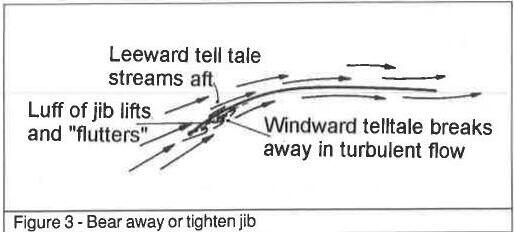
- If we sail too closely to the wind then the windward tell tales will flutter violently as the air flow breaks away from the lee side of the sail (Fig. 3). Bear away or tighten the jib sheet.
Fairlead Adjustment
When sailing upwind there should be an even angle of attack all the way up the jib luff. This prevails when all the jib luff tell tales stream aft when the sail is correctly set and at the correct angle to the wind.
A jib with too much twist will produce an uneven slot and a leech that is too open in some places.
For correct fairlead adjustment:
- Set the jib for upwind sailing and cleat the sheet.
- Steer so that all three windward jib luff tales stream backwards. Gently luff up and observe whether or not all three windward tell tales “break” at the same time. If they do not then there is too much twist in the jib. This causes the foot and middle of the jib to be at a different entry angle to the wind from the top of the jib.
- If the upper tell tale “breaks” before the lower then the foot of the jib is closer to the wind and the upper third of the jib is looser.
- The remedy is to loosen the foot and tighten the top by moving the fairlead forward.
- If the lower tell tales “break” before the upper, move the fairlead backwards.
Reaching
When reaching the tell tales can be used to obtain the correct setting of the jib by the crew. Remember that on a reach the jib has excessive twist that can only be cured by barber haulers. Ignore the top tell tale and use the middle and bottom tell tales.
- When the leeward tell tale flicks up ease the sheet until it streams aft;
- when the windward tell tale becomes erratic the sheet needs to be pulled in.
Mainsail Tell Tales
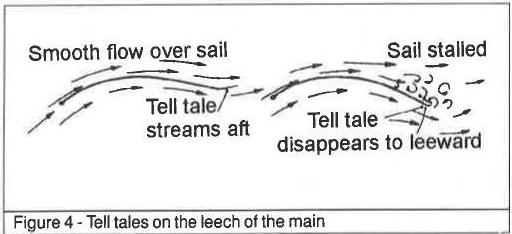
Tell tales on the leech of the main are useful to obtain the correct setting of the sail twist. In light winds it is very easy to over-sheet the mainsail with too much vang or mainsheet tension. The upper part of the sail then stalls in the leech area and the sail loses power.
- The tell tale at the top batten is the most important to ensure the correct amount of twist.
- When the middle and lower tell tales fail to stream it is usually a sign that the boom is too near the centre line or the sail is too full thus giving too tight a leech.
- In medium conditions where maximum power from the sail is required, sail close-hauled and
- use sufficient main sheet tension to bring the boom to the center of the boat.
- Adjust the vang so that the top tell tale is just on the point of collapsing.
- Remember to adjust the vang as wind strength changes.
- In strong winds the main sail tell tales will stream all the time. Your aim should be to keep the boat upright by flattening the sail as much as possible with the various adjustments available.
Cold Water Survival
Why do people act irrationally and why might they die when they become hypothermic?
The body quickly surrenders its heat when it is surrounded by cold water and as the cold blood circulates through the brain and heart the function of these vital organs becomes impaired because their chemical reactions are slowed by cold. A slowing of the brain chemistry causes mental impairment and can cause unconsciousness; cooling of the heart can lead to the state of electrochemical anarchy known as fibrillation which, unless it can be checked, leads to death.
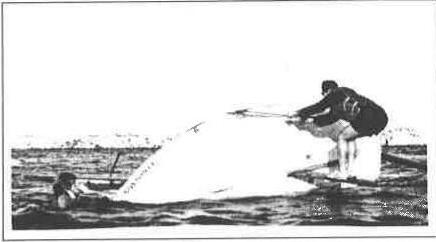
Following a capsize in cold water, the main concern should be the preservation of body heat. In a person who swims vigorously, blood is forced to flow to the large muscles of the upper body and the legs. Thermograms show that in such a person the arms, shoulders and upper chest are areas of high heat loss. Therefore, blood is cooled in those areas and when it returns to the heart and deep body areas in the course of its circulation, this cooled blood lowers the core temperature of the body. On the other hand, thermograms of someone holding still in cold water show that the high heat loss areas are down the side of the chest and in a V shape in the groin area. Furthermore, a person who swims in cold water looses body heat more quickly than one who remains still. Survival time can be increased by about one third merely by holding still in the water instead of swimming.
In 10°C water an average person is able to swim a little less than a mile before being completely incapacitated by cold.
When the drown-proofing technique, where the head is lowered slowly down into the water and gently raised to breathe is compared with treading water then drown-proofing generally brings about quicker cooling than slow treading water. A tremendous amount of heat can be lost from the head and submersing it in the cold water will accelerate heat loss compared to treading water, which keeps the head out of the water.
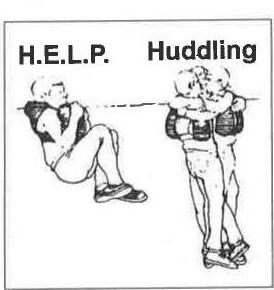
The best position in the water is one that minimizes heat loss. For an individual this is the H.E.L.P. (Heat Escape Lessening Posture) position. The HUDDLE is best for small groups.
Rewarming is an aspect of cold water survival that is often overlooked. If someone is very hypothermic, merely covering them with blankets may not be enough to enable them to generate sufficient heat to rewarm themselves. The key to rewarming, therefore, is to provide some external source of heat for the victim. Hot drinks, electric blankets and hot water bottles can help in this endeavour. Occasionally it may be necessary to resort to the technique long practised by mountaineers, namely removing your own clothes and those of the victim and covering yourselves so that some of your own body heat can be transferred to the chilled body you have rescued.
Remember these survival tips if you should experience a cold-water capsize:
- If you are able to get out of the water onto the upturned boat, do so.
- Unless land is within easy reach, holding still in the water is preferable to swimming or other vigorous movement.
- Whatever happens, try to keep your head clear of the water.
- The HELP or HUDDLE procedures can cover areas of high heat loss and lead to increased survival time.
Government Update
November 1997
From the Ontario Sailing Association.
Several long term government projects, which affect recreational boaters, are presently nearing completion. It is important that any questions or concerns you may have in these areas be brought to the attention of the office as soon as possible as final submissions will be made in the next couple of months. If you wish to have a copy of the latest draft document please contact the office at 416 425 7245 (Tel from Toronto) or (1 888 672 7245 (Tel from places other than Toronto) or Fax 905 572 6056 or e-mail [email protected].
It must be stressed that the proposals listed below are still in draft form and some of the details will change between now and the final publication of the regulations governing each issue.
Operator Knowledge
The Canadian Coast Guard (CCG) and the Minister of Fisheries and Oceans are about to announce a requirement for all boaters, in all types of boats, to meet a minimum basic knowledge requirement. It appears likely that this requirement will be phased in over many years. At the present time it is expected that all persons born after 31 December 1983 will be required to meet the standard. The “in force” date will likely be 1 January 1999. Coupled with the knowledge requirements will be age restrictions which will limit unaccompanied qualified children less than 12 years of age to boats with engines of less than 10 horsepower and unaccompanied qualified children between 12 and 16 years of age to vessels of less than 40 horsepower.
Our association is exploring partnerships with other training bodies to develop an accredited, 8 hour training course which will meet the Coast Guard’s requirements.
Vessel Identification
CCG expects to announce the requirements for nation wide vessel identification program which will once again apply to all vessels. The in force date is likely to be sometime in 1999 as there are several infrastructure hurdles yet to be cleared. Renewal periods will likely be 2 years for most vessels, with canoes and rowboats on a 5 year cycle. At the present time the system will be operated on a cost recovery basis. Specific fees for CCG support of recreational boating are likely to be three years away.
Safety Equipment
The Small Vessel Regulations will be changed early in 1998 to give boaters more options on the safety gear they are required to carry on board their vessels. Some additional equipment will be required including waterproof flashlights, and buoyant heaving lines. As well, all vessels will be required to have PFD’s which actually fit everyone on board. All members should review the draft standards which are expected to be released in the next few weeks.
Aids to Navigation
Continued pressure on Coast Guard funding has resulted in a comprehensive review of all aids to navigation. Many light houses and fog horns have already been closed or transferred to the private sector. A second round of cuts has seen many navigation marks and several ranges reviewed. At the present time all these aids are thought by the CCG to be “commercial” in nature, but they have asked that lists circulated to our member clubs be reviewed. If any of the aids slated for deletion are required by recreational boaters they will be retained but we can expect to pay for them down the road. We have sent a list of these proposed changes to a sampling of representative clubs in each area. If your club did not receive a package and would like one, please contact Al Will at the OSA office.
Weather Forecasts
Environment Canada has released plans to change the existing weather forecasts. It is proposed that during the boating season three daily forecasts will be released at 03:00, 10:00 and 15:00. These will be accompanied by a long term outlook. Weather warnings will continue to be issued as required. The near shore forecast for the Great Lakes will no longer be available.
Contravention’s Act
The Contravention’s Act, which permits “ticketing” for minor boating offenses will soon be Canada-wide. Additions to the usual charges for inadequate PFD’s ($200.00!!!) will include several new offenses from the Collision Regulations. OSA is suggesting that these include infractions for right of way rules and several other offenses including operating at a safe speed and failure to keep a proper lookout. The present proposal only covers failure to exhibit proper lights. Enforcement agencies feel that it is important to be able to charge careless boaters with offenses
1998 Albacore Regatta Schedule
Tentative Schedule as at Jan 19/98
| Date | Event | Host Club | Location | Contact (Telephone/Internet) |
|---|---|---|---|---|
| Mar 23-27 (G) | Mid Winters | Sarasota S S | Sarasota, FA | Rosemary Helmer 416-964-8427 [email protected] |
| May 31 | Harbour Master 1-2 | RCYC | Inner Harbour | Rosemary Helmer 416-964-8427 [email protected] |
| Jun 6 (TBC) | Peterborough Examiner | Peterb S.C. | Clear Lake | Harold Briggs 705-742-2746 |
| June 6-7 | TARTS & BALLS | TS&CC | Humber Bay | Derrek Griffiths 416-944-1353 |
| Jun 14 (TBC) | Harbour Master 3-4 | TISC | Inner Harbour | Wendy DiRisio 416-943-0426 |
| Jun 20-21 | RCYC Open | RCYC | Inner Harbour | Rosemary Helmer 416-964-8427 [email protected] |
| Jun 27 (TBC) | Midland Walwyn | Nepean S.C. | Nepean | Ed Nicholas 613-738-7050 |
| Jun 27-28 | LSSA | Port Credit Y.C. | Port Credit | Debbie Thomas 416-422-5084 |
| Jun 28 (TBC) (G) | Centennial Regatta | Peterbor. SC | Clear Lake | Harold Briggs 705-742-2746 |
| Jul 4 | Westwood Open | Westwood SC | Outer Harbour | Nancy Forsyth 416-485-6426 |
| Jul 4 (TBC) | North Americans? | Lars Rathjen [email protected] | ||
| Jul 5 | Harbour Master 5-6 | OHCC | Outer Harbour | Zsolt Kecskemeti 905-201-9796 |
| Jul 11 | OHCC Open | OHCC | Lake/Outer Harb | Zsolt Kecskemeti 905-201-9796 |
| Jul 12 | Harbour Master 7-8 | Mooredale SC | Outer Harbour | Todd Johnstone 416-937-3572 [email protected] |
| Jul 18 | Women’s Helm | St. JT S.C. | Outer Harbour | Marek Balinski 416-214-0437 [email protected] |
| Jul 19 | Harbour Master 9-10 | TISC | Inner Harbour | Wendy DiRisio 416-943-0426 |
| Jul 25-26 | St. Jamest Open | St. JTSC | Outer Harbour | Marek Balinski 416-214-0437 [email protected] |
| Aug 1 (TBC) | North Americans??? | Lars Rathjen [email protected] | ||
| Aug 8 | Mooredale Open | Mooredale SC | Outer Harbour | Todd Johnstone 416-937-3572 [email protected] |
| Aug 9 (TBC) | Harb Master 11-12 | Westwood SC | Outer Harbour | Nancy Forsyth 416-485-6426 |
| Aug 15 (G) | PABAR | Pointe au B SC | Georgian Bay | Jeff Wilkins 416-496-1000 |
| Aug 15 (TBC) | New Skipper’s Race | Westwood SC | Outer Harbour | Nancy Forsyth 416-485-6426 |
| Aug 22 (TBC) | Toronto Island Open | TISC | Inner Harbour | Wendy DiRisio 416-943-0426 |
| Aug 23 | Harb Master 13-14 | OHCC | Outer Harbour | Zsolt Kecskemeti 905-201-9796 |
| Sep 5 (TBC) (G) | Fanfare’97 (Area 10) | Nepean SC | Nepean | Ed Nicholas 613-738-7050 |
| Sep 5 (TBC) | Round the Island | St. JTSC | Toronto | Marek Balinski 416-214-0437 [email protected] |
| Sep 6 | Harb Master 15-16 | St. JTSC | Outer Harbour | Marek Balinski 416-214-0437 [email protected] |
| Sep 11-13 | Canadian Champ | RCYC | Lake/Outer Harb | Rosemary Helmer 416-964-8427 [email protected] Mike Leishman 416-699-8100 [email protected] |
G = Races designated for Gooderham Series
The Gooderham Trophy was established in the memory of Bill Gooderham to encourage Albacore sailors to attend Regattas across Ontario and is awarded annually to the helmsperson who achieves the best result in the series of annually designated races
Harbour Master Scoring: Ian Aukema (Ph) 416 225-3108 (Fax) 905 851-6460
Back by Popular Demand! Mid-Winter Albacore Regatta
March 23-27, 1998 — Sarasota Sailing Squadron, Sarasota, Florida
The Midwinter Regatta represents an early season training opportunity and most of all a week of fun and fitness. Given that 1998 is a non-Worlds year there will be one less event to attend so why not organize your holidays now and plan to be on the starting line next to our friends from the US Albacore fleet. Those already committed to go are Barney Harris, Daphne Byron, Rosemary Helmer, Chris Gorton, Rolf Zeisler. We are working on Jasper & Becky Craig, Peter Duncan, Heather Wroldsen, Joanna Byron, Don Oakie…. So why not add your name to the list? It is a vacation to be remembered and certainly not to be missed!! Read the April 1997 Shackles & Cringles and you will see just how much fun we had last year.
The Races:
Mon. March 23 is Registration Day. Racing begins on Tues. There will be 8 races, 2 per day with 1 drop.
Venue:
The Sarasota Sailing Squadron is located on the east end of City Island, at the northern end of Longboat Key.
Directions:
From Canada:
Take 401 west to Windsor and Detroit. Look for Interstate 75 (I-75) and go south to Florida. Once you reach the outskirts of St. Petersburg area follow these local instructions.
Local instructions:
From I-75, south, take State 780 exit west to downtown Sarasota. If coming south on US 41 (Tamiami Trail), turn right and go west on State 780, which crosses Sarasota Bay via a causeway. At St. Armand’s Circle (a traffic circle) merge right and go North toward New Pass Bridge and Longboat Key. Do not cross New Pass Bridge, but when you come to the Bridge, bear right and continue until you see the Sailing Squadron on the left near the end of the road.
Flying:
There may be flights into Sarasota. If not, Tampa International Airport is 55 miles north on I-75. With advance knowledge of who is arriving when we can probably arrange pick-ups at the airport. Alternately, organize a week long car rental with car pick-up at the airport. Flights during March sell out early so we recommend you call your travel agent and book a flight to-day!
Accommodations:
The Sarasota Yacht Squadron has a lawn to accommodate 30+ tents. Showers and hot water are located on the premises. We’ve had some great BBQs courtesy of the Canadian contingent who continue to amaze our American counterparts with our gourmet skills. We swear they come first for the food and second for the sailing.
If you prefer your creature comforts you could rent a Winnebago and park it in the parking lot or rent a room at one of the many local motels. Also, if you regularly review The Globe or The Star there are often condominiums available to rent on Longboat Key during this time of year.
Family Holiday Activities:
Bring the family; they will find plenty to do. Siesta Key offers great beaches. Sarasota offers the Ringling Brothers Museum. St. Petersburg, an hour north, offers the Salvador Dali Art Gallery. Both have major league baseball teams in Spring Training and a broad selection of restaurants. Disney World and Cape Canaveral are within driving distance. Plenty to do, likely not enough time to see it all!
Pre-Registration:
Fees have not been finalized but will likely be US $60.00. Forms will be mailed to those who indicate interest by emailing, calling, faxing or writing Rosemary Helmer (Toronto; [email protected]) or Daphne Byron (Silver Spring, MD; [email protected]).