July 1998
July 01, 1998
July 1998 issue of the Canadian Albacore Association newsletter (Volume XXXVIII, Number 3) — Gordon Chu’s Commodore’s Corner, Barney Harris’s “Albacore Worlds: An Open Event?” with a long e-mail debate on Worlds qualification and A/B fleets, Peter Duncan’s report on the 1998 North American’s at Westwood with full results, Tarts and OHCC regatta results, two history features (Nick Hancock on the Albacore class and Charles Bryan on Toronto’s Outer Harbour), the Notice of Race for the 1998 Canadian Championships at RCYC, and the Notice of AGM with proxy form.
A Touch of History
Volume XXXVIII; Number 3 — July 1998
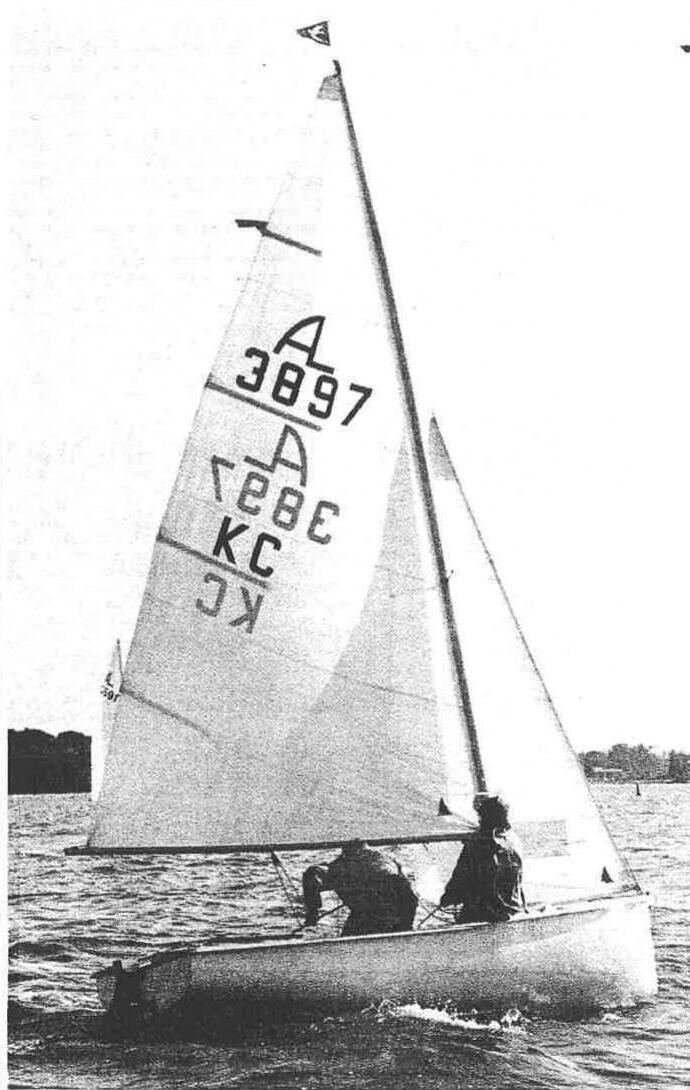
Clifford and Barbara Parker in 1974 Canadian’s. Photo by Wilkinson Studios, published in 1974 Shackles and Cringles.
In this issue: Worlds ’99 (page 4) · North American’s (page 10) · Canadian’s (page 18) · AGM (page 20)
The Albacore Advantage
A One-Design Boat
- no unnecessary expense of constant upgrades in design.
A Safe Boat
- large air-filled tanks give excellent buoyancy
- hull shape gives stability on the water
- self-rescue after an unexpected puff is easy
A Light and Manageable Boat
- tongue load of less than 100 lbs gives ready trailerability
- launching and retrieving are a breeze
A Comfortable Boat
- large, open cockpit
- benches on port and starboard sides
A Performance Boat
- seriously campaigned by major sailmakers
- planes in moderate winds
- buoyant heavy-air hull shape
Ideal for Junior Clubs
- 4 to 5 juniors will fit easily
- will stand up to heavy use
A Vibrant Class Association
- well organized and vital
- recognized by the International Sailing Federation
- strong fleets through Ontario, Canada, US, Great Britain, Ireland and Bermuda
- top notch competitive sailing
- junior programs in some areas
The Canadian Albacore Association
The Canadian Albacore Association is responsible for encouraging participation in and maintaining the integrity of the Albacore class in Canada.
P.O. Box 16 660, Eglinton Ave. East, Toronto, Ont. M4G 4G1
1997/1998 Executive
| Position | Name | Address | Contact |
|---|---|---|---|
| Commodore | Gord Chu | 38 Queensdale Avenue Toronto, ON M4J 1X9 | Res.: 416 465 5558 Bus.: 416 972 7336 Fax: 416 972 5515 [email protected] |
| Past Commodore | Bob Stiff | 20 Southlea Avenue Toronto, ON M4G 3L9 | Res.: 416 423 3294 Bus.: 416 482 5002 [email protected] |
| First Vice Commodore | Laurie Harrison | 24 Noble Street Toronto, ON M6K 2C8 | Res.: 416 536 7025 Bus.: 416 946 3139 Fax: 416 536 8196 [email protected] |
| Second Vice Commodore | Mike Leishman | 94 Harris Avenue Toronto, ON M4C 1P6 | Res.: 416 699 8100 Bus.: 416 494 3343 Fax: 416 368 0956 [email protected] |
| Third Vice Commodore | |||
| Rear Commodore | |||
| Specifications Chair | David Weaver | 14 Lansdowne Road North Cambridge, ON N1S 2S8 | Res.: 519 623 4402 Bus.: 905 525 9140 x24907 Fax: 905 572 7944 [email protected] |
| Chief Measurer | Rick Clayton | 362 Brookdale Avenue Toronto, ON M5M 1P8 | Res.: 416 783 9194 Bus.: 905 670 8700 |
| Treasurer | Heather MacNaughton | 83 Lillian Street, Unit #1 Toronto, ON M4S 2H7 | Res.: 416 481 8503 Bus.: 616 982 2120 Fax: 416 944 5891 [email protected] |
| Secretary | Raines Koby | 5 Cosdale Avenue Palgrave, ON L0N 1P0 | Res.: 905 880 1866 Bus.: 905 264 6123 Fax: 905 264 2944 |
| Shackles Editor | Uwe Ackermann | Dept Physiology, University of Toronto Toronto, ON M5S 1A8 | Res.: 416 686 1426 Bus.: 416 978 4017 Fax: 416 978 4940 [email protected] |
| Membership | Peter Nurse | 76 Normandy Blvd Toronto, ON M4L 3K3 | Res.: 416 698 5726 Bus.: 416 396 6736 [email protected] |
| IAA Representatives | Rosemary Helmer, IAA Secretary Ian Rogers, IAA Treasurer | 264 St. Clair Ave. West Toronto, ON M4V 1R7 155 University Ave., Suite 1600 Toronto, ON M5H 3B6 | Res: 416 964 8427 Bus: 416 410 4644 Fax: 416 961 4644 [email protected] Res: 416 485 5136 Bus: 416 361 0626 Fax: 416 361 6303 |
| IAA Chief of Specifications | David Weaver |
Shackles and Cringles is a quarterly publication of the Canadian Albacore Association. Deadlines for publication are January 15, April 15, July 15 and October 15.
Commodore’s Corner
It has been a terrific summer for sailing so far! I hope that you have had as much chance to sail your boat as I have had.
The Albacore North American Championships in July at the Westwood Sailing Club were a great success. Seven boats made the trip up from the US and there was a great turn-out of 51 boats for the two-day affair. Congratulations to Barney Harris and David Byron for their outstanding performance. See the attached story for all the details.
The Canadian Championships are coming up Sept 11–13, hosted by RCYC. It should be a well-run event and I hope that many of you will come out. Don’t forget that the Annual General Meeting will be held after the Saturday dinner. Please have a look at the Notice for the AGM. If you going to be acting as proxy for another member who cannot attend, please be sure to fill out the Proxy Form. Originally allocated 2 qualification spots to the 1999 world’s in the US were allocated to the 1998 Canadian Championships. This has been increased to 10 spots.
For those of you on the albacore-list “chat” group, there has been a lively discussion recently regarding the world championships. There are questions as to whether or not there should be limits on number of boats; whether or not there should be a qualification process; and whether there should be a single fleet or a division into A and B fleets. (If you want to get in on the fun, email to [email protected] and request addition to the albacore-list.)
In recent years, there has been limit to the number of boats which may attend. Typically this has been 60 boats and 20 spaces were allocated each to the CAA, USAA and NAA. Given that there have been limits, then there was a qualification process to determine who the 20 will be, as opposed to a first-come basis. Recent reality has been that one or more of the associations may not fill all their spots. Once this has been communicated to the organizing committee, then extra spots are made available to the other associations.
Qualification process in the past has usually required that an individual must finish in the top half of a regatta. This requirement is based on the premise that the world’s is a serious event and that unqualified should not be invited. It has been suggested that this can be alleviated by having A and B fleets similar to the way we do the Canadian Championships. Despite the process just describe, rarely has a Canadian member who wanted to go to the world’s not been able to do so.
With regards to the 1999 world’s in the US, the USAA has not indicated for certain whether or not there will be an allocation of spots to the CAA. An unofficial word is that CAA will initially be allocated 20 spots. Given then that there will likely be a limit to the number of Canadian spots (barring additional spots opening up), then the CAA will continue with the qualification process.
Gordon Chu
Web Sites of Interest
- Canadian Albacore association: www.albacore.ca
- Ontario Sailing Association: www.sailon.org
- Environment Canada Weather Forecasts: weather.ec.gc.ca
Albacore Worlds: An Open Event?
I have always strongly felt that the Albacore Worlds should be an open event. Anyone with an Albacore, a pulse, a measurement certificate, and current membership in any national Albacore class association should be able to attend, participate, learn, and contribute. My philosophy is that you do not improve so that you can go to a Nationals or Worlds; you go to the championship events to get good in the first place! I have participated in every Albacore World Championship since 1985. EVERY time I return home with a bunch of new friends, a better sailor, and wishing it would never end. It is incomprehensible to me that the CAA, NAA, IAA, or USAA should conspire to systematically prevent any Albacore sailor from having this experience.
I believe that the only requirements for entry into the Albacore Worlds should be a pulse, a legal boat, and current membership in any national Albacore Assn. I believe that the era of participation limits and the resulting qualification process has passsed; there is simply no real need to restrict the size of this event. On the contrary, I believe that allotting limited slots to countries acts to reduce participation, and should be stopped.
The Albacore class needs to carefully reexamine exactly what rationale supports the current practice of forcing Albacore sailors to qualify for their own World Championship. Why do we do it the way we do? Should the Albacore Worlds be an Open Event? I have always wondered what the advantages of having to qualify for an event are. How does it benefit the class and the membership? Will it increase participation? How will having to “qualify” for worlds strengthen the Albacore class? Should we have an A and B division for Worlds? I posed these questions to Albacore people on the E-mail list and have collected responses which are repeated here with only minor editing for clarity. My intent is to incite a much needed, vigorous open debate on this topic.
I hope to see EVERY ONE OF YOU at Albacore Worlds in Rehoboth in 1999!
Barney Harris, Albacore USA 8011 “TEAM SPOT”
[email protected]
E-mail responses:
The success of a class depends on numbers of active participants and the quality of racing.
The Albacore has succeeded by letting all participate but creating different levels, A and B division. Unless you are an Olympic class, I don’t think it is smart to exclude people. If you run into space constraints, then for the sake of managing an event, there need to be qualifiers. Options in this area include the obvious of performance, but can include active participation or a lottery system.
Regards, Riaz
[Riaz Latifullah is a four time US National Champion and past USAA President]
All boats allowed, using the upcoming nationals a/b fleet process
Saskia Mooney
[Saskia currently crews for Daphne Byron, edits the Potomac River Albacore Fleet Newsletter, and will be buying her own Albacore in 1999]
I participated in the 1995 Worlds in Kingston, On. I qualified via a local regatta (Ottawa) from the previous year, but I was only given the final OK at the last minute. It is amazing the experience you get from such a high caliber regatta, so I think it should be opened to all.
Mark Audet
[Mark hails from RA centre sail club in Ottawa, and drives Albacore 7034]
No qualifying; everybody who shows, sails. Encourage a lot of boats to come. Give B fleet trophies to winners in self-selected B Fleet (with race committee doing some including in B fleet if necessary). Split the fleet into gold and silver only if over 65 boats show up. Plus or minus 45 gold, 20 silver, or adjusted to take into account a combination of the following criteria: self-selection, previous racing results, and (perhaps) 1st or 2nd day scores. Give a lot of discretion to a competent race management committee to make the calls. Thanks for asking.
Lloyd Leonard
USA 7377
I am all for open invitation to everyone with a pulse and a measurement certificate. If you are afraid of people not knowing enough rules, the proof of participation in club regattas should be enough. Regattas in general should be an excuse for gathering as much competition as possible. The more the merrier. Qualifications requirements will put off many sailors who are too busy to attend the qualifiers. And I bet many of those used to be good and keen but later put racing on the back burner due to other matters in life. We should encourage participation to grow the class. Under the circumstances, I don’t think it helps to tell people not to race in the Worlds because they are not good enough. I think there should be only one fleet in the Worlds. Having 2 fleets is a bit like measuring with 2 scales. It also makes things more complicated. I have enough on my hands without having to sort out who to beat and who not to bother.
Tin Htoo
Qualification for worlds was always nominally required because of the 20 slots given to each country initially. That there have been no real problems with potential sailors being rejected is due to the fact that not all three countries send all of their best 20 sailors to the worlds. As much as I like the new-world style of unlimited access to anything you like to do (a great plus compared to Europe), I think that the nominal qualification requirement (e.g., finish in the top 50% of your country) keeps the spirit high and may entice some crews to put a little bit more effort in their sailing. A B-fleet would help to keep everyone involved. All sailors below the 50% level automatically qualify for B-fleet as well as the ones between the 50% point and the top 20 who participate. A minimum number of USAA regattas sailed (2 or 3) should also be considered.
Is this too strict? How can it be assured that there is a viable B-fleet start? The Nationals elimination competition may not be the ideal format.
Rolf Zeisler, USA 7378
In regards to the qualifying for Albacore “Worlds” would greatly depend on which country was hosting, and fleet size. If you are worried about having too many people on one line you could set up a provision that with ANY single class event, like US Nationals, NA’s, Mid Atlantics, you can split the fleet based on the first couple races. The is the solution that the many other classes use to split the fleet. With regards to qualifying for an event, you could just make an allocation that a person sail a certain number of events on their home waters (with some exceptions to those who are very far from a regular ‘fleet”), or you can leave the event “open” and allow the pulses with measurement certificates, and then worry about splitting the fleet up if you get too many people. I would tend to disagree with a starting split at the “the worlds” which would tend to get people who could do well in A fleet but were certain they could WIN in B fleet.
I know that I have been away from committed sailing to the Albacore class for a while, and I hope to change this arrangement, but I hope that my opinions are still valid, and this is because I will always credit the class for getting me interested in racing, and fostering my fairly successful development.
Chris Bagemihl [Chris is Sailing Director at American Yacht Club in Rye, NY, and former crew of USA 7305 & 7499]
I think that anyone should be able to sail in the Albacore Worlds (or whatever you want to call it), but definitely not in the championship fleet. The pitiful level of knowledge of the rules (or lack of willingness to comply) on the part of many “novice” sailors and the devastating impact this can have on an innocent boat is more than enough to convince me that only properly qualified sailors should be allowed to compete in an international championship worthy of the title. I speak from much experience in different classes and very large fleets (the worst cases I can remember are the 1974 505 North Americans with 105 unruly boats on the starting line, and some early “Canadians” when we had well over 100 boats).
Starting line barging and mark rounding collisions and failure to give room, loom large as infractions which are all too common. Duffers must not be allowed to spoil the competition of serious contenders for championships.
Dave Weaver [Dave is current Specifications Chair for the CAA]
I don’t see having A and B Fleets. It’s hard enough to get 60 boats to show up. I did run a North Americans and World Championship Week because we had all the racers in one spot and had allocated a week to the events.
The US has never had qualifying because we rarely used all the slots available to us. There was a strong feeling that the fleet should be capped at 60 divided 25 to the host in N.A., 20 to the other country and 15 overseas. If the North American allocation was used up and more than 15 boats came from elsewhere then the 60 could be expanded. I think we had 61 boats once in Kingston.
Dave Wallerstein USA [Dave is a past president of USAA]
I think the fleet should be anyone with a boat, measurement certificate, and a pulse!!!!!
What a problem it would be to have too many boats!! Potentially, we could have A and B fleets if there was a desire or if there were just tons of boats there. The beauty is that the Brits and the Canadians are used to sailing in big fleets. I guess we have to decide how the Americans feel about it. Above all, the most important thing is to make it a fun competitive event - not a bunch of way uptight people micro managing measurement etc.
Matt Edwards USA 6701 [Matt is a past president of USAA]
I think that defining a qualifying regatta or series of regattas would be difficult—for example, would you deny entry to someone who has sailed in 30 years worth of worlds just because the did poorly in one regatta, or for some reason couldn’t make that regatta? also, who would define the regattas? the Washington fleet? or the Canadians? However, I do think it is appropriate to not let just anyone with a boat come… that is difficult to administer— we really don’t want a raw beginner coming, for example but again given the participation over the last several worlds in the US that this has not been a problem.
John Lawser USA 7355 [John is a past president of USAA]
Under previous world’s rules, there were limits to the number of boats that may participate. If there are more people wanting to go than there are spots, then a qualification process is a necessity. However, even if there was no issue with the number of participants, I think that a qualification process beginning the year prior to the world’s is a positive thing. I say this not because we would want to prohibit anyone from going, but rather to make it a more meaningful experience for those who are going.
As an analogy, think of a social or training event organized by any sort of volunteer organization. If you make it free and do not ask for any commitment from people to show up, it is not uncommon for the organizers to be disappointed by the turn-out. However, if you had drummed up some excitement, set a fee and gotten people to buy a ticket, then you can expect higher degree to motivation on people to show up.
By a qualification process, people are buying into participating. Also, the fact that membership is limited can increase the meaning and value of going to the world’s. (I’m talking about the teenage clique’s and marketing strategy here.) The qualification process will validate the world’s as a valuable thing. For those at the front of the fleet, qualification and going to the world’s if they want to is not an issue. However, for a middle-of-the-fleeter, the qualification process becomes a goal, and they will attain great satisfaction from attaining it.
I believe that a qualification process does in fact generate excitement for the upcoming event as the fleet checks out after each event to see who has qualified. A qualification process can also result in greater participation. I can recall one instance in 1995 when someone from Toronto went to an out-of-town regatta in order to win a spot. This person would not have gone to this event if there was no need to qualify.
Barney, I also agree that to deny somebody the opportunity to go is not a good thing. This depends of course on whether there are any limits to how many boats from a country may participate, and I guess for 1999 this is up to the USAA (and IAA?) to decide. Under a qualification process, not everybody who qualifies will end up going, and any unallocated spots will be allocated to those who do want to go. If there are more people wanting to go than open spots, then some sort of merit process must decide. If however, there are no limits on participation by the world’s organizer, then effectively a qualification process is invalid. However, this does not necessarily mean that it has no meaning or value. If managed correctly, the benefits of the qualifying process may still be achieved at the same time not denying anybody from participating.
Gordon Chu CAN 7954 [Gordon is current CAA Commodore]
My take is that we should let our objectives be our guide. If we want to use the lure of worlds to increase participation in our fleets and have everyone strive to becoming better, we should not make it seem out of reach to the mortal sailors (like me). If on the other hand we want to increase cache we can heap on the restrictions and the three of you can slug it out.
Middle ground might be to let the optimum size of a great race (others with more experience may know what this # is) dictate the max. size and if necessary do things like entry requirements and A and B fleets only in order to have the best race possible. Even the idea of A and B fleets leaves me a little cold. I like to buy a dollar lottery ticket, gamble $10 when/if I ever go to RENO, and sail with the greats in our fleet and hopefully the world. I may not beat them, but on a good day with a very favorable wind shift, I might be able to read the name on their transoms and that keeps me coming back. Its sort of like playing tennis. Most of us would rather play with a better player. Besides, it is very infrequently that a slow sailor messes up a good one, they are just too far ahead. So, maybe a better question is how do we assure that we get the biggest representative sample of good sailors from around the world to Worlds. I would think # of boats expected (and of course the large prize) would be more effective than restrictions. Nothing would be worse than not to have the results mean anything, except having to cancel for lack of attendance.
Bill Kleysteuber [Bill is current Albacore Fleet #10 Lieutenant]
I believe we should not have to qualify for the World’s for the following reasons:
- last few World’s full quota has not been reached;
- I would like to plan my summer and my time off from work. I certainly do not want to wait till next Sept. to see if I qualify;
- I want to plan practicing with my crew as early as possible;
- We should have the option to “talk it up” at the Community Clubs in Toronto - especially if it is in an accessible place like Rehobeth;
- Overall, I want to decide the Albacore regattas I go in - I do not want to be waiting to qualify for something I may not even be able to attend (although have qualified in the past).
If open to anyone, there may be concern there will be inexperienced sailors on the start line. However, the A and B fleet idea should alleviate this concern. Perhaps skippers should have to qualify for A fleet but not B fleet. Another idea would be to allow anyone who has qualified in the past to go into A fleet. I do not believe we will have a problem with too many boats - it would be a great problem for the Albacore fleet to have!
Heather Macnaughton CAN 7944 [Heather is current CAA Treasurer]
Should people have to qualify for the 1999 Albacore world championships?
Short answer: NO.
Should the next Albacore Worlds have A and B fleets as we now do with US Nationals? Having sailed A/B qualified regattas before, I personally have mixed feelings. For example, I sailed the Blue Jay Nationals in 1987 (? I was 12 or 13) and they had A and B fleets. The first day was supposed to be 2 qualifier races to split the fleets. Unfortunately, the wind died completely, and so only one race was completed in drifter conditions. The RC decided to split the fleets based on that race alone, despite the fact that everyone knew that the finishes weren’t representative of skill level. (EVERYONE can have a bad race in a drifter…c.f. 1997 AL Nationals). The upside was that it was very easy for me to win the B fleet. The point is that sure, you can get a fair A/B split. But it’s also relatively easy for conditions to conspire to put people in the “wrong” fleet, in which case, why spilt them to begin with?
Nathan D. Marsh USA 6896
As to the question of whether or not we should have A and B fleets in the worlds: If it increases the size of the fleet then I say that it should be a resounding YES. The world championship experience is something that should be accessible to a broader range of Albacore sailors. It will certainly peak interest in the class, don’t you think? In Toronto, the Albacore class is quickly turning into a club-class, with very little interest by private individuals in purchasing new boats for the purposes of racing. Besides, in Toronto, on Fridays, we usually get 60 or more boats, so having a larger fleet at the worlds would be a welcome sight. What should be the maximum number of boats at the worlds? 30? 50? 60? There used to be 80+ Albacores at the Canadian Championships years ago. That’s a great starting line, if you ask me. Probably hell for the race committee, though. Should we have to qualify for the worlds? It would make sense, but the class is too small, and qualification would certainly diminish the numbers. Who wants to have a “worlds” with 25 boats? To me that’s not a very good racing experience.
Henry Pedro CAN 7888
There’s nothing un-managaeable about a 65 boat fleet. In fact, it would make a very interesting worlds. Splitting it into A and B (or Gold and Silver) is a nice idea, though. We see 60+ boats for most Friday races in Toronto Harbour.
Henry
Barney, I think Heather’s suggestion has some merit. In many of the really large classes (Lasers, J-24’s etc.) they will have sail-offs two days before the start to select silver and gold fleets. The gold fleet then competes for the worlds, but a complete set of awards is given in the silver fleet. This format allows everyone to go, but keeps the fleets to manageable sizes.
Barn;
At SSA we’ve started fleets well over 100 boats (J-24’s, Lasers, Optimists) or 60 to 80 boat fleets (Snipes, J-24’s, Lasers) without any major trouble. The keys are a square line and plenty of room. On several occasions we’ve used a midline boat. This is usually a small rigid inflatable which sets itself on the line at the 5 minute gun with two people with radios and the authority to call boats over. I have been involved with these efforts as a competitor, on the midline boat, and on the committee or pin boats and it’s totally doable as long as the timing is coordinated and the individuals on the committee boats know what they’re doing. Setting a line quickly and accurately or anchoring a RIB exactly on a starting line isn’t as easy as it looks. The committee boathandling skills and overall on-water organization needs to be much, much higher than with smaller fleets if it’s going to come off.
Feel free to pass this along to the albacore list if you think anybody’s interested.
Rick Harris (Barney’s brother)
Barney Harris replied:
Thanks for your thoughts. I remember Herne Bay - it howled…. I sailed with my younger brother Rick - we weighed in at 295 lbs total. At one point we capsized three times on one top reach….
The class’ experience at Herne Bay, site of 1985 Albacore UK Nationals, in which over 100 boats were started at one time, shows that the size of the fleet at Albacore Worlds need not be limited for reasons of fleet managability during starts. Gate starts can be used (in steady breeze) to reliably get starts off without recalls. Line starts will work with the correct conditions, i.e. current not pushing boats over the line and no clearly favorable side of the course. Good race committee work is critical with larger fleets. As evidenced by the most recent North Americans, even a “small” fleet of 51 boats will reliably “jump the gun” when the starting line is not properly set, forcing recall after recall.
I believe that denying entry to any paying class member is wrong. There is just no plausible reason to do it. I say invite everyone - help the less experienced improve, provide great competition for the experts, make new friends, and have a great week long party for all to enjoy.
Best to all,
Barney Harris, USA 8011 “The Ethnic Cleanser”
At the recent UK National Champs Jonathon Weeks was trying to find out who would go to the Worlds in 99, should he be looking for a restricted group of people?
I DON’T THINK SO.
The last BIG fleet of Albacores that I recal was in 1985 Herne Bay (UK Nationals) which was then split 60 Worlds Fleet, rest Presidents Fleet. Do you think you are likely to have this kind of problem?
I DON’T THINK SO.
But if you did would it not be a great problem.
As for the Name and who give you permission well that’s for the organisers to twist somearms!
Best of luck with your Champs
Derek Gibbon Past Chairman UK NAA (and for those of you who care…still alive and sailing) and still Scottish Rep
In an earlier e-mail I said that the 85 Worlds split was at 60 boats, what I failed to say was that the UK Nationals was 103 boats, I think over 6 races, two a day, followed by the 60 Worlds & 43 Presidents fleet. The request for the split came from the USA/Canadian Assoc. However the fact that Worlds and Nationals held in the UK use Gate Starts makes this very much easier. However, I am sure that a well behaved fleet of 103 Albacores could get line starts off without the use of Black Flags and General recalls. (MAYBE NOT!) I hasten to add that even Gate Starts need the occasional General Recall.
Derek Gibbon. 6852 “Blue Magic”
Tarts
| Position | Helm/Crew | 1 | 2 | 3 | 4 | 5 | Total |
|---|---|---|---|---|---|---|---|
| 1 | Dave Harris, Kevin Smith | 4 | 1 | 2 | 1 | 2 | 5.5 |
| 2 | Ken Clarke, Dee Patterson | 5 | 2 | 1 | 6 | 1 | 8.5 |
| 3 | Gary Bain, Pat Malby | 1 | 8 | 4 | 2 | 5 | 11.75 |
| 4 | M. Morrison, ? | 3 | 3 | 5 | 8 | 3 | 14.00 |
| 5 | T. Johnstone, ? | 6 | 4 | 6 | 3 | 10 | 19.00 |
| 6 | D. Wettlaufer, ? | 7 | 7 | 7 | 11 | 4 | 25 |
| 7 | B. Farrell, ? | 9 | 9 | 3 | 4 | 9 | 25 |
| 8 | R. Helmer, George Roth | 2 | 11 | 10 | 9 | 8 | 29 |
| 9 | Ian Rogers, Trish Bongard-Godfrey | 10 | 10 | 8 | 5 | 6 | 29 |
| 10 | Marty Cameron, ? | 8 | 6 | 11 | 10 | 7 | 31 |
| 11 | Ian Aukema, ? | 11 | 5 | 9 | 7 | 11 | 32 |
And so Dave and Kevin are the first team to qualify for the Worlds’
OHCC Regatta — Toronto, July 11
| Helm/Crew | Race 1 | Race 2 | Race 3 | Race 4 | Total Points | Final Finish |
|---|---|---|---|---|---|---|
| Stiff/Stiff | 20 | 7 | 20 | 20 | 47 | 20 |
| Browne/Browne | 12 | 15 | 16 | 11 | 38 | 13 |
| Harris/Smith | 0.75 | 4 | 9 | 4 | 8.75 | 2 |
| Brayshaw/Brawshaw | 24 | 14 | 18 | 10 | 42 | 16 |
| Thomas/Smythe | 21 | 26 | 26 | 27 | 73 | 27 |
| Roth/Rutherford | 11 | 24 | 23 | 6 | 40 | 14 |
| King/Ter Brugge | 18 | 17 | 10 | 23 | 45 | 19 |
| Cameron/Mullin | 26 | 21 | 12 | 17 | 50 | 21 |
| Ackermann/Duff | 14 | 11 | 27 | 18 | 43 | 17 |
| Johnstone/Helling | 8 | 18 | 15 | 3 | 26 | 9 |
| Monged/Greaves | 29 | 29 | 28 | 29 | 86 | 29 |
| Revill/Birse | 28 | 28 | 21 | 16 | 65 | 25 |
| Withrow/Swatlowski | 13 | 16 | 13 | 2 | 28 | 11 |
| Broughton/Marshall | 5 | 2 | 7 | 8 | 14 | 6 |
| Clarke/Palmer | 9 | 0.75 | 3 | 0.75 | 4.5 | 1 |
| Neumann/Silverberg | 25 | 25 | 22 | 21 | 68 | 26 |
| Sinclair/Kramer | 30 | 30 | 29 | 30 | 89 | 30 |
| Marin/Mehta | 22 | 20 | 8 | 13 | 41 | 15 |
| Arneson/Tate | 27 | 23 | 25 | 28 | 75 | 28 |
| Chu/Mehling | 7 | 12 | 31 | 24 | 43 | 18 |
| Carey/Sherlock | 23 | 22 | 14 | 26 | 59 | 23 |
| Humphreys/MacInnes | 6 | 9 | 0.75 | 7 | 13.75 | 5 |
| Rubin/Jubs | 17 | 10 | 5 | 12 | 27 | 10 |
| Wilson/Edmonstone | 19 | 19 | 24 | 25 | 62 | 24 |
| Gilcrest/Goode | 4 | 5 | 2 | 9 | 11 | 4 |
| Cawthorne/Grummitt | 10 | 8 | 6 | 19 | 24 | 8 |
| Morrison/Smith | 3 | 13 | 11 | 5 | 19 | 7 |
| Abbaszadeh/Steacy | 16 | 27 | 19 | 22 | 57 | 22 |
| Nurse/Kline | 15 | 6 | 17 | 14 | 35 | 12 |
| Smith/Quinton | 2 | 3 | 4 | 15 | 9 | 3 |
1998 North American’s
July 4–5, Westwood Sailing Club, Toronto, Canada
59 boats, light to moderate winds
In an incredible display of mastery, US Champion Barney Harris with David Byron sailed a perfect series of five first place finishes to win their first North American Albacore title. In a tight contest, host Canadians David Harris and Ross King finished second besting Ken Clarke with crew, Kate Mullen. Finishing 18th, Joanna Byron and Gretchen Wilkinson were the next highest placing American team.
Harris and Byron dominated the 59 boat fleet with perfect starts, first leg strategy and good boat speed. “Barney and David basically had each race won within the first two minutes of the race,” according to Gordon Chu, who finished in 5th place. “They were correct in figuring out the favoured end of the line and the favoured side of the course. With this they could figure out the strategy for the start and the first tack. After this it was simply a matter of superior boatspeed, handling and conservative tactics.”
Harris, who lead each race from the second tack off the line, agreed that the start was his top priority. “In such a large fleet getting off the line cleanly is absolutely critical. With so many good sailors, starting at the pin or boat is a much higher stakes game. It is more important to be in clear air and moving than all the way to the correct end. We opted to go for THE start in all races. To do this we would not commit to a spot on the line until the last minute; we would search the line for a nice gap and sail into it with 20 or 30 seconds left - fortunately for us, the starts in which we ended up in the third row were recalled!”
Harris and Byron were ruthless in their execution of their starting strategy. They fought for and won the perfect start in each race. Canadian Albacore Commodore, Chu commented, “This was made easier for them since I don’t believe anybody much put up a serious fight for this start.” “Perhaps,” speculated Commodore Chu with tongue in cheek, “this because of the Canadian character to be conservative and to not cause a scene.” We’ll be sure to look for that conservative Canadian character at the “Starboard” in Rehoboth this fall.
Recalling the start in the last race, Chu described Harris and Byron’s tactics. “The windward (starboard) end was significantly favored. A number of boats had set up a minute before the start and were patiently luffing. One boat was right at the mark, but had drifted slightly down the line. There was another boat on the layline but Two boat lengths from the line. Less than 30 seconds before the start, Barney comes charging in on port tack between these two boats, tacks onto starboard (with David pushing the boom out at the same time to stop their forward momentum) and fits himself into this tiny but perfect spot between these two boats. This was quite a display of bravado and boat handling.”
Team work is critical to achieve such starts, and Harris gives David Byron much of the credit for his success. “He has a complete comprehension of upwind tactics and strategy in a shifting breeze; the sensitivity to know when the boat is going fast, when it is not, and what to do to fix it; the composure and intelligence to think out what the best next move should be amidst a din of extraneous disturbances. Of course his boat handling is great - he drags the boat and me around the course the whole time!”
In the battle for second place Ken Clarke and Kate Mullen put together a series of three seconds and a third, but their 16th place in the third race allowed Dave Harris and Ross King to beat them by seven points in the shortened series that did not allow for a throw-out.
Of the seven other American teams, who traveled to the regatta, Joanna Byron and Gretchen Wilkinson edged Daphne Byron with Saskia Mooney who finished 20th. Lucian Casper teamed with Fabian Pease were 27th while Lars Rathjen and Janice Stapulonis finished 31st. Peter Duncan with Keith Sigg on board, managed a 7th in one race, but were otherwise relegated to below the middle of the fleet. “In the one race we did well, Peter said, “we had speed to keep up with the leaders, but this regatta was all about the start. We got pounded in 4 of 5 starts and from there it is very difficult to catch up.”
Starting in 60 boat fleets takes a whole different strategy and mind set than in a 40 boat race. Achieving consistent finishes was very difficult in the large competitive fleet where positions could shift dramatically as 10–20 boats simultaneously rounded many of the marks. It is clear that the Americans need to visit Toronto more often to sharpen these skills before Worlds next year. Commenting on the increased competition, Harris said, “the participation and numbers have been on the upswing in the Albacore class for some time now. We are seeing greater participation in our local fleet with 21 new members this year - as well as the fleets in Canada. This does not surprise me, the Albacore is a great one design dingy; the sailing of which is only bettered by the parties after.”
And the parties were phenomenal. The Toronto sailors really made the event fun for all of the visiting Americans. They housed us all in their homes. On Friday there was a warm up for the main event with an evening race followed by dinner and drinks at a local pub for 120 of your favorite sailing friends. All participants were recognized with a roll call from last to first as special prizes were given out over the cheers of the crowd. Saturday after the racing Westwood Sailing Club cooked up a superb stir-fry dinner and barbecue. Dinner was followed by a band with dancing on the deck in the glow of the mid-summer sunset and the stars after midnight. A mere eight hours later St. Jamestown SC was hosting a breakfast before the Sunday races.
By Sunday afternoon a tired, but happy crowd applauded Barney and David on a truly outstanding regatta and turned our attention to packing up the boats for the trip home. Barney’s heroics didn’t end on the race course. He carried four Albacores back to Washington on the roof of Spot and his new TRIPLE deck trailer. If he ever loses his day job, I’m sure he as a career as a transport specialist. For all who have not been to a regatta in Toronto, clear your calendars and make plans to go soon…a great sailing, good company, and a fun time is guaranteed.
Peter Duncan
Portions of this article will appear in an upcoming issue of Sailing World
| Skipper | Crew | Boat # | Place | Points | NA#1 | NA#2 | NA#3 | NA#4 | NA#5 | |
|---|---|---|---|---|---|---|---|---|---|---|
| Barney Harris | David Byron | US | 8011 | 1 | 3.75 | 0.75 | 0.75 | 0.75 | 0.75 | 0.75 |
| Dave Harris | Ross King | CAN | 7166 | 2 | 18 | 3 | 2 | 3 | 3 | 7 |
| Ken Clarke | Kate Mullen | CAN | 7630 | 3 | 25 | 2 | 3 | 16 | 2 | 2 |
| Tim Broughton | Karen Marshall | CAN | 7563 | 4 | 45 | 7 | 6 | 4 | 10 | 18 |
| Gordon Chu | Christine Mehling | CAN | 7954 | 5 | 52 | 12 | 17 | 6 | 4 | 13 |
| Paul Gerlich | Sherry Mehta | CAN | 8014 | 6 | 60 | 11 | 7 | 5 | 21 | 16 |
| John Cawthorne | Jackie Grummitt | CAN | 8018 | 7 | 66 | 4 | 16 | 21 | 5 | 20 |
| Marek Balinski | Nora Hoffer | CAN | 8017 | 8 | 75 | 8 | 4 | 9 | 12 | 42 |
| Uwe Ackermann | Janet Duff | CAN | 7474 | 9 | 82 | 25 | 19 | 17 | 18 | 3 |
| John Turnbull | Melody Byblow | CAN | 8019 | 10 | 83 | 32 | 13 | 8 | 9 | 21 |
| George Roth | Becky Mattes | CAN | 7400 | 11 | 84 | 19 | 9 | 41 | 11 | 4 |
| H. MacNaughton | Rory Ring | CAN | 7944 | 12 | 84 | 14 | 11 | 14 | 26 | 19 |
| John H. Gilchrist | Heather Gilchrist | CAN | 7527 | 13 | 86 | 6 | 23 | 32 | 14 | 11 |
| Norm Rubin | Nona Arneson | CAN | 8012 | 14 | 87 | 5 | 18 | 52 | 7 | 5 |
| Ed Nicholas | Sue Forgues | CAN | 5858 | 15 | 87 | 20 | 8 | 24 | 27 | 8 |
| Ann Savege | Laurie Harrison | CAN | 7472 | 16 | 87 | 13 | 25 | 10 | 30 | 9 |
| Elizabeth Marin | Kristen Huelsmann | CAN | 7942 | 17 | 90 | 22 | 29 | 19 | 6 | 14 |
| Joanna Byron | Gretchen Wilkinson | US | 7499 | 18 | 98 | 18 | 14 | 28 | 23 | 15 |
| Fred Koehlmann | Kathryn Koehlmann | CAN | 8009 | 19 | 99 | 10 | 10 | 29 | 28 | 22 |
| Daphne Byron | Saskia Mooney | US | 7380 | 20 | 107 | 24 | 21 | 13 | 22 | 27 |
| Ted Mallett | Abby MacInnes | CAN | 5007 | 21 | 110 | 17 | 12 | 23 | 34 | 24 |
| Todd Johnstone | Teresa Miolla | CAN | 7479 | 22 | 110 | 15 | 35 | 18 | 16 | 26 |
| Rick Clayton | Lynn Shannon | CAN | 7955 | 23 | 111 | 38 | 27 | 12 | 24 | 10 |
| Bruce Nash | Mary A Edmonstone | CAN | 7933 | 24 | 112 | 16 | 28 | 11 | 19 | 38 |
| Malcom Higgins | Fran Steacy | CAN | 7971 | 25 | 120 | 9 | 5 | 2 | 52 | 52 |
| Peter Duncan | Keith Sigg | US | 342 | 26 | 122 | 35 | 30 | 7 | 20 | 30 |
| Lucien Caspar | Fabian Pease | US | 7131 | 27 | 129 | 43 | 31 | 20 | 29 | 6 |
| Ron Walker | Michael Sinclair | CAN | 8022 | 28 | 139 | 41 | 22 | 22 | 15 | 39 |
| Marty Cameron | Carol Burrows | CAN | 7562 | 29 | 139 | 30 | 26 | 35 | 25 | 23 |
| Derek Shenstone | Brent Whiteley | CAN | 7249 | 30 | 149 | 36 | 15 | 27 | 35 | 36 |
| Lars Rathjen | Janice Stapulonis | CAN | 7492 | 31 | 160 | 37 | 40 | 38 | 13 | 32 |
| Jill Carey | Diane Sherlock | CAN | 7972 | 32 | 163 | 52 | 38 | 25 | 17 | 31 |
| Mary Neumann | John McGuinnes | CAN | 7969 | 33 | 164 | 28 | 37 | 26 | 33 | 40 |
| Gary Drinkill | Tom Elliot | CAN | 7974 | 34 | 165 | 45 | 41 | 31 | 36 | 12 |
| Peter Nurse | Larry Rogers | CAN | 7970 | 35 | 166 | 21 | 32 | 39 | 31 | 43 |
| Chris Hanson | Christine Short | CAN | 7957 | 36 | 166 | 23 | 36 | 30 | 40 | 37 |
| Steve Goode | Sanju Mehta | CAN | 7750 | 37 | 167 | 46 | 48 | 37 | 8 | 28 |
| Steven Bretherton | Steven Quick | CAN | 7250 | 38 | 176 | 49 | 39 | 15 | 38 | 35 |
| Chris Beneteau | Liz Murphy | CAN | 7887 | 39 | 184 | 40 | 34 | 49 | 32 | 29 |
| Bob Logue | Carmen Aradi | CAN | 7471 | 40 | 187 | 31 | 20 | 42 | 46 | 48 |
| Jim MacDonald | Rob Murray | CAN | 8015 | 41 | 189 | 42 | 43 | 34 | 37 | 33 |
| Van Sheppard | Christena Sheppard | CAN | 7978 | 42 | 193 | 50 | 49 | 33 | 44 | 17 |
| Barbara Revill | Ken Birse | CAN | 7473 | 43 | 198 | 34 | 33 | 36 | 48 | 47 |
| Jason Roth | Pat Maltby | CAN | 6657 | 44 | 199 | 44 | 47 | 40 | 43 | 25 |
| Daniel DesJardins | Joanne Knowlton | CAN | 7959 | 45 | 200 | 29 | 24 | 43 | 52 | 52 |
| Denis T. Wettlaufer | Alan Pike | US | 5923 | 46 | 203 | 26 | 44 | 44 | 45 | 44 |
| Ken Price | Nancy Forsyth | CAN | 7958 | 47 | 206 | 33 | 46 | 45 | 41 | 41 |
| Rolf Zeisler | Susan Zeisler | US | 6883 | 48 | 208 | 47 | 42 | 46 | 39 | 34 |
| Babak Abbaszadeh | Chris Hebert | CAN | 7966 | 49 | 218 | 39 | 45 | 47 | 42 | 45 |
| Dianne Clark | Bill Collins | CAN | 8016 | 50 | 235 | 27 | 52 | 52 | 52 | 52 |
| Henry Pedro | Pam Nazar | CAN | 7888 | 51 | 239 | 48 | 50 | 48 | 47 | 46 |
History: 1. The Albacore Class
by Anon — found by Bob Stiff in the archives
This is our class’ silver anniversary. It’s 25 years since the first national championship was held on the Solent in the south of England. Since then the Albacore has grown and developed to meet the needs of a wide range of sailing and racing enthusiasts in three nations. For example, this year sail number 7000# was issued for a Canadian-built wooden boat. Obviously it’s different than the early boats but those differences reflect the concern to maintain a one-design hull that recognizes the need for gradual improvements and individuality within strict specifications.
We’ve come a long way since 1954 when various sailing clubs around Portsmouth, England were looking for an ideal boat to handle local conditions in the Solent. They wanted a great deal. This dinghy had to be modern and light. Yet it had to be suitable for family sailing and racing in the high winds and rough waves found in this area of the south coast. The group of sailors included Charles Currey of Fairey Marine, Eric Roberts of Hardway Sailing Club, Roy Windebanke, Eric Downing of Stokes Bay Sailing Club and Jack Bowers.
At that time Fairey Marines was producing the first hot-molded 12-foot long sailing dinghy known as the Firefly. Designed by the legendary Uffa Fox it was a super success. Much of this success was due to the dinghy’s construction. During the Second World War Fairey Aviation had made the plywood wings for the famous Mosquito fighter aircraft by baking them in a huge autoclave. This oversize oven was used after the war to cook the firm’s line of plywood boats. A short while later Uffa Fox designed the 15-foot Swordfish and this too proved quite popular around Britain. This boat was considered by the committee but rejected. Asked why, Jack Bowers commented that it’s “rather like a pop-tune. Some catch on. Some don’t”. Also, this was a time of do-it-yourself in Britain and the Swordfish was sold only as a completed boat. A compromise was made. The committee decided to base its new design on a Swordfish hull but put three inches more freeboard on the transom then fair the sheer through to the stem. Also the name Albacore was chosen to commemorate the Fairey Torpedo bomber aircraft. Although just as successful it was less well known than the Swordfish.
Although Fairey Marine made the majority of the early boats. some were made from kits. The first of these was built by Jack Bowers. When the class rules were being drawn up the committee often went round to his boat to decide on the width of the decks or sidetanks or other features. Jack Bower’s boat ‘Plain Jane’ - AL5 - was the first true Albacore. Its measurements formed the basis of the class’s specification until changes were made in the mid 70’s.
So, if Bower’s boat is number five where are AL1 - 4? Legend has it that two young sailors were trying to finish a couple of Swordfish themselves. They knew they would not be able to register them so when they heard of the new class they were eager to join. These boats were AL 1 and AL2. Fairey Marine built a substandard boat AL3 for use by clubs that were interested in trying the new Albacore. But the craft didn’t survive as it only had two plywood skins - the other boats had three. Finally AL4 was registered by owner Eric Roberts, but before it was completed. AL1, got a new owner a few years ago who had her completely modernized. It would have been cheaper for him to have bought two new boats. Maybe he thought it was worth it because it was among the prize winners in the ’76 Nationals. Until recently AL4 was raced regularly. It’s 17 years since AL5 winner of the first Nationals was sailed. According to her custodian and Albacore builder Don Young she’s still in good shape “although a bit dried out now.”
The class grew quickly with 30 boats registered in the first year.
At the first class championships in 1955 - over a weekend at the Stokes Bay Sailing Club - there were 28 boats. The winner was Jack Bowers. The class grew quickly in Britain where it was sailed by many clubs including sailing associations of the armed forces. This led to Albacore fleets in such places as Gibraltar and Singapore.
The introduction of the Albacore to North America and Canada dates back to 1958. A three-man committee at the Royal Canadian Yacht Club in Toronto had the task of choosing a new club training boat to replace it’s ageing fleet of cat boats. The three were Paul Henderson, Bud Whittaker and the late Bill Gooderham who did so much to help this class in its early days. After reviewing a wide range of craft in the 13 - 17 foot range the committee chose the Albacore. It was similar to the 14-foot International dinghy but had more freeboard, was slightly flatter, more stable and carried less sail.
The first 10 boats from Fairey Marine, numbers 470 to 480 arrived in 1959 at RCYC They each cost $875 f.o.b. Toronto. Many of Canada’s top sailors learned their early skills in these craft. Even now after many years of use and alterations a few of these first ten are still being sailed and raced. These first boats were wooden, of course. They had heavy steel centreboards which needed a block and tackle to raise them although the slot was subsequently widened to take a wooden board. The early boats also had stern decks, buoyancy bags throughout and heavy gunmetal fittings. The original masts were aluminum, but not with the extruded sections that we have today. Above the jumpers was a wooden tapered section which allowed some mast bend. A fixed gooseneck meant the mast had to rotate when the boom was let out. This was a standard feature on all the early Fairey Marine dinghies.
About this time many ‘cottage country’ residents in the Muskokas were looking for a family racing dinghy. So the weekends saw Bill Gooderham taking Abacores up there - two on a trailer and one on a car roof - to meet the new interest in sailing.
Many owners in Canada finished their boats themselves from kits supplied by Fairey Marine. While there was lots of interest in the Albacore, many cottagers were looking for the ease of maintenance provided by a fiberglass hull. Despite Bill Gooderham’s urging Fairey Marine was not interested in producing fiberglass hulls for the Canadian market. So, in 1961, in conjunction with Whitby Boat Works, Bill had a mould taken off a Fairey Marine wooden hull. The first Canadian produced Albacores - but in fiberglass - were sold in Ontario. However, Fairey Marine, sole holders of a licence to build, heard of this enterprise and a trans-Atlantic legal battle was launched. For a brief time, the craft built by Whitby was called an ‘Albatross’. Finally, Fairey Marine was convinced of the need for a fiberglass boat. It agreed to licence Whitby to build fiberglass Albacores for the Canadian market. That step was all that was needed to get the class moving in Canada. Sales rose dramatically. In 1963 there were more than 200 registered Albacores sailing in about 18 clubs in Southern Ontario. Bill Gooderham said he himself sold more than 85 boats in 1965. Soon the Albacore was the dominant sailing class in Ontario’s cottage country and the most popular club boat on Toronto’s busy waterfront.
At the same time George O’Day was importing Albacores into the United States. Fleets were started in such places as Hyannis Port, Massachusetts and Reno, Nevada. This growth in sales and interest in sailing, particularly racing, made it essential to have a class association. The Canadian Albacore Association was formed and in 1961 the first championship was held in Muskoka. There were 37 entries and the joint winners were Gooderham and Jack Langmaid.
Already there were ‘hot beds’ of Albacore enthusiasts. One was centred around Toronto and two others were in the Muskokas and Kawarthas.
In 1963 there were more than 200 registered Albacores sailing in about 18 clubs in Southern Ontario. Sailing was in vogue in the mid-60s and the Albacore was the right boat to have then. There’s no doubt that the early enthusiasm for the boat encouraged by a hard-working executive and membership has carried the class forward into the 70’s. It also helped to keep the class intact over the years and able to compete in popularity against numerous other classes of dinghy classes that have come and gone since then.
By the late 60s the Albacore was by far the most popular two-person sailing dinghy in Canada. Every season there were more regattas throughout southern Ontario. The standard of racing was improving rapidly too. At the end of a busy summer the Canadian championships were held in Muskoka. As the numbers grew it became difficult to find a venue that could accommodate the four fleets totalling close to 200 boats.
This active period also saw other developments. The association’s bi-monthly newsletter Shackles and Cringles was well established; a part-time secretary treasurer was hired; and the organization of fleets into districts was started. All of this work involved people giving up their time. Yet this commitment to improve the class has been perhaps its greatest strength over the years.
Grampian Boats of Whitby was the second builder in Canada. A short time later McGruer & Clark of Owen Sound was licenced to build fiberglass boats and so was Allen to build for US owners.
A review of the correspondence during this period shows that this was not an easy task for either the executive or builders. The Albacore’s layout was not designed to take advantage of fiberglass construction. Also at this time, there was only a rather basic specification based on AL5 and no official lines for the hull.
Other builders were soon to follow. Skene Boats of Ottawa was licenced in 19??# and is still building at the time of writing this. This makes him by far the most prolific builder of Albacores in the world.
In an effort to widen the class’ popularity in 1974 builders were licenced in Manitoba and British Columbia. But the numbers in these two areas is still small.
About this time 6-H of Kingston was licenced to build. More recently Halman Marine of Stoney Creek was licenced, too, although he has yet to produce a finished boat.
Perhaps one of the most important developments in the class, and one that received little publicity, occurred in 1975. After a lot of work the national association in the U.K. had finally managed to establish the proper shape of the Albacore. At long last we had the official shape of the hull and it was down full-size on paper.
Up to that time all builders in Canada had to take a mould from the hull of another boat or use a beefed-up and travel-worn wooden plug that had been built by Fairey Marine. Obviously, this was not a reliable method for a one-design class that needed new builders. In spring ’75 a measuring session of six separate boats using templates made from the lines showed that they were all within tolerances of the proper lines except one - the Allen hull. After considerable debate within the executive this builder was told that he could not build any more hulls from his current plug other than for the sail numbers he had already bought from the Association
Meanwhile work started in all three associations to get back to a standard hull shape. After nearly five years work this is showing results. In Canada the National Research Council in Ottawa, using a sophisticated computer system, took the Albacore’s lines and transferred them to a full-size wooden plug. Skene Boats made a mould from this and with new building techniques, is marketing a super accurate boat.
Another sign of the class’ maturity was to have its first North American championship. It was held in Toronto during a hot, foggy, windless weekend in Centennial Year. Since then the regatta has been hosted every other year by the Canadians and Americans. In recent years it’s been part of the CORK week in Kingston. The first winner was Don Grant of South Muskoka. What made the win interesting was his boat: Number 624 - a revamped Fairey Mark 1. It had a light hull, centre mainsheet (fairly radical then) plus super new mast and sails from the U.K. Its speed was phenomenal. But really Grant’s boat matched the development that was happening in the U.K. Racing dinghy development there at that time was more advanced than in Canada.
From about that time the racing trends in Canada started to become much more sophisticated. The numbers of wooden boats started to increase rapidly with Fairey hulls, completed by Davis and Don Young, imported from the U.K. These were beautifully finished boats. This trend was later followed by some hybrids. A few keen types bought fiberglass hulls and put wooden decks on them. This was followed by a trend to completely rebuild old Mark 1 hulls. Yet despite these trends none of these boats showed superior speed that would make the other boats obsolete on the race course.
Rondar Boats also started importing its fiberglass boats here in 1975. A short time later the first Woof wooden boat arrived.
And now we have our own wooden boat. At the Toronto Boat Show this year there was great interest in the first Canadian-built wooden boat made by Racing Sailboat Services using the West system. Visitors were impressed and builder Bob Whitehouse already has 5 orders for other boats.
With Canadian, North American, then mid-winters and junior championships it seemed inevitable that the class should have a World championship. This was Tony Griffin’s idea and it was held in 1971 on Lake Ontario from the Royal Canadian Yacht Club in Toronto. It was so successful that this regatta has been held every two years since then and alternating between the U.S., Britain and Canada. Each time local sailors have been the winners.
As the competitors from the different associations got together it was inevitable that mutual problems of the class should be discussed. Then ways were found to solve them. The first move was to form an international association with Tony Griffin as commodore. The work started on two projects 1) to resolve the licencing of the boat so that the Association could have more control over its development; 2) to start negotiations to develop a standard set of specifications for the class. Until then the only ‘specs’ were based on AL5’s original dimensions. With new developments in the class there was clearly a need for change. Also, each of the three associations deviated slightly with their own changes to suit local needs. Clearly a uniform spec was needed before the differences became too serious. Both projects are now complete. The International Association has full control from Fairey Marine over the class’ development and licencing. And, except for some very minor differences all three Associations have adopted the international specifications.
This article was written by yearbook editor Nick Hancock. It is partly based on three separate features previously published in Albacore newsletters and yearbooks; ‘A brief history of the Albacore Class’ in the 1963 yearbook; ‘Silver Jubilee of the National Albacore Association’ by Graham and Jean Rogers and ‘Birth of the Albacore Class in Canada’ by David Whitfield both published in recent issues of Shackles and Cringles. The rest of the article was compiled by the writer from notes and a lot of personal reminiscing after being actively involved with the class since 1966. If any readers have information that could be added please forward it to the association. Then this article could be used as the start of a history of the class.
# KC 7000 was built in 1980.
# the first Skene boat appears to have been KC 4789, built in 1972.

History: 2. The Outer Harbour, Toronto
In the Beginning….
Just about where the Mooredale Sailing Club now stands there used to be a long island called Fisherman’s Island. The island was formed by material being washed off the Scarborough Bluffs and carried to form the land that protected and formed Toronto Harbour. All of this happened some time ago. At the east end of Toronto Harbour and behind Fisherman’s Island there was this enormous swamp that did last until quite recently. The swamp, called Ashbridges Bay, stretched from Fisherman’s island to the mainland just about where Front Street is now and east to where the existing Ashbridges Bay is now. The Don River wandered through the marsh and entered the open water just where Docks Night-club is now located.
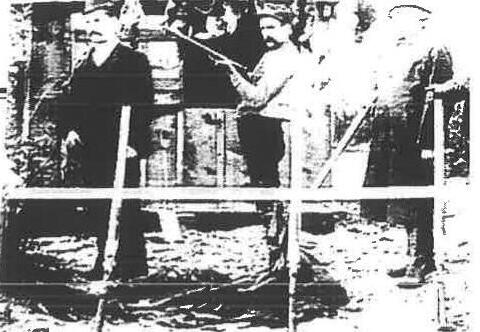
Above: A bitta’ huntin’ in Ashbridgres Bay
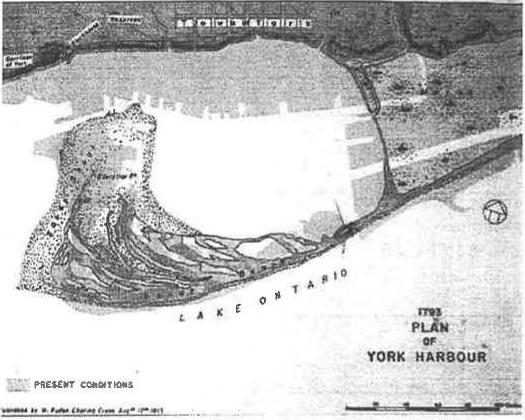
Comparison of waterfront outlines 1793 and 1980
By two agreements in 1787 and 1801 the land where much of Toronto now sits was purchased from the Mississauga Indian Nation. The price was about 10 shillings [say about $1.25 Canadian, though inflation since 1800 must be figured in] and it was paid in equivalent worth of native tobacco. By current real estate values this was quite a bargain. At this time the population of Toronto was about 450 people.
In 1850 a Toronto Harbour Commission [Harbour Trust] was established with the usual confusion of responsibilities divided between the Commission and the City of Toronto. The current Toronto Harbour Commissioners was established by act of the Federal Parliament in 1911.
One of its first concerns was to deal with Ashbridges Bay swamp. At the time it was described as ‘a bullfrog pond’, ‘a malarial swamp teaming with pestilence and disease’. It was the city’s cesspool. Waste from the cattle byres of Gooderham & Worts drained directly into its waters, though there was lots of duck hunting and fishing. There were summer cottages [demolished in 1920] located along the Island but iron foundries and oil companies operated on the north side of the Bay. In 1912 a proposal went to the Toronto City council to fill in the swamp for commercial land development and to build a park, 1000ft wide, running from the Eastern Gap to Woodbine Avenue - four and a quarter miles long. Work on all of this project continued through the thirties.
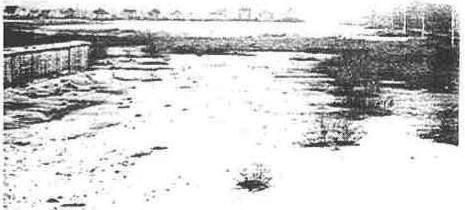
Cottages on Fisherman’s island
The next big development on land south of the Keating Channel occurred in the 1960s when, in anticipation of the building of the Seaway, the EL Couisins dock was built at the Eastern Gap, [just behind Cherry Beach - or as Bobby Logue tells us it was called Bare-bum Beach, because of skinny dipping that went on there - and he should know]. In 1968 a Bold Concept Plan was developed for the water outside the Eastern Gap. It included the Leslie Street Spit to provide a breakwater for the Outer Harbour - which in turn was dredged and planned for moving shipping activities from the Inner Harbour to the Outer Harbour [a new airport was planned for this area also].
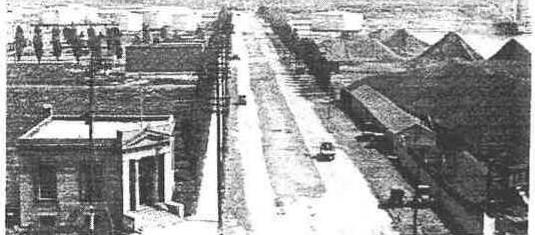
Cherry Street in the 1920’s
The location of the Outer Harbour Sailing Federation is quite unique in the Toronto area. With the installation and operation of the Hearn Power Station, water was constantly being taken from the Ship Channel [the south bascule bridge crosses the Ship Channel], used for cooling in the power station and, when warm, was then discharged into the Outer Harbour [this happens at the Bailey bridge by the entrance to the Outer Harbour Marina]. This discharge of warm water into the bay meant that the sailing season could start earlier and end later than elsewhere in the Toronto Area. A group of RCYC dinghy sailors recognized this fact and arranged to sail their boats from this area rather than from their Island Clubhouse [perhaps the fact of having a more relaxed dress code than on their home clubhouse had something to do with it also]. These hardy souls were the Water Rats. Unfortunately, with the mothballing of the Hearn Station there is not now the flow of warm water.
In the late 60s and early 70s many sailing factors came together getting ready for big events:
- A group of active sailors, Fred Stinson, Gord Norton, Paul Henderson, Bill Cox and Jack Jones with Paul Van Busthink formed the nucleus of the future Sail Ontario with boats called Petrals which were donated by Alcan. The group operated out of Ontario Place
- Montreal was being considered for the 1976 Olympics, and consideration was being given for Toronto to be the location for the sailing events. The Outer Harbour would form the base of the facilities. To this end planning and some work was started on Aquatic Park [which later became Tommy Thomson Park].
- About the same time Paul Henderson, Head of the International Yacht Racing, was on the Sail Ontario committee and wanted a place for Olympic sailors to sail and train.
- Several new clubs such as St. Jamestown and Mooredale were interested in small boat sailing and looking for a place from which to sail.
- As sailing was developing there was no location in the Toronto Area for multihull vessels to berth.
- Upper Canada College wanted a place for rowing.
To provide facilities for all of these activities was a problem and as with all such problems there was enthusiasm but little money. Jack Jones, who had been Chief Engineer of the Toronto Harbour Commissioners since 1956 and a long-time keen sailor, was in a pivotal position to bring the group together and to assist in the formation of a co-operative which would later be the Outer Harbour Sailing Federation. As a result of his interest and persuasive powers The Toronto Harbour Commissioners undertook to build the protective hook on the north side of the Outer Harbour Basin just at the Water Rats Beach. This is the hook that now protects Mooredale and other dinghy docks. Members scrounged the old temporary classrooms for clubhouses and much of the other equipment - but it was all to be considered temporary for a period of five years with the facilities moving then to Aquatic Park.
It seemed as though the fledgling clubs had no sooner become established in their new home, when extensive expansion of ‘The Spit’ was started by dredging and landfill that was trucked in from the massive Toronto construction program. All of this has played havoc with the sailing, but, nevertheless, continues to form the base for the 60+ Albacore fleet that meets each Friday night of the season so that newly converted sailors and experienced hands can share the joy of Albacore sailing.
This motley array of fact has been gathered by Charles Bryan, co-editor of Gybe Talking, the newsletter of the Mooredale Sailing Club, Toronto. His sources included the following:
Jack Jones, former Chief Engineer of the Toronto Harbour Commissioners, was involved in and passed on much of recent history.
The Toronto Harbour Commissioners Public Relations and Archival Departments provided photographs and information from their records. For these hard facts we are grateful.
Reprinted in slightly modified form, with permission of the co-editors, Merle Kisby and Charles Bryan. Thanks.
The 1998 Canadian Albacore Championships, September 11–13: Notice of Race
| Organizing Authority: | The Canadian Albacore Association |
| Host Club: | Royal Canadian Yacht Club, Toronto, Ontario, Canada |
| Racing Rules: | This regatta will be governed by The Racing Rules of Sailing (RRS), the prescriptions of the Canadian Yachting Association, the Albacore Class Rules, the Sailing Instructions and the Canadian Albacore Association constitution. |
| Event Category: | This regatta is designated as a Category A event. |
| Eligibility: | Regatta is open to all Albacore sailors who are 1998 paid-up members in good standing of their national Albacore Association (AA). |
* Be prepared to provide at registration a valid Albacore Association Membership & Measurement card showing proof of a completed 1998 buoyancy test. This is an RCYC and CAA insurance requirement. If in doubt RCYC reserves the right to confirm membership with the respective national AA, request an immediate buoyancy test or to refuse registration.
| Fleets: | Eligible Albacore members may choose to register in A or B Fleet. A Fleet - Championship Event - 1999 Worlds Qualifier – 10 positions B Fleet - Challenger Event – Helms may sail 3 days (Fri., Sat. & Sun.) or 2 days (Sat & Sun only). Races not sailed will be scored DNS. |
| Scoring: | Low Point System. |
| Measurement: | RCYC will not provide measurement services for boats at this Regatta. Registrants are encouraged to make their own arrangements (we can provide a list of measurers.) Only two sets of sails may be registered. |
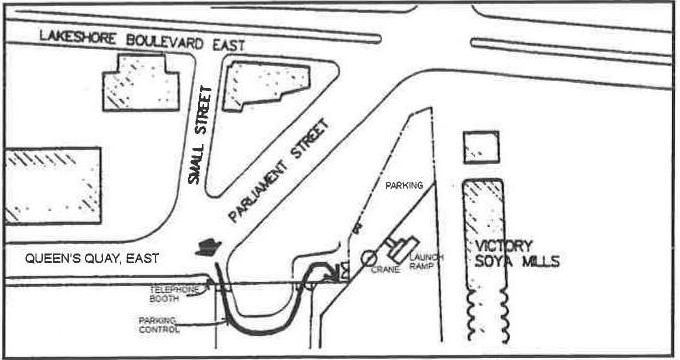
| Access: | Enter RCYC parking lot off Queen’s Quay East, South Side. See map below. City side trailer parking, crane and ramp visible east end of parking lot. |
| Parking: | $8.00/day/car in the RCYC city parking lot. Free street parking on Small St. (runs North off Queen’s Quay) and Mill St. (runs East off Parliament 1 block north of Lakeshore Boulevard.) Read City signs. Early arrival prior to 8:30 am suggested. |
| Docking: | Launching dollies available on the island side. Please store boats on the north lawn of Club on both Fri. and Sat. nights. |
| Ferries: | To Island – 1/4 to and past the hour. To City – On the hour and 1/2 hour. Ferry - Dress Code: Men: Shirt with collar & sleeves; long trousers (no jeans) or Bermuda shorts worn with knee length hose. Women: Dress; or a skirt, slacks (no jeans) or Bermuda shorts with blouse, sweater/tunic. Dinner: Ballroom - Dress Code: Men: Jacket, shirt, tie pants or knee length shorts with knee length hose/socks. Women: Pant suits or dresses or skirt & blouse. |
Program of Events & Times:
| Fri. 9/11/98 | 9:00 - 11:00 am | Registration @ RCYC Island Club (Early Registration is requested) |
| 11:00 am | Skipper’s Meeting | |
| 11:15 am | Leave Dock for Race Course South of Toronto Island | |
| 1:30 pm | 1st Race (A & B Fleets) 2nd Race to follow immediately after 1st | |
| 6:30 pm | CAA Past Commodore’s Race - Come bet on your CAA PC! Past Commodores will race in the Inner Harbour. | |
| Sat. 9/12/98 | 9:00 - 10:00 am | Coffee/Juice & Donuts/Muffins |
| 11:00 am | First Gun, 3 Races (Race 3, Lunch on water Races 4 & 5) | |
| After Racing | Beer on Shore, Fun Prizes | |
| 6:00 - 7:00 | Cash Bar (in Ballroom) | |
| 7:00 pm | Dinner in the Ballroom | |
| 8:15 pm | Annual General Meeting & Draws for Prizes | |
| 9:00 - 12:00 pm | Entertainment in Ballroom | |
| Sun. 9/13/98 | 9:00 - 9:30 am | Coffee/Juice & Donuts/Muffins |
| 9:30 am | Leave Dock for Race Course South of Toronto Island | |
| 10:30 am | First Gun, 2 Races (Race 6 Lunch, Race 7). No race to start after 1 pm. | |
| After racing | Beer on Shore & Fun Prizes | |
| 4:00 pm + 1 hour | Prize Giving |
[Info received in raw form on August 25 -ed]
Registration
By August 31 EARLY REGISTRATION - by Mail Cheque and letter postmark dated August 31, 1998.
Entry Fees: $130.00 per boat (Early Registration Cheques & Mail dated August 31, 1998)
$150.00 per boat (Late Registration)
Extra Dinners - Saturday evening. $40.00 per person - Order Fri. at Registration
Registration Fee includes: Registration Package; 2 T-Shirts; 7 races; Ferry Pass to Island Saturday and Sunday; Coffee/Juice & Donuts/Muffins Sat & Sun morning; Beer/Soft Drinks after Sat & Sun; Prizes to A Fleet Top 5 teams & B Fleet Top 3 teams; Sat. Evening Dinner for Skipper & Crew; Fun Prizes.
** Please bring your own lunch! **
Awards
Fun Prizes will be awarded daily after racing during “Beer on Shore” gathering. PLUS
A Fleet Awards:
- Individual prizes to top 5 helms and crews.
- Canadian Championship Top Team - John Geikie Trophy
- Canadian Championship Top Crew - Beefeater Trophy
- Combined Top Helm & Crew for Ontario & Canadian Championships - Beefeater Trophy
- Top Women Helm - Ladies Helm Plate - David Treissman & Philomena Egan Plate
- Worlds ’99 Qualifying Positions to Top 10 Helms who place in the top half of the A Fleet and have not previously qualified.
Masters Fleet Awards
Top Helm & Crew (Helm minimum age of 50 years) - Boat Builders Trophy
B Fleet Awards:
- Individual prizes to top 3 helms and crew.
- Canadian B Fleet Champions - Top Helm & Crew - Fiberglas Canada Trophy
A or B Fleet Trophies
- Top Family (Related Skipper & Crew) - Family Trophy
- Top Albacore Youth Sailor (Age 19 years or less as of December 31, 1998.)
Past Commodores Race:
- Fun Prizes to Top 3 Past Commodores
Billets Wanted/Billeting Offered: Contact Lynne & Keith MacInnes: 416-922-6440 Email: [email protected]
Questions? call: Rosemary Helmer H: 416-964-8427 or Janice Peck R.C.Y.C. 416-967-7245
Canadian Albacore Association Notice of Annual General Meeting
| DATE: | Saturday, September 12, 1998 |
| TIME: | Immediately following dinner |
| PLACE: | Royal Canadian Yacht Club, Toronto, Ontario |
All members of the Canadian Albacore Association are urged to attend the Annual General Meeting of the Association. In their absence all Full Members of the Association may nominate a proxy, using the form attached. To be recognized, the form must be presented to the secretary prior to the beginning of the meeting.
Agenda
- Notice of Meeting.
- Establishment of a Quorum.
- Collection of Proxies.
- Minutes of Annual General Meeting, September 20, 1997
- Reports of Officers
- Election of Officers for 1998-1999.
- Appointment of Auditor.
- Other Business.
- Adjournment.
Raines Koby
Secretary, Canadian Albacore Association
Canadian Albacore Association Proxy
- I …………………… hereby appoint …………………… as my proxy holder for the purpose of attending the Annual General Meeting of the Canadian Albacore Association for the year 1998.
- I understand that I may direct how my proxy holder is to vote and I direct that my proxy holder may (circle A or B, and if choosing B, fill in how you limit the authority you are giving)-
- vote in accordance with his or her discretion on any matter specified in the notice or which may properly come before the meeting, or
- vote as follows in respect of each matter raised in the notice (identify each matter from the notice and then clearly note “FOR” or “AGAINST” following such reference):
Signature of member: …………………… Date: ……………………
Please print name here ……………………