Late Fall/Winter 2005
November 01, 2005
A chat with 2005 North Americans winner Bob Robinson, the Dotan pop-up rudder and HAPCO mold updates, Andrew Alberti on starting-line rules, and a recap of the Albacore Internationals in Lyme Regis, UK.
Message from the Commodore
Hi Gang;
Commodore Bear here for another year. With such a solid staff I'm just going to float on down the harbour and watch my CAA execuctive work their magic. It was a great year for Albacore sailing, training and racing. My alleged mind drifts back over the memories of this 2005 summer.
We started off like always with the Toronto Boatshow. Lots of Albacore friends dropping by, we want to kick it up a notch this coming January. The CAA is planning on building a new booth. The idea is to update photos and market ourselves a little better. By "We" I am talking about as much of the Canadian Albacore world as possible. The CAA is going to put out information on what we do to keep our boat one of the coolest classes in the nation. We are also going to give the community clubs AND any regular sailing clubs that use Albacores to strut their stuff with flyers for recruiting new members, volunteers from the clubs to work the booth and information on the boat itself. We have a committement from Ontario Yachts to help out this year and hype the boat. That will include a boat and a sales page on specs, price etc. We are also going to have a slide show and videos of the boat in action. Should be a fun way to kick off the year.
After the boatshow we started with the onshore training. We had a rules seminar with Andrew Alberti that certainly helped explain the new changes and reinforce the old ones. We also had some on-the-water training with Chris Cook for the up and coming crowd. This was a great success and we will do it again. The CAA did two training classes at the Hamilton Bay Sailing Club that were well received. The energy was fantastic and it showed by the HBSC turnout at the Canadian's this year. Well done to all the people who helped this to happen. Thanks also to Big Harold G, who is the Hamilton contact and point man for our new alliance.
On the membership front we are up this year which is great news. I believe the renewed interest in the class comes from different angles. The perception of an organized class (we're fooling the masses so far) helps to light a fire with the on-the-fence gang. We have members all over the place right now and I know that the class newsletters and updates and tuning guides etc., all help to give a feeling of being part of the Albacore community. Thanks again to Christine (newsletters) and Janet Duff (membership) for all their work.
Keep spreading the word! I'm a sailing Nerd and proud of it. Our leader is George Roth (chief measurement guy). This year the CAA with the other organizations ok'd the digital compass (numbers only people, no beeps to tack etc.) and helped to stop the practice of changing centreboards during regattas - long for light and medium and short for a blow. Uh Uh. We love the Brits but Man stop messing with the boat. Lots of great regattas this year. The Canadian's went off without a hitch. The blow on Saturday (T.O. 2005 Saturday Legend) with 10 foot waves and gusts recorded by our Race Chair Bobby Logue at 32 knots. Two broken masts, boats on shore, busted centreboards and rudders and one boat towed upside down for two miles. Ouch! There were higher waves and winds than we had in England. Home Sweet Home. But it was a happy fleet when there were only three races and the go home sign was up. Thanks to Sandy for the organization of this and the last bunch of Canadian's. Sandy's taking a well deserved break and Van Sheppard is organizing the 2006 Canadian's in Nepean. Also, thanks to all our sponsors for the great booty!
There were all kinds of regattas this year and thank you to Ed Young for putting the schedule together. I'm sure RCYC will forgive you one day for forgetting them (Hi Heather). It was non-stop racing action and if you traveled then you had an even better time. Next year, there's going to be a Hamilton Open to add to the list. Get that trailor ready my friends. The HBSC knows how to party!
On the financial front all is well. Our man Jason Roth is around for another year as all we have are lawyers and engineers but no accountants. Thanks Jason, he keeps the CAA exec. on an even keel. It ain't sexy but it's sure necessary that numbers stuff. And lastly the Secretary of Defence and Offence and Minister of Organization: Teresa Miolla. T does all the rest of the jobs, from trophys to minutes, to ideas for improving our Association, she keeps all of us moving in the right direction. Me, I'm the idea guy but Teresa organizes the rest for me to maximize these ideas (or bury them when I lose it) and makes these ideas come to life. Thanks to T and to all who helped out. It was a great year and next year should be even better. Enjoy your break.
Yours caught on the pin end,
Commodore Bear
The Canadian Albacore Association thanks Quantum Sails for their continued support.
Message from the Editor
Thank you to everyone who contributed to this issue of S&C and the previous issues, and for putting up with my demands. It has been a fun filled, busy year with a lot going on, so please continue to send me your articles, pictures and comments, we want to hear from our members. The class continues to grow and every week we get new members, which is very exciting. The CAA is responsible for encouraging participation in and maintaining the integrity of the Albacore Class in Canada and we thank you for your support.
On the race training front, thank you to the volunteers and particpants for making the training events happen, especially Ann White and Tim Broughton. Without our many volunteers, regattas, training and class growth would not be as strong as they are today, keep up the great work.
Don't forget to visit the website for continuous updates and photos www.albacore.ca
Happy Sailing,
Christine
Thank you to the following photographers:
Yvonne Howard – front cover, page 14
Caryl Silver page 8
Robert MacDonald pages 2,7,14,15,16
Teresa Miolla pages 12,13
Terry Wagg page 5
99 Rose Point Road Parry Sound, Ontario 705-746-9559 [email protected]
News From The North
The summer sailing series here at Nepean was quite well attended, with the number of Albacores racing on Wednesday nights up to around 10-12 on average. This is in conjunction with a small fleet of Fireballs, and a normal start has anywhere from 15-18 boats on the line, with a high of 20 on a couple of evenings. This is still a far cry from the numbers in a Friday night race, but it's enough traffic to keep things exciting for those of us that are looking for experience with large fleet starts. Warner and Sonja have put on quite the clinic over the summer, and I have seen as much of the stern of their boat as I want to for one season! (Actually, more than I wanted to, but I'm sure it is character building... and I'm sure that my character can use some building...).
We have missed Caroline and Luc at the club this season, as they have struggled to get their boat repaired properly following their unfortunate collision at the North American's last season. Their boat is now, finally, back at the club and has been out for the final two local regattas of the season. As usual, the repair work that was done by Patagonia was outstanding, and the finish on the repair has been rubbed more than the belly of a Buddha.... Now if Luc can get his back into shape for next season, we look forward to having them back in the fleet.
We have had several new additions to our fleet this season. I'd like to welcome:
*Frank Maloney and Melanie Rushworth sailing in 7959
*Derek Lay and various crews sailing originally in 7942, and more recently in 7960
*Rob and Genevieve Mitchell who are now sailing in 7942
*Kevin O'Rourke sailing in 7142.
I guess it is actually a welcome back for Kevin, who after a layoff of 6 years has finally come back out to race again this season.
We are all very pleased with the growth that has been happening in our fleet, and hope to continue it next year!! If you are reading this article, please feel free to move to Ottawa and come sailing with us. We are friendly and make really wicked drinks after our regattas.....
And since regattas have come up, a summary of this year's local regattas is in order. The first major local regatta was the Nepean One Design, which also doubled as the Ontario Championships this season. We had a very good turnout with 21 boats competing. Barney Harris with Karen Piatkowski crewing took home first place, followed by Patti Maloney and I, and Jeff Beitz with son Brian crewing took home third place. The winds were not up to our usual standard for the NOD, but the drinks still flowed freely from the blenders, and I believe that everyone's thirst was adequately quenched before we ran out of berries..... just have to watch the ice-cream headaches ....must drink slower...must drink slower.....
The next local event that the fleet took part in was the Kanata Open regatta, which was held over the Labour Day weekend. Seventeen boats took part, and over the two days a total of nine races were sailed in a wide range of wind strength. The highlight of the weekend was the squall that blew through on Saturday afternoon where wind strengths got up to 20 knots and the planing was just spectacular! The lowlight of the weekend was the carnage brought about by the same squall, as one boat lost its mast (failed shroud) and several had to be rescued after capsizing. The racing between myself and Gord Fleming was tight all weekend, and I was lucky enough to prevail over some pretty stiff competition. The final results at the top of the fleet were Patti Maloney and I winning the event, with Gord Fleming and Irene Gunn in second place. Third place went to Doug and Kay Marsh who came all the way from Pennsylvania to sail with us.
The final local event of the season, Fanfare, was held at Nepean on the weekend of September 10th and 11th. Saturday was a difficult day with light winds coming from pretty much every direction at some point in the day. The race committee persevered though and managed to get off three races. Sunday was a much better day with good winds out of the south and some very exciting racing. Continuing my run of good luck, Patti and I came out on top in the event. Gord Fleming and Irene Gunn were second again, and Marek Balinski and Nora Hoffer took third place.
Nepean will be hosting the 2006 Canadian's and we look forward to seeing everyone there !
Hamilton Update
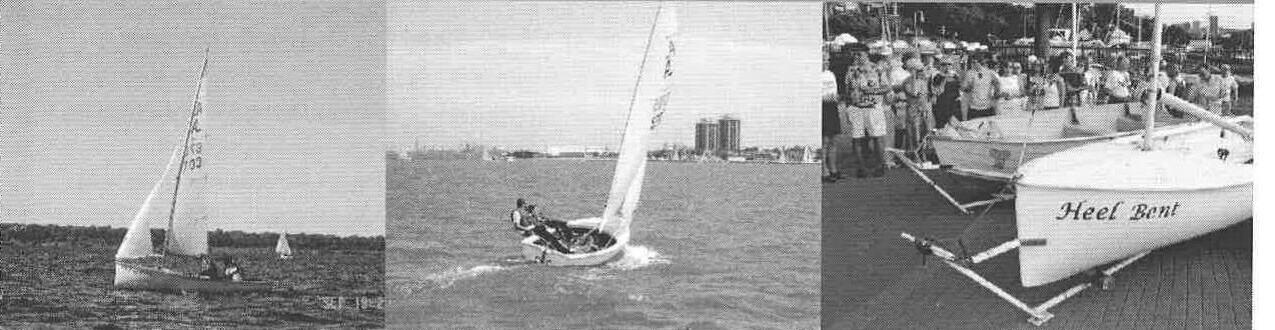
There are Albacores in Hamilton!
A whole fleet of them! Four years ago I didn't even know what an Albacore was but then I discovered the Hamilton Bay Sailing Club and now I can't get enough of them!
If you didn't get a chance to visit our club during the 2004 Canadian Albacore Championships then you may not believe it. Located in the basement of the Gartshore Thompson building adjacent to Pier 4 Park, you will find a thriving sailing club. History of the club dates back to the early 70's when it started as the Hamilton-Burlington 'Y' Sailing Club with only two Albacores. Currently, our 180 members enjoy many social activities, parties, and some even learn to sail! We have a fleet of approximately 15 Albacores, majority of them are 5000 & 6000 series Skene boats. We also have two 505's and three 21' Sirius swing-keel boats. Our newest boats were recently scooped up from Mooredale Sailing Club and we have working on them in an attempt to make them competitive racing boats.
The focus of the club is teaching the basics of sailing to a varied demographic. Members come down on their designated night and receive hands on instruction from experienced sailors. As sailing is very much a social sport, most evenings end off at the neighbouring Leander Boat Club where the deck overlooking the bay is a great place for a few beverages and stories.
Our racing committee works hard to put on 8 races a year where all members are encouraged to come out and give it a try. Fun and learning are the main goals of our club races, but there are usually a few keen sailors who have to be out in front. The big prize is the coveted red hat. The only way to get one is to win a race, or bribe someone who has one.
Another mainstay for HBSC is our Friday night friendlies. Every Friday night members come to sail, then stay for a potluck dinner at the clubhouse. In addition to that, there are several clubhouse parties most popular of which is Lobsterfest. Fresh lobster on the BBQ, served with salads and as always a few beverages. During the hot summer days our annual trip to the pristine waters of Killbear Provincial Park on Georgian Bay is a great escape while a mid-winter trip to a southern resort to sail the warm seas is becoming very popular as well. Social events carry on throughout the year and include a Commodore's Ball, Christmas party, and pub-crawls in the winter.
We are very grateful to the members of MSC who have recently enlightened us to the number of avid Albacore sailors in Toronto and beyond. Our members have visited on many Friday nights to take part in the outer harbour races, which have been a great learning experience. The CAA has also helped us get up to speed with latest techniques by leading a couple of racing clinics at our club. The hospitality of all the Toronto clubs has been fantastic. We have developed many new friends and look forward to continuing our social and sailing interaction next year.
Come and see us in June 2006 ,as we plan to host a regatta. Check out www.hwcn.org/link/hbsc for more information. If you are in the area don't hesitate to stop by the club. There are people out every night of the week during the summer months.
Getting to Know Bob Robinson AL USA 7966
Recently S&C had a chat with Bob Robinson regarding his success in winning the 2005 North Americans.
Q: Congrats in winning the 2005 North Americans recently held in Gloucester, Virginia. Although it was extremely hot, and the conditions were challenging, what do you think attributed to your success in the winning the regatta?
A: To deal with the heat Jill (Williamson) and I both took dips when necessary. Figuring out the wind was challenging, but it seemed to me that there were large oscillations, with a lot of minor shifts and velocity changes. We tried to ignore the minor shifts and stayed with the major ones. We found it was key to have clear air at the starts and be in a position to get on the favored tack early enough to lead the fleet to the next shift and wind line. If we were in a big left phase at the start for example, we would choose to not start at the very favored pin but in the middle or even at the boat, so we could get on to port as soon as possible, and then would just wait of the big righty to cross back. The two races where we could not get free and do this, we had to work our way up the middle and these were the two races that we did not win.
Q: You have sailed successfully with several different crew, at your best as a competitor, what are your strengths?
A: I think that I am patient and just try to be a good communicator. When sailing with different people I find it is important to talk through things before they happen, and discuss things after in order to make them better. I look to incorporate a crew's input as well, because they may have learned a better way sailing with someone else. I'm also very relaxed when I sail. I try to concentrate on sailing the boat fast and try to figure out the wind shifts. I have my crew look around and feed me info by asking for specific inputs.
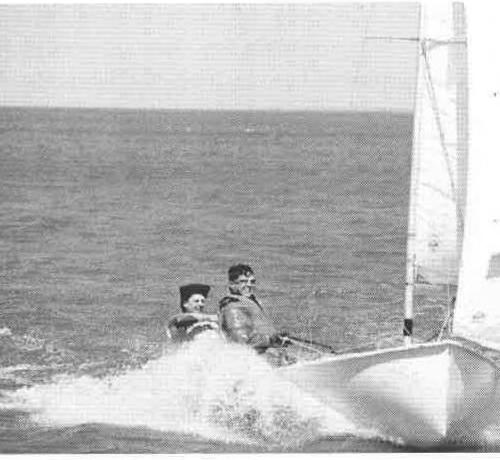
Q: At what age did you learn to sail, and what type of boat was it?
A: I learned to sail at 8 during sailing camp at our local club Jolly Roger Sailing Club (JRSC) in Toledo, Ohio. The boat was made completely of plastic (including rudder and centerboard) and was called a 320. I started racing that same year.
Q: Who was your biggest early influence in sailing?
A: My parents owned a Thistle, so my first sailing experiences were cruising around in the bow. The Thistle is sailed all across the US, so almost all of my summers as a kid were spent traveling to regattas and in doing so, I have been to almost all of the states in the US.
Q: What other classes have your sailed? Do you think that has helped in your success?
A: The first boat I owned was a Laser. I purchased it at the age of 15 for $500. I still have it and race it on occasion. I also owned a 505 for a couple of years. I have primarily raced 320s, 420s, Flying Juniors, Thistles, and on occasion some other classes. Probably sailing for four years on the US Naval Academy dingy team is the most influential thing that has made me the sailor I am today.
Q: Why did you decide to sail Albacores?
A: When my wife and I moved to the Washington DC area from Hawaii (where we lived for three years) we were looking for a boat that was popular enough to get good numbers on the starting line for local events, but also provided an opportunity (excuse) to travel. The Albacore was a pleasant surprise of a find.
Q: What do you like about the Albacore Class?
A: We like that the boat has a nice mix of comfort and high performance. That the ideal crew weight is around that of normally sized people. With the tapered mast, and rig controls, the boat can be very technical, yet simple enough that there are not a million strings to pull. We also like the variety of event locations, and the great friends that we have made both in Canada and the US.
Q: How would you like to see the class change/grow?
A: I would love to see the class become more family oriented. I think it would be great if we could get a critical mass where we have "programs" for the kids on shore while the adults race, (maybe I'm biased in this response with the arrival of baby number three).
Q: What changes would you like to see in the Albacore (if any).
A: I think the boat is fine how it is. I think that the new pole set up was a great improvement to the boat.
Q: What are your goals for the upcoming Internationals? Where would you like to finish?
A: Shooting for the top 5, but more realistically the top 10. These adjustable shrouds are quite a change to sailing the boat, and hopefully we can learn how to use them effectively early enough in the regatta so we can keep up.
Bob and his sister Taylor finished 17th.
2005 North American Championships
The North American Championships took place the weekend of August 6/7 in Gloucester, Virginia this year with the Ware River Yacht Club hosting the event. As most of the participants will agree, it was probably the hottest weekend EVER. In very challenging conditions thirty-five boats participated, with ten boats coming from Canada. Six of the top ten boats were CANADIAN!!
At the end of the day most of the participants, if not all, were billeted with residents/sailors from Gloucester. The generosity and kindness shown was really overwhelming, with many hosts helping out at the "container party", where the twelve boats that were participating in the International's in the UK, were dismantled and packed into the forty foot container. It was a long night of packing in the heat with the mosquitoes but the tired group finished the task sometime between 10 and 11 pm. If you've never been to a "container party" try it sometime, the next one will be in 2009 – see Peter Duncan for details.
Thank you to the USAA and the WRYC for hosting the NA's this year. The 2006 NA's will take place in Canada, the location will be announced in the new year.
| Sail | Skipper | Crew | Place |
|---|---|---|---|
| 7966 | Bob Robinson | Jill Williamson | 1 |
| 7970 | Jasper Craig | Becky Craig | 2 |
| 6701 | Barney Harris | David Byron | 3 |
| 7933 | Ross Findlater | Andrew Monteiro | 4 |
| 7981 | Warner Moneiro | Sonja MacAuley | 5 |
| 8018 | Alan Measor | Richard Piercey | 6 |
| 7000 | Ian Brayshaw | Jeff Beitz | 7 |
| 8808 | Barrie Farrell | Sandy Swiatlowski | 8 |
| 8094 | Teresa Miolla | Christine Short | 9 (also won top female helm) |
| 7979 | Lars Rathjen | Janice Rathjen | 10 |
Dotan Rudder
Toronto Island Sailing Club acquired its first Dotan rudder in 2004, and four more in 2005. Since we launch and dock in a narrow, shallow, and weedy channel, and sail and race in weedy Toronto, we were initially attracted to the Dotan's "magic" pop-up and pop-down mechanism. Dotan's website describes the mechanism as "flick of the wrist magic" and that isn't far off the mark. Especially after a few minutes of practice, a skipper can flip the rudder up above the waterline (letting all captured weeds escape) and lock it back down in full sailing position in about two seconds total, without moving from normal "driving" position! Moreover, if the rudder runs aground, it will automatically pop up and save itself, at an adjustable level of force. Also, if desired, the blade can be locked in either the "up" or "down" position. Neat-o!
Thus far, the Dotan rudders have had positive reviews, compared to the standard-issue Ontario Yachts blades and tiller assemblies on our boats. They are very lightweight to carry, can be transom-rigged on land, and float. The blades appear to be quite-ding resistant – or, perhaps better stated, they are quite ding-avoidant since they virtually can't be run aground.
The blade we chose – Rudder 25, blade 2 – has a slightly smaller and more tapered profile than the Ontario Yachts blade, and seems to perform and feel similar, as far as we have noticed. Two other Dotan blades – 1 and 1A – are also apparently Albacore-legal.
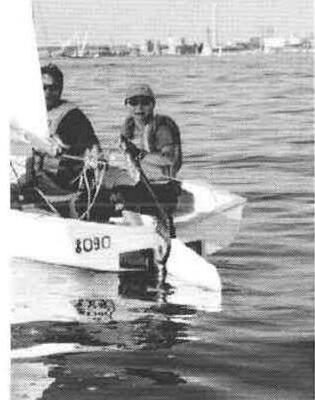
For the 2005 purchase, our Fleet Captain negotiated the price in Euros by email, arranged for payment by bank transfer, and received the package mailed from Latvia less than two weeks later. Based on advice from Canadian Border Agency staff, effort was made to keep the shipment value below C$1,600 to decrease the likelihood of attracting duties and taxes. Overall – despite a few banking problems and not-insignificant shipping fees – ordering and obtaining the rudders from Latvia was easy.
Has TISC encountered problems? Well, a few: The 2005 rudders came with two gudgeons (Dotan's "default" configuration), so we had to jury-rig a top pintle for each rudder. One of our (badly) installed pintles fell out during a dump-and-turtle in the big waves on the Saturday of the Canadians, and the resulting torque on the bottom gudgeon understandably cracked it open. So we suggest that you communicate your specs when ordering.
We're also still learning about durability, and how the Dotan's fit into the sailing club environment. Recently, a plastic coulisse-bolt sheared on our oldest Dotan rudder, making it useless until a spare was ordered and arrived. So we're trying to remind our members that the Dotan mechanism shouldn't be abused -- e.g., with the boat on its dolly. We've also discovered that the pop-up mechanism can activate while sailing at (very!) high speed when a large clump of weeds is flushed off the centerboard. Unfortunately, the rudder is designed to lock in the "full up" position in those circumstances, so regaining control of a planing Albacore and slowing down until the rudder can gently be re-deployed takes some practice. (When that happened to me, (your male co-author) jammed down on the tiller hard enough to force the rudder back down -- but also hard enough to crack the top of the transom, which is not designed for that particular force!). So, we are still at the learning stage.
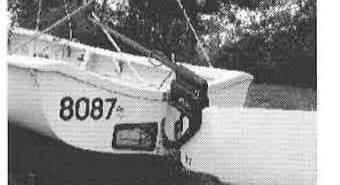
For Albacore racers who hang out in weedy and/or shallow waters, assuming you're as content with the blades as we are, the Dotan looks like an attractive choice.
Dotan blades are made of:
-fiberglass
-carbon (currently not allowed in the Albacore class)
-fiberglass carbon/kevlar reinforced (currently not allowed in the Albacore class)
-varnished wood
-wood covered with glass
Visit the website at www.dotan.com. There are many very detailed pictures and descriptions of the composition, installation, use, feedback and photos. Contact with Dotan can be done by email and they will answer all questions.
HAPCO Mold Update
Prototype Hull Mold Progress
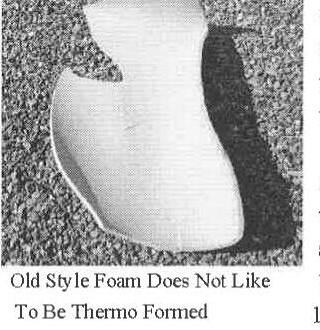
Work continues on the prototype HAPCO Albacore. As of this writing we have one hull set of thermoformed foam core all trimmed and fit and ready for infusion. We had a minor setback when we discovered that there is a new and old version of the foam core we are using – and the old stuff did not like to be thermoformed. It just turned brown and curled up like a potato chip as show in the left figure.
After many discussions with the manufacturer we discovered the slight difference in these versions of foam core and how to specify it for future buys. Foam core products are in short supply these days due to a general growth in the composites manufacturing sector. We hear that much of the world's capacity is being shipped to places like China and so lead times for foam core material can range from 5 to 14 weeks. Fortunately our builder was able to sweet talk the guys in the foam core manufacturer's lab out of a couple sheets – enough to complete the prototype HAPCO Albacore hull. We now have adequate foam core on order for several boats which should arrive soon enough to not impede our near to mid term progress.
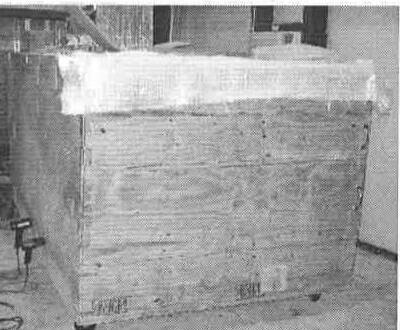
The process is to fire up the HAPCO foam core oven shown in the figure below. This unit consists of an insulated plywood box lined with fiberglass and fitted with steel shelving. Heat is supplied by four electric hot air guns like the type one would use to strip paint.
After the interior temperature is around 260 F we insert two pieces of foam for 6 minutes and 30 seconds. Several people are needed for the next step which is to quickly remove the heated foam and throw in another two pieces. The heat foam is like a wet noodle at this stage. We have around 20 seconds to flop it into the hull mold and hold it into position manually using rags or gloves to insulate from the high temperature. After around 2 minutes the foam is cool enough to remove – now formed to fit the hull mold.
HAPCO Thermo Form Oven
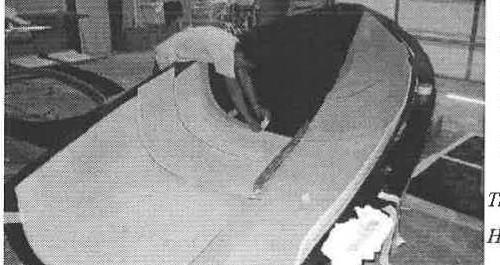
After these parts were formed, the tedious task of hand fitting each began. Using hack saws, sanders, and files each was trimmed to form a near perfect but joint with the others. This required several hours. We made detailed measurements on these parts with the intention of cutting future foam core sets in advance, and reducing or eliminating the handwork for future hulls to reduce cost. Ultimately we will order the foam, glass, and other components pre-cut by the manufacturer, so the materials for each boat can be ordered at one time, simplifying stocking and reducing production labor.
Thermo Formed Foam Core Material in HAPCO Albacore Mold
Know Your Rules
This article was originally published in the RCYC Kwasind Newsletter
The first thing I want to comment on is in the starting procedure.
Rule 26 specifies the starting sequence for a race.
In the new rules it is clear that any of penalty flags "I", "Z", "Z with I" or black flag are preparatory signals when they are used so the "P" flag doesn't have to go up with them. This makes them easier to see.
26 STARTING RACES
Races shall be started by using the following signals. Times shall be taken from the visual signals; the absence of a sound signal shall be disregarded.
| Signal | Flag and sound | Minutes before starting signal |
| Warning | Class flag; 1 sound | 5* |
| Preparatory | P, I, Z, Z with I, or black flag; 1 sound | 4 |
| One-minute | Preparatory flag removed; 1 long sound | 1 |
| Starting | Class flag removed; 1 sound | 0 |
* or as stated in the sailing instructions
The next things to look at are the penalties for being over at the start. The simplest penalty is the default. If you are over the line early then you must return and restart. The basic rule is the definition "start". It was completely rewritten this time but means essentially the same thing.
Start A boat starts when, having been entirely on the pre-start side of the starting line at or after her starting signal, and having complied with rule 30.1 if it applies, any part of her hull, crew or equipment crosses the starting line in the direction of the first mark.
Rule 29 describes how the race committee informs you that you are over early.
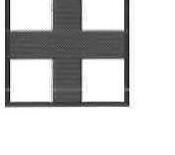 |
29 RECALLS29.1 Individual Recall When at a boat's starting signal any part of her hull, crew or equipment is on the course side of the starting line or she must comply with rule 30.1, the race committee shall promptly display flag X with one sound. .... |
If you are on the course side of the line when the starting gun goes, the committee will signal with an "X" flag and a sound signal and you have to return to start.
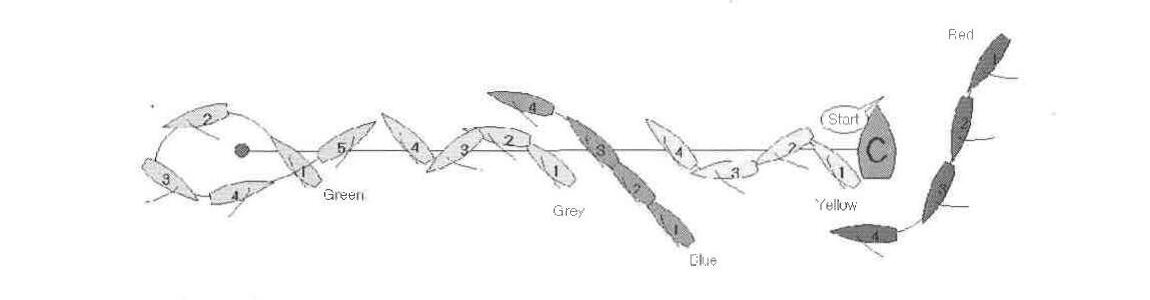
If you are over early you have to return to start. In the diagram three of the five boats are slightly over the line at position 1 when the starting gun goes. The yellow boat bears away, dips below the line completely so at position 3 she is completely on the pre-start side of the line. At position 4 she starts.
The grey boat also dips but never complete returns to the pre-start side of the line. She therefore never starts.
The green boat goes around the end of the line. At position 4 she is completely on the pre-start side and at position 5 she starts.
As fleets become large and aggressive race committees need some tools to discourage boats from being over the line early.
Rule 30 provides various tools to the race committee.
 |
30 STARTING PENALTIES30.1 Round-an-End Rule If flag I has been displayed, and any part of a boat's hull, crew or equipment is on the course side of the starting line or its extensions during the minute before her starting signal, she shall thereafter sail from the course side across an extension to the pre-start side before starting. |
Rule 30.1 is common after general recalls or in larger fleets where the race committee expects some problems. It says that if you are over at any time during the last minute before the start you have to return around one of the ends. This is often a more severe penalty than just dipping to return so it discourages you from being over early. Unfortunately it also encourages everyone to start near the ends and can cause more problems. Sometimes rule 30.1 applies even without the "I" flag. Some races put this in the sailing instructions automatically after a general recall.
In the same diagram, let's say that position 1 for all boats is one minute before the start when the "I" flag drops and position 3 is the starting gun. The simplest case is the blue boat. They are just over the line at the start so they are called over early using the "X" flag. They will have to sail down to one end of the line, go around it and start. The yellow and green boats were both over during the minute before the start (at position 1 and 2). The green boat correctly goes around the end of the line and is in fact below the line again by the time the gun goes. No "X" flag would be required for her. She will just continue to start as she does at position 5. The yellow boat attempts to dip below the line. If there had been no "I" flag this would have been a clean start. Instead this boat has not started correctly. The committee will have to display an "X" flag and the yellow boat will have to round one of the ends of the line and start.
The red boat is on the course side of the line at one minute before the start but since she "thereafter sails from the course side across an extension to the pre-start side before starting" she makes a clean (if late) start.
Next time I will continue with further parts of this rule.
2005 Albacore Internationals, Lyme Regis, UK
In the Beginning.....
The First Worlds and the beginning of the International Albacore Association
An idea that germinated in the mind of Tony Griffin mid-1970 is to bear fruit in late June of this year (1971) when approximately 100 boats will compete in the first Albacore World Championship to be hosted by the Royal Canadian Yacht Club.
There is an old principle in management science that he who comes up with an idea should be stuck with the responsibility of turning it into a reality, and hence Tony Griffin was appointed World Albacore Regatta Chairman with Jim Temple as Deputy Chairman. However, another principle of management is that you surround yourself with lots of competent people and delegate all sorts of jobs, and the C.A.A. now has a first class World Regatta Committee with an extraordinary number of volunteers press-ganged into coping with the multitude of tasks that arise in an undertaking of this magnitude.
In recognition of this first important step toward making the Albacore an international class, and of this high level of competition anticipated in the event itself, His Excellency, the Governor General, has kindly consented to give a trophy to the winner of the World Championship series, and His Excellency will attend the first day of the week's racing.
Even though not everyone that wants to race will be able to, the week should provide some quite spectacular competition, and those of us who aren't competing, it will be great fun to take a motor boat and follow the races at close quarters. And by the way, we will need all the crash boats we can get, so do feel free to come on out and both enjoy the racing and pick up the sailor who parts from his boat.
Reproduced from an article by Daniel Owen in the 1971 C.A.A. Year Book
Lyme Regis 2005
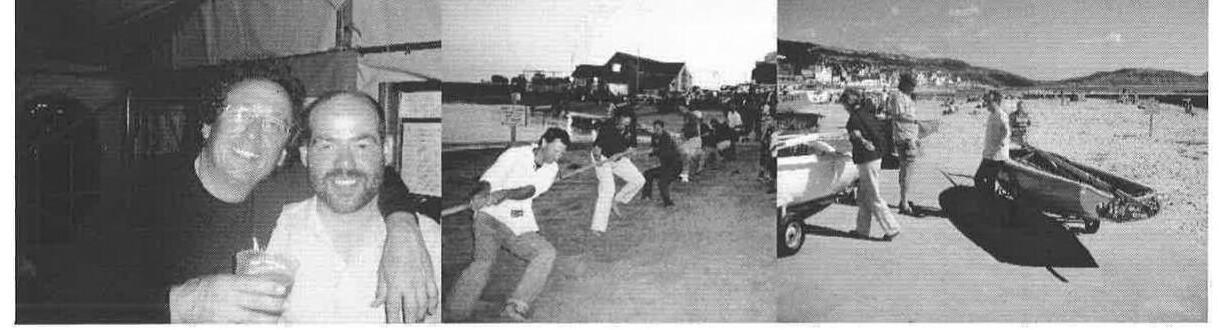
In early August, just after the North Americans, 12 Albacores were packed into a 40' container to be shipped to Lyme Regis, England. The "container team" was a mix of 4 boats from Canada and 8 from the United States, participating in the 2005 Albacore Internationals. The Albacore Internationals happen every 2 years and the host alternates between England and North America, so Canada hosts the event every 8 years, or so.
On Friday, September 1st at 6:30 AM (yes, you read correctly) 20+, tired people met at Strawberry Fields waiting for our hero Jock to deliver the container. Well, at about 6:45am, our man arrived – and there were some pretty happy faces (ok, not so pretty – due to the early wake up call). First, we were shown Jock's fabulous container moving gizmo toy – definitely a guy thing, but for a chick – not so much. Finally, the container doors were opened with baited breath, and the anticipated moment of finding out if the 5 hours of container packing in 100+ degree weather in Virginia paid off. Ok drum roll please.....phew; there they were, in their same positions, the 12-pack of tuna – to quote Barney.
With the help of the local Lyme residents and club members that brought their trailers and tow vehicles, the container was unpacked quite quickly. Here's a tip, do not take apart your dolly (or local term trolley) totally, unless you are lucky enough to find some boys from the Shetlands to put the 50 plus pieces together for you!!
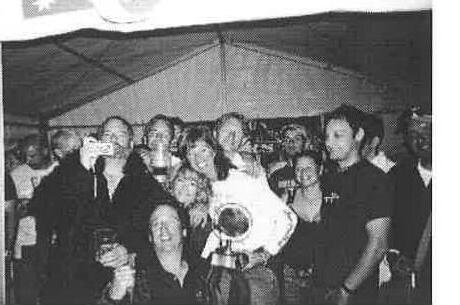
The regatta organizers did a great job on the event. There was a marquee set up where dinner was held, daily prizes given and beer was served by big burly barmen. Every night the Wookie Jacket was given to an individual who did a questionable, funny event the day/night prior. Funny thing, it was always given to a male!
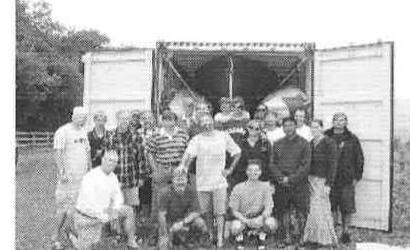
75 boats participated in the event, comprised of teams from England, the Shetland Islands, United States and Canada. The boys from the Shetlands drove for 12 hours and took a ferry with boats in tow for 12 hours to participate at Lyme. The teams from Canada did respectively well. Congratulations to Raines Koby and Abby MacInnes, top Canadian boat (9th) and winning the Lyme Bay Perpetual Trophy. Teresa Miolla won the Humsberg Trophy in the UK Nationals for the most improved traveler from the previous UK Nationals held in Torbay in 2001. Congratulations to Adam Nicholson who not only won the youth trophy at Lyme, but also at this year's Canadians and US Nationals.
It must be told that depending on which wind god you pray to, only one was listening – thankfully. The winds that were in Torbay in 2001, were not at Lyme. Light and shifty was always on the menu and the waves were bigger than the wind.
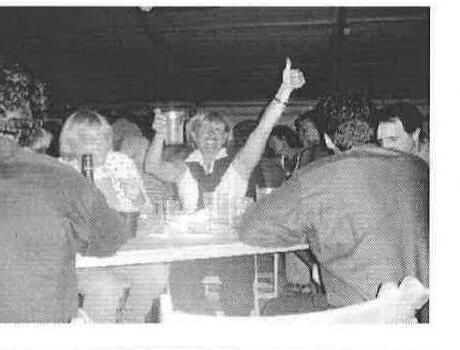
Usually 2 races were held daily. I know what you're thinking easy peasy 2 races a day, but the races were 10 LEGS and the legs were miles long, at times you were would find yourself on mental holidays wondering if Mr. Darcy walked on those pretty hills, or could we sail to France from here - I have my passport.......ops. Nine races were completed and 7 counted. A good time was had by all and the marquee ran out of beer!
Thank you to Barney Harris and Peter Duncan for their time, effort, dedication and love of the boat, in organizing the container to Lyme.
The 2007 Albacore Internationals are going to take place in the United States, with the West River Sailing Club hosting the event. If you have never participated in an Internationals, this will be an event not to be missed. The regatta promises the best of Albacore racing, many good times, stories and friendships to be forged.
Now, if they could just work on the US beer.......
Mark in your calendars now:
US Nationals October 3- 5, 2007
Internationals October 6–10, 2007
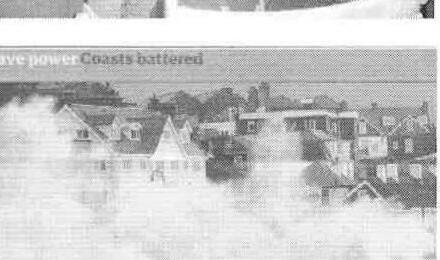
The south westerly that showed up two weeks after the Internationals.
2005 Canadian Albacore Championships

The 2005 Canadian Championships were held in Toronto, this past September 23 - 25th, with the Outer Harbour Sailing Clubs hosting the event. Forty-one boats participated in the Championship Fleet, which sailed on Lake Ontario. The Challenger Fleet had 10 boats racing in the Outer Harbour.
Friday, the first day of racing, was a very challenging day for the Championship Fleet, with many general recalls, and black flags, unfortunately only one very shifty, mind melting race was actually completed – which was won by the Ken & Ken team!
The Challenger Fleet was lucky enough to get three races completed that day.
The second day of the event, brought on more challenges for both fleets. The wind that day ranged from 20-33 knots, and the waves were 6-10 feet (gravel was required). Many boats experienced unfortunate carnage, as it was probably the hardest day physically this year to sail. Some may even say that the Saturday from the Canadian's beat "Ashbridges Bay from '95", but did it beat Meaford? Again, the Challenger Fleet completed more races than the Championship Fleet (hmm...do we need to switch their names around?).
The Saturday night party was on the quiet side, the band was in shock with the lack of people on the dance floor – Barney was there – ok dancing on the sidelines, but he was there, and he wasn't dancing like Elaine either!
The breeze didn't stay for the final day of the event, and everyone's favorite – light and shifty returned and two races were completed on the Lake, while once again the Challengers completed more races. Overall, the Championship Fleet completed 6 races and the Challengers banged out 11 !! Good thing the Challengers were given sailing gloves in their regatta package (thank the CAA for that), with all the races they had.
Congratulations to:
The Championship Fleet (Canadian sweep)
Ann White & Jean Paul Bureaud – 1st place
Van Sheppard & Patty Maloney – 2nd place
Raines Koby & Abby MacInnes – 3rd place
The Challenger Fleet:
Paul Townsend & Carey Jones – 1st place
Pasquale Leone & Isabelle Bissonett – 2nd place
Andrew Bell & Angel Bernardez – 3rd place
Thank you
Sandy Swiatlowksi for organizing the event, Bob Logue and helpers for the Championship Fleet
Ed Young and helpers looking after the Challenger Fleet, Dave Harris for the Caesar Bar
Tim Broughton for the kegs, Quantum Sails, North Sails, The Rigging Shoppe
Absolut Marine (new sponsor), Fogh Marine, Genco Marine, All the volunteers!!
Thank you everyone that participated and contributed to the success of the weekend.
The 2006 CANADIAN CHAMPIONSHIPS WILL BE HELD IN NEPEAN
SEPTEMBER 15- 17th
SEE YOU THERE!!
2006 Canadian Albacore Association Executive
|
Commodore & IAA Rep Past Commodore First Vice Commodore & Secretary Second Vice Commodore & Website |
Third Vice Commodore & S&C Editor Rear Commodore Specifications Chair Chief Measurer |
Membership Treasurer IAA Treasuer CANADIAN ALBACORE ASSOCIATION |