Spring 2015
May 01, 2015
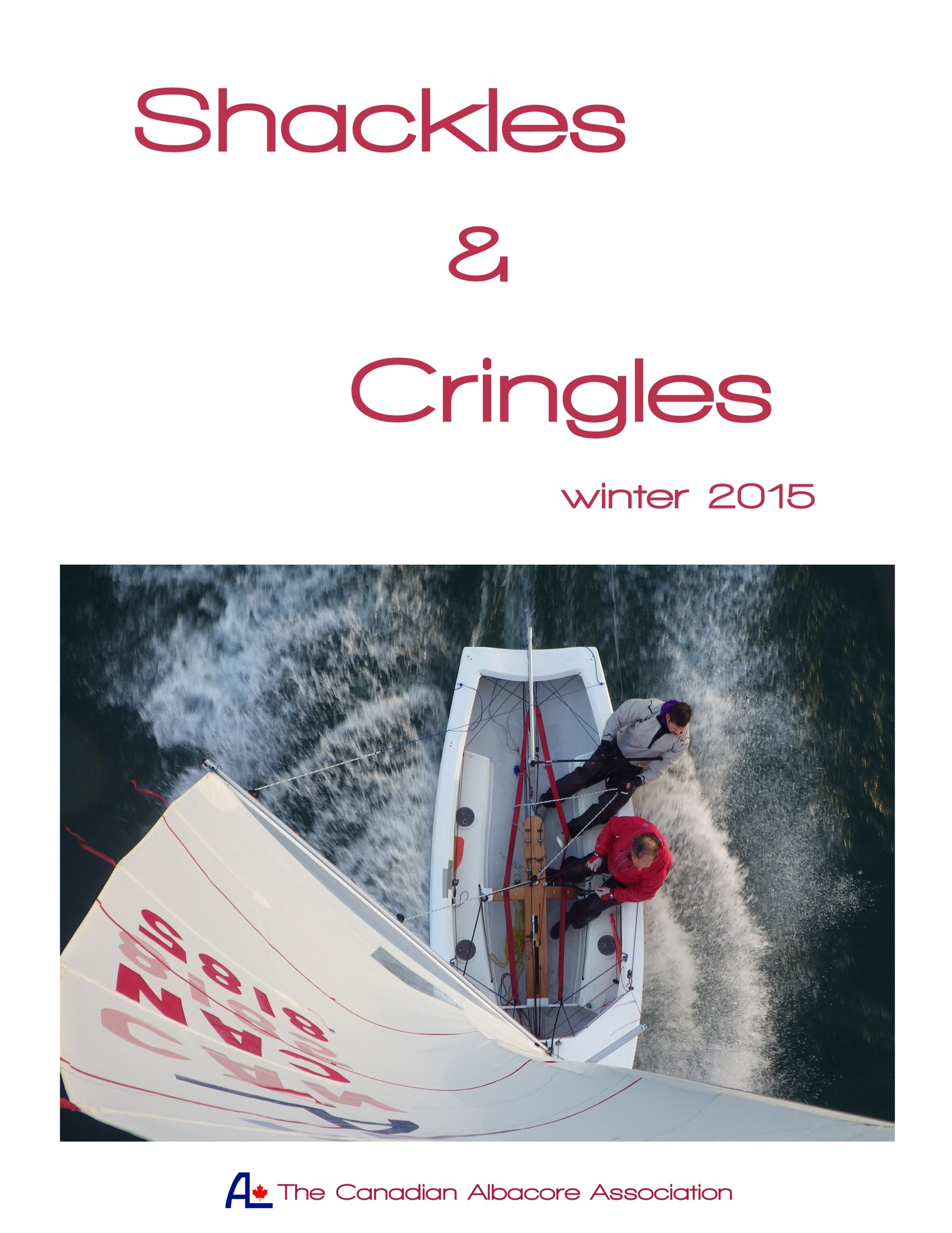
George Carter and Almir Tavares win the 2015 Internationals in Sarasota, the epic saga of shipping UK boats across the Atlantic, crewing wisdom from a survey of the fleet, and news from the Shelburne Harbour Sailing Academy.
Message From The Commodore
Hello Sailors,
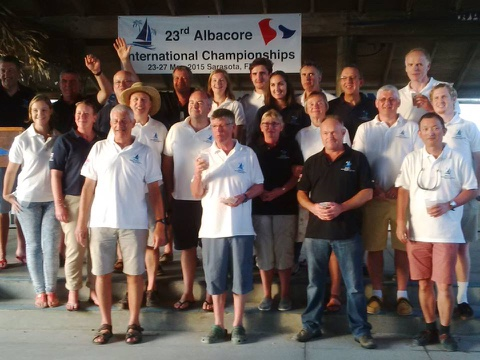
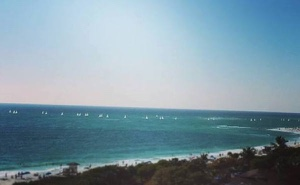
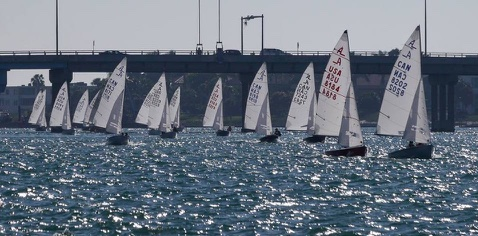
I am sure that you have all heard about the fantastic Albacore Internationals event hosted by the USAA in conjunction with the Sarasota Sailing Squadron - we had 8 days of top-notch racing with the Midwinter's followed by the Internationals. We even experienced 2 days of racing in the Gulf of Mexico! Warm air temperatures combined with warm water and medium breezes always results in a great racing environment and this year's International Regatta was a tremendous success. George Carter and Almir sailed an excellent event and came away with a solid victory: Congratulations George and Almir!
On the home front we have the 2015 season planned with some exciting changes to the previous format for the Harbour Master Series. We are revising things slightly so there are now three series: Spring, Summer, and Fall. The Spring series starts us off with 5 weekends in May before moving into the traditional summer Harbour Masters and Fall series racing. Standby for details to be posted on the CAA website.
The Ontario Championships are to be held mid-July at Hamilton Bay Sailing Club. The Canadians return to the Buffalo Canoe Club after a 3 year absence from Lake Erie sailing.
As we all know, in order to participate in the series racing and other CAA sponsored events, we all have to be members. Membership in the CAA has many benefits, some of the basic ones are:
- Development and promotion of Albacore Sailing - high participation both at the club and regatta level, attracting sailors from other classes;
- Maintenance of the Albacore Class in Canada - 75% of all Albacore boats built are in Canada. The strength of the class has allowed high interest in the Albacore. Even 40 year old Albacores hold value in the cottage market;
- Administration of the Class Rules & Constitution - The Albacore class is unique, consistent efforts keep the Albacore true to its roots, 40 year old Albacores still lead races against the newest boats. This is very rare in any class!
- Organization and coordination of the Ontario Albacore Championship, The Canadian Albacore Championship, The North American Albacore Championship, International Albacore Championship, Harbour Master Race Series, Fall Series and the Gooderham Series;
- Maintenance of a contingency fund (the CAA boat manufacturing investment fund [new tooling], so that we can ensure that there will always be new Albacores made). With the advancement in build techniques and tooling, the CAA is in a position to secure a new Albacore that will carry us for another 30 years;
- Training for all levels of sailors, and
- Affiliation with the Ontario Sailing Association
These are just some of the benefits. For more details please visit the CAA website, albacore.ca.
Remember that membership is one of the key sources of revenue for the Canadian Albacore Association. We need the membership numbers to continue to provide the services and events that we have all come to expect.
Our early membership registration ends May 31 this season, so please take advantage of this opportunity to continue to participate in our great class!
Ian Brayshaw, Commodore
2015 Albacore Internationals Wrap Up
George Carter and Almir Tavares sailed a consisitent regatta against 43 competitors to finish 2015 Albacore International Champs. This is George's 4th and Almir's 3rd win in Sarasota. I am sure I am joined by the whole community when I congratulate them on their decisive win. Here are their answers to a few questions I asked them about this experience:
George: I got into Albacore sailing when I moved to Toronto with work. I had sailed and raced boats since I was six back in the UK, originally in dinghies but mostly in Dart catamarans. I joined Mooredale Sailing Club the first spring after I moved and started sailing in the Albacore fleet. Because I had little recent monohull experience, I crewed for the first couple of seasons, sailing with and learning from a lot of different helms due to the random draw of the weekly Friday night racing.
I enjoy the close racing of the Albacore, the quick maneuvering that gives you more tactical options than the catamaran did, and also the greater depth of controls to adjust the rig, to get the maximum performance from the boat across a variety of wind conditions.
To me teamwork means an effective division of labour in the boat; to sail the boat as fast as possible through the water at all times; to acquire, share and process as much information from outside the boat to enable sound decision making and, I would say finally, to know each others strengths and weaknesses to be able to support each other for the best team result and the most fun.
The amount of effort it takes to get to an Internationals event typically means: more preparation, more spare parts snf the new sails come out, etc. Tactically in a long event like this, you can't win the regatta in the first couple of days, but you can lose it! So normally we will be sailing conservatively, avoiding taking big risks on one side of the course or another, and trying to avoid sailing any discards. As the regatta progresses, wherever you are in the fleet, you know who you are racing against and you can keep an eye on your key competitors and not take too many risks against them. Our best day in the internationals was not day 1 where we scored 1,1,4 but day 3, when we finished 3rd best boat on the day, but beating all of the boats we had to beat in all 4 races. That was a key day and we were really pleased with how we sailed.
With the Internationals this year we knew that our training was going to be compromised by my school work. I arrived at Sarasota at 1 am Monday morning, only 10 hours before Race 1. What we could do though was by making sure that the boat was working well, with Almir helming in the midwinters, and by getting as fit as possible, we could at least control those factors.
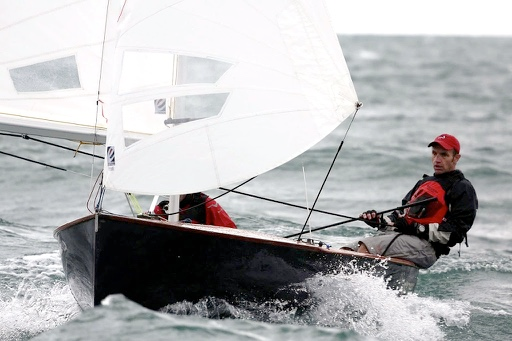
Almir: I only started sailing in 2008, but I was willing to jump in the front or in the back, as long as I was learning. I now sail 3 - 6 days/week helming and crewing Albacores and keelboats. Because I look at the boat as the 3rd member of the Albacore team, I prepped and tuned 8185 so she was up and running. Understanding the timing of the conditions in Sarasota, calm in the morning with thermal winds building, and how to switch gears from flat water sailing to chop, were both important lessons I learned.
I gave George constant feedback based on my previous week's experience with the chop - to drive low, not to tack too tight, build power after tacks, letting the jib out, always pushing him to question his moves and decisions. I admit I am not necessarily the easiest crew to sail with - but George is a very patient man and puts up with my constant questioning.
George: I always love Sarasota, you dig your boat out of the snow in Toronto, drive for 24 hours and voilà, you are in a sailing paradise! You pitch your tent, watch the sun rise and set and have some great racing in between. What's not to like and why should you not be relaxed – which is a great attitude for a good regatta result. Sailing in the gulf this time round was fantastic! We love the waves downwind so that was great for us. Sarasota typically is windward-leeward courses, but to have the reaches was also really good, We had some great reaches with really good boatspeed.
I find that Sarasota is a pretty unpredictable place. Often one side of the beat pays more than the other and it is important to keep a close eye on the extreme sides of the course to see this first. I think we did get our fair share of luck early on in the regatta. We had so little time to practice; in fact before the first race we did one practice tack and one gybe! We sailed, in general, a very conservative regatta which in the end paid off well for us. Over a few years we have developed the sails with North Sails, so we know well what settings we like and we were pretty confident in our equipment and were able to get our head out of the boat more than before and, given our circumstances leading up to regatta, did not have any real expectations of winning. So perhaps that helped somewhat.
Almir: We put enough pressure on ourselves and I am not sure if we would sail as well if we were not each so tough on ourselves. Winning one race is easy … winning multiple races is much harder, so we took every race seriously and every day was new. We had major boat issues at the Canadians and the Ontarios, so we did not let the foot off the gas at any point.
George: As Almir implied, we can never control how well others sail, sometimes failures or incidents can occur that you could not have predicted, so we just took each race and each day at a time and sailed sensibly upwind - and then on the reaches, we sailed the boat like it was stolen! If you go in with that attitude then I think you can separate yourselves well from the stress of thinking about winning prematurely. Some teams can get overwhelmed. We just thought that we would much rather be in the lead with a chance of winning instead of wishing we were in that position, so I think we learned to put those thoughts in their place, and it worked out for us.
12 Go Off To Sarasota (With Apologies To Enid Blyton!!)
Albacore Internationals, August 2013, Abersoch UK: Barney Harris had just finished his presentation for Sarasota 2015 and we were all sold – hot, sunny, white sands, regular breeze. Where was the downside?
So, metaphorically, I opened my mouth and put my foot in it!! I agreed to take control of the project to get the UK Albs to Sarasota for the 2015 Internationals. It was actually a logical choice as I had just been elected Treasurer of the NAA. I could therefore open a bank account in the name of the NAA for the security of everyone's deposits.
As Barney had said – get the commitment and the money up front or it will never happen.
Action point 1) – publicise on the NAA forum and get all interested parties to contact me. There was plenty of interest - the first 8 came quite easily, and it looked at one point that we might make 16 – 2 x 40' containers.
Action point 2) – set out the rules for contributors. We started the fund in October 2013 with everyone paying in £75 per month for 12 months. There would be no refunds for anyone who backed out. If they wanted out they would have to sell their space to someone new or lose what had been paid in. Also, in the event of ‘wrong' numbers there would need to be agreement to stump up extra money to cover the cost of the empty space.
Action point 3) – sort out shipping costs. Easier said than done. If not the internet is as good a place to start as any. I contacted in the region of a dozen or so Freight Forwarders to give me some prices. What came back was quite varied and also indicated those that were keen to help us and those that did not care. The most surprising was the indicative cost from a reputed dinghy/yacht shipping specialist - at their price we would not be going at all! Barney kept me supplied with his extensive collection of notes and photos. Always good to refer to in times of doubt.
So, in a nutshell, by March 2014 I had a good idea of numbers. We were probably going to be 11 or 12 in total. That presented the awkward problem of having to use a 45' container and not being able to take launching dollies. A massive thanks goes to Barney for sorting that out for us.
But – not every shipping line can take a 45' container. That meant our options and costs would change again. Instead of into Savannah GA and out from Miami FL we would have to go in and out from Charleston SC – that meant longer and more expensive land transport. And getting hold of one of those things!! We ended up having to buy the thing – but it saved rental issues at SSS.
Now given the timescales of the whole project – 18 months – it was rather disconcerting to have the Freight Forwarder tell me that we could not firm anything up until we were into 2015. I found that extremely frustrating, all that pre-planning but nothing confirmed. Would the budget still be sufficient? Would we even get the schedule we required?
It turns out that ocean shipping is a bit like hopping on and off city busses. No need to book in advance – there is always space – and vessel schedules can change at the last minute.
By mid January we had a confirmed shipping schedule which would mean loading the container on Saturday 14th February – great for the love-birds!!!
Finally, after all the planning we had action and we all met up as a group on loading day which despite the time of year was not freezing cold and was mostly dry. What a scene we were. We could have carpeted an entire Hotel - but the rope supplies were looking rather dodgy. But once we got going from first boat to last we loaded in 3½ hours. Doors locked, job done, panic over.
Panic over???????
There really is an App for everything, and Hyundai Merchant Marine is no exception. A consignment tracking App to keep me updated (worried?) minute by minute every day! And also the web version with the pretty pictures of boats, lorries and trains and an interactive map. Brilliant. It showed we had loaded and projected that the container would arrive SSS on Monday 16th March at 7am in the morning – no problems.
Sometimes ignorance is best really. That App took over my life. The boat departed a day late – so arrival now Tuesday 17th March. It arrived in Charleston on Sunday 8th March but US Customs decided they need to bump up their office Thanksgiving party fund so pulled our container out for X-ray at a cost to us of $300 - more delay. By Wednesday it was now showing departure from Charleston on Friday 13th March with arrival as Thursday 19th March at 3pm.
Who was driving this thing? Where were they getting these dates from? Do they not know we are in a hurry? I could just see it - the guy in the rail yard looks at the paperwork. Not due till 19th? It can wait till Monday then. NOOOOOOOOO!!!!!!!
Finally we are released by Customs end of day Wednesday 11th. Trucked to the rail head Thursday 12th – back on track now? Wait….WHAT!!!!!!!!!!!!!!!!! Tracking site now says arrival SSS on Tuesday 24th March at 3pm!!!!!!! It's all gone wrong. My fault. Nothing I can do. Will just have to sit and drink beer – or maybe avoid SSS altogether – tour Florida in my RV instead.
Miserable 2 days. I think I know what hell must feel like. Everything was a problem.
Wake up Saturday morning (14th) to see that we had departed Charleston rail yard en route to Jacksonville. Yahoo!! Arrived Jacksonville early afternoon Saturday. That should bring things back on track. Jacksonville is only a day's truck to SSS at the worst.
That infernal tracking website is now really winding me up. Arrival SSS now showing as Wednesday 25th March – lay day!!!!!!! Then no movement for another 2 miserable days!!!
Finally, on the afternoon of Monday 16th it all came together. Rail to Tampa that evening and then the trucker would collect Tuesday morning for delivery to SSS. Thank the Lord! That meant I could fly out from the UK on Tuesday 17th in a much happier state of mind.
This shipping lark is quite easy really.
So now you know just how smoothly these things run I'm sure there will be no shortage of volunteers to organise a CAA/USAA container for the 2017 event in Weymouth UK.
But you MUST get commitment up front – get paying the money into a fund now.
First Over The Finish Line — Reflections On The Art Of Crewing
The following quotes were collected from a survey of Canadian Albacore crew in an effort to clarify to the world (and ourselves) what it is about crewing that keeps us at it.
“It's damned hard to be a crew. You have to be a contortionist, a psychic, and a glutton for verbal abuse, not to mention flawless” - Dave Perry
What's So Great About Albacores?
I love the beauty of the sport - nothing beats looking over your shoulder and seeing the big Toronto fleet behind you on a bright summer day.
I love the Albacore. It's a simple boat, but a deep one. It's very sensitive to body movement and balance, but I don't have to worry about a spinnaker or trapeze. Some people are all about trapezes and I get that, they're pretty sexy I guess, but I think straight leg hiking is sexier. ;) The albacore can plane with the best of them in the right wind, so it's a fun boat.
I find the space issue forward of the thwart to be a bit of a challenge and the centre board up the arse once or twice is a quick reminder to be careful where you sit.
A little more ass-padding couldn't hurt. Bruised knees aren't so bad, but the tailbone's a killer.
It has simple lines. You can always find someone to sail with and black and blue are my favorite colours.
New Crew In The Albacore Fleet?
In your early days, your roll in teamwork is to keep your eyes open, listen to the helm, ask questions, and absorb everything you can about making the boat get where it needs to go.
Get used to it. You are subservient. They are the boss. There are NOT enough cheese & crackers provided.
Crewing is kind of an evolution. sooner or later you start getting the hang of things and keep the jib full. And if you stick with it, sooner or later you're feeling good and building some real confidence.
You need to grow a third arm - push the boom out, heel the boat to windward, serve drinks, straddle a centreboard that refuses to stay up and look for breeze.
You can't just google it and know how to sail you have to spend time on the water!
I find the crew's role is actually more important in many ways than the helm and certainly we have more duties to look after during a tack or a gibe.
A helm's bark is usually worse than their bite, it can be pretty intense on the race course, but 99% of the barkers apologize after the excitement – it's just the way it is, and it's not usually directed at you.
To me racing and sailing lends a sense of freedom that I find hard to get any where else in my life.
Okay Then, Why Crew Again?
As crew you're always in the thick of sailing a sweet boat on beautiful water with a like-minded enthusiast at the tiller. And when you get back to the dock for a well-earned beverage you've always got a story to tell.
I helm the occasional race but I find the start line a little too nerve racking to do that too often. So I crew, for the purity of the sport - against the same obstacles as have faced sailors for hundreds of years.
Any day on the water is a good one, so whether crewing or helming is pretty inconsequential. It's still sailing.
The job is the same: win. Which means go faster then everyone else, not matter what sail you are adjusting.
If you're crew there's always someone else on board to either learn from or to critique. That stuff makes you better.
It's the best way to learn all aspects of racing, besides driving.
What Advice Can You Give Others?
Don't take things personally,. Try and leave issues on the water, so you can enjoy the après sail!
Over the course of the day, you are going to fall or get tripped up in lines and have a bad tack, but so will your helm, try not to do it at the same time.
It's important to care, but when your emotions get stirred up you lose focus and miss important information. It also makes it much harder for the skipper.
When hiking out try to keep your head in line with your shoulders and you shoulder blades slid nicely down and away form your neck - it can get pretty painful!
Message to helms: it might be nice for the racing helms to let the crew use their own technique through the tacks. Is every helm an instructor in a different martial art?
This ain't the Olympics...stop taking yourself so seriously.. Sure, do your best, sure be competitive, try hard, but remember - this is your leisure activity.
Helms always say things 3 times, hike hike, hike, jib jib jib
What Does Teamwork Mean To You?
As crew, it's good to get to the point where you feel confident chipping in with advice, reading the conditions, and making some of the tactical decision calls.
Both teammates get a VETO - safety and fun first but either person can say: “I am not up to this and we gotta go in”.
Setting your partner up for success - sailing to the partner you have in the boat, not the one you wish you had. We all know our shortcomings and sailing to some fantasy crew (or helm) who can roll the boat harder is not helpful - cause it ain't changing during today's race!
I'm slowly getting better at seeing beyond and outside the boat. Time on the water and taking up laser sailing, where I am my own helm, have helped with that.
I love the friendships that develop and the real sense of team work that develops sailing. It is a great way to get to know somebody and racing is a great way to learn strengths and weakness in an individual.
Have clear expectations for each other and for yourself - talk about it, write it down and share it.
Agreeing who is doing what and why you think this is a good distribution of the labour in advance and agreeing not to micro-manage one another's portfolio!
I think a good crew is the one that is helping the boat go faster and calling strategy, so I give a lot of feedback about everything and am always pushing my helm to question his moves and decisions.
We are both allowed to make mistakes.
Clarifying shared goals - short and long term: for the warm up, for the pre-race, for the starting sequence, for the race for the day, for the event, for the series or season.
Having a real de-brief. every day. Save re-living or arguing about mistakes on the water. Get off the water, have a beer and discuss it all with a view to what needs to stop, start or continue...for future performance.
Teamwork is very rewarding: efforts are combined, you always add value, no matter how good the helm is - they need you, that you learn every time you sail - with the good, the bad, the ugly.
I feel my regular helm and I make a very good team and I really love how we have slowly come to know how the other person is going to move in the boat. I really like being in tune with each other AND the boat.
It's nice when your relationship with your helm is such that you can pee in front of them,
Swallowing the lake water on the reaches!
How Do You Go About ‘Managing' Your Helm?
When you hear “Oh F!@#” … don't look back
Try to compliment - great job on the start, nice squirt, great wave driving, I like what you did on that reach, nice job, thank you, good call on that shift … if you can muster a way to voice something positive, it really builds confidence and reinforces what your partner is good at.
Happy skipper=fast skipper, fast skipper=happy skipper so, whatever it takes, make them think that you're going fast!
Throwing an inexperienced helm on the tiller can be pretty fun, speaking as a more experienced sailor. Great to show by example how you can commit to hiking if conditions allow. Tacks can get pretty hairy though, so best to keep your head low and be ready to hustle. Who hasn't found themselves coaching a shell-shocked new helm through a 360 or two?
Have been willing to jump on the front or in the back as long as I was learning, So, I am a bette driver because I know what the crew feels and can see and I am a better crew because I understand the driver position.
How do you stop your helm from drowning? Take your foot off his head!
I can put up with water in the face, cold, turtling but I can't stand an angry helm.
Sometimes I need to remind the helm that it is my race too and, as a community club member, also my boat.
Got A Shoulder Impingement?
Holding the entire weight of the mainsail on a long, light wind downwind leg (in a boat well heeled to windward) puts a lot of strain on the shoulder. Shoulder impingements result from muscle imbalance and improper alignment when bearing weight and can sneak up on you and take quite awhile to repair. To keep your shoulders healthy and impinge-free:
- when holding the mainsail up and out, start by aligning and lengthening your spine/neck axis then raise your shoulder blades up, in and down to tuck into their “pockets” (concentrate on keeping your scapula tucked in and down at all times, even when working on the computer)
- stretch and strengthen evenly when performing weight-bearing exercises of any kind, both internal (chest) and external (shoulder blade) rotator muscles
- keep those thumbs up to ensure proper rotation
- try to keep your chin tucked in a neutral, aligned position - use your whole body to look up.
- take any opportunity to rest from the load, at least for a few seconds.
Crewing Soft Skills
So you've mastered calling wind shifts for your helm, dialing in the boat speed with precise 1mm sail control adjustments, and fine tuned your movement in the boat to mere fractions of grams. These skills are important to winning races, but have you mastered the crewing soft skills of sailing? The technical hard skills will win you races, but the soft skills will give you flexibility and freedom to sail with different helms and boats. Become a master of the following six areas and elevate your crewing game.
Motivation: All of these soft crewing skills described below are dependent on your level motivation. Why do you want to get better? Is it to try and win the Ontario's this year? Place in the top ten once, or consistently, on a Friday Night Race? Diversify your technical skills by sailing with multiple helms? Or is it simply to get more time on the water and have fun?
Motivation is that non-tangible inner drive which pushes you further than you thought you could go. It is critical to helping you achieve your goals. Having it is apparent to others - it is something you wear, can be felt by people around you, and those with a similar motivation will be drawn to it. It will directly impact your availability, incentive, attitude, commitment, snacktician skills, and how much fun you have.
Availability: Good sailing results go hand-in-hand with practice, and as the adage goes, practice makes perfect. Time on the water racing, speed testing, running through drills and practicing mark roundings all take time. The more available you are to commit to an intense training program, the more likely you will find a helm with a similar desire to improve. Having the flexibility to swing down to the sailing club if another crew drops out or doesn't show, can also go a long way to building your reputation as a dependable crew.
While it may be uncomfortable for the first few times, just hanging around the club is also a great way to get your foot in the door. As a newbie, you need to build a reputation of wanting to sail and being available to sail. If you are an established crew but are upping your game, a shift in behaviour will also be noticed by others and can lead to new opportunities.
Attitude: No one wants to sit in a boat for 7 hours with Debbie Downer (though no doubt there would be some great stories after a day with her). This is especially true when you've just been passed by 4 boats on a reach, got caught on the wrong side of a huge shift or blew a mark rounding and put your nose into the side of a woody!
Your ability to lighten the mood in the boat, focus on the positives, and keep your helm looking forward instead of dwelling on the past all contribute to an upbeat environment that will make each outing with you pleasurable, and more likely to be repeated. No-one wants to work with someone whose company they don't enjoy, and even the a good friendship in the boat can only take so much negativity if it isn't balanced out by positives.
Commitment: How bad do you want it? Can your helm count on you to keep a regatta date in 4 months, or are you liable to flake out? Are you able to make the weekly race training, all the weekly races and the weekend regatta? Or will you trade up if a better opportunities comes knocking? A good sailing program, focused on tangible improvement in race results, requires a lot of time on the water. Your commitment to a prescribed program goes a long way to building a helm's confidence in you and the team. This is a reputation building skill and of all the soft skills, this one may lead to the most significant improvements in your results. Unless you are actively not trying, any time spent in a boat racing will make you a better sailor.
Snacktician: Often left to the last minute, the regatta lunch program is an overlooked area where you can quickly increase your demand as a crew. Nothing is worse than doing poorly in the first 2 races of a regatta, then having to eat mini carrots and a granola bar (apologies to all those who do eat this willingly). What if you could look forward to eating a pulled pork sammie, kolbasa cold cuts, jerk chicken roti's, a shrimp cocktail, and rehydrate with a certain yeasty carbonated beverage (if this was legal of course). Sounds pretty good right? It might even make those final 3 races a little bit better and give you the energy to push a little harder.
This also applies to regatta weekends. Having snacks and beverages on hand for boat pack up, the road trip out, setting up the boat, apres-sailing, boat teardown, and the drive back are highly valued assets. With a little planning, a trip to Bulk Barn, and The Beer Store will virtually ensure you are “sailing up” for the rest of the season.
Fun: This above all else is a core soft skill and should not be forgotten. This isn't the Olympics, the Pan Am Games, or any other world-class sailing event. Don't get me wrong, the Albacore fleet is competitive and the level of skill is very high, but it is still an Albacore and you are still going to work on Monday.
When the wind dies, and you are just sitting out there bobbing around with everyone else, laughing about the bad tactical decisions you (or someone else) made earlier, is more enjoyable than hopping around the boat trying catch that 0.002 knots of pressure in the jib. It is easy to take this whole thing too seriously and get caught up in the moment. Sometimes it is harder to laugh at yourself and keep it light. If you aren't looking forward to the race, something is wrong. All the above is built on a foundation of fun. If you aren't having it, find the problem and fix it.
In summary, you can be a technical guru of a crew, but that alone may not enough to get you into a good boat consistently. A superb crew has mastered both the hard and soft skills. Weight distribution and motivation are mutually inclusive. Tacking well and snacking well are complementary skills. You get the idea.
Shelburne Harbour Sailing Academy
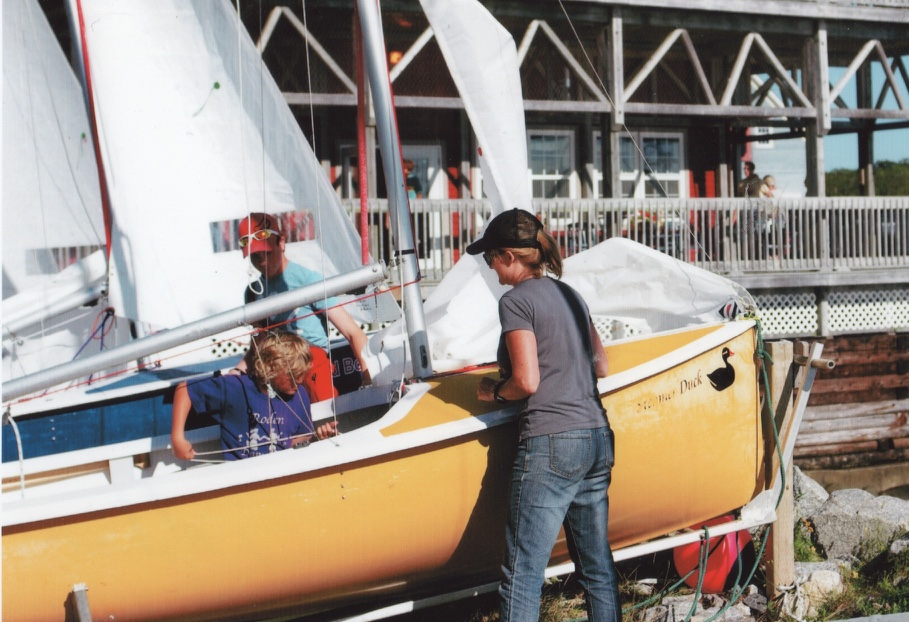
The East Coast Albacore fleet has seen some remarkable progress in the past 7 years. What started out as a bunch of derelict ex-Navy League boats was transformed into a fleet of ten working Albacores that forms the basis of our learn-to-sail program in Shelburne, NS.
The recent couple of years has seen the formation of the Shelburne Sailing Academy and Family Aquatic Centre which has taken up residence in a grand old historic building that once housed Harley S. Cox & Sons Boat Builders – builders of many historic fishing schooners and grand steamers.
The Shelburne Sailing Academy's goal is to teach Adults and Youth the pleasures of sailing within the CanSail Program, while instilling a lifelong love of the sport in all its participants.
How do our Albacores factor into this? Well, from the original fleet of ten boats, we have pared the fleet down to eight, but with upgraded rigging and sails. All the Academy Albacores, as well as a number of privately owned Albacores in Shelburne, went through a rigorous measurement process and were eventually issued class measurement certificates in 2013, making the fleet official. Moreover, we have corrected and repaired years of neglect and poor quality fixes, resulting in all of the boats being perfectly sound with tight buoyancy.
Due to their age, non-tapered masts and excess weight, these boats might not win national regattas, but, nevertheless, they provide great tactical back and forth on the racecourse during our weekly race series. And in the right hands, and in favourable wind and wave conditions, they often penetrate well into the top five and have been known to win a race or two.
All summer long the Shelburne Sailing Academy runs learn-to-sail programs for kids as young as six, putting them in both Optimists and Albacores.
We are currently working on a fleet upgrade program where we are working on purchasing high performance Albacores, especially good foam cored boats to replace the aging ex-Navy League fleet. This will ensure that our best sailors are put into the best boats for competition.
A wrap-up from 2014:
- We started an adult learn-to-sail program in Albacores (bring your kids too – kids were put into Optimists while parents learned to sail in Albacores)
- We started Opti racing on Friday had a total of 9 kids competing. These same kids are seen on the Wednesday series in Albacores.
- Tanner Christie, with crew Jackie Nickerson, trained from an early age at Shelburne Sailing Academy, won the Sea Cadet provincials and Atlantic regionals in 420s. They also won Baddeck Race Week in 420s – when the two aren't racing 420s they are racing Albacores.
- Savannah Taylor finished in the top half of gold fleet in the province in Opti's. When Savannah isn't sailing Optis, you'll find her in her Albacore, racing in the weekly series.
- Will Tipton was the youngest competitor in the province (probably in Canada) competing in silver fleet at Baddeck. Will and his dad Guy sail Albacores during the week.
- Evan Bower and Nick Williams competed in the high performance regatta in Rye NY. Evan and Nick are also seen honing their skills in Albacores during the weekly series and in the East Coast Albacore Championship.
- The East Coast Albacore Championship was won by Julie Stewart and Jamie Stanley from Toronto
CAA 2015 Race Schedule
SS = Spring Series · FNR = Friday Night Series · HM = Summer Series · FS = Fall Series
- May: Spring Series weekends throughout the month (Sun 3, 10, 17, 24, 31)
- June: RCYC Founders Regatta June 6 · Nepean One Design June 20–21 · TISC Regatta June 27
- July: OHCC Regatta July 4 · Ontarios at RHYC, Hamilton July 11–12 · Pan Am Games July 10–26 · Harbour Master (Summer) series begins July 18
- August: Mooredale Regatta Aug 8 · Para Pan Am Games Aug 7–15 · Women's Helm Aug 15 · Westwood Regatta Aug 22 · East Coast Regatta, Shelburne NS Aug 21–23 · New Helm's Regatta Aug 29
- September: OHCC Back-to-School Regatta Sept 4–6 · Kanata Open Regatta Sept 5–6 · Canadian's, Buffalo Canoe Club Sept 11–13 · Nepean Fanfare Regatta Sept 12–13 · JTown Regatta Sept 19 · QCYC Sept 26
- October: Fall Series weekends throughout the month
- November: JTown Hallowe'en Regatta Oct 31–Nov 1
2015 CAA Executive Board
| Commodore | Ian Brayshaw |
| Rear Commodore & Canadians Regatta Chair | Darren Monster |
| Past Commodore | Mary Neumann |
| First Vice-Commodore & Race Chair | Marek Balinski |
| Second Vice-Commodore & Promotions | Dominic Goodwill |
| Third Vice-Commodore & Education | Frank Loritz |
| Chief Measurer | Ken Yamazaki |
| Specifications Committee Chairman | David Weaver |
| Treasurer | John Cawthorne |
| Secretary | George Carter |
| Membership Secretary | Jason Wattleworth |
| Editor, Shackles & Cringles | Tannis Baker |
Canadian Albacore Association
970 Queen Street East PO Box 98093 Toronto ON M4M 1J8
albacore.ca
The editor would like to thank all those who generously contributed to this issue including Pauline Rook and others for their photos and Lynn Pashleigh for a gorgeous cover!