Shackles & Cringles — Spring 2016
May 01, 2016
George Carter on the hunt for a new Albacore builder, Barney Harris's HAPCO mast manufacturing project, race management fundamentals, and two members on joining the fleet.
Message From The Commodore
Hello Sailors!
2016 season is now underway and, thanks to the diligent work of the executive, we are expecting this season to be a memorable one. The Friday night and Harbour Master series racing is now underway in Toronto. We have the Ontario championships completed at Mooredale. And, the Canadian Championships are returning to Toronto after a 5 year hiatus, so everyone mark your calendars for the 16th of September.
As most of you are now aware the CAA has rolled out a new website. This has come after several months of work behind the scenes. Graham Pearson has put forth a great effort to maintain the historical information from the past website, while providing the updated capabilities that we expect from websites these days. Please look at the CAA-Rawfish video section, this is the best way to review the current events and goings on in and around the fleet. If you or your albacore club would like to submit videos of your albacore activities, feel free to check this out and submit - we want your input!
The CAA are again sponsoring the learn-to-race seminars (Intro through to Advanced) in addition to the weather forecasting and the other training seminars that Frank Loritz is organizing. For more information and details, refer to albacore.ca.
As usual we need your input to continue the spread of information in these editions of Shackles and Cringles. If you have matters of interest in your club, fleet, or albacore activities that you want to share, please forward these on, we are always looking to spread the word on what is going on in our great class.
See you on the water!
Ian Brayshaw
Raw Fish 2016 — Share Your Stories!
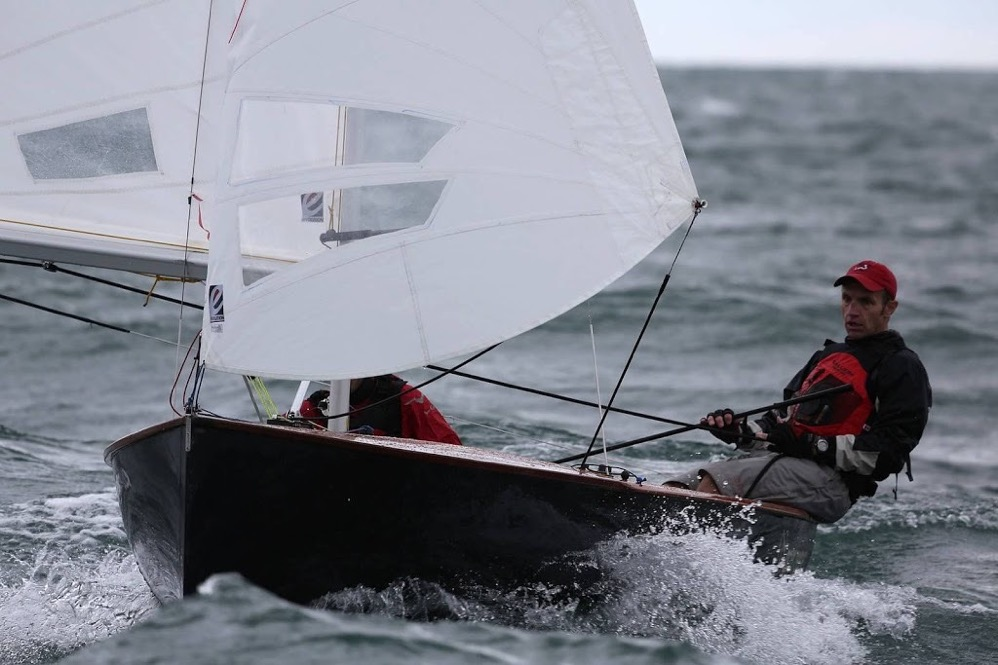
Tom Saunders, now of Kanata Sailing Club, started sailing Albacores at his family place on West Hawk Lake, Manitoba. The Lake has had Albacores since the early 60s when locals brought over Ferris Marine kits from England (his Dad owned 1228). Tom has made some very fun action videos of sailing in SW blows, which he has shared with the CAA.
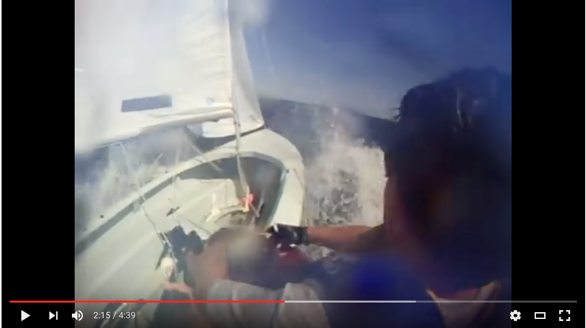
Now you too can share your Albacore-love with the world by shooting videos of where you live/play/sail and uploading them to the CAA's very own Raw Fish You Tube Channel.
Get creative. Short, long, polished, or RAW … whatever you want to share, however you want to share it! It's all about the Albacore community … its social activity, characters, competition!
All you need to do is email [email protected] and tell us your Google username (so we can add you to the Youtube channel contributors list!) and your club affiliation (if you've got one! No worries if not!). Once you're on the list, you'll be able to simply link your vids to the You Tube Raw Fish 2016 Playlist and they'll go live as fast as you can post them!
For all the latest videos, visit albacore.ca/rawfish. Subscribe to/like our Youtube channel! Post your faves to Facebook and Twitter! Spread the Albacore-love wide and far!
RaceQs – Capture The Action
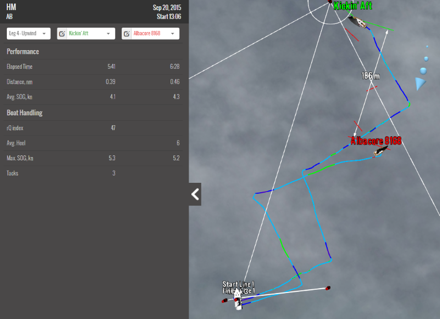
Want to get even more fun out of racing? Michael Williamson, CAA Race Chair, has discovered a very interesting app called RaceQs.
RaceQs installs on your mobile phone, and it allows tracking and capturing all the action.
How does it work? Just start the app before your race, then drop your phone in a dry bag and tuck it somewhere safe. As you race the app tracks your GPS and sail data. It can upload in real time so friends back at the club can keep tabs on your progress. But, if you prefer not to use mobile data, it just stores your GPS route and uploads later when you're back on a wifi network.
Why is this cool? For starters, you can review your whole race in 3D and see how you made out compared to the competition, figure out which shifts you caught or missed, relive the whole event and work out what tactics helped or hindered. And if you enable other app features you can even track crazy details like the heel and pitch of your boat.
Word on the street is the more people who use RaceQs, the better the post race replays get. More phones = more data = more entertaining replays. Think you might like to try it out? Download for iPhone or Android and let's have some fun.
Ontarios Championship Recap
So it's Friday night and as any sailor interested in sailing the next day would do I check the forecast. Crap, 0 knots gusting to 3 knots. Sounds like a great day for wake boarding, harnessing some rays and a few wobbly pops right? Nope, its the Ontario's, one of the more anticipated Albacore events in North America. Call Andrew (Rydholm, my crew)to check out how much he likes being fried like an ant? On the fence but he's sounding keen. Ok, let's just play this one by ear and pray for the forecast to change.
Saturday, morning, forecast hasn't budged. It's a little difficult to get motivated to sail in 3 knots when you're in a nice warm, comfy bed but Andrew's keen and it's not like it won't be a beautiful day so put your crap together, Monster, its game time. Mad dash off to Timmies for some coffees, sandwiches. Registered late, rushed onto the water and to our surprise there's actually enough breeze to fend off the bugs - day's already off to a good start!!! First race and we decided to execute our first tactic, rockin' beats! That's right, Albacore fleet meet brothers Doug & Steve Butabi!!
First race is off and it's a light breeze out of the East. Now local knowledge really starts to pay off here but it's the wacky Outer Harbour, so there's really no guarantees. From my experience there's a few East wind strategies that really depend on the time of day. Don't ask me why, it just is. In the early day, the right side of the shoreline usually pays off. Later part of the day, the wind clocks slightly right and the left is almost a guaranteed corner banger. But it's early in the day, so right it is!! About half way up the leg we're seriously doubting this surefire strategy but we have tunes, not a cloud in the sky and a boat full of refreshments, sweet! … So we've seriously over committed to the right side, let's just keep going until we get a shift or the board pops up. Andrew yelps as the board jabs him in the back. Yep, there's our cue. Out of nowhere a right shift comes in and puts us in the lead - whoo hoo, Darren fluke tactics 1, Andrew 0!! A few head bobs to the beats and we're on the downwind. Slow and painful but this is where the real focus comes in. With toothpicks propping our eyelids open, we maintained our lead all the way to the finish. Winning the first race has it's advantages and disadvantages. Winning can be a great confidence booster that can keep momentum going or, it can make you cocky and over confident. Strategy: stay cool, don't get too excited. Don't do anything too crazy, be conservative. The next 3 races, the wind started to build from the same direction, making the day a pleasure to be out on the water. We finished off the day with 4 points and, to our surprise, Allan and Ralph with a seemingly effortlessly day, were only 1 point behind. Beers were enjoyed on the Mooredale patio as the sun set, followed by dinner at the Hot House on the Esplanade.
Day 2 started off with a little more enthusiasm until we actually got on the water. With light winds out of the south west, the race committee started us with a short windward-leeward course. Again, Outer Harbour, local knowledge. West wind is hard left and run the south shore all the way up. I think we ended up going just a bit deeper than everyone else which made all the difference because there appeared to be 2 different wind directions. We managed to get to the windward 1st and from there extended our lead, winning the first race of the day. The wind died and racing was postponed. A few shirts came off, some tunes were rockin' while Allan and Ralph sunbathed and picked fresh mint for mojitos on the south shore, I think … Thankfully the race committee took mercy on us and cancelled the racing.
Again, back on shore for some beers and prizes. Typically after winning a race or regatta I like to reflect on what made that race or regatta different from others. I can honestly say that the tunes we had going, not taking ourselves too seriously and having a good time was the number one strategy that really paid off this regatta. In the end the race committee really did a fantastic job and Michael from the CAA also did a great job putting the regatta together - so be sure to give our volunteers some gratitude next time you see them.
Joining The Albacore Fleet
I like a good challenge. Luckily for me, so does my wife Julie.
All things considered, our ignorance was probably our friend when we decided to try dinghy sailboat racing together. It did feel romantic at the time: Team Stewart/Stanley, learning to sail and taking the dinghy world by storm! Summer time fun! Fresh air and a bit of exercise!
We basically had no idea. Sometimes it's hard to stop when you get an idea in your head.
In the spring of 2010 we had purchased a 34 foot keelboat, the Emma, and had brought her from Huntington on Long Island Sound to Toronto where she is berthed at the Outer Harbour marina. I couldn't help but notice all the small boat sailing and racing surrounding us. It brought back memories of sailing little boats as a kid.
Before long I was feeling the pull to race again, and while our charming O'Day is fine for many things she would never be a racing boat. She was just too big and, well, keelboaty. So I began the search for something smaller.
The first task was picking a boat but that was easy: the Albacore rapidly emerged as the only two person dinghy in the city that's widely raced. We learned that it wasn't unusual to have 50 boats at a Friday Night race...that you didn't have to be a gorilla to sail one...that it was a highly competitive fleet...and that the 2011 Worlds would be coming to Toronto.
Sailing at the Worlds, or rather the Internationals, seemed an entirely reasonable goal. No, I hadn't set foot in a dinghy in thirty five years, and no, Julie had no background at all, but we were game. We could figure it out.
Further decisions had to be made. Join a community club or go private and buy a boat? Buy a new boat or a second hand one? Wood or plastic? We made the rounds on Regatta Road, asked questions, tried not to be too newbyish, and narrowed our options. Wood boats: beautiful but out of the question for the maintenance challenged. A new Ovington: tempting, but really...had we earned it yet? A more than second hand Skene from the early 80's? Well yes!
So I guess you could say we “joined the Albacore fleet” and I mean that very loosely – in October of 2010. More accurately we sailed for a little while, near some other Albacores, one bracing autumn day when we found our way to a Sunday Harbour Masters race. We had prepared by going out twice the week before. Pretty nice sails too.
The last day of Toronto's Fall Series that season was a bit windy. Fifteen knots maybe, but probably less. Enough to make me a little, and Julie a lot, uncertain about our decision to jump in. We had a wobbly sail towards the start, while I rediscovered the concept of being 'in irons' and Julie asked nervously what's going on? What are you doing? Seriously sweetie, WTF?!
Boats began gathering around the line and I figured it would be best for everyone if we stayed clear. Sailing around a gang of other Albacores in a gusty northeasterly was more than we were ready for. Julie was looking for direction while I was trying to summon the God of long lost sailing chops. We'd barely recovered from the odd and off-putting sensation of being in irons when we attempted a necessary gybe. Perhaps we should have stayed in irons, because the maneuver was a flop and we were down. Really down. A chilly two and half hours later, after drifting through the Eastern Gap, a very waterlogged 6888 made the beach at the Toronto islands.
It wasn't until 2011 that we actually started and finished a race. During that first season we subjected ourselves and the newly christened Pug (6888) to all kinds of goodness: wonkily sailed regattas, bunches of dumb races, anguish, and long, seemingly unhelpful training sessions. But despite everything and for whatever reason, we also discovered that we loved being in the boat together.
Three OCS' at the 2011 Worlds in Toronto came near the end of our first season. Not pretty. But later that fall at a Harbour Masters race we made the podium for the first time. Beside second-place-at-the-worlds finisher Ian Brayshaw no less. Ian gave us encouragement that was better than the beer glass. It was a while before we made it into the top three again, but a nod and a “good race” from one of the top sailors goes a long way, doesn't it?
That first season schooled us. We had come to understand that if we were going to hang with the top boats we were going to have to spend more time on the water. Julie would have to learn everything from top to bottom. I was going to have to re learn everything that I knew as a sixteen year old - as well as a bunch of new stuff. (To date myself, I left sailing before the two boat length mark room rule became three, around the time when the two turn penalty surfaced, and in the days when a windward boat could yell 'mast abeam' at a boat to leeward to get it to stop luffing you. Really. Stone Age.)
Luckily, Julie and I loved (most) everything about what we were doing. We were hooked on this beautiful and unforgiving sport.
Can't thank the fleet enough for putting up with us, and being so gracious and welcoming along the way – Ian and Jeff for lending us 8147, Allan for the svelte 8161, Pasquale for 8120, Ralph for 7960, Henry for 7700 and the Ottawa crew Monty and Matt for the boat loans in our season of need (did we forget anyone?). A special shout out to Kirk for doing a great repair job on a distressed 6888, and giving her new life. She's still considered a hottie in Shelburne, NS.
The Quest For A New Builder
For many years the North American Albacore market was supplied with boats by Ontario Yachts. The boats were reasonably priced, built in a single production run, and thanks to a combined effort from top Albacore sailors, Barney Harris and Henry Pedro, the rigging was developed over time to a system that worked well for the community clubs, the key buyers of the boats.
But, alas, all was not well at Ontario Yachts: the Albacore was not making enough money for the company and, as it turned out, there were serious quality problems with the product. After hull number 8030, the boats were either very heavy to begin with or absorbed large amounts of water. This can be seen in the accompanying chart showing the JTown fleet (observed just after I had just purchased an old OY boat 7982). The basic hull weight of 240 lb which 7982, a heavily repaired ex-Westwood 1995 boat, still closely followed, was well exceeded by far newer boats, with 8056 weighing in at 348 lb (with the 10 lb centreboard removed from the actual weight of 358 lb).
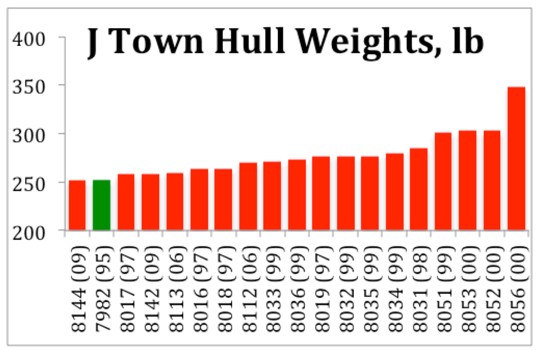
Although new boats were lighter at first, they gained weight rapidly and also showed signs of being poorly constructed, e.g. leaking from Day 1, water emerging from the foredeck when a fitting hole was drilled in a brand new boat and repair after repair being required to keep the boats serviceable. The boats were a drain on the owners' resources and were not fit for the community clubs' service.
What is not as obvious at first, but in my opinion is more important, is the effect that this build quality issue had on the growth of the class. I sailed for many years in the UK, which has literally hundreds of successful dinghy classes. In all of these years, my family never bought a new boat, and neither did the majority of our fellow sailors. Certainly not the newcomers to the classes we sailed. Good quality, competitive secondhand boats are the lifeblood of all successful dinghy classes and the quality issues with the OY boats post-1998 robbed the North American Albacore class of many years of inexpensive, competitive boats for entrants to the Albacore class. In the meantime, the class lost ground to other boats. RS boats began to be imported, many of these roto-moulded with expensive moulding tools, producing boats with very low unit costs (<10% of the cost of a fiberglass hull), perfect for teaching and training but heavy and without the necessary stiffness for racing. The class lost ground in the minds of potential consumers, in particular sailing schools, and the perception remains that the Albacore is expensive, old fashioned and not even a consideration for a fleet purchase.
Apologies for the long introduction, but it is important to set the scene for change, to create the burning platform. The class has suffered through little fault of its own, with quality problems that were not foreseeable, but had a significant effect on the class today.
Ok, a bit more history, the change in fortune for the class started in 2010. I had long been looking at the Pinnell and Bax's (a sailing supplier in the UK) price list and had seen the Ovington Albacore on the list. Fully fitted-out, it was an attractive price with the newly strengthened Canadian dollar. Ovington was a well-established respected boat maker in the UK, the boat was epoxy and looked better built. The clubs got together and against a counter bid by OY to improve their quality (for extra cost), the clubs chose to order a container of Ovingtons. The logistics were much more complicated, of course, but aside from quality and design issues with the (Canadian-made) foils, and somewhat unusual rigging, the boats were a huge success.
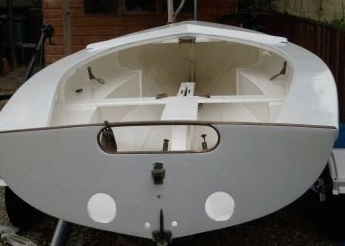
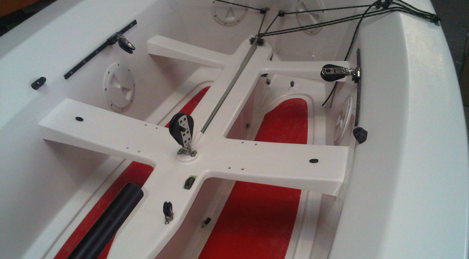
Due to the quality issues with the rigging and after a bidding process involving several other suppliers to fit out future orders, the Ovington boats have since been supplied by Rondar Raceboats, who fit out boats for Canada with rigging specs developed from the original Barney and Henry designs. An example of one of the specifications (the jib halyard) is included below. The specification now runs to 11 pages.
Rondar Raceboats have served the class well. Initial quality issues with their foils were addressed with modifications to oversized centerboards which were air freighted to Canada and then replaced free of charge with the next order.
So why the need for any change to and arrangement that has served the class well at a time when we desperately needed support? Our concern was raised with a change in staffing at Ovington, the partner who had been sympathetic and helpful to the class left and was bought out, immediately; holding of the current year's price for boats ordered by Dec 31st was not an option; the hull price increased significantly; and the NAA (UK National Albacore Association) increased their moulding fee (they own the moulds) for exported boats only – a change the CAA recently got reversed. With a change in the exchange rate, the delivered price of the boat increased from $14,100 Can to $17,800 from 2013 to 2014. Although some increase of price is inevitable, this large increase was a concern. The CAA wants the Canadian market to be in control of its own destiny but it was clear that there were many aspects of the boat's supply chain controlled by parties not interested in the Canadian class. To add insult to injury, at the 2015 internationals in Sarasota, we learned that Ovington had seemingly charged the individual UK buyers had significantly less than the bulk Canadian buyers.
Here are some points of pain of our current new boat supply chain:
- A complicated supply chain (CAA/NAA/Ovington/Rondar/Container/shipping/Duty)
- Cost is expensive compared to rival classes and there is no clear price for customers
- There are no routes of purchase for somebody who doesn't know the class
- There are no boats in stock, and are only available once/year at most with a 6-12 month lead time
- The boat itself is complicated and expensive to make compared to new designs
- The boat is 'old-fashioned' in looks and construction techniques
- The boat is made on a mould, that we do not own, and the hull mould is close to the end of its useful life
- No manufacturer is actively marketing the class
- Royalties from the new boats pass to the NAA and RYA not the CAA
Points 1-4 are clear to understand. A customer has to be very determined to buy a new boat to put up with the difficulties of the purchase process. The chances of attracting new buyers to the class are very slim and arguably these are the customers we must focus on hardest to attract to the class.
Let me focus a little on points 5 and 6. The Ovington is, quite frankly, the best looking and best constructed Albacore ever built - kudos to Ovington for doing a great job in creating new deck and interior moulds. The mould design, however, has many hours built into the construction that contribute to increased cost. Firstly, look under the inside of the sidedeck. There are three brackets for stiffening the seating area. Each one of these brackets has to be moulded, de-moulded, trimmed and glued in place. Ignoring the brackets, the hull is built in at least 5 pieces, again, all of which need to be moulded, de-moulded, trimmed and then glued. This is, or more accurately was, an issue for all traditional dinghy classes. They were designed to be home-built out of wood and, as fiberglass techniques evolved, the construction techniques mirrored wooden construction with many of the same labour inefficiencies. I remember talking to Ovington about the Albacore construction several years ago. The Albacore takes 5 days to build excluding rigging, whereas the more modern, much more expensive, 49er takes 3 days including the rigging, with only 2 parts in the hull mould – a hull and a deck.
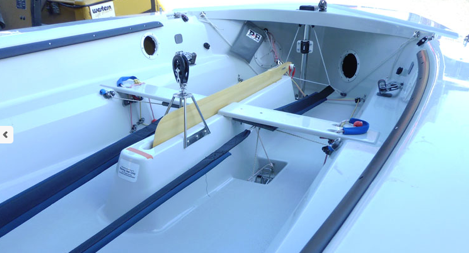
Almost all of the successful 'traditional' classes in the UK have redesigned their tooling to reduce the cost of manufacture of the boat and update the looks. The GP14, the Lark, the Enterprise, the Wayfarer, the Solo, the Fireball, the Cadet, the Scorpion, the Phantom, the Mirror, the Firefly, the Osprey, the Graduate etc. And yes back in the 50's when many of these classes emerged, they did have great sounding names!
These classes compete against the newly developed boats from RS, Ovington and other builders partly because they chose to redesign the boat to improve the cost of manufacture, which should also increase quality and reduce maintenance. Note in each case, how the buoyancy tanks are now part of the deck mould, and imagine how many hours of labour (and leak points) are saved by this. The boats also look modern and potentially more appealing to institutions – the main buyer of the new Firefly. The Enterprise has also been made self-draining, (note the recessed bailers – actually unnecessary now – potentially another $300 saved off the price of a new boat).
So that is the background. What is the current position? Firstly the CAA formed a committee to look at options for the future supply of boats, addressing as many of the listed points of pain as possible. The frontrunner by far is Rondar Raceboats themselves. They have proved good partners in the 3 shipments of boats so far and they were the manufacturer who completed the redesigns of the Firefly and Enterprise. This redesign and retooling is a process that is expensive and should be carried out by a company with a proven track record. Rondar have been chosen by other classes, most recently the Squib, to carry out similar processes.
Ultimately we would like to retain ownership of the moulds, with manufacturing options in Canada to supply our own market. Rondar previously entered into arrangements with the Enterprise class where the cost of the retooling was split 50:50 with the class association in exchange for a 5 year exclusive manufacturer clause. After 5 years, Rondar hope to have proven that they are good enough partners in manufacturing and marketing to continue manufacturing with the then association-owned moulds. It is an attractive proposition and as a first step in January 2016, Rondar applied to the RYA for a licence to build the Albacore for the Canadian market.
Initial discussions surrounding redesigning the boat took place, with some potential savings identified, examples of which are included below:
| Design Change | Estimated $CAD Saving |
|---|---|
| Modernized moulds, fewer pieces | $2500 in labour for construction and fit out. |
| Simplify fittings for community club boats | $1000 |
| Use polyester not epoxy | $450 |
| Self-draining hull (no bailers) | $250 |
| Total | $4200 |
If this process takes place, some decisions need to be taken early. The first would be the nature of the redesign of the mould: within the current rules, or optimized with small, non-performance critical changes in the rules to facilitate efficient manufacture?
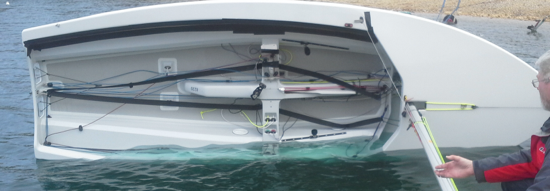
The self-draining hull or not self-draining is a particularly emotive topic for some. The boat will be cheaper to make, arguable more appealing for teaching (who nowadays sails a boat that remains filled with water after a capsize?). However the boat floats higher when capsized making the centerboard potentially more difficult to reach and the boat more likely to invert. Photographs from the initial tests by Rondar in the UK illustrate this design challenge.
Polyester is not only cheaper than epoxy, but stiffer and more easily repaired; epoxy has an inherent water resistance. The new Firefly is polyester, the Enterprise is epoxy. The argument is that the issues with the OY were not the fault of the resin material but of design and building practices. A well built polyester Albacore should last as long as an epoxy boat at a lower cost. This is not a decision that needs to be made early on; both materials can be used interchangeably on the same mould.
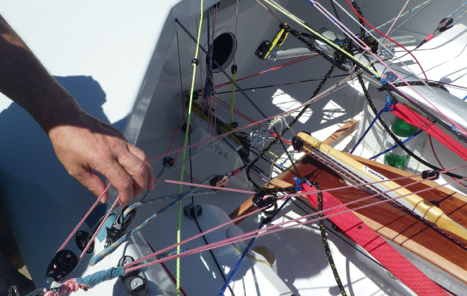
The fittings of the Albacore are very complicated and potentially intimidating to a newcomer to the class. Look at an RS vision ($11k including 3 sails) compared to a Hapco boat or the jib halyard specification earlier in the article.
A simplified rigging options would be a much better bet for a cottage sailor and the community club boat could also be reviewed for areas where savings could be made. All boats would be upgradable if desired in future.
Finally it is worth mentioning the marketing of the boat. It has been a long time, if ever, since the Albacore has had a builder with any interest in marketing. There would be a significant benefit to the class to have a builder invested in actively marketing the boat, brochures, online content, attendance at boat shows, meetings with institutions and holding some inventory of new boats and equipment. If the class can align with a builder that can and will support building the class, then we stand a better chance of appealing to the key market that is poorly served by our existing arrangement - the customer who does not yet know they want an Albacore.
That is the key takeaway, if any from this article. We must ensure that whatever process we ultimately follow we leave the class not only better serving the existing user base with a reliable supply of cost-effective, high quality, long-lasting new boats, but that we reach further and broaden the class's appeal to the thousands of potential new Albacore owners who we have not reached in recent years.
Breaking Through To Success
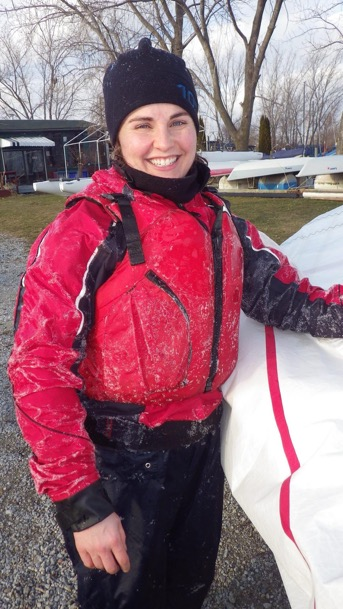
It is a bit daunting to write an article, as I am relatively new to racing and have only been sailing for four seasons! However, I was asked to share some of my experiences on my transition from crewing to helming during some of the races last year, and I hope that this can be helpful for other sailors looking to do the same.
I started racing in the second half of 2013, and spent nearly all of 2014 crewing – both in and out of races. But I realized that while it was great for many aspects of skill development, it wasn't enough for me to be a well-rounded racer – and I definitely was interested in eventually helming. At the beginning of the 2015 season I made a point of going out on social sails with experienced sailors who were more than happy to let me helm in various conditions. I received a lot of tips and got a much better feel for how the boat was going through the water on all points of sail. I also grew much more confident with my boat handling skills, and I was much less afraid that I would do something wrong.
The turning point in my desire to take my performance to another level came as crew in one of the Friday night races – I asked for feedback from my helm and was told I was doing something fundamentally wrong. I set out to correct this bad habit, and managed to do so within two races. I then made the decision to apply this type of learning to all sailing situations. Not be afraid to ask for feedback, and to actually practice what I'd learned.
I started to watch videos to see how other people managed the skill I was trying to learn, and then applied what I saw. Goals were very important – even small ones such as handling the jib sheets properly while tacking! I tried to ask every helm I sailed with on Friday nights what I was doing right or wrong in order to improve.
My breakthrough for success came when I was lucky enough to start helming with George Carter as my crew in the Toronto Harbour Masters, leading to a 3rd overall finish as a helm for the series. Obviously I had outstanding crew who was very experienced, but I also did a lot of active learning. I kept notes on each race all season as crew or helm – what I'd done right, what I'd done wrong, and one or two key points to learn or practice. We discussed each race in detail. I also listened intently to what others had to say about my races and also about their own – learning from a variety of situations. Do not be afraid to ask others about what happened during a race, especially if they are finishing ahead of you. Outside of racing, I took out new sailors often to solidify my own knowledge through teaching.
As crew I managed a second at the Canadians – this was the result of all the experience I'd accumulated throughout the whole season, including all the hours at the helm, and of course another great sailor as my partner. Helming so much during the season helped me immensely as crew that weekend, in better understanding the controls and tactics, and how we can work together as a team to compete successfully.
I had some good luck with the amazing people I sailed with, and I put in a lot of hard work on and off the water. I think anyone who is curious and eager can combine both and manage to do well, even in our very-competitive fleet. There is obviously so much more to practice, learn and perfect – and I'm sure this coming season will show me just how much work I have yet to do.
Race Management 101
101.1 Preparation
People/Boats: In the best of all possible worlds go for 3 boats - Committee Boat (minimum 2 people), Mark Boat (2 people) and a Pin Boat (2 people). If you are low in personnel the minimum people required would be 3 people on a committee boat: PRO/timer, gun/horn operator (number recorder) and flag operator (second eyes on the line). Everyone should be wearing synchronized watches.
Flag Prep: At a minimum make sure you have: Prep, class, general recall, individual recall, postponement, shortened course flags and, if not using a course board or a fixed course, course flags. Tie on as many flags as you have halyards at the dock.
Noise making and communication equipment: Make sure they are working!
101.2 At The Course
- Arrive on course a minimum half hour before
- Determine wind direction, strength and shiftiness
- Anchor based on observations and raise On Station Flag, only once anchored
- Wind strength determines length of upwind leg and whether triangle or Windward/Leeward course: Breezy = triangles for planing opportunities/Light = WL/ to give tactical opportunities
- Put out marks on the course accordingly
- Set a line across the wind leaving 1 1/2 boat lengths per boat in light to medium/2 boat lengths in heavy
- Set the windward mark in the middle of any oscillating shift - closer for light winds/further for heavier
- Adjust the start line at a right angle to windward mark with anchor
- If triangle course, reaching mark should be positioned to afford planing, preferably on both legs
101.3 Sequence
- Sound one minute prior to Class Flag at 5'/Prep flag up at 4'/Prep down at 1' and Class down at start. Make sure flag raiser is holding flag line as far up stanchion as possible so that flags and guns are synchronous.
- If a mistake is made during sequence, immediately postpone with 2 blasts and start sequence again asap, leaving at least a minute. Warning beeps are not necessary for a repeat.
- If a boat is OCS, the RC should notify them, and they don't retire immediately, they should be scored DND.
- If they do retire or they are not notified, then they are scored OCS.
101.4 Shortening Course
- Sometimes it becomes necessary to shorten a course due to: extreme conditions, loss of breeze or loss of light.
- Anchor and set a line beside any mark of the course before any boats have passed that mark. This is now the finishing line
- Raise the “S” flag (blue square inside white square) along with 2 sound signals once the lead boat has passed the last mark before the finish
101.5 Finish
- Using the windward mark as the pin, set finish line at middle of oscillation at right angle to the wind
- The line should be long enough that boats can choose a strategic finish but committee can still read sail numbers.
- Position pin boat with someone using binoculars if one has one
- Only one person only calls finishing numbers
HAPCO's Albacore Mast And Boom Manufacturing — Project Update
No tapered aluminum dinghy spars are manufactured in North America. This means the every mast on every Albacore must be imported from Europe or Australia. HAPCO has imported nearly forty masts into the United States over the years. Importing masts is fraught with difficulty, high expense, complicated logistics, and more often than not, one or all of the masts is/are damaged in shipping.
HAPCO does not have enough spars in stock to complete its present crop of Albacores and were loathing the prospect of ordering more. Out of the blue, we were approached by an old friend who manages an aluminum extrusion operation on the US East coast. He was interested in extruding spars and asked if we wanted to participate. This project is ongoing. The following describes progress to date regarding metallurgy, engineering & design, plans for manufacture, and related future work.
Metallurgy: We started by providing a few pieces of broken mast and boom sections to look over. They performed gas chromatography / mass spectrometry on the material, enabling an accurate elemental composition to be determined. From this it was determined the material to be 6082 aluminum, a common European alloy that is not normally used in the USA. Tensile testing is where a thin sample is stretched to destruction while accurately recording the force and elongation to determine the elastic modulus, tensile yield stress, and failure mode. We found the other masts material strength to be nothing out of the ordinary– in contrast to what the promotional literature would have one believe. An aluminum alloy that would exceed these properties was found in a variant of the popular 6061 with a touch more magnesium that should, according to calculations, result in 8 or 10% greater tensile strength and a similar increase in elongation. The significance of constructing a mast of this material is that it can be flexed to a greater degree before it takes a permanent set.
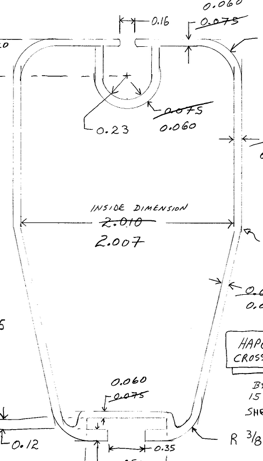
Engineering & Design: We compared cross section properties of popular mast sections including the D, M2, M7 and came up with a section with a stiffness in between the M2 and D. Having sailed extensively with both I have always considered the M2 to be upper limit of stiffness for an Albacore while the D was, in some conditions, too soft. Our mast section will have a stiffness that we have targeted to be somewhere in between. We were scrupulously careful to NOT simply copy any other mast section. This cross section was laid out in 2-D CAD. We used the CAD program's features to calculate the area moment and section modulus – two parameters engineers use to relate the strength and stiffness of beams. We had several detailed discussions on exactly how precisely a die manufacturer can hold its tolerances, and the variability of resulting extrusion, and the likelihood and bounds of deviation. We performed studies on the mast section stiffness and strength that would result if the wall thickness came out a bit thicker or thinner than intended. We then performed several studies where we explored the range of potential extruded sections. The final design was selected to maximize the likelihood of a useable product.
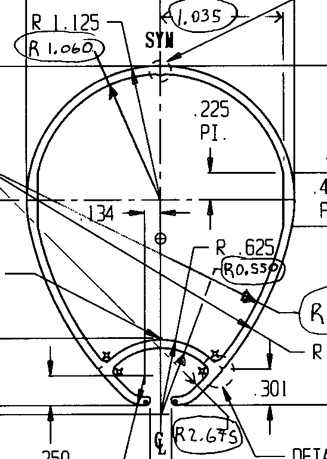
Assembly Guide Marking: Having assembled a bunch of masts I have always found it difficult to accurately find the center of the front side when installing halyard sheave boxes, mast ram tracks, and jib stick rings. Similarly when cutting halyard exit openings I always had to measure and double check that we were not cutting through the web at the back. So we designed small grooves in the front center of the mast and on each side at the confluence of the exterior and web to guide riggers. We put a small bump on the inside on the front to make up for the material missing in the groove.
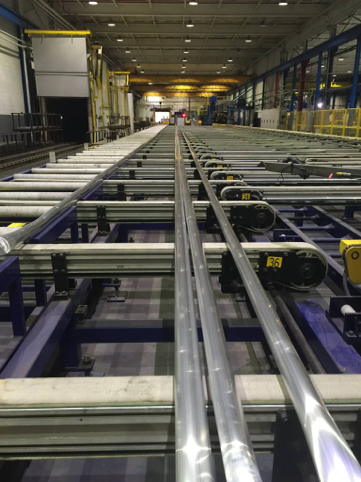
Initial Extrusion: We extruded several hundred feet of mast samples for testing. The wall thickness and dimensional fidelity looks good.
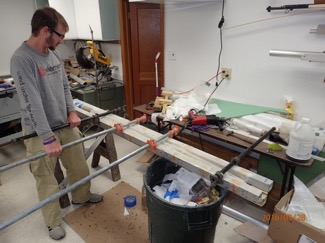
Tip Taper: There have been two methods used in the past. First is two sharp V cuts made on either side of the mast. The front and back are them brought together and welded on both sides. This was common practice on older spars. The second method is to make a v-shaped cut in the front of the mast and then bend the sides together and connect them with a single weld. The vast majority of new mast tip tapers are created this way. Our initial approach is the single cut on the front of the mast. It took a bit of head scratching to figure out how to make the taper cut. For our first attempt we simply cut the front of the mast off on a band saw. This resulted in a too much material being removed at the bottom end of the taper. For our second attempt, we measured the external distance around the prismatic section of the mast using a flexible tape. We then measured the external distance at two inch intervals from the start of the taper to the tip. We subtracted these from the prismatic external distance and marked half this distance from the front centerline to each side. This will be a better starting point for cutting the taper. We constructed a fixture to bend the cut mast tip into a tapered shape for welding. This fixture is designed to hold the mast in between two fiberglass forms mounted to a hinged structure. When brought together, the forms will force the cut mast tip into the taper form. That's the theory. This facet of the mast manufacturing is still in process.
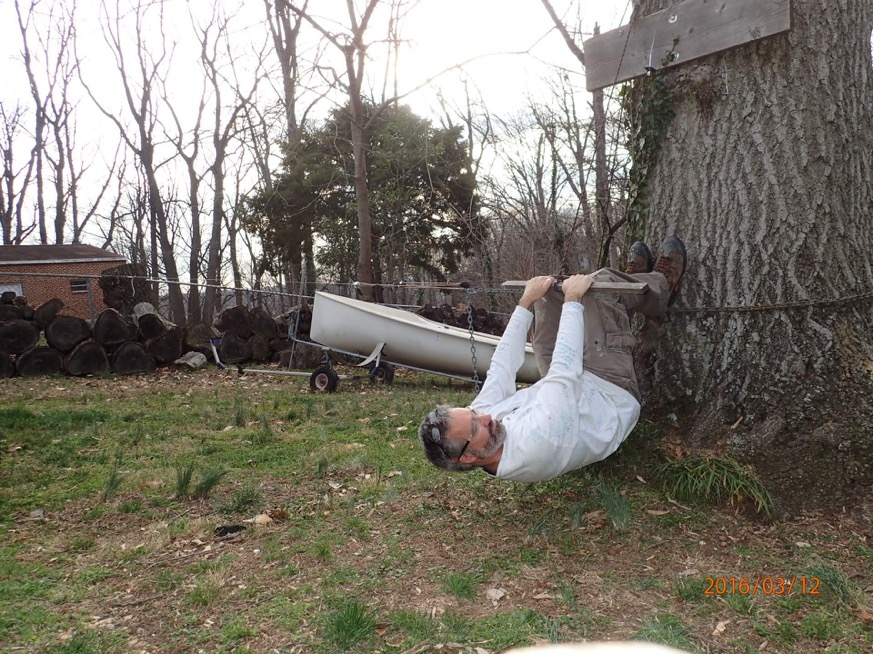
Rigging: We now procure out own wire rope and terminations and perform our own swaging, reducing cost but more importantly reducing lead time and logistic headaches. We audited standards for wire rope assemblies and found that a proof test at 60% of break strength was adequate to weed out any bad swages and yet not damage the wire rope assembly. HAPCO set up a simple rig between two trees to test each shroud, using a cascaded block system and human test weight. We first pulled several shrouds to destruction and confirmed the failure mode showed that we were getting the full designed strength. Since then we have and continue to proof tested every swaged wire rope assembly we make.
Future Work: With the design of the spar in process we started to examine other aspects of the Albacore's rig including the boom, spreader bracket, and a main halyard locking device.
Boom Design: We looked at the various boom products in use and have done some engineering and design for a boom. We note that the most common mode of failure for a boom is being bent around the side stay during a high wind gybe or capsize event. I note that all other booms are prismatic – that is they do not vary along their lengths. The HAPCO boom is designed to be a bit taller and therefore stiffer in the vertical direction than other booms. To keep weight below current designs, we have designed the interior width to be just a small amount wider than a stock architectural aluminum channel. It is our intention to have a short length of this channel inserted within each boom and centered about the point where the shroud contacts the boom when eased out. This will greatly enhance the strength in this one area while not adding much to the overall boom weight. A better engineered design that will both perform better, by way of its greater stiffness and lighter weight, while having greater strength margin for the most common mode of failure. This design is still only on paper but we hope to produce some this summer.
Spreader Bracket: It is HAPCO's intention to develop a new spreader bracket design with integral jib stik turning block mount. The spreader positioning will be similar to existing bracket designs. The block mounting feature will serve to keep the jib stik away from the mast and reduce scuffing. Better to suspend this block from a purpose built piece of hardware rather than the various kludged means employed thus far.
Main Halyard Lock: This system will incorporate a locking device that will suspend the main sail from the top of the mast. The main will still be hoisted and lowered on a halyard in accordance with class rules, but the tensile load of suspending the main will be applied at the mast top and the halyard will be slack within the mast. This feature is still on the drawing board but we expect a prototype this summer.
This work has been fit in and around our boat construction projects. HAPCO has been simultaneously assembling THREE new Albacores that will be on the water this spring, bringing the total boats constructed to fourteen. In addition HAPCO has molded parts for two more hulls. These next two Albacores will be fitted with HAPCO spars. We hope to have one on the water later this year.
Your 2016 CAA Executive Board
| Rear Commodore & Canadians Regatta Chair | Darren Monster |
| Commodore | Ian Brayshaw |
| Past Commodore | Mary Neumann |
| First Vice-Commodore & Race Chair | Michael Williamson |
| Second Vice-Commodore & Promotions | Graham Pearson |
| Third Vice-Commodore & Education | Frank Loritz |
| Secretary | George Carter |
| Membership Secretary | Michelle Adolph |
| Treasurer | John Cawthorne |
| Chief Measurer | Ken Yamazaki |
| Specifications Committee Chairman | David Weaver |
| Editor, Shackles & Cringles | Tannis Baker |
As always, the editor would like to thank everyone for their generous contributions. Please feel free to send me material!
© 2016 Canadian Albacore Association | www.albacore.ca