Volume XLIV, Issue 9, Summer 2003
June 01, 2003
Ann Savege's Commodore's letter previewing the 2003 Albacore Internationals in Kingston and a buoyancy-certification rule change, an Outer Harbour Centreboard Club regatta flyer, Heather Macnaughton's Internationals registration update, the Preliminary Notice of Race for the 2003 Canadian Albacore Championship, George Roth's "The Albacore" class overview reprinted from Canadian Yachting, Peter Duncan's long-form "Sail Faster" guide to moving up the fleet, a blank Sailing Skill Scorecard self-assessment form, and the 2003/04 executive contact table.
Letter from the Commodore
Hello Fellow Albacore Sailors
Well, what a spring – or lack of it – so far this year. We can only hope that the summer makes up for the lack of friendly weather in May and June (as I write this it is raining and cool yet again).
Albacore International Regatta 2003
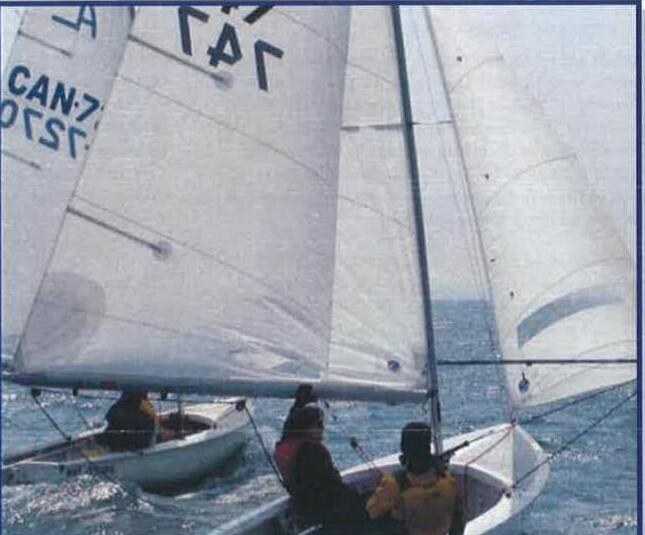
However sailors are hardy beasts and the keen racers have long been on the water with many racing programs in full swing. Enthusiasm is high as the racers prepare their minds and their bodies for the Albacore International Regatta 2003, a week of racing in Kingston in July. It is Canada’s turn to host this regatta and we will be welcoming our own sailors as well as those from across the ocean and across the border to this world class sailing location.
It takes a lot of time and effort to put together an international regatta – to find a challenging and accessible location, top quality race management, affordable and convenient accommodation and social venues. The CAA would like to thank the Event Committee, chaired by Heather Macnaughton and including Christine Short, Yvonne Howard, Karen Piatkowski and Leslie Connell who have worked hard to make this event happen.
Be sure to check the results in the fall issue of Shackles, or on our web site after the event.
Buoyancy
By now boat owners will have received the appendix for your measurement certificate that reflects the changes made to the buoyancy section of the Albacore class rules – Rule 4 – by the Royal Yachting Association in England, which maintains the class rules. It is still a requirement that your boat be tested annually for buoyancy – it is just good common sense to do this – however the buoyancy certification process has been changed from a buoyancy test that is performed in front of a witness to self certification by the boat owner. An added requirement is that the owner’s signature on the buoyancy declaration must be witnessed by a person designated by the CAA. The CAA has designated that an official of any sailing club can witness your signature. We believe this will give all boat owners access to an appropriate person for the signature witness requirement.
The buoyancy of your boat is a critical safety factor and we would encourage all boat owners and boat users to maintain your boat for an appropriate standard of buoyancy. STAY SAFE.
Please check this newsletter and our web site for Albacore news and information on other events.
Happy sailing!
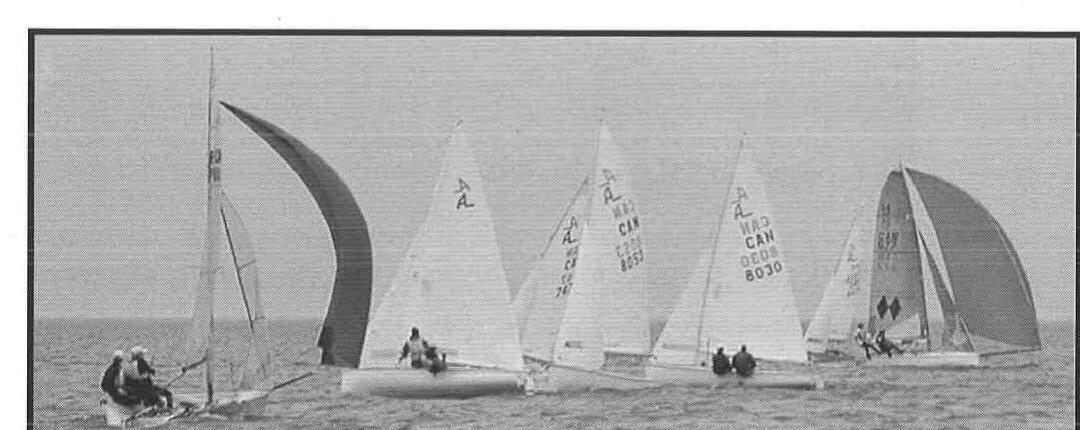
Outer Harbour Centreboard Club Albacore Regatta
Registration: Outer Harbour at OHCC
Races: On the lake, weather permitting.
Cost: $55 per boat
Includes: breakfast – coffee, juice, muffins…, happy hour, dinner, prizes (for best cross-dresser)
Lunch: Bring your own. Lunch is on the water.
Extra Dinner: $15
| Schedule | |
|---|---|
| 9:00 a.m. | Registration |
| 10:00 a.m. | Skippers Meeting |
| 11:00 a.m. | 1st Race 2nd Race to immediately follow first Race |
| Lunch time to be determined by the Race Committee | |
| 2:45 p.m. | 3rd Race 4th Race to follow 3rd Race, time permitting |
| 4:45 p.m. | Cocktails |
| 5:15 p.m. | Dinner Awards |
All times are approximate and weather dependent.
(If 4 races, best 3 to count, if 3 or less races, all to count.)
Albacore Internationals
The Albacore Internationals will be held in Canada during the week of July 20 to 26, 2003 in Kingston, Ontario. Canada has not hosted the Worlds since 1995 so we are looking forward to a great week of events.
The Internationals committee has been working hard all winter putting together an excellent program and obtaining lots of goodies to give away.
Our committee consists of all ladies!! The committee is Christine Short, Karen Piatkowski, Yvonne Howard, Leslie Connell and myself.
The first 60 registrants (both skipper and crew) will get both a Cork Mount Gay Hat as well as an Internationals cooler bag. Goodie bags are at this moment being worked on to give to all participants and we have a whole array of useful items for everyone to enjoy throughout the week (lip balm, suntan lotion, etc.). In addition, we will have draw prizes daily at our Apres Sailing Albacore Pub.
Registration is going very well with now over 50 boats registered and 4 to 5 more expected from the UK.
Henry Pedro has been working hard on arranging charters and although the container from the UK is no longer going to happen, we believe 5 to 6 boats will be in attendance from the UK via charters.
Windshirts – we have lots of fantastic windshirts and would like to offer them to all members of the class to buy. They are an Internationals momento as well as a great windshirt. They retail at $120 and can be bought through the CAA for only $69 plus tax. They are waterproof as well as breathable.
Looking forward to seeing you all at the regatta in July!
2003 Canadian Albacore Championship
Invitation: The Canadian Albacore Association (CAA) invite you to attend the 2003 Canadian Albacore Championship Regatta to be held Friday through Sunday, September 12 – 14, 2003.
Site: The 2003 Canadian Albacore Championship will be held on Lake Ontario.
Eligibility: The 2003 Canadian Albacore Championship Regatta is open to Albacore class sailors who meet all class membership and yacht measurement requirements and who have paid all event fees before beginning official competition. All entrants must be members in good standing of the CAA and/or USAA. There will be a Championship fleet and a Challengers fleet. Helms who have won the Challenger fleet trophy are not eligible to helm in the Challenger fleet.
Rules: The 2003 Canadian Albacore Championship Regatta will be governed by the 2001 – 2004 Racing Rules of sailing including changes issued by the ISAF, the prescriptions of the Canadian Yachting Association (CYA), and the rules of the CAA, except where altered by this notice of the Regatta Sailing Instructions. In the event of conflict, the Regatta Sailing Instructions will take precedence.
Scoring: The low point scoring system will apply. The completion of one (1) race constitutes a series. One throw-out will be allowed providing at least five (5) races are completed. The intent is to complete at least seven (7) races.
Measurement: All boats must be accompanied with a valid measurement certificate and a current buoyancy endorsement. All boats must comply with CAA measurement specifications for this event. No provisions will be made for issuing new measurement certificates or buoyancy endorsements at this regatta.
Registrations & Fees: On site registration will be available. The entry fee is $160.00 Canadian per boat. Please make cheques payable to Canadian Albacore Association. The entry fee includes all racing, regatta awards, Friday barbeque and Saturday dinner.
Accommodations: The following have been reserved: 10 rooms at Days Inn Beaches. Rate: $99.99 Cdn. plus taxes per night. Rate includes overnight accommodation, two double beds, complementary continental breakfast, and parking. Smoking & non-smoking rooms available. Add $10.00 for each add.person/room. Bookings: 416-694-1177, dial “O” for front desk. Reservations are under Swiatlowski/Albacore Racing Regatta. Book before September 3rd, 2003.
10 rooms at Quality Hotel Downtown Toronto, 111 Lombard St. Rate: $140.00 Cdn. plus taxes per night. Rates include overnight accommodation, 1 queen bed c/w pull out sofa, deluxe continental breakfast buffet. Max. 4 per room. Parking extra. For reservations call 416-367-5555. Quote group number of #15927. Book before August 12th, 2003.
| Schedule | ||
|---|---|---|
| Friday, Sept. 12 | 09:00 – 11:30 | Registration |
| 12:00 | Skipper’s Meeting | |
| 13:00 | First Gun 2 – 3 races, no race to start after 16:00 | |
| 19:00 | Barbeque at Mooredale Sailing Club. Draw: Door prizes | |
| Sat. Sept. 13 | 10:00 | First Gun 3 – 5 races, no race to start after 16:00 Lunch on the water. |
| 18:30 | Cocktails at Ashbridges Bay Yacht Club | |
| 19:00 | Dinner & AGM | |
| Sun. Sept. 14 | 10:00 | First Gun, 2 – 3 races, no race to start after 13:00 Awards to follow ASAP after racing. |
The Albacore
Dinghy sailing is a passion for many and enjoying keen racing in Albacores is part of that passion.
But an Albacore … What is it?
A 15ft vision of the boat’s designer, Uffa Fox, who planned the design in 1948 in England as a simple planing dinghy for the active sailing community – perfect for family, or friends, for racing or pleasure, or instruction. The Albacore today, 42 years later in Canada, still fulfills those ideals. Hulls are built of various materials such mahogany cold rolled over a mould, or as in Canada today, foam core fiberglass reinforced. Spars are Aluminum to a height of near 26 ft with foils made of laminated Sitka spruce wrapped with fiberglass coating.
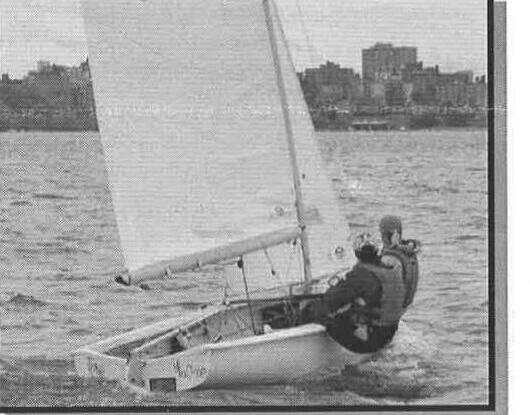
A licensed builder, Ontario Yachts of Burlington Ontario, constructs all new Canadian boats. The building specifications require the hull measure to the International Class rules that are maintained as part of the copyrighted design. The Class Rules have been designed to establish the measurements and specifications that describe the Albacore design. The rules can only be changed by joint agreement among the member associations of the International Albacore Association.
The Albacore by definition has been a one-design class since its inception. The objective of the class is to maintain a standard that is simple and withstands idle design tinkering which does not add value to the performance of the boat. Clearly, by keeping fairly rigid standards, boats built 55 years ago can compete effectively with hulls coming out of the moulds today. Most importantly, the Albacore owner does not have to incur the unnecessary expense of constant upgrades in the hull. Thus, competition occurs among boats of equal caliber on the water. The bottom line is … It’s the performance of a crew against a crew that is what counts.
The Canadian Albacore Association (CAA) is the national association of Canadian owners of Albacore dinghies. The Association was formed in 1961 and celebrated its 40th Year of operation in 2001. Rumor has it that the late Bill Gooderham created the demand for this new hot boat back in the early ‘60s simply by planing back and forth on the Muskoka lakes. Wide-eyed cottagers apparently lined up with cheque books in hand at the end of their docks to place an order for the Albacore (then imported from England) following his display. A planing Albacore still has the same effect on prospective boat owners 42 years after its arrival in Canada but with one added benefit. The Class now has a history supported by a well-established Class Association.
The CAA is one of five international fleets of Albacore owner Associations. The other officially formed fleets are in the United States, England, Scotland and Ireland. Additionally, we often hear from less formally structured groups in Cyprus, France and Wales.
The Association has come along way on the strength of its volunteer executives and members since 1961. Today, the major fleets are concentrated in the Ontario cities of Toronto and Ottawa where regattas and club events occur weekly during the active sailing season. There are large groups of Albacores sailing in the Ontario South-West and regional areas of Muskoka and Halliburton lakes, many as pleasure sailors. Smaller fleets sail in British Columbia, Alberta, Saskatchewan, Manitoba, Quebec and areas of the Maritime Provinces on small lakes or man-made reservoirs. Many boat owners enter the class by buying a previously owned hull and later trade-up to a newer hull.
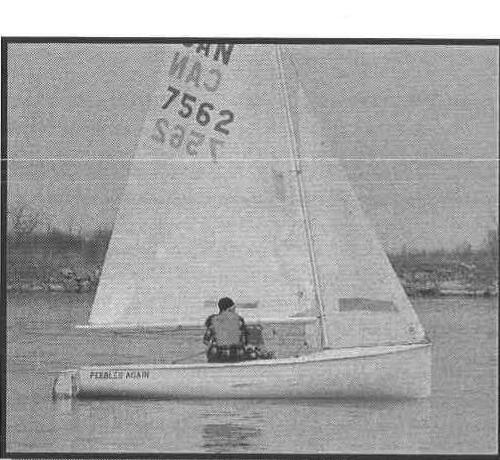
Maintaining the competitive side, International “worlds” events are held on a bi-annual basis, rotating between Europe and North America. In 2003 Canada hosts this event in Kingston during July 20th to 26th using the sailing venue of Lake Ontario. The CAA will welcome sailors from England and United States to make a fleet upwards of 60 boats.
In the Toronto area there are schedule regattas and club races beginning in May running through September. It is easy to enjoy as a spectator from either the Inner Harbor or Outer Harbor Cherry Beach area, keen club races between the Community clubs on Friday evenings. This event alone attracts from 45 to 70 boats in a race, many are beginner sailors being introduced to the passion of Albacore sailing. Some seasoned sail observers have stated that this represents the largest on-going club race series in a one-design dinghy class worldwide. Quite an honor for a 55-year-old design.
Community clubs are unique in the Toronto sailing society. They allow many to enjoy, learn and gain experience on a low cost investment. Members join a club, who own the hulls. Older club members instruct and introduce newer members to the finesse of sailing in a race. This allows many to ease into the true sport of sailing, gaining some of the passion.
But what is it like to handle these round bottomed, flared to a tapered flat shaped hulls that allow this passion of “planing” action?
From the eyes of a seasoned competitor, some word pictures as a race progresses … We call it an adventure!
To make “Albs” go well in a breeze you need several things to come together all at once. A well-tuned boat is a given. Making it give the jubilation you want results from having two people in the boat who understand it. In a breeze, when the crew, understands the tactics of boat handling, performance comes easy. You can both relax and enjoy the moment regardless of the weather. What you do is to live on the edge, pushing the boat to the extreme, especially on the beam-reaching legs of a course – reaping the flight down the wild side of dinghy sailing that’s the dream in all of us.
Now the race. The weather mark is not quite a 1/8 inch on the horizon, if you can see it off to the north, as is the gybe mark to the west, all set for us to pass to port!
Bang! The gun goes and were off – oooops one guy is over. The rest of us hike our butts off as we try to go to windward across whitecaps in the bay. Then, we’re there at the mark. One boat that went to the right is trying to slip in first. Another is there … still another is following next … and off we go down the broad reach, up on a plane, then gybe, and were all on a screaming beam reach. Higher, faster we go … more for the passion … more screaming for that “fix.”
Another gets to the leeward mark first. We’re on his heel. Back to weather … tack … flatten … hike … head up … drive the boat … tack. We’re crossing him. Here comes still another on the starboard lay line … Up …
“Man overboard!” comes the voice from the yellow boat … “Up, Up” … Was he bluffing? (No, he wasn’t as his quick crew fell out, then climbed back aboard without the skipper and the boat skipping a beat!) Off again on the broad plane, then gybe … then scream! More screaming as more gusts hit. Back to weather … Finish … we got him! … Wow … a first!
But the “fix” will carry on as we all roll the mind images on reruns in those moments of daydreams. May there be more days of this celebrated Albacore sailing passion!
To find more check the class web site, www.albacore.ca.
Sail Faster: Tips for moving up in the fleet
It’s New Years Day 2003 and I’m sitting in Vermont looking at snow, snow and more snow and wondering which resolutions might move me closer to the front of the fleet. Moving up, after all, is why many of us play this game. How we go about learning to sail faster, however, is not always the most effective. So in keeping with the saying, “you teach best what you most need to learn”, here is a look at what I think has helped me move closer to the front and my plan for this year.
Some History
Contrary to some of the rumors, I was not born in an Albacore- but it is not far from the truth. And while recent years I’ve been hunting around the front half of the fleet, those of you who have long memories know that I’ve spent more time below the middle of the fleet than in the front half. So I write not from the point of view of a “champion” or an “expert,” but someone who has learned a lot from the ups and downs of over 30 years of Albacore sailing.
I started racing an Albacore when I was 10 years old. As a kid you get plenty of coaching and advice, even if you are too hard headed to accept it. In spite of my thick skull (and to the credit of my father’s patience and demands of my instructors) some things did sink in. By the time I was in my late teens I’d learned enough to graduate to “A” fleet. While I did not sail in college, my first job as a high school teacher did allow me lots of time to sail in my early 20’s. I took some of the advanced clinics run by the Ontario Sailing Association, and one summer made sure I sailed 1 to 4 hours every day for about 60 days of the summer. The year following that summer I reached a peak in my sailing career. Ten years of experience, some formal instruction and a summer of intense (but mostly solo) practice got me to 11th out of about 45 boats at the 1982 North Americans.
Then I moved to California, went back to school, dismantled Never Again (#342), and started a family. Crewing on an I-14 and occasionally helming a borrowed Albacore in Nationals was the most sailing I could fit in for over 10 years. My position in races I did sail sank to the back of the fleet. Though I try to forget, I was about 26th in a 30 boat fleet in 1991. In 1992 I completed the rebuild of Never Again and began the task of clawing my way back to the front of the fleet.
About 15 minutes after I finished attaching the pintles, I was sailing my first race in my rebuilt boat. No practice, no tuning … just throw it together and go. In spite of good intentions, I continued to spend about 90% of my time in the boat racing and only 10% practicing. But the times I did find to go out and practice often created measurable decreases in my distance from the leaders. Now after another 10 years of working at it I’ve made it back to 11th in North Americans, but I really don’t want to wait another decade to close the gap. So what works and what doesn’t?
What is sailboat racing all about?
Sailing is a sport of perfection. Unlike many sports where you can perform some heroic feat to win, a sailing race is more often won by NOT MAKING MISTAKES. In a one design class the boats all travel about the same speed. For a given set of conditions the laws of physics limit the maximum speed of a dinghy. You can’t just press an accelerator to go faster and push yourself to the front of the pack. Once you slip, you tend to only “catch up” when others slip back to you. Those who finish in the front spend more time sailing at the maximum speed for the conditions that others in the race. Each momentary lapse of concentration, each poor tack, each moment pinching slips you back from the ideal race. Each moment you slip back, you risk falling into bad air which forces you back even faster.
Practice, Not Racing, Makes Perfect
To get to the front we need to PRACTICE every move so that it becomes second nature- so that we approach perfection in every aspect of boat handling. Break down every maneuver into its smallest part and practice each part until it is perfect. Then assemble the perfected parts into a perfect maneuver. The day before the 1998 Nationals, Marc Witowski and I practiced leeward mark roundings with Jasper and Becky Craig for about 45 minutes. In that time we did about 20 approaches working steering, whisker pole handling, set up for the next leg and maximizing acceleration around the mark. In that regatta there were several occasions where we were able to gain 4-5 places at the leeward mark due to our superior roundings. The past three years I’ve been practicing about 5-6 days and racing about 25-30 days (20%). This year I plan to try to double the practice time achieving a 40% practice to race ratio.
Master Boat Handling and Racing Will Follow
Early on I learned all about starting technique, rules, tactics, windshifts, tuning and more. All the while I sailed upwind with the boat heeled at least 10–20 degrees. I gave away more distance from not having the boat flat than all other things combined. I would have been far better off to spend my early time learning how to depower and control the boat in more than 8 knots, rather than all the racing techniques. Even today sailing flat is one of my biggest weaknesses. If the boat does not feel like it is heeling to windward it is not flat enough. I need to do several hours of PRACTICE (in 15–20 minute sets) sailing with the boat heeled to windward 10 degrees (a floating card compass makes a good level) and the crew screaming at me if I don’t do it. I need to practice this with my eyes closed. I need to be able to do this in 5 knots to 35 knots.
Learn It All Over Again
Learning to sail comes in waves of repetition with each repetition taking the skill to the next higher level. Take tacking (or gybing), for example. I learned to tack the first day I learned to helm. By the end of the day I thought I knew how to do it pretty well (Just imagine a cocky ten year old). But as I discovered when I started to race, tacking in open water to get home is very different than tacking on a crowded windward leg. Then there is learning to roll tack … then roll tacking well … then roll tacking in all conditions…then learning to do plant a tack right on a competitors wind…and so on. Trying to learn to do a perfect roll tack right on a competitor is not something you can learn in one day. You have to build up to it. You can’t do it if you don’t have the experience to judge the relative speed of boats or the skill to steer within a few inches of a desired spot.
I watch a lot of sailors struggle through tacks. This is one of the easiest things to improve. Next time you are sailing to a race or waiting for a start, do a set of ten tacks. Start out slow and deliberate. Analyze your tack and pick out the problem spots. Look at your wake – did you turn 90 degrees, or more? Work on perfection (at what ever level you are at) rather than speed. Analyze the elements of the tack and practice the parts (half tacks, just the luffing, how long to hold the jib, etc.). Watch or ask others to learn what top sailors do. Then practice some more. Keep the tacks slow, but reduce the interval between tacks down to 20 seconds (count aloud) and then down to 10 seconds or less.
On several occasions in the past two years Dave Niblett and I have done extended tacking drills going 15–20 minutes tacking at short intervals. At one practice we tacked the length of the Toronto harbor three times in a row. The importance of good tacking became clear at the Canadians in 2002 when we got in a tacking duel with Kevin Smith and Raines Koby on the final leg of a race with first place at stake. Raines and Abby tacked perfectly and extended their lead. We were able to come out of our tacks flatter and with more power than Kevin. We gained on each tack closing a three length lead to three feet before we ran out of race course. But what if we had been just a bit better. We would only need to have gained about 2 inches more on each of twenty tacks to have moved into second place.
It’s All Practice
I used to go to regattas to do as well as I could. Now, thanks to advice from Barney Harris, I go to regattas TO LEARN. I have a plan for what I’m trying to accomplish at a particular event. While I’m still trying to compete, I’m also focused on using the time to build a skill. At Mid-Winters I’m often working on starts and boat handling (since the short course format emphasizes these). At Mid-Atlantics last year it was team work – separating duties and communication. This was the first event of a two year commitment to race together through the 2003 Internationals. We needed to work out who would do what (in most cases) and develop a common language so we could communicate efficiently in the heat of battle. Dave and I will be putting in more time on that this year. When things are happening fast there is no substitute for each knowing what they have to do with minimal discussion.
So go to as many events as your schedule allows. Don’t avoid Nationals or Mid-Atlantics because you are afraid of big fleets. Use that as an opportunity TO LEARN how to sail in big fleets. Don’t be intimidated by the start. Find an open spot away from the crowd and practice being on time and moving fast as the gun goes. Don’t let frustration prevent you from learning. There will be many boats going better than you. Try to match them. Try to observe what they are doing differently. Try to remember the situation and discuss it with them over a beer after the race. Most Albacore sailors are only too happy to offer advice to those who are willing to come out and give it a try. The most important thing is to SHOW UP AND TRY. It is very hard to improve sitting at home.
Reduce the Variables
Sailing is a very complex sport. It is mental, physical and emotional. It has equipment, wind, sea-state and competition factors. With so many variables to keep track of, anything you can do to reduce these will improve your chances of getting to the top faster. Simplify, simplify, simplify. I know Mega Woof (6434) is tricked out with every string Barney has invented and a few more I’ve added, but I really make 90% of my rig adjustments with three strings (sheet, vang and jib halyard). When I first re-rigged Never Again (342) in 1992 it had very few strings as I re-learned how to sail.
Study the fleet and you will see almost any kind of boat with any kind of sails can do well in the hands of a good team. Select a brand of sails (preferably one that has a current tuning guide) that you like and stick to it. Learning to reproducibly set one suit of sails is more important than any reported speed advantage of a particular sailmaker. Pick a hull that is competitive (I’d argue almost any hull above #6800 can get you to the top quarter of the fleet) and rig it to a level that suits your skill. Having strings for everything does you no good if you don’t know what to do with them. Start with an easily adjustable vang. Next add an adjustable jib halyard. If you have a bunch of other controls, consult the tuning guide or ask someone who does well with your brand of sails where to set these controls for average conditions. Mark these and leave them there until you get to the point that you feel you have reached a plateau and you understand how that control can move you ahead of you peer group.
You’ll notice Mega Woof does not have a deck mounted mast ram. Many have urged me to add one. I’m not sure I know how to use it to great advantage. I’m not sure my Sobstad sails need it (they need much less mast tuning than Norths). I can’t tell you how many places I’ve lost when I’ve forgotten to undo a ram or prebender as conditions have changed. Maybe I’ll have one some day, but only when I’m convinced that is the thing standing between me and the next step to the front of the fleet.
Tuning and Boat Speed
There is nothing like a well tuned boat to propel you to the front of the fleet. But there is no amount of “boat speed” that can overcome poor boat handling and weak sailing skills. All the boat speed advantage one might get out of ideal rigging and equipment can be nullified by poor tacks, poor upwind steering or allowing the boat to heel 10 degrees. Time after time I’ve seen sailors agonize over their “slow boat” or poor equipment commenting on how much better they could do if they had a faster boat. They eventually get the “faster boat” and they go just as slow. Drop a good sailor in almost any boat, and they emerge near the front of the pack. For ten years Jasper and Becky Craig consistently sailed an average boat (#7127) with average rigging to the front of the fleet.
Boat speed that comes from optimizing tuning does matter. Ultimately this will determine who wins among the top 5–10 places. Getting to the optimal tuning for your boat and sails is an iterative experimental process. It proceeds in small increments and you can ONLY learn it when your boat handling is good enough to not mask what is going on with tuning.
In about 1995 I went out for a practice sail before Nationals with Barney Harris and a few others. We were in about 12 knots of gusty wind and pass after pass others were faster. Trying to help out, Barney was telling me to tighten my vang and add more rake to depower the rig. I tried this, but had little success. It was frustrating. Then Barney hopped in my boat and crewed for me. It was then the real problem was discovered. I was cleating my main which slowed my response to the gusts. When each gust hit, I heeled 10-20 degrees before I was able to ease the main. Even when I eased the main, I didn’t get the boat flat. To compensate for the helm I was tugging on the tiller and steering a highly variable course. Once I concentrated on these elements of boat handling and steering, I was much more competitive with the other boats. While my sail adjustments and tuning might not have been optimal, my boat handling was much worse. I could have read books on tuning and spent weeks on adjustments and never improved because a bigger problem was overwhelming the adjustments I was making.
When you look at the boats the leaders sail, I’m always amazed at how differently they are set up. Chris Gorton and Barney Harris are two of the best North American sailors. They both use North low aspect sails, and they disagree on more tuning settings than they agree on. They have different sailing styles and their set up works for their style. My point is there is not one answer.
When you start out, copy the best. Find several people at the front of the pack who have a boat and sails similar to yours and ask them if you can measure their settings (most will let you). Duplicate these on your boat. Most critical items are mast butt position, leading edge of centerboard, mast rake (as set by shroud position), spreader length and sweep, and jib fairlead position. Calibrate your jib halyard so you can compare and record your rake/rig tension (as set by the jib halyard) under various conditions. Make sure all wet surfaces are fair and very smooth- especially foils. Make sure mast and foils are aligned with centerline of boat and shimmed to take out all side-to-side play. A few hours of fooling around on shore is all it takes to make these adjustments.
Once you are set, go sailing. Work on boat handling, steering and sail set (sheeting, vang, jib halyard and other sail adjustments) issues until you are sure these are not holding you back. After each race or practice session, analyze why other boats beat you. Only when you are convinced that boat handling is not the cause should you return to experimenting with tuning elements.
Handling the Big Blow
For a lot of people one of the biggest challenges is learning to handle a boat in high winds. When it blows things happen much faster, leaving less time to think and placing a premium on knowing things instinctively. There is also the fear factor – fear of breaking the boat, fear of capsizing, even fear of survival in really wild conditions. All of this is very real and everyone has to find their own way through it.
Good news is that the Albacore is tough, seaworthy boat. If maintained in good condition. Annual checks of buoyancy tanks, standing rigging and high load fittings should keep the equipment from failing. With sound equipment an Albacore can be sailed in winds well over 30 knots with the weight of two adults on board.
The biggest problem then is to develop the knowledge and experience to handle these conditions. Get over concerns about capsize by trying it (several times) on purpose on a calm day. Once you are confident you can flip, right and sail home, you are over half the battle. Read some tuning guides and articles on sailing Albacore in high winds, ask some people, put up old sails and get out and try it. Work up to ever higher velocities. Learning to manage 15 knots with ease will give you a basis for doing all right in 20 knots. Once you get comfortable in 20 knots, you’re ready to try 25 knots.
When going out in conditions that are above your comfort level try to go out in deep water (where you won’t stick your mast in the bottom if you capsize). Try to go out in steady winds before you try shifty or gusty winds of the same velocity. Try to find a non-race situation for practice. You don’t need the pressure of five boats bearing down on you to add to the excitement. You are also more likely to be willing to experiment if you don’t feel a race is at stake. If you are at a regatta and it is too windy for you to race, be sure to rig up and go out for some practice. This can be an ideal time for you to learn in near the same conditions that you might have raced in. Try single-handing if you have a good safe body of water. I found that single-handing in 10 knots was good practice for sailing with a crew in 15 knots. In all cases work on “perfect” technique. Don’t let yourself off the hook saying that gybe was okay for 20 knots … work to make it as good and smooth as in 7 knots. There is nothing like doing ten high wind gybes in a row to build your technique and confidence. Building the technique, confidence and stamina to sail in high winds will make racing in second nature and you will find your position vastly improves over others. I note how almost all of the US sailors who spent a week sailing in the big blow at 2001 Internationals in Torquay are now very confident to challenge high wind days and usually do much better than those with less experience.
Find the Biggest Problem
What’s your biggest problem (or if you prefer, area for improvement)? You need to analyze WHY you are not keeping up with the leaders and select the most important issues to work on. There will be dozens of variables and things you could work on. If you don’t identify and resolve the big issues, the working on the others won’t matter, as you won’t see the improvement. It is like finding an injured person and bandaging a cut on their finger when they need a tourniquet on their leg.
I would say that for me (and most skippers) over 50% of what slips us back from the leaders can be attributed to boat handling, steering and sail set (adjustments to sails underway- often called “shifting gears”). 20% has to do with strategy, wind shifts and how you sail the course. 20% has to do with starts and tactics. 10% has to do with equipment and tuning. That is why a great sailor (those who have spent lots of time on the water practicing) is able to hop into any boat or any class and do pretty well. 90% of the package goes with them. Steve Hunt, US team 470 sailor, demonstrated this when he sailed an Albacore for the first time at 2002 North Americans. With an average boat, old sails and a new crew. He was able to place 7th in a very competitive fleet.
Each of us needs to do an honest assessment of where we can find the most improvement. If you are consistently finishing an hour race 15–20 minutes behind the leaders you are looking for the big items that account for a 25–30% speed deficit. This is most likely to be found in boat handling, steering, sail set, wind shifts or starting. Even with perfect tuning, you would still be 15–20% off the pace, and the chance of learning perfect tuning for your boat would be very small as other factors would overwhelm the results of your tuning experiments. Those who are finishing only a few minutes (5–10%) off the pace have a harder time. You have to examine everything to find the 1–3% improvements that will get you equal or better than the leaders. In this realm it is more likely that tuning, equipment selection, fine tuning of sail set (half inch differences) will add up to the speed you need.
Make mental notes of where you stack up each leg. Are you behind from the start or do you jump out only to fade over the race? Do you do better in strong winds or light? Do you pass more boats upwind or off the wind? There is a Sailing Skill Scorecard elsewhere in this issue to help you assess where you need to spend time. I suggest you rate yourself and ask three other boats in your peer group to assess your skills. The composite picture should help direct you practice and training sessions.
Make a Plan
Enough of the analysis. It is time to make a plan to improve. Pick out (and write down) the top three areas that you feel will make a difference and formulate a plan to address them over the course of the season. Don’t try to fix everything at once. Pick a few items and work on making them “perfect.” Even in the depth of winter (I’m finishing this article during the President’s weekend blizzard) you can read books or work on your boat. If you are able, you could join one of the training sessions in Florida. Get everything ready so you can come to Midwinters or the first local event ready to sail.
Your plan should include both practice sessions and racing time. BOTH should be directed toward specific skills you want to improve. There is no substitute for time in the boat, so you should get out and PRACTICE as much as you can. Some of my best performances have been when I’ve just spent a lot of time sailing- even if it was mostly single handing my Albacore in light and moderate breeze.
I’m well into working my plan for 2003. I hope it won’t be long until each of you develops your plan and starts becoming a better sailor and nudging ever closer to the front of the fleet. If you pass me along the way, be sure to wave and offer some advice when we are back ashore.
Hans Gottschling
The Dinghy Boatcover Specialist for 30 Years
Tel. 905 277-3306
www.Gottschlingboatcovers.com
1655 Coram Crescent, Mississauga, On L4X 1L1
Sailing Skill Scorecard (SSS)
Rate performance of your team on each factor using 5 point scale.
1 = top performer (top 10%)
2 = knocking on the door (10–20%)
3 = above average (20–50%)
4 = below average (50–75%)
5 = bottom of fleet (> 75%)
Identify areas for improvement. Not all areas have equal impact on overall performance.
| Equipment | |
|---|---|
| Equipment integrity | |
| Sails | |
| Foils | |
| Hull | |
| Spars/Rig |
| Preparation | |
|---|---|
| Pre-regatta prep | |
| Knowledge of RRS | |
| Knowledge of class rules | |
| Knowledge of tactics | |
| Knowledge of rig/tuning | |
| Knowledge of wind shifts | |
| Weather forecasting | |
| Tides/Current | |
| Boat Set up (tuning/alignment) |
| Training | |
|---|---|
| Personal Strength/endurance | |
| Boat Handling/Seamanship | |
| Crew Communication | |
| Division of tasks among crew |
| Boat Handling/Steering/Gear shifting | |
|---|---|
| Sailing flat (no heel) | |
| Gust response | |
| Lull response | |
| Steering without rudder action | |
| Fore/Aft trim (weight position) | |
| Steering up wind (sailing in grove) |
| Strategy | |
|---|---|
| Pre-race plan/strategy | |
| Analysis of Tides/Current | |
| Analysis of wind velocity/shifts |
| Starting | |
|---|---|
| Line bias analysis | |
| Plan formulation | |
| Location on line | |
| Timing | |
| Clear Air | |
| Speed at gun | |
| First 50% of first leg |
| Boat Speed | |
|---|---|
| Upwind (0-6 kts) | |
| Upwind (7–14 kts) | |
| Upwind (15–22 kts) | |
| Upwind (>22 kts) | |
| Upwind point mode | |
| Upwind speed mode | |
| Reaching (displacement mode) | |
| Reaching (marginal plane) | |
| Reaching (full plane) | |
| Running (no surfing) | |
| Running (surfing) | |
| Mark Roundings | |
| Tacking | |
| Gybing | |
| Shifting gears (wind velocity response) | |
| Whiskerpole handling | |
| Jib stick handling |
| Tactics (executed on water) | |
|---|---|
| Upwind | |
| Reaching | |
| Downwind | |
| Mark rounding |
| Head Game | |
|---|---|
| Winning mental picture | |
| Holding on to leads | |
| Recovery from bad start | |
| Recovery from big error | |
| Assertiveness | |
| Avoiding big risks/errors |
2003 Canadian Albacore Association Executive
| Commodore | Ann Savege 35 Church St. #302 Toronto, Ontario M5E 1T3 [email protected] H 416-361-1808 B 416-922-5322 |
|---|---|
| Past Commodore | Heather Macnaughton 99 Harbour Square, unit 1812 Toronto, ON M5J 2H2 [email protected] H 416-367-9898 B 416-868-8205 F 416-868-3817 |
| First Vice Commodore | Dave Smith 30 Dancer’s Drive Markham, ON L6C 2C4 [email protected] H 905-887-8422 B 416-493-9020 |
| Second Vice Commodore | Henry Pedro 351 Highfield Road Toronto, ON M4L 2V4 [email protected] H 416-465-7563 C 416-991-8581 |
| Third Vice Commodore | POSITION VACANT |
| Rear Vice Commodore | Sandy Swiatlowski 61 Eldridge Place Whitby, Ontario L1N 9E5 [email protected] H 905-665-8867 |
| Specifications Chair | David Weaver 14 Lansdowne Rd North Cambridge, Ontario N1S 2S8 [email protected] H 519-623-4402 B 905-525-9140 x24907 F 905-572-7944 |
| Chief Measurer | George Roth 212 Willowdale Avenue Waterloo, Ontario N2J 3M1 [email protected] H 519-746-1300 B 519-746-1300 F 519-746-1162 |
| Treasurer | Jason G. Roth 60 Cheviot Cres. Brampton, Ontario L6Z 4G7 [email protected] H 905-840-5395 B 905-362-4435 F 905-362-4605 |
| Secretary | Teresa Miolla 326 Riverside Drive Toronto, Ontario M6S 4B2 [email protected] H 416-769-0990 B 416-236-1871 F 416-769-0660 |
| Editor, Shackles & Cringles | Karen Piatkowski 350 Laird Drive Toronto, Ontario M4G 3X9 [email protected] H 416-429-0432 B 416-449-7880 F 416-449-8981 |
| Membership | Abby MacInnes 29 Burlington Crescent Toronto, Ontario M6H 2L5 [email protected] H 416-654-0685 B 416-978-2600 F 416-978-6168 |
| IAA Representatives | President: Ken Clarke 1236 Queen Victoria Avenue Mississauga, Ontario L5H 3H3 [email protected] H 905-891-5742 |
| Internationals Chair | Heather Macnaughton 99 Harbour Square, unit 1812 Toronto, ON M5J 2H2 [email protected] H 416-367-9898 B 416-868-8205 F 416-868-3817 |
| Treasurer (IAA) | Raines Koby 5 Cosdale Place Palgrave, Ontario L0N 1P0 [email protected] H 905-880-1866 B 905-792-6080 |
Canadian Albacore Association
47A Harbour Square, P.O. Box, 81047
Toronto, Ont. M5J 2V3
www.albacore.ca