Volume XLVII, Issue 10, Fall 2003
November 01, 2003
Barrie "Bear" Farrell's Commodore's Corner on 35 years in Albacores, Karen Piatkowski's editor's letter announcing the 2004 executive, Barney Harris previewing Lyme Regis as the proposed 2005 Internationals venue, Maxim Newby's Rehoboth Nationals report, full results from the 2003 US Nationals, Canadian Championships, and Kingston Internationals, Barney Harris's "Fly Away Whisker Pole" how-to, his essay on running great regattas, and a probabilistic approach to setting regatta entry fees.
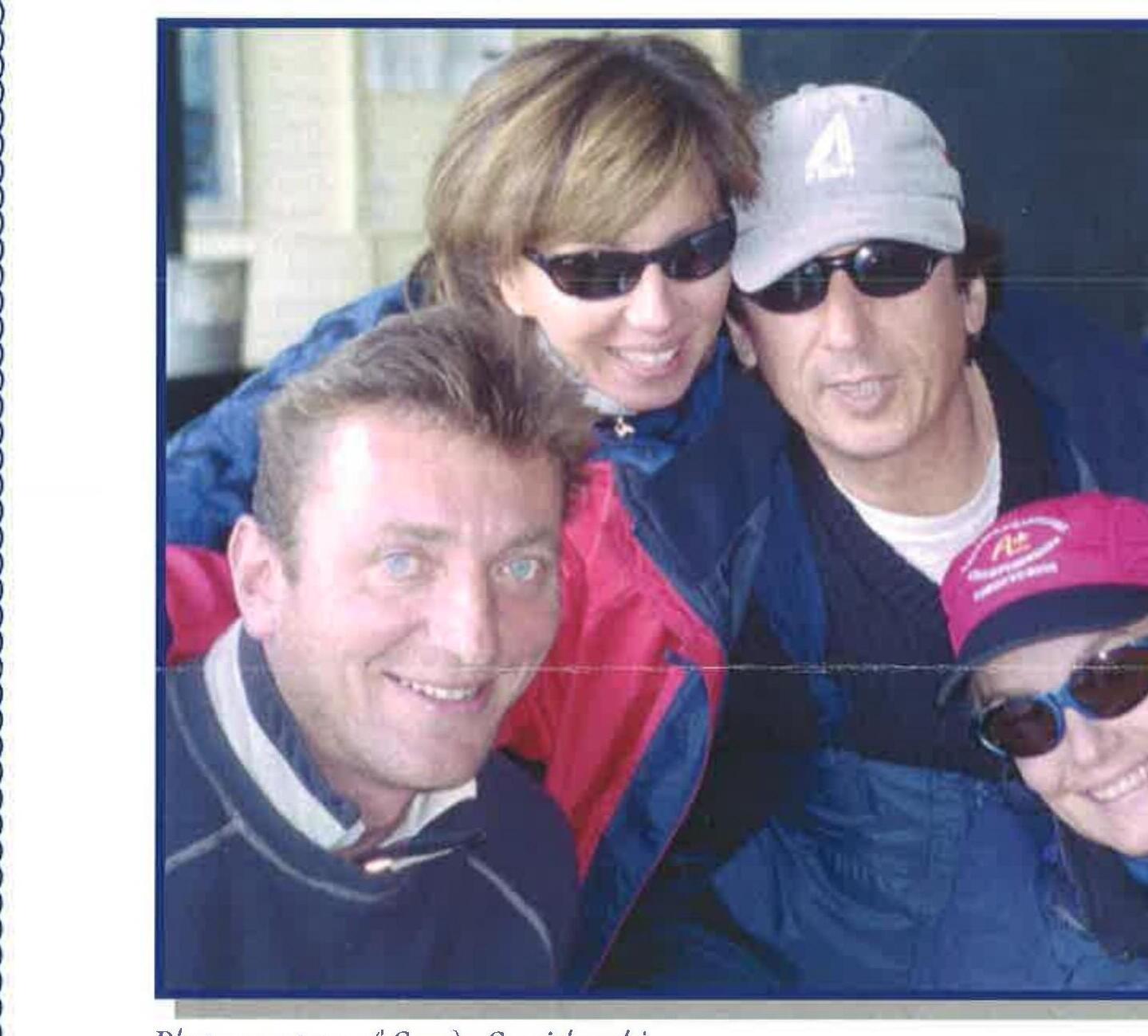
Commodore’s Corner
My mind drifts back… (sorry but I’m a product of the 70’s) to 1968. My Dad asked me if I would like to join a Yacht Club. The snob value appealed to me so I said “sure”. The next thing I knew, instead of hanging out on “yachts” I was shipped off to the National Yacht Club Boot Camp Sailing School. Our fearless leader was a burly 5ft.-65 year old, battle-axe named Louise Gardner. Mrs. Gardner (or ‘The Dragon Lady’ as she was lovingly referred to) was a foredeck on an 8 metre, tough as nails and had a love for sailing like no one else I’ve ever met. And through means which would cause lawsuits today, she instilled this same love in all of her students. Just ask Kevin Smith (he still has the scars to prove it). And at the centre of this Sailing School was this little family boat called the Albacore.
Although this boat was slagged off by the 505, fireball etc. crowd they couldn’t deny the popularity of the class. Every yacht club in Toronto as well as along the north shore of Lake Ontario which had a sailing school (it was also huge in the Muskokas too) taught youngsters to sail in the Albacore. Adults were also into the class in a big way. The fleets at the Canadians were often in the 70+ range and just to qualify for the “A” fleet was a big deal. I spent four years in sailing school and another 5 years teaching sailing, almost all in Albacores. With the advent of the Lazer and Lazer 2’s the writing was on the wall for the Albacore as a kids boat. In 1977 I joined a Punk band and lost touch with planet Earth and worst of all, with Sailing Uffa Fox’s crazy craft.
1989
My Dad dragged me down to some club called Mooredale Sailing Club on a Friday night. It was blowing the “dog off the chain” (Henryism), boats were capsizing right at the dock and there were 50 Albacores on the line, only 200 metres from the shore. The ripping sound of the sails flapping stirred some wild inner animal in me and I was hooked once more. The Toronto fleet had left the Yacht clubs and was now centralized in the Outer Harbour. And how the boat had changed – vangs that could bend trees, bridles instead of centre horse travellers, jib sheets inside the shrouds. It used to be that how high you pointed was based on how strong your crew was. And they stopped making the hulls out of paper mache. I’ve been active in the class since that night and what a blast!
So, where’s the Albacore class today? Here in Canada the fleet is very strong in Toronto and Ottawa. There are also some great pockets in Hamilton, Bala (16 boats racing every Saturday) Pointe au Barel, The Muskokas, Coboconk and a few more I’d love to hear about, and from. Over the next year or two (I’m easy to bribe, just look at the pictures!!) I’d like to bring some of these people into the CAA and hopefully get more sailors to think about purchasing an Albacore. For the fleets that already exist (but have older boats) it might be fun to billet some of these sailors and set up crew spots in one or two of the community club regattas next summer. Maybe the same could happen in Ottawa. I figure that if you have a bunch of sailors racing every week then some of these people must have that evil competitive gene. Then we let nature take its course. The fleet in the U.S. is well on its way to a full recovery and it would be wise for us to emulate Barney Harris’s enthusiasm in spreading the word about this great class. I’d love to see more youth in this class but the reality is that the Albacore is a boat for funky Adults that don’t mind getting their butts wet. With Olympic sailors now joining our ranks and enjoying the level of Competition, the status of the class can only go up. Hopefully this enthusiasm will be passed on to the social sailing crowd as well. Will this be easy? Well, fasten your lifejackets – its going to be a fun ride.
Letter from the Editor
I know it’s been a while since the last issue of Shackles & Cringles. My apologies for not getting this edition off to you sooner, but it’s been a very busy summer!!
Usually I try to make room for all the regatta results from the past summer, but these are easily accessed on our web site, www.albacore.ca. For this issue I will include the most recent regatta results, The Canadian Championships, and the US Nationals. I think the enclosed articles are well worth reading, on those cold winter nights we all know will soon be upon us.
I want to take this opportunity to advise you of the changes to the CAA executive for 2004. Ann Savege has graciously moved to the position of Past Commodore in order for Barrie Farrell to accept the position of Commodore. As many of you know, Barrie is an active, enthusiastic member of the albacore fleet, and I am sure his position will bring innovation to the executive. Welcome aboard, Barrie.
With Ann as Past Commodore, this means that Heather Macnaughton will no longer be an executive member on the CAA. After eight years as an executive member, her experience and presence will be missed.
Henry Pedro reluctantly leaves his position of Second Vice Commodore, in order to make time for his growing family. Henry will be replaced on the executive by Peter Epstein. (I’m sure he’ll thank me for this later – if anyone is available to help Peter with the set up and organization of the Boat Show in January 2004, please contact him – his coordinates are on the back cover.)
After being vacant for the past year, Christine Short has accepted the position of Third Vice Commodore, in charge of training. Nobody knows training like Christine, so get ready for a very active start to next years sailing season. Welcome, Christine!!!
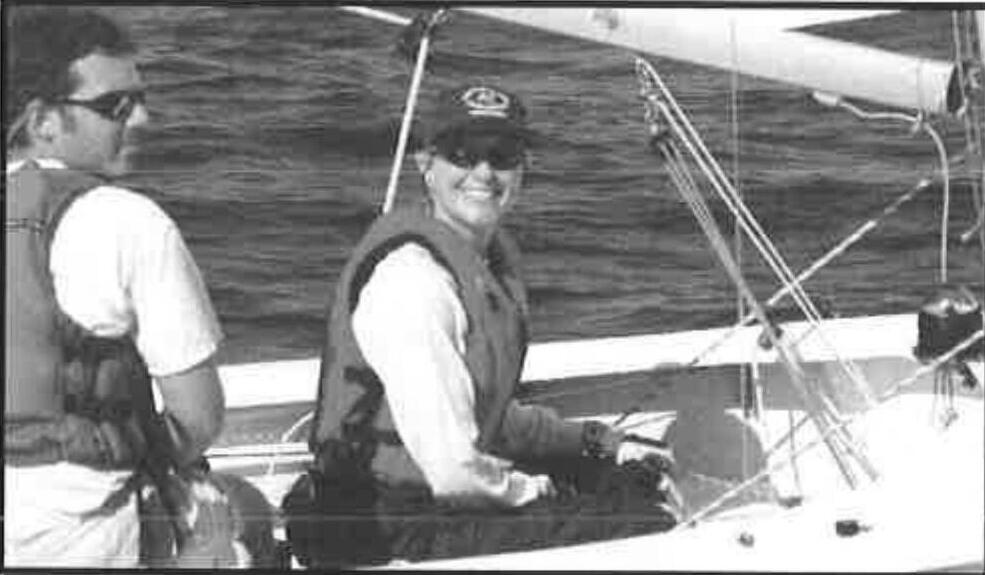
I hope you enjoy this issue, and as always, I welcome your feedback.
Worlds 2005 Venue Preview
The UK National Albacore Association has proposed Lyme Regis as the venue for the 2005 Albacore Internationals.
Lyme is a small seafront town with many old buildings, shops, B&Bs, and pubs. It is located on the southern coast of England around 40 miles to the North and East of Torquay (site of the 2001 Internationals) and faces the same body of water. The scenery around Lyme is pretty spectacular and consists of sandy cliffs, beaches, and rocks to either side as far as the eye can see. Find more information at http://www.lymeregis.com.
The sailing area is in the Northern end of Lyme Bay. Water depth drops to Albacore mast height (24 feet) within 400 meters of the breakwater, so the is no risk of sticking one’s mast in the mud while racing.
Club Facilities: Lyme Regis Sailing Club (LRSC; www.lrsc.org.uk) is located across the street from the boat storage and launching area. LRSC has an enclosed yard area, showers, a bar and kitchen, and a roof top deck that overlooks the harbor. Lyme Regis Sailing Club has an active Albacore fleet that, with 15 boats, is one of the largest in the region. The race committee and club are well acquainted with albacore racing because the Albacore is well represented in LRSC’s management, so we can expect a well organized event.
Boat Storage and Launching: Boats will be kept on dollies in a parking lot to the west of Victoria Pier. There are presently three launching ramps into the harbor. Jeremy Rook (LRSC Albacore Fleet Captain) says that these will be raised and replaced with a single concrete launch ramp next year and will be functioning for the 2005 Albacore event.
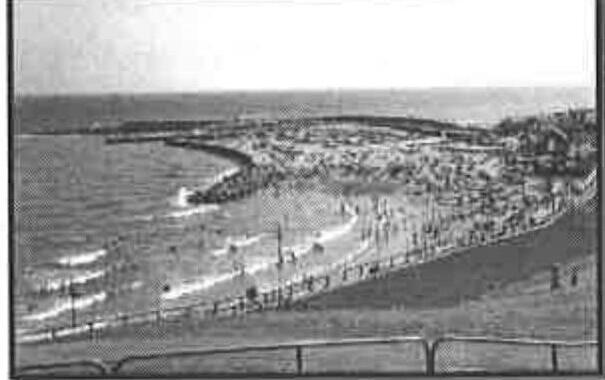
Wind and Sea Conditions: The southern coast of the UK has excellent sailing conditions with frequent good weather systems backed up a sea breeze that shows up in the absence of anything else. Winds for the beginning of September can range from light to moderate to heavy, and depend on the weather systems that come through. Lyme bay is exposed to the English Channel to the south and can see ocean type swell. Winds from the West, North, and East are sheltered by the surrounding land and so do not see unusually large swell.
Tidal range at Lyme is 1.4 meters in summer and 3.6 meters in the spring. The first week of September will be in between these times, and so the range will fall in the vicinity of 2.5 meters.
Tidal currents off Lyme run either from the West (flood) or East (ebb). Peak current will range between 0.5 and 0.9 knots depending on the time of year. The bathymetry shows a gradual sloping from 20 meters at 3 miles off shore to around 10 meters near the harbor, so there may be less current closer to shore, but if there is, it won’t be much less.
Rehoboth to the Max … or should it be … (Max to the Rehoboth)?
Hi Albacores:
Just got back from Rehoboth Bay in Delaware where I crewed with Milutin Ajdacic in Westwood Albacore #8030 in the US National Championships (finishing 9th). Big wind all three days, screaming reaches all 3 days (I think we planed on every offwind leg for at least a minute or two and several times we planed the entire leg without respite).
Milutin pulled off a spectacular save in the 5th race. We were on a powerful continuous planing starboard reach on the 2nd (or was it the 5th?) leg, Henry Pedro and Karen Piatkowski just behind and to windward and Barry Farrell from Mooredale just behind and to leeward (we were in 3rd place) when suddenly our boat heeled dramatically to windward (I presume we hit a momentary lull in the wind). I was sure we were going in and I was scrambling to get over the port gunnel (we had started to ship water over the starboard side) to get on the centerboard when the boat just got lifted back and within a second we were back level and still planing! Karen told me later that Milutin had just stayed in his hiking position while buried under water and pumped the sail as the wind returned which got us back upright (the whole thing only took about 3 or 4 seconds). I, of course, was bouncing all over the place but I did hold on to the jib sheet though I have no memory of it. Ooohs and Aaahs were heard from Henry and Karen and Barry later told us he saw it too and thought it was awesome. We didn’t even lose ground to either of the other boats. We later pulled well ahead of Barry and just held Henry and Karen at bay for the rest of the race to finish 3rd.
That was our big moment of glory though we sailed really well the rest of that day also. At the end of day 2 we were sitting on 25 points in 8th but only 3 points behind 4th and 7 behind Henry and Karen in 3rd. There were 2 races on the last day, both of which we started really well, being in 2nd place halfway up the 1st leg in race 2 and 5th or 6th rounding the 1st mark in race 1. A single (but big) mistake in each race caused us to finish much further back and gave us no chance to move up.
Meanwhile, Henry and Karen were having to fend off challenges from Barry Farrell and Sandy Swiatlowski and Bob Robinson (USA) & Heather MacNaughton. These pairs finished, respectively, 5th, 3rd and 4th in the penultimate race, day 3. Going into the last race and to hold onto 3rd, Henry needed to finish no worse than one place behind Barry while Bob needed to finish 2 places above Barry to finish 4th. Henry brilliantly covered Barry in the final race to comfortably finish 5th (3rd overall). Meanwhile, Bob and Heather finished just ahead of both of them and slipped into 4th overall by a hair. Ann White and Jean-Paul Bureaud topped them all in the final race with a 3rd place finish, and 6th overall.
The matchless pair of Barney Harris and David Byron won 1st place handily while Jasper & Becky Craig, also from USA, had a very strong showing in 2nd. The rest of the top ten were mainly from north of Lake Ontario, as there were 6 all-Canadian boats plus a Canadian crew in places 3 to 10. Of these 13 Canadians sailors, 11 were from Toronto (5 from Westwood). Nice regatta. (Should it be renamed the US-Toronto Nationals?) Final results are on CAA website http://www.albacore.ca/.
Both Milutin and I felt we improved a lot over our earlier efforts in the International at Kingston (finished 21st there – I should note that the fleet in US was not as large or as talented), so we both left the final regatta of the season looking forward to next year. Hope you are too. See you on the water!
USAA Albacore Nationals 2003
Conditions:
Day 1: Temp 63°F; Winds 18-30 kt
Day 2: Temp 68°F; Winds 14-18 kt
Day 3: Temp 68°F; Winds 12-18 kt
| Pos | Sail | Skipper | Crew | Pts | R1 | R2 | R3 | R4 | R5 | R6 | R7 |
|---|---|---|---|---|---|---|---|---|---|---|---|
| 1 | 6701 | Barney Harris | David Byron | 6 | (1) | 1 | 1 | 1 | 1 | 1 | 1 |
| 2 | 7970 | Jasper Craig | Becky Craig | 15 | 3 | (DNC) | 2 | 4 | 2 | 2 | 2 |
| 3 | 7700 | Henry Pedro | Karen Piatkowski | 28 | 5 | (DNC) | 4 | 5 | 4 | 5 | 5 |
| 4 | 7966 | Bob Robinson | Heather McNaughton | 31 | 10 | 2 | (11) | 6 | 5 | 4 | 4 |
| 5 | 8098 | Barrie Farrell | Sandy Swiatlowski | 31 | (8) | 3 | 5 | 8 | 6 | 3 | 6 |
| 6 | 652 | Ann White | Jean-Paul Bureaud | 32 | 4 | (DNC) | 9 | 2 | 7 | 7 | 3 |
| 7 | 7456 | Bob Bear | Kelsey Averill | 38 | 2 | 4 | 13 | 3 | (14) | 9 | 7 |
| 8 | 7933 | Ross Findlater | Andrew Monteiro | 53 | 6 | (DNC) | 3 | 9 | 17 | 10 | 8 |
| 9 | 8030 | Milutin Ajdacic | Maxim Newby | 53 | 7 | (DNC) | 8 | 7 | 3 | 12 | 16 |
| 10 | 8094 | Teresa Miolla | Christine Short | 60 | 9 | (DNC) | 6 | 13 | 9 | 13 | 10 |
| 11 | 7124 | Khin Thein | Thant Thein | 61 | 14 | (DNC) | 10 | 10 | 12 | 6 | 9 |
| 12 | 7971 | David Wallerstein | Pete Epstein | 77 | 15 | (DNC) | 12 | 21 | 10 | 8 | 11 |
| 13 | 6731 | Dianne Clark | Bill Collins | 90 | 12 | (DNC) | 16 | 16 | 15 | 17 | 14 |
| 14 | 8083 | Lloyd Leonard | Jill Williamson | 97 | 18 | (DNC) | 23 | 15 | 11 | 18 | 12 |
| 15 | 7378 | Rolf Zeisler | Sue Zeisler | 102 | (DNC) | DNC | 17 | 12 | 22 | 11 | 13 |
| 16 | 8027 | Byron Daphne | Ian Coleman | 108 | 16 | (DNC) | 21 | 19 | 13 | 20 | 19 |
| 17 | 8021 | Jim Graham | Susan Graham | 114 | (DNS) | DNC | 14 | 11 | 8 | DNF | DNC |
| 18 | 8044 | Ann Savege | Keri Romanufa | 115 | 17 | (DNC) | DNC | 20 | 20 | 16 | 15 |
| 19 | 7945 | Doug Marsh | Kay Marsh | 116 | (DNC) | DNC | 15 | 14 | 18 | 15 | DNC |
| 20 | 6434 | Peter Duncan | Ian Duncan | 120 | (DNC) | DNC | 18 | 22 | 21 | 14 | 18 |
| 21 | 7981 | Walter Monteiro | Sonja McCauley | 126 | (DNC) | DNC | 20 | 17 | 16 | 19 | DNC |
| 22 | 5923 | Denis Wetlaufer | Zak Ferguson | 135 | 13 | (DNC) | 22 | 23 | 23 | DNC | DNC |
| 23 | 7980 | Adam Nicholson | Fred Nicholson | 138 | (DNC) | DNC | DNC | DNC | 19 | 21 | 17 |
| 24 | 7306 | Dan Miller | Scott Snyder | 138 | (DNC) | DNC | 19 | 18 | OCS | OCS | 20 |
| 25 | 7979 | Lars Rathjen | Sparky Rathjen | 142 | (DNC) | DNC | 7 | DNC | DNC | DNC | DNC |
| 26 | 8026 | Joanna Beaver | Gretchen Wilkenson | 146 | 11 | (DNC) | DNC | DNC | DNC | DNC | DNC |
| Pos | Sail | Skipper | Crew | R1 | R3 | R4 | R5 | R6 | R7 | Pts |
|---|---|---|---|---|---|---|---|---|---|---|
| 1 | 8052 | Rebecca Eagen | Al Measor | (DNC) | 2 | 1 | 2 | 1 | 3 | 9 |
| 2 | 7499 | Dave Huber | Dave Tator | 1 | (5) | 2 | 4 | 2 | 2 | 11 |
| 3 | 7133 | Gene Spillane | Tim Boyce | (DNC) | 3 | 3 | 5 | 3 | 1 | 15 |
| 4 | 8095 | Matt Edwards | Scott Hornida | (DNC) | 1 | DNF | 1 | DNC | DNC | 26 |
| 5 | 7109 | Doug Foord | Jennifer Miller | (DNC) | DNF | 4 | 3 | DNC | DNC | 31 |
| 6 | 7305 | Dan Caplan | Dory Caplan | (DNF) | 4 | 5 | DNC | DNC | DNC | 33 |
| 7 | 7264 | John Ferguson | Alex Ferguson | (DNC) | DNF | DNF | DNC | DNC | DNC | 40 |
2003 Canadian Albacore Championship, commentary Toronto, Ontario
The Canadian Albacore National Championships were conducted out of the Outer Harbor Federation of community clubs in Toronto, Ontario on September 12, 13, and 14, 2003. An A and a B fleet sailed in Lake Ontario on separate courses. A total 47 boats competed with entries from the UK, Canada, and the United States. Race management and overall organization for this event was exceptional.
The event commenced on Friday, September 12 in a Southeast breeze that built throughout the day to 15 knots. Two races were held in spectacular sunshine and moderate temperatures. After racing the sailors were treated to complementary beer at the Outer Harbor Centerboard Club followed by grilled steaks at the Mooredale Sailing Club.
Day 2, Saturday, September 13 started with light airs that gradually built to nearly 20 knots under partly cloudy skies and moderate temperatures that dropped a bit as the day wore on. With several hundred miles of fetch, the wind driven waves made for challenging upwind sailing and fast planes off wind – ideal conditions for the classic Uffa fox designed Albacore. A total of four races were completed – a long day on the water. The Ashbridges Bay yacht Club hosted the Albacore AGM, dinner, and raffle.
Sunday dawned with overcast skies and lightish airs that gradually dropped with the second of two races for that day ending with a shortened course. Awards followed immediately afterwards.
The event was fraught with disaster for many: several had breakdowns, OCS or Z flag penalties, capsizes, and difficulty deciphering the subtle wind shifts and unusual (for a lake) current conditions. Barney Harris and David Byron posted a perfect series of eight bullets to win the A fleet convincingly. The Harris/Byron team was consistently in the top four at the top mark and were able to pass and or extend on the leaders to win every race. Top UK Albacore sailor Neville Herbert and United States crew Doug Foord sailed well in a borrowed boat to claim second place in the A fleet. Recent Albacore International runner up team of Ian Brayshaw and Jeff Beitz sailed well but accumulated several double digit finishes for third place. Fourth place team of Anne White and Jean-Paul Bureaud had an excellent series going with all top ten finishes until a second in race seven turned out to be an OCS under a black flagged start, which dropped them to fourth. Canadian sailor Tin Htoo sailed consistently, finishing each race without altercations, breakdowns, or starting violations to claim 5th.
In the B fleet, Nona Johnstone and Teresa Mastracci prevailed over ten other teams in a ten race series sailed on a separate course from the A fleet. Laurie Harrison and Ken Duffy finished second and Pasquale Leone and Samantha Allen finished third. The finishing margins in the B fleet were considerably smaller than in the A fleet.
Complete scores can be seen at:
2003Canadians/2003Canadiansres.html">www.albacore.ca/2003Canadians/2003Canadiansres.html
Canadian Albacore Championship – September 12-14, 2003
| Pos | Sail # | Helm | Crew | Club | R1 | R2 | R3 | R4 | R5 | R6 | R7 | R8 | Total | 1 drop |
|---|---|---|---|---|---|---|---|---|---|---|---|---|---|---|
| 1 | 6701 | Barney Harris | David Byron | WRSC | 1 | 1 | 1 | 1 | 1 | 1 | 1 | 1 | 8 | 7 |
| 2 | Blank | Neville Hebert | Doug Foord | DWSC | 3 | 3 | 6 | 3 | 2 | 3 | 15 | 22 | 57 | 35 |
| 3 | 7243 | Ian Brayshaw | Jeff Beitz | 6 | 2 | 17 | 15 | 4 | 2 | 4 | 13 | 63 | 46 | |
| 4 | 652 | Ann White | Jean-Paul Bureaud | SJTSC | 7 | 5 | 3 | 2 | 8 | 4 | OCS | 24 | 91 | 53 |
| 5 | 7270 | Tin Htoo | Colin Mowatt | MSC | 13 | 22 | 2 | 4 | 14 | 12 | 7 | 4 | 78 | 56 |
| 6 | 6700 | Van Sheppard | Stephanie Strand | NSC | 16 | 4 | 7 | 16 | 3 | 6 | 27 | 9 | 88 | 61 |
| 7 | 7958 | Gordon Flemming | Patty Maloney | NSC | 10 | 9 | 13 | 12 | 10 | 9 | 2 | 17 | 82 | 65 |
| 8 | 8098 | Barrie Farrell | Sandy Swiatlowski | MSC | 4 | 10 | OCS | 7 | 9 | 5 | 29 | 11 | 113 | 75 |
| 9 | 8017 | Kirk McGregor | Fran Steacy | SJTSC | 24 | 7 | 12 | 5 | 17 | 10 | 5 | 21 | 101 | 77 |
| 10 | 7981 | Ross Findlater | Sylvain Goupil | CFBT | 12 | 17 | 11 | 11 | 16 | 8 | 13 | 12 | 100 | 83 |
| 11 | 7700 | Henry Pedro | Karen Piatkowski | WSC | 5 | 8 | 21 | 17 | 5 | 22 | 25 | 6 | 109 | 84 |
| 12 | 8016 | Mary Neuman | Ian Aukema | SJTSC | 21 | 11 | 15 | 9 | 20 | DNF | 10 | 2 | 126 | 88 |
| 13 | 8043 | Robert Sieradski | Julia Erichsen | MSC | 9 | 21 | 10 | 25 | 7 | 13 | OCS | 3 | 126 | 88 |
| 14 | 8051 | Mike Morrison | Paul McHugh | SJTSC | 8 | 13 | 38 | 13 | 12 | 11 | 9 | 23 | 127 | 89 |
| 15 | 7419 | Ken Clarke | Janet Duff | OHCC | 17 | 15 | 4 | 8 | 13 | DNF | 8 | 27 | 130 | 92 |
| 16 | 5471 | David Niblett | Peter Duncan | MLSC | 22 | 6 | 5 | 24 | 11 | 38 | 23 | 8 | 137 | 99 |
| 17 | 8091 | Richard Thorpe | John McCarthy | WSC | 11 | 12 | OCS | 18 | 6 | 25 | 11 | 18 | 139 | 101 |
| 18 | 7977 | Tim Broughton | Karen Marshall | MSC | 2 | 38 | RET | 6 | 22 | 7 | 16 | 14 | 143 | 105 |
| 19 | 8049 | Steve Goode | Peter Epstein | WSC | 36 | 25 | 23 | 20 | 15 | 14 | 12 | 5 | 150 | 114 |
| 20 | 8041 | Todd Johnstone | Mel DeSouza | MSC | 20 | 16 | 22 | 19 | 27 | DNF | 6 | 7 | 155 | 117 |
| 21 | 8101 | Milutin Ajdacic | Ross King | WSC | 19 | 18 | 8 | 22 | 38 | DNF | 3 | 16 | 162 | 124 |
| 22 | 8094 | Teresa Miolla | Christine Short | MSC | 26 | 14 | OCS | 10 | 21 | 16 | 14 | 32 | 171 | 133 |
| 23 | 8044 | Ann Savege | Doug Doole | MSC | 23 | 19 | 14 | 23 | 25 | 21 | 17 | 33 | 175 | 142 |
| 24 | 8035 | Ed Young | Allan Measor | SJTSC | 28 | 20 | 9 | 28 | 23 | 17 | 18 | OCS | 181 | 143 |
| 25 | 8085 | Norm Rubin | Christine Watters | TISC | 15 | 35 | 20 | 14 | 32 | 15 | 20 | 29 | 180 | 145 |
| 26 | 7944 | Heather Macnaughton | Yvonne Howard | RCYC | 18 | 23 | 16 | 27 | 26 | 18 | 22 | OCS | 188 | 150 |
| 27 | 7933 | Warner Monteiro | Sonja McAuley | NSC | 25 | 27 | 24 | 29 | 29 | 18 | DNF | 21 | 197 | 159 |
| 28 | 8097 | Marty Cameron | John Struthers | WSC | 14 | 32 | 25 | 33 | 19 | 19 | 26 | 31 | 199 | 166 |
| 29 | 7400 | George Roth | Keri Romanufa | OHCC | 33 | 24 | 19 | 21 | 28 | 23 | 24 | 30 | 202 | 169 |
| 30 | 8018 | Chis Maslowski | Nigel Rigby | SJTSC | 31 | 28 | 29 | 36 | 29 | 20 | 30 | 10 | 213 | 177 |
| 31 | 7980 | Adam Nicholson | Fred Nicholson | Bala SC | 30 | 26 | 26 | 26 | 24 | 24 | 31 | 25 | 212 | 181 |
| 32 | 8102 | Neil Wilson | Linda Dresser | TISC | 32 | 30 | 27 | 34 | 31 | 26 | 28 | 19 | 227 | 193 |
| 33 | 6731 | Diane Clark | Bill Collins | OHCC | 34 | 33 | 28 | 37 | 38 | DNF | 19 | 20 | 247 | 209 |
| 34 | 7983 | George Wilson | Suzanne Wilson | MSC | 27 | 29 | 18 | 31 | 30 | DNF | DNC | DNC | 249 | 211 |
| 35 | 7630 | Caroline St-Onge | Luc Dejardins | NSC | 29 | 31 | 30 | 35 | 38 | DNF | 32 | 26 | 259 | 221 |
| 36 | 7405 | Ian Rogers | Sarah Tory | PBSC | 35 | 34 | 31 | 30 | 38 | DNF | 34 | 28 | 268 | 230 |
| 37 | 8090 | Charles Pollock | Kathy Smith | TISC | 38 | 36 | 32 | 32 | 33 | DNF | 33 | DNF | 280 | 242 |
| Pos | Sail # | Helm | Crew | Club | R1 | R2 | R3 | R4 | R5 | R6 | R7 | R8 | R9 | R10 | Total | 1 drop |
|---|---|---|---|---|---|---|---|---|---|---|---|---|---|---|---|---|
| 1 | 8048 | Nona Johnstone | Teresa Mastracci | TISC | 2 | 1 | 3 | 4 | 2 | 2 | 1 | 4 | 1 | 7 | 27 | 20 |
| 2 | 8045 | Laurie Harrison | Ken Duffy | MSC | 1 | 4 | 6 | 1 | 4 | 1 | 3 | 3 | 7 | 3 | 33 | 26 |
| 3 | 8042 | Pasquale Leone | Samantha Allen | MSC | 5 | 6 | 2 | 2 | 5 | 5 | 7 | 1 | 2 | 1 | 36 | 29 |
| 4 | 8052 | Rebecca Eagen | Sandra Mitchell | SJTSC | 3 | 2 | 1 | 9 | 3 | 6 | 2 | 6 | 3 | 6 | 41 | 32 |
| 5 | 8032 | Jill Carey | Winston Lau | SJTSC | 7 | 5 | 4 | 5 | 6 | 4 | 5 | 5 | 4 | 4 | 49 | 42 |
| 6 | 8099 | Harold Murray | Susan Callahan | MSC | 11 | 11 | 11 | 3 | 1 | 7 | 4 | 2 | 5 | 2 | 57 | 46 |
| 7 | 6040 | Paul Townsend | Carey Jones | UMSC | 6 | 3 | 5 | 6 | 8 | 3 | 11 | 7 | 8 | 5 | 62 | 51 |
| 8 | 7479 | Carol Burrows | Carmen Aradi | MSC | 4 | 7 | 11 | 11 | 7 | 8 | 11 | 9 | 6 | 8 | 82 | 71 |
| 9 | 7447 | Martin Rheaume | Bertrend Renaud | SRA | 8 | 8 | 8 | 7 | 9 | 9 | 6 | 8 | 11 | 11 | 85 | 74 |
| 10 | 8050 | Andrew Bell | Sarita Jackson | WSC | 9 | 9 | 7 | 8 | 10 | 10 | 8 | 11 | 11 | 11 | 94 | 83 |
Albacore International Championship Results – Kingston, Ontario, August 20-26
| Pos | Sail | Skipper / Crew | R1 | R2 | R3 | R4 | R5 | R6 | R7 | R8 | R9 | R10 | R11 | R12 | R13 | Total Points | Net Points After 2 Drops |
|---|---|---|---|---|---|---|---|---|---|---|---|---|---|---|---|---|---|
| 1 | USA6701 | Harris, Barney / David Byron | 2 | 1 | 8 | 1 | 2 | 2 | 12 | 1 | 1 | 1 | 3 | 2 | 2 | 38.00 | 18.00 |
| 2 | CAN7414 | Brayshaw, Ian / Jeff Beitz | 5 | ZPG | 4 | 5 | 6 | 12 | 1 | 3 | 2 | 4 | 2 | 3 | 3 | 79.00 | 38.00 |
| 3 | CAN7700 | Gorton, Chris / Henry Pedro | 4 | 12 | 2 | 6 | 12 | 5 | 3 | 2 | 4 | 3 | 4 | 5 | 4 | 66.00 | 42.00 |
| 4 | CAN7977 | Broughton, Tim / Karen Marshall | 3 | 7 | 5 | 2 | 3 | 10 | 5 | 10 | 15 | 5 | 6 | 7 | 5 | 83.00 | 58.00 |
| 5 | CAN8030 | Smith, Kevin / John McHutchion | 7 | 5 | 9 | 3 | OCS | 3 | 11 | 8 | 6 | 6 | 9 | 4 | 8 | 139.00 | 68.00 |
| 6 | GBR6825 | Herbert, Neville / Steve Penfold | 1 | ZPG | 3 | 8 | 1 | OCS | 2 | 14 | OCS | 2 | 1 | 1 | 1 | 192.00 | 72.00 |
| 7 | CAN7958 | Fleming, Gordon / Patty Maloney | 33 | 41 | 16 | 18 | 4 | 7 | 17 | 6 | 16 | 7 | 13 | 6 | 6 | 190.00 | 116.00 |
| 8 | CAN7419 | Clarke, Kenneth / Janet Duff | 20 | 9 | 1 | 31 | 14 | 4 | 7 | 21 | 17 | 15 | 15 | 9 | 13 | 176.00 | 124.00 |
| 9 | CAN652 | White, Ann / Jean-Paul Bureaud | 12 | 2 | 20 | 17 | 15 | 37 | 29 | 5 | 12 | 11 | 16 | 17 | 12 | 205.00 | 139.00 |
| 10 | USA8088 | Hublitz, Marty / Eddie Hornick | 10 | 3 | 30 | 13 | 16 | 26 | 10 | 29 | 3 | 25 | 5 | 36 | 7 | 213.00 | 147.00 |
| 11 | USA7363 | Smith, Dave / Carolyn Smith | 8 | 23 | 18 | 7 | 9 | 1 | 19 | 4 | 29 | 9 | 27 | 24 | DNF | 238.00 | 149.00 |
| 12 | CAN8098 | Farrell, Barrie / Sandy Swiatlowski | 9 | 20 | 10 | 22 | 10 | 14 | 16 | 9 | 13 | 21 | 20 | 26 | 11 | 201.00 | 153.00 |
| 13 | USA7375 | Brown, Jude / Karen Piatkowski | 16 | 18 | 14 | 23 | 7 | 13 | 8 | 23 | 33 | 22 | 11 | 10 | 18 | 216.00 | 160.00 |
| 14 | USA6434 | Duncan, Peter / David Niblett | 17 | 48 | 31 | 29 | 21 | 9 | 4 | 13 | 7 | 16 | 18 | 8 | 23 | 244.00 | 165.00 |
| 15 | CAN7270 | Thoo, Tin / John McCarthy | 36 | 31 | 21 | 16 | 8 | 33 | 6 | 12 | 14 | 20 | 32 | 12 | 9 | 250.00 | 181.00 |
| 16 | CAN8017 | Mcgregor, Kirk / Fran Steacy | 32 | 32 | 7 | 9 | 13 | 30 | 36 | 33 | 5 | 12 | 10 | 13 | 20 | 252.00 | 183.00 |
| 17 | USA8083 | Leonard, Lloyd / Karl Wittnebel | 44 | 14 | 11 | 24= | 28 | 32 | 18 | 20 | 21 | 14 | 7 | 29 | 15 | 277.50 | 201.50 |
| 18 | GBR7425 | Thorpe, Richard / David Thorpe | 35 | 39 | 35 | 36 | OCS | 34 | 9 | 18 | 9 | 8 | 8 | 11 | 10 | 312.00 | 213.00 |
| 19 | CAN8050 | Gerlich, Paul / Iva gerlich | 22 | 10 | 29 | 24= | 25 | 31 | 24 | 42 | 18 | 19 | 28 | 14 | 14 | 300.50 | 227.50 |
| 20 | CAN8097 | Cameron, Marty / Joanie Cameron | 13 | 13 | 13 | 44 | 5 | 23 | 39 | 19 | 22 | 31 | 39 | 20 | 40 | 321.00 | 237.00 |
| 21 | CAN8101 | Ajdacic, Milutin / Maxim Newby | 15 | 28 | 17 | 27 | 19 | 40 | 27 | 30 | 19 | 13 | 29 | 23 | RAF | 347.00 | 247.00 |
| 22 | CAN7933 | Findlater, Ross / Sylvain Goupil | 46 | 42 | 33 | 28 | 39= | 21 | 22 | 15 | 27 | 17 | 12 | 15 | 21 | 338.50 | 250.50 |
| 23 | US8027 | Byron, Daphne / Nate Bokil | 19 | 25 | 12 | 30 | 22 | 16 | 34 | 11 | 45 | 24 | 35 | 37 | 30 | 340.00 | 258.00 |
| 24 | USA7971 | Wallerstein, David / Joseph Perez | 23 | 36 | 39 | 19 | 41 | 24 | 21 | 34 | 11 | 10 | 31 | 35 | 17 | 341.00 | 261.00 |
| 25 | CAN7403 | King, Ross / Leslie Connell | 28 | 49 | 27 | 15 | 18 | 6 | 23 | 17 | 37 | 30 | 30 | DNF | DNF | 400.00 | 280.00 |
| 26 | CAN8043 | Bain, Gary / Alan Pike | 14 | 44 | 24 | 11 | 38 | 8 | 31 | 36 | 35 | 28 | 45 | 30 | 27 | 371.00 | 282.00 |
| 27 | CAN8051 | Morrison, Mike / Mac Van Rossem | 6 | 11 | 53 | 37 | 30 | RAF | 41 | 32 | 34 | 32 | 21 | 16 | 26 | 399.00 | 286.00 |
| 28 | CAN8094 | Miolla, Teresa / Christine Short | 27 | 6 | 19 | RAF | 26 | 25 | 57 | 40 | 31 | 23 | 38 | 25 | 33 | 410.00 | 293.00 |
| 29 | CAN7981 | Monteiro, Warner / William O’Gorman | 21 | 52 | 40 | 38 | 43 | 28 | 26 | 24 | 20 | 42 | 19 | 19 | 16 | 388.00 | 293.00 |
| 30 | CAN6700 | Sheppard, Van / Stephanie Strand | 31 | 29 | 28 | 4 | 42 | 27 | 25 | 27 | 8 | DNS | 43 | 38 | DNF | 422.00 | 302.00 |
| 31 | CAN8016 | Neumann, Mary / Peter MacAuley | 37 | 43 | 25 | 20 | 20 | 22 | 15 | 7 | 36 | 46 | 33 | 49 | DNF | 413.00 | 304.00 |
| 32 | CAN8055 | Balinski, Marek / NoraHoffer | 30 | 4 | 26 | 41 | 37 | 43 | 33 | 22 | OCS | 33 | 24 | 31 | 24 | 408.00 | 305.00 |
| 33 | CAN8044 | Savege, Ann / Pasquale Leone | 25 | 8 | 22 | 33 | 11 | 17 | 38 | 41 | 54 | 40 | 48 | 33= | 38 | 408.50 | 306.50 |
| 34 | CAN8099 | Zieradzki, Robert / Carol Burrows | 34 | 16 | 32 | 34 | 23 | 20 | 30 | 49 | DNF | DNS | 26 | 33= | 25 | 442.50 | 322.50 |
| 35 | CAN8085 | Rubin, Norman / Christine Watters | 11 | 35 | 15 | 14 | 31 | 35 | 28 | 25 | 10 | DNS | DNF | DNS | DNF | 444.00 | 324.00 |
| 36 | CAN7961 | Chu, Gordon / Christine Mehling | 24 | 22 | 6 | 26 | 32 | 15 | 48 | 37 | 40 | 44 | 36 | 45 | DNS | 435.00 | 327.00 |
| 37 | CAN8049 | Goode, Steve / Peter Epstein | 26 | 37 | 41 | 21 | 27 | 11 | 20 | 38 | 26 | 35 | 46 | DNS | DNF | 448.00 | 328.00 |
| 38 | CAN7166 | Harris, David / Bill Collins | 41 | 33 | 51 | 42 | 35 | 18 | 14 | 31 | 32 | 27 | 40 | 39 | 19 | 422.00 | 329.00 |
| 39 | USA8021 | Graham, James / Susan Graham | 18 | 40 | 36 | 39 | 29 | 19 | 32 | 46 | 53 | DNS | 23 | 32 | 36 | 463.00 | 350.00 |
| 40 | USA7378 | Zeisler, Rolf / Susa Heller-Zeisler | 48 | 38 | 45 | 35 | 44 | 38 | 49 | 16 | 25 | 34 | 25 | 28 | 34 | 459.00 | 362.00 |
| 41 | USA7456 | Bear, Robert / Kelsey Averill | 51 | 47 | 42 | 47 | 36 | 36 | 13 | 52 | 44 | 18 | 14 | 44 | 29 | 473.00 | 370.00 |
| 42 | CAN7960 | Monteiro, Andrew / Melodie Gummer | 39 | 15 | 23 | 10 | 17 | 41 | 46 | 57 | 51 | 47 | 53 | 43 | 41 | 483.00 | 373.00 |
| 43 | GBR7988 | Brooks, Victoria / Helen McHale | 29 | 30 | 38 | 12 | 34 | 39 | 42 | 28 | 43 | 43 | 47 | 40 | 39 | 464.00 | 374.00 |
| 44 | CAN7944 | Macnaughton, Heather / Yvonne Howard | 38 | 21 | 37 | 32 | 24 | 47 | 43 | 39 | 39 | 29 | 34 | DNF | DNS | 503.00 | 383.00 |
| 45 | 8100 | Roth, Jason / Mike Spicer | 42 | 45 | 34 | 48 | 45 | 49 | 51 | 43 | 23 | 26 | 17 | 18 | DNF | 501.00 | 390.00 |
| 46 | 7630 | St. Onge, Caroline / Luc Desjardins | 43 | 19 | 47 | 43 | 33 | 29 | 53 | 26 | 41 | 41 | 44 | 47 | 35 | 501.00 | 401.00 |
| 47 | GBR7984 | Fontes, Peter / Judy Fontes | 45 | 34 | 44 | 40 | 51 | 50 | 58 | 44 | 28 | DSQ | 22 | 21 | 22 | 519.00 | 401.00 |
| 48 | 7499 | Huber, David / David Tator | 40 | 27 | 46 | 45 | 39= | 44 | 40 | 48 | 52 | 36 | 37 | 27 | 31 | 512.50 | 412.50 |
| 49 | 6890 | Kleysteuber, Bill / Eric Connell | 49 | 50 | 57 | 46 | OCS | 42 | 44 | 45 | 30 | 39 | 52 | 22 | 28 | 564.00 | 447.00 |
| 50 | USA5923 | Wettlaufer, Denis / Lucien Casper | 56 | 46 | 50 | 51 | 46 | 52 | 37 | 47 | 24 | 37 | 42 | 42 | 37 | 567.00 | 459.00 |
| 51 | GBR6930 | Brooks, Robin / Doug Doole | 47 | 24 | 52 | 50 | 49 | 46 | 45 | 53 | 38 | 48 | 50 | 41 | DNF | 603.00 | 490.00 |
| 52 | CAN7980 | Nicholson, Adam / Fred Nicholson | 53 | 51 | 54 | 52 | 53 | 54 | 50 | 35 | 42 | 38 | 41 | 48 | 32 | 603.00 | 495.00 |
| 53 | AL7133 | Spillane, Gene / Laura Lee Balkwill | 54 | 58 | 48 | 54 | 48 | 48 | 47 | 50 | 48 | DNS | 49 | 50 | DNF | 674.00 | 554.00 |
| 54 | 7306 | Miller, Dan / Chris Eckert | 50 | 54 | 49 | 55 | 47 | 53 | 35 | 56 | 47 | DNF | DNS | DNF | DNF | 686.00 | 566.00 |
| 55 | 7887 | Rheaume, Martin / Bertrand Renaud | 58 | 56 | 59 | 58 | 55 | 55 | 54 | 54 | 46 | 45 | 51 | 46 | DNF | 697.00 | 578.00 |
| 56 | US7110 | Wirth, George / Wilda Heiss | 55 | 53 | 58 | 53 | 54 | 45 | 52 | 51 | 49 | DNS | DNS | DNS | DNF | 710.00 | 590.00 |
| 57 | US7109 | Foord, Doug / TBA | DNS | DNS | 43 | 49 | 50 | 51 | DNF | 55 | 50 | DNS | DNF | DNS | DNF | 718.00 | 598.00 |
| 58 | KC7707 | Bain, Chuck / Alexandre Graham | 52 | 55 | 55 | 57 | 52 | 56 | 55 | 58 | DNF | DNS | DNF | DNS | DNF | 740.00 | 620.00 |
| 59 | 7447 | McCullough, Alan / Ed Masotti | 57 | 57 | 56 | 56 | 56 | 57 | 56 | 59 | 55 | DNS | DNS | DNS | DNF | 749.00 | 629.00 |
The Fly Away Whisker Pole
I have been messing around with one of these up the mast pole systems, and I have to say, it’s a really nice improvement to the boat. There are two variants of this system. Both rely on a shock cord to hoist the pole to the spreaders from where it dangles while sailing upwind. Both have a third jib sheet connected to the jib clew that runs inside the pole at its lower end and exits at the top. From here the line is lead down thru the mast ring and then to some sort of cleat. The difference is how the inboard end is constrained. The first variant has a guide formed of a tensioned line to which the upper (when stowed) or inboard (when deployed) end of the pole is connected. The pole is arranged to slide on this line with a metal loop. The second variant has no guide – the inboard/upper end of the pole assumes a position in space sprung next to the mast with the shock cord to the spreaders and the launcher line thru the mast ring. I have the second variant in 6701. I prefer the second variant because when reaching the pole makes a smaller angle to the horizontal and allows the jib to twist nicely. The guided types place too much down force on the jib while reaching and over tension the leech.
After a season of use including practice and competition, I can say the boat is nicer to sail with either type – and this is from a starting point of loathing the added windage. After using the fly away pole – so dubbed by Steve Penfold of the UK, for several regattas including Internationals and UK Nationals, it has me won over for the following reasons:
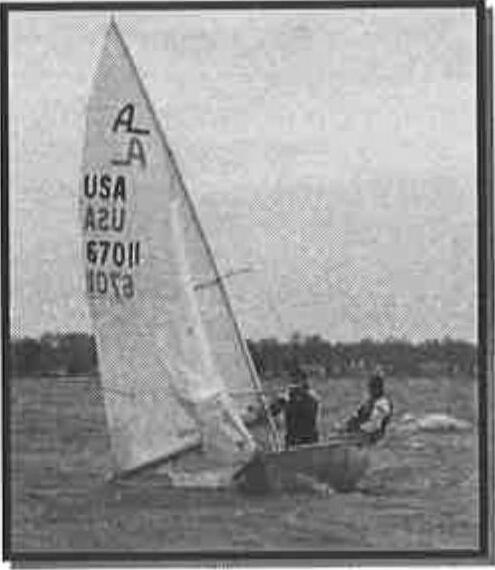
1. The ease with which the crew can deploy and retract the pole. With a regular pole with clip or bayonet ends, the crew must stand up and walk forward and manually connect it to the jib clew and mast. Doing so is difficult in breezy conditions and downright dangerous in winds over 25 kts. The pole launcher system makes deploying the pole simple – pull the string and the pole is drawn to the jib clew, comes down, and booms the jib away from the boat with no stomping around in the front of the boat fumbling with a clip.
2. The adjustability – I had been using a pole of 4’6” in length and another of maximum length. The short pole seemed to work o.k. while reaching. I have since found that in many cases the jib will set far better at pole lengths either larger or smaller than the 4’6” value, and so having an adjustable pole makes real sense. Using the fly away pole, an both main and jib can be set up optimally for any wind angle from DDW to close hauled. The task of holding the jib out to leeward is effectively replaced with the task of running the pole and sheet. A heck of a lot easier physically, but more challenging from the sailing point of view.
3. Its impossible to lose the pole. Ok not impossible – but since it’s tied to the boat by two pieces of string, its unlikely that it will go missing in a capsize or other event.
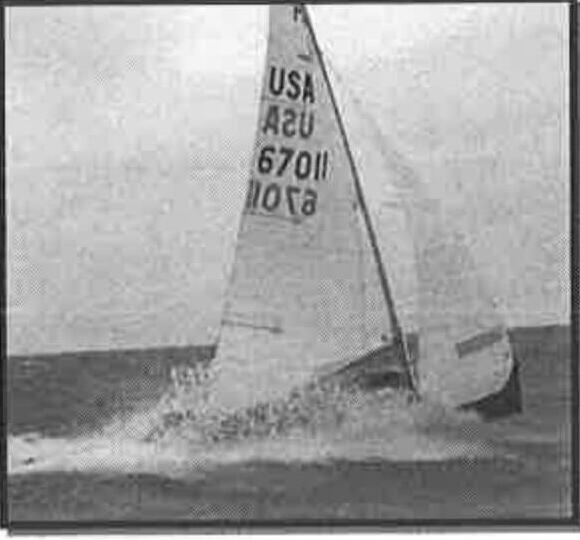
4. Crew relations – I often sail with my wife Becky. She was not a natural born sailor, so every time in the boat is an unnatural act. Anything that makes her life as crew easier is better for me. This launchable pole really shines here. No more yammering at her about clipping the pole to the jib. She just pulls the line and that’s it. To retract the pole, just uncleat it and it goes away. The crew never has to touch it. This pole system may mean that I might even get a few more years out of Becky as crew. Extrapolating this to the rest of the class, if it makes the crew’s task easier without fundamentally changing the boat (like a trapeze) or costing a lot, then it’s probably going to be good for the class in general.
5. One less pole – for the past year I have been carrying and using two poles – one at max length and one 4’6” in length. With the fly away pole system I now only need to carry one. Furthermore, the pole is not at risk of being stepped on, and so it can be of thinner wall and smaller diameter.
6. Less boat damage – I have an old woof hulled wooden Albacore. It’s nearly impossible to launch and retrieve the old pole during a series of races without gouging up the deck, seats, and hull with the damn thing. The fly away pole system pretty much eliminates this wear and tear.
7. Less cost – the fly away pole system is slightly cheaper when compared to carrying two poles @ US$60 a pop. There are no clip end fittings – only a pressed or glued in grommet, three pulleys, a cleat, shock cord and line.
8. Small helms (not me) can get a large crew – with a launchable pole they can sail the boat in high winds while keeping the weight on the rail – and therefore compete equally with heavy helms with lighter crews. This broadens the boat’s appeal since a small helm is not penalized for being small.
How to use it:
Bear away set to wing and wing: Bear away and ease the main sheet. Release the old jib sheet. The crew should have their windward hand on the wind ward jib sheet and their leeward hand on the pole launch line. Pull the pole line till the outboard end of the pole is at the clew. Now, snap the windward jib sheet as the boat nears a DDW course; the clew and pole should swing to windward. When the pole is pointed outside the shear line, the crew should quickly pull the launch line hand over hand until its fully deployed and cleated. Then pull the windward sheet all the way aft and fill the jib.
Bear away onto a reach: The crew should approach the mark with the jib sheet in the leeward / aft hand and pole launch line in the other. Ease the jib as the boat bears away and smoothly pull the launch line. Do not jerk the launch line or the pole may overshoot and come to rest sticking past the jib, violating the 50mm rule. If this occurs, ease the launch line till the pole end clears away from the clew and re deploy slowly and smoothly. Once the pole end reaches the clew, the line can be pulled faster until it is set appropriately.
Bear away gybe to wing and wing: this is really neat – the crew should have the jib sheet in leeward / aft hand and pole launch line in the other. As the boat bears away, simply deploy the pole as if one were bearing away onto a reach. When the boom comes across, continue to pull the launch line till the pole is fully deployed and cleated. Then grab the jib sheet to fill the jib.
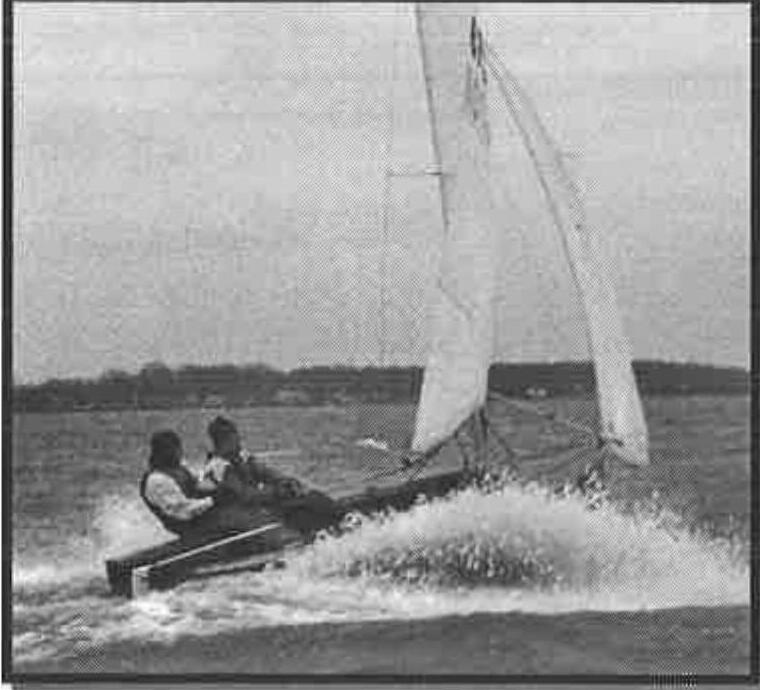
Reach to reach gybe: David and I practiced this maneuver in high winds during the few days before Internationals this season. We were able to keep the boat fully planed off throughout the maneuver about 30% of the time. Ease the jib sheet as the boat bears away from a reach. Ease the pole launch line but do not release it all the way – the pole should be able to swing behind the jib luff – cleat it in this position. Next release the old jib sheet and pull in on the new one. Pull the launch line and adjust the jib sheet until the pole is set correctly.
Run to run gybe: Gybe the main first. Then release the old jib sheet and ease the pole launch line half way. Snap the new jib sheet such that the clew and outboard pole end are brought to the new windward side. The Helm can do this if its not too windy. When the pole end is pointed outside the sheer line, the crew should pull it as fast as they can until fully deployed and cleated and then reach for the jib sheet.
When rounding the leeward mark, all one has to do is release the pole launch line and sheet the jib. One can wait until the boat has begun to head up to round the mark, thereby keeping the jib deployed and pulling for the longest possible time.
Commodore’s Reminder:
Hi gang. After getting left in the watery dust at the Internationals I have become a devotee of the mast launch “jib stick”. The rigging setups can be very creative but please remember that the length of the pole (including any and all fittings) must be 1830 mm. If you haven’t done so please give your headstay pole a quick measuring. There’s nothing like having an excuse to mess with your Albacore during the off-season.
Hans Gottschling
The Dinghy Boatcover Specialist for 30 Years
Tel. 905 277-3306
www.Gottschlingboatcovers.com
1655 Coram Crescent, Mississauga, On L4X 1L1
Thoughts on Running Great Regattas
I remember the 1997 Albacore Worlds at Hayling Island. What a week – nearly everyone stayed on the island in the provided dorms, ate meals in the club restaurant, and spent every evening in the club bar. There was no driving – our rental car served as a storage locker. It seemed like every night the club bar would be jammed with sailors drinking and whooping it up, only to close too early – even though it was after midnight. By weeks end I really felt like I had gotten to know just about everyone there on some level, made many friends, and really did not want it to end.
Another great event was the 1998 505 Worlds in Hyannis. Over 100 boats attended. Every night the club had a post race happy hour that included lots of food and beverages. Every night everyone went to the club to eat, drink, and laugh about the day’s events. Each morning the same crew would show up for breakfast and coffee.
From 1989 till 1999 the US Albacore Association conducted its Nationals and two International championships in Rehoboth, Delaware. Each of these events featured beer at the club every day after racing and a dinner every night. The vast majority of competitors stayed at the Bay Resort Hotel which happens to be only a short walk to the “Starboard”, a local watering hole. It turned out that everyone tended to stick together throughout these events, making every one of them memorable.
What makes a truly great event? The type that you wish it would not end; the type where you forget what day it is during the week; one in which you think to yourself, “Wow, I can’t wait to do that again”. What these events have in common is the creation of a community where a group of like minded people spend several days doing something they all like – racing sailboats – and socializing before and afterwards. I believe that, in addition to running good races, an essential component of a successful event is to entice the entire group to gather and spend time together every day. I have participated in literally hundreds of dinghy regattas starting from a young age as a competitor, mark boat operator, PRO, Judge, Event Chairman, and bottle washer/floor sweeper and have formulated some thoughts on running successful events for your reading pleasure.
Selecting a Venue: Reliable wind tops off my personal list of event characteristics. No matter how perfect everything else is, if there is no breeze, the event will be a flop. This is why we never run major events on the Potomac River – in spite of the huge infrastructure, billeting opportunities, and alternative interest activities available to non sailors we have here. There is very little wind on the Potomac.
Ideally, you will want some sort of dinghy racing infrastructure with crash and committee boats, marks, ground tackle, flags, and the people who know what to do with them and preferably an active local fleet. The event chairman and Principle Race Officer should have recent experience with the class. There must be some place to stage, launch, and recover the boats. Ideally there will be fresh water available to wash boats and gear immediately after sailing. There should be some sort of club facility with showers, a bar (a very important feature), and a place to socialize after sailing. If there is no club facility, then a temporary one can be set up using a tent so the party is not dampened by inclement weather. The host club should have web access so press releases and scores can be posted in near real time.
A range of housing options are necessary. Some teams consist of only skipper and crew. Others will bring children, infants, or others and may need to rent an entire house. The fiscally challenged will want to camp or get billeted with local members. The ideal venue will include all of these in close proximity to the club facility. Many great venues also serve as vacation resorts and as a consequence, are high priced. While the food and entertainment associated with an event can almost always be worked out reasonably, if the housing costs $250/night, this will dissuade many.
Sometimes, there are some people who attend regattas who are not there to sail. The ideal event location will include interesting activities for these people while others in their entourage are on the water sailing. Good shopping, restaurants, sight seeing, or other attractions enable those with non sailing spouses to have a family vacation. A spectator boat for major events is nice to have as well.
When To Schedule: When planning the season, avoid coincident events or consecutive major events. The idea here is to give people a single choice as to when they can race. With events on consecutive week ends, some will select one of two, rather than adjusting their schedules to fit the one event available. Do not schedule local fleet races the same time as a major championship. The idea is to have as much participation at as many events as possible.
Advertising: The earlier and more often you can go to press with the details of the event, the better. Not everyone will read the email list, nor will they read the printed news letter. I was astonished when several UK sailors stated the reason they did not attend the 2003 Internationals was due to a lack of information for the event and other activities in spite of this information being available on the web site for months. Remove this barrier and its detrimental effect on regatta turn out by informing all class members and the general public with several reminders and updates using every medium available.
One on One: Mass snail and e-mail is an excellent way to communicate information, but this alone is not enough. We should maintain a dialog with the fleet based on face to face communication or by telephone. People can often be persuaded to attend an event with some encouragement. Sometimes a person will have some minor issue such as the lack of a crew or a minor trailer or boat repair – easily solved but only if one knows about it in advance.
Food And Entertainment: The importance of organizing some sort of social event including food and drinks and building this into the entry fee can not be overstated. Socializing before and after racing is the primary reason the vast majority of people attend these events.
Some argue that people will not attend if the entry fee is too high. I believe this is inaccurate. Food and drinks can be purchased far more cost effectively for a group of people than individually. Something as simple as pizza dinner costs an insignificant amount of money. Getting all participants to show up in one place for the entire evening is a key ingredient of the best events. The best way to do this is to include after sailing drinks & munchies and a dinner into the entry fee. This relies on the very simple theory that if people pay for a dinner and drinks in advance, they will show up and eat it.
Race Management: Volumes could be written regarding race management, but there are a few key areas that can spoil an otherwise nice day on the water. They all focus on maximizing the ratio of time spent racing to that spent waiting around.
Start On Time: Do not delay based on the # of boats sitting around on shore at a particular time. A better approach would be things look slow in the dinghy park, send someone out to walk around and tell each person one on one that the start will occur on time and to get moving. The PRO may wish to postpone a short while on the water if a long transit to the racing area in light winds or an adverse tide delays the majority of competitors. It’s a fact that some teams will be late due to oversleeping or traffic – and they may miss the first race. This is not the end of the world: its more important to get the races started on time. The 2002 Albacore NAs is an example of what not to do – the breeze was on for the last day. One competitor went out, capsized, and was not able to right her boat (the name of the skipper will be withheld but her initials were JOANNA BYRON). The RC had several boats on the course and stood by while the hapless crew tried again and again to get going. This was prudent except for the fact that the motor boat used was the one with the course marks in it! The entire race was delayed 45 minutes since the course could not be set – meanwhile other motor boats milled around the area with nothing to do. In this instance, the PRO should have substituted a different boat to keep an eye on that unnamed sailor and had the mark boat set the course.
Thoughts on Running Great Regattas – (continued)
I remember the 1997 Albacore Worlds at Hayling Island. What a week – nearly everyone stayed on the island in the provided dorms, ate meals in the club restaurant, and spent every evening in the club bar. There was no driving – our rental car served as a storage locker. It seemed like every night the club bar would be jammed with sailors drinking and whooping it up, only to close too early – even though it was after midnight. By weeks end I really felt like I had gotten to know just about everyone there on some level, made many friends, and really did not want it to end.
Another great event was the 1998 505 Worlds in Hyannis. Over 100 boats attended. Every night the club had a post race happy hour that included lots of food and beverages. Every night everyone went to the club to eat, drink, and laugh about the day’s events. Each morning the same crew would show up for breakfast and coffee.
From 1989 till 1999 the US Albacore Association conducted its Nationals and two International championships in Rehoboth, Delaware. Each of these events featured beer at the club every day after racing and a dinner every night. The vast majority of competitors stayed at the Bay Resort Hotel which happens to be only a short walk to the “Starboard”, a local watering hole. It turned out that everyone tended to stick together throughout these events, making every one of them memorable.
What makes a truly great event? The type that you wish it would not end; the type where you forget what day it is during the week; one in which you think to yourself, “Wow, I can’t wait to do that again”. What these events have in common is the creation of a community where a group of like minded people spend several days doing something they all like – racing sailboats – and socializing before and afterwards. I believe that, in addition to running good races, an essential component of a successful event is to entice the entire group to gather and spend time together every day. I have participated in literally hundreds of dinghy regattas starting from a young age as a competitor, mark boat operator, PRO, Judge, Event Chairman, and bottle washer/floor sweeper and have formulated some thoughts on running successful events for your reading pleasure.
Selecting a Venue: Reliable wind tops off my personal list of event characteristics. No matter how perfect everything else is, if there is no breeze, the event will be a flop. This is why we never run major events on the Potomac River – in spite of the huge infrastructure, billeting opportunities, and alternative interest activities available to non sailors we have here. There is very little wind on the Potomac.
Ideally, you will want some sort of dinghy racing infrastructure with crash and committee boats, marks, ground tackle, flags, and the people who know what to do with them and preferably an active local fleet. The event chairman and Principle Race Officer should have recent experience with the class. There must be some place to stage, launch, and recover the boats. Ideally there will be fresh water available to wash boats and gear immediately after sailing. There should be some sort of club facility with showers, a bar (a very important feature), and a place to socialize after sailing. If there is no club facility, then a temporary one can be set up using a tent so the party is not dampened by press.
How To Estimate and Set Regatta Entry Fee
I like to take a probabilistic approach to determining event turn out and use this to set the entry fee. Using this approach accounts for the fact that one never really knows whether a particular person will show up – but you can estimate the likelihood or probability of them showing up. I like to group people into the following categories:
95% – These are the stalwart class members who try to never miss an event and who make it a priority in their lives. They will be there unless they are dead. Place me in this category, but note that if I were dead I would have my corpse dragged to the event to be propped up in the corner of the bar with a beer in my hand. Adjust the alcohol estimate accordingly.
75% – People in this category will show up generally and will go to reasonable lengths to make it all happen.
50/50 – Those who would let a flat tire on their trailer, the loss of a crew a week before, or some other minor impediment keep them from making an event. These folks will need occasional assistance finding crew or dealing with some relatively minor boat issue.
25% – Those who will show only if they get it planned well in advance with near ideal circumstances and one of the many small issues in life do not get in the way at the last minute.
1. the sum of all boats is the total number of people who might attend – it is a number you could not possibly exceed under the most ideal circumstances.
2. the most probable attendance by first categorizing each class member and then sum the product of the number of boats in each category times the probability to get the total probable attendance.
3. the lowest number of attendees would be the first two categories or my lowering the probability of each category to the next lower level.
The cost of an event consists of fixed and variable elements. meals are variable – double the people and the cost doubles as well. trophies are generally fixed. race committee costs are generally fixed. the total cost will be the sum of the fixed costs plus the product of variable per boat costs times the number of the attendees. the per boat cost is then:
estimated per boat cost = [ fixed costs + number of boats° variable per boat cost ] / number of boats — EQUATION 1
This is pretty straight forward – the product of the entry fee times the number of boats – but a further issue is late entry membership penalty. generally a percentage of the entrants will pay at the event and will accept the late entry fee. some others will not be USS members and can get soaked for a few more dollars. the class keeps this money. to account for the late fee, I suggest looking at past events to see what percentage of persons have not been pre registered for similar events in the past. the average income per boat will be:
Average income per boat = entry fee + (% who typically pay late fee) ° late fee + (% non USS members) ° non USS penalty — EQUATION 2
To set the cost one can simply set equation 1 = equation 2 and solve for entry with late fee and non USS membership penalty as parameters. Generally a late fee should be 15 to 25 percent of the entry fee and the non USS member penalty should be around US$5.
You will want to not lose money if the worst happens and the fewest number of boats shows – as if the weather forecast was particularly nasty for example. Conversely you do not want to over bill the sailors and end up making a huge amount of money either.
Using this method to set the price of an event will eliminate headaches at the last minute as the expenses add up and the turn out falls a bit short. And if the turn out is greater than expected, then bank the cash and buy more beer next time!
I have run two Albacore Nationals, many 505 local events, and most recently, the 2003 505 East Coast Championships. In every case, the class made a few $ – and everyone had fun. The costs were reasonable for what the participants received in return.
2003/04 Canadian Albacore Association Executive
| Commodore | Barrie Farrell 46 Bellefair Ave. Toronto, Ontario M4L 3T8 [email protected] H 416-693-6223 B 905-840-5395 |
|---|---|
| Past Commodore | Ann Savege 35 Church St. #302 Toronto, Ontario M5E 1T3 [email protected] H 416-243-0848 B 905-362-4435 |
| First Vice Commodore | Dave Smith 30 Dancer’s Drive Markham, Ontario L6C 2C4 [email protected] H 416-361-1808 B 416-922-5322 |
| Second Vice Commodore | Peter Epstein 259 Blantyre St. Toronto, Ont. M1N 2S2 [email protected] H 905-887-8422 B 416-493-9020 |
| Third Vice Commodore | Christine Short 423-65 Scadding Ave. Toronto, Ontario M5A 4L1 [email protected] C 416-587-9357 B 416-504-2891 |
| Rear Vice Commodore | Sandy Swiatlowski 61 Eldridge Place Whitby, Ontario L1N 9E5 [email protected] H 416-703-2086 B 416-359-4755 |
| Specifications Chair | David Weaver 14 Lansdowne Rd North Cambridge, Ontario N1S 2S8 [email protected] H 905-665-8867 |
| Chief Measurer | George Roth 212 Willowdale Avenue Waterloo, Ontario N2J 3M1 [email protected] H 519-623-4402 B 905-525-9140 F 905-572- |
| Treasurer | Jason G. Roth 12 Kirkpatrick Street Brampton, Ontario L6Z 4J8 [email protected] H 905-840-5395 B 905-362-4435 |
| Secretary | Teresa Miolla 326 Riverside Drive Toronto, Ontario M6S 4B2 [email protected] H 416-769-0990 B 416-236-1871 F 416-769-0660 |
| Editor, Shackles & Cringles | Karen Piatkowski 350 Laird Drive Toronto, Ontario M4G 3X9 [email protected] H 416-429-0432 B 416-449-7880 F 416-449-8981 |
| Membership | Abby MacInnes 29 Burlington Crescent Toronto, Ontario M6H 2L5 [email protected] H 416-654-0685 B 416-978-2600 F 416-978-6168 |
| IAA Representatives | President: Ken Clarke 1236 Queen Victoria Avenue Mississauga, Ontario L5H 3H3 [email protected] H 905-891-5742 |
| Internationals Chair | Heather Macnaughton 9898 99 Harbour Square, unit 1812 8205 Toronto, ON 3817 M5J 2H2 [email protected] H 416-367- B 416-868- F 416-868- |
| Treasurer (IAA) | Raines Koby 5 Cosdale Place Palgrave, Ontario L0N 1P0 [email protected] H 905-880-1866 B 905-792-6080 |
Canadian Albacore Association
47A Harbour Square, P.O. Box, 81047
Toronto, Ont. M5J 2V3
www.albacore.ca