Winter 2005
December 01, 2005
Building an Albacore mold, a boat rescued from eBay, the 2005-2008 racing rules changes explained, and a full slate of Alba-Scopes horoscopes.
Message from the Commodore
Hi Gang,
Commodore Bear here ready to bring you up to date on what's happening during the "not-the-off" season for your CAA Executives. The boat show is up and rockin'! Thanks to Peter Epstein for the organization and Teresa Miolla for the loan of "Beaver Tales" 8094 for the booth. We had volunteers helping with the set-up, take-down and manning of the booth during the show. Too many names to mention, but thank you all for your efforts.
It's a "World's" year in 2005. This time around it's the Brits' turn to host. There is still a little room in the container so if you want to have a blast I'd love for you to join me in Lyme Regis Sept. 3rd-9th. The Canadian's are going to be held in Toronto from September 23rd – 25th. Organizer, Sandy (I'll crush your head!) Swiatlowski is hoping to have the AGM and Bar B.Q. on the Friday and a Dinner and a rockin' band on the Saturday night. Start working out now sailors! Pump iron! Take a drink! Pump Iron! Go to Pub! Man, we are athletes. Outer Harbour is going to host and we're hoping for a big "B" fleet of 25-30 this year.
This year's racing schedule will be a little different because of the International's. Our friends south of the border are hosting the North American's, which is also the weekend that the boats that are going "abroad" have to be loaded on the container. Please "bear" with us with some of the changes - Ed (not the sock) Young will make sure that there are lots of great regattas you can attend this year.
Hope you like the new-look Shackles. The multi-tasking Christine Short is on the case (or cases of us lazy writers) and is off to a great start.
You may have noticed that the CAA membership fee is up a toonie-and-a-half. This money will be used for maintaining our "war chest" for an Albacore mould. We are the only Albacore Association that does this and it's to insure the future of the class. There is a cool mould issue going on right now and you can read more about that in this edition of S & C. Our treasurer, Jason Roth, keeps his eyes on our CAA wallet and has made sure that we have the funds to perpetuate the class on our terms.
On the training front, the aforementioned Christine is organizing a rules seminar for the spring, (new rules year my friends) please attend. I'm still hearing "mast to beam" which has been dead for four years! I believe I said: "I think you should read your rules, dear chap" Or something like that. There is also going to be a race-training clinic open to average sailors. After my below average Canadian's and US National's I don't qualify. Have fun anyway. I'll be the guy serving the lunch on shore.
In this issue you will find your application for membership, so if you can all be so kind as to send in your cheques to Membership Maven Abby, then the CAA can throw some really good Executive meetings at CAA Secretary Teresa's house. Sometimes known as the "Sofa Lady", (owns 20 sofa's, likes to lounge and watch Desperate Housewives, beds for her cats or furniture shopping addict-we don't know where the name came from) Teresa is the real Commodore. She organizes the lot of us, keeps us on track and watches over the whole yearly process of bringing you some great regattas and other sailing activities. I'm just here 'cause I have the loudest voice to say, "ALRIGHT, LETS MOTION TO END THIS MEETING!"
I'm also here because I love this crazy boat and the great people that the old Albacore seems to bring together. I had a very interesting afternoon a few weeks ago. I was going to meet with our Chief Measurer George (the puck stops here) Roth and the "Godfather of Specifications" Dave Weaver. Mmmm, I thought. The history of the Albacore Mould. Fascinating I'm sure. And guess what? It was. Yeah, we talked about the thrill of Fluid Mechanics and the amazing effect of a long waterline and of course we talked about Donald (Smokey) Oakie and Ontario Yachts. Bla, bla, bla. What was the most fun was to hear the stories of insane regattas past. Dave had to plane out between the breakwalls at the '86 Canadian's (held at TS & CC) just to fight off the waves. If you failed you ended up on the cement wall with one less boat. George told of Albacore regattas with outrageous numbers of boats attending and the parties that went with them. To see these two men's eyes light up at the thought of 35 knots of wind was worth the trip to Cambridge. These two old Salts (anyone older than me is an old salt) have been on the Executive forever. Their dedication is astounding and humbling, but I understand it completely. As you can see from my letter the CAA Executive gives you lots of bang for your buck. (Oh, yeah and the website - thanks Henry) But why do we do it. As Dave Weaver said to me: "this is what I do for fun!"
Amen,
Bear
Photo acknowledgements to Robert MacDonald (cover, pp 3, 4 & 5) and Becky Harris (pp 2 & 8)
Canadian Albacore Association Executive for 2005
| Role | Name | Contact |
|---|---|---|
| Commodore | Barrie Farrell | 416-693-6223, [email protected] |
| Past Commodore & Current IAA Rep | Ann Savege | 416-361-1808, [email protected] |
| First Vice Commodore | Ed Young | 416-690-1621, [email protected] |
| Second Vice Commodore | Janet Duff | 416-760-7254, [email protected] |
| Third Vice Commodore & S&C Editor | Christine Short | 416-703-2086, [email protected] |
| Rear Commodore | Sandy Swiatlowski | 905-665-8867, [email protected] |
| Specifications Chair | David Weaver | 519-623-4402, [email protected] |
| Chief Measurer | George Roth | 519-746-1300, [email protected] |
| Membership | Abby MacInnes | 416-654-0685, [email protected] |
| Secretary | Teresa Miolla | 416-769-0990, [email protected] |
| Treasurer | Jason G. Roth | 905-840-5395, [email protected] |
| IAA Treasurer | Raines Koby | 905-880-1866 |
| IAA Past President | Ken Clarke | 905-891-5742, [email protected] |
Canadian Albacore Association, 47A Harbour Square, P.O. Box 81047, Toronto, Ontario M5J 2V3 — www.albcore.ca
Message from the Editor: Happy 2005!
Now that the holiday season has come and gone, it's time to get back to business. I have taken over the production of S&C for 2005 and have been left mighty big shoes to fill by our past editor, Karen Piatkowski. In the past 3 years, Karen produced 12 issues of S&C and the CAA and its members would like to thank Karen for her great work and contributions.
S&C is the Class' newsletter, so we want to hear from Ottawa, Hamilton, Muskoka, Vancouver, Toronto - all of our members. Please send your comments, photos and updates about your club or boat either by email or mail. Whether you are a racer or a casual sailor, there is nothing better than working hard all week and getting into a boat and having that "ah-ha moment" (to quote Oprah), when the water gently splashes you and you are one with the water and the boat, we want to hear about your "ah-ha stories"!
We have an exciting contest for all full and associate members that send in their 2005 applications by May 15, 2005. Your name will go into a draw for a chance to win a Quantum Jib, so don't delay and complete the application inside this newsletter and support the Class, not only to try to win the jib but to ensure that the Class continues to grow and stay strong. The Albacore Class celebrated its 50th anniversary last year; the CAA is responsible for encouraging participation in and maintaining the integrity of the Albacore Class in Canada. In order to fulfill these responsibilities we need your support. Your membership provides you with a quarterly subscription of S&C, participation in CAA sponsored events, access to the Members' Home Page, boat and sail measurement certification, and full members are eligible to vote at all General Meetings of the Association.
I would like to thank everyone who has contributed to this edition of S&C, I know I have made a lot of demands on short notice, but thanks for putting up with me.
On the Race Training front, details regarding a Rules Seminar, Speaker Series, Race Management Course, and Race Training Weekend are still being fine tuned in regards to dates etc. I am considering dates closer to the beginning of the sailing season (March – April) for the seminars. The Race Training Weekend will be available to CAA members who have raced and would like to improve and hone their skills. As usual, an understanding of the Racing Rules of Sailing is always a good thing. The Racing Rules of Sailing 2005-2008 has been published and should be available at all fine sailing suppliers and chandlers, and every sailor should always have a copy with them, if anything it makes a good scavenger hunt item. Please see our website www.albacore.ca regarding the above noted items and any other notices and updates, or contact me in early March if you do not have website access.
Christine
Tactics: Tack or Cross?
We have written a few articles for the Albacore class over the last few years. Our main theme has always been to "look at the big picture" and "know where you want to go".
A perfect example of this is the classic port-starboard crossing. Regardless of whether you are on port or starboard the first question that you need to answer when you find yourself in this situation is "am I going in the direction I want to go"? If you are going the direction you want to go, and you are on starboard, it pays dividends to wave that port tack boat on, even if you have to duck half of his or her boat. Let's picture the alternative.
Situation I:
You're on starboard and you feel you are going in the right direction. A port boat approaches and without thinking you yell out "STARBOARD"!! It's too close for the port boat to duck and take your transom so they tack and now they are lee bowing you, and you are fighting to hold your lane. Your big picture concentration is now compromised and you now have to focus in on this boat ahead and to leeward of you. Unfortunately, the boat you called starboard on is the King of pinching and there is no way you can hold this lane and you now must tack and find a new lane. At best, you will do two tacks to get back to where you were 7 minutes ago but you have lost one and half boat lengths (being generous) because you didn't look two moves ahead. Remember it's a chess game out on the racecourse; one bad move can cost you the game.
Your other viable option would have been to wave that boat through, even if it means altering course a little. Just weigh the two choices, lose a boat length and a half (again being generous) or a few feet?
Situation II (using the boat above to your advantage):
Just after the start or half way up the weather leg, you're hemmed in and have no lane to escape and find a clean lane. All the boats are beating and you are the leeward boat with a wall to weather and astern. Your choices are few. You can drag it out and wait for the boats to (hopefully) tack over and give you a lane or you can go over and engage and create your own opportunity. One thing that you need to remember, for the most part everyone is waiting for everyone else to start tacking over. We are all watching each other. How many times in your boat does your crew tell you "ok So and So just tacked, should we go"? Just by tacking you can create a chain reaction.
As well, you can create room by using the port or starboard to your advantage. If the entire fleet is heading off on starboard and you want to create an opening, you can tack onto port and sail up to the closest starboard boat and tack to leeward close enough to throw an effective lee bow. Make them your "goat" to do the dirty work. Now think, what are their choices? Stay there? Tack and do the same thing to the next row? Your first tack and ultimate lee bow will be like a ripple in the water, the further out it goes the more "good damage" (oxymoron) it will do.
If you were the starboard boat in this situation a good option for you would be to wave this boat through (across your bow) and send them up to the next row. It would not be in your best interest for you to become the "goat" and have to bail out and start the ripple in the fleet. Remember, whether you are on port or starboard you must always push the fleet to create openings for you so you can sail your race.
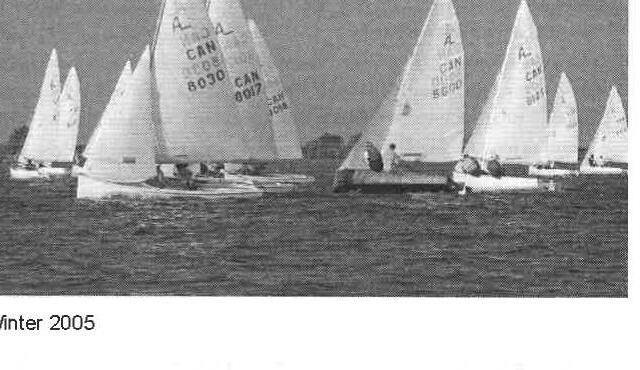
Boat Handling: Tim's Bits – The Reaching Leg
Mainsail
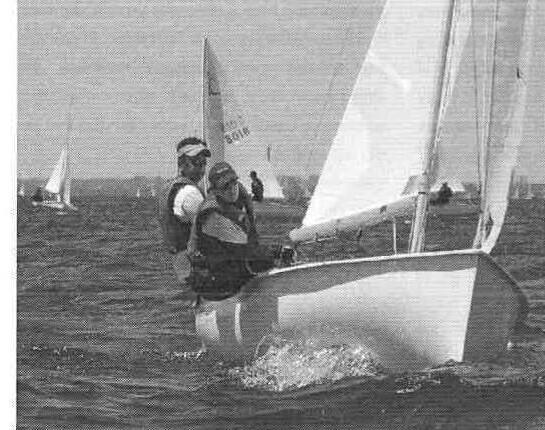
- Enough vang on just to trim in the top of the main a little bit. Seems to reward fiddling, based on getting all the ticklers and telltales flying. Lots of twist.
- Tends to drop off the outhaul, but not so far as the full shelf is deployed – seemed too baggy - halfway seemed to feel powerful without getting too much curve, (i.e., disturbed airflow).
- Have worked hard at mainsheet trim. "When in doubt, let it out" seems to have worked. In waves, after pumping, it's critical to let it out again. Better to let it out, and steer down.
- In middle to light air, keeping the pre bender on as much as while sailing upwind seemed to be very useful. Keeps the entry of the main from being too baggy. Also helps to keep the mast upright.
Jib
- Any major speed difference is probably due to rigging a mast-deployed pole. Allows us to trim the jib so it looks just like it does going upwind, just swung well away from centreline. Probably has another nice side effect of keeping the airflow over the back of the main from being disturbed by a hooked jib.
- Use the jib on the reaches like a spinnaker, with constant adjustments. Occasional moments of joy when in sync with the main pumping in waves.
- Generally do not ease off the rig tension very much for reaching, certainly not as much as running. Maybe open the sag up to 3-4 inches. Could do a bit more, because the pre-bender is keeping the mast from flopping back too far, but did not see any benefit to do so. Perhaps Barney's adjustable forestay, to keep the mast forward while allowing the jib to sag would be an improvement. Certainly useful running, not sure about reaching.
All The Other Stuff
- As usual, fore-aft boat balance is critical.
- We do not kick the board back a lot. Tried going with less board in the water, but as soon as the lateral resistance diminished there was some sideslip, then it felt like the sail shape and speed through the water was lost.
- Less slavishly devoted to the rhumb line. Seems a few degrees of course change can improve boat speed a lot. The trick is ensuring that the extra speed is used to work down to, or below, the rhumb line, to avoid the last minute dive to the mark, giving the whole fleet the inside advantage.
- When there isn't a wall of dirt coming off the weather mark, we've had a little luck running very low early, and then using the improved wind angle for speed the rest of the leg.
Courtesy of Tim Broughton & Laurie Harrison
Building An Albacore Mold
Last summer Peter and I had tons of spare time on our hands that we needed to fill so we decided to build a set of Albacore molds. Kidding aside, this is something I have always wanted to do. It has been quite a learning experience for me and all the many people who volunteered their time to help out.
We decided to start with the deck mold since this was the smallest and simplest part. First we had to extend and fair the deck. We had to create a mold that extended around 6 inches past the boat. This required that we glue extension onto the deck edges and then faired these into the deck. After coating the entire deck with primer, sanding thru 600 grit, and then applying several coats of wax and spraying with PVA mold release, we were ready to lay up the mold. In parallel with these efforts, we prepared a few sample lay ups to see how different mold release systems worked and to refine the exact mix for the gel coat. We tested McLube, wax and wax with PVA and found that the wax with PVA was by far the best option. For gel coats we determined that one scoop of colloidal silica with one half spoon of graphite powder was the best mixture, making a gooey thick substance that could be rolled on and that would remain in place after doing so.
The time came to lay up the first layer of fiberglass for the deck mold. We had a crew of albacore sailors over. We started with a layer of gel coat. We allowed this to partially cure till it was stiff to avoid print thru. We then applied one layer of 4 oz cloth, followed by three layers of 10 oz cloth. After this cured, we bonded 3/8 inch balsa core with a mixture of epoxy resin with colloidal silica, coating both the cured fiberglass and the balsa with the mayonnaise like mixture. After this cured we had many gaps in between the balsa blocks particularly over convex surfaces. We filled these and sanded the entire exterior smooth. One thing about balsa, it soaks up a TON of resin. To reduce the balsa's thirst for resin we first painted on a thin coat of resin and allowed this to partially cure while we ate lunch. We then applied several layers of 10 oz / sq yard fiberglass. After curing was the moment of truth – demolding. In theory we had done all the right things, but when we went to pop the deck mold off the boat it didn't budge. Fortunately the only issue was my being on the steep part of the learning curve – I had no idea just how violent one must sometimes be to separate the two with a
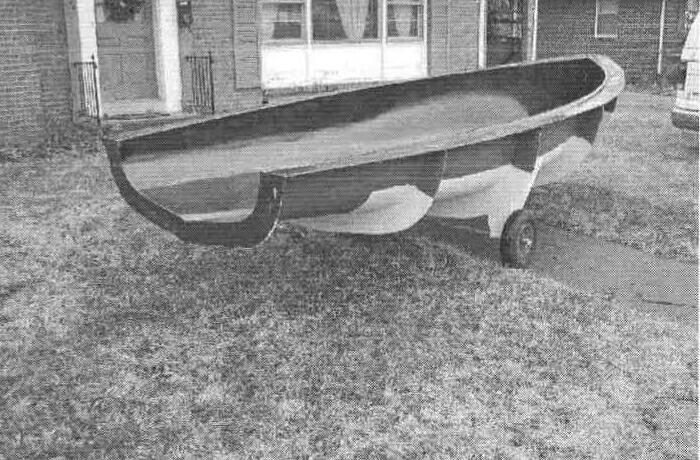
length of 2x4 lumber under the forward edge of the mold. By lifting and dropping the boat a foot I was, after 20 or so iterations, able to separate the two with an enormous CRACK! The resulting mold surface was nearly perfect. We trimmed the rough edges with a jigsaw and then sealed the open balsa with epoxy.
The anxiety did not end at that point – we still had the extensions glued to the inner and outer edges of the deck all round the boat. Fortunately our plans worked – the epoxy did not adhere well to the un prepared LP surface and, for the most part, simply separated with only minimal force, leaving the boat pretty much intact. Next task was to prepare the hull to serve as a plug. The hull mold is over twice the surface area of the deck and had greater requirements for stiffness and fidelity of form. I ended up buying two rolls of 20 oz / sq yard fiberglass cloth and a whole bunch of 3/8 inch thick end grain balsa core material. We started preparing the hull by sanding the entire exterior with 60 grit using an orbital. We were very careful to not sand thru the epoxy, which had been applied in 1999 during the boat's refinishing, so that the fairing compound did not get into the wood's grain. We followed the basic process outlined in a wooden boat article that basically starts with combing the fairing compound onto the hull with a saw toothed spatula – not unlike setting tile grout. We then used a variety of devices to sand this surface fair. These included an air powered line sander, which I used by the auto body industry to sand bondo in cars, a homemade long board, and a commercially bought long board. As one could imagine, this took many hours of laborious hand sanding, followed by checking with battens, straight edges, re filling and more sanding. After over a month of sanding nearly every free minute, we had a faired hull that had no hollows and appeared to be as perfect as we could make it. We now had to make it smooth. We applied several coats of single part primer and block sanded the hull. We found more areas, which were not quite fair and had to do some minor filling and sanding again. After another month we had a hull that was fair and smooth, sanded to 600 grit.
We made some measurements of the hull plug to ensure it was within class rules. We found that the hull was legal and well within the tolerance specified in the class rules except for a couple spots far from the hull centerline near the turn of the bilge where we were within one mm of the maximum dimension. We considered bumping the hull with more filler – but decided to go with the plug as is. If the plug turns out to be illegal we will modify the first boat and build a new mold. Hopefully this will not happen.
After 10 coats of wax it shined like a new boat – albeit a multi colored new boat – under the florescent lights of my basement shop. We then sprayed on a coat of PVA and the hull plug was ready for its first layer of glass. We applied epoxy gel coat as for the deck and allowed it to partially cure. We followed with two layers of 4 oz / sq yard cloth. The light cloth's purpose is to reduce print thru, since the heavier 20 oz / sq yard cloth was kinda bumpy. We followed this with three layers of 20 oz / sq yd cloth and allowed it to cure. We bonded the balsa core much as we did for the deck, and then added 2-3 layers of 20 oz / sq yd cloth over the balsa. The hull mold is designed with an open transom, which made demolding easier – we rested the boat and mold upside down on sawhorses, on the aft end of the mold with the boat suspended inside. We then stood on the open scupper ports on the transom and the hull fell out with a pronounced whoosh!
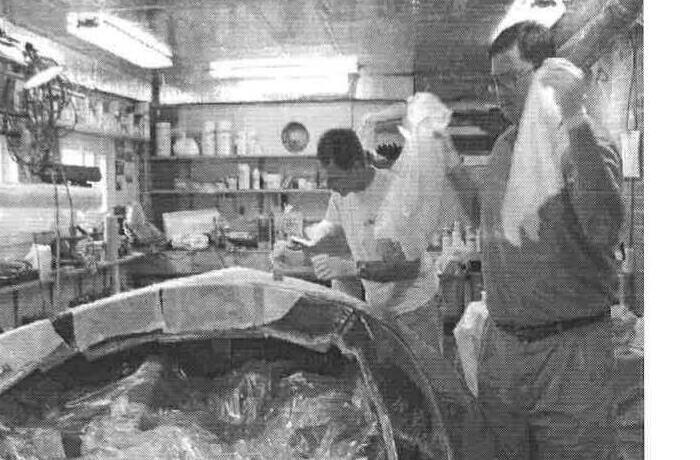
Next task was to return the plug to sailable condition for the US Nationals, which were only a week away. I was chiseling the fairing compound out of the centerboard slot on the Wednesday prior to the event! Needless to say, I didn't get much sleep that week. It was a photo finish, but we made it to the starting line on time and had a wonderful weekend celebrating the albacore class on its 50th anniversary in the United States. One week later, we had 6701 again stripped of keel bands, bow fitting, and centerboard gasket and upside down on horses. The mold shell needed to be completed with stiffeners, a six-inch flange at the shear, and handling gear like wheels. This took from mid October thru the end of December. We formed the ribs from end grain balsa with glass laminated to either side. This was trimmed to fit the exterior of the mold and filleted and taped in place. We needed a flange of around six inches all around the shear. This had to be airtight and transition smoothly into the hull. The purpose of this flange was to stiffen the hull mold and to provide a place to seal the vacuum bag. Finally, we added dolly wheels – the same type as on a Rapide or other dinghy dolly – using a length of galvanized steel pipe for an axle –and a single caster wheel in the front to make it easy to roll around.
I think we had been in contact with just about every small boat builder in North America and had not found a workable situation. We were resigned to build the first few hulls ourselves until by way of one of our vendors we came across Gorton Merrick, a small fiberglass mold shop on Maryland's Eastern shore. We met at our home and looked at the mold and came to an agreement. We transported our molds there. This gives us the potential of rapidly scaling up our production if the first few boats prove to meet with our satisfaction. Presently we are getting some sample laminates laid up which we are doing destructive flexure and dimple tests on along with extensive engineering calculations. This will be, by far, the most highly engineered Albacore ever.
Scribbles From The Chief Measurer
Christine, being a new editor, asked for help: "Would you whip up an article for Shackles"? To which I offered. . . well, not an article, but perhaps some scribbles, hopefully of interest to all readers, on some of the goings-on within the class. I'll try to be short and to the point in listing a few of the recent bits and pieces. If you have any questions, forward them to me. I'll be happy to comment in the next issue, or directly.
At the AGM last September in Hamilton, a couple of rules were proposed and endorsed by the Canadian membership for inclusion into the 2005 issue of the International Albacore Class rules, that are published in March, by the Royal Yachting Association in England.
The first item concerned Electronic Compasses. The rule proposed and approved was: Change to Part B, Rule 14.9 to be:
"Electronic devices other than timing devices, electronic compasses and/or devices displaying heading and time, provided they do not correlate time and heading information. The electronic compass may have an adjustable dampening to a maximum of 10 seconds."
So, what does this mean? You may have an electronic or digital compass that shows you information that is NO MORE than any existing analog compass. That's it, plain and simple. Some may have the SUUNTO devices now . . . Others may have analog types attached to your mast gate. Electronic or Digital may not provide any more information than those now existing currently installed.
We then spoke of a Centerboard issue that arose in England. And we endorsed the following proposed new rule:
Part B, Rule 7.5: "Only one centerboard shall be used during an event of less then 7 consecutive days, except when the centerboard has been lost or damaged beyond repair."
Why? It was brought to the attention of the International Rules Committee that some sailors within the National Albacore Association (the English association) had, in recent regattas (during the summer of '04), changed centerboards depending on wind conditions. These people believed an advantage may be gained and that it may be possible to try and optimize the boat performance for different wind conditions by using different centerboards within a regatta event. This is considered an expensive trend and the IRC has recommended the rule proposed above, as an interim step, in order to stop the practice. A more complete rule will follow, hopefully in a year's time.
A new proposal has been tabled by the IRC to change the way in which the centerboard is measured, which will also tighten up the variation in the various existing centerboards. The current rule on centerboards shows only the measurement to be done on the board itself: not as part of the hull, as it would perform while under sailing conditions.
This current rule allows people to have several centerboard pin positions as well as several centerboards. The new rule, still to be agreed upon, will add a depth measurement to the class rules to be recorded as part of the centerboard when the centerboard is fully installed within the hull.
To accurately make sure that any new centerboard rule applies fairly to all existing class members, a detailed set of data on existing centerboard depths needs to be gathered before this proposal is finalized.
CAN 7000...A Boat That Was Destined For E-Bay
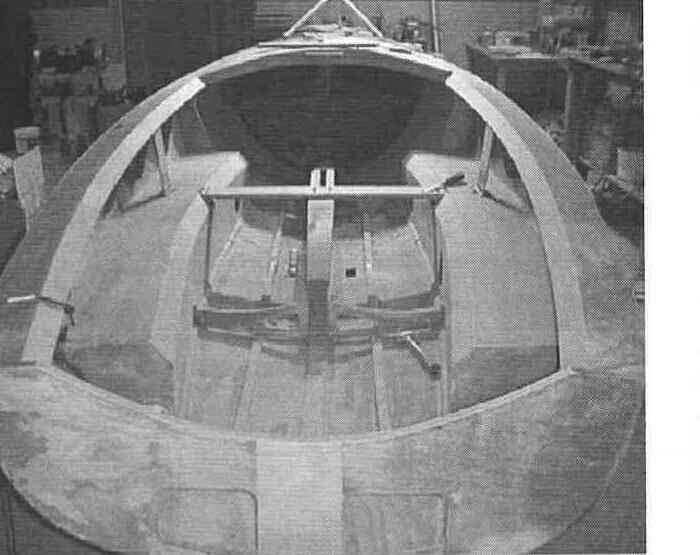
Sometime in spring of last year, an email came across my desk from Peter Duncan in the U.S. asking me to look at a boat that was about to be put on e-bay. At that time I was not looking at buying another Albacore but the thought of another project peaked my interest. I went to the web site that had a picture of 7000 on its trailer with the boat cover on it. The picture told me nothing of the condition 7000 was in.
A few more emails from Peter, I found out someone else was looking at. The report came back that overall the boat was in good repairable condition however the deck was suspect to need replacing. Besides knowing the builder and original owner of 7000, this is all the information I had to make an offer on this boat that quite possible could end up in the wrong hands and have an outboard put on the transom.
CAN 7000 is the third of seven Whitehouse Albacores built in the early eighties in Toronto. These boats are unique because Bob Whitehouse worked extremely hard to control where the weight is placed. The boats are made of 2 ply 1/8th" cedar. These boats did away with the thwart and went with "knees" to support the c/b trunk and add in stiffening the hull.
I was interested enough in 7000 and put in an offer without seeing more than a picture of it with the cover on. My offer was originally rejected and the present owner intended to put it on e-bay with a reserved bid. To my surprise my offer was accepted and I now faced the biggest problem, getting it back East. After a very long process I finally contracted Andrews trucking out of Niagara on the Lake. They put 7000 onto the gooseneck of the truck and delivered it to my door for $600.00 Canadian. This was far better than the quotes of $4,500.00 U.S. I was getting State side.
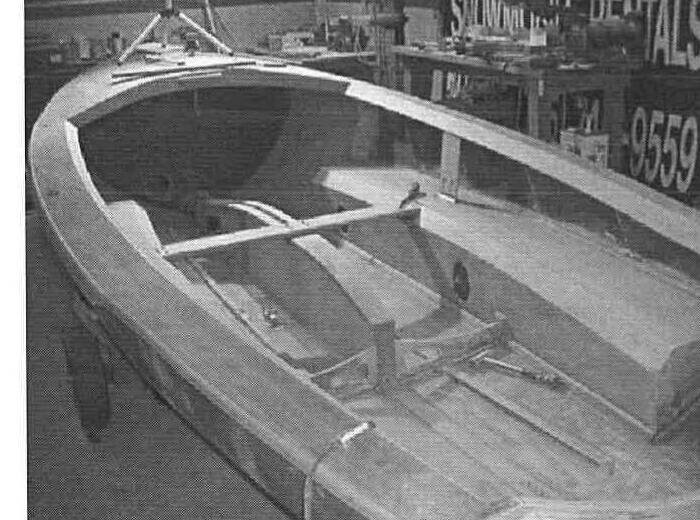
In Mid October, 7000 arrived to my door. When I uncovered it I was prepared for the worst. Early reports from others that had gone to look at it had suggested it needed a new deck among other things. To my surprise there were no surprises, all was well within reasonable repair that I could do in my shop.
To date, I have removed all the 1980's rigging (16lbs) and have the interior totally scraped and sanded back down to the wood. In the month of February, 7000 will be flipped over and the tedious job of fairing the hull will begin. It is our goal to have 7000 in the water sailing in May.
This is part one of an on-going series of how 7000 was brought back to life!
Know Your Rules
The Racing Rules of Sailing are published for 4 years. The changes introduced in 2001 with the 2001-2004 Racing Rules of Sailing were fairly minor. A new book has just gone to press covering the 2005-2008 Racing Rules of Sailing. The changes introduced this year are also fairly minor.
I am going to focus on the meaning of the changed rule rather than the meaning of the differences. In many cases the changes are designed to cleanup loopholes or unclear wording in the previous rules. An explanation of the change would require an explanation of the loopholes that are no longer there. This is beyond the level of these articles and would, I believe, confuse more than help. The astute and curious reader may be able to read the situation that I describe and follow along with their old rule book and find the loophole, but remember that all you are doing is finding loopholes that aren't there anymore. I will also, as usual, be focusing on the rule changes from the racers' perspective and particularly the right of way rules. I have shown the deleted parts in parentheses( ) and the new parts underlined.
The 2005-2008 Rules Part 2
There are very few situations where the changes made this year will change the way that we sail. If you sail as you would have under last years rules you will be fine almost all of the time.
Rule 13 is the first rule in Part 2 to have changed:
13 WHILE TACKING
After a boat passes head to wind, she shall keep clear of other boats until she is on a close-hauled course. During that time rules 10, 11 and 12 do not apply. If two boats are subject to this rule at the same time, the one on the other's port side or the one astern shall keep clear.
The only change is the addition of the words "or the one astern".
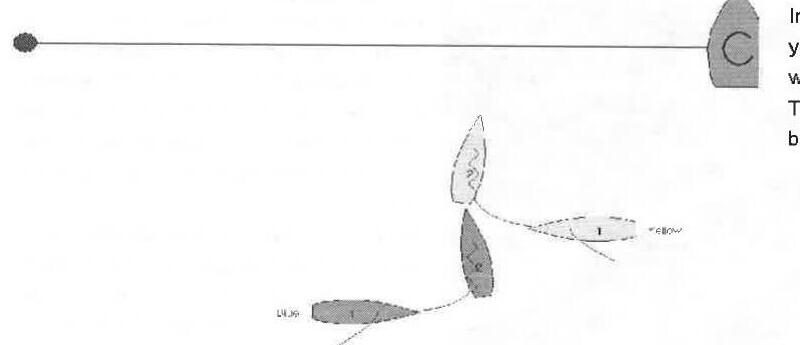
In the diagram the blue boat and the yellow boat have both passed head to wind. Neither is on the other's Port side. The blue boat is clear astern of the yellow boat and must stay clear.
14 AVOIDING CONTACT
A boat shall avoid contact with another boat if reasonably possible. However, a right-of-way boat or one entitled to room(a) need not act to avoid contact until it is clear that the other boat is not keeping clear or giving room, and
(b) shall not be penalized under this rule unless there is contact that causes damage or injury.
Andrew Alberti, Canadian Judge — This article was originally published in The R.C.Y.C. Kwasind newsletter.
In rule 14 the words "or injury" are added to the end. This means that a right-of-way boat that could have acted to avoid contact can be penalized if there is injury to a crew member, not just damage to the boat.
Rule 16.2 has had quite a few changes since the "new rules" were introduced in 1997. This book makes another attempt:
16.1 When a right-of-way boat changes course, she shall give the other boat room to keep clear.
16.2 In addition, when after the starting signal (boats are about) a port-tack boat is keeping clear by sailing to (cross or are crossing each other on opposite tacks, and the port-tack boat is keeping clear) pass astern of (the) a starboard-tack boat, the starboard–tack boat shall not change course if as a result the port-tack boat would immediately need to change course to continue keeping clear.
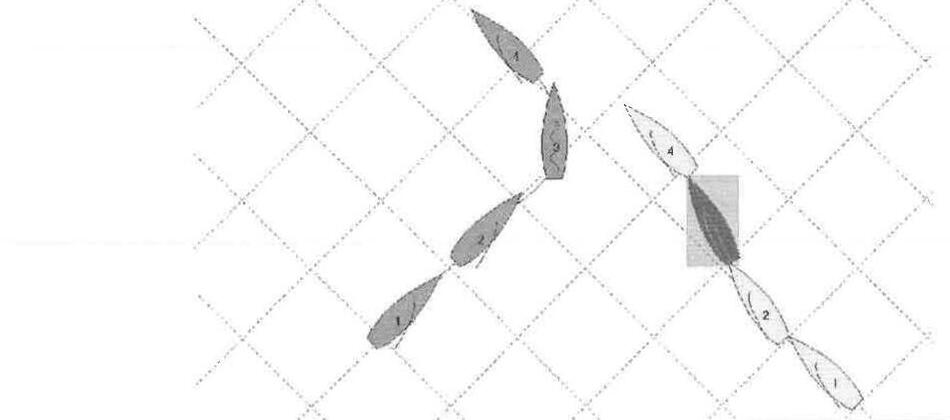
In the second diagram, red on port was going to cross ahead of green on starboard. Green luffed up a little at position 3 to make it more difficult for red to cross. Red immediately tacked and kept clear. Since red was not going to cross astern of green, green has not broken the new version of rule 16.2. In practical terms green is very close to breaking rule 16.1 which has not changed.
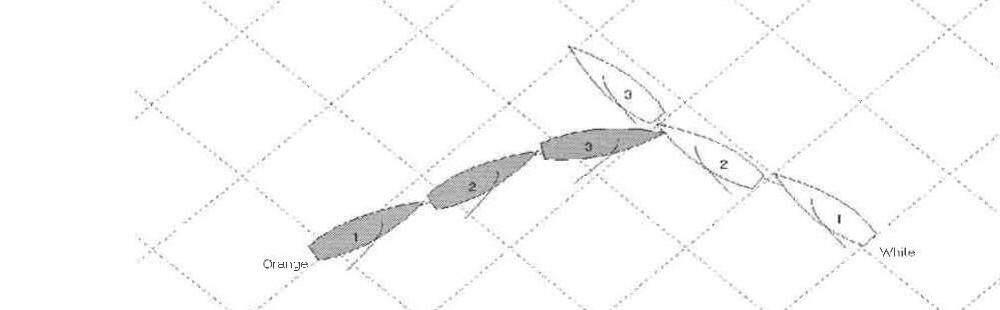
In the third diagram the orange boat on port was keeping clear by passing astern of white. White bore away which forced orange to immediately bear away further to keep clear. White has broken rule 16.2.
Alba-Scopes – Your Forecast For The Year
Aries
Pay your CAA Membership ASAP. Aries is the first sign of the Zodiac, and that's pretty much how you see yourself, leader of the pack – but you tend to initiate than complete. That pretty much sums up your last leg on the racecourse unfortunately. Summon up your inner strength required to take on most anyone. You can do this my little Ram. Work on what drags you down on that last leg, is it your lunch? Are you thinking about your first beer? Or is it a tactics issue? Your element is Fire, think action, enthusiasm and a burning desire to play the game – win that mug. Be a luv and invest in ratchet blocks for your crew.
Taurus
Pay your CAA Membership ASAP. It's all about the reward, unlike the Arian's love of games; Taureans love the rewards of the game. You are a Bull and perhaps you could lighten up on being so stubborn – do you always have to win the pin end? All that practice you've made has paid off; Practice = Success. Your element is Earth, keep plodding along, in pursuit of your goals. Bulls are strong and well-built, but you may have enjoyed too many rum balls over the holidays, so, do 4 sets of 10 ab crunches daily to keep your fab ab 6-pack physique. Be a luv and invest in ratchet blocks for your crew.
Gemini
Pay your CAA Membership ASAP. Gemini's love to talk! It's not just idle chatter with these folks either. Who do you hear at mark roundings? A Gemini keeping us in line. You are a mix of the ying and the yang, and represented by the Twins and sometimes we are not sure which Twin will show up at the regatta – gee which Twin was that that just tacked on us? You are both curious and clever, which is why you are swell at parties and a good date. You talk a great game but also love to listen and learn. Your element is Air. You love the camaraderie of games and play and that's why you excel at team events – your ability to communicate effectively and to think clearly is why your dance card is always full and skippers love you.
Cancer
Pay your CAA Membership dues ASAP. Our Crab friend likes tradition and is very patriotic, and likes to wave the flag, and often seen on race committees. The Crab should consider attending the CAA's Race Management Course to be held in the Spring as a "refresher:" It is said that the Crab is the first to laugh and the first to cry, so while you were pushing someone over the start line, you too were over early. Try not to go into your shell Crabby when this happens - get your timing right the first time. Your element is Water, like the rolling waves of the sea, you can make quite a splash, but try to hike a little harder to prevent this from happening, you can do this since you are wise to listen to your gut, and therefore have a very strong one. Be a luv and invest in ratchet blocks for your crew.
Leo
Pay your CAA Membership dues ASAP. These folks are hard to miss, since they love being centre stage. Like Lions, Leos tend to be dignified and strong and it is this sense of their power which allows then to get things done. An excellent person to have on any committee as they see their projects through to completion. Suggested reading - The Racing Rules of Sailing 2005-2008, or better yet, attend the CAA's Racing Rules seminar in the Spring, so that you don't ruffle any feathers along the way, since you are so overbearing. Your element is Fire and you are hot, hot, hot, fearless and strong, but you should really think twice before you attempt that barge at the mark. Be a luv and invest in ratchet blocks for your crew
Virgo
Pay your CAA Membership dues ASAP. Those born under this sign are forever the butt of jokes for being picky and critical, but your attention to detail is for a reason: to help others – you make an excellent boat boy. You revel in exacting behavior and are a whiz with minutiae, which is why the new approved electronic compass is a good investment for you. Your element is Earth, so you're grounded, no flash and dash in your sailing gear and you look best in muted shades of tan and warm yellow. You make a great partner for road trips since you are extremely hygienic – no gummy bears stuck in your car seats. Practice rounding the leeward mark; get a feel for when to start the turn, where to turn and what the rate of turn should be – you will thank me later.
Libra
Pay your CAA Membership ASAP. Librans are the sign of partnerships, everything is done as a pair, hence the Scales, and so they make great Albacore sailors. You epitomize balance and quest for fairness, peace and harmony, so you should make yourself available for protest committees. You are a lover not a fighter, but your fickleness and indecisive nature causes the odd crash tack and you find yourself buying cocktails to achieve peace since you abhor conflict. Your element is Air, and you like to use your big brain, but your Rico Sauvé butter-like smoothness can cause you to sometimes appear a little vain. The Scales need to be on the lookout for their lower backs, which tend to shoulder burdens, and means that they don't like to hike, so the crew needs to be advised of such laziness.
Scorpio
Pay your CAA Membership ASAP. Scorpions should not be taken lightly. These folks are complex and secretive, so don't expect to get much out of them – consider this at a tack or cross situation. Scorpions can lose their temper even become vengeful when someone gets in their way – so when they ask for room, people please give it to them! Your element is Water, in this case "still waters run deep", emotions are kept under cover, again secrets to be used another day. Scorpions have great regenerative powers, so if you think taking them head to wind is going to bring them down, think again my friends, their tails grow back and you are the one who ends up in the water. Scorpions don't know the word quit, a powerhouse like no other which is why they get the job done, and another person to add to the committee.
Sagittarius
Pay your CAA Membership ASAP. The home of the wanderers. That was you tacking back and forth across the racecourse last year, not able to commit to one side – you like the action and adventure and that explains things. It's a good idea to give Sags lots of room to explore, once these folks start to feel hemmed in, they become impatient and difficult, so remember this when trying to take a Sag up. The element associated with you is Fire. Just as fire can move quickly and uncontrollably, so can Sagittarius, sounds a little dangerous on a starting line. You are physical and athletic, full of stamina – which speaks of a tacking duel – avoid it with a Scorpion. Be a luv and invest in ratchet blocks for your crew.
Capricorn
Pay your CAA Membership ASAP. Capricorns are all about hard work. Life is one big project for the Goat. Since getting to the top isn't always a walk in the park you must practice, practice practice, tack, tack, tack, gybe, gybe, gybe, but you will get there as you are disciplined. When you do get to the top don't forget to thank the little people that helped you i.e. your crew. Caps can get a bit materialistic and greedy, so when you get a little lift – remember – don't be too greedy. You need to watch your teeth and knees and not be too daring– sounds like you should consider being be on race committee…or have you thought about golf or croquet? Your element is Earth. Caps aren't interested in wild ideas or round the world dreams, you would rather work – guess you're not going to Lyme this year.
Aquarius
Pay your CAA Membership ASAP. You want to make the world a better place and have a humanitarian nature, but Water Bearer do not be the marshmallow on the starting line. Try and use your visionary skills and look for the next wind shift instead of Brad Pitt. You are truly the trailblazer of the Zodiac and doesn't your flashy sailing wardrobe reflect that. Your heart is in the right place and your few oddities should be overlooked. Be wary of weak ankles and some of you have cankles, invest in some good dinghy booties and avoid the Manolo Blahniks for a while. The element associated with you is Air and your offbeat, original approach will win the day, just like a peanut butter & nutella sandwich. Be a luv and invest in ratchet blocks for your crew.
Pisces
Pay your CAA Membership ASAP. You are the twelfth sign of the Zodiac, and lucky you carry many of the characteristics of the eleven previous signs. The Pair of Fish symbolizes that you go with the flow. Your self-sacrificing nature often finds you as the blocker on the racecourse. At times you have a difficulties distinguishing fact from fantasy and perhaps you should consider wearing Oakley's instead of the rose-colored glasses that you currently wear. The element associated with you is Water, so you can relate to water's unpredictable nature, you love to swim, save that for when you are single-handed sailing please. You need to focus on your feet which means Birkenstock shoes–very unfortunate for you, but hopefully most people will overlook this faux pas due to your compassion and charitable nature.
More Scribbles & Musings On Moulds...
(GR): Many may be aware that Barney Harris has undertaken, as a partner in Hapco Marine, with Peter Duncan and Peter's dad, John, to build a mould for the future potential of licensing a builder in USA. Some may have a perception that this will be a new "faster" hull.
Please remember: an Albacore is an Albacore. In the dinghy park, one may seem faster than another. Put a different skipper in it and put it on the water. . . that's a different matter!
Seriously though, Barney has succeeded in building only a MOULD to date: not a hull. He has a long way yet to travel with this venture. So far, Barney has religiously recorded and measured each of the fifty or so required hull shape measurements as he progressed through this exercise. Jude Brown, a US Measurer and a US Navy architect, verified many of those detailed measurements. Yes, Barney used his very good Richard Woof built hull, 6701, as the base of his mould, but that does not mean that any future hulls, if built, will be any different than any existing hull, whether it's a GRP built by Ontario Yachts or Skene, or any other fiber glass builder or any different than any wood builder either, for that matter. Barney's future hulls will be subject to all of the measurement scrutiny that any current existing hull must maintain. Barney may have, within class rules, a different placement of rig items or other interior structure items, such as tanks, thwart, etc, but those will not make it a "faster" hull. Faster, is a perception that is a reflection of the actions of the skipper.
By building a new hull from a new mould it will mean that it will be subject to a full "template" check. That is, at each station of measurement as described within the class rules. This is to verify that no changes have been mistakenly made to the hull shape. GRP hulls made in Canada were subject to the same measurement on the fifty items listed within the class rules a long time ago. These detailed steps in measurement are not deemed to be necessary on each "copy" that Ontario Yachts builds today. This is because once the mold is established as being "stable," there is little opportunity, if any, for deviation in the hull shape to occur during the moulding process.
So far, none of Barney's future hulls have even been moulded; let alone any testing of the strength of the mould. When and if a hull is produced, and the full measurement is accepted, the US Class Association will then, by class rules, need to provide a license to that builder organization before any production hulls are available.
Of course the resultant end product will determine if this venture will have some success. Those details of costs, follow-up service, at this time, are totally unknown.
As this project unfolds, I may have other details to share; I'll list them in future issues.
(B&P): Will this be a faster albacore?
As I have said before: All Albacores are fast sitting in the parking lot; they only go slow when the people get in them. There isn't much one can do to an Albacore to make it dramatically faster than another Albacore as the class rules are quite restrictive in terms of the boat's form, materials, rigging, etc. We intend on using the same or similar fiberglass, resins, core materials, and adhesives as other small boat builders. We hope to make the hull somewhat stiffer than other composite hulls through better engineering, design, and careful manufacture. I have always believed that, compared to some of the wood boats, composite Albacores fall short of their ultimate potential due to a lack of the foregoing. The point here is that we are not trying to stretch the rules in any way here - we only wish to build a really nice boat that will last and be capable of racing at the top of the class.
(B&P): Why do it?
Why not? I have always wanted to build a boat of my own. The Albacore is small and materials to build one don't cost all that much – so the risk is low and I can't think of a nicer boat to build. Barney for one has definitely done stupider things in his life.
(B&P): Questions & Answers....
Here is an attempt to answer some of the questions we seem to encounter frequently . . . but first, some background. HAPCO Marine LLC is owned by Barney Harris, John Duncan, and his son Peter Duncan. HAPCO is a part time, for fun, business. I don't think that John or Peter need any introduction - John was instrumental in bringing the Albacore from the Muskoka lakes to the Washington DC area in the late 1960s and served as an early president of the US Albacore Assn. and has been involved in the business of building and selling albacores since the 1970s. Peter is the latest USAA past president, grew up in Albacores, and among other things of interest, rebuilt, over 3 years, a nearly wrecked fairy marine 342. John and Peter re started HAPCO Marine in the late 90s and brought me on board as an equal partner in 1999. HAPCO Marine sells boat parts, line, supplies, clothing and of course Albacores. We have rebuilt over 20 boats all of which have been re sold to active class members. A typical rebuild will require 200-300 hours of labor plus US$ 1 - 1.5K of parts, supplies, fasteners, line, and materials. Our philosophy is to supply boats with no barriers to sailing - they are ready to go - just put it in the water and race it. HAPCO has also sold around 6 brand new albacores. We obtained bare hulls from Ontario Yachts and fitted them out with spars, rigging, and foils built to our own specifications. HAPCO sold these boats for US$8350. We have tried to orient our business to foster the growth of the Albacore class - for this reason we do not do repairs or rigging since this would detract from the rate that we can rebuild or fit out new boats - but we freely share any and all specifications, drawings, set up data, and advice. We seek seasoned dinghy racers to buy the boats we rebuild - since we are expending considerable personal time on this, we want the best bang for the time spent in terms of racing boats on the line.
All Albacores are fast sitting in the parking lot...
(B&P): Who will measure the mould you will be using?
Molds are not measured - boats are measured. We have measured the plug and will measure the boats built from tooling created there from. I fully expect every boat we build will have full offset measurements at least initially before we can call them Albacores. To that end HAPCO has begun to build a measurement jig, consisting of aluminum tubing and other hardware to rapidly and accurately measure albacore hull offsets. HAPCO is funding the materials and parts for this. This jig will be donated to the USAA after it is complete. After we are satisfied that the boats are legal we will bring the measurement tool to Canada and the UK to demonstrate this to the satisfaction of anyone who wants to watch.
(B&P): The current market for Albacores in NA cannot support more than one builder
With all due respect to those who may hold this belief, this is Baloney. We believe the market for small boats is at least partially and perhaps predominantly a function of how they are promoted and sold. We all have seen well organized and promoted dinghy classes that prosper and grow, creating a need for new boats, whereas poorly run fleets wither and die. Having boats available to buy is a major factor – recall the dealer selling Hunter bathtubs and Laser 2s. With a small amount of advertising, as in greater than zero, broader availability, and dealers with a financial incentive, the market for Albacores can be doubled in a year and doubled again the year after. This greater market will be available to ALL builders – not just HAPCO. To sum it up, we do not want to decrease other builders' Albacore business – on the contrary, we believe that our efforts will, in the long run, broaden the class'prospects with new growth in new fleets – and result in a larger market for all builders.
This topic has created a lot of input and will be continued in the next issue of S&C. Comments and input from others are always welcome... Editor
2005 Preliminary Event Schedule
| Date | Event | Venue |
|---|---|---|
| March 18 - 20 | Mid Winters | Sarasota Sailing Squadron, Florida |
| June 4 - 5 | Tarts | Toronto Sailing & Canoe Club |
| June 11 - 12 | RCYC Open | Royal Canadian Yacht Club, Toronto |
| June 18 - 19 | CAA Race Training Weekend | Toronto Outer Harbour/Lake Ontario |
| August 6 - 7 | North American Championships * | Ware River Yacht, Glouchester, Virginia |
| September 3 - 9 | International Regatta ** | Lyme Regis Sailing Club, Lyme Regis UK |
| September 23 - 25 | Canadian Championships | Toronto Outer Harbour/Lake Ontario |
| October 8 - 10 | US Nationals | TBD |
* Details of container shipping can be found under the North American Albacore Forum: www.albacore.org/forum
** Regatta details www.championships-at-lyme.org.uk. To charter a boat or have a boat available for charter contact Jeremy Rook at [email protected]
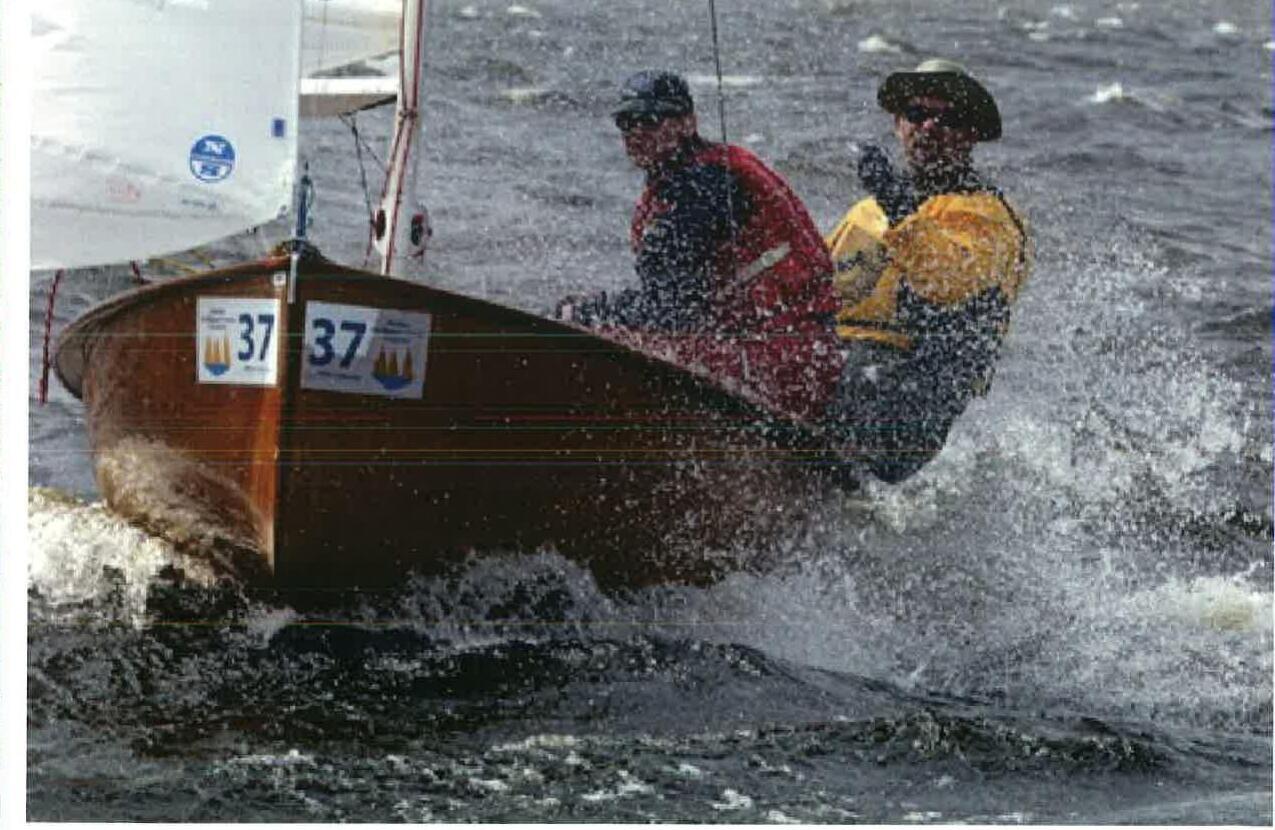
Photo provided by John Langley, copyright protected and reserved — www.johnsimages.com/gallery