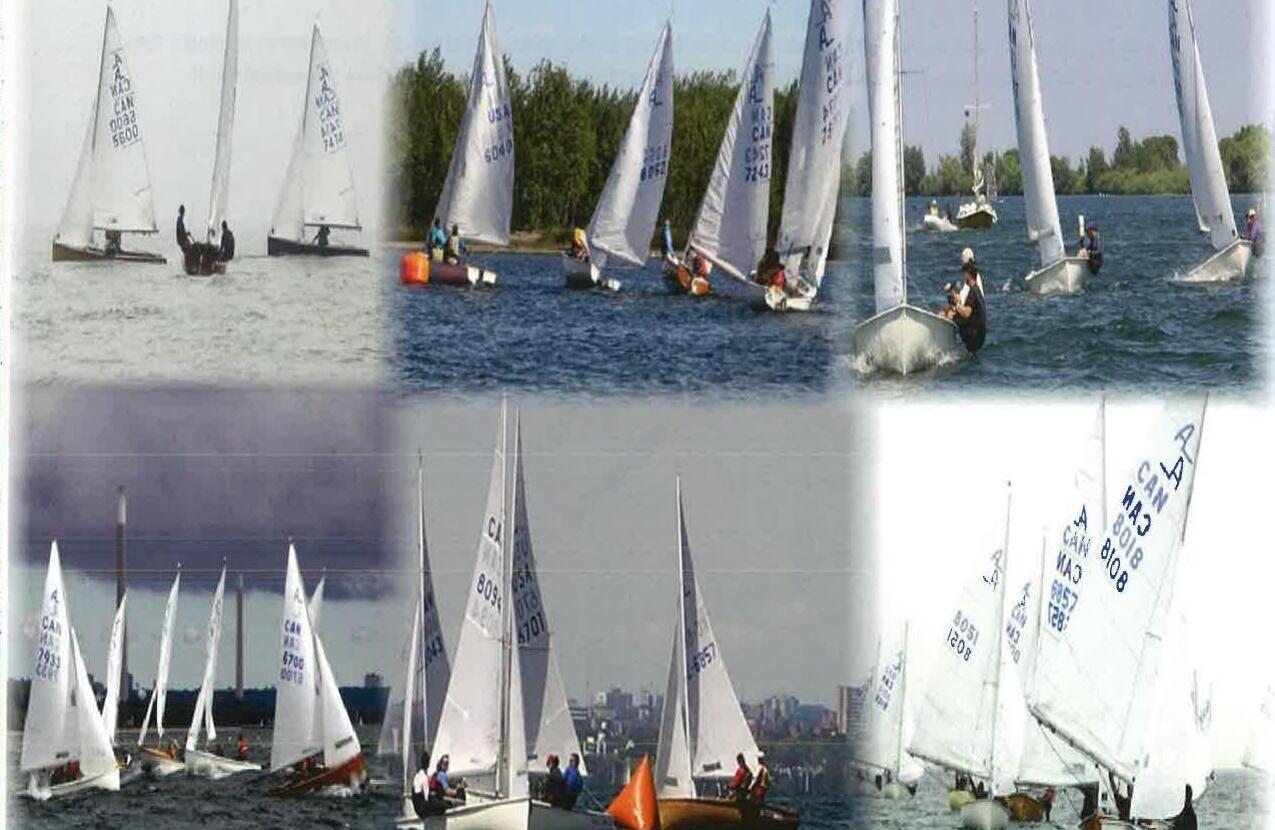
Winter/Spring 2006
March 01, 2006
IAA's 30th anniversary, a Q&A with British sailor Neville Herbert, buoyancy tank testing and repair, and a racing-rules breakdown of being over early at the start.
Message from the Commodore
Hi Gang,
Commodore Barrie here with the latest and the greatest from your Canadian Albacore Association Executive.
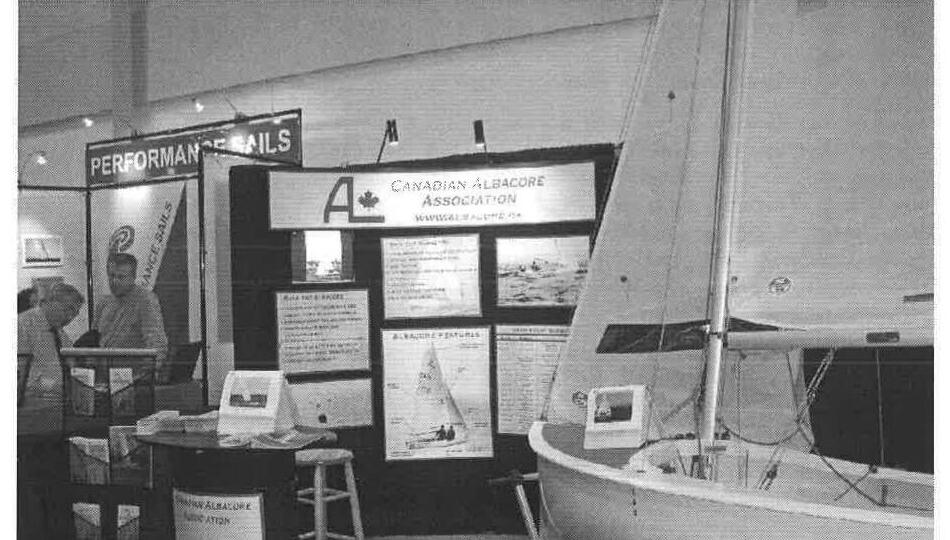
We just kicked off the year with the Toronto International Boatshow. Our new booth (see the picture on the opposite page) was up and looked great. Thanks to Henry and Teresa for the new booth and of course our million wonderful volunteers who helped out with the set-up, monitoring and the shut down and to Heather Macnaughton for organizing the volunteers. Great work.
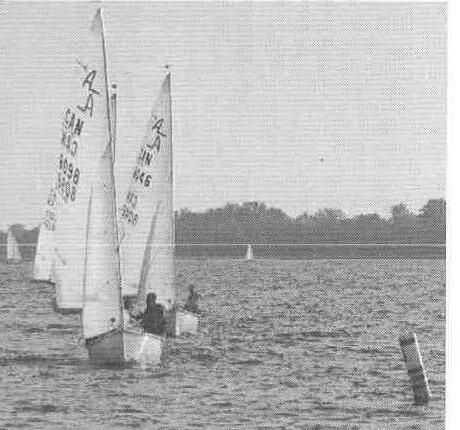
We have three major regattas to look after this year. Since it's not an Internationals year, I hope we can see some big turnouts and support of the events. The North American's are in Toronto, June 10th & 11th, the Ontario's are back in Peterborough, July 1st & 2nd and the Canadian's will be held in Nepean this year, September 15th 16th & 17th. Also, the Hamilton Bay Sailing Club is going to host the first Hamilton Albacore Open on Saturday, July 29th. Can't wait!
Last year, we were up in membership numbers for the first time in a while and we hope to do the same this year. As an added bonus, if you join as either a full or associate member by April 30th, you get a shot at our draw for a Quantum Jib (thanks Quantum). Again my pals and I on the CAA executive don't get a chance to win. After last fall, my jib is Kleenex. Good for 0-1 knots (my specialty). You lucky dogs.
On the training front, the CAA is putting on a North U in-class coarse April 8th. It's filling up, so I suggest you get your seat booked now. It's a one power day of Tactics. Plan your work. Work your plan. Blow it out your ear. See ya there.
As for sailing and racing, the Mid-Winters Regatta is going on in Sarasota March 24th, 25th & 26th. It's not the March Break, it's the week after so no excuses. I know of 5 boats from Canada going so far and we'd love to see you there with us. You can camp on the beach so the price is right. The Loonie is doing pretty well these days too. Party time.
So my Family of Tuna Riders, it's winter, the Olympics are finished and you're cozy at home reading this. Look out your window and you will see your fab CAA executive hard at work. We want the summer off just like you, except for Van Sheppard, he's running the Canadian's so no rest for the wicked.
Time to wash out that wet suit and duct tape those hiking boots. Won't be long my Friends.
Bear
Thank you to Quantum Sails for their continued support of the Canadian Albacore Association
Message from the Editor
Hello Sailor,
I hope you are enjoying the last bit of our winter season, and getting keen for sailing to begin. We on the executive have continuously been meeting and working hard on how best to add value and continue to grow the class. We thank you for your support and contributions, which includes everyone who contributes to the S & C newsletter, email updates, regattas and events. There are many regattas and events going on throughout the full 2006 season, and we look forward to seeing you at them.
On the race training front, the CAA is hosting a Tactics Seminar which North U is instructing April 8th. The Race Training weekend in Toronto is planned for May 27/28 weekend, the details are still being finalized. We also hope to have sessions in Hamilton and in the Kanata/Nepean areas too.
Further details on the above mentioned events will be posted on the CAA website or give me a call at 416-703-2086 for more information.
Happy Sailing,
Christine
Thank you to the Robert MacDonald for the photos and cover
Canadian Albacore Association's Booth at the Toronto International Boatshow
International Albacore Association Turns Thirty Years Old
The Albacore class grew from its roots along the south coast of England in the 1950's into a major national class in England, Scotland, Canada and the United States. In addition, Albacores could be found scattered in Cyprus, Gibraltar, Hong Kong, Kenya or other former British colonies where the Royal Armed Services had established fleets near their bases. In 1963 the Albacore became a National class administered by the Royal Yachting Association ("RYA") in England, but by the early 1970's there were nearly as many Albacores racing outside of England as there were in the mother country.
Albacore sailors were beginning to travel between countries and were discovering that the rules were starting to diverge from country to country. There were also developing issues on how to grow and promote the class. Each country thought they had the best idea for their Albacore owners, but it wasn't the same answer in every country. If the class wanted to promote international competition, as many of the sailors desired, then there needed to be some larger organization to coordinate rules and activities between all countries. Each of the major countries had developed their own administrative body and the RYA took over the copyright of the Albacore (from Fairey Marine) in the late 1960's. The RYA might have been a natural body to organize the class, but its jurisdiction did not have a way to incorporate owners in North America. The Albacore class considered becoming a full International Sailing Federation class ("ISAF"), but the cost and the criteria were too high for the Albacore owners to elect to go that way.
The class leaders identified that the main objectives in creating an international organization were:
- to harmonize the rules so all Albacores could compete as equal
- to promote the development of new fleets and expand the class
- to promote international competition.
From that base agreement, a group of delegates from each major country began to work together and negotiate how to establish an international governing body for the Albacore class. As Canadian, Tony Griffin, said, "Agreement on the objectives was relatively easy. Lofty principles are never difficult to agree upon; but the steep descent from ideals to practicalities is difficult. We are always reluctant to give way on our own cherished, workable methods, in favour of somebody else's! It speaks well for all these groups of representatives that a notable spirit of compromise was evident throughout and this, more than anything else, should give the new Association a good start in life". The end result was to create a hybrid organization, an association of associations to govern the coordination of activities, which affected all countries while giving rights to the RYA as the copyright holder and each national Albacore Association to govern within their own boundaries.
It was thirty years ago this past fall these negotiations gave rise to the International Albacore Association ("IAA"). The first meeting took place in July at Association Island, scene of the 1975 World Championships. At this meeting they adopted the constitution which sets out the purpose of the Association, the Class rules, the holding of the copyright on the design, the membership of the Association, the terms of entry for new members and the relationship of the IAA with the National Associations and the RYA. It describes the Council and officers and sets out their duties, stipulates general meetings, sets out some rules for international regattas and covers licenses to builders. The IAA constitution, with amendments over the years, is available for reading on the home page at http://www.albacore.org/iaa-constitution.asp.
Today, the International Albacore Association is the overall coordinating body for Albacore activities worldwide. The members of IAA are not individuals, but rather the major Albacore associations in the world (at this time, Great Britain, Canada and USA). Each national association with membership of 50 or more individuals is represented by two "councilors" (commonly known as "IAA reps"). The country which is in line to host the next International Albacore Championship, gets one extra councilor who shall serve as President of the IAA. Peter Duncan is the current President of the IAA and his term will continue until December 2007. The rest of the councilors and officers of the IAA can be found on the web at http://www.albacore.org/iaa-contacts.asp. Voting on issues in the IAA is apportioned based on the number of owner members in each country (15-50 members = 2 votes, 51-100 members = 4 votes and 101-200 members = 6 votes).
One of the most important tasks of the IAA is the management and interpretation of the Albacore class rules. To date, the IAA and its sub-committee, the International Rules Committee ("IRC") have done a good job of keeping the rules uniform for Albacores around the world. Today there are only two areas where the rules differ between countries (use of adjustable shrouds and number of jibs allowed per year), and both of these differences pre-date the formation of the IAA. In the coming year, there will be much discussion of the class rules as the IRC looks at how the Albacore class can bring its rules into the 21st century by adopting the standard format used by all ISAF and National classes.
In addition to managing the rules, the IAA will likely be addressing the need for developing more builders of the Albacore and how to support marketing the class in each country so that we continue to grow and attract new members.
Though the IAA is not a highly visible body, it is the one group that is able to harmonize the interests of all Albacore owners around the world. As the IAA heads into its 4th decade, the objectives that brought it into existence thirty years ago are no less important, but the challenges of implementing them grow greater all the time. It is fortunate that three decades of working together, by the leaders of the Albacore owner's associations around the world, has brought us to a point where there is considerable cooperation and harmony between the CAA, NAA and USAA. With your input and support, the IAA will continue to promote the Albacore and all the fun and friendships we associate with being part of this great class.
2006-2007 IAA Councilors
| President: | Peter Duncan (USA) |
| Vice President: | Richard Thorpe (Great Britain) |
| U.S. Members: | Lloyd Leonard Barney Harris |
| British Members: | Richard Thorpe Jeremy Rook |
| Canadian Members: | Barrie Farrell (Secretary) Raines Koby (Treasurer) |
| World Chief of Specifications: | David Weaver (Canada) |
| RYA Representative: | Michael McNamara (Great Britain) |
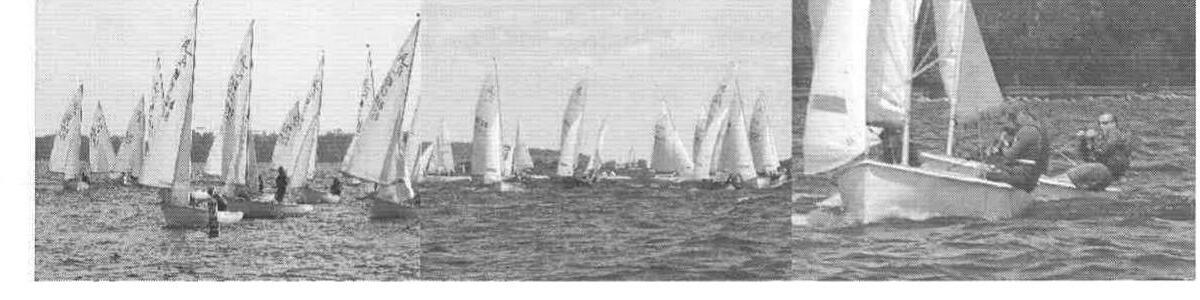
2005 IAA Report
Peter Duncan, IAA President
The IAA holds general meetings not less than every two years at the International Championship. This past year (2005) at Lyme Regis, the IAA sponsored an open forum discussion addressing each of the purposes listed.
Attendees reported that the Albacore class is thriving in pockets. Where it is strong, it is often the dominant fleet (Toronto, Lyme Regis, Washington), but in many other areas it has lost ground to other dominant fleets. There was discussion of programs to shore up and preserve our strong areas and ideas of how to begin to attract new members and penetrate new areas. Barney Harris reported on Hapco's efforts to develop an Albacore that would be stronger and longer lasting by utilizing the latest in fiberglass composite technology.
Under the topic of rules, Peter Fontes (outgoing RYA rep) reported via mail that the Albacore class had received notice from the RYA (who holds the copyright to the Albacore name and class rules and who administers the class in Great Britain) that in order to continue to maintain status as an RYA national class, the Albacore class would have to bring its rules into compliance with the ISAF format by November 2005. This is important for the UK sailors as the British association is totally dependent on the RYA for measurement of all boats and administration of class records. Michael McNamara, the incoming RYA rep, will work with David Weaver (CAN), the head of the Albacore Internationals Rules Committee, to seek an extension of this deadline and begin work to draft a compliant set of rules to be approved by the national associations. You can expect to hear more about this effort as the fall approaches.
The USA will be the host of the next Albacore International Championship. The venue will be the West River Sailing Club (just south of Annapolis, MD) in October 2007. The following Internationals in 2009, will be held in UK with preliminary efforts focusing on building support to hold the event in the town of Looe on the south coast of England between Lyme Regis and Torquay.
These topics were reported by the councilors at the official IAA general meeting where election of officers for 2006-2007 took place and decisions to approve actions taken. A full list of IAA officers and representatives as well as minutes from the meeting can be found on the IAA web page at www.albacore.org.
Getting to Know Neville Herbert
Recently S&C had a chat with British sailor Neville Herbert (AL 6825)
Q: At what age did you learn to sail, and what type of boat was it?
A: I started sailing when I was 10 years old in a two man, 3 sail, youth boat called a cadet, which can be sailed up to the age of 17. The cadet is locally club raced with a fantastic nation-wide sailing circuit with a highly competitive standard. However, I was not particularly good and sailed around the back of the fleet. I sailed various new and old cadets with varying crews but never quite managed to get any better than mid-fleet.
Q: Who was your biggest early influence in sailing?
A: My local club had a number of exceptionally talented sailors, a few of which went on to sail at Olympic level, these guys were maybe 8-10 years older and totally dedicated to sailing, every weekend they would be traveling to various nationwide or European events. Adrian Stead - Olympic 470 representative and Americas Cup skipper, Richard Lott - Finn Olympic representative and Rodney Patterson, 3 time medalist all came from my home club. They hardly ever sailed at club level and it seemed that club racing would only get you so far, so I decided to start traveling to as many events as I could to sail against better people and learn more about big fleet sailing.
Q: What other classes have you sailed? Do you think that has helped in your success?
A: I started sailing lasers when I was around 18 and went to as many open events as I could, sailing single handed in fleets of up to 100 boats with three rows on the start line rapidly improved my boat handling and starting techniques. I began traveling to events in Europe and sailed against the likes of Ben Ainslie - Laser & Finn Gold medalist and Iain Percy - Finn Gold medalist. Watching these guys coming off the start line in 25 knots and trying to stay with them for a three hour race showed the level of fitness and dedication needed to sail at the top level, unfortunately I had a day job as well and left laser sailing after qualifying for the British Sailing Team at the '99 Laser Worlds in Australia. Every day blew 30 knots and I soon realized they lived at another level which only existed if you sailed every day.
Q: Why did you decide to sail Albacores?
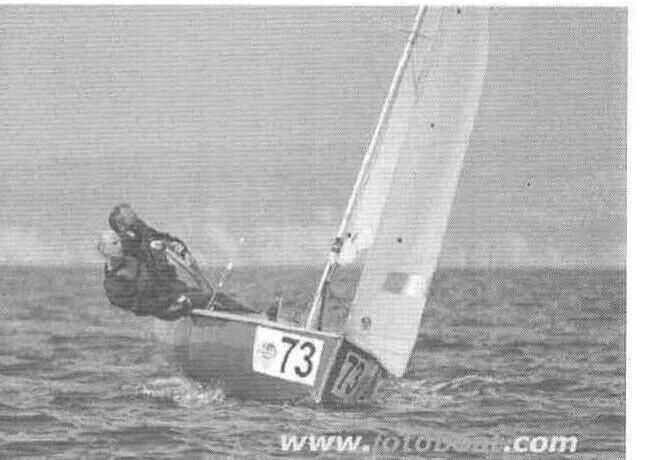
A: With no boat of my own, I helmed my father's Albacore at the 2000 Albacore Nationals at Looe in Cornwall. The atmosphere, sailors and the event were excellent, really refreshing after the single handed events. Mike McNamara won, Barney Harris came 4th, and we came 13th out of 41. My future crew Steve Penfold came 12th, a result he has never let me forget. A week later, I bought Barney's boat 8011 and asked Steve to crew. With a new boat and crew, we started doing every Albacore event we could including sailing on the US circuit where the standard at the front end of the fleet was superior to that of the UK. Our first Internationals were in Torquay in 2001, which was another fantastic event with the biggest entry in years and the prospect of a big breeze. We were pleased to finish 7th and planned to campaign towards the next Internationals in Canada in 2003, an event we should have won with 5 race wins, but threw it away by collecting one too many OCS's.
Q: What do you like about the Albacore Class?
A: The Albacore is a big, heavy, relatively slow boat which is ideal for keeping fleets tightly packed. It is difficult to gain much of a speed advantage and even more difficult to climb through the fleet after a poor start as the boat won't plane upwind and takes a pretty decent breeze before she picks up down wind. There has been little or no development in the UK, but in its heyday it was one of the most popular dinghies sailed with a fleet in almost every club in the country. What really appeals is that you can jump in the Albacore and have good competitive racing at an affordable price with really any size of crew you choose.
Congratulations to you and your crew (Steve Penfold) on your 3rd place finish at the 2005 Albacore Internationals.
Q: What do you think attributed to your success at the regatta?
A: The regatta was actually a bit disappointing for us. We had bought a Woof the season before and had started using US Norths. I was worried that we were maybe a bit on the light side so we opted for a more flexible rig with a M7 mast. We went into the event feeling confident as the 2004 National Champions, but a little tired from doing so much sailing. In the bigger breeze we just were not on the pace and suffered upwind. In the lighter stuff we had a distinct edge, particularly downwind but it wasn't enough. We missed a vital shift in race one and ended up 17th so from the beginning we had to play catch up. The mid-week party didn't help our cause much either!
Q: What changes would you like to see in the Albacore (if any)?
A: The Albacore really needs to start moving with the times, I did a season as the UK Chairman, a job which proved to be much more difficult than I had envisioned, with obstacles appearing every time the word 'change' or 'development' was mentioned. The majority of Albacore sailors have been sailing them for years and the class just doesn't have the appeal to the younger sailor. The class is perceived as a boat for the 'older' sailor with limited opens throughout the season, with a three day nationals with low turn out. In order for the class to grow, we need to adopt modern building techniques with modern materials along with sail and rig development. The biggest problem is that there are simply too many choices of dinghies available and the Albacore doesn't have the appeal to the younger crews.
Q: How would you like to see the class change/grow?
A: It would be great to see more entries at events. The majority of Albacore sailors don't venture further from their home club. Events last year saw entries down to an average of around 10 boats in the UK, yet the sailing was outstanding. The big events are really worth traveling to, the Mid-Winters, US Nationals, UK Nationals, Canadians and Internationals are such good events and offer really close competitive racing. I'd like to see more development and closer relationships between the North American and UK associations. How can one association allow adjustable rigs when the others don't? The cost of a wood boat is ridiculous and personally I think the class needs to embrace new builders. There is too much emphasis on the older Woofs. A well set-up, down to weight, glass hull can be just as quick.
Q: What are your strengths as a competitor?
A: Sailing lasers taught me very quickly that if you're not in the front row at the start, you make the rest of the race so much more difficult for yourself. 90% of the race is about starting. At the 2003 Internationals in Kingston, the leader at the first mark went on to win every single race, and the first leg was only 15 minutes long! I'm not conservative on the start at all, I try to win every start of every race. Sailing at the front allows you to dictate the race, hit the shifts first and sail in clear air in the direction you want. I don't sail with a compass as it doesn't tell you what is happening up the course, whereas, boat angles and relative pressure across the course are more important. I've also been lucky to have a dedicated crew who is just as keen to win as me but takes some pressure off the event once ashore, as Steve does everything possible to get himself arrested.
Q: How do you do well in a large fleet, when you don't always get the opportunity to sail in one?
A: Since the 2005 Internationals, I have put the Albacore in the shed and started sailing 505's, the boat is remarkably similar and I enjoy the additional speed that the massive rig provides. The 505 class is very proactive with a world wide circuit which attracts some of the best non-Olympic sailors, 2005 saw over 170 at the worlds. The class is still relatively small in the UK, but sailing other classes such as the 505 or fireball improves your all round sailing. The downwind angles are particuarly important with the 505's new assymetric kite and upwind the boat will plane in as little as 10 knots, at these speeds, the fleet can get spread out pretty quickly, which is why the Albacore is such a good boat for close, competitive sailing.
Q: What are your plans for the future?
A: I intend to campaign the 505 this season as the Worlds are in the UK in July and in early January 2007 in Australia. I hope to make it out to the Albacore Mid-Winters this year, as there really is no better sailing than Florida in March. After the 505 campaign, I will jump back in the Albacore and begin the build up to the 2007 Albacore Internationals in the US. Hopefully, we will be on pace and see a container of UK boats shipped over to give the US and Canadians some tough competition.
2006 North American Albacore Championship
June 10th & 11th, hosted by the Royal Canadian Yacht Club.
Registration: Register after the Friday Night Race at the Waterside Tennis Club, or via fax (see RCYC.ca for the form), or Saturday morning from 9 am to 9:30 am at the RCYC Dinghy Docks.
Includes:
- 2 days of racing on the LAKE (start at 11 AM)
- Buffet dinner and dance at RCYC on Saturday night
- Beer, pop and snacks after racing both days
- Two beautiful RCYC plaques for the top five boats
- 2 RCYC race mugs for boats 6 to 15
- 2 long sleeved cotton shirts with RCYC and North American insignias (while quantities last)
- Extra activities on Saturday night in conjunction with the Easter Seals Regatta
Registration Fee: $129.00 per boat
Competitor presentation will be held at Westwood Sailing Club in the Outer Harbour following racing on Sunday.
NOR and Race Registration form will be posted at RCYC.ca/sailing/regattas and on the Canadian Albacore Association's website.
For further information, please contact Heather Macnaughton at 416-367-9898 or at [email protected]
Looking forward to seeing you there!
Upcoming Events
March 24-26 — Mid-Winters, Sarasota, Florida
NorthU Tactics Seminar
Saturday, April 8, 2006 — $100.00 — Toronto
You can spend a lifetime learning to be a better sailor. NorthU accelerates the process. North U Racing Seminars "Turn sailors into racers, and racers into winners" by teaching the techniques used by the world's top racers. The emphasis is on practical straightforward ideas that will help you win. The curriculum presents the latest in Racing Tactics and Racing Strategy using an interactive multi-media format which allows you to learn and test your new knowledge in the class.
Rules & Tactics Class Outline
| Race & Win -The Racing Hierarchy -Heads Up! -Tactics and Winning |
Rules -Rules Are the Game -5 Core Rules -Conflicts and Transitions |
Starts -Starting Rules -Starting Tactics |
Upwind Tactics -Upwind Rules -Tactical Principles -Cover or Split? -Attack and Defence -Windward Mark Approaches |
| Reaching Tactics -Reaching Rules -Positioning, Control, Clear Air -Inside vs. Outside Reaches |
Running Tactics -Rules on Runs -Attack and Defence -Positioning End Game |
Mark Rounding Rules and Tactics -Jibe Mark Rules and Tactics -Leeward Mark Rules and Tactics |
Finishing Tactics and Rules -Finishing Upwind -Finishing Downwind |
Only through an understanding of the RULES and the TACTICS they dictate - can you race successfully.
To register: http://www.albacore.ca/seminar_regform.html
You must be a Canadian Albacore Association Member to participate.
Win a Quantum Jib from the Canadian Albacore Association. Become a Canadian Albacore Association Member (Full or Associate) by April 30, 2006 and your name will be entered into a draw for a chance to win a Quantum Jib!
2006 Albacore Schedule of Events
May: First Friday Night Race (5) — Harbour Master 1&2, Toronto (22) — CAA Race Training Weekend, Toronto (27-28)
June: Tarts & Balls, Toronto G+ (3-4) — North American Championships, Toronto (10-11) — Nepean One Design, Nepean (17-18) — Ladies Helm, J-Town Toronto (24) — Harbour Master 3&4, Toronto (25)
July: Ontario Albacore Championship, Peterborough G+ (1-2) — OHCC Regatta, Toronto (8) — Harbour Master 5&6, Toronto (9) — Westwood Regatta, Toronto G+ (15) — J-Town Regatta, Toronto (22) — Harbour Master 7&8, Toronto (23) — Hamilton Open, Hamilton (29)
August: Mooredale Regatta, Toronto (12) — New Skippers' Regatta, Toronto / Don Rantz Regatta, Ottawa (19) — Don Rantz Regatta, Ottawa / Harbour Master 11&12, Toronto (20) — Toronto Island Open, Toronto (26)
September: RCYC Royal Weekend, Toronto / Kanata Open, Kanata G+ (2) — Kanata Open, Kanata G+ (3) — Last Friday Night Race (8) — Nepean Fanfare Regatta, Nepean (8-9) — Harbour Master 13&14, Toronto (10) — Canadian Albacore Championship G+, Nepean / AGM (15-17) — Harbour Master 15&16, Toronto (24)
October: US National Championship, Washington (7-9)
G+ Races designated for Gooderham Series — The Gooderham Trophy was established in the memory of Bill Gooderham to encourage Albacore sailors to attend regattas across Ontario and is awarded annually to the helmsperson who achieves the best result in the series of annually designated races.
** These races marked with asterisks are sanctioned events by the Canadian Albacore Association.
Toronto Island Sailing Club — 40th Anniversary Party
AHOY!!!!! Calling all former & present members of North Toronto Sailing Club, now known as Toronto Island Sailing Club.
Mark your calendars now — TISC will be holding our 40th Anniversary party on July 29th, 2006.
- Open House 2-4 p.m.
- Catered Dinner (price tbd)
- Dancing under the stars
- Slide show of the decade(s)
Consult our website: www.torontosailing.com or sign up for more details - by email to [email protected]
Buoyancy Tank Testing and Repair
It's spring and you've pulled your Albacore out from its winter storage location and are looking forward to a season of fair winds and exciting sails. The first order of business once the boat is assembled is to test it for buoyancy. So, you and an assistant don life jackets and risk hypothermia by capsizing the boat at the dock and sitting on top of it for five minutes per side while you submerge its buoyancy tanks. You pull the boat up the ramp, remove the tank plugs and sure enough, out comes enough water to wash out the inside of your boat.
Buoyancy tank repairs can be the bane of Albacore maintenance. Tank leaks can be elusive, persistent and frustrating. Having looked after a fleet of fifteen Albacores in various states of well-being for the last five years, I've seen just about every type of tank repair from simple de-lamination to full-on punctured hulls.
Before you venture out to the dock side in near frigid weather to eagerly dump your boat into the water, remember, there is an alternative method described in the Albacore rules.
Rule 4.2.3 says:
"All openings in buoyancy compartments shall be closed with their own stoppers except where tubes for a pressure/vacuum gauge and source are connected. Equipment for producing and assessing pressure differentials between buoyancy compartments and surrounding atmosphere shall be connected to the compartment. Super or sub atmospheric pressure shall be applied to the compartment, sufficient to produce a reading of at least …"
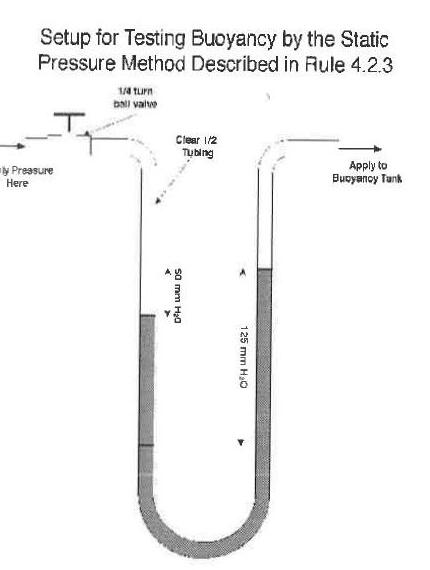
I built a simple U-tube manometer out of clear plastic tubing and a few fittings from the hardware store. I then modified a buoyancy tank plug to accept an air fitting to attach the tubing and used a "shop-vac" on blow mode to supply the required pressure. Once the required pressure of 150 mm of water is reached, I shut off the supply valve and wait 30 seconds. If the pressure doesn't drop below 50 mm, then the tank is considered buoyant. If it does drop below 50 mm I start looking for leaks.
"My tanks aren't buoyant! What now?"
First obviously, is to identify the source of the leak. Again the "shop-vac" comes in handy. These vacuum cleaners can be reversed so that they blow instead of suck, and can't generate much pressure. This is good since you don't want to inadvertently blow apart your buoyancy tanks. They can however, blow a LOT of air. This makes for relatively easy work. With the help of an assistant, blow air into the tank plug opening and apply a soapy solution with a paint brush along the seams of the tank in question. It will become apparent in a short time where the leak is.
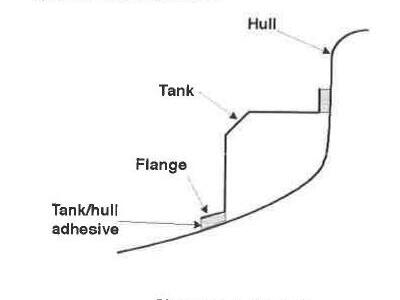
I'm going to concentrate on the most common buoyancy tank ailment: de-lamination from the hull. Chances are that the tank flange has become un-glued from the hull side or bottom.
Here is a representation of a typically constructed hull / tank joint on a fiberglass boat:
Typical Tank/Hull Joint
Clean the Area:
Insert a thin blade or small flat screwdriver into the area where the tank has separated and pry it apart gently. This step is to gauge how much has delaminated. Pry up gently until you find the area where the adhesive is still solid and the tank flange is still solidly glued to the hull. Insert several thin blades (sharpened popsicle sticks work well) every couple of inches to separate the tank from the hull in the affected area and allow this to dry. Check for and remove any dirt, loose material or loose adhesive. Original tank-to hull adhesive dries hard and becomes brittle over time. Be patient and remove all the debris from the area.
Hint: wetting and brushing the area liberally with Acetone will speed up the drying process and will also help clean any debris, silicone, oil or other foreign material.
Mix the Epoxy:
Once the area is clean and dry, mask off the areas away from the repair with masking tape and waxed paper to minimize cleanup. Mix up some epoxy (I prefer to use West System epoxy) and apply a coating of liquid epoxy to the mating surfaces of the tank flange and hull. Note: Epoxy is quite toxic and can cause chemical sensitivity, so wear some latex gloves and make sure the area is properly ventilated during epoxy work. With the remaining epoxy, mix in a generous amount of thickening agent like colloidal silica, cabosil or fumed silica. All of these are good space fillers and add strength to the epoxy. Add the filler and stir until you get a thick paste with the consistency of smooth peanut butter. It should form stiff peaks but still be spreadable.
Using a thin blade, (an old knife works well as does a narrow putty knife) work the filler into the gap you created with the popsicle sticks. Be liberal and use enough filler.
Here's a neat trick: To aid the flow of epoxy adhesive filler deeper into the affected area, apply vacuum with a "shop vac" to the tank plug while applying the filler to the tank / hull joint. This will help draw the epoxy filler further into the seam.
Carefully remove the popsicle sticks making sure that there is epoxy filler in the spaces vacated by the sticks. The flange should snap back together close to the hull and squeeze out epoxy filler in the process. Wipe up the excess. If necessary, apply weights to the tank flange to help it mate to the hull. Let this set overnight.
Tape the Seams:
The next day, roughen up the surface of the flange and surrounding hull area with 80 grit sandpaper. You should also sand away any excess blobs of cured epoxy that oozed out during the curing process. Lean right into the sandpaper when you sand. You really want to make a nice rough surface for this step. Wash the area well with clean towels and acetone and let it dry.
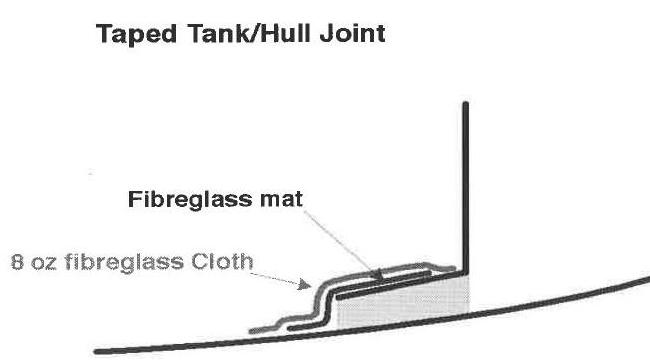
You'll need some medium weight fiberglass mat (random oriented stranded fiberglass) and some 8 or 10 oz fiberglass cloth. Cut a piece of mat to fit over the entire repair leaving about ½" of space between the flange and the tank wall. Then cut a piece of fiberglass cloth that will completely overlap the mat by about a half an inch. Again, mix up some epoxy and "wet" the sanded surface with a paintbrush using the epoxy.
Lay down the fiberglass mat and wet it out thoroughly with a paintbrush. Tap the mat with the tip of the paintbrush to get any air bubbles out. The mat should turn nearly transparent when it is sufficiently wetted out. Now carefully lay the fiberglass cloth over the mat and wet it out too, removing air bubbles as you go. The end result should look like this representation.
Let this cure for several days to a week. Since epoxy breaks down easily in UV light you should paint this with several coats of topside paint to match the interior of your boat. Before you paint, dry sand the area thoroughly with 120 grit paper followed by a light wet sanding with 220 grit paper. Wash the area well with soap and water and let it dry. Simply paint to the colour of your choice and you're done!
Know Your Rules
This article was originally published in the RCYC Kwasind newsletter.
In the past issue we talked about being over at the start. This time I want to talk about the right of way rules that apply when you are over early. There is one important rule here.
20.1 A boat sailing towards the pre-start side of the starting line or its extensions after her starting signal to start or to comply with Rule 30.1 shall keep clear of a boat not doing so until she is completely on the pre-start side.
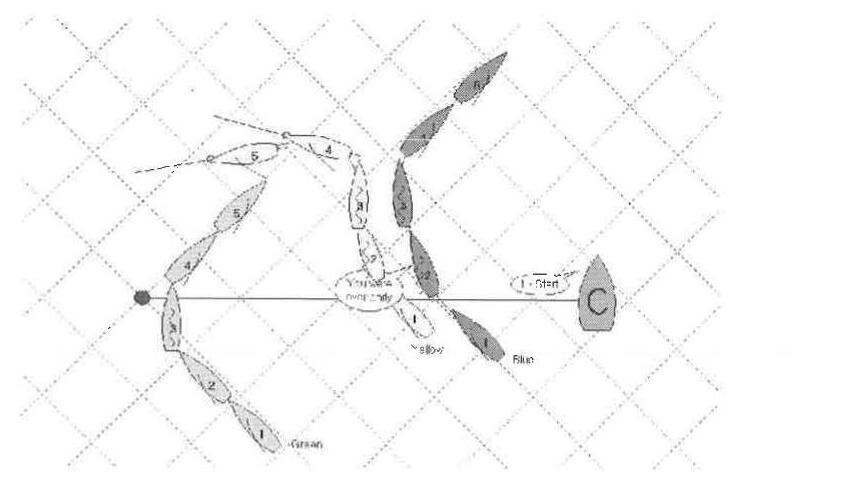
It is commonly understood that a boat that is over early loses her rights. It turns out that she doesn't lose her rights until she is sailing back towards the start.
If we look at the diagram, the start signal goes at position 1. The yellow boat is over the line early. She does not initially realize it. The blue boat has been overtaking her to weather so the yellow boat starts to luff the blue boat at position 2.
The blue boat has heard the hail from the committee boat that yellow was over early so yells to the yellow boat to tell her. The yellow boat continues to luff and between position 3 and 4 the blue boat tacks away. The yellow boat is the leeward boat, she has right-of-way. She is not returning to start so she still has rights.
At position 4 the yellow boat bears away. She is still not sailing towards the pre-start side of the line or its extensions. The green boat is on port tack. The yellow boat still has right of way as a starboard tack boat.
At position 5 finally yellow is sailing towards the prestart side of the extensions of the line. Green on port tack now has right of way over yellow even though yellow is on the starboard.
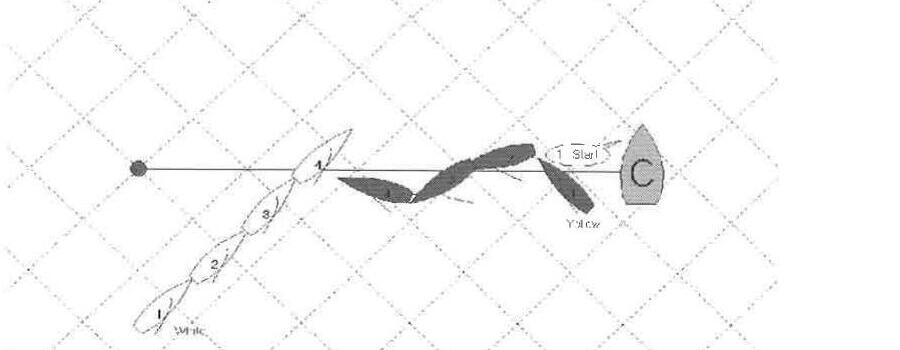
Copy of TSS software registered to Andrew Alberti
In the second diagram again the starting signal is at position 1. Yellow is over early. At position 2 and 3 she is returning to the pre-start side of the line to start. At position 4 she is now completely on the pre-start side and regained her rights over white who is late on port tack. Red has however just gained her rights and has to initially give white time to keep clear (Rule 15) which she probably will be just keeping going.
15 Acquiring Right of Way When a boat acquires right of way, she shall initially give the other boat room to keep clear, unless she acquires right of way because of the other boat's actions.
30.2 20% Penalty Rule If Flag Z has been displayed, no part of a boat's hull, crew or equipment shall be in the triangle formed by the ends of the starting line and the first mark during the minute before her starting signal. If a boat breaks this rule and is identified, she shall receive, without a hearing, a 20% scoring penalty calculated as stated in rule 44.3(c). …
Rule 30.2 is usually used by race officers who have been having trouble with general recalls. It imposes an automatic 20% penalty on any boat that is over in the last minute before the start has a 20% penalty even if there is a general recall.
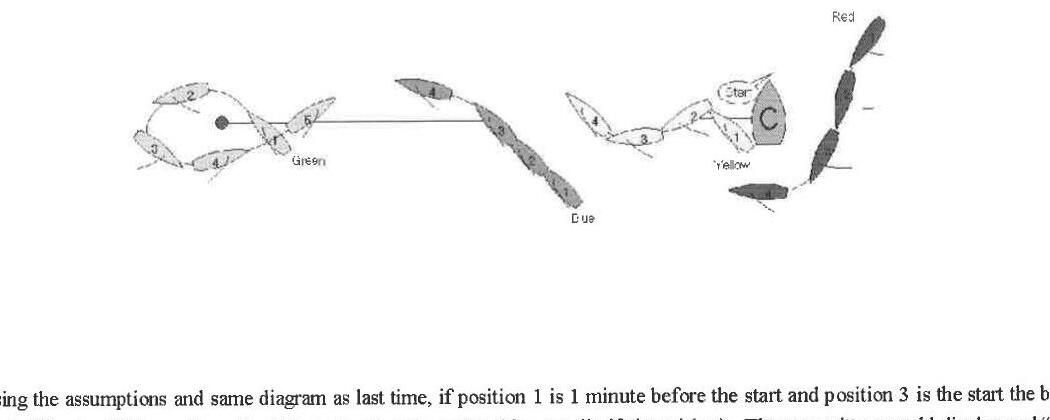
Using the assumptions and same diagram as last time, if position 1 is 1 minute before the start and position 3 is the start the blue boat will get a 20% penalty and will have to return to restart (she can dip if she wishes). The committee would display and "X" flag for this boat. The green and yellow boats will both get 20% penalties, but both have already returned and don't have to return again. The red boat is on the course side of the line during the last minute but she is not in the triangle formed by the ends of the starting line and the first mark so she does not get a 20% penalty.
2006 Canadian Albacore Association Executive
| Commodore & IAA Rep Barrie Farrell 416-529-2952 [email protected] | Third Vice Commodore & S&C Editor Christine Short 416-703-2086 [email protected] | Membership Janet Duff 416-760-7254 [email protected] |
| Past Commodore Ann Savege 416-361-1808 [email protected] | Rear Commodore Van Sheppard 613-270-8791 [email protected] | Treasurer Jason G. Roth 905-840-5395 [email protected] |
| First Vice Commodore & Secretary Teresa Miolla 416-769-0990 [email protected] | Specifications Chair David Weaver 519-623-4402 [email protected] | IAA Treasurer Raines Koby 905-880-1866 |
| Second Vice Commodore & Website Henry Pedro 416-465-7563 [email protected] | Chief Measurer George Roth 519-746-1300 [email protected] | Canadian Albacore Association 47A Harbour Square, P.O. Box 81047 Toronto, Ontario M5J 2V3 www.albacore.ca |