Year End 2006
December 01, 2006
Year-end 2006 issue: Commodore Teresa Miolla's Santa-list message, 2007 New Year's resolutions from fleet members, Ann White on winning the Canadians, the US Nationals recap, an interview with UK Champion Orlando Gledhill, Henry Pedro's towing/trailering guide, two teams' Internationals prep plans, the Alba-Scopes zodiac feature, and the 2007 executive.
Message From The Commodore
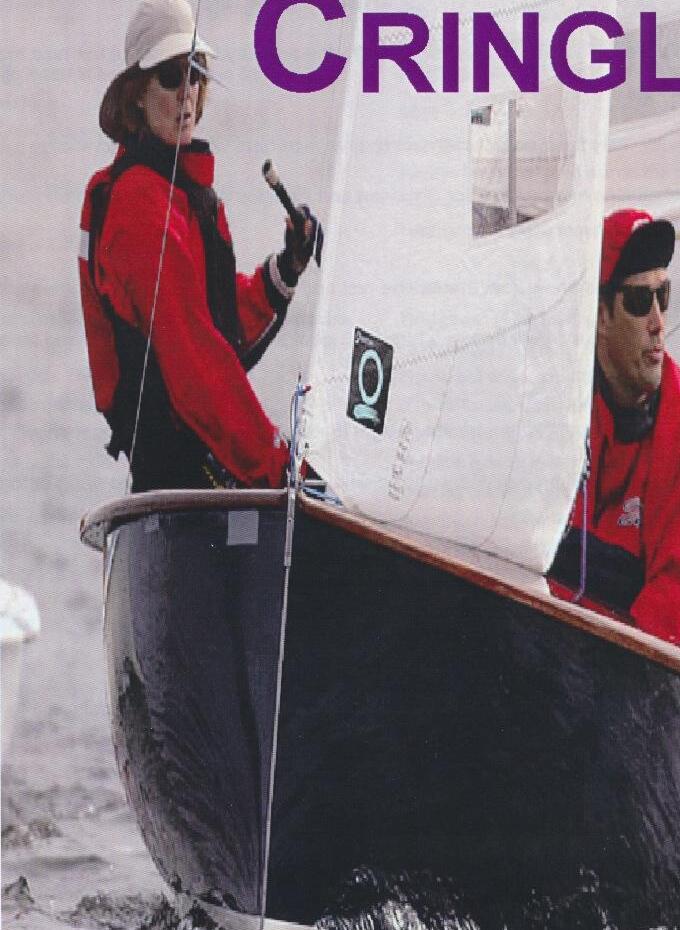
Season's Greeting's Albacore Sailors,
By the time you read this article, Santa will be back at the north pole, neatly tucked into bed and catching up on a few well deserved zzzzz's. Since I received nothing on my Santa's list last year (coal was NOT on the list) I thought I would make a wish list for the enthusiastic CAA executive instead. So here we go....
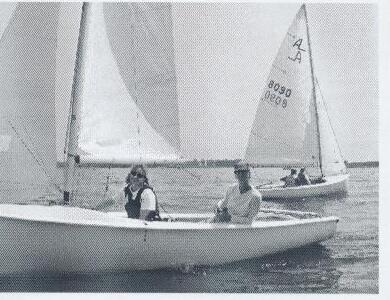
Allan: A regatta schedule that has been co-ordinated with the wind gods (10-15 knots); a new boat that is fast enough to catch Beaver Tales
Ann: no controversial issues so she can just sip on her wine and daydream about her next manicure or trip to Africa through out the meetings
Cathy Ann: a brand new fully functional knee and executive members who aren't so verbose
Christine: millions of articles and pictures for Shackles and Cringles without having to beg anymore (okay guilty as charged!!)
David Weaver: Barney builds a new boat that will be fast and fall within all the specification guidelines
George: That no more blue cards will be lost; a high tech goof proof method to weigh and measure old and new boats; pucks made out of foam
Henry: a self righting boat; a sexy new website design; loads'o'volunteers for the boat show
Janet: memberships paid in full (hopefully by paypal so there isn't any extra paperwork) before the sailing season starts; more things to laugh about
Jason: the debit side matches the credit side; new golf clubs (???) or new crew (preferable)
Sandy: another incredibly successful Canadians regatta where Barrie will pick her up and whirl her around while the rest of us sing Happy Birthday to her
Stephanie: a women's clinic to teach everyone how to beat Ann White and a general clinic to teach us how to beat Barney
And Santa if you really care to send me something useful, any of the following books would be great;
"Beating Broughton on a Beat" by Raines Kolby
"How to Self Right an Albacore in Under 30 Seconds" by Henry Pedro & Chris Gorton (2nd edition has pictures)
"How to Buy a Boat Sight Unseen" by Warner Monterio, preface by George Wilson
"Reconditioning Beautiful Wood Boats That Can do a Horizon Job on the Fleet" by Jeff Beitz
"The Barefoot Sailor" by Neville Herbert
"Racing to Win with Only One Handicap: A Hangover" Rory Martin, "HeadLock" by Uncle Hammer is a good adjunct.
Happy Holidays Everyone!
T
Albacore 2007 Resolutions
Fleet members' New Year's resolutions, submitted anonymously by sail number.
8100
I resolve to sail more than 6 times this year.
I resolve to beat my dad in a regatta at least once in my life!
6888
Keep knees intact
Sail more than 6 times
Anonymous
Practice drinking American beer
8018
Lose 30 lbs (collectively)
Learn how to make a boat go faster in heavy air than in light air (the physics on this one baffle me)
Beat the Beavers in the US Nationals
Don't finish 4th
Go Pro... Sponsorships likely to include Corona, Captain Morgan's Spiced Rum and Speedo
Don't sail on the Potomac or the Ottawa River
8009
Never continue to discuss sex, politics or religion after the one minute signal.
Always comment on how thin your crew looks in Wetskins.
Never get between Ann White and the start line.
Learn how to fiberglass.
Remember to put the battens in the sail.
Save my lungs for running.
Always remember that your worst race is better than your best day at work.
7166
Wash my thong at least once a month
8088
Buy a better bottle of PORT for 2007.
NEVER LET YOUR HELM HELP YOU REMOVE DUCT TAPE
Anonymous
Don't be the marshmallow!
7419
Need to learn read numbers on digital compass
7983
Wear coordinated clothing always. It is SO important to look good on the water. Suzanne and I are going to get matching thongs.
Figure out how to sail an Albacore flat in 10 knots of wind, instead of that nice comfortable heel. It should not be that hard! If we start now we can master this skill before we turn 80.
Always listen to my crew except when she complains about my pinching. You gotta stick with what you do best!
8041
Feel the wind coming
Always have the good ear on the right side when I really need to hear something
Learn how to have more than one good start per season
6700
Find Crew! (135-155lbs, brilliant tactician, owns brewery, loves varnishing...)
Figure out what is not symmetrical in my mast setup (I need to adjust halyard tension when tacking)
Don't show my centerboard while racing (in other words, more practice gybing in high winds)
Plan logistics around regattas better. There is a strong correlation between my sleep and food intake and my performance on the water. I make far fewer mistakes when I have enough food, water and rest.
Find, read and digest a book on understanding geographic effects on wind
Install (beer) cooler in forward tank
Attend regatta in Georgian Bay (hopefully someone else is resolving to plan a regatta in Georgian Bay....)
NEED RUDDER?
Rudders/Centerboards/Daggerboards
Custom work is our specialty!
1st 2005 Albacore Canadians
2nd 2003 Albacore Internationals
Phil's Foils & Composites
(613) 599-6951
www.philsfoils.com
Winning The Canadian: Focused on "the game, and not the goal"
Heading to this year's Canadian Albacore Championships, I was acutely aware that I had never won the same regatta, two years in a row. As last year's Canadian Champions, how would Jean Paul (JP) and I overcome the pressure to "win again!", against the odds, and resolve the challenges presented by this particular regatta. Here is the inside story.
Given that The Canadians was to have an award winning race committee, I knew starting on time (not OCS and not late) would be critical. For weeks prior to the regatta, while others were starting early, and getting away with it, I concentrated on starting at the gun. The practice paid off. At The Canadians we started confidently, well positioned, on time and with good speed. In three days we had no bad starts, and had only one OCS on a general recall. Two of our key competitors carried OSC results from the first day of racing.
The first two days of the regatta were light winds ranging from 2 to 5 knots. In 3-8 knots our Quantum Sails, while terrific in most conditions, tend to be under powered compared to North Sails. We had to squeeze every bit of usable draft and speed out of the Quantum's to keep pace with the top of the fleet.
While I like light air (actually I like all wind conditions), JP would rather be hiking. He just wasn't in a happy place at the front of the boat but, like all great crews, never gives up and rarely complains. Every race felt like a struggle with the weather, the boat, the fleet, staying focused and optimistic in our less than ideal conditions.
To stay focused in tough regattas, JP and I treat every race like a new race, on a new day. We stubbornly follow our checklist of "things to do and review" before each race. We put the last race behind us, open a new page, and set out to tune, start and strategize like never before.
With JP's encouragement I have learned to ignore the idiosyncratic behavior of other boats, ignore the gossipmongers and stick to business. Between races I take a few deep breaths to flush the mental refuse and set the wind sniffer to work.
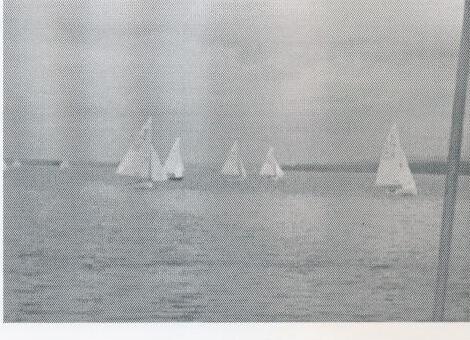
How did I do so well?
After two days of racing, and in spite of what felt like a difficult regatta, we were in first place with results of 1, 2, 4, and 10. Carrying a 10th place, in a talented fleet, there was no room for another lousy finish. Several boats were able to win if they sailed well, and we didn't. The regatta was going to be won, or lost, on Day Three. The heat was on, and it was on high.
How do you keep your cool in pressure cooker conditions? Rather than fixating on "winning" I focus on sailing "my best race ever". I find this attitude helps me overcome the zillions of things that inevitably go wrong. Concentrating on "the game, and not the goal", keeps me tuned to the moment, solving immediate problems, and not obsessing about our position, or another boats position, in the race.
By the start of the third race, on the third day, the wind had picked up to 15 knots. We had two other competitors for first place. JP was smiling and the fun was about to begin.
The wind had been oscillating and a 150-metre start line made it critical that we start at the favored end. With a minute to the start, and the fleet lining up by the committee boat, we did a final mid line wind check. JP said, "the wind had gone left, the pin end is favored". I looked up and down the starting line somewhat doubtful. I hadn't seen it. Could the whole fleet be wrong?
I reluctantly took JP's advice and turned toward the pin. As we bore off, roaring through our lee, full-tilt toward the pin, was former World Champion, Barney Harris. We planed down the line and started to windward of Barney near the port end. We won the windward leg, with Barney on our tail, 30 boat lengths ahead of the fleet. Great call JP!
Our 10-place finish, that caused us so much angst after day two, turned out to be our drop. We won the regatta with 19 points, 9 points ahead of second place Barney Harris and Erich Hess. While the last race, on the last day, was a sailing highlight, achieving our goal of consistent results, against the odds, and under duress, was the reason we won The Canadians.
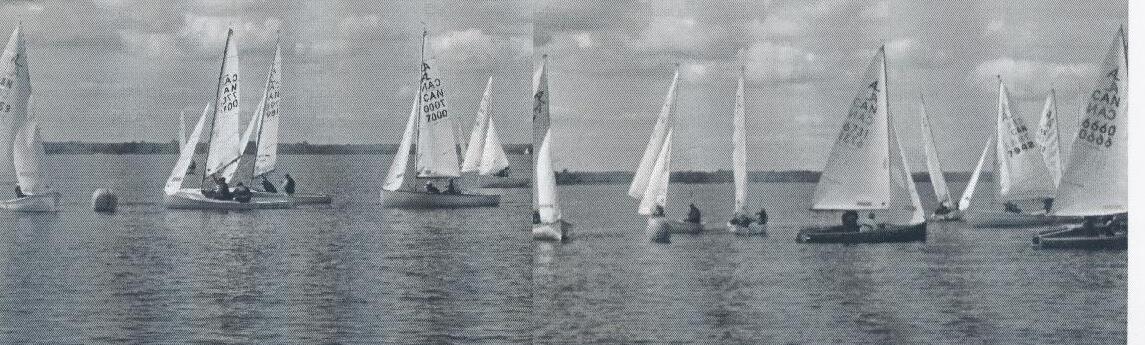
US Nationals 2006
October 7-9 PRSA, Alexandria, VA
Saturday started blustery and cool as forecasted with winds from the Northeast topping out at 20 knots on the dock before the skippers meeting, however winds moderated throughout the morning as the fleet busily rigged. With winter hats worn by some and some electing to stay ashore, the fleet took to the Potomac River with Barney and David taking the lead reveling in the moderate to heavy winds. Once the fleet reached Haines Point the median winds were in the 15 knot range with a few larger gusts, which made for great sailing conditions. Restricted by the river's dimensions the windward mark was placed relatively close to shore making it interesting the further the fleet sailed upwind. Van Sheppard said, "It seemed the further upwind you got, the more tacks had to be made." I felt the same way, the further you got upwind the frequency at which you tacked increased due to the large shifts in the wind, which if you played the shifts right, you could sail almost directly upwind. As I got closer to the windward mark I always thought that if the tack I was on was not taking me closer to the mark we would tack, knowing (or hoping) that the squirrelly winds would shift back. Some of the Canadians were welcomed to the river with the shifty winds and a nice refreshing Potomac swim. Three races were sailed on Saturday with Barney taking the lead with three bullets, Jasper and Becky Craig in second with 9 points, Erich Hesse and Jill Decker in third with 10 points and Van Sheppard and Harvey Barnes with 11 points. Alana Jordan and Erika Seamon took the lead in the Challenger's Fleet sailing the last two races for the day. A barbecue followed races at the Washington Sailing Marina.
Temperatures moderated for day two with three more races and a medium breeze dying throughout the day. The first two races of the day featured the top boats on the last beat in many tacking duels with many tactical situations, exciting racing! The last race was won by Jasper and Becky Craig in a horizon job. By the end of the last race the wind had shut off almost completely leaving some boats beyond the time limit. A regatta dinner followed races on Sunday and then the AGM.
On Monday there was a very spotty wind and racing was cancelled for the day. A barbecue ensued with awards following. Bill Kleystuber was awarded the endurance award for starting all the races with the highest point total. Daphne Byron and Nate Bokil were awarded the over 100 award with a funny picture to go with it. The most improved over last year's nationals was Bob Bear. The top woman was Teresa Miolla and Christine Short from Toronto. Top Junior and winning the Challenger Fleet was Alana Jordon and Erika Seamon. I believe Alana has some polishing to do. Luckily, I have no polishing to do finishing second with my crew Jillian Decker. The Craig's finished third; Van Sheppard and Harvey Barnes were the top Canadian finishers in fourth place and taking the regatta, sailing together for the first time this year, was Barney Harris with long time crew David Byron.
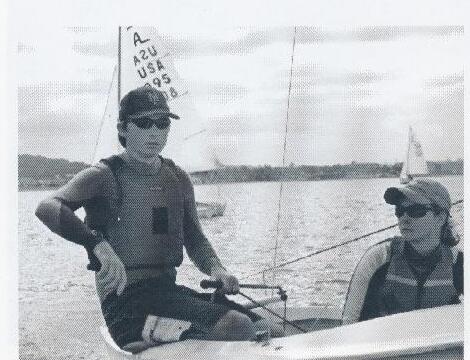
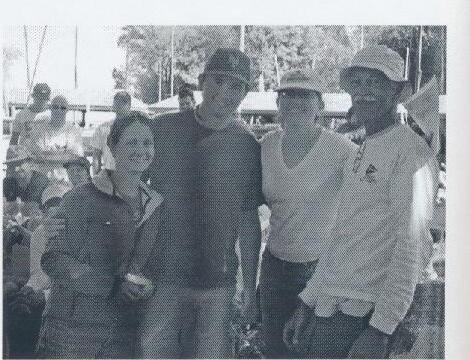
How did I do so well?
For those of you that don't know, I grew up sailing CC Mercury's and Sunfish on the Great South Bay on the south shore of Long Island, NY. I went to NY Maritime College and sailed on the team there for four years, practicing three to four days a week and racing almost every weekend. In addition to the boats I learned to sail on I have sailed Lasers, JY15's, Flying Scots, 420's, V15's, FJ's and now Albacores. This was my first year sailing Albacores.
After the US Nationals I have heard the question "How did you so well?" I thought to myself and said "How DID I do so well?" If you look at the results from last summer the highest place I received in any regatta was 3rd. The following is what I have come up with.
- Attitude - I felt going into the regatta that anyone could win a race due to the wacky winds of the Potomac. I knew if you got behind there would usually be big wind shifts to get you back in the game, so it was important to keep your head in it and keep plugging.
- Venue and Conditions - Sailing in home waters is always easier. I sailed as many weekends in the Albacore spring and fall series we had, which allowed me to get accustomed to the new waters. The Saturday of the regatta the forecast was for big winds so I told Jill all we have to do is get through Saturday and the rest of the regatta would be light winds. Our hefty (just kidding) crew weight of 285 lbs did not hurt us too much as Saturday turned out to be moderate winds and the rest of the regatta was light which worked to our advantage. The light winds and no waves also helped my situation with a Skene boat.
- Question the big dogs - In most fleets the top guys are willing to share what they do and luckily I have Barney to question. When asked, I jumped at the chance to crew for him at Canadian Nationals, where it was like I got a private clinic on how to set up and sail the Albacore, for which I am very grateful. But I have to say that the one thing that hit me most about how he sailed is how much dialogue that goes on in the boat. He is continually reevaluating the current situation and talking out loud to the crew. I think this is a great way to keep yourself focused and to keep your crew in the know about what's going on so they can anticipate maneuvers and add information to the dialogue.
- Crew - Jill and I sailed my last year of college together which has helped greatly with our coordination and timing of maneuvers. Two weekends before Nationals Jill and I marked the boat up with settings and then went out for a test sail. These markings were important to mimic settings of the boat to racing conditions and I only put them on two weeks before Nationals (I wish I had put them on earlier). I used a tuning guide to mark the jib halyard and jib tracks. Then we practiced tacking and jibing till I felt that our maneuvers were up to speed. If you look at the top boats at most big regattas you will find that they have steady crew which is essential to winning. Thank you Jill for being the one I can depend on.
To finish, I would like to end with a quote I said to Van Sheppard the morning we showed up at his house for breakfast before Canadian Nationals: "I have a 1982 uncored Skene." Van looked at me quizzically and chuckled "They are all uncored". It's obvious that I still have a lot to learn about Albacores.
I would just like to take this time to thank all the people that I have met my first year of sailing Albacores. From lending to even supplying me plugs, rudders, boats, sails, Albacore knowledge, and housing as well as finding me a used boat at a great price, everyone has been extremely helpful. All the people I have met over the course of the year from Newport News, VA to Nepean, have been a pleasure to meet. The racing has been great and meeting everyone has been even better. See you on the water in 2007!
How To Be A Road Warrior
The Albacore Midwinters are coming up very soon. That means that you should be thinking about getting yourself and your boat down there for some excellent warm weather early season sailing! Although some may choose to fly down to Florida, there are those brave souls who will opt to tow their Albacore to Sarasota, Florida for the three day event.
I have been travelling to regattas for about ten years. In the grand scheme of things I haven't been sailing that long, but between six trips to the Sarasota Midwinters, nine Canadian championships, six US championships and countless other "away" events I have quite a lot of traveling and trailering experience. I estimate conservatively that I have towed Albacores for over 70,000 km.
Now, I've had my share of breakdowns from simple flat tires to broken engine mounts and have emerged largely unscathed. Over the years I have developed a set of guidelines that I follow, along with a preparation regimen that helps me to make those long distance trips more pleasurable, less eventful and easier to do.
1. Prepare your car. Prepare your trailer: This may seem obvious enough, but there's a strong chance that as you read this you will identify at least one aspect of your car's health that needs attention.
Inflate your tires to the proper pressure. Pay attention to the rear tires. Your car should have a sticker on it somewhere (mine is inside the driver side front door) that tells you what the proper inflation pressure is. Usually there are a normal pressure and a full load pressure. Because you are packing your car full of gear and adding a trailer to the back you should inflate the rear tires to the full load pressure. This also applies to your trailer. Your trailer tires are marked with their maximum inflation pressure on the sidewalls. Make sure they are properly inflated. It's fine to inflate them to their maximum pressure. Underinflated tires generate excess heat because of increased friction and rolling resistance and can blow out at the least opportune times. Usually the end result involves pulling over on the side of a busy interstate or worse, on the side of hwy 401.
Check your oil and change it if necessary. Get your engine tuned up. Have your brakes checked. Is there a slight miss to the engine from time to time? Is the check engine light on? Get it looked at before you leave. Remember that you are going to be on the road for a long time with your car loaded and stressed beyond what it sees in your daily commute.
Check your trailer's wiring and lights. Trailer wiring jobs are about the worst made and poorly installed circuits in existence. Botched lighting and wiring jobs are often the cause of confusion, delay, and can cause dangerous situations. I've seen dozens of bone-headed wiring jobs from people who have lighting gremlins and decided to run a parallel lighting system to people who figured that it's acceptable that the trailer causes that lighting fuse to blow from time to time. Car manufacturers spend millions of dollars designing their wiring systems to be incredibly robust and durable. They have to perform flawlessly for the life of the car. You should treat your trailer's wiring the same way. If you have any trouble with the wiring whatsoever, remove the entire wiring harness completely and throw it away. A complete trailer wiring harness with lights and connectors costs less than $50 and can eliminate all of your grief with little work. If you have any doubts, take your trailer to an RV shop and ask them to do it for you.
2. Carry Spares. Of anything that could break. Most regatta participants carry spare boat parts, fasteners and a toolkit, so do the same for your car and trailer. Carry spare fuses for your car. Take along spare lamps for your car's signal lights, a spare headlight bulb, spare trailer lights. Make sure you have a spare wheel for your trailer with a properly inflated tire on it in good condition. Remember to bring that extra trailer hub. Make sure the spare tire on your car is properly inflated. Bring a spare pin and retaining clip for your removable trailer hitch. If I can break and lose these things on a road trip, so can you. Carry a basic toolkit that can help you perform basic roadside repairs to minor breakdowns. In addition to my boat toolkit and spare parts I carry a road-going toolkit consisting of the following:
A set of deep metric and imperial sockets, a socket extension, ratchet, adjustable wrench, a set of imperial and metric combination wrenches, lockjaw pliers, wire cutters, utility knife, a screwdriver set, hammer, pry-bar, chisel, electrical tape, a portable soldering iron and solder.
Here's a great anecdote: On my last trip home from Florida a hub broke on my new trailer. This was probably a fluke. What are the chances that a nearly new and properly lubricated hub breaks? Luckily it broke down very close to an RV shop that was just opening their doors for the day's business. Thanks to Barney Harris for this tip: Take your trailer to an RV or trailer shop and have them remove one of the hubs from your trailer. Ask them to remove one hub and leave it completely intact, greased and put it in a Ziploc bag. Make sure they include a replacement nut and cotter pin in the bag. Then get them to install a brand new hub in its place.
3. Bring munchies and water: Everyone sets out in great spirits, a feeling of invincibility and happy thoughts of what to expect at the end of the journey. Truth is that driving long distances on straight smooth roads is extremely mind numbing. The endless stretches of dashed lines on the roadway, the long expanses of guardrail combined with the gentle vibrations from your car can produce powerful hypnotizing effects. A nice light snack of small bite sized pieces goes a long way to breaking the monotony of the drive because it keeps your mouth busy and your brain alert. Avoid heavy foods. Don't eat burgers and fries or cookies. Avoid overly salty foods like potato chips and beef jerky in large quantities. Although I eat all of the above from time to time on the road my favourite road snack has become a good trail mix. A mixture of raisins, peanuts, dried cranberries sunflower seeds (or whatever your favourite mixture is) is a great road snack. You can eat it in very small quantities over a long period of time and it does not bloat you. Bring plenty of water. Try to avoid sweet soft drinks or heavily caffeinated beverages because they give you that initial sugar rush and then once your body processes it you tend to "crash" making matters worse. Don't overeat. If you overfill yourself with a big meal you'll get drowsy.
If you're driving to the US from Canada be sure to stop at a Tim Hortons before you cross the border – it will be the last decent coffee you'll find from here to Florida. I've stopped at countless places along I-75 and the coffee is truly dreadful.
4. Keep the wheels rolling: Prepare yourself and your driving partners mentally and physically to keep the car moving at all times except for fuel stops. Try to combine your bathroom breaks with fuel stops. Be disciplined in your approach. The drive to Sarasota from Toronto will take you 23 hours if you drive non stop with only fuel and bathroom breaks. It can stretch on agonizingly for days if you take a leisurely and un-disciplined approach to the drive. I have found that the best system is to drive for four hours and rest for four hours. Switch drivers and instead of chatting constantly on your off shift, plan to get at least two to three hours sleep while your partner drives.
5. Bring Entertainment: Have lots of great tunes at your fingertips. For the times that both driving partners are awake having great music is a must. If you have a CD changer then fill it up with upbeat happy tunes that get the blood flowing. If you have an iPod or other portable music player that you can hook up to your car stereo then make a few dozen playlists with great variety that can please you and your driving partner for the duration of the trip.
6. Get plenty of rest before you leave: Be sure to get plenty of sleep the night before you leave for your trip. I've been guilty of leaving preparations to the last minute and have found myself packing or preparing at midnight or later the night before I am supposed to leave on a trip. You really need to be fresh and alert so that you don't become drowsy and fatigued too early in your journey, so get plenty of rest before you embark.
Border Crossing: As you may know there are strict new rules in place at border crossings into the United States and Canada. Play it safe and bring your passport. It is the universally accepted form of identification and even though it is not strictly compulsory at the time of this writing, it soon may be. I have crossed the border dozens and dozens of times and can probably count on one hand the number of times that I've been asked for photo identification. With this track record I still never forget my passport. Do not attempt to take any foodstuffs into the United States. They have very strict laws regarding the importation of meats, vegetables and other food and you can get into serious trouble if you don't declare what you have. Play it safe and leave the food at home. Buy what ever you need to eat after you cross into the US.
Duty Free: Don't disappoint your friends in the US! Some of the best booze deals can be found at the Canadian side Duty Free shops in Fort Erie, and Windsor. Stock up.
On the way back, it's been my experience however that the duty free shops in Michigan have poor deals. I have found much lower prices on beer, wine and spirits in the supermarkets in Michigan, so shop around if you have time. The deals at the duty free shop in Buffalo are pretty good, though.
Happy Travelling!
Getting To Know Orlando Gledhill
Recently S&C had an email chat with the 2006 UK Champion, Orlando Gledhill
Q At what age did you learn to sail, and what type of boat was it?
Age 12, in a mix of CL14s, Albacores and Lasers.
Q Who was your biggest early influence in sailing?
My Dad. When my family moved to Canada in 1982 he bought Albacore KC 236 and we learned to race that together on Mary Lake in Muskoka over the next few summers. The racing was run by the Port Sydney Yacht Club, which did not have a clubhouse, but had very good parties after racing at members' cottages around the lake. The first few years we finished last all the time, so I was motivated to try to improve on that. In about 1985 my Dad bought an old club boat from Mooredale Sailing Club in Toronto (this was much newer than old 236) and we sailed that, again on Mary Lake.
Q Why did you decide to sail Albacores?
Initially because that was what was sailed on Mary Lake and that was what my Dad bought. We never travelled to race and the boats we had would not have been competitive away from Mary Lake. When I began to get more into racing I moved into Laser IIs and Lasers and did an Olympic campaign in the Laser for 1996. I got back into the class in 2005 when I was looking for something that would take a largish helm and could be sailed with my wife.
Q What other classes have you sailed? Do you think that has helped in your success? (Congrats on your 2nd place in the Laser Masters Worlds in Korea this year!)
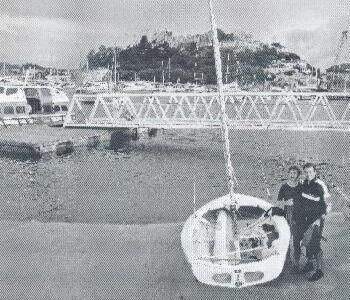 Mainly Lasers. Also team raced in Laser IIs and Larks for 2 years when at University in the UK. I think of myself of basically a Laser sailor and very much learning what makes an Albacore go. I do think the Laser sailing has helped me in the Albacore. The basic skills of sailing the boat fast through the water, starting and hitting windshifts transfer pretty well. Most of the Laser body movement stuff does not work in the Albacore because it is heavier, but having sailed a highly-competitive one-design class is obviously a big help.
Q Congrats in winning the 2006 UK National's held in Torquay with your crew Jon Frary. What do you think attributed to your success in the winning the regatta? Do you and Jon sail together on a regular basis? What type of training do you do? (if applicable) Where do you sail out of? The typical conditions?
Being honest, the fact that Chris Turner, Mike McNamara and Mike Holmes (who all beat us pretty convincingly at the 2005 Internationals) were not there was a pretty significant factor. Also, Barney Harris was sailing a borrowed boat and had brought his light weather crew and the conditions were moderate to windy.
The conditions suited us. We were consistently quick in the windier stuff and there was more sailing in the full-hiked range than anything else. Fitness was a factor on day 2, with three races and I thought we were reasonably fit so that did help. When you are quick, that makes the tactics a lot easier. It the lighter stuff we were slower and Barney Harris and Erika Seamon definitely had a speed edge in that. Good crew was obviously important, but because the conditions were generally moderate, boathandling was not a huge issue. I try to sail the boat as fast as I can and get the shifts right. If the boat feels slow I try not to lose concentration on the race and I ask Jon Frary (my crew) to have a look around at other boats and/or fiddle with the controls. He is much better on the technical side than me, so that seems to work well. Basically, if there is anything on the boat that is fundamentally different from a Laser, I get Jon to deal with it, because the chances are that I do not understand it. In Torquay, when the wind is offshore, it is important to keep looking up the course and see the bands of breeze coming down and position yourself accordingly. We did not get it right all the time, but when we got it wrong, we could normally close distance on the first reach.
Jon and I do not sail together that regularly. He lives in Norfolk about halfway up the East Coast of England and I live in London. Before the 2006 UK Nationals we had about 4 days of practice on the water, 3 of these on our own. That was not a lot, but we both sail Lasers as well, so our general sailing/racing skills were reasonably sharp and we were in reasonable shape so it was just a question of getting used to the Albacore again and working on boathandling. Our training consisted mainly of quite a bit of Laser sailing, running and gym work by me (Jon claimed to be doing fitness work, but I have to take his word for it!). On the water in the Alb we focused mainly on boathandling and crew work and downwind boatspeed.
Q You were continuously measuring your boat every day at the UK Nats., is that a typical thing for you? Do you record the measurements if so what type of notes do you make? What are you looking for?
Typical in the Albacore, because I do not really know what makes it go. I am just focused on making sure I have the boat set up according to the standard parameters. I don't take notes, just make marks on the mast so I can repeat settings and get to them quickly. We had just bought a new suit of sails before the 2006 Nationals so I had to do a fair bit of measuring to get marks for rig tension and rake that worked for the new sails. That was probably what you saw us doing.
Q Are you planning on participating in the 2007 Internationals? Will you be shipping your boat?
I do definitely want to go to the Internationals in the USA and my crew, Jon Frary, is also keen. It is still a little uncertain whether work and family commitments will permit this: my wife is expecting a baby shortly so lengthy absences unlikely to be that popular next year. But I am working on it. If I go, I will ship my boat.
Q What type of training will you focus on for the event?
I will try to do as many events over here as Jon and I can find time for and apart from that do some practising on our own and some fitness work. If I can find anyone over here who wants to do some practising then we will do that, time permitting. Time on the water is key, but hard to achieve.
Q Do you know that the adjustable shrouds are not allowed when racing in the USA and Canada? Will this change the way you will prepare for the Internationals?
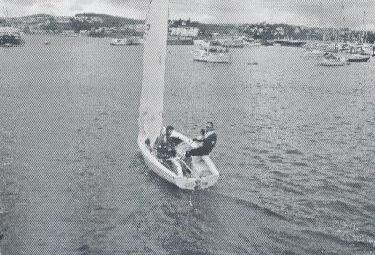 Yes (although my understanding from Barney Harris is that they are allowed so long as you do not actually use them).
No, apart from not adjusting my shrouds in practice, just to get used to it. I am relaxed about this difference as most of the sailing I have done in my life has been without adjustable shrouds. If anything, it is adjustable shrouds that I am not used to. I do not think I am particularly clever at adjusting them, so I am looking forward to this variable being taken out of the equation.
Q What are your goals for the Internationals?
Well, results-wise we would obviously like to win the thing, but not sure how realistic this is as have never sailed against the full North American fleet and Barney at home is obviously going to be a different prospect from Barney abroad in a borrowed boat. Also not sure who will be turning up from the UK--we were beaten pretty convincingly by a number of them at the last Internationals. We will be trying to sail as well as we can and the result will be what it will be.
Apart from that, want to have fun and improve our skills and knowledge of how to make the boat go.
Q What changes would you like to see in the Albacore (if any).
I would like the UK events to be a little better attended and for new faces to keep coming into the class over here. But the recent trends are positive.
Q What do you like about the Albacore Class?
Not much I don't like about it. The boat performs well without requiring crazy amounts of time on the water. Good, close one-design racing and very well-run major championships. Carries a wide range of helm/crew weights and will take husband and wife teams. Boats and gear last long time. Class members are very friendly.
Q How would you like to see the Class change/grow?
I think the boat itself is very good, I would just like there to be a few more of them.
Getting Ready For The Internationals
Team CAN 7141 "Old School" (6644)
Boat Prep
The upcoming 2007 Albacore Internationals has been in the forefront of our minds for the last two years. Over the last two years we have focused on the boat, boat set up and of course deciding which boat will be sailed at the Internationals. It was always assumed that CAN 7000, Quantum Leap was the hottest boat in our stable however since we have recently sold Quantum Leap we will be focusing on CAN 7141 "Old School" and sailing my woof in this event. As far as boat prep, 7141 is ready to go and only minor tweaking is all it needs for the '07 sailing season (barring any disasters). We also plan to have CAN 7243, GrimReaper ready to go, just as a back up.
Boat list:
- Foils
- Spare boom
- running rigging, control lines
- Sails
- Covers
- Trailer
Physical Prep
Our biggest goal is to reduce our combined skipper crew weight, diet and exercise has already begun (Oct 06). Aside from weight we both will be improving our cardiovascular system and I personally (crew) am working on legs, abs, arms, and shoulders for those long windward legs.
Mental Prep
Working on a list such as this a year from the event is the beginning of our "mental prep". Given that we are both family guy's and business owners a big part of our mental prep is taking care of as many issues as possible prior to the event. Our list is something like this:
a) Inform family of event, personal goals and team goals. It's always a good thing to have our family on board with what we are doing.
b) Knowing a year in advance our sailing commitment helps organize work projects and work loads. I try not to have too much on my plate prior to a large event. Once we get on the road for the Int's we try and only think, breath and talk sailing.
c) Remove all potential distractions. Knowing that we have the best boat possible, best equipment possible, best gear possible helps us stay focused on the regatta and not rushing around trying to fix or change something. Part of out mental prep is going to a regatta to sail not work on the boat.
d) Organize. Oct 06, room booked for the event! Will be regeristing for the event as soon as we can.
e) After the 06 US Nationals both Ian and I made a list of items we need for the upcoming year, i.e. sailing gear, race sails, practice sails, etc. All has been ordered and is now out of the way.
f) Review sailing articles, tuning guides etc.
Sailing Prep
Our sailing prep is fairly simple, get out sailing. We have targeted our regatta's and club fleet racing we will be doing for the 07 sailing season. We have a list of specific area's we will focus on in every race (that list is for us only,...sorry).
Best of luck to all the teams!
Jeff Beitz
Ian Brayshaw
CAN 7141 Old School (6644)
CAN 7243 GrimReaper
Raines Koby
If I was just informed that in 8 months I would be attending a major International Event Regatta for which I wanted to finish better than any previous result then this is what I would do.
First meet with my sailing partner and brain storm. Plan a few hours for this i.e. six pack. Start a making major "working" list. Talk is cheap. Write it down. This list will form the backbone our campaign. The list is divided into sub-sections addressing all the key elements of racing:
- boat issues: gear to be fixed
- tuning notes: settings for all conditions & identify a tuning partner or two
- boat handling: what needs on the water practice, practice, practice
- rules review: boring - read book
- tactics and strategies: what are the past mistakes - what are the fixes - focus on eliminating mistakes - as they say in baseball eliminate the unforced errors
- fitness plan
- regatta pack list, accommodations etc
- spring summer fall regatta and practice schedule
- regatta site local knowledge
- set goals for various activities and of course a finish goal for the Internationals
If you go through this process with focus and passion you can't help but raise you game you few notches. Under the veneer of a serious campaign the final key ingredient is mental attitude: have fun, be relaxed and be a team player.
Good Luck,
Raines Koby
One Design Boat Covers
Hans Gottschling
The Dinghy Boat Cover Specialist since 1969
[email protected]
905-277-3306 Mississauga, Ontario
Alba-Scopes
Aries
Pay your CAA Membership ASAP.
Aries is the first sign of the Zodiac, and that's pretty much how you see yourself, leader of the pack – but you tend to initiate than complete. That pretty much sums up your last leg on the race course unfortunately. Summon up your inner strength required to take on most anyone. You can do this my little Ram. Work on what drags you down on that last leg, is it your lunch? are you thinking about your first beer? or is it a tactics issue? Your element is Fire, think action, enthusiasm and a burning desire to play the game – win that mug. Be a luv and invest in ratchet blocks for your crew.
Taurus
Pay your CAA Membership ASAP.
It's all about the reward, unlike the Arian's love of games, Taureans love the rewards of the game. You are a Bull and perhaps you could lighten up on being so stubborn – do you always have to win the pin end? All that practice you made has paid off Practice = Success. Your element is Earth, keep plodding along, in pursuit of your goals. Bulls are strong and well-built, but you may have enjoyed too may rum balls over the holidays, so, do 4 sets of 10 ab crunches daily to keep your fab ab 6pack physique. Be a luv and invest in ratchet blocks for your crew.
Gemini
Pay your CAA Membership ASAP.
Geminis love to talk! It's not just idle chatter with these folks either. Who do you hear at mark roundings? A Gemini keeping us in line. You are a mix of the ying and the yang, and represented by the Twins and sometimes we are not sure which Twin will show up at the regatta – gee which Twin was that that just tacked on us? You are both curious and clever, which is why you are swell at parties and a good date. You talk a great game but also love to listen and learn. Your element is Air. You love the camaraderie of games and play and that's why you excel at team events – your ability to communicate effectively and to think clearly is why your dance card is always full and skippers love you. Be a luv and invest in ratchet blocks for your crew.
Cancer
Pay your CAA Membership dues ASAP.
Our Crab friend likes tradition and is very patriotic, and likes to wave the flag, and often seen on race committees. It is said that the Crab is the first to laugh and the first to cry, so while you were pushing someone over the start line, you too were also over early. Try not to go into your shell Crabby when this happens - get your timing right the first time. Your element is Water, like the rolling waves of the sea, you can make quite a splash, but try to hike a little harder to prevent this from happening, you can do this since you are wise to listen to your gut, and therefore have a very strong one. Be a luv and invest in ratchet blocks for your crew.
Leo
Pay your CAA Membership dues ASAP.
These folks are hard to miss, since they love being centre stage. Like Lions, Leos tend to be dignified and strong and it is this sense of their power which allows then to get things done. An excellent person to have on any committee as they see their projects through to completion. Suggested reading - The Racing Rules of Sailing 2005-2008, so that you don't ruffle any feathers along the way, since you are so overbearing. Your element is Fire and you are hot, hot, hot, fearless and strong, but you should really think twice before you attempt that barge at the mark. Be a luv and invest in ratchet blocks for your crew.
Virgo
Pay your CAA Membership dues ASAP.
Those born under this sign are forever the butt of jokes for being picky and critical, but their attention to detail is for a reason: to help others – another excellent person to have on any committee. Virgos revel in exacting behavior and are a whiz with minutiae. Suggest investing in the newly approved compass. Their element is Earth, so they're grounded no flash and dash so their sailing gear is very coordinated/and muted. Be a luv and invest in ratchet blocks for your crew.
Libra
Pay your CAA Membership ASAP.
Librans are great Albacore sailors, everything is better if it's done as a pair, hence the Scales. They epitomize balance and quest fairness, peace, and harmony – sounds like a great person for a protest committee. They are the lovers not the fighters of the Albacore world, but tend to be fickle and indecisive so the odd crash tack may occur - but expect a cocktail to achieve peace since they abhor conflict. The Scales need to be on the lookout for their lower backs, which tend to shoulder any burdens – which means – they don't hike so the crew needs to be advised of such laziness. Be a luv and invest in ratchet blocks for your crew.
Scorpio
Pay your CAA Membership ASAP.
You shouldn't take Scorpians lightly. They are dead serious in their missions. These folks are complex and secretive, so don't expect to get much out of them – consider this at a tack or cross situation. Scorpions can lose their temper even become vengeful when someone gets in the way – so when they ask for room – people please give it to them! Your element is Water – in this case 'still waters run deep' – emotions are kept under cover – again secrets to be used another day – be scared my friends. Scorpions don't know the word quit, a powerhouse like no other which is why they get the job done, add another person to the committee! Be a luv and invest in ratchet blocks for your crew.
Sagittarius
Pay your CAA Membership ASAP.
The home of the wanderers. That was you tacking back and forth across the race course last year not being able to commit to one side of the course – you like the action and adventure that explains things. The Archer represents Sagittarians, although it's the Centaur flinging arrows. The element associated with Sagittarius is Fire. Just as fire can move quickly and uncontrollably, so can Sagittarians – sound a little dangerous on a starting line. You are physical and athletic, full of stamina – which speaks of a tacking duo – avoid it with a Scorpian. You have unflinching optimism and feel that you will cross that boat because are a lucky bunch, so you may not have to take the penalty specified in new Rule 31.2. Be a luv and invest in ratchet blocks for your crew.
Capricorn
Pay your CAA Membership ASAP.
Capricorns are all about hard work. Life is one big project for the Goat. Since getting to the top isn't always a walk in the park you must practice, practice practice, tack, tack, tack, gybe, gybe, gybe, but you will get there as you are disciplined. Caps can get a bit materialistic and greedy, so when you get a little lift – remember – don't be too greedy. You need to watch your teeth and knees and not be too daring, sounds like you should consider being be on race committee...or have you thought about golf or croquet? Your element is Earth. Caps aren't interested in wild ideas or round the world dreams, you would rather work – guess you're not going to West River this year. Be a luv and invest in ratchet blocks for your crew.
Aquarius
Pay your CAA Membership ASAP.
You want to make the world a better place. While you are generally sympathetic and compassionate, you like it when things go your own quirky way. Your element is Air and you are truly the trailblazers of the Zodiac and are determined to make the world a better place and to help everyone they can along the way and you often tell boats to cross you instead of tacking on you. You are also liable to be spasmodic – we watch you on the dance floor! You work best in groups so you can be found in a general recall. You are gifted in the arts - so there may be some drama queen in you! Buy some good booties - you have weak ankles. You don't like living within boundaries, so you tend to get the odd OCS from time to time. Be a luv and invest in ratchet blocks for your crew.
Pisces
Pay your CAA Membership ASAP.
Hello dreamer! You could sail the albacore by yourself due to your solitude nature. You are weak-willed and easily led so you should be watched out for boats that will lead you astray. You adapt to the circumstances around you so you excel in light and shifty conditions - clearly a winner in the Inner Harbour, Nepean, or on the Potomac River. You are observant and listen well, so you know when there has been a course change. Some of you make really great crews due to your submissive natures. Always wear sunscreen you are sensitive inside and out. The color of choice for Pisces is Soft Seagreen - could that be the new sailing fashion statement for 2007? Be a luv and invest in ratchet blocks for your crew.
2007 Canadian Albacore Association Executive
Commodore
Teresa Miolla
[email protected]
Past Commodore
Ann Savege
[email protected]
First Vice Commodore
Allan Measor
[email protected]
Second Vice Commodore & Website
Henry Pedro
[email protected]
Third Vice Commodore
Stephanie Mah
[email protected]
Specifications Chair
David Weaver
[email protected]
Chief Measurer
George Roth
[email protected]
Rear Commodore
Sandy Swiatlowski
[email protected]
Editor – Shackles & Cringles
Christine Short
[email protected]
Secretary
Cathyann White
[email protected]
Membership
Janet Duff
[email protected]
Treasurer
Jason G. Roth
[email protected]
IAA Treasurer
Raines Koby
IAA Representative
Barrie Farrell
[email protected]
CANADIAN ALBACORE ASSOCIATION
47A Harbour Square,
P.O. Box 81085
Toronto, Ontario M5J 2V3
www.albacore.ca

GEORGIAN BAY MARINA
Custom work on Albacores
Refinishing * Re-Rigging * Rig Set Up
Dealer for: Harken, Ronstan, Seldon, Holt, Marlow
Fall Booking special on Seldon Cumulus Albacore Masts and Seldon Booms
Call for pricing and spring delivery
99 Rose Point Road Parry Sound, Ontario
705-746-9559 [email protected]